Capture velocities for direct loading of heavy molecules into conveyor-belt magneto-optical traps
Pith reviewed 2026-06-26 11:16 UTC · model grok-4.3
The pith
Calculations show conveyor-belt MOTs retain nonzero capture velocity for BaF-137 and BaH-138 molecules.
A machine-rendered reading of the paper's core claim, the machinery that carries it, and where it could break.
Core claim
The central claim is that the CB-MOT mechanism, which uses blue-detuned polarization-gradient forces on type-II transitions, provides direct loading with nonzero capture velocity for BaF-137 and BaH-138, extending the experimental result already obtained for BaF-138.
What carries the argument
The conveyor-belt MOT (CB-MOT) force field generated by blue-detuned polarization gradients on type-II molecular transitions, whose capture velocity is computed via optical-Bloch equations followed by classical trajectory integration.
If this is right
- Direct CB-MOT loading extends to molecules whose hyperfine structure complicates conventional dual-frequency MOTs.
- The mechanism remains viable for molecules whose narrower linewidth and longer wavelength reduce available radiative force.
- CB-MOT loading supplies a route for heavy laser-coolable molecules limited by photon recoil or low scattering rate.
- The calculations map the molecular conditions under which the dipole-force conveyor-belt loading stays effective.
Where Pith is reading between the lines
- The same numerical pipeline could be run on other candidate molecules such as SrF or YbF to rank their suitability for direct CB-MOT loading.
- If the predicted capture velocities are confirmed, experiments could compare loading efficiency between CB-MOT and red-detuned MOT geometries for the same molecular species.
- The results suggest that hyperfine complexity alone does not eliminate the possibility of efficient direct loading when polarization-gradient forces dominate.
Load-bearing premise
The optical-Bloch-equation force model and classical trajectory propagation fully capture the dynamics without significant unmodeled effects such as extra hyperfine couplings or recoil losses.
What would settle it
An experimental measurement that finds zero or near-zero capture velocity when loading a slowed BaF-137 or BaH-138 beam into a CB-MOT would falsify the calculated prediction.
Figures
read the original abstract
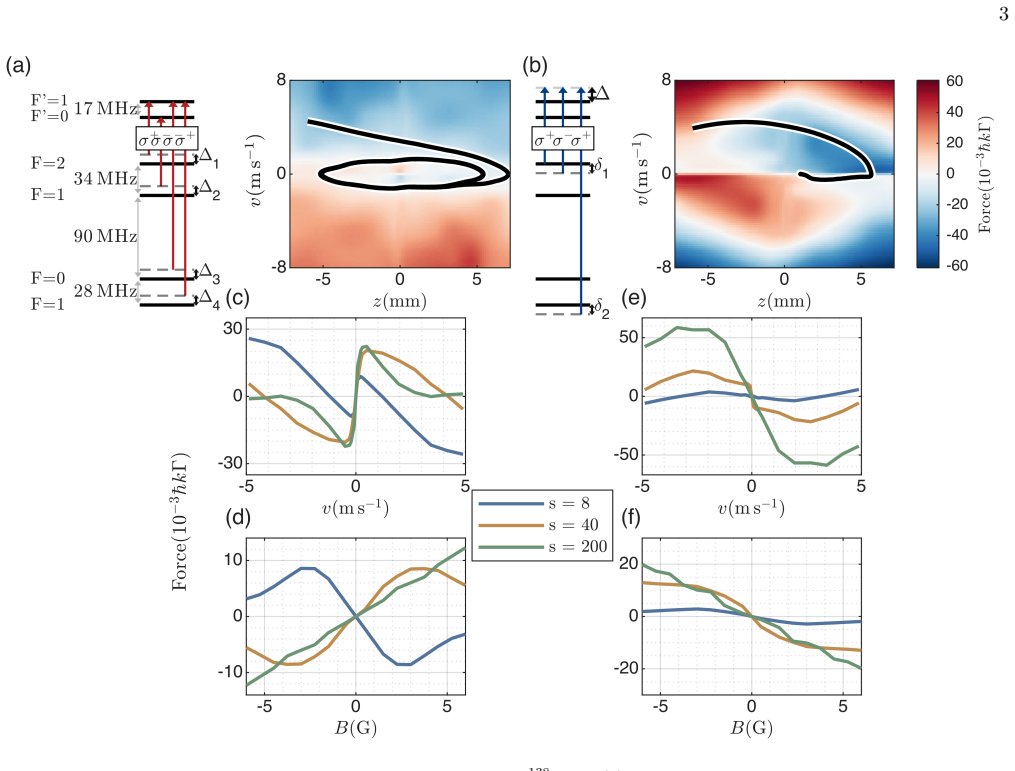
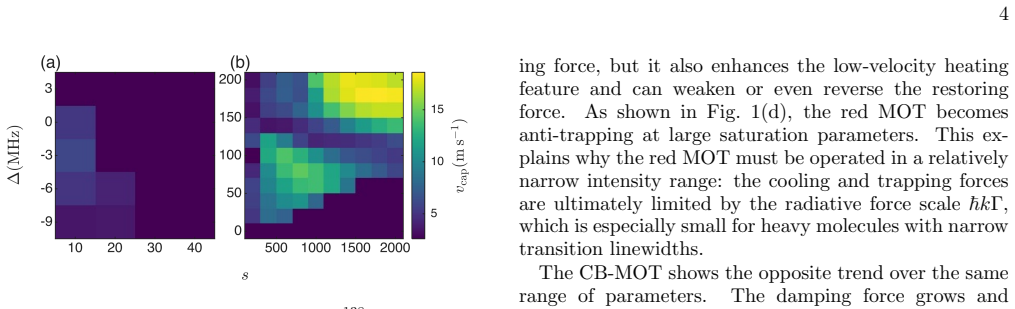
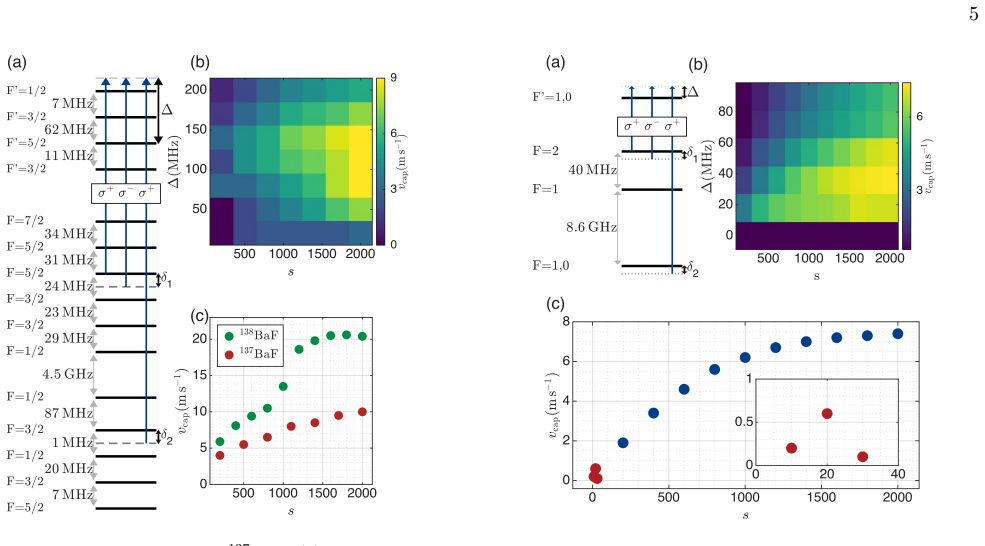
Conveyor-belt magneto-optical traps (CB-MOTs) use blue-detuned polarization-gradient forces to provide simultaneous cooling, confinement, and loading on type-II molecular transitions. Recent experiments with \baf{138} showed that this mechanism can directly load a slowed molecular beam with an efficiency exceeding that of a conventional red-detuned MOT. Here we use established optical-Bloch-equation force calculations and classical trajectory propagation to ask whether this direct-loading strategy should extend beyond the specific molecule used in the first demonstration. For \baf{138}, the calculation reproduces the experimentally observed trend that the CB-MOT capture velocity increases with laser intensity. We then apply the same framework to two closely related but experimentally distinct cases: \baf{137}, whose dense hyperfine structure complicates a conventional dual-frequency MOT, and \bah{138}, whose narrower linewidth and longer wavelength reduce the available radiative force. In both cases, the CB-MOT retains a broad region of nonzero capture velocity. These results identify the molecular conditions under which direct CB-MOT loading should remain effective and show that the dipole-force-dominated conveyor-belt mechanism provides a practical loading route for heavy laser-coolable molecules whose MOT performance is otherwise limited by photon recoil, scattering rate, or hyperfine complexity.
Editorial analysis
A structured set of objections, weighed in public.
Referee Report
Summary. The manuscript uses established optical-Bloch-equation force calculations combined with classical trajectory propagation to compute capture velocities in conveyor-belt magneto-optical traps (CB-MOTs). For BaF-138 the calculations reproduce the experimentally observed increase of capture velocity with laser intensity. The same framework is then applied to BaF-137 (dense hyperfine structure) and BaH-138 (narrower linewidth, longer wavelength), concluding that the CB-MOT retains a broad region of nonzero capture velocity in both cases and therefore offers a practical direct-loading route for heavy molecules whose conventional MOT performance is limited by hyperfine complexity or photon recoil.
Significance. If the model remains quantitatively accurate in the new regimes, the work identifies the molecular conditions under which the dipole-force-dominated CB-MOT mechanism remains effective, extending the direct-loading strategy demonstrated for BaF-138 to species where conventional red-detuned MOTs are hindered. The reproduction of the BaF-138 intensity trend provides an internal consistency check that strengthens the overall approach.
major comments (1)
- [Results for BaF-137 and BaH-138] Application to BaF-137 and BaH-138: the central claim that the CB-MOT retains a broad region of nonzero capture velocity rests on the unverified quantitative accuracy of the OBE+trajectory model when hyperfine level density increases (BaF-137) or when linewidth drops and wavelength lengthens (BaH-138). The only internal check supplied is reproduction of the intensity trend for BaF-138; no cross-checks (extra hyperfine couplings, recoil heating rates, or independent force calculations) are described for the altered parameter regimes. This directly affects whether the computed capture-velocity surface stays above zero over a broad region.
Simulated Author's Rebuttal
We thank the referee for their careful review and for highlighting the importance of model validation when extending the calculations to BaF-137 and BaH-138. We respond to the major comment below.
read point-by-point responses
-
Referee: [Results for BaF-137 and BaH-138] Application to BaF-137 and BaH-138: the central claim that the CB-MOT retains a broad region of nonzero capture velocity rests on the unverified quantitative accuracy of the OBE+trajectory model when hyperfine level density increases (BaF-137) or when linewidth drops and wavelength lengthens (BaH-138). The only internal check supplied is reproduction of the intensity trend for BaF-138; no cross-checks (extra hyperfine couplings, recoil heating rates, or independent force calculations) are described for the altered parameter regimes. This directly affects whether the computed capture-velocity surface stays above zero over a broad region.
Authors: The optical-Bloch-equation force calculation is a standard, molecule-specific method that incorporates the complete hyperfine structure, magnetic sublevels, transition matrix elements, linewidth, and wavelength as explicit inputs for each species. For BaF-137 the denser hyperfine manifold is included by expanding the density-matrix basis to encompass all relevant states; the formalism itself imposes no sparsity requirement. For BaH-138 the narrower linewidth and longer wavelength enter directly through the detuning, spontaneous-emission rate, and wave-vector in the force expression. The reproduction of the measured intensity dependence for BaF-138 therefore validates the combined OBE-plus-trajectory procedure under the same numerical framework used for the other two molecules. While additional independent calculations (e.g., semiclassical Monte-Carlo recoil heating or alternative force solvers) would be valuable for quantitative error bars, they are not necessary to establish the existence of a broad nonzero capture-velocity region, which follows from the qualitative behavior of the dipole-force-dominated conveyor-belt mechanism. We therefore do not revise the manuscript on this point. revision: no
Circularity Check
No circularity: standard OBE+trajectory model validated by reproduction of external experiment
full rationale
The paper computes capture velocities via established optical-Bloch-equation forces followed by classical trajectory integration. It first reproduces the experimentally observed intensity dependence for BaF-138, then applies the identical framework to BaF-137 and BaH-138. No parameter is fitted to the target capture-velocity surfaces, no quantity is defined in terms of itself, and no load-bearing step reduces to a self-citation or ansatz introduced by the authors. The derivation chain therefore remains self-contained against external benchmarks.
Axiom & Free-Parameter Ledger
axioms (2)
- domain assumption Optical Bloch equations provide an accurate description of the radiative force on the target molecules under the stated laser conditions
- domain assumption Classical trajectory propagation suffices to determine capture velocity without quantum wavepacket effects
Reference graph
Works this paper leans on
-
[1]
L. D. Carr, D. DeMille, R. V. Krems, and J. Ye, New J. Phys.11, 055049 (2009)
2009
-
[2]
Langen, G
T. Langen, G. Valtolina, D. Wang, and J. Ye, Nature Physics20, 702 (2024)
2024
-
[3]
DeMille, N
D. DeMille, N. R. Hutzler, A. M. Rey, and T. Zelevinsky, Nature Physics20, 741 (2024)
2024
-
[4]
S. L. Cornish, M. R. Tarbutt, and K. R. Hazzard, Nature Physics20, 730 (2024)
2024
-
[5]
Karman, M
T. Karman, M. Tomza, and J. P´ erez-R´ ıos, Nature Physics20, 722 (2024)
2024
-
[6]
K.-K. Ni, S. Ospelkaus, M. H. G. de Miranda, A. Peer, B. Neyenhuis, J. J. Zirbel, S. Kotochigova, P. S. Julienne, D. S. Jin, and J. Ye, Science322, 231 (2008)
2008
-
[7]
Aikawa, D
K. Aikawa, D. Akamatsu, M. Hayashi, K. Oasa, J. Kobayashi, P. Naidon, T. Kishimoto, M. Ueda, and S. Inouye, Physical Review Letters105, 203001 (2010)
2010
-
[8]
B. Yan, S. A. Moses, B. Gadway, J. P. Covey, K. R. Hazzard, A. M. Rey, D. S. Jin, and J. Ye, Nature501, 521 (2013)
2013
-
[9]
Y. Bao, S. S. Yu, L. Anderegg, E. Chae, W. Ketterle, K.-K. Ni, and J. M. Doyle, Science382, 1138 (2023)
2023
-
[10]
C. M. Holland, Y. Lu, and L. W. Cheuk, Science382, 1143 (2023)
2023
-
[11]
N. B. Vilas, P. Robichaud, C. Hallas, G. K. Li, L. An- deregg, and J. M. Doyle, Nature628, 282 (2024)
2024
-
[12]
J. T. Zhang, L. R. B. Picard, W. B. Cairncross, K. Wang, Y. Yu, F. Fang, and K.-K. Ni, Quantum Science and Technology7, 035006 (2022)
2022
-
[13]
Di Rosa, The European Physical Journal D-Atomic, Molecular, Optical and Plasma Physics31, 395 (2004)
MD. Di Rosa, The European Physical Journal D-Atomic, Molecular, Optical and Plasma Physics31, 395 (2004)
2004
-
[14]
E. S. Shuman, J. F. Barry, and D. DeMille, Nature467, 820 (2010). 7
2010
-
[15]
Anderegg, B
L. Anderegg, B. L. Augenbraun, Y. Bao, S. Burchesky, L. W. Cheuk, W. Ketterle, K.-K. Ni, and J. M. Doyle, Nature Physics14, 890 (2018)
2018
-
[16]
Anderegg, L
L. Anderegg, L. W. Cheuk, Y. Bao, S. Burchesky, W. Ketterle, K.-K. Ni, and J. M. Doyle, Science365, 1156 (2019)
2019
-
[17]
B. K. Stuhl, B. C. Sawyer, D. Wang, and J. Ye, Physical Review Letters101, 243002 (2008)
2008
-
[18]
J. F. Barry, D. J. McCarron, E. B. Norrgard, M. H. Stei- necker, and D. DeMille, Nature512, 286 (2014)
2014
-
[19]
Truppe, H
S. Truppe, H. J. Williams, M. Hambach, L. Caldwell, N. J. Fitch, E. A. Hinds, B. E. Sauer, and M. R. Tarbutt, Nature Physics13, 1173 (2017)
2017
-
[20]
Anderegg, B
L. Anderegg, B. L. Augenbraun, E. Chae, B. Hemmer- ling, N. R. Hutzler, A. Ravi, A. Collopy, J. Ye, W. Ket- terle, and J. M. Doyle, Physical Review Letters119, 103201 (2017)
2017
-
[21]
A. L. Collopy, S. Ding, Y. Wu, I. A. Finneran, L. An- deregg, B. L. Augenbraun, J. M. Doyle, and J. Ye, Phys- ical Review Letters121, 213201 (2018)
2018
-
[22]
N. B. Vilas, C. Hallas, L. Anderegg, P. Robichaud, A. Winnicki, D. Mitra, and J. M. Doyle, Nature606, 70 (2022)
2022
-
[23]
Z. Zeng, S. Deng, S. Yang, and B. Yan, Physical Review Letters133, 143404 (2024)
2024
-
[24]
J. E. Padilla-Castillo, J. Cai, P. Agarwal, P. Kukreja, R. Thomas, B. G. Sartakov, S. Truppe, G. Meijer, and S. C. Wright, Phys. Rev. Lett.135, 243401 (2025)
2025
-
[25]
Z. D. Lasner, A. Frenett, H. Sawaoka, L. Anderegg, B. L. Augenbraun, H. Lampson, M. Li, A. Lunstad, J. Mango, A. Nasir, T. Ono, T. Sakamoto, and J. M. Doyle, Physical Review Letters134, 083401 (2025)
2025
-
[26]
J. Dai, B. Riley, Q. Sun, D. Mitra, and T. Zelevinsky, Phys. Rev. Lett.136, 233403 (2026)
2026
-
[27]
M. R. Tarbutt, New Journal of Physics17, 015007 (2015)
2015
-
[28]
J. A. Devlin and M. R. Tarbutt, New Journal of Physics 18, 123017 (2016)
2016
-
[29]
J. A. Devlin and M. R. Tarbutt, Physical Review A98, 063415 (2018)
2018
-
[30]
K. N. Jarvis, J. A. Devlin, T. E. Wall, B. E. Sauer, and M. R. Tarbutt, Physical Review Letters120, 083201 (2018)
2018
-
[31]
J. J. Burau, P. Aggarwal, K. Mehling, and J. Ye, Physical Review Letters130, 193401 (2023)
2023
-
[32]
Jorapur, T
V. Jorapur, T. K. Langin, Q. Wang, G. Zheng, and D. De- Mille, Physical Review Letters132, 163403 (2024)
2024
-
[33]
S. J. Li, C. M. Holland, Y. Lu, and L. W. Cheuk, Physical Review Letters132, 233402 (2024)
2024
-
[34]
C. Hallas, G. K. Li, N. B. Vilas, P. Robichaud, L. Anderegg, and J. M. Doyle, Physical Review Letters 10.1103/w9qc-rczf (2026)
-
[35]
G. K. Li, C. Hallas, and J. M. Doyle, New Journal of Physics27, 043002 (2025)
2025
-
[36]
S. S. Yu, J. You, Y. Bao, L. Anderegg, C. Hallas, G. K. Li, D. Lim, E. Chae, W. Ketterle, K.-K. Ni, and J. M. Doyle, Nature Communications 10.1038/s41467- 025-67944-6 (2026)
-
[37]
Lyu and M
Q. Lyu and M. R. Tarbutt, Phys. Rev. Res.8, 023259 (2026)
2026
-
[38]
T. Chen, W. Bu, and B. Yan, Physical Review A94, 063415 (2016)
2016
-
[39]
R. L. McNally, I. Kozyryev, S. Vazquez-Carson, K. Wenz, T. Wang, and T. Zelevinsky, New Journal of Physics22, 083047 (2020)
2020
-
[40]
Bause, N
R. Bause, N. Balasubramanian, T. Fikkers, E. H. Prin- sen, K. Steinebach, A. Jadbabaie, N. R. Hutzler, I. A. Aucar, L. F. Pasteka, A. Borschevsky, and S. Hoekstra, Physical Review A111, 062815 (2025)
2025
-
[41]
Z. Zeng, S. Yang, S. Deng, and B. Yan, Physical Review Letters136, 073402 (2026)
2026
-
[42]
Kogel, T
F. Kogel, T. Garg, M. Rockenh¨ auser, and T. Langen, Phys. Rev. Res.7, L022041 (2025)
2025
-
[43]
T. K. Langin and D. DeMille, New Journal of Physics 25, 043005 (2023)
2023
-
[44]
S. Xu, R. Li, Y. Xia, M. Siercke, and S. Ospelkaus, Phys- ical Review A108, 033102 (2023)
2023
-
[45]
W. Bu, T. Chen, G. Lv, and B. Yan, Physical Review A 95, 032701 (2017)
2017
-
[46]
Zhang, Z
Y. Zhang, Z. Zeng, Q. Liang, W. Bu, and B. Yan, Phys- ical Review A105, 033307 (2022)
2022
-
[47]
Emile, R
O. Emile, R. Kaiser, C. Gerz, H. Wallis, A. Aspect, and C. Cohen-Tannoudji, Journal de Physique II3, 1709 (1993)
1993
discussion (0)
Sign in with ORCID, Apple, or X to comment. Anyone can read and Pith papers without signing in.