REVIEW 4 major objections 5 minor 132 references
Tidal Debris Candidates from the $\omega$ Centauri Accretion Event and its Role in Building Up the Milky Way Halo
T0 review · 4 major / 5 minor · reviewed 2026-08-15 · deepseek-v4-flash
Pith's one-line read The Milky Way field contains 463 stars chemically matched to Omega Centauri's core, likely tidal debris from its accretion event.
desk verdict A useful candidate catalog, but the boldest claims outrun what the classifier validation can support. read the letter →
The pith
A machine-rendered reading of the paper's core claim, the machinery that carries it, and where it could break.
The reading
What carries the argument
The central machinery is a chemical-tagging neural network: a fully connected multi-layer perceptron that takes thirteen APOGEE abundance ratios as input and outputs a membership probability for sharing the $\Omega$ Centauri core's abundance patterns, trained on 1,794 cluster stars against a negative sample of globular cluster, Magellanic Cloud, and Sagittarius stars. This network supplies the chemical tag that isolates the 463 candidates. The supporting machinery is an N-body model of a Plummer-sphere progenitor with mass $10^8\,M_\odot$, whose simulated stripped particles are matched to the candidates in sky coordinates, distance, proper motion, radial velocity, and energy-action space, where the radial action $J_R$ is used to classify debris as accreted-halo-like.
What would settle it
Run the same classifier on a sample of field stars with known unrelated origins, or on mock stellar populations built from APOGEE measurement errors, and count the fraction that pass $P>0.8$; if the field false-positive rate approaches the number of candidates, the chemical association collapses. Alternatively, measure abundances of elements excluded from the training set, such as barium or europium, for the 463 candidates and check whether they trace the $\Omega$ Centauri core distribution rather than the general halo.
Extended reading notes
Core claim
Using a neural-network classifier trained on 1,794 APOGEE spectra of the $\Omega$ Centauri core and a negative sample of 15,119 objects drawn from globular clusters, the Magellanic Clouds, and the Sagittarius system, the paper assigns every APOGEE field star a membership probability $P$ for sharing $\Omega$ Centauri's abundance patterns across thirteen abundance ratios and combinations. It reports 463 stars with $P>0.8$, 284 with $P>0.9$, and 186 with $P>0.95$, whose chemistry -- especially elevated C+N, Al, and Ce -- resembles the cluster's unusual populations. Most of these candidates have high radial action $J_R$ and sit in the accreted halo, while a minority show prograde or retrograde disk-like kinematics, which the paper interprets as stripping from an extended progenitor. Nearly all stars in a selected Gaia-Sausage-Enceladus sample have $P<0.1$, so the two structures appear chemically distinct, although the paper leaves open the possibility that GSE hosted $\Omega$ Centauri. An N-body model of a $10^8\,M_\odot$ Plummer progenitor reproduces the observed sky positions, distances, proper motions, radial velocities, and energy-action spread of the candidates, supporting a massive dwarf-galaxy origin.
Load-bearing premise
The load-bearing premise is that $\Omega$ Centauri's multi-element chemical fingerprint is rare enough in the APOGEE field that a classifier trained only on the cluster and a curated set of unrelated stars does not mislabel ordinary field stars as debris.
Editorial extensions
If this is right
- A census of 463 chemically tagged debris candidates gives a far larger footprint of the Omega Centauri event than the known tidal tails, enabling tests of the progenitor's orbit and mass-loss history.
- The dominance of high-$J_R$, accreted-halo orbits among the candidates implies that the debris has been dynamically heated and mixed into the halo, so the event contributed to building the stellar halo rather than only the disk.
- The chemical separation from the Gaia-Sausage-Enceladus sample suggests at least two distinct accretion events helped shape the inner halo.
- The presence of both prograde and retrograde disk-like debris requires a progenitor large enough to spill stars across the Galactic center at pericenter, supporting a dwarf-galaxy-scale original system.
- The reported metal-poor, high-$\alpha$, chemically homogeneous plume is an additional ancient halo component, chemically independent of both GSE and Omega Centauri.
Reading between the lines
- If the same classifier were run against a field-only negative sample with a measured false-positive rate, the number of genuine debris stars could be substantially below 463, because unrelated metal-poor field stars may share the training chemistry.
- Because the classifier is trained on the surviving core, debris stripped before Omega Centauri's later self-enrichment episodes would not carry today's fingerprint, so 463 is likely a lower-bound census of the original system, not the full extent of the event.
- High-resolution follow-up of the 463 candidates in elements outside the training set, such as barium or europium, would provide an independent test of the association and could expose interlopers.
- The same training scheme applied to other massive clusters with suspected dwarf-galaxy origins could map additional accretion events; the paper's inconclusive M54-Sagittarius test is a caution that the method's power depends on the uniqueness of each system's chemistry.
Signed reviews
Editorial analysis
A structured set of objections, weighed in public.
Referee Report
Summary. The paper trains a fully connected neural network on APOGEE DR17 multi-element abundances of the ω Cen core (1,794 stars after quality cuts) against a negative sample of globular-cluster, LMC/SMC, and Sagittarius stars, and uses the network output P to select 463 APOGEE field stars with P>0.8 as ω Cen tidal debris candidates (§3.1). The candidates are then analyzed in energy–action and orbital spaces, compared with a kinematically selected GSE sample (§4), and compared with a 500 Myr N-body simulation of a 10^8 M_sun Plummer progenitor in a static Milky Way potential (§5). The paper also reports a metal-poor high-α 'plume' in the P–[Fe/H] plane and concludes that ω Cen was an independent, massive dwarf-galaxy merger, while acknowledging that association with GSE cannot be ruled out.
Significance. If the 463 chemically tagged candidates are genuine, this would be the largest census of ω Cen tidal debris to date and would provide important dynamical evidence for a massive dwarf-galaxy progenitor, with consequences for the assembly history of the Milky Way halo. The use of the full APOGEE abundance vector, the explicit cross-validation on external clusters, and the plan to release the candidate table are clear strengths. However, the reliability of the central catalog is inferred only from curated negative classes whose separability the authors themselves acknowledge, and no field-level false-positive estimate is provided. Because the kinematic and N-body conclusions inherit the catalog, the significance of the paper is presently conditional. The 'plume' is also stated more strongly than demonstrated: its existence and chemical homogeneity are not tested. These issues are fixable with additional analysis, which is why I recommend major revision rather than rejection.
major comments (4)
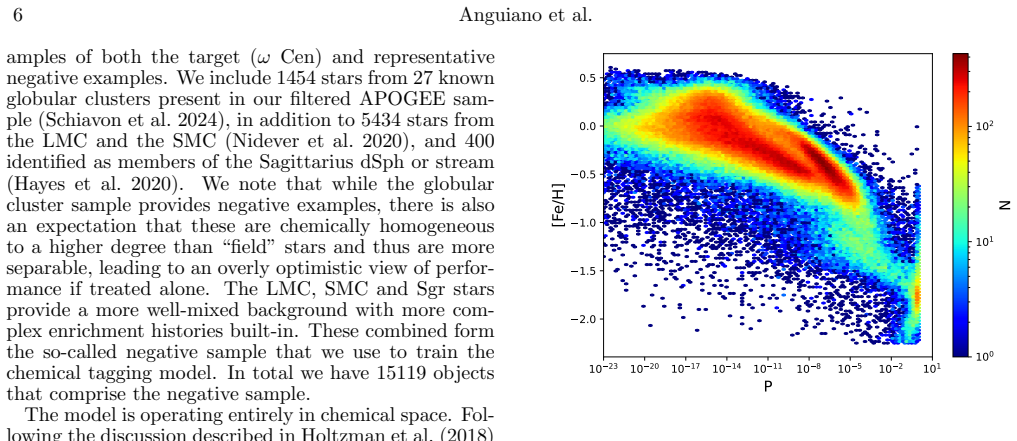
- [Section 3.1, Figs. 4 and 5] The central claim of '463 ω Cen debris candidates' rests on a classifier whose precision is measured only on a curated test set with a roughly 12% positive prior, while the actual APOGEE field has more than 99% of its stars at P<0.01 (Fig. 5). The negative training sample (globular clusters, LMC/SMC, Sagittarius) is more chemically coherent than the general field, and the paper explicitly acknowledges this for the globular clusters; the cluster-level validation in Fig. 7 therefore does not bound contamination in the field. Because [Fe/H] is an input feature and the P–[Fe/H] plane shows strong structure tracing known field components, the P>0.8 candidates could be, to zeroth order, the metal-poor tail of the field. Please provide a field-level false-positive estimate, for example by applying the tagger to an APOGEE field sample cross-matched with an independent origin indicator, or by a mock-contamination test that draws stars from field-like abundance distributions and reports the expected number of P>0.8 interlopers.
- [Section 3.2, Fig. 5, and Abstract] The 'metal-poor high-α chemically homogeneous halo debris' (the plume) is selected by the cuts P<0.1 and −2.5<[Fe/H]<−1.9, but no significance test is given against a field population at the same metallicity, and no quantitative homogeneity statistic is reported. Calling this structure 'chemically homogeneous' in the abstract is therefore unsupported by the present evidence. In addition, because the plume is defined by P<0.1, its separation from the ω Cen core is partly by construction. Please add a null-hypothesis comparison, a scatter-versus-measurement-error test, and a statement of how the plume is distinguished from unrelated metal-poor halo stars, or soften the claim.
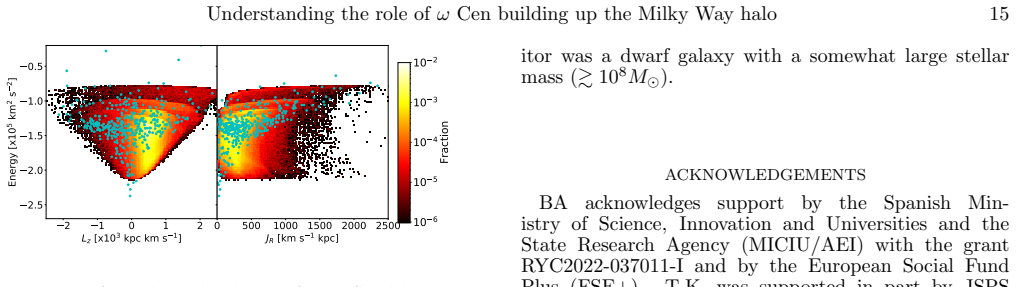
- [Sections 5.1–5.2, Fig. 15] The conclusion that the ω Cen progenitor had a stellar mass ≳10^8 M_sun is inferred from a single N-body model with M=10^8 M_sun, scale radius 1 kpc, a pre-stripped dark matter halo, and a static Milky Way potential integrated for only 500 Myr. The comparison with a 10^6 M_sun model is useful, but it does not explore the sensitivity of the prograde Lz component to progenitor radius, density profile, pericentric history, or time dependence of the Galactic potential; the text itself concedes that periods of very small pericenter cannot be ruled out. As written, the mass inference is not robust. Please add a parameter study or an analytic bounding argument, or explicitly present the result as a single-model illustration with the strong caveats it requires.
- [Section 4.1, Fig. 12] The statement that the GSE sample is chemically distinct from ω Cen is based on the same ω Cen-trained classifier, and the selected GSE sample is known to contain ω Cen debris and plume stars, as shown by the P>0.001 bump in the reverse CDF in the left panel of Fig. 12. The paper discusses this contamination qualitatively but does not quantify the fraction of the GSE sample affected or rerun the comparison after removing the ω Cen candidates and plume stars. Please quantify the contamination and report the comparison on a cleaned GSE sample before using this result to support the 'independent merger event' interpretation.
minor comments (5)
- [Section 6] The text lists 'NGC 3101' among the four validation clusters; this should be NGC 3201, as in Fig. 7.
- [Section 3.1] The statement 'In total we have 15119 objects that comprise the negative sample' is inconsistent with the sum of the stated components (1,454 + 5,434 + 400 = 7,288). Please correct the numbers or define explicitly what the 15,119 objects are, since the class balance enters the interpretation of the precision curve in Fig. 4.
- [Table 2] The caption says the table shows the first four entries of the debris candidates, but the printed table lists only column descriptions; please include sample rows or change the caption to match the table contents.
- [References] Several references are incomplete: Brown et al. (2018) contains a bare DOI, and Wilson et al. (2019) lists 'PASA, 999, 999'. These should be updated before resubmission.
- [Section 3.1] The network is described as having three hidden layers (256, 128, and 32 units), but the text says 'for the two hidden layers, we use the Rectified Linear Unit'; please specify the activations for all three hidden layers for reproducibility.
Circularity Check
Central 463-candidate census is a supervised classifier output and not circular, but the C+N and Al 'hallmark' trends used as evidence are input features to the same classifier, making that confirmation circular.
-
self definitional
[Section 3.1 (model input list) and Section 3.2 / Figure 6 discussion]
"we use the following individual abundances measured in the APOGEE spectra for our exercise: [C/Fe], [N/Fe], [O/Fe], [Mg/Fe], [Al/Fe], [Si/Fe], [Mn/Fe], [Ni/Fe], [Fe/H], [CI/Fe], [Na/Fe], [K/Fe], [Ca/Fe], [Co/Fe], [Ce/Fe]. ... A good number of the debris candidates are clearly enhanced in C+N, Al abundances with respect to the rest of the debris population and most of the Galactic halo. ... The hallmark C+N and Al trends are potential evidence that an extended part of the ω Cen tidal debris stream has been found."
The neural-network membership probability P is a function of the input abundances, which include [C/Fe], [N/Fe], and [Al/Fe] (Table 1 lists C, N, Al among the model inputs). Selecting stars with P > 0.8 therefore selects stars whose C+N and Al patterns lie near the ω Cen training distribution. Reporting that the candidates are 'clearly enhanced in C+N, Al' and treating the 'hallmark C+N and Al trends' as independent 'potential evidence' that tidal debris has been found is a validation of the selection using the same features that define the selection; by construction, high-P candidates resemble ω Cen in those dimensions. This does not make the census itself circular, but this particular confirmation is.
full rationale
The core claim — 463 field stars with P > 0.8 — is the output of a supervised neural-network classifier trained on APOGEE ω Cen core abundances (Section 3.1). That is the operational definition of weak chemical tagging, not a hidden reuse of the target as input. The GSE comparison is an independent application of the same classifier to a kinematically selected sample, and the N-body mass inference compares a 10^8 Msun model with a 10^6 Msun model rather than fitting to the candidate list. The one genuine circularity is the paper's use of C+N and Al enhancements as confirmatory evidence, even though C, N, and Al are among the classifier's input features; that step is self-definitional but is an aside rather than the basis of the census. The absence of a field-level false-positive rate for the 463 candidates is a real contamination risk, but it is a statistical validity concern, not a circularity of the derivation chain.
Assumptions & free parameters
free parameters (6)
- P > 0.8 membership threshold =
0.8
- Neural network architecture and hyperparameters =
256-128-32 units, ReLU, MSE, gradient descent
- Negative sample composition =
15,119 stars (1,454 GC + 5,434 LMC/SMC + 400 Sgr + others)
- N-body progenitor mass =
1e8 M_sun (comparison run 1e6 M_sun)
- N-body scale radius and DM-stripped assumption =
1 kpc, no DM
- Plume selection cuts =
P<0.1, [Fe/H]<-2.0 (also -2.5<[Fe/H]<-1.9)
assumptions (5)
- domain assumption Chemical abundance patterns of ω Cen are conserved and sufficiently unique for tagging
- domain assumption APOGEE abundance measurements are reliable across S/N 40-300 and the full parameter range
- domain assumption The Bovy (2015) gravitational potential accurately represents the Milky Way for orbit/action calculations
- domain assumption The Horta et al. (2023) E-Lz selection provides a representative GSE sample
- ad hoc to paper Static potential and short integration for N-body
invented entities (1)
-
Metal-poor high-α 'plume' debris
independent evidence
Cite this review
Pith. "Pith review of Tidal Debris Candidates from the $\omega$ Centauri Accretion Event and its Role in Building Up the Milky Way Halo." pith.science (2026). https://pith.science/paper/RXOUGCIQ
@misc{pith2026250508353,
  author       = {Pith},
  title        = {Pith review of: Tidal Debris Candidates from the $\omega$ Centauri Accretion Event and its Role in Building Up the Milky Way Halo},
  year         = {2026},
  howpublished = {\url{https://pith.science/paper/RXOUGCIQ}},
  note         = {Machine review of arXiv:2505.08353}
}
abstract
We identify stellar tidal debris from the $\omega$ Centauri ($\omega$ Cen) system among field stars in the APOGEE survey via chemical tagging using a neural network trained on APOGEE observations of the $\omega$ Cen core. We find a total of 463 $\omega$ Cen debris candidates have a probability $P > 0.8$ of sharing common patterns in their chemical abundances across a range of individual elements or element combinations, including [C+N], O, Mg, Al, Si, Ca, Ni, and Fe. Some debris candidates show prograde or retrograde disk-like kinematics, but most show kinematics consistent with the accreted halo, showing high radial actions, $J_{R}$, values. We find that a sample of Gaia-Sausage-Enceladus (GES) members are chemically distinct from the $\omega$ Cen core, suggesting that $\omega$ Cen is associated to an independent merger event shaping the Milky Way halo. However, a connection between GSE and $\omega$ Cen cannot be ruled out. A detailed comparison with $N$-body simulations indicates that the $\omega$ Cen progenitor was a massive dwarf galaxy ($\gtrsim 10^8 M_{\odot}$). The existence of a metal-poor high-$\alpha$ chemically homogeneous halo debris is also reported.
Figures


Figures from the paper (11 more)



Reference graph
Works this paper leans on
-
[1]
2022, ApJS, 259, 35 Allende Prieto, C., Beers, T
Abdurro’uf, Accetta, K., Aerts, C., et al. 2022, ApJS, 259, 35 Allende Prieto, C., Beers, T. C., Wilhelm, R., et al. 2006, ApJ, 636, 804 Alvarez Garay, D. A., Mucciarelli, A., Lardo, C., Bellazzini, M., & Merle, T. 2022, ApJ, 928, L11
2022
-
[2]
J., Anguiano, B., Chanam´ e, J., et al
Andrews, J. J., Anguiano, B., Chanam´ e, J., et al. 2019, ApJ, 871, 42
2019
-
[3]
B., Scholz, R
Anguiano, B., Zucker, D. B., Scholz, R. D., et al. 2015, MNRAS, 451, 1229
2015
-
[4]
R., Hayes, C
Anguiano, B., Majewski, S. R., Hayes, C. R., et al. 2020, AJ, 160, 43 Astropy Collaboration, Price-Whelan, A. M., Lim, P. L., et al. 2022, ApJ, 935, 167
2020
-
[5]
L., Oelkers, R
Beaton, R. L., Oelkers, R. J., Hayes, C. R., et al. 2021, AJ, 162, 302
2021
-
[6]
C., Drilling, J
Beers, T. C., Drilling, J. S., Rossi, S., et al. 2002, AJ, 124, 931
2002
-
[7]
Bekki, K., & Freeman, K. C. 2003, MNRAS, 346, L11
2003
-
[8]
A., Chapman, S
Bellazzini, M., Ibata, R. A., Chapman, S. C., et al. 2008, AJ, 136, 1147
2008
Show all 132 references
-
[9]
R., Piotto, G., et al
Bellini, A., Bedin, L. R., Piotto, G., et al. 2010, AJ, 140, 631
2010
-
[10]
Deason, A. J. 2018, MNRAS, 478, 611
2018
-
[11]
R., Bershady, M
Blanton, M. R., Bershady, M. A., Abolfathi, B., et al. 2017, AJ, 154, 28
2017
-
[12]
2021, A&A, 651, A79
Bonifacio, P., Monaco, L., Salvadori, S., et al. 2021, A&A, 651, A79
2021
-
[13]
2015, The Astrophysical Journal Supplement Series, 216, 29
Bovy, J. 2015, The Astrophysical Journal Supplement Series, 216, 29
2015
-
[14]
Brown, A. G. A., Vallenari, A., Prusti, T., & de Bruijne, J. H. J. 2018, Astronomy & Astrophysics, doi:10.1051/0004-6361/201833051
2018 doi
-
[15]
2021, MNRAS, 506, 150
Buder, S., Sharma, S., Kos, J., et al. 2021, MNRAS, 506, 150
2021
-
[16]
2020, ApJ, 891, 167
Calamida, A., Zocchi, A., Bono, G., et al. 2020, ApJ, 891, 167
2020
-
[17]
2000, A&A, 357, 977
Carraro, G., & Lia, C. 2000, A&A, 357, 977
2000
-
[18]
2019, A&A, 624, A24
Carretta, E. 2019, A&A, 624, A24
2019
-
[19]
G., et al
Carretta, E., Bragaglia, A., Gratton, R. G., et al. 2009b, A&A, 505, 117 —. 2010, ApJ, 714, L7
2010
-
[20]
Grand, R. J. J. 2023, arXiv e-prints, arXiv:2306.00770
2023 arXiv
-
[21]
2021, A&A, 654, A151
Casamiquela, L., Castro-Ginard, A., Anders, F., & Soubiran, C. 2021, A&A, 654, A151
2021
-
[22]
2006, arXiv e-prints, astro
Charbonnel, C., & Prantzos, N. 2006, arXiv e-prints, astro
2006
-
[23]
2020, ApJ, 904, 198
Cheng, Z., Li, Z., Wang, W., Li, X., & Xu, X. 2020, ApJ, 904, 198
2020
-
[24]
Chiba, M., & Beers, T. C. 2000, AJ, 119, 2843
2000
-
[25]
S., Yong, D., et al
Cordoni, G., Da Costa, G. S., Yong, D., et al. 2021, MNRAS, 503, 2539
2021
-
[26]
V., Hasselquist, S., et al
Cunha, K., Smith, V. V., Hasselquist, S., et al. 2017, ApJ, 844, 145 Da Costa, G. S., & Coleman, M. G. 2008, AJ, 136, 506 De Silva, G. M., Freeman, K. C., Bland-Hawthorn, J., et al. 2015, MNRAS, 449, 2604
2017
-
[27]
J., Belokurov, V., Koposov, S
Deason, A. J., Belokurov, V., Koposov, S. E., & Lancaster, L. 2018, ApJ, 862, L1
2018
-
[28]
A., Da Costa, G
Denissenkov, P. A., Da Costa, G. S., Norris, J. E., & Weiss, A. 1998, A&A, 333, 926
1998
-
[29]
Dinescu, D. I. 2002, in Astronomical Society of the Pacific Conference Series, Vol. 265, Omega Centauri, A Unique Window into Astrophysics, ed. F. van Leeuwen, J. D. Hughes, & G. Piotto, 365
2002
-
[30]
Donlon, T., & Newberg, H. J. 2023, ApJ, 944, 169
2023
-
[31]
J., Sanderson, R., et al
Donlon, T., Newberg, H. J., Sanderson, R., et al. 2024, MNRAS, 531, 1422
2024
-
[32]
W., Rix, H.-W., & Ness, M
Eilers, A.-C., Hogg, D. W., Rix, H.-W., & Ness, M. K. 2019, ApJ, 871, 120
2019
-
[33]
J., Weinberg, D
Eisenstein, D. J., Weinberg, D. H., Agol, E., et al. 2011, AJ, 142, 72
2011
-
[34]
J., et al
Fattahi, A., Belokurov, V., Deason, A. J., et al. 2019, MNRAS, 484, 4471 Fern´ andez-Trincado, J. G., Vivas, A. K., Mateu, C. E., et al. 2015, A&A, 574, A15 Fern´ andez-Trincado, J. G., Zamora, O., Garc´ ıa-Hern´ andez, D. A., et al. 2017, ApJ, 846, L2
2019
-
[35]
R., Bellazzini, M., & Pancino, E
Ferraro, F. R., Bellazzini, M., & Pancino, E. 2002, ApJ, 573, L95
2002
-
[36]
K., Feltzing, S., Sahlholdt, C
Feuillet, D. K., Feltzing, S., Sahlholdt, C. L., & Casagrande, L. 2020, MNRAS, 497, 109
2020
-
[37]
Forbes, D. A. 2020, MNRAS, 493, 847
2020
-
[38]
A., & Kroupa, P
Forbes, D. A., & Kroupa, P. 2011, Publications of the Astronomical Society of Australia, 28, 77
2011
-
[39]
2002, ARA&A, 40, 487 Gaia Collaboration, Brown, A
Freeman, K., & Bland-Hawthorn, J. 2002, ARA&A, 40, 487 Gaia Collaboration, Brown, A. G. A., Vallenari, A., et al. 2021, A&A, 649, A1 Gaia Collaboration, Vallenari, A., Brown, A. G. A., et al. 2022, arXiv e-prints, arXiv:2208.00211
2002 arXiv
-
[40]
2019, A&A, 629, A34 Garc´ ıa P´ erez, A
Garcia-Dias, R., Allende Prieto, C., S´ anchez Almeida, J., & Alonso Palicio, P. 2019, A&A, 629, A34 Garc´ ıa P´ erez, A. E., Allende Prieto, C., Holtzman, J. A., et al. 2016, AJ, 151, 144
2019
-
[41]
V., & Casetti-Dinescu, D
Geisler, D., Wallerstein, G., Smith, V. V., & Casetti-Dinescu, D. I. 2007, PASP, 119, 939
2007
-
[42]
2004, ARA&A, 42, 385
Gratton, R., Sneden, C., & Carretta, E. 2004, ARA&A, 42, 385
2004
-
[43]
2011, A&A, 534, A72
Pilachowski, C. 2011, A&A, 534, A72
2011
-
[44]
G., Sneden, C., Carretta, E., & Bragaglia, A
Gratton, R. G., Sneden, C., Carretta, E., & Bragaglia, A. 2000, A&A, 354, 169
2000
-
[45]
E., Siegmund, W
Gunn, J. E., Siegmund, W. A., Mannery, E. J., et al. 2006, AJ, 131, 2332
2006
-
[46]
2008, A&A, 486, 951 H¨ aberle, M., Neumayer, N., Seth, A., et al
Gustafsson, B., Edvardsson, B., Eriksson, K., et al. 2008, A&A, 486, 951 H¨ aberle, M., Neumayer, N., Seth, A., et al. 2024, arXiv e-prints, arXiv:2405.06015
2008 arXiv
-
[47]
2016, ApJ, 833, 81
Hasselquist, S., Shetrone, M., Cunha, K., et al. 2016, ApJ, 833, 81
2016
-
[48]
L., Holtzman, J
Hasselquist, S., Carlin, J. L., Holtzman, J. A., et al. 2019, ApJ, 872, 58
2019
-
[49]
R., Lian, J., et al
Hasselquist, S., Hayes, C. R., Lian, J., et al. 2021, ApJ, 923, 172
2021
-
[50]
R., Majewski, S
Hayes, C. R., Majewski, S. R., Shetrone, M., et al. 2018, ApJ, 852, 49
2018
-
[51]
R., Majewski, S
Hayes, C. R., Majewski, S. R., Hasselquist, S., et al. 2020, ApJ, 889, 63
2020
-
[52]
D., et al
Haywood, M., Di Matteo, P., Lehnert, M. D., et al. 2018, ApJ, 863, 113
2018
-
[53]
H., et al
Helmi, A., Babusiaux, C., Koppelman, H. H., et al. 2018, Nature, 563, 85
2018
-
[54]
W., Casey, A
Hogg, D. W., Casey, A. R., Ness, M., et al. 2016, ApJ, 833, 262
2016
-
[55]
A., Shetrone, M., Johnson, J
Holtzman, J. A., Shetrone, M., Johnson, J. A., et al. 2015, AJ, 150, 148
2015
-
[56]
A., Hasselquist, S., Shetrone, M., et al
Holtzman, J. A., Hasselquist, S., Shetrone, M., et al. 2018, AJ, 156, 125
2018
-
[57]
P., Mackereth, J
Horta, D., Schiavon, R. P., Mackereth, J. T., et al. 2021, MNRAS, 500, 1385 —. 2023, MNRAS, 520, 5671
2021
-
[58]
M., Asplund, M., Keller, S
Howes, L. M., Asplund, M., Keller, S. C., et al. 2016, MNRAS, 460, 884
2016
-
[59]
2021, arXiv e-prints, arXiv:2104.02829
Hubeny, I., Allende Prieto, C., Osorio, Y., & Lanz, T. 2021, arXiv e-prints, arXiv:2104.02829
2021 arXiv
-
[60]
A., Bellazzini, M., Malhan, K., Martin, N., & Bianchini, P
Ibata, R. A., Bellazzini, M., Malhan, K., Martin, N., & Bianchini, P. 2019, Nature Astronomy, 3, 667
2019
-
[61]
2004, ApJ, 616, L107
Ideta, M., & Makino, J. 2004, ApJ, 616, L107
2004
-
[62]
2017, A&A, 604, A106
Jean-Baptiste, I., Di Matteo, P., Haywood, M., et al. 2017, A&A, 604, A106
2017
-
[63]
I., & Pilachowski, C
Johnson, C. I., & Pilachowski, C. A. 2010, ApJ, 722, 1373 J¨ onsson, H., Holtzman, J. A., Allende Prieto, C., et al. 2020, arXiv e-prints, arXiv:2007.05537
2010 arXiv
-
[64]
H., Bos, R
Koppelman, H. H., Bos, R. O. Y., & Helmi, A. 2020, A&A, 642, L18
2020
-
[65]
2018, MNRAS, 473, 4612
Kos, J., Bland-Hawthorn, J., Freeman, K., et al. 2018, MNRAS, 473, 4612
2018
-
[66]
B., & Ishigaki, M
Kuzma, P. B., & Ishigaki, M. N. 2025, MNRAS, 537, 2752
2025
-
[67]
R., Majewski, S
Law, D. R., Majewski, S. R., Skrutskie, M. F., Carpenter, J. M., & Ayub, H. F. 2003, AJ, 126, 1871
2003
-
[68]
C., & Sarajedini, A
Layden, A. C., & Sarajedini, A. 2000, AJ, 119, 1760
2000
-
[69]
W., Joo, J
Lee, Y. W., Joo, J. M., Sohn, Y. J., et al. 1999, Nature, 402, 55
1999
-
[70]
2000, A&A, 359, 907
Leon, S., Meylan, G., & Combes, F. 2000, A&A, 359, 907
2000
-
[71]
O., P´ erez-Villegas, A., et al
Limberg, G., Souza, S. O., P´ erez-Villegas, A., et al. 2022, ApJ, 935, 109 Understanding the role of ω Cen building up the Milky Way halo 17
2022
-
[72]
T., Schiavon, R
Mackereth, J. T., Schiavon, R. P., Pfeffer, J., et al. 2019, MNRAS, 482, 3426
2019
-
[73]
R., Nidever, D
Majewski, S. R., Nidever, D. L., Smith, V. V., et al. 2012, ApJ, 747, L37
2012
-
[74]
R., Patterson, R
Majewski, S. R., Patterson, R. J., Dinescu, D. I., et al. 2000, in Liege International Astrophysical Colloquia, Vol. 35, Liege International Astrophysical Colloquia, ed. A. Noels, P. Magain, D. Caro, E. Jehin, G. Parmentier, & A. A. Thoul, 619
2000
-
[75]
Ostheimer, J. C. 2003, ApJ, 599, 1082
2003
-
[76]
R., Hasselquist, S., Lokas, E
Majewski, S. R., Hasselquist, S., Lokas, E. L., et al. 2013, ApJ, 777, L13
2013
-
[77]
R., Schiavon, R
Majewski, S. R., Schiavon, R. P., Frinchaboy, P. M., et al. 2017, AJ, 154, 94
2017
-
[78]
F., Milone, A
Marino, A. F., Milone, A. P., Piotto, G., et al. 2009, A&A, 505, 1099 —. 2012, ApJ, 746, 14
2009
-
[79]
F., Milone, A
Marino, A. F., Milone, A. P., Karakas, A. I., et al. 2015, MNRAS, 450, 815
2015
-
[80]
L., Shetrone, M
Martell, S. L., Shetrone, M. D., Lucatello, S., et al. 2016, ApJ, 825, 146
2016
-
[81]
H., & Helmi, A
Massari, D., Koppelman, H. H., & Helmi, A. 2019, A&A, 630, L4 M´ esz´ aros, S., Masseron, T., Garc´ ıa-Hern´ andez, D. A., et al. 2020a, MNRAS, 492, 1641 —. 2020b, MNRAS, 492, 1641 M´ esz´ aros, S., Masseron, T., Fern´ andez-Trincado, J. G., et al. 2021, MNRAS, 505, 1645
2019
-
[82]
F., Abadi, M
Meza, A., Navarro, J. F., Abadi, M. G., & Steinmetz, M. 2005, MNRAS, 359, 93
2005
-
[83]
2017, New Astronomy, 52, 65 —
Miki, Y., & Umemura, M. 2017, New Astronomy, 52, 65 —. 2018, MNRAS, 475, 2269
2017
-
[84]
W., De Silva, G., Sharma, S., & Zucker, D
Mitschang, A. W., De Silva, G., Sharma, S., & Zucker, D. B. 2013, MNRAS, 428, 2321
2013
-
[85]
W., De Silva, G., Zucker, D
Mitschang, A. W., De Silva, G., Zucker, D. B., et al. 2014, MNRAS, 438, 2753
2014
-
[86]
R., & Pancino, E
Monaco, L., Bellazzini, M., Ferraro, F. R., & Pancino, E. 2005, MNRAS, 356, 1396
2005
-
[87]
L., Flynn, C., & Freeman, K
Morrison, H. L., Flynn, C., & Freeman, K. C. 1990, AJ, 100, 1191
1990
-
[88]
Koposov, S. E. 2018, ApJ, 863, L28
2018
-
[89]
2019, MNRAS, 488, 1235
Belokurov, V. 2019, MNRAS, 488, 1235
2019
-
[90]
P., Conroy, C., Bonaca, A., et al
Naidu, R. P., Conroy, C., Bonaca, A., et al. 2020, ApJ, 901, 48
2020
- [91]
-
[92]
L., Holtzman, J
Nidever, D. L., Holtzman, J. A., Allende Prieto, C., et al. 2015, AJ, 150, 173
2015
-
[93]
L., Hasselquist, S., Hayes, C
Nidever, D. L., Hasselquist, S., Hayes, C. R., et al. 2020, ApJ, 895, 88
2020
-
[94]
1986, ApJS, 61, 667
Norris, J. 1986, ApJS, 61, 667
1986
-
[95]
E., & Da Costa, G
Norris, J. E., & Da Costa, G. S. 1995, ApJ, 447, 680
1995
-
[96]
A., & Kannappan, S
Norris, M. A., & Kannappan, S. J. 2011, MNRAS, 414, 739
2011
-
[97]
2008, ApJ, 676, 1008
Noyola, E., Gebhardt, K., & Bergmann, M. 2008, ApJ, 676, 1008
2008
-
[98]
2020, A&A, 637, A80
Shetrone, M. 2020, A&A, 637, A80
2020
-
[99]
2025, A&A, 693, A155
Pagnini, G., Di Matteo, P., Haywood, M., et al. 2025, A&A, 693, A155
2025
-
[100]
R., Bellazzini, M., Piotto, G., & Zoccali, M
Pancino, E., Ferraro, F. R., Bellazzini, M., Piotto, G., & Zoccali, M. 2000, ApJ, 534, L83
2000
-
[101]
2017, A&A, 601, A112
Pancino, E., Romano, D., Tang, B., et al. 2017, A&A, 601, A112
2017
-
[102]
2021, MNRAS, 500, 2514
Pfeffer, J., Lardo, C., Bastian, N., Saracino, S., & Kamann, S. 2021, MNRAS, 500, 2514
2021
-
[103]
G., Schiavon, R
Phillips, S. G., Schiavon, R. P., Mackereth, J. T., et al. 2022, MNRAS, 510, 3727
2022
-
[104]
R., et al
Piotto, G., Villanova, S., Bedin, L. R., et al. 2005, ApJ, 621, 777
2005
-
[105]
Price-Whelan, A. M. 2017, The Journal of Open Source Software, 2, 388
2017
-
[106]
Queiroz, A. B. A., Anders, F., Chiappini, C., et al. 2020, A&A, 638, A76
2020
-
[107]
Queiroz, A. B. A., Chiappini, C., Perez-Villegas, A., et al. 2021, A&A, 656, A156
2021
-
[108]
C., Anguiano, B., De Silva, G., et al
Quillen, A. C., Anguiano, B., De Silva, G., et al. 2015, MNRAS, 450, 2354
2015
-
[109]
C., Reyl´ e, C., Fliri, J., et al
Robin, A. C., Reyl´ e, C., Fliri, J., et al. 2014, A&A, 569, A13
2014
-
[110]
2007, MNRAS, 376, 405
Romano, D., Matteucci, F., Tosi, M., et al. 2007, MNRAS, 376, 405
2007
-
[111]
A., Beaton, R
Santana, F. A., Beaton, R. L., Covey, K. R., et al. 2021, AJ, 162, 303
2021
-
[112]
Sarajedini, A., & Layden, A. C. 1995, AJ, 109, 1086
1995
-
[113]
P., Zamora, O., Carrera, R., et al
Schiavon, R. P., Zamora, O., Carrera, R., et al. 2017, MNRAS, 465, 501
2017
-
[114]
P., Phillips, S
Schiavon, R. P., Phillips, S. G., Myers, N., et al. 2024, MNRAS, 528, 1393
2024
-
[115]
2014, arXiv e-prints, arXiv:1404.7828
Schmidhuber, J. 2014, arXiv e-prints, arXiv:1404.7828
2014 arXiv
-
[116]
A., & Preto, M
Sellwood, J. A., & Preto, M. 2002, in Astronomical Society of the Pacific Conference Series, Vol. 275, Disks of Galaxies:
2002
-
[117]
2015, ArXiv e-prints, arXiv:1502.04080
Shetrone, M., Bizyaev, D., Lawler, J., et al. 2015, ArXiv e-prints, arXiv:1502.04080
2015 arXiv
-
[118]
H., Dotter, A., Majewski, S
Siegel, M. H., Dotter, A., Majewski, S. R., et al. 2007, ApJ, 667, L57
2007
-
[119]
D., Martell, S
Simpson, J. D., Martell, S. L., Da Costa, G., et al. 2020, MNRAS, 491, 3374
2020
-
[120]
V., Suntzeff, N
Smith, V. V., Suntzeff, N. B., Cunha, K., et al. 2000, AJ, 119, 1239
2000
-
[121]
V., Bizyaev, D., Cunha, K., et al
Smith, V. V., Bizyaev, D., Cunha, K., et al. 2021, AJ, 161, 254
2021
-
[122]
G., et al
Spina, L., Magrini, L., Sacco, G. G., et al. 2022, A&A, 668, A16
2022
-
[123]
I., & Korchagin, V
Tsuchiya, T., Dinescu, D. I., & Korchagin, V. I. 2003, ApJ, 589, L29
2003
-
[124]
I., & Dinescu, D
Tsuchiya, T., Korchagin, V. I., & Dinescu, D. I. 2004, MNRAS, 350, 1141 van der Maaten, L., & Hinton, G. E. 2008, Journal of Machine Learning Research, 9, 2579
2004
-
[125]
2019, MNRAS, 484, 2832 Villalobos, ´A., & Helmi, A
Vasiliev, E. 2019, MNRAS, 484, 2832 Villalobos, ´A., & Helmi, A. 2009, MNRAS, 399, 166
2019
-
[126]
G., & Cassisi, S
Villanova, S., Geisler, D., Gratton, R. G., & Cassisi, S. 2014, ApJ, 791, 107
2014
-
[127]
J., Price-Jones, N., Bovy, J., et al
Webb, J. J., Price-Jones, N., Bovy, J., et al. 2020, MNRAS, 494, 2268
2020
-
[128]
C., Hearty, F
Wilson, J. C., Hearty, F. R., & Skrutskie, M. F. 2019, PASA, 999, 999
2019
-
[129]
M., Gerhard, O
Wylie, S. M., Gerhard, O. E., Ness, M. K., et al. 2021, A&A, 653, A143 Wylie-de Boer, E., Freeman, K., & Williams, M. 2010, AJ, 139, 636
2021
-
[130]
U., Grundahl, F., et al
Yong, D., Roederer, I. U., Grundahl, F., et al. 2014, MNRAS, 441, 3396
2014
-
[131]
2023, MNRAS, 524, 2630
Youakim, K., Lind, K., & Kushniruk, I. 2023, MNRAS, 524, 2630
2023
-
[132]
E., Chojnowski, S
Zasowski, G., Cohen, R. E., Chojnowski, S. D., et al. 2017, AJ, 154, 198
2017
Reviewed August 15, 2026 · model on record in the stance chip above.
Discussion (0). Continue with ORCID to comment.