REVIEW 4 major objections 6 minor 167 references
From Voids to Clusters: Mergers and Evolutionary Pathways of Star-Forming and Quenched Low-Mass Galaxies
T0 review · 4 major / 6 minor · reviewed 2026-08-07 · deepseek-v4-flash
Pith's one-line read Quenched low-mass galaxies in voids undergo roughly three times as many late-time mini mergers as their cluster counterparts, marking a distinct evolutionary pathway.
desk verdict Useful first census of merger types for low-mass galaxies in voids vs clusters, but the headline quenched-void mini-merger excess is resolution-limited and rests on a small sample. read the letter →
The pith
A machine-rendered reading of the paper's core claim, the machinery that carries it, and where it could break.
The reading
What carries the argument
The analysis rests on the merger-history catalogues of the TNG300-1 run, with mergers classified by stellar mass ratio into major ($>1/4$), minor ($1/10$–$1/4$), and mini ($<1/10$), and on the void-to-cluster ratio $R$ of cumulative merger fractions across lookback-time bins. The companion-mass statistic MeanStellarMass (the stellar-mass-weighted average secondary mass over the last 8 Gyr) is the device that reveals the bimodality of quenched void galaxies, splitting them into an old low-mass-accretion pathway and a younger higher-mass-merger pathway. Environment is defined by a void finder applied to the density field and by cluster-centric radius $<3R_{200}$ around halos above $10^{13}\,M_\odot$, and star-forming versus quenched status is assigned by both sSFR and UVJ cuts at $z=0$.
What would settle it
Re-run the same merger-fraction analysis at higher resolution (for example TNG50-1, which has roughly ten times better mass resolution) for the same stellar-mass range and look-back bins, and check whether the void-to-cluster mini-merger ratio at late times stays near $R\sim3$; if it collapses toward unity, the central environmental contrast is a resolution artifact. The equivalent observational check is to count resolved low-mass companions around quenched void and cluster galaxies in deep surveys and compare the counts.
Extended reading notes
Core claim
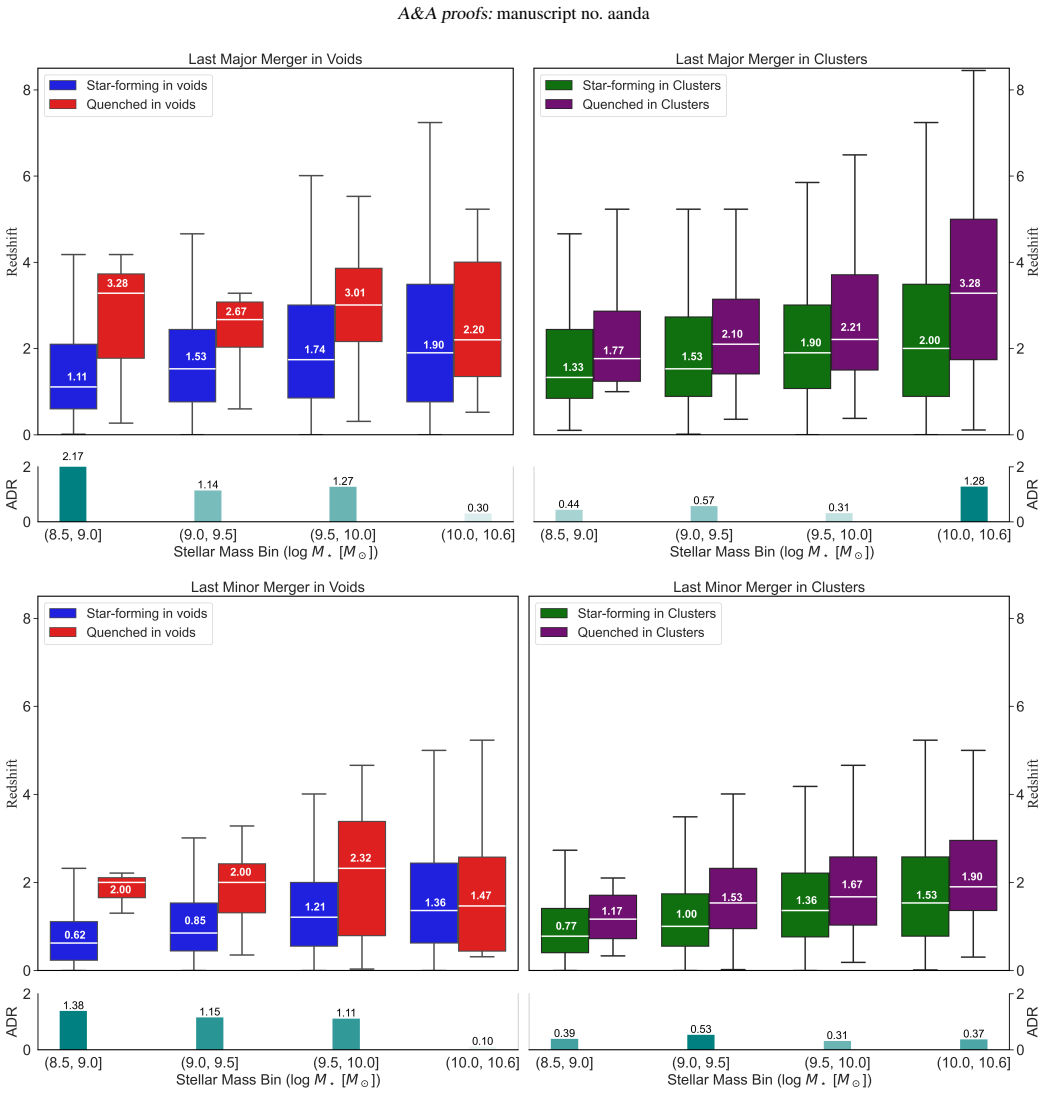
On its own terms, the paper establishes that environment and quenching state jointly control the assembly of low-mass galaxies ($10^{8.5}\le M_\star/M_\odot\le 10^{10.5}$). The central discovery is that quenched galaxies in voids show dramatically elevated late-time mini and minor merger fractions, with void-to-cluster ratios $R\sim3.0$–$3.3$ for mini and $R\sim2.7$–$2.9$ for minor mergers, while star-forming galaxies show only moderate recent enhancement ($R\sim1.6$–$1.8$) and at intermediate epochs the pattern reverses for quenched cluster galaxies ($R\sim0.6$–$0.8$). The paper also finds that quenched void galaxies are not a single population: the mean mass of merger companions is bimodal, tracing an older pathway built from early low-mass accretion and a younger pathway with more recent, higher-mass mergers. It further shows that mini mergers are the most effective channel for boosting star formation rate and efficiency across all environments, whereas major mergers dominate the gas fractions of low-mass galaxies, and that mergers barely affect already-quenched systems.
Load-bearing premise
The results assume the simulation's tracking reliably recovers very small companion galaxies, down to a few star particles, so the high mini-merger counts in voids are real rather than a by-product of limited resolution.
Editorial extensions
If this is right
- Late-time assembly of low-mass galaxies is dominated by small accretion events, not just major mergers, so models of low-mass growth must include mini mergers as a primary channel.
- Quenched galaxies in voids are not uniformly dead: a subpopulation is being assembled recently through relatively higher-mass mergers, alongside an older population built from early low-mass accretion.
- Merger-triggered star formation is effective only in gas-rich star-forming systems; quenched galaxies show no measurable SFR, SFE, or gas-fraction response to mergers, implying gas content gates merger-driven star formation.
- The reversal of the void–cluster merger ratio at intermediate epochs indicates that group and cluster assembly were themselves sites of enhanced merger activity for quenched galaxies.
Reading between the lines
- A testable prediction: deep imaging of quenched void galaxies should reveal an excess of very low-mass companions or tidal debris relative to quenched cluster galaxies, mirroring the simulated $R\sim3$ mini-merger contrast.
- The bimodality in quenched void galaxies predicts two distinct stellar-population age patterns—uniformly old stars in the low-mass-accretion path and a younger population with a recent accretion-triggered burst in the high-mass-merger path.
- A resolution-convergence test in a higher-resolution run (TNG50-1) that drives the late-time mini-merger ratio toward unity would show the void–cluster contrast to be partly a numerical artifact.
- The absence of merger effects on quenched galaxies argues that semi-analytic models should make merger-driven star formation depend on the gas fraction of the remnant, not just on merger mass ratio.
Editorial analysis
A structured set of objections, weighed in public.
Referee Report
Summary. This manuscript analyzes low-mass galaxies (10^8.5 <= Mstar/Msun <= 10^10.5) in the TNG300-1 simulation, comparing star-forming and quenched galaxies in voids versus groups/clusters. Using the Rodriguez-Gomez et al. (2017) and Eisert et al. (2023) merger catalogs, it tracks the last ~10.5 Gyr of evolution, splits mergers into major, minor, and mini classes, mass-matches the four environmental/star-formation samples, and examines merger fractions, merger timescales, companion mass distributions, and the impact of mergers on SFR, SFE, and gas fraction. The headline result is a strong late-time environmental contrast for quenched galaxies: void quenched galaxies show roughly three times more mini and minor mergers than cluster quenched galaxies (R~3.0-3.3 and R~2.7-2.9 in Figure 9), while star-forming galaxies show a more moderate enhancement (R~1.6-1.8). The paper also reports earlier assembly for quenched systems, a bimodal mean merger companion mass for quenched void galaxies, and environment-dependent merger effects on star formation and gas content.
Significance. If the central claims survive scrutiny, this would be a valuable step: it is a first statistical census of mini/minor/major merger histories for low-mass galaxies separately in void and cluster environments, using a publicly available large-volume simulation. The authors make good use of existing merger-tree catalogs, apply explicit mass-matching before environmental comparisons, and separate the analysis by merger mass ratio, galaxy type, and time bin. The distinction between mini and minor mergers, and the emphasis on voids, goes beyond most previous work and could motivate new observational and simulation-based tests. However, the headline void/cluster contrast for quenched galaxies rests on small samples and on merger events whose companion masses are very close to the TNG300-1 resolution limit, so the quantitative ratios in Figure 9 are not yet established at the level the conclusions claim.
major comments (4)
- [Section 2.3.2 and Section 2.3.3] The sample construction explicitly excludes galaxies with SFR=0: Section 2.3.2 states "we exclude galaxies without star formation (SFR=0)" for clusters, and Section 2.3.3 describes the void sample as containing galaxies "with SFR,0" (presumably SFR not equal to zero). This removes the most strongly quenched systems from the quenched sample, biasing it toward galaxies with residual star formation. Because the paper's central comparison is between star-forming and quenched populations, and because the largest claimed environmental contrast (Figure 9, R~3 for quenched galaxies) concerns exactly these quenched systems, this exclusion is load-bearing. The authors should either justify why SFR=0 galaxies are excluded, or repeat the analysis including them (for example, with a finite sSFR floor) to show that the qualitative results are unchanged.
- [Section 3.4.1, Figure 9, and Section 2.1] The headline mini-merger ratios for quenched galaxies (R~3.0-3.3 in the [0-5] Gyr bin) rely on recovering mergers with secondary stellar masses an order of magnitude below the primary. For a primary at the sample's low-mass edge of 10^8.5 Msun, a mini merger (mass ratio <1/10) involves a companion below ~3.2x10^7 Msun, i.e. only about three TNG300-1 stellar particles (m_bary=1.1x10^7 Msun, Section 2.1). Minor mergers are similarly unresolved below roughly 10^9 Msun primaries. The resolution floor is also environment-dependent: tidal stripping in clusters can destroy or strip low-mass companions before coalescence, selectively suppressing the cluster mini/minor counts and artificially inflating the void/cluster ratio. The caveat in Section 3.5 that "absolute values at the low-mass end may be affected by resolution limitations" is stated for the mean-merger-mass bimodality, not for the Figure 9 ratios, and the claim that "the relative separation between the two subpopulations... remain[s] robust" does not cover the environmental R statistic. To support the central claim, the authors should repeat the ratio analysis using only higher-mass primaries (e.g., Mstar > 10^9 Msun) or otherwise demonstrate that the void/cluster mini-merger contrast is not a resolution artifact.
- [Section 3.4.1 and Table 1] After mass matching, the quenched void sample contains only 153 galaxies (Section 3.4), and the Figure 9 ratio for quenched mini mergers in the [0-5] Gyr bin is based on a small absolute number of events. The quoted "propagated 1-sigma uncertainties" are not shown in the main text, and the number of mini-merger events per environment and time bin is not reported. Given the small sample, a difference of only a few cluster events could change R by order unity. The authors should report the actual event counts and confidence intervals for the quenched panels of Figure 9, so the reader can assess whether R~3 is statistically distinguishable from R~1.
- [Section 4, final paragraph] The concluding paragraph states that "quenched galaxies in voids typically reside in more massive dark matter haloes and experience fewer recent mergers—particularly major ones—reducing their ability to replenish their gas reservoirs." This is internally inconsistent with the paper's own main result: Figure 9 and conclusion item (5) report that quenched void galaxies undergo far more mini and minor mergers at late times (R~3.0-3.3 and R~2.7-2.9). If the intended statement is restricted to major mergers only, it should say so explicitly; as written, it contradicts the central quantitative finding and will confuse readers.
minor comments (6)
- [Section 2.3.3] The phrase "with SFR,0" appears to be a typographical rendering of "SFR not equal to 0"; please write this explicitly.
- [Section 3.4.1 and Figure 9] The shaded uncertainty regions described in the text are not visible or reproduced in the main text; consider adding a version of Figure 9 with explicit error bars or event counts, especially for the quenched panels.
- [Section 3.5] The definitions of MeanStellarMass, MeanLookbackTime, and AccretedStellarMass appear only in footnotes; moving these definitions to the methods section would improve clarity.
- [Section 2.1] The notation for the simulation is inconsistent (TNG300_1 in Section 2.1, TNG300 elsewhere); please standardize.
- [Section 3.2] In the text near Figure 5, "relatively by Stellar feedback" appears to be missing words; the sentence should be rephrased.
- [Section 3.6] The statement that mergers have "little to no impact on quenched galaxies" is based on z<1 merger incidence and z=0 properties; because the quenched classification is made at z=0, transient merger-induced effects at earlier epochs may be missed. A sentence acknowledging this selection effect would help.
Circularity Check
Central merger-rate comparison is self-contained; secondary claim that mergers do not affect quenched galaxies is partly an artifact of the sSFR selection.
-
self definitional
[Sec. 2.3.5 + Sec. 3.6 (Figs. 12, 13)]
"In the literature, we commonly define "quenched" galaxies as those whose logarithmic Specific Star Formation Rate (sSFR) falls below a certain fixed threshold at any redshift, namely sSFR≤10−11 yr−1 ... our analysis reveals no significant differences between mergers and non-mergers in the properties of quenched galaxies in both environments suggesting that once star formation has ceased, mergers do not substantially modify their star-forming properties."
The quenched sample is defined by an sSFR threshold at z=0, so every member has SFR/Mstar below 10^-11 yr^-1 by construction. Comparing the SFR distributions of merger and non-merger subsamples inside this population therefore cannot reveal whether mergers enhance SFR: any merger that pushed SFR above the threshold at z=0 would have excluded the galaxy from the sample. The reported null SFR result is thus inherited from the selection rule rather than measured from merger physics. The SFE and gas-fraction comparisons are less constrained by the definition, but the broad statement that mergers do not substantially modify quenched galaxies leans on the SFR comparison and is presented as an empirical conclusion.
full rationale
The paper's headline result, that void quenched galaxies experience about three times more late-time mini mergers than cluster quenched galaxies (R~3.0-3.3), is not circular: the void/cluster environment assignment and the merger-tree catalogs (Rodriguez-Gomez et al. 2017; Eisert et al. 2023) are independent of the z=0 sSFR/UVJ classification, and the samples are mass-matched before computing merger fractions. The assembly histories, merger-fraction ratios, and mean-companion-mass distributions are all measured quantities that could in principle have come out differently. The only reduction found is the secondary claim in Section 3.6 that mergers have little effect on quenched galaxies: because 'quenched' is defined by an sSFR cutoff, an SFR comparison inside that sample is partly closed by selection. This does not undermine the main environmental merger-rate comparison, but the 'little to no impact' conclusion should be understood as partly definitional rather than a fully independent discovery. The TNG300 resolution floor near 10^8.5 Msun is a real correctness risk for the mini-merger ratios, especially with only 153 quenched void galaxies after mass matching, but that is a numerical validity concern, not circularity.
Assumptions & free parameters
free parameters (7)
- sSFR quenching threshold =
10^-11 yr^-1
- UVJ quiescent selection lines =
U-V > 0.88(V-J)+0.85 and U-V > 1.3, V-J < 1.6
- Stellar mass range =
10^8.5 to 10^10.5 Msun
- Merger mass ratio boundaries =
major >1/4, minor 1/10 to 1/4, mini <1/10
- Void finder density threshold and minimum radius =
R_v > 7 Mpc, density contrast threshold not specified
- Cluster selection thresholds =
M200 >= 1e13 Msun, R < 3 R200, at least 10 galaxies per halo
- Mass-matching bin width and downsampling =
0.1 dex bins, random downsampling, no seed given
assumptions (4)
- domain assumption IllustrisTNG300-1 provides a sufficiently realistic model of low-mass galaxy formation and quenching.
- domain assumption The merger history catalogs (Rodriguez-Gomez et al. 2017; Eisert et al. 2023) correctly identify all mergers and secondary stellar masses, including mini mergers.
- domain assumption The AM void finder with the chosen parameters recovers reliable voids and their galaxy membership.
- ad hoc to paper Selection at z=0 on quenched or star-forming status does not bias backward merger histories.
Cite this review
Pith. "Pith review of From Voids to Clusters: Mergers and Evolutionary Pathways of Star-Forming and Quenched Low-Mass Galaxies." pith.science (2026). https://pith.science/paper/RYT77MI3
@misc{pith2026250606711,
  author       = {Pith},
  title        = {Pith review of: From Voids to Clusters: Mergers and Evolutionary Pathways of Star-Forming and Quenched Low-Mass Galaxies},
  year         = {2026},
  howpublished = {\url{https://pith.science/paper/RYT77MI3}},
  note         = {Machine review of arXiv:2506.06711}
}
abstract
The evolution of low-mass galaxies is shaped by both internal processes and environmental factors, yet the role of environment and mergers in regulating their growth and star formation rates remains poorly understood, especially in the low-density regime. This study aims to compare the evolutionary pathways and merger histories of star-forming and quenched galaxies in dense (cluster) and under-dense (void) environments, focusing on galaxies with stellar masses in the range $10^{8.5} \leq M_\star/M_\odot \leq 10^{10.5}$. It presents the first statistical analysis within this stellar mass range, explicitly distinguishing between mini, minor, and major mergers across varying environments. Using the high-resolution TNG300-1 simulation from the IllustrisTNG project, we classify galaxies as star-forming and quenched based on sSFR and UVJ criteria. We track their physical properties over the last $\sim 10.5$ Gyr ($z < 2$), follow their complete merger histories, distinguishing between major, minor, and mini mergers, and assess the statistical impact of these mergers on star formation and gas content.
Figures


Figures from the paper (11 more)




Reference graph
Works this paper leans on
-
[1]
& Mähönen, P
Aikio, J. & Mähönen, P. 1998, The Astrophysical Journal, 497, 534 Argudo-Fernández, M., Hernández, C. G., Verley, S., et al. 2024, Astronomy & Astrophysics, 692, A258
1998
-
[2]
2016, The Astro- physical Journal, 821, 90
Athanassoula, E., Rodionov, S., Peschken, N., & Lambert, J. 2016, The Astro- physical Journal, 821, 90
2016
-
[3]
Bagla, J. S. 2002, Journal of Astrophysics and Astronomy, 23, 185
2002
-
[4]
M., Loveday, J., & Brunner, R
Ball, N. M., Loveday, J., & Brunner, R. J. 2008, Monthly Notices of the Royal Astronomical Society, 383, 907
2008
-
[5]
L., McGee, S
Balogh, M. L., McGee, S. L., Mok, A., et al. 2016, Monthly Notices of the Royal Astronomical Society, 456, 4364
2016
-
[6]
L., Navarro, J
Balogh, M. L., Navarro, J. F., & Morris, S. L. 2000, The Astrophysical Journal, 540, 113
2000
-
[7]
P., Nichol, R
Bamford, S. P., Nichol, R. C., Baldry, I. K., et al. 2009, Monthly Notices of the Royal Astronomical Society, 393, 1324
2009
-
[8]
J., Arnold, J
Barton, E. J., Arnold, J. A., Zentner, A. R., Bullock, J. S., & Wechsler, R. H. 2007, The Astrophysical Journal, 671, 1538
2007
Show all 167 references
-
[9]
H., Hearin, A
Behroozi, P., Wechsler, R. H., Hearin, A. P., & Conroy, C. 2019, Monthly Notices of the Royal Astronomical Society, 488, 3143
2019
-
[10]
S., Conroy, C., & Wechsler, R
Behroozi, P. S., Conroy, C., & Wechsler, R. H. 2010, The Astrophysical Journal, 717, 379
2010
-
[11]
S., Wechsler, R
Behroozi, P. S., Wechsler, R. H., & Conroy, C. 2013, ApJ, 770, 57
2013
-
[12]
J., & Shioya, Y
Bekki, K., Couch, W. J., & Shioya, Y . 2002, The Astrophysical Journal, 577, 651
2002
-
[13]
F., Naab, T., McIntosh, D
Bell, E. F., Naab, T., McIntosh, D. H., et al. 2006, The Astrophysical Journal, 640, 241
2006
-
[14]
Benson, A., Hoyle, F., Torres, F., & V ogeley, M. S. 2003, Monthly Notices of the Royal Astronomical Society, 340, 160
2003
-
[15]
R., Eisenstein, D., Hogg, D
Blanton, M. R., Eisenstein, D., Hogg, D. W., Schlegel, D. J., & Brinkmann, J. 2005, The Astrophysical Journal, 629, 143
2005
-
[16]
F., Conselice, C
Bluck, A. F., Conselice, C. J., Bouwens, R. J., et al. 2009, Monthly Notices of the Royal Astronomical Society: Letters, 394, L51
2009
-
[17]
Blumenthal, K. A. & Barnes, J. E. 2018, Monthly Notices of the Royal Astro- nomical Society, 479, 3952
2018
-
[18]
P., & Xu, G
Bode, P., Ostriker, J. P., & Xu, G. 2000, The Astrophysical Journal Supplement Series, 128, 561
2000
-
[19]
R., Kofman, L., & Pogosyan, D
Bond, J. R., Kofman, L., & Pogosyan, D. 1996, Nature, 380, 603
1996
-
[20]
2022, The Astronomy and astrophysics re- view, 30, 3
Boselli, A., Fossati, M., & Sun, M. 2022, The Astronomy and astrophysics re- view, 30, 3
2022
-
[21]
M., Popping, G., et al
Bottrell, C., Yesuf, H. M., Popping, G., et al. 2024, Monthly Notices of the Royal Astronomical Society, 527, 6506
2024
-
[22]
2024, arXiv preprint arXiv:2407.10900
Boylan-Kolchin, M. 2024, arXiv preprint arXiv:2407.10900
2024 arXiv
-
[23]
2025, Monthly Notices of the Royal Astronomical Society, staf471
Boylan-Kolchin, M. 2025, Monthly Notices of the Royal Astronomical Society, staf471
2025
-
[24]
D., et al
Brinchmann, J., Charlot, S., White, S. D., et al. 2004, Monthly notices of the royal astronomical society, 351, 1151
2004
-
[25]
R., Ellison, S
Brown, W., Patton, D. R., Ellison, S. L., & Faria, L. 2023, Monthly Notices of the Royal Astronomical Society, 522, 5107
2023
-
[26]
Bustamante, S., Sparre, M., Springel, V ., & Grand, R. J. 2018, Monthly Notices of the Royal Astronomical Society, 479, 3381
2018
-
[27]
H., Ellison, S
Byrne-Mamahit, S., Hani, M. H., Ellison, S. L., Quai, S., & Patton, D. R. 2023, Monthly Notices of the Royal Astronomical Society, 519, 4966 Article number, page 21 of 26 A&A proofs:manuscript no. aanda
2023
-
[28]
G., Patton, D., et al
Carlberg, R., Cohen, J. G., Patton, D., et al. 2000, The Astrophysical Journal, 532, L1
2000
-
[29]
2003, Publications of the Astronomical Society of the Pacific, 115, 763
Chabrier, G. 2003, Publications of the Astronomical Society of the Pacific, 115, 763
2003
-
[30]
J., Chapman, S
Conselice, C. J., Chapman, S. C., & Windhorst, R. A. 2003, The Astrophysical Journal, 596, L5
2003
-
[31]
J., Yang, C., & Bluck, A
Conselice, C. J., Yang, C., & Bluck, A. F. 2009, Monthly Notices of the Royal Astronomical Society, 394, 1956
2009
-
[32]
2020, The Astrophysical Journal, 889, 156
Contini, E., Gu, Q., Ge, X., et al. 2020, The Astrophysical Journal, 889, 156
2020
-
[33]
2019, The Astrophysical Journal, 882, 167
Contini, E., Gu, Q., Kang, X., Rhee, J., & Yi, S. 2019, The Astrophysical Journal, 882, 167
2019
-
[34]
A., Hough, T., Vega-Martínez, C
Cora, S. A., Hough, T., Vega-Martínez, C. A., & Orsi, Á. A. 2019, Monthly Notices of the Royal Astronomical Society, 483, 1686
2019
-
[35]
2021, Publications of the Astronomical Society of Australia, 38, e035
Cortese, L., Catinella, B., & Smith, R. 2021, Publications of the Astronomical Society of Australia, 38, e035
2021
-
[36]
S., Primack, J
Cox, T., Jonsson, P., Somerville, R. S., Primack, J. R., & Dekel, A. 2008, Monthly Notices of the Royal Astronomical Society, 384, 386
2008
-
[37]
A., Schaye, J., Bower, R
Crain, R. A., Schaye, J., Bower, R. G., et al. 2015, Monthly Notices of the Royal Astronomical Society, 450, 1937
2015
-
[38]
P., Pimbblet, K
Crossett, J. P., Pimbblet, K. A., Jones, D. H., Brown, M. J., & Stott, J. P. 2017, Monthly Notices of the Royal Astronomical Society, 464, 480
2017
-
[39]
J., Springel, V ., White, S
Croton, D. J., Springel, V ., White, S. D., et al. 2006, Monthly Notices of the Royal Astronomical Society, 365, 11
2006
-
[40]
S., Fazio, G
Cybulski, R., Yun, M. S., Fazio, G. G., & Gutermuth, R. A. 2014, Monthly No- tices of the Royal Astronomical Society, 439, 3564 Dalla Vecchia, C. & Schaye, J. 2008, Monthly Notices of the Royal Astronomical Society, 387, 1431
2014
-
[41]
W., Kaviraj, S., Lintott, C
Darg, D. W., Kaviraj, S., Lintott, C. J., et al. 2010, Monthly Notices of the Royal Astronomical Society, 401, 1043
2010
-
[42]
2016, The Astrophysical Journal, 825, 113
Darvish, B., Mobasher, B., Sobral, D., et al. 2016, The Astrophysical Journal, 825, 113
2016
-
[43]
2021, arXiv preprint arXiv:2108.05874 Davé, R., Anglés-Alcázar, D., Narayanan, D., et al
Das, A., Pandey, B., Sarkar, S., & Dutta, A. 2021, arXiv preprint arXiv:2108.05874 Davé, R., Anglés-Alcázar, D., Narayanan, D., et al. 2019, Monthly Notices of the Royal Astronomical Society, 486, 2827
2021 arXiv
-
[44]
J., Robotham, A
Davies, L. J., Robotham, A. S. G., Driver, S. P., et al. 2015, Monthly Notices of the Royal Astronomical Society, 452, 616
2015
-
[45]
S., & White, S
Davis, M., Efstathiou, G., Frenk, C. S., & White, S. D. 1985, Astrophysical Jour- nal, Part 1 (ISSN 0004-637X), vol. 292, May 15, 1985, p. 371-394. Research supported by the Science and Engineering Research Council of England and NASA., 292, 371
1985
-
[46]
& Geller, M
Davis, M. & Geller, M. J. 1976, Astrophysical Journal, V ol. 208, pp. 13-19 (1976)., 208, 13 De Lucia, G., Springel, V ., White, S. D., Croton, D., & Kauffmann, G. 2006, Monthly Notices of the Royal Astronomical Society, 366, 499 De Ravel, L., Le Fèvre, O., Tresse, L., et al. ...
1976
-
[47]
2018, The Astrophysical Journal, 869, 6
Deger, S., Rudnick, G., Kelkar, K., et al. 2018, The Astrophysical Journal, 869, 6
2018
-
[48]
2017, The Astrophysical Journal, 843, 126
Delahaye, A., Webb, T., Nantais, J., et al. 2017, The Astrophysical Journal, 843, 126
2017
-
[49]
G., Rodríguez-Martín, J., Díaz-García, L., et al
Delgado, R. G., Rodríguez-Martín, J., Díaz-García, L., et al. 2022, Astronomy & Astrophysics, 666, A84 Di Matteo, P., Combes, F., Melchior, A.-L., & Semelin, B. 2007, Astronomy & Astrophysics, 468, 61 Di Matteo, T., Springel, V ., & Hernquist, L. 2005, nature, 433, 604
2022
-
[50]
L., Cao, C., Xu, C
Domingue, D. L., Cao, C., Xu, C. K., et al. 2016, The Astrophysical Journal, 829, 78 Domínguez-Gómez, J., Pérez, I., Ruiz-Lara, T., et al. 2023, Nature, 619, 269
2016
-
[51]
2019, Monthly Notices of the Royal Astronomical Society, 485, 4817
Donnari, M., Pillepich, A., Nelson, D., et al. 2019, Monthly Notices of the Royal Astronomical Society, 485, 4817
2019
-
[52]
1980, Astrophysical Journal, Part 1, vol
Dressler, A. 1980, Astrophysical Journal, Part 1, vol. 236, Mar. 1, 1980, p. 351- 365., 236, 351
1980
-
[53]
2023, Monthly Notices of the Royal Astronomical Society, 519, 2199
Eisert, L., Pillepich, A., Nelson, D., et al. 2023, Monthly Notices of the Royal Astronomical Society, 519, 2199
2023
-
[54]
L., Mendel, J
Ellison, S. L., Mendel, J. T., Patton, D. R., & Scudder, J. M. 2013, Monthly Notices of the Royal Astronomical Society, 435, 3627
2013
-
[55]
L., Patton, D
Ellison, S. L., Patton, D. R., Simard, L., & McConnachie, A. W. 2008, The As- tronomical Journal, 135, 1877
2008
-
[56]
L., Viswanathan, A., Patton, D
Ellison, S. L., Viswanathan, A., Patton, D. R., et al. 2019, Monthly Notices of the Royal Astronomical Society, 487, 2491
2019
-
[57]
L., Patton, D
Ferreira, L., Ellison, S. L., Patton, D. R., et al. 2025, Monthly Notices of the Royal Astronomical Society: Letters, 538, L31
2025
-
[58]
A., Kannappan, S
Florez, J., Berlind, A. A., Kannappan, S. J., et al. 2021, The Astrophysical Jour- nal, 906, 97
2021
-
[59]
2015, Monthly Notices of the Royal Astronomical Society, 450, 4486 Gallagher III, J
Furlong, M., Bower, R., Theuns, T., et al. 2015, Monthly Notices of the Royal Astronomical Society, 450, 4486 Gallagher III, J. S. & Ostriker, J. P. 1972, Astronomical Journal, V ol. 77, p. 288 (1972), 77, 288
1972
-
[60]
2014, Monthly Notices of the Royal Astronomical Society, 445, 175
Genel, S., V ogelsberger, M., Springel, V ., et al. 2014, Monthly Notices of the Royal Astronomical Society, 445, 175
2014
-
[61]
Ghafour, P., Tavasoli, S., & Shojaei, M. R. 2025, Journal of Cosmology and Astroparticle Physics, 2025, 001
2025
-
[62]
Gunn, J. E. & Gott III, J. R. 1972, Astrophysical Journal, vol. 176, p. 1, 176, 1
1972
-
[63]
H., Gosain, H., Ellison, S
Hani, M. H., Gosain, H., Ellison, S. L., Patton, D. R., & Torrey, P. 2020, Monthly Notices of the Royal Astronomical Society, 493, 3716
2020
-
[64]
F., Hernquist, L., Cox, T
Hopkins, P. F., Hernquist, L., Cox, T. J., et al. 2006, The Astrophysical Journal Supplement Series, 163, 1
2006
-
[65]
F., Hernquist, L., Cox, T
Hopkins, P. F., Hernquist, L., Cox, T. J., & Kereš, D. 2008, The Astrophysical Journal Supplement Series, 175, 356
2008
-
[66]
R., V ogeley, M
Hoyle, F., Rojas, R. R., V ogeley, M. S., & Brinkmann, J. 2005, The Astrophysical Journal, 620, 618
2005
-
[67]
2012, Monthly Notices of the Royal Astro- nomical Society, 426, 3041 Jaffé, Y
Hoyle, F., V ogeley, M., & Pan, D. 2012, Monthly Notices of the Royal Astro- nomical Society, 426, 3041 Jaffé, Y . L., Verheijen, M. A., Haines, C. P., et al. 2016, Monthly Notices of the Royal Astronomical Society, 461, 1202
2012
-
[68]
& Yan-chun, S
Jia-jie, Q. & Yan-chun, S. 2021, Chinese Astronomy and Astrophysics, 45, 31
2021
-
[69]
2022, The Astrophysical Journal, 926, 115
Jian, H.-Y ., Lin, L., Hsieh, B.-C., et al. 2022, The Astrophysical Journal, 926, 115
2022
-
[70]
2018, Publications of the Astronomical Society of Japan, 70, S23
Jian, H.-Y ., Lin, L., Oguri, M., et al. 2018, Publications of the Astronomical Society of Japan, 70, S23
2018
-
[71]
& Fairall, A
Kauffmann, G. & Fairall, A. 1991, Monthly Notices of the Royal Astronomical Society, 248, 313
1991
-
[72]
D., Heckman, T
Kauffmann, G., White, S. D., Heckman, T. M., et al. 2004, Monthly Notices of the Royal Astronomical Society, 353, 713
2004
-
[73]
E., Aragón-Salamanca, A., et al
Kelkar, K., Gray, M. E., Aragón-Salamanca, A., et al. 2019, Monthly Notices of the Royal Astronomical Society, 486, 868 Kennicutt Jr, R. C. 1989, Astrophysical Journal, Part 1 (ISSN 0004-637X), vol. 344, Sept. 15, 1989, p. 685-703., 344, 685
2019
-
[74]
P., Oemler Jr, A., Schechter, P
Kirshner, R. P., Oemler Jr, A., Schechter, P. L., & Shectman, S. A. 1981, As- trophysical Journal, Part 2-Letters to the Editor, vol. 248, Sept. 1, 1981, p. L57-L60., 248, L57
1981
-
[75]
H., Cisternas, M., & Querejeta, M
Knapen, J. H., Cisternas, M., & Querejeta, M. 2015, Monthly Notices of the Royal Astronomical Society, 454, 1742
2015
-
[76]
H., Beygu, B., et al
Kreckel, K., van Gorkom, J. H., Beygu, B., et al. 2014, Proceedings of the Inter- national Astronomical Union, 11, 591 Laganá, T. F. & Ulmer, M. 2018, Monthly Notices of the Royal Astronomical Society, 475, 523
2014
-
[77]
G., Tissera, P
Lambas, D. G., Tissera, P. B., Alonso, M. S., & Coldwell, G. 2003, Monthly Notices of the Royal Astronomical Society, 346, 1189
2003
-
[78]
B., Tinsley, B
Larson, R. B., Tinsley, B. M., & Caldwell, C. N. 1980, Astrophysical Journal, Part 1, vol. 237, May 1, 1980, p. 692-707. Research supported by the Alfred P. Sloan Foundation, 237, 692
1980
-
[79]
& Wandelt, B
Lavaux, G. & Wandelt, B. D. 2010, Monthly Notices of the Royal Astronomical Society, 403, 1392
2010
-
[80]
2020, The Astrophysical Journal, 902, 75
Li, P., Wang, H., Mo, H., Wang, E., & Hong, H. 2020, The Astrophysical Journal, 902, 75
2020
-
[81]
2007, Astronomy & Astrophysics, 461, 881
Limousin, M., Kneib, J., Bardeau, S., et al. 2007, Astronomy & Astrophysics, 461, 881
2007
-
[82]
C., Jian, H.-Y ., et al
Lin, L., Cooper, M. C., Jian, H.-Y ., et al. 2010, The Astrophysical Journal, 718, 1158
2010
-
[83]
C., Weiner, B
Lin, L., Koo, D. C., Weiner, B. J., et al. 2007, The Astrophysical Journal, 660, L51
2007
-
[84]
C., Willmer, C
Lin, L., Koo, D. C., Willmer, C. N., et al. 2004, The Astrophysical Journal, 617, L9
2004
-
[85]
R., Koo, D
Lin, L., Patton, D. R., Koo, D. C., et al. 2008, The Astrophysical Journal, 681, 232
2008
-
[86]
C., Li, C., Wang, L., & Wang, E
Lin, Y ., Sodi, B. C., Li, C., Wang, L., & Wang, E. 2014, The Astrophysical Journal, 796, 98
2014
-
[87]
M., Davis, M., Faber, S., et al
Lotz, J. M., Davis, M., Faber, S., et al. 2008, The Astrophysical Journal, 672, 177
2008
-
[88]
& Belli, S
Man, A. & Belli, S. 2018, Nature Astronomy, 2, 695
2018
-
[89]
2018, Monthly Notices of the Royal Astronomical Society, 480, 5113
Marinacci, F., V ogelsberger, M., Pakmor, R., et al. 2018, Monthly Notices of the Royal Astronomical Society, 480, 5113
2018
-
[90]
L., Balogh, M
McGee, S. L., Balogh, M. L., Wilman, D. J., et al. 2011, Monthly Notices of the Royal Astronomical Society, 413, 996
2011
-
[91]
M., Cortese, L., Croom, S
Medling, A. M., Cortese, L., Croom, S. M., et al. 2018, Monthly Notices of the Royal Astronomical Society, 475, 5194
2018
-
[92]
1984, Astrophysical Journal, Part 1 (ISSN 0004-637X), vol
Merritt, D. 1984, Astrophysical Journal, Part 1 (ISSN 0004-637X), vol. 276, Jan. 1, 1984, p. 26-37., 276, 26
1984
- [93]
-
[94]
Mihos, J. C. 2004, Clusters of Galaxies: Probes of Cosmological Structure and Galaxy Evolution, 277
2004
-
[95]
M., Moreno, J., White, A., et al
Moorman, C. M., Moreno, J., White, A., et al. 2016, The Astrophysical Journal, 831, 118
2016
-
[96]
L., et al
Moreno, J., Torrey, P., Ellison, S. L., et al. 2015, Monthly Notices of the Royal Astronomical Society, 448, 1107 Article number, page 22 of 26 Mohammad Reza Shojaei1 et al.: From V oids to Clusters
2015
-
[97]
L., et al
Moreno, J., Torrey, P., Ellison, S. L., et al. 2021, Monthly Notices of the Royal Astronomical Society, 503, 3113
2021
-
[98]
L., et al
Moreno, J., Torrey, P., Ellison, S. L., et al. 2019, Monthly Notices of the Royal Astronomical Society, 485, 1320
2019
-
[99]
P., Naab, T., & White, S
Moster, B. P., Naab, T., & White, S. D. 2013, Monthly Notices of the Royal Astronomical Society, 428, 3121
2013
-
[100]
2006, The Astrophysical Journal, 636, L81
Naab, T., Khochfar, S., & Burkert, A. 2006, The Astrophysical Journal, 636, L81
2006
-
[101]
P., Pillepich, A., Springel, V ., et al
Naiman, J. P., Pillepich, A., Springel, V ., et al. 2018, Monthly Notices of the Royal Astronomical Society, 477, 1206
2018
-
[102]
2015, Astronomy and Computing, 13, 12
Nelson, D., Pillepich, A., Genel, S., et al. 2015, Astronomy and Computing, 13, 12
2015
-
[103]
2018, Monthly Notices of the Royal Astronomical Society, 475, 624
Nelson, D., Pillepich, A., Springel, V ., et al. 2018, Monthly Notices of the Royal Astronomical Society, 475, 624
2018
-
[104]
2019, Computational Astrophysics and Cosmology, 6, 1
Nelson, D., Springel, V ., Pillepich, A., et al. 2019, Computational Astrophysics and Cosmology, 6, 1
2019
-
[105]
Neyrinck, M. C. 2008, Monthly notices of the royal astronomical society, 386, 2101
2008
-
[106]
2004, Monthly Notices of the Royal Astronomical Society, 355, 874 Oemler Jr, A
Nikolic, B., Cullen, H., & Alexander, P. 2004, Monthly Notices of the Royal Astronomical Society, 355, 874 Oemler Jr, A. 1974, PhD thesis, California Institute of Technology
2004
-
[107]
H., et al
Oh, S., Kim, K., Lee, J. H., et al. 2018, The Astrophysical Journal Supplement Series, 237, 14
2018
-
[108]
P., Naab, T., Johansson, P
Oser, L., Ostriker, J. P., Naab, T., Johansson, P. H., & Burkert, A. 2010, The Astrophysical Journal, 725, 2312
2010
-
[109]
1980, Comments on Astrophysics, V ol
Ostriker, J. 1980, Comments on Astrophysics, V ol. 8, P. 177, 1980, 8, 177
1980
-
[110]
D., Ceccarelli, L., & Lambas, D
Padilla, N. D., Ceccarelli, L., & Lambas, D. 2005, Monthly Notices of the Royal Astronomical Society, 363, 977
2005
-
[111]
2018, The Astrophysical Journal, 868, 132
Pan, H.-A., Lin, L., Hsieh, B.-C., et al. 2018, The Astrophysical Journal, 868, 132
2018
-
[112]
G., van Dokkum, P
Patel, S. G., van Dokkum, P. G., Franx, M., et al. 2013, The Astrophysical Jour- nal, 766, 15
2013
-
[113]
2002, The Astrophysical Journal, 565, 208
Patton, D., Pritchet, C., Carlberg, R., et al. 2002, The Astrophysical Journal, 565, 208
2002
-
[114]
R., Wilson, K
Patton, D. R., Wilson, K. D., Metrow, C. J., et al. 2020, Monthly Notices of the Royal Astronomical Society, 494, 4969
2020
-
[115]
J., Kovaˇc, K., et al
Peng, Y .-j., Lilly, S. J., Kovaˇc, K., et al. 2010, The Astrophysical Journal, 721, 193
2010
-
[116]
J., Renzini, A., & Carollo, M
Peng, Y .-j., Lilly, S. J., Renzini, A., & Carollo, M. 2012, The Astrophysical Jour- nal, 757, 4
2012
-
[117]
Perez, J., Michel-Dansac, L., & Tissera, P. B. 2011, Monthly Notices of the Royal Astronomical Society, 417, 580
2011
-
[118]
2014, Astronomy & Astrophysics, 562, A1
Perret, V ., Renaud, F., Epinat, B., et al. 2014, Astronomy & Astrophysics, 562, A1
2014
-
[119]
Platen, E., Van De Weygaert, R., & Jones, B. J. 2007, Monthly notices of the royal astronomical society, 380, 551
2007
-
[120]
& Geller, M
Postman, M. & Geller, M. 1984, Astrophysical Journal, Part 1 (ISSN 0004- 637X), vol. 281, June 1, 1984, p. 95-99., 281, 95
1984
-
[121]
F., Williams, R
Quadri, R. F., Williams, R. J., Franx, M., & Hildebrandt, H. 2011, The Astro- physical Journal, 744, 88
2011
-
[122]
W., Markevitch, M., Clowe, D., Gonzalez, A
Randall, S. W., Markevitch, M., Clowe, D., Gonzalez, A. H., & Bradaˇc, M. 2008, The Astrophysical Journal, 679, 1173
2008
-
[123]
P., Davies, L
Robotham, A., Driver, S. P., Davies, L. J., et al. 2014, Monthly Notices of the Royal Astronomical Society, 444, 3986
2014
-
[124]
P., et al
Robotham, A., Liske, J., Driver, S. P., et al. 2013, Monthly Notices of the Royal Astronomical Society, 431, 167
2013
-
[125]
2015, Monthly Notices of the Royal Astronomical Society, 449, 49
Rodriguez-Gomez, V ., Genel, S., V ogelsberger, M., et al. 2015, Monthly Notices of the Royal Astronomical Society, 449, 49
2015
-
[126]
V ., Genel, S., et al
Rodriguez-Gomez, V ., Sales, L. V ., Genel, S., et al. 2017, Monthly Notices of the Royal Astronomical Society, 467, 3083 Rodríguez Medrano, A. M., Paz, D. J., Stasyszyn, F. A., & Ruiz, A. N. 2022, Monthly Notices of the Royal Astronomical Society, 511, 2688 Rodríguez-Medrano,...
2017
-
[127]
R., V ogeley, M
Rojas, R. R., V ogeley, M. S., Hoyle, F., & Brinkmann, J. 2004, The Astrophysical Journal, 617, 50
2004
-
[128]
Rosas-Guevara, Y ., Tissera, P., Lagos, C. d. P., Paillas, E., & Padilla, N. 2022, Monthly Notices of the Royal Astronomical Society, 517, 712
2022
-
[129]
S., Kewley, L
Rupke, D. S., Kewley, L. J., & Barnes, J. E. 2010, The Astrophysical Journal Letters, 710, L156
2010
-
[130]
Sahni, V ., Sathyaprakash, B., & Shandarin, S. F. 1994, arXiv preprint astro- ph/9403044
1994
-
[131]
J., Fabello, S., et al
Saintonge, A., Tacconi, L. J., Fabello, S., et al. 2012, The Astrophysical Journal, 758, 73
2012
-
[132]
& Mirabel, I
Sanders, D. & Mirabel, I. 1996, Annual Review of Astronomy and Astrophysics, 34, 749
1996
-
[133]
A., Bower, R
Schaye, J., Crain, R. A., Bower, R. G., et al. 2015, Monthly Notices of the Royal Astronomical Society, 446, 521
2015
-
[134]
2015, Astronomy & Astrophysics, 575, A74
Schreiber, C., Pannella, M., Elbaz, D., et al. 2015, Astronomy & Astrophysics, 575, A74
2015
-
[135]
M., Ellison, S
Scudder, J. M., Ellison, S. L., Torrey, P., Patton, D. R., & Mendel, J. T. 2012, Monthly Notices of the Royal Astronomical Society, 426, 549
2012
-
[136]
2015, Monthly Notices of the Royal Astronomical Society, 452, 575
Sijacki, D., V ogelsberger, M., Genel, S., et al. 2015, Monthly Notices of the Royal Astronomical Society, 452, 575
2015
-
[137]
D., et al
Silva, A., Marchesini, D., Silverman, J. D., et al. 2018, The Astrophysical Jour- nal, 868, 46
2018
-
[138]
& Holley-Bockelmann, K
Sinha, M. & Holley-Bockelmann, K. 2009, Monthly Notices of the Royal Astro- nomical Society, 397, 190 Sol Alonso, M., Lambas, D. G., Tissera, P., & Coldwell, G. 2006, Monthly No- tices of the Royal Astronomical Society, 367, 1029
2009
-
[139]
S., Hopkins, P
Somerville, R. S., Hopkins, P. F., Cox, T. J., Robertson, B. E., & Hernquist, L. 2008, Monthly Notices of the Royal Astronomical Society, 391, 481
2008
-
[140]
C., Feldmann, R., et al
Sparre, M., Hayward, C. C., Feldmann, R., et al. 2017, Monthly Notices of the Royal Astronomical Society, 466, 88
2017
-
[141]
2022, Monthly Notices of the Royal Astronomical Society, 509, 2720
Sparre, M., Whittingham, J., Damle, M., et al. 2022, Monthly Notices of the Royal Astronomical Society, 509, 2720
2022
-
[142]
2010, Proceedings of the International Astronomical Union, 6, 203
Springel, V . 2010, Proceedings of the International Astronomical Union, 6, 203
2010
-
[143]
2005, Monthly Notices of the Royal Astronomical Society, 361, 776
Springel, V ., Di Matteo, T., & Hernquist, L. 2005, Monthly Notices of the Royal Astronomical Society, 361, 776
2005
-
[144]
& Hernquist, L
Springel, V . & Hernquist, L. 2003, Monthly Notices of the Royal Astronomical Society, 339, 289
2003
-
[145]
2018, Monthly Notices of the Royal Astronomical Society, 475, 676
Springel, V ., Pakmor, R., Pillepich, A., et al. 2018, Monthly Notices of the Royal Astronomical Society, 475, 676
2018
-
[146]
D., Tormen, G., & Kauffmann, G
Springel, V ., White, S. D., Tormen, G., & Kauffmann, G. 2001, Monthly Notices of the Royal Astronomical Society, 328, 726
2001
-
[147]
2016, Astronomy & Astrophysics, 591, A51
Steinhauser, D., Schindler, S., & Springel, V . 2016, Astronomy & Astrophysics, 591, A51
2016
-
[148]
R., Bullock, J
Stewart, K. R., Bullock, J. S., Wechsler, R. H., & Maller, A. H. 2009, The Astro- physical Journal, 702, 307
2009
-
[149]
M., Lavaux, G., Hamaus, N., et al
Sutter, P. M., Lavaux, G., Hamaus, N., et al. 2015, Astronomy and Computing, 9, 1
2015
-
[150]
J., Genzel, R., & Sternberg, A
Tacconi, L. J., Genzel, R., & Sternberg, A. 2020, Annual Review of Astronomy and Astrophysics, 58, 157
2020
-
[151]
G., Vasei, K., & Lehnert, M
Tavasoli, S., Rahmani, H., Khosroshahi, H. G., Vasei, K., & Lehnert, M. D. 2015, The Astrophysical Journal Letters, 803, L13
2015
-
[152]
2013, Astronomy & Astrophysics, 553, A15
Tavasoli, S., Vasei, K., & Mohayaee, R. 2013, Astronomy & Astrophysics, 553, A15
2013
-
[153]
& Cen, R
Tonnesen, S. & Cen, R. 2012, Monthly Notices of the Royal Astronomical Soci- ety, 425, 2313
2012
-
[154]
J., Kewley, L., & Hernquist, L
Torrey, P., Cox, T. J., Kewley, L., & Hernquist, L. 2012, The Astrophysical Jour- nal, 746, 108
2012
-
[155]
F., V ogelsberger, M., et al
Torrey, P., Snyder, G. F., V ogelsberger, M., et al. 2015, Monthly Notices of the Royal Astronomical Society, 447, 2753 Van de Weygaert, R. & Platen, E. 2011, in International Journal of Modern Physics: Conference Series, V ol. 1, World Scientific, 41–66 V ogelsberger, M., Gen...
2015
-
[156]
A., Van Dokkum, P
Wake, D. A., Van Dokkum, P. G., & Franx, M. 2012, The Astrophysical Journal Letters, 751, L44
2012
-
[157]
Wechsler, R. H. & Tinker, J. L. 2018, ARA&A, 56, 435
2018
-
[158]
K., Schawinski, K., Treister, E., Trakhtenbrot, B., & Sanders, D
Weigel, A. K., Schawinski, K., Treister, E., Trakhtenbrot, B., & Sanders, D. B. 2018, Monthly Notices of the Royal Astronomical Society, 476, 2308
2018
-
[159]
2018, Monthly Notices of the Royal Astronomical Society, 479, 4056
Weinberger, R., Springel, V ., Pakmor, R., et al. 2018, Monthly Notices of the Royal Astronomical Society, 479, 4056
2018
-
[160]
R., Tinker, J
Wetzel, A. R., Tinker, J. L., Conroy, C., & Van Den Bosch, F. C. 2013, Monthly Notices of the Royal Astronomical Society, 432, 336
2013
-
[161]
E., Labbé, I., van Dokkum, P
Whitaker, K. E., Labbé, I., van Dokkum, P. G., et al. 2011, The Astrophysical Journal, 735, 86
2011
-
[162]
E., Van Dokkum, P
Whitaker, K. E., Van Dokkum, P. G., Brammer, G., et al. 2010, The Astrophysical Journal, 719, 1715
2010
-
[163]
J., Quadri, R
Williams, R. J., Quadri, R. F., Franx, M., Van Dokkum, P., & Labbé, I. 2009, The Astrophysical Journal, 691, 1879
2009
-
[164]
J., Quadri, R
Williams, R. J., Quadri, R. F., Franx, M., et al. 2010, The Astrophysical Journal, 713, 738
2010
-
[165]
Woods, D. F. & Geller, M. J. 2007, The Astronomical Journal, 134, 527
2007
-
[166]
Wuyts, S., Schreiber, N. M. F., Lutz, D., et al. 2011, The Astrophysical Journal, 738, 106
2011
-
[167]
1994, arXiv preprint astro-ph/9409021 Article number, page 23 of 26 A&A proofs:manuscript no
Xu, G. 1994, arXiv preprint astro-ph/9409021 Article number, page 23 of 26 A&A proofs:manuscript no. aanda Appendix A: Additional Merger Statistics Figure A.1 summarizes the merger histories of star-forming and quenched galaxies in voids and clusters. At early times (>10.5 Gyr...
1994 arXiv
Reviewed August 7, 2026 · model on record in the stance chip above.
Discussion (0). Sign in to comment.