REVIEW 3 major objections 4 minor 81 references
Centrality-based identification of important edges in complex networks
T0 review · 3 major / 4 minor · reviewed 2026-08-14 · deepseek-v4-flash
Pith's one-line read By transferring three standard centrality measures from vertices to edges and peeling away less central edges layer by layer, this paper shows that important connections—not important nodes—are what localize seizure-relevant interactions…
desk verdict A useful edge-centrality toolbox paper whose headline epilepsy finding likely rests on an unjustified zero-distance convention for adjacent edges in closeness centrality. read the letter →
The pith
A machine-rendered reading of the paper's core claim, the machinery that carries it, and where it could break.
The reading
What carries the argument
The machinery is the edge adjacency matrix (the line graph whose vertices are the original edges, with two such vertices connected when the original edges share an endpoint) combined with a zero-distance convention: the path length between adjacent edges is set to 0, and for weighted networks path length is the sum of inverse weights. Plugging this adjacency matrix into the standard eigenvector equation, and using the same shortest-path distances in the betweenness and closeness formulas, yields the three edge centralities. The web decomposition then iteratively computes a chosen edge centrality, removes all edges at or below the current minimum into a web, recalculates on the remaining edges, and finally reverses the web order so that the last-removed edges form the rank-1 "most important" web. The decomposition is what turns a one-shot edge ranking into a mesoscopic hierarchy of important connection sets.
What would settle it
A decisive test is to rerun the closeness-based web decomposition on the epilepsy data with the distance between adjacent edges set to 1 instead of 0; if the rank-1 web no longer overlaps the seizure onset zone, the clinical conclusion rests on the zero-distance convention rather than on a network property.
Extended reading notes
Core claim
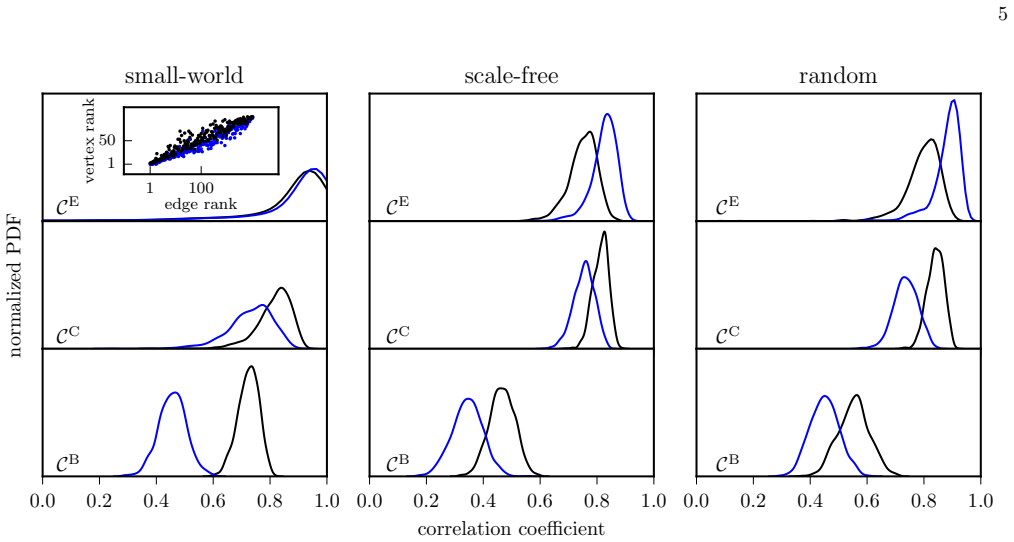
On its own terms, the paper's central discovery is that edge centralities defined through the edge adjacency matrix—two edges adjacent if they share a vertex—behave like vertex centralities in many respects but deliver information vertex rankings do not. In weighted small-world, scale-free, and random networks, the top-ranked edge is very often connected to a top-ranked vertex (up to 90% of scale-free realizations, depending on the measure), and edges ranked high by closeness or betweenness are disproportionately traversed by shortest paths; in scale-free networks they connect core or core-periphery vertices. Yet the three edge centralities identify the same top edge in only roughly 20–50% of weighted model networks, so the concept is not redundant. The edge-centrality-based web decomposition produces a bottom-up hierarchy of edge sets that are usually star-like, and in the epilepsy application the temporally stable edges and the rank-1 web point to interactions near and inside the seizure onset zone, in contrast to vertex centralities, which point outside it. This contrast is the strongest evidence the paper offers that edge-level importance is not a corollary of vertex-level importance.
Load-bearing premise
The load-bearing premise is that two edges sharing a vertex are at distance zero from each other in the path metric; if that convention is changed, edge closeness changes and the star-like webs—including the seizure-zone localization—may not survive.
Editorial extensions
If this is right
- If edge centralities capture importance that vertex centralities miss, then studies that rank only vertices—for example brain-network hub analyses—are missing a layer of structure that can point to the clinically relevant region.
- The web decomposition supplies a hierarchy of important edge sets, which is useful exactly when the single most important edge cannot be identified unambiguously.
- In evolving epileptic brain networks, the most important edge webs localize near and inside the seizure onset zone and in homologous contralateral regions, suggesting a network-based marker for seizure dynamics.
- Because the rank-1 web is typically star-like, the method connects edge importance to structures relevant to synchronization and percolation, giving dynamics studies a specific subgraph to analyze.
- The methods apply unchanged to binary and weighted networks of any topology; only the number and composition of webs depend on the centrality chosen.
Reading between the lines
- The zero-distance convention for adjacent edges is what makes edge closeness reward edges that share a vertex, so the star-like appearance of webs may be an artifact of the measure; testing with adjacent-edge distance set to 1 would separate metric artifacts from network structure.
- The epilepsy result rests on a single patient, and the paper does not compare the webs with chance-level surrogates; a multi-patient replication with surrogate networks would be needed before the finding can guide clinical practice.
- The web decomposition effectively treats communities as groupings of edges rather than vertices; this could yield a new definition of overlapping communities, since an edge belongs to exactly one web but a vertex can be incident to edges in many webs.
- Because the different edge centralities agree on the top edge in only a minority of model networks, any practical use should probably aggregate across centralities or validate the chosen measure against dynamics.
Signed reviews
Editorial analysis
A structured set of objections, weighed in public.
Referee Report
Summary. The paper proposes edge-level analogues of three standard vertex centralities—betweenness, closeness, and eigenvector centrality—and introduces an iterative 'web decomposition' that partitions the edge set into importance-ranked layers. The methods are tested on synthetic small-world, scale-free, and random networks, on Zachary's karate club, and on evolving functional brain networks of one epilepsy patient. The main reported findings are that important edges tend to connect important vertices, that edge centralities highlight topology-specific structures (including star-like webs), and that in the epilepsy case the most temporally stable important edges and the rank-1 web point to sites near or within the seizure onset zone.
Significance. If the proposed edge centralities and the web decomposition are well defined and reproducible, the paper offers a practical toolbox for edge-level network analysis, and the epilepsy application would be a clinically interesting illustration. The algorithmic decomposition into importance-ranked webs is a useful extension, and the synthetic experiments are systematic across model families and weight settings. However, the central definition of edge closeness is ambiguous or inconsistent as written, and the headline epilepsy conclusion rests on a single patient and on the unexamined zero-distance convention; with these unresolved, the significance of the reported findings is currently uncertain.
major comments (3)
- [Sec. II, Eq. (4), definition of d_ij] As written, the convention d_ij := 0 for adjacent edges makes the edge-closeness measure ill-defined. Under the usual additive shortest-path definition, any two edges connected by a chain of adjacent edges then have zero distance, so the denominator in Eq. (4) vanishes for every edge in a connected component. The paper nevertheless reports finite CC_e values, which means that some other computational convention must be used implicitly. Please state precisely how edge distances are computed, and explain the motivation for setting adjacent-edge pairs to zero. This is not a cosmetic point: all closeness-based results, including the web decomposition in Figs. 8, 10, and 13, depend on this choice.
- [Sec. IV.B, Fig. 13] The core application claim—that temporally stable edges and the rank-1 CC_e-based web point to the seizure onset zone—is supported by a single patient and by no inferential statistics or surrogate controls. With n=1, the apparent localization could reflect patient-specific electrode placement, the chosen centrality convention, or the zero-distance rule, rather than a property of seizure dynamics. The paper's caveat that the findings 'need to be validated on a larger database' addresses sample size but not this definitional dependency. Please add sensitivity analyses under alternative edge-distance conventions (for example, standard line-graph distance) and a degree/strength-preserving null-model comparison, or substantially soften the conclusion.
- [Sec. III.A, Fig. 2, Table II] The correlation analyses between edge ranks and vertex ranks are reported without significance tests, confidence intervals, or null models. Because the centrality definitions share construction principles, part of the observed relationship may be mechanical; for closeness, the zero-distance convention ties edge closeness directly to local degree and strength. A permutation test or a rewiring-based null model is needed before concluding that 'important edges indeed connect important vertices' in a nontrivial sense.
minor comments (4)
- [Sec. II, Eq. (2)] The sentence 'excluding the pairs with vertex k' is unclear for edge betweenness, since k is an edge; please specify which endpoint pairs are excluded.
- [Sec. II, decomposition algorithm] The threshold rule in step 3 uses the '<' sign for repeated eliminations within the same iteration, but the interplay between re-computation and tie handling is described only through the example; a short pseudo-code or flow chart would remove ambiguity.
- [Sec. III, network generation] The expression for the edge density appears to be missing a division sign; it should likely read epsilon = 2E / (V (V - 1)).
- [Sec. I, Introduction] The claim that there are 'only a few metrics' for edge importance would be strengthened by a brief comparison with existing edge-centrality measures beyond edge betweenness and bridgeness, especially since edge betweenness is a well-established concept.
Circularity Check
The epilepsy web-localization result is partly a restatement of the zero-distance convention used to define edge closeness centrality.
-
self definitional
[Sec. II (path-length definition and Eq. 4); Sec. III.D; Sec. IV.B (Fig. 13, lower panel)]
"For i and j being connected to a same vertex, we define dij := 0. ... In case of adjacent edges, i.e., edges connected by a single vertex, we again define dij := 0. ... CC_e(k) = E−1 / Σ_l dkl"
Setting d_kl=0 for any two edges that share a vertex makes Eq. (4)'s denominator count only non-adjacent edges, so CC_e increases with the number of edges incident to an edge's endpoints. The decomposition removes the lowest-CC_e edges first, so the final rank-1 web is forced to be a star-like set around high-degree/strength vertices. Consequently the paper's reported observation that the most important CC_e/CE_e webs are star-like (Sec. III.D) and the epilepsy claim that the CC_e-based W1 (Fig. 13, lower panel) points to the SOZ are consequences of the d_kl:=0 convention, not independent findings about network topology or seizure dynamics. The stated caveat 'these findings need to be validated on a larger database' addresses sample size, not this definitional dependency.
full rationale
The paper's core methodological development—edge eigenvector, closeness, and betweenness centralities plus the iterative web decomposition—is not circular in the formal sense: the centralities are standard vertex concepts adapted to edges, the decomposition is evaluated on 1000 synthetic small-world/scale-free/random networks and on Zachary's karate club, and no parameter is fitted to a target outcome and then renamed as a prediction. The self-citations (e.g., Refs. 10, 61, 66-70, 80) are used for established methods such as evolving functional networks, mean phase coherence, and the prior SOZ debate, and they are not load-bearing in a way that would force the paper's conclusions. However, one definitional choice is load-bearing for the headline application: setting the distance between adjacent edges to zero in the definition of path length (Sec. II) means Eq. (4)'s closeness centrality is dominated by the number of edges sharing endpoints, and the web decomposition therefore automatically returns star-like structures. The paper transparently notes the star-like character of most important webs (Sec. III.D) but then uses the CC_e-based W1 to conclude that temporally stable important edges point to the seizure onset zone (Sec. IV.B). That conclusion reduces, to a considerable degree, to 'edges incident to dense/high-strength local neighborhoods in the functional network are near the SOZ,' which is an artifact of d_ij:=0 rather than an independent validation of the SOZ's dynamical importance. The paper's own limitation statement only invokes sample size, not this definitional dependency. Overall circularity score 4: the central methodology is independent, but the strongest application-specific claim is substantially built into the measure's definition.
Assumptions & free parameters
assumptions (5)
- ad hoc to paper Distance between adjacent edges is set to zero in all shortest-path computations (Sec. II, definition of dij).
- domain assumption Edge centrality measures are valid proxies for importance of edges (Sec. II).
- domain assumption The network is undirected and either binary or weighted with positive weights; self-loops are excluded (Sec. II).
- ad hoc to paper Betweenness centrality on disconnected networks treats pairs with no path as contributing zero, although this is not stated (Sec. II, Eq. 2 and example in Table I).
- domain assumption The web decomposition's iterative thresholding at the minimum centrality yields a meaningful importance hierarchy (Sec. II, algorithm steps).
invented entities (1)
-
Web (edge-centrality-based decomposition layer)
Cite this review
Pith. "Pith review of Centrality-based identification of important edges in complex networks." pith.science (2026). https://pith.science/paper/RZXW2SXE
@misc{pith2026190810667,
  author       = {Pith},
  title        = {Pith review of: Centrality-based identification of important edges in complex networks},
  year         = {2026},
  howpublished = {\url{https://pith.science/paper/RZXW2SXE}},
  note         = {Machine review of arXiv:1908.10667}
}
read the original abstract
Centrality is one of the most fundamental metrics in network science. Despite an abundance of methods for measuring centrality of individual vertices, there are by now only a few metrics to measure centrality of individual edges. We modify various, widely used centrality concepts for vertices to those for edges, in order to find which edges in a network are important between other pairs of vertices. Focusing on the importance of edges, we propose an edge-centrality-based network decomposition technique to identify a hierarchy of sets of edges, where each set is associated with a different level of importance. We evaluate the efficiency of our methods using various paradigmatic network models and apply the novel concepts to identify important edges and important sets of edges in a commonly used benchmark model in social network analysis as well as in evolving epileptic brain networks.
Figures


Figures from the paper (10 more)


Reference graph
Works this paper leans on
-
[1]
author author S. Boccaletti , author V. Latora , author Y. Moreno , author M. Chavez , \ and\ author D.-U. \ Hwang ,\ title title Complex networks: Structure and dynamics , \ 10.1016/j.physrep.2005.10.009 journal journal Phys. Rep. \ volume 424 ,\ pages 175--308 ( year 2006 ) NoStop
-
[2]
author author A. Arenas , author A. D\'iaz-Guilera , author J. Kurths , author Y. Moreno , \ and\ author C. Zhou ,\ title title Synchronization in complex networks , \ 10.1016/j.physrep.2008.09.002 journal journal Phys. Rep. \ volume 469 ,\ pages 93--153 ( year 2008 ) NoStop
-
[3]
author author E. Bullmore \ and\ author O. Sporns ,\ title title Complex brain networks: graph theoretical analysis of structural and functional systems , \ 10.1038/nrn2575 journal journal Nat. Rev. Neurosci. \ volume 10 ,\ pages 186--198 ( year 2009 ) NoStop
-
[4]
author author J. F. \ Donges , author Y. Zou , author N. Marwan , \ and\ author J. Kurths ,\ title title The backbone of the climate network , \ 10.1209/0295-5075/87/48007 journal journal Europhys. Lett. \ volume 87 ,\ pages 48007 ( year 2009 ) NoStop
-
[5]
author author R. J. \ Allen \ and\ author T. C. \ Elston ,\ title title From physics to pharmacology? \ @noop journal journal Rep. Prog. Phys. \ volume 74 ,\ pages 016601 ( year 2011 ) NoStop
2011
-
[6]
Barth\'elemy ,\ title title Spatial networks , \ 10.1016/j.physrep.2010.11.002 journal journal Phys
author author M. Barth\'elemy ,\ title title Spatial networks , \ 10.1016/j.physrep.2010.11.002 journal journal Phys. Rep. \ volume 499 ,\ pages 1--101 ( year 2011 ) NoStop
-
[7]
author author A.-L. \ Barab\'asi , author N. Gulbahce , \ and\ author J. Loscalzo ,\ title title Network medicine: a network-based approach to human disease , \ 10.1038/nrg2918 journal journal Nat. Rev. Genet. \ volume 12 ,\ pages 56--68 ( year 2011 ) NoStop
-
[8]
author author M. E. J. \ Newman ,\ title title Communities, modules and large-scale structure in networks , \ 10.1038/NPHYS2162 journal journal Nat. Phys. \ volume 8 ,\ pages 25--31 ( year 2012 ) NoStop
Show all 81 references
-
[9]
Baronchelli , author R
author author A. Baronchelli , author R. F. \ i Cancho , author R. Pastor-Satorras , author N. Chater , \ and\ author M. H. \ Christiansen ,\ title title Networks in cognitive science , \ @noop journal journal Trends Cogn. Sci. \ volume 17 ,\ pages 348--360 ( year 2013 ) NoStop
2013
-
[10]
Lehnertz , author G
author author K. Lehnertz , author G. Ansmann , author S. Bialonski , author H. Dickten , author C. Geier , \ and\ author S. Porz ,\ title title Evolving networks in the human epileptic brain , \ 10.1016/j.physd.2013.06.009 journal journal Physica D \ volume 267 ,\ pages 7--15...
2013 doi
-
[11]
Heckmann , author W
author author T. Heckmann , author W. Schwanghart , \ and\ author J. D. \ Phillips ,\ title title Graph theory -- recent developments of its application in geomorphology , \ http://dx.doi.org/10.1016/j.geomorph.2014.12.024 journal journal Geomorphology \ volume 243 ,\ pages 13...
2014 doi
-
[12]
\ Gao , author M
author author Z.-K. \ Gao , author M. Small , \ and\ author J. Kurths ,\ title title Complex network analysis of time series , \ @noop journal journal EPL (Europhysics Letters) \ volume 116 ,\ pages 50001 ( year 2016 ) NoStop
2016
-
[13]
Holme \ and\ author J
author author P. Holme \ and\ author J. Saram\"aki ,\ title title Temporal networks , \ 10.1016/j.physrep.2012.03.001 journal journal Phys. Rep. \ volume 519 ,\ pages 97--125 ( year 2012 ) NoStop
2012 doi
-
[14]
Belykh , author M
author author I. Belykh , author M. di Bernardo , author J. Kurths , \ and\ author M. Porfiri ,\ title title Evolving dynamical networks , \ http://dx.doi.org/10.1016/j.physd.2013.10.008 journal journal Physica D \ volume 267 ,\ pages 1 -- 6 ( year 2014 ) NoStop
2013 doi
-
[15]
Kivel \"a , author A
author author M. Kivel \"a , author A. Arenas , author M. Barthelemy , author J. P. \ Gleeson , author Y. Moreno , \ and\ author M. A. \ Porter ,\ title title Multilayer networks , \ @noop journal journal J. Complex Netw. \ volume 2 ,\ pages 203--271 ( year 2014 ) NoStop
2014
-
[16]
Fortunato \ and\ author D
author author S. Fortunato \ and\ author D. Hric ,\ title title Community detection in networks: A user guide , \ http://dx.doi.org/10.1016/j.physrep.2016.09.002 journal journal Phys. Rep. \ volume 659 ,\ pages 1 -- 44 ( year 2016 ) NoStop
2016 doi
-
[17]
Alon ,\ title title Network motifs: theory and experimental approaches , \ @noop journal journal Nat
author author U. Alon ,\ title title Network motifs: theory and experimental approaches , \ @noop journal journal Nat. Rev. Gen. \ volume 8 ,\ pages 450--461 ( year 2007 ) NoStop
2007
-
[18]
Fornito , author A
author author A. Fornito , author A. Zalesky , \ and\ author M. Breakspear ,\ title title The connectomics of brain disorders , \ @noop journal journal Nat. Rev. Neurosci. \ volume 16 ,\ pages 159--172 ( year 2015 ) NoStop
2015
-
[19]
author author M. P. \ Rombach , author M. A. \ Porter , author J. H. \ Fowler , \ and\ author P. J. \ Mucha ,\ title title Core-periphery structure in networks , \ @noop journal journal SIAM J. Appl. Math. \ volume 74 ,\ pages 167--190 ( year 2014 ) NoStop
2014
-
[20]
L\"u , author D
author author L. L\"u , author D. Chen , author X.-L. \ Ren , author Q.-M. \ Zhang , author Y.-C. \ Zhang , \ and\ author T. Zho ,\ title title Vital nodes identification in complex networks , \ http://dx.doi.org/10.1016/j.physrep.2016.06.007 journal journal Phys. Rep. \ volum...
-
[21]
Havlin , author D
author author S. Havlin , author D. Y. \ Kenett , author A. Bashan , author J. Gao , \ and\ author H. E. \ Stanley ,\ title title Vulnerability of network of networks , \ @noop journal journal Eur. Phys. J. ST \ volume 223 ,\ pages 2087--2106 ( year 2014 ) NoStop
2014
-
[22]
Bialonski , author G
author author S. Bialonski , author G. Ansmann , \ and\ author H. Kantz ,\ title title Data-driven prediction and prevention of extreme events in a spatially extended excitable system , \ 10.1103/PhysRevE.92.042910 journal journal Phys. Rev. E \ volume 92 ,\ pages 042910 ( yea...
-
[23]
\ Liu \ and\ author A.-L
author author Y.-Y. \ Liu \ and\ author A.-L. \ Barab \'a si ,\ title title Control principles of complex systems , \ @noop journal journal Rev. Mod. Phys. \ volume 88 ,\ pages 035006 ( year 2016 ) NoStop
2016
-
[24]
author author A. J. \ Gates \ and\ author L. M. \ Rocha ,\ title title Control of complex networks requires both structure and dynamics , \ 10.1038/srep24456 journal journal Sci. Rep. \ volume 6 ,\ pages 24456 ( year 2016 ) NoStop
2016 doi
-
[25]
Lehnertz , author H
author author K. Lehnertz , author H. Dickten , author S. Porz , author C. Helmstaedter , \ and\ author C. E. \ Elger ,\ title title Predictability of uncontrollable multifocal seizures -- towards new treatment options , \ 10.1038/srep24584 journal journal Sci. Rep. \ volume 6...
-
[26]
\ Kuhnert , author C
author author M.-T. \ Kuhnert , author C. Geier , author C. E. \ Elger , \ and\ author K. Lehnertz ,\ title title Identifying important nodes in weighted functional brain networks: A comparison of different centrality approaches , \ 10.1063/1.4729185 journal journal Chaos \ vo...
-
[27]
Spitz \ and\ author E.-A
author author A. Spitz \ and\ author E.-A. \ Horv \'a t ,\ title title Measuring long-term impact based on network centrality: U nraveling cinematic citations , \ 10.1371/journal.pone.0108857 journal journal PLoS ONE \ volume 9 ,\ pages e108857 ( year 2014 ) NoStop
-
[28]
Almgren \ and\ author J
author author K. Almgren \ and\ author J. Lee ,\ title title An empirical comparison of influence measurements for social network analysis , \ 10.1007/s13278-016-0360-y journal journal Soc. Netw. Anal. Min. \ volume 6 ,\ pages 52 ( year 2016 ) NoStop
-
[29]
Geier \ and\ author K
author author C. Geier \ and\ author K. Lehnertz ,\ title title Long-term variability of importance of brain regions in evolving epileptic brain networks , \ 10.1063/1.4979796 journal journal Chaos \ volume 27 ,\ pages 043112 ( year 2017 a ) NoStop
-
[30]
author author M. S. \ Granovetter ,\ title title The strength of weak ties , \ 10.1086/225469 journal journal Am. J. Sociol. \ volume 78 ,\ pages 1360--1380 ( year 1973 ) NoStop
1973 doi
-
[31]
Girvan \ and\ author M
author author M. Girvan \ and\ author M. E. J. \ Newman ,\ title title Community structure in social and biological networks , \ 10.1073/pnas.122653799 journal journal Proc. Natl. Acad. Sci. U.S.A. \ volume 99 ,\ pages 7821--7826 ( year 2002 ) NoStop
-
[32]
\ Cheng , author F.-X
author author X.-Q. \ Cheng , author F.-X. \ Ren , author H.-W. \ Shen , author Z.-K. \ Zhang , \ and\ author T. Zhou ,\ title title Bridgeness: a local index on edge significance in maintaining global connectivity , \ @noop journal journal J. Stat. Mech. Theor. Exp. \ volume ...
2010
-
[33]
\ Slotine \ and\ author Y.-Y
author author J.-J. \ Slotine \ and\ author Y.-Y. \ Liu ,\ title title Complex networks: the missing link , \ @noop journal journal Nat. Phys. \ volume 8 ,\ pages 512--513 ( year 2012 ) NoStop
2012
-
[34]
Liao , author M
author author H. Liao , author M. S. \ Mariani , author M. Medo , author Y.-C. \ Zhang , \ and\ author M.-Y. \ Zhou ,\ title title Ranking in evolving complex networks , \ @noop journal journal Phys. Rep. \ volume 689 ,\ pages 1--54 ( year 2017 ) NoStop
2017
-
[35]
author author L. C. \ Freeman ,\ title title Centrality in social networks: Conceptual clarification , \ 10.1016/0378-8733(78)90021-7 journal journal Soc. Networks \ volume 1 ,\ pages 215--239 ( year 1979 ) NoStop
1979 doi
-
[36]
author author M. E. J. \ Newman ,\ title title Scientific collaboration networks. II . Shortest paths, weighted networks, and centrality , \ 10.1103/PhysRevE.64.016132 journal journal Phys. Rev. E \ volume 64 ,\ pages 016132 ( year 2001 ) NoStop
-
[37]
Barrat , author M
author author A. Barrat , author M. Barth\'elemy , author R. Pastor-Satorras , \ and\ author A. Vespignani ,\ title title The architecture of complex weighted networks , \ 10.1073/pnas.0400087101 journal journal Proc. Natl. Acad. Sci. U.S.A. \ volume 101 ,\ pages 3747--3752 ( ...
-
[38]
Wang , author J
author author H. Wang , author J. M. \ Hernandez , \ and\ author P. Van Mieghem ,\ title title Betweenness centrality in a weighted network , \ @noop journal journal Phys. Rev. E \ volume 77 ,\ pages 046105 ( year 2008 ) NoStop
2008
-
[39]
Opsahl , author F
author author T. Opsahl , author F. Agneessens , \ and\ author J. Skvoretz ,\ title title Node centrality in weighted networks: Generalizing degree and shortest paths , \ 10.1016/j.socnet.2010.03.006 journal journal Soc. Networks \ volume 32 ,\ pages 245--251 ( year 2010 ) NoStop
2010 doi
-
[40]
author author L. C. \ Freeman ,\ title title A set of measures of centrality based on betweenness , \ @noop journal journal Sociometry \ volume 40 ,\ pages 35--41 ( year 1977 ) NoStop
1977
-
[41]
Kitsak , author L
author author M. Kitsak , author L. K. \ Gallos , author S. Havlin , author F. Liljeros , author L. Muchnik , author H. E. \ Stanley , \ and\ author H. A. \ Makse ,\ title title Identification of influential spreaders in complex networks , \ @noop journal journal Nat. Phys. \ ...
2010
-
[42]
Garas , author F
author author A. Garas , author F. Schweitzer , \ and\ author S. Havlin ,\ title title A k -shell decomposition method for weighted networks , \ @noop journal journal New J. Phys. \ volume 14 ,\ pages 083030 ( year 2012 ) NoStop
2012
-
[43]
Eidsaa \ and\ author E
author author M. Eidsaa \ and\ author E. Almaas ,\ title title s -core network decomposition: A generalization of k -core analysis to weighted networks , \ 10.1103/PhysRevE.88.062819 journal journal Phys. Rev. E \ volume 88 ,\ pages 062819 ( year 2013 ) NoStop
-
[44]
Eidsaa \ and\ author E
author author M. Eidsaa \ and\ author E. Almaas ,\ title title Investigating the relationship between k-core and s-core network decompositions , \ @noop journal journal Physica A \ volume 449 ,\ pages 111--125 ( year 2016 ) NoStop
2016
-
[45]
Fortunato ,\ title title Community detection in graphs , \ 10.1016/j.physrep.2009.11.002 journal journal Phys
author author S. Fortunato ,\ title title Community detection in graphs , \ 10.1016/j.physrep.2009.11.002 journal journal Phys. Rep. \ volume 486 ,\ pages 75--174 ( year 2010 ) NoStop
2009 doi
-
[46]
author author D. J. \ Watts \ and\ author S. H. \ Strogatz ,\ title title Collective dynamics of `small-world' networks , \ 10.1038/30918 journal journal Nature \ volume 393 ,\ pages 440--442 ( year 1998 ) NoStop
1998 doi
-
[47]
Albert \ and\ author A.-L
author author R. Albert \ and\ author A.-L. \ Barab\'asi ,\ title title Statistical mechanics of complex networks , \ 10.1103/RevModPhys.74.47 journal journal Rev. Mod. Phys. \ volume 74 ,\ pages 47--97 ( year 2002 ) NoStop
2002 doi
-
[48]
Erd o s \ and\ author A
author author P. Erd o s \ and\ author A. R\'enyi ,\ title title On random graphs I , \ @noop journal journal Publ. Math. Debrecen \ volume 6 ,\ pages 290--297 ( year 1959 ) NoStop
1959
-
[49]
Batagelj \ and\ author U
author author V. Batagelj \ and\ author U. Brandes ,\ title title Efficient generation of large random networks , \ 10.1103/PhysRevE.71.036113 journal journal Phys. Rev. E \ volume 71 ,\ pages 036113 ( year 2005 ) NoStop
2005 doi
-
[50]
author author J. M. \ Bolland ,\ title title Sorting out centrality: A n analysis of the performance of four centrality models in real and simulated networks , \ 10.1016/0378-8733(88)90014-7 journal journal Soc. Networks \ volume 10 ,\ pages 233--253 ( year 1988 ) NoStop
-
[51]
Stephenson \ and\ author M
author author K. Stephenson \ and\ author M. Zelen ,\ title title Rethinking centrality: M ethods and examples , \ 10.1016/0378-8733(89)90016-6 journal journal Soc. Networks \ volume 11 ,\ pages 1 -- 37 ( year 1989 ) NoStop
1989 doi
-
[52]
Nakao ,\ title title Distribution of measures of centrality: enumerated distributions of F reeman's graph centrality measures
author author K. Nakao ,\ title title Distribution of measures of centrality: enumerated distributions of F reeman's graph centrality measures. \ @noop journal journal Connections \ volume 13 ,\ pages 10--22 ( year 1990 ) NoStop
1990
-
[53]
author author R. B. \ Rothenberg , author J. J. \ Potterat , author D. E. \ Woodhouse , author W. W. \ Darrow , author S. Q. \ Muth , \ and\ author A. S. \ Klovdahl ,\ title title Choosing a centrality measure: E pidemiologic correlates in the C olorado S prings study of socia...
-
[54]
author author S. P. \ Borgatti ,\ title title Centrality and network flow , \ @noop journal journal Soc. Networks \ volume 27 ,\ pages 55--71 ( year 2005 ) NoStop
2005
-
[55]
author author M. E. J. \ Newman ,\ title title A measure of betweenness centrality based on random walks , \ @noop journal journal Soc. Networks \ volume 27 ,\ pages 39--54 ( year 2005 ) NoStop
2005
-
[56]
Manimaran , author S
author author P. Manimaran , author S. R. \ Hegde , \ and\ author S. C. \ Mande ,\ title title Prediction of conditional gene essentiality through graph theoretical analysis of genome-wide functional linkages , \ 10.1039/B905264J journal journal Mol. BioSyst. \ volume 5 ,\ pag...
-
[57]
author author T. W. \ Valente , author K. Coronges , author C. Lakon , \ and\ author E. Costenbader ,\ title title How correlated are network centrality measures? \ @noop journal journal Connections \ volume 28 ,\ pages 16--26 ( year 2008 ) NoStop
2008
-
[58]
\ Nguyen , author M
author author T.-P. \ Nguyen , author M. Scotti , author M. J. \ Morine , \ and\ author C. Priam ,\ title title Model-based clustering reveals vitamin D dependent multi-centrality hubs in a network of vitamin-related proteins , \ @noop journal journal BMC Syst. Biol. \ volume ...
2011
-
[59]
Wang , author W
author author H. Wang , author W. Winterbach , \ and\ author P. van Mieghem ,\ title title Assortativity of complementary graphs , \ 10.1140/epjb/e2011-20118-x journal journal Eur. Phys. J. B \ volume 83 ,\ pages 203--214 ( year 2011 ) NoStop
-
[60]
author author W. W. \ Zachary ,\ title title An information flow model for conflict and fission in small groups , \ @noop journal journal J. Anthropol. Res. \ volume 33 ,\ pages 452--473 ( year 1977 ) NoStop
1977
-
[61]
Geier , author S
author author C. Geier , author S. Bialonski , author C. E. \ Elger , \ and\ author K. Lehnertz ,\ title title How important is the seizure onset zone for seizure dynamics? \ 10.1016/j.seizure.2014.10.013 journal journal Seizure \ volume 25 ,\ pages 160--166 ( year 2015 ) NoStop
2014 doi
-
[62]
author author M. G. \ Everett \ and\ author S. P. \ Borgatti ,\ title title Analyzing clique overlap , \ @noop journal journal Connections \ volume 21 ,\ pages 49--61 ( year 1998 ) NoStop
1998
-
[63]
Batool \ and\ author M
author author K. Batool \ and\ author M. A. \ Niazi ,\ title title Towards a methodology for validation of centrality measures in complex networks , \ @noop journal journal PLoS ONE \ volume 9 ,\ pages e90283 ( year 2014 ) NoStop
2014
-
[64]
Qi , author E
author author X. Qi , author E. Fuller , author R. Luo , \ and\ author C.-Q. \ Zhang ,\ title title A novel centrality method for weighted networks based on the K irchhoff polynomial , \ https://doi.org/10.1016/j.patrec.2015.02.007 journal journal Pattern Recognit. Lett. \ vol...
2015 doi
-
[65]
Qiao , author W
author author T. Qiao , author W. Shan , \ and\ author C. Zhou ,\ title title How to identify the most powerful node in complex networks? A novel entropy centrality approach , \ @noop journal journal Entropy \ volume 19 ,\ pages 614 ( year 2017 ) NoStop
2017
-
[66]
Schindler , author H
author author K. Schindler , author H. Leung , author C. E. \ Elger , \ and\ author K. Lehnertz ,\ title title Assessing seizure dynamics by analysing the correlation structure of multichannel intracranial EEG , \ 10.1093/brain/awl304 journal journal Brain \ volume 130 ,\ page...
-
[67]
Schindler , author S
author author K. Schindler , author S. Bialonski , author M.-T. \ Horstmann , author C. E. \ Elger , \ and\ author K. Lehnertz ,\ title title Evolving functional network properties and synchronizability during human epileptic seizures , \ 10.1063/1.2966112 journal journal Chao...
-
[68]
Bialonski , author M
author author S. Bialonski , author M. Wendler , \ and\ author K. Lehnertz ,\ title title Unraveling spurious properties of interaction networks with tailored random networks , \ 10.1371/journal.pone.0022826 journal journal PLoS ONE \ volume 6 ,\ pages e22826 ( year 2011 ) NoStop
-
[69]
Geier \ and\ author K
author author C. Geier \ and\ author K. Lehnertz ,\ title title Which brain regions are important for seizure dynamics in epileptic networks? I nfluence of link identification and EEG recording montage on node centralities , \ @noop journal journal Int. J. Neural Syst. \ volum...
2017
-
[70]
Stahn \ and\ author K
author author K. Stahn \ and\ author K. Lehnertz ,\ title title Surrogate-assisted identification of influences of network construction on evolving weighted functional networks , \ 10.1063/1.4996980 journal journal Chaos \ volume 27 ,\ pages 123106 ( year 2017 ) NoStop
-
[71]
author author H. P. \ Zaveri , author S. M. \ Pincus , author I. I. \ Goncharova , author R. B. \ Duckrow , author D. D. \ Spencer , \ and\ author S. S. \ Spencer ,\ title title Localization-related epilepsy exhibits significant connectivity away from the seizure-onset area , ...
2009
-
[72]
Warren , author S
author author C. Warren , author S. Hu , author M. Stead , author B. H. \ Brinkmann , author M. R. \ Bower , \ and\ author G. A. \ Worrell ,\ title title Synchrony in normal and focal epileptic brain: T he seizure onset zone is functionally disconnected , \ @noop journal journ...
2010
-
[73]
Wilke , author G
author author C. Wilke , author G. Worrell , \ and\ author B. He ,\ title title Graph analysis of epileptogenic networks in human partial epilepsy , \ 10.1111/j.1528-1167.2010.02785.x journal journal Epilepsia \ volume 52 ,\ pages 84--93 ( year 2011 ) NoStop
2010
-
[74]
Varotto , author L
author author G. Varotto , author L. Tassi , author S. Franceschetti , author R. Spreafico , \ and\ author F. Panzica ,\ title title Epileptogenic networks of type II focal cortical dysplasia: A stereo- EEG study , \ 10.1016/j.neuroimage.2012.03.090 journal journal NeuroImage ...
-
[75]
Zubler , author H
author author F. Zubler , author H. Gast , author E. Abela , author C. Rummel , author M. Hauf , author R. Wiest , author C. Pollo , \ and\ author K. Schindler ,\ title title Detecting functional hubs of ictogenic networks , \ 10.1007/s10548-014-0370-x journal journal Brain To...
-
[76]
Goodfellow , author C
author author M. Goodfellow , author C. Rummel , author E. Abela , author M. P. \ Richardson , author K. Schindler , \ and\ author J. R. \ Terry ,\ title title Estimation of brain network ictogenicity predicts outcome from epilepsy surgery , \ 10.1038/srep29215 journal journal...
-
[77]
author author A. N. \ Khambhati , author K. A. \ Davis , author T. H. \ Lucas , author B. Litt , \ and\ author D. S. \ Bassett ,\ title title Virtual cortical resection reveals push-pull network control preceding seizure evolution , \ @noop journal journal Neuron \ volume 91 ,...
2016
-
[78]
\ Li , author X.-L
author author Y.-H. \ Li , author X.-L. \ Ye , author Q.-Q. \ Liu , author J.-W. \ Mao , author P.-J. \ Liang , author J.-W. \ Xu , \ and\ author P.-M. \ Zhang ,\ title title Localization of epileptogenic zone based on graph analysis of stereo- EEG , \ @noop journal journal Ep...
2016
-
[79]
Sanz-Garcia , author T
author author A. Sanz-Garcia , author T. Rings , \ and\ author K. Lehnertz ,\ title title Impact of type of intracranial EEG sensors on link strengths of evolving functional brain networks , \ 10.1088/1361-6579/aace94 journal journal Physiol. Meas. \ volume 39 ,\ pages 074003 ...
-
[80]
Mormann , author K
author author F. Mormann , author K. Lehnertz , author P. David , \ and\ author C. E. \ Elger ,\ title title Mean phase coherence as a measure for phase synchronization and its application to the EEG of epilepsy patients , \ 10.1016/S0167-2789(00)00087-7 journal journal Physic...
-
[81]
Boccaletti , author J
author author S. Boccaletti , author J. Almendral , author S. Guan , author I. Leyva , author Z. Liu , author I. Sendi \ n a-Nadal , author Z. Wang , \ and\ author Y. Zou ,\ title title Explosive transitions in complex networks' structure and dynamics: Percolation and synchron...
2016
Reviewed August 14, 2026 · model on record in the stance chip above.
Discussion (0). Continue with ORCID to comment.