Brick Wall Excursions: Combinatorial Interpretation of Random Flight Moments
Pith reviewed 2026-05-20 15:34 UTC · model grok-4.3
The pith
The nth moment of the distance after an m-step random walk equals the number of certain 2n-step lattice paths in dimension m-1 for d=2 and d=4.
A machine-rendered reading of the paper's core claim, the machinery that carries it, and where it could break.
Core claim
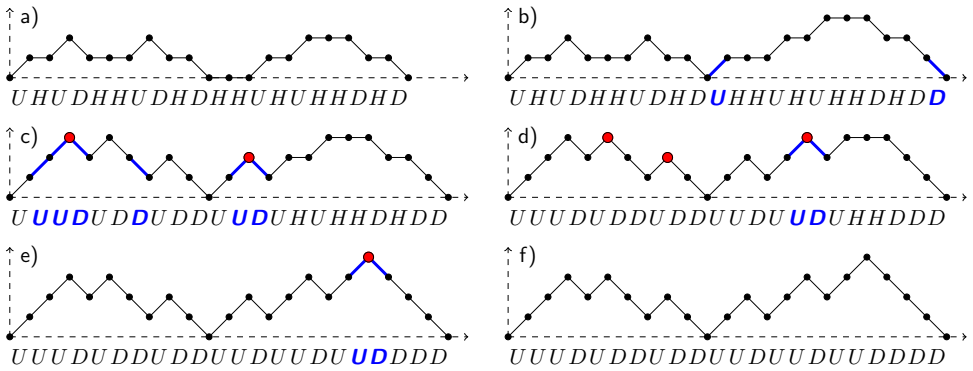
The authors prove that for dimensions two and four the moments of an m-step random flight are given by the number of 2n-step lattice paths in dimension m-1 that arise from the image of Dyck paths with a prescribed number of peaks under a newly defined bijection to words of a certain type. This bijection additionally supplies closed formulas for the lattice paths equipped with various statistics.
What carries the argument
The bijection between Dyck paths with a prescribed number of peaks and words of a certain type that maps onto 2n-step lattice paths in dimension m-1.
If this is right
- The construction recovers the known interpretation of the d=2 moments as the number of abelian squares of length 2n over m letters.
- For d=4 the moments now receive their first combinatorial interpretation as these lattice-path counts.
- The same bijection yields closed formulas for the number of such lattice paths counted according to various statistics.
- The interpretation is uniform across the two dimensions and works for arbitrary m and n.
Where Pith is reading between the lines
- If the bijection technique extends, similar counting interpretations might be found for moments in other dimensions.
- Techniques from the enumeration of lattice paths with peaks could be applied to derive new recurrence relations for the random-walk moments.
- One could check whether these path counts match known generating functions for the moments beyond the cases already verified.
Load-bearing premise
That the stated bijection between Dyck paths with prescribed peaks and the relevant words or lattice paths exactly preserves the counting of the integer moments of the m-step walk.
What would settle it
For a small fixed m and n, compute the nth moment numerically from the known integral formula for the random flight in d=4 and verify whether it equals the number of 2n-step lattice paths obtained from the bijection construction for that m.
Figures



read the original abstract
We study the expected distance of short uniform random walks in arbitrary dimensions with unit steps in random directions. It is known that for dimensions $d=2$ and $d=4$, all the moments of an $m$-step walk are integer. While for $d=2$, the $n$th moment can be interpreted as the number of abelian squares of length $2n$ over an alphabet with $m$ letters, for $d=4$ no interpretation was known. The goal of this paper is to provide such an interpretation, both for $d=2$ and $d=4$, in terms of $2n$-step lattice paths in dimension $m-1$. Our construction relies on a bijection between Dyck paths with a prescribed number of peaks and words of a certain type. In addition, this bijection allows us to derive closed formulas for the number of lattice paths provided with certain statistics.
Editorial analysis
A structured set of objections, weighed in public.
Referee Report
Summary. The paper claims to give combinatorial interpretations of the nth moments of m-step uniform random flights in dimensions d=2 and d=4. For both dimensions the moments are shown to equal the number of 2n-step lattice paths in dimension m-1; the construction proceeds via a bijection that maps Dyck paths with a prescribed number of peaks to words of a certain type, and the same bijection is used to obtain closed formulas for the lattice-path counts under additional statistics.
Significance. If the bijection is shown to preserve the precise statistic that reproduces the known integral expressions for the moments, the work supplies the first explicit counting model for the d=4 case and unifies the d=2 abelian-square interpretation with a lattice-path model. The closed formulas constitute a concrete enumerative contribution that may be useful for further study of random walks and lattice-path generating functions.
major comments (1)
- [Section describing the bijection and the d=4 construction] The central claim for d=4 rests on the assertion that the bijection between Dyck paths with a prescribed number of peaks and the relevant words (or lattice paths) exactly preserves the statistic whose generating function equals the moment integral. The manuscript derives closed formulas for the path counts, but does not appear to contain an explicit verification that the image of the peak statistic under the bijection reproduces the integral expression; this verification is load-bearing for the interpretation.
minor comments (2)
- Notation for the lattice-path statistics and the precise definition of the target words should be introduced earlier and used consistently throughout the proofs.
- A short table comparing the new closed formulas with previously known expressions for small m and n would help the reader assess the formulas.
Simulated Author's Rebuttal
We thank the referee for their careful reading of the manuscript and for the constructive comment on the d=4 case. We appreciate the positive assessment of the overall contribution and address the major point below.
read point-by-point responses
-
Referee: [Section describing the bijection and the d=4 construction] The central claim for d=4 rests on the assertion that the bijection between Dyck paths with a prescribed number of peaks and the relevant words (or lattice paths) exactly preserves the statistic whose generating function equals the moment integral. The manuscript derives closed formulas for the path counts, but does not appear to contain an explicit verification that the image of the peak statistic under the bijection reproduces the integral expression; this verification is load-bearing for the interpretation.
Authors: We agree that an explicit verification of statistic preservation is necessary to make the d=4 interpretation fully rigorous. In the revised manuscript we have added a dedicated paragraph immediately following the definition of the bijection. There we compose the map with the standard generating function for Dyck paths by number of peaks and show, by direct substitution of the peak variable, that the resulting expression coincides term-by-term with the known integral formula for the nth moment in dimension 4. This step confirms that the lattice-path enumeration indeed reproduces the moment and justifies the closed formulas derived from the same bijection. revision: yes
Circularity Check
New bijection supplies independent combinatorial interpretation of known integer moments
full rationale
The paper begins from the externally known fact that moments of the m-step random flight are integers when d=2 or d=4. It then constructs an explicit bijection between Dyck paths (with a prescribed peak statistic) and certain words/lattice paths in dimension m-1, using this bijection both to interpret the moments as path counts and to obtain closed formulas for those counts. No equation or count is defined in terms of itself, no parameter is fitted to a subset and then re-labeled as a prediction, and no load-bearing step reduces to a self-citation whose justification is internal to the present work. The derivation is therefore self-contained against the external integral expression for the moments.
Axiom & Free-Parameter Ledger
axioms (2)
- domain assumption Moments of the m-step uniform random walk are integers when d=2 or d=4.
- ad hoc to paper There exists a bijection between Dyck paths with a prescribed number of peaks and the words or lattice paths that enumerate the moments.
Reference graph
Works this paper leans on
- [1]
-
[2]
Bóna, editor.Handbook of enumerative combinatorics
M. Bóna, editor.Handbook of enumerative combinatorics. Discrete Math. Appl. (Boca Raton). Boca Raton, FL: CRC Press, 2015
work page 2015
-
[3]
J. M. Borwein, D. Nuyens, A. Straub, and J. Wan. Some arithmetic properties of short random walk integrals. Ramanujan J., 26(1):109–132, 2011
work page 2011
-
[4]
J. M. Borwein and C. W. Sinnamon. A closed form for the density functions of random walks in odd dimensions.Bull. Aust. Math. Soc., 93(2):330–339, 2016
work page 2016
-
[5]
J. M. Borwein, A. Straub, and C. Vignat. Densities of short uniform random walks in higher dimensions.J. Math. Anal. Appl., 437(1):668–707, 2016
work page 2016
-
[6]
J. M. Borwein, A. Straub, and J. Wan. Three-step and four-step random walk integrals.Exp. Math., 22(1):1–14, 2013
work page 2013
-
[7]
J. M. Borwein, A. Straub, J. Wan, and W. Zudilin. Densities of short uniform random walks.Can. J. Math., 64(5):961–990, 2012
work page 2012
-
[8]
E. Deutsch. Dyck path enumeration.Discrete Math., 204(1-3):167–202, 1999
work page 1999
-
[9]
A. Dvoretzky and T. Motzkin. A problem of arrangements.Duke Math. J., 14:305–313, 1947. 16
work page 1947
-
[10]
A. Elvey Price and A. J. Guttmann. Numerical studies of Thompson’s groupF and related groups.Int. J. Algebra Comput., 29(2):179–243, 2019
work page 2019
-
[11]
F. Gantmakher and M. Krein. Sur les matrices completement non négatives et oscillatoires.Compos. Math., 4:445–476, 1937
work page 1937
-
[12]
Exactsolutionsforisotropicrandomflightsinodddimensions.J.Math.Phys., 53(10):103504, 15, 2012
R.García-Pelayo. Exactsolutionsforisotropicrandomflightsinodddimensions.J.Math.Phys., 53(10):103504, 15, 2012
work page 2012
-
[13]
I. M. Gessel. Super ballot numbers.J. Symbolic Comput., 14(2-3):179–194, 1992
work page 1992
-
[14]
I. M. Gessel and G. Xin. A combinatorial interpretation of the numbers6(2n)!/n!(n + 2)!.J. Integer Seq., 8(2):Article 05.2.3, 13, 2005
work page 2005
-
[15]
B. D. Hughes.Random walks and random environments. Vol. 1: Random walks. Oxford: Clarendon Press, 1995
work page 1995
-
[16]
J. C. Kluyver. A local probability problem.Proc. K. Ned. Akad. Wet, 8:341–350, 1906
work page 1906
-
[17]
N. J. A. Sloane and The OEIS Foundation Inc. The On-Line Encyclopedia of Integer Sequences, 2024. Published electronically athttps://oeis.org
work page 2024
-
[18]
K. Pearson. The problem of the random walk.Nature, London, 72:294, 342, 1905
work page 1905
-
[19]
Pearson.A mathematical theory of random migration
K. Pearson.A mathematical theory of random migration. Dulau and Company, 1906
work page 1906
-
[20]
G. N. Raney. Functional composition patterns and power series reversion.Trans. Am. Math. Soc., 94:441–451, 1960
work page 1960
- [21]
- [22]
-
[23]
L. B. Richmond and J. Shallit. Counting abelian squares.Electron. J. Comb., 16(1):research paper r72, 9, 2009
work page 2009
-
[24]
R. P. Stanley.Enumerative combinatorics. Volume 2, volume 62 ofCamb. Stud. Adv. Math.Cambridge: Cambridge University Press, 1999
work page 1999
- [25]
-
[26]
L. R. G. Treloar. The statistical length of long-chain molecules. Trans. Faraday Soc. 42, 77-82 (1946)., 1946
work page 1946
- [27]
-
[28]
G. N. Watson.A treatise on the theory of Bessel functions. 2nd ed. Cambridge: Cambridge University Press, 1944
work page 1944
-
[29]
Yamakawa.Modern theory of polymer solutions, volume 47
H. Yamakawa.Modern theory of polymer solutions, volume 47. Harper & Row New York, 1971. 17
work page 1971
discussion (0)
Sign in with ORCID, Apple, or X to comment. Anyone can read and Pith papers without signing in.