Existence of Minimal Homotopies for Immersed Planar Curves
Pith reviewed 2026-06-29 00:07 UTC · model grok-4.3
The pith
Lifting immersed planar curves to higher codimension yields area-minimizing null homotopies via Douglas minimizers.
A machine-rendered reading of the paper's core claim, the machinery that carries it, and where it could break.
Core claim
For closed curves of class C^1, uniform convergence of the Douglas minimizers is proved and the limiting map minimizes area among all C^1 spanning maps of the original planar curve. The construction extends to closed Lipschitz curves using approximation and Sobolev compactness arguments. Since the limiting minimizing disk lies in the original plane, it directly produces a null homotopy whose swept area is minimal among all admissible homotopies of the original curve.
What carries the argument
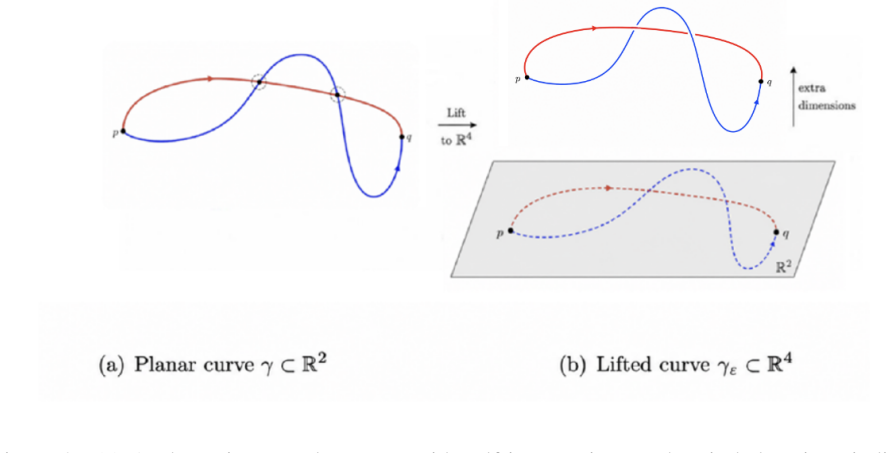
Lifting the immersed planar curve to higher codimension to obtain an embedded curve, followed by application of Douglas's solution of the Plateau problem.
If this is right
- For C^1 curves the limiting map minimizes area among all C^1 spanning maps.
- The construction extends to Lipschitz curves by approximation and Sobolev compactness.
- The minimal disk lies in the plane and therefore supplies a null homotopy of minimal swept area.
- The variational construction connects Plateau theory to minimal homotopy area without using combinatorial decomposition of self-intersections.
Where Pith is reading between the lines
- The same lifting argument may apply to curves of lower regularity, such as continuous or rectifiable curves.
- Numerical approximation of Douglas minimizers on lifted curves could produce concrete minimal homotopies for given immersions.
- The method suggests that minimal homotopy area can be computed variationally even when self-intersections fail to be transverse.
- The construction may interact with other planar invariants such as total curvature or algebraic area.
Load-bearing premise
The area-minimizing disk for the lifted embedded curve converges to a surface that remains inside the original plane.
What would settle it
An explicit immersed C^1 curve whose lifted Douglas minimizer converges to a surface whose area is strictly larger than the infimum of areas of all admissible null homotopies of the original curve.
Figures
read the original abstract
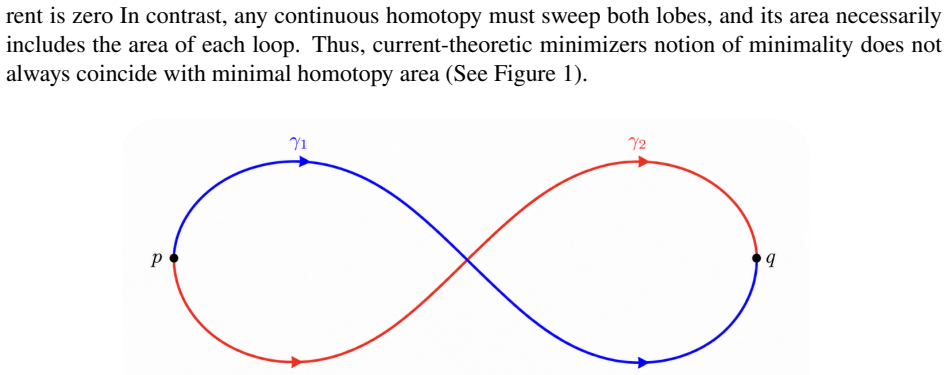
We study the existence of area-minimizing homotopies between homotopic curves in the plane. While the classical Plateau problem establishes the existence of least-area surfaces spanning a single Jordan curve, the corresponding existence theory for homotopies between curves is more subtle and is not directly covered by the same framework. Existing results in the plane are mainly based on combinatorial and algebraic methods, such as decomposing curves into self-overlapping subcurves. These methods are highly effective in the planar setting, but they are often tied to special classes of curves and rely strongly on the local structure of the self-intersections, frequently assuming transverse crossings. In contrast, our approach is geometric and variational, and does not depend on the local structure of the self-intersections. In this paper, we develop a variational existence theory for minimum-area homotopies of immersed planar curves. Our approach adapts classical minimal surface methods by lifting an immersed planar curve with self-intersections into higher co-dimension, where it becomes embedded. For such a lifted curve, we apply Douglas's solution of the Plateau problem to obtain an area-minimizing disk. For closed curves of class $C^1$, we prove uniform convergence of the Douglas minimizers and show that the limiting map minimizes area among all $C^1$ spanning maps of the original planar curve. We then extend the construction to closed Lipschitz curves using approximation and Sobolev compactness arguments. Since the limiting minimizing disk lies in the original plane, it directly produces a null homotopy whose swept area is minimal among all admissible homotopies of the original curve. In this way, the construction connects Plateau theory with minimal homotopy area minimization.
Editorial analysis
A structured set of objections, weighed in public.
Referee Report
Summary. The paper develops a variational approach to area-minimizing null homotopies for immersed closed planar curves. It lifts an immersed curve to an embedded curve in higher codimension, applies Douglas's solution of the Plateau problem to obtain an area-minimizing disk, proves uniform convergence of these minimizers for C^1 curves (showing the limit minimizes area among C^1 spanning maps), and extends the result to Lipschitz curves via approximation and Sobolev compactness. The abstract asserts that the limiting disk lies in the original plane and therefore yields a minimal-area null homotopy for the original immersed curve.
Significance. If the central claim is established, the work supplies a geometric variational existence theory for minimal homotopies that is independent of the local structure of self-intersections and connects classical Plateau theory directly to the problem of minimal swept area. The lifting construction and the use of Douglas's theorem plus compactness arguments constitute a coherent strategy that could apply more broadly than combinatorial decompositions.
major comments (1)
- [Abstract (final paragraph)] Abstract (final paragraph) and the convergence argument for C^1 curves: the claim that 'the limiting minimizing disk lies in the original plane' is load-bearing for the conclusion that the construction produces a valid null homotopy of the immersed planar curve. Uniform convergence of the Douglas minimizers and the subsequent Sobolev-compactness argument for the Lipschitz case do not automatically force the extra-dimensional coordinates to vanish; an additional justification (e.g., a projection step, uniqueness of the minimizer, or maximum principle) is required to exclude limits that remain outside the plane. Without this step the central existence statement does not follow from the preceding analysis.
minor comments (1)
- [Abstract] The abstract refers to 'all admissible homotopies' without an explicit definition of the admissible class (e.g., whether maps are required to be C^1, Lipschitz, or merely continuous on the boundary); this should be stated once in the introduction for clarity.
Simulated Author's Rebuttal
We thank the referee for the careful reading and for identifying the need for an explicit justification that the limiting disk lies in the original plane. We address this point below and will revise the manuscript to incorporate the missing step.
read point-by-point responses
-
Referee: [Abstract (final paragraph)] Abstract (final paragraph) and the convergence argument for C^1 curves: the claim that 'the limiting minimizing disk lies in the original plane' is load-bearing for the conclusion that the construction produces a valid null homotopy of the immersed planar curve. Uniform convergence of the Douglas minimizers and the subsequent Sobolev-compactness argument for the Lipschitz case do not automatically force the extra-dimensional coordinates to vanish; an additional justification (e.g., a projection step, uniqueness of the minimizer, or maximum principle) is required to exclude limits that remain outside the plane. Without this step the central existence statement does not follow from the preceding analysis.
Authors: We agree that an explicit argument is required. In the revised manuscript we will insert a dedicated paragraph after the uniform-convergence statement for C^1 curves. Each coordinate function of a Douglas minimizer is harmonic. Because the boundary values of the extra-dimensional coordinates converge uniformly to zero, the maximum principle for harmonic functions forces these coordinates to vanish identically on the disk; the same conclusion passes to the Sobolev limit in the Lipschitz case. This supplies the missing justification that the limiting disk lies in the original plane and therefore yields a null homotopy of the immersed curve. revision: yes
Circularity Check
No circularity; derivation applies classical Douglas theorem plus compactness to lifted curves without self-referential reduction.
full rationale
The paper adapts the external Douglas solution of the Plateau problem to a lifted embedded curve in higher codimension, then invokes uniform convergence for C^1 curves and Sobolev compactness for Lipschitz curves to obtain a limiting disk. The abstract states that this disk lies in the original plane and thereby yields a minimal null homotopy, but no equation or step is shown to be equivalent to its own inputs by construction, nor does any load-bearing premise reduce to a self-citation chain or fitted parameter renamed as prediction. The argument rests on standard variational methods and approximation, which are independent of the target result. No self-definitional, fitted-input, or ansatz-smuggling patterns appear in the provided text.
Axiom & Free-Parameter Ledger
axioms (2)
- standard math Douglas's solution of the Plateau problem yields an area-minimizing disk for an embedded curve in higher codimension
- domain assumption Uniform convergence and Sobolev compactness arguments preserve minimality when passing to the limit in the plane
Reference graph
Works this paper leans on
-
[1]
Extending Immersions and Regular Homotopies in Codimension 1
Samuel Blank. “Extending Immersions and Regular Homotopies in Codimension 1”. PhD thesis. University of Michigan, 1967
1967
-
[2]
Measuring similarity between curves on 2-manifolds via homotopy area
Erin Wolf Chambers and Yusu Wang. “Measuring similarity between curves on 2-manifolds via homotopy area”. In:Proceedings of the twenty-ninth annual symposium on Computa- tional geometry(2013), pp. 425–434
2013
-
[3]
From Curves to Words and Back Again: Geometric Computation of Minimum-Area Homotopy
Hsien-Chih Chang, Brittany Terese Fasy, Bradley McCoy, David L Millman, and Carola Wenk. “From Curves to Words and Back Again: Geometric Computation of Minimum-Area Homotopy”. In:Algorithms and Data Structures (WADS 2023). Springer. 2023, pp. 605–619
2023
-
[4]
Solution of the problem of Plateau
Jesse Douglas. “Solution of the problem of Plateau”. In:Transactions of the American Mathematical Society33.1 (1931), pp. 263–321
1931
-
[5]
Evans.Partial differential equations
Lawrence C. Evans.Partial differential equations. Vol. 19. American mathematical society, 2022
2022
-
[6]
Combinatorial properties of self-overlapping curves and interior boundaries
Parker Evans and Carola Wenk. “Combinatorial properties of self-overlapping curves and interior boundaries”. In:Discrete & Computational Geometry69.1 (2023), pp. 91–122
2023
-
[7]
On Minimum Area Homotopies of Normal Curves in the Plane
Brittany Terese Fasy, Selcuk Karakoc, and Carola Wenk. “On minimum area homotopies of normal curves in the plane”. In:arXiv preprint arXiv:1707.02251(2017)
work page internal anchor Pith review Pith/arXiv arXiv 2017
-
[8]
Die Grundlehren der mathematischen Wis- senschaften, Band 153
Herbert Federer.Geometric Measure Theory. Die Grundlehren der mathematischen Wis- senschaften, Band 153. New York: Springer-Verlag, 1969.isbn: 978-3540606567
1969
-
[9]
Trudinger.Elliptic partial differential equations of second order
David Gilbarg and Neil S. Trudinger.Elliptic partial differential equations of second order. Vol. 224. 2. Springer, 1977
1977
-
[10]
Heinonen, P
J. Heinonen, P. Koskela, N. Shanmugalingam, and J. T. Tyson.Sobolev Spaces on Met- ric Measure Spaces: An Approach Based on Upper Gradients. New Math. Monogr. 27, Cambridge Univ. Press, 2015
2015
-
[11]
On the Minimum Area of Null Homotopies of Curves Traced Twice
Zipei Nie. “On the minimum area of null homotopies of curves traced twice”. In:arXiv preprint arXiv:1412.0101(2014)
work page internal anchor Pith review Pith/arXiv arXiv 2014
-
[12]
Plateau’s Problem: the Douglas-Rad ´o Theorem
A. Pegoraro. “Plateau’s Problem: the Douglas-Rad ´o Theorem”. In:Bachelor’s thesis, Uni- versit`a degli Studi di Padova(2025)
2025
-
[13]
On Plateau’s problem
Tibor Rad ´o. “On Plateau’s problem”. In:Annals of Mathematics31.3 (1930), pp. 457–469. 19
1930
-
[14]
Walter Rudin.Principles of mathematical analysis. 3rd ed. McGraw-Hill, 1976
1976
-
[15]
Existence of least-area mappings of N-dimensional domains
Brian White. “Existence of least-area mappings of N-dimensional domains”. In:Annals of Mathematics118.1 (1983), pp. 179–185. 20
1983
discussion (0)
Sign in with ORCID, Apple, or X to comment. Anyone can read and Pith papers without signing in.