REVIEW 3 major objections 5 minor 18 references
An Extension of Discrete Lagrangian Descriptors for Unbounded Maps
T0 review · 3 major / 5 minor · reviewed 2026-08-14 · deepseek-v4-flash
Pith's one-line read By truncating each orbit's descriptor sum at the moment it exits a fixed interaction region, this paper extends Discrete Lagrangian Descriptors to unbounded maps and shows the truncated field still carries stable and unstable manifolds…
desk verdict A useful, clearly written practical extension of DLDs to unbounded maps, but the central claim that a large interaction region transfers the manifold-detection theorems is asserted, not proved, and the numerics are illustrative rather than validating. read the letter →
The pith
A machine-rendered reading of the paper's core claim, the machinery that carries it, and where it could break.
The reading
What carries the argument
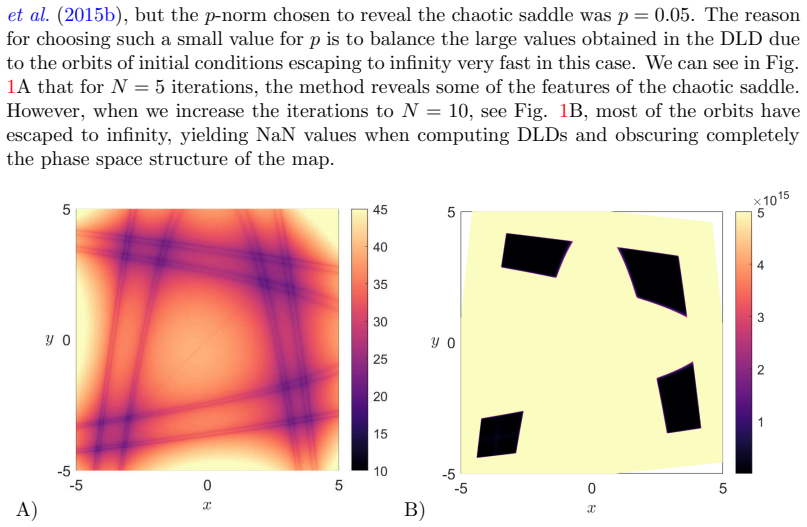
The load-bearing mechanism is the stopping-time rule $N^\pm_{x_0}=\max_{k=1,\dots,N}\{k\mid f^{\pm k}(x_0)\in R\}$, which truncates the $\ell^p$-arclength sum (with $0<p\le 1$) at the last iterate inside a fixed interaction region $R$, here a circle of radius $r=100$. The rule turns escape into a legitimate end-of-sum signal and therefore prevents the NaN and overflow contamination produced by fixed-iteration descriptors on unbounded maps; it also makes the transit-time count $T_{x_0}=N^+_{x_0}+N^-_{x_0}$ available at no extra cost. The formal justification is transfer from the original descriptor: for large $R$ the new sum is expected to approach Eq. (3), so the previously proved singular-feature theorem is invoked for the variable-iteration version.
What would settle it
On the Hénon map with $A=9.5$, $B=-1$, recompute $D_p$ with the same grid and $N=10$, $p=0.05$, for interaction radii $r=50$, $r=100$, and $r=200$; if the singular-feature curves extracted from $\|\nabla D_p\|$ drift or disappear as $r$ grows, the large-region approximation is not working. A more direct check is to compare $D_p(x_0,N)$ with the fixed-iteration sum for an orbit whose escape happens exactly at iteration $k$: if the boundary-crossing jump is comparable to the retained sum, the transfer of the theorem lacks uniformity.
Extended reading notes
Core claim
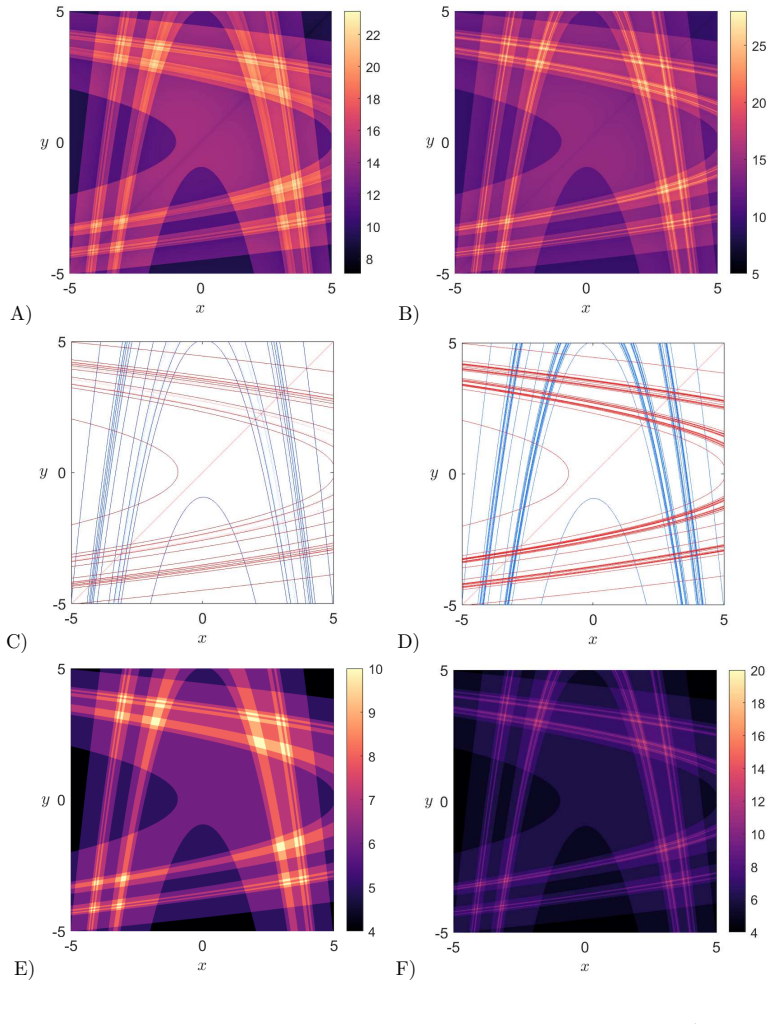
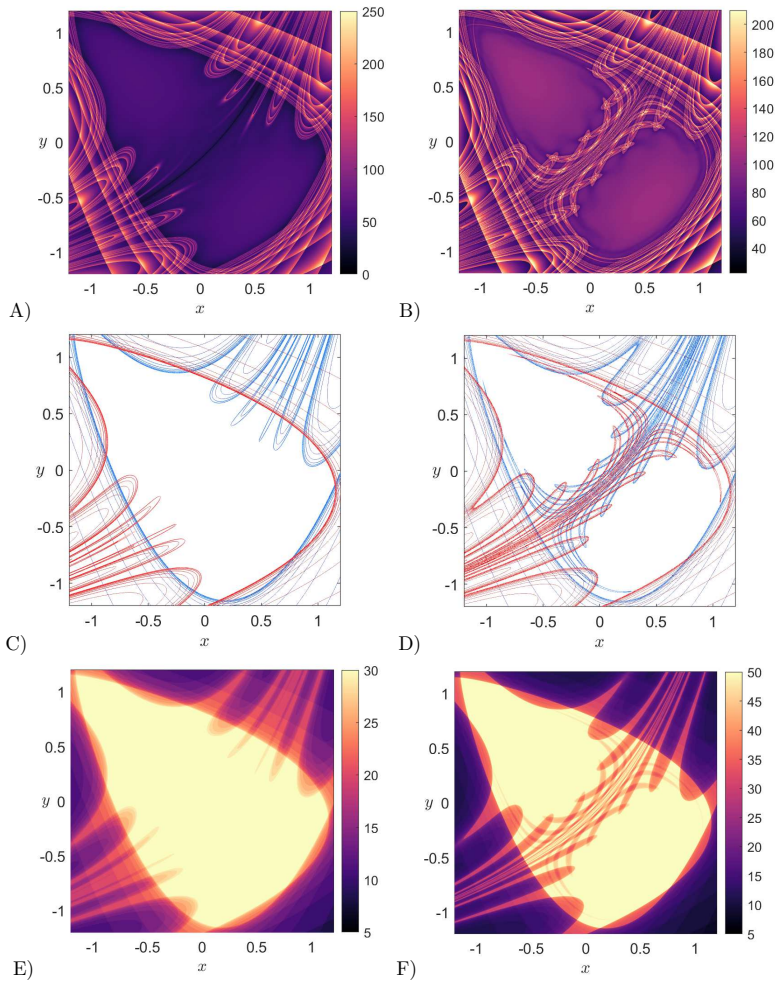
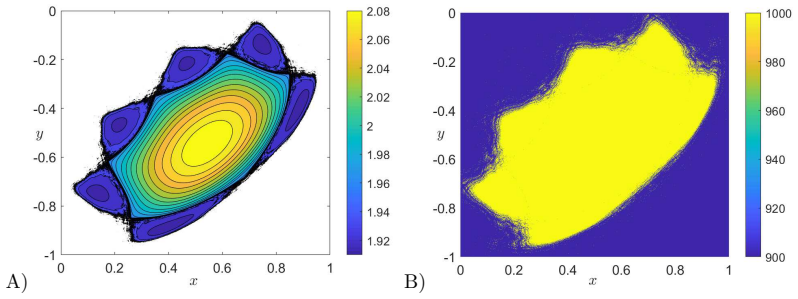
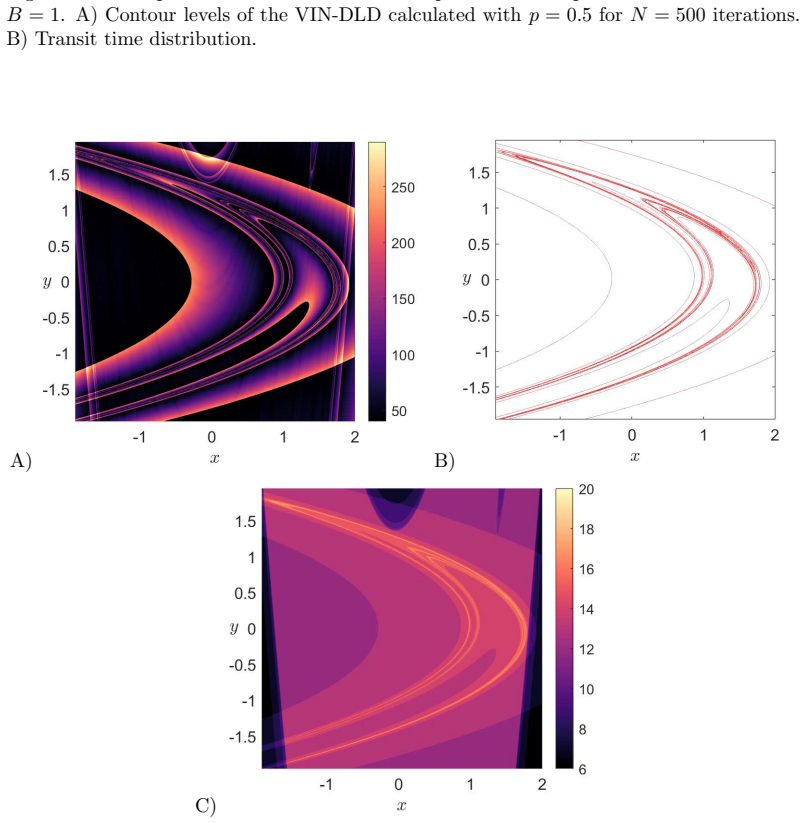
The paper's central claim is that the Variable Iteration Number Discrete Lagrangian Descriptor, $D_p(x_0,N)=\sum_{i=-N^-_{x_0}}^{N^+_{x_0}-1}\|x_{i+1}-x_i\|^p$ with $N^\pm_{x_0}$ the number of forward/backward iterates of $x_0$ that stay inside a fixed planar region $R$, replaces the fixed-iteration descriptor $\mathcal{M}^D_p(x_0,N)$ for unbounded maps without sacrificing the manifold-detection property. The argument is that for $R$ large enough the truncated sums approximate the fixed-iteration sums, so the points where $D_p$ is non-differentiable still locate stable and unstable manifolds, exactly as proved for the original descriptor. On the Hénon map the method is shown to reveal the chaotic saddle for parameters $(A,B)=(9.5,-1)$, the KAM tori and surrounding stable/unstable manifolds for $(0.298,1)$, and the strange attractor for $(1.4,0.3)$, and the gradient of $D_p$ extracts the manifolds directly.
Load-bearing premise
The load-bearing premise is that choosing the interaction region $R$ large enough makes the truncated variable-iteration sums close enough to the fixed-iteration descriptor that the proved manifold-detection property transfers; the paper states this as an expected result rather than proving a quantitative bound in $R$ and $N$.
Editorial extensions
If this is right
- The same orbit data used for $D_p$ also produce the transit-time distribution $T_{x_0}$, so escape statistics for the map come from the same computation.
- The gradient magnitude $\|\nabla D_p\|$ yields stable and unstable manifolds directly, without separately integrating manifolds.
- Iteration-averaged values $\langle D_p\rangle=D_p/N$ draw the KAM tori of regularity islands as smooth contours, where classical exit-time plots are flat and uninformative.
- Because escape no longer contaminates the scalar field, larger maximum iteration counts $N$ can expose finer layers of chaotic-saddle structure.
- The construction is stated for general invertible maps, so the Hénon tests instantiate a general recipe rather than a one-off calculation.
Reading between the lines
- I would expect the main uncontrolled error to be the single large jump an orbit takes when it crosses the boundary of $R$: that jump is present in $D_p$ for escaped orbits but absent for orbits that linger inside, so two nearby initial conditions can differ by an amount comparable to the whole retained sum.
- A natural strengthening, not attempted here, would be to prove a bound such as $|D_p-\mathcal{M}^D_p|\le C(r,N)$ under hyperbolicity or a uniform escape bound; with that, the heuristic 'large $R$' transfer becomes a theorem rather than an expectation.
- Because the stopping rule is purely spatial, it is plausible that the construction extends to non-autonomous or higher-dimensional invertible maps and to maps whose escape sets are anisotropic; those regimes are untested in the paper.
Signed reviews
Editorial analysis
A structured set of objections, weighed in public.
Referee Report
Summary. The paper proposes a modification of Discrete Lagrangian Descriptors (DLDs), termed Variable Iteration Number DLDs (VIN-DLDs), designed for unbounded maps whose orbits escape to infinity. Instead of iterating every initial condition for a fixed number N of forward and backward steps, the sum in Eq. (8) is truncated when the orbit leaves a fixed planar interaction region R (chosen as a circle of radius r=100 in the examples). The central claim is that for large enough R, VIN-DLDs approximate the fixed-iteration DLDs of Eq. (3), so the rigorous manifold-detection properties proved for DLDs in Lopesino et al. (2015b) transfer to VIN-DLDs. The method is illustrated on the Hénon map for three parameter regimes: a chaotic saddle (A=9.5, B=-1), KAM tori and stable/unstable manifolds (A=0.298, B=1), and a strange attractor (A=1.4, B=0.3). The VIN-DLD outputs are compared visually with transit-time (exit-time) distributions. The paper concludes that VIN-DLDs overcome the NaN/overflow problems of fixed-iteration DLDs on unbounded maps and provide a useful tool for phase-space visualization.
Significance. If the transfer of the manifold-detection property were rigorously established, the proposed VIN-DLD would be a practical and useful extension of DLDs to open and unbounded dynamical systems, a class that includes many physically relevant maps. The paper is clearly written and the numerical examples indeed recover the expected phase-space structures of the Hénon map, which lends empirical support to the method. The comparison with exit-time distributions is a helpful sanity check. However, the central mathematical claim that VIN-DLDs inherit the singular-feature properties of fixed-iteration DLDs is only asserted, not proved, and no quantitative validation (convergence in R, error bounds, comparison against known manifold shapes) is provided. The paper also extends a continuous-time ergodic-partition argument to discrete maps without proof. These gaps are significant but addressable within the scope of the manuscript.
major comments (3)
- [Section 2, after Eq. (8)] The statement that for a large interaction region R the VIN-DLD approaches the fixed-iteration DLD of Eq. (3), and therefore inherits the properties proved in Lopesino et al. (2015b), is the load-bearing step of the paper, yet it is only phrased as an expectation ('the expected result is that...') and is not supported by any bound or proof. For an orbit that exits R, Dp(x0,N) is not a partial sum of Eq. (3) with a small omitted tail: the variable stopping rule changes the set of terms included, and the final jump across the boundary can be comparable to the retained sum. The authors should either prove a quantitative estimate of the form |Dp(x0,N)-MDp(x0,N)| < C(R,N) for suitable orbits, or provide a rigorous statement of when singular features are preserved under this truncation. Failing that, the manifold-detection capability of VIN-DLD remains an empirical observation, not a consequence of the earlier DLD theory.
- [Section 3, Figures 2-5] The numerical results are not validated quantitatively. The paper does not provide a convergence study with respect to the interaction-region radius r (the choice r=100 is presented without justification), does not compare the detected manifolds against analytically known expressions (e.g., the stable/unstable manifolds of the Hénon map's fixed points), and gives no error metric for the claimed agreement with transit-time distributions. Since the central methodological claim is about approximation in R, a simple log-log plot of a suitable norm of (Dp - MDp) versus r, or a comparison of detected manifold points as r increases, would substantially strengthen the argument. Without such a check, the reader cannot assess whether r=100 is in the asymptotic regime or whether the observed structures are robust to the truncation.
- [Section 3, KAM tori discussion and Eq. (12)] The claim that the iteration-averaged VIN-DLD <Dp> in Eq. (12) detects KAM tori via the connection with Birkhoff's Ergodic Partition Theorem is not justified. The cited theorem and its Lagrangian-descriptor application in Lopesino et al. (2017) are formulated for continuous-time systems, and the paper argues only that Eq. (3) 'can be interpreted as a discretized version' of the continuous descriptor. This is not a proof that the ergodic-partition result carries over to discrete maps, especially under the variable truncation convention. The authors should either provide a proof for the discrete case or clearly mark this as a heuristic analogy. Since KAM tori recovery is one of the three main advertised applications, this gap is load-bearing for the corresponding claim.
minor comments (5)
- [Throughout] There are numerous typographical errors and misspellings, e.g., 'dynamical behavior' instead of 'dynamical behavior' (Section 1), 'exapmple' and 'increaseing' (Section 3), 'iteartions' and 'demosntrate' (Section 3), 'corrsponds' in figure captions. A careful proofreading pass is needed.
- [Section 2, Eq. (7)] The definition of N±x0 as a maximum over k is slightly ambiguous: it implicitly requires that the orbit stays inside R for all intermediate steps. This should be stated explicitly, since the formula alone does not encode the 'until it leaves R' stopping rule.
- [Section 2, paragraph on the shape of R] The claim that the shape of R is not important 'without loss of generality' is plausible but not demonstrated; for non-circular R, the boundary-crossing jump and the stopping rule change. A brief remark that the expected approximation property would hold for any bounded R with the same asymptotic reasoning would be helpful.
- [Figure 2, 3, and 5] The figures are presented without colorbars or axis labels in several panels, making it difficult to interpret the Dp value ranges. Adding colorbars and labeled axes would improve the reproducibility and readability of the results.
- [Section 3, transit time comparison] The comparison between VIN-DLD and transit-time distributions is purely visual. While the agreement is encouraging, a quantitative similarity measure (e.g., correlation or mutual information) would make the validation more convincing.
Circularity Check
No significant circularity: VIN-DLD is a truncation of the previously defined DLD, and the paper's validation is against external Hénon-map structures; the unproven 'expected result' is a support gap, not a circular reduction.
full rationale
The paper defines the VIN-DLD in Eq. (8) as the same sum as the fixed-iteration DLD in Eq. (3) but with summation limits N±x0 determined by first exit from an interaction region R. This is an explicit truncation of the earlier diagnostic, not a quantity defined in terms of the structures it claims to detect. The central transfer step is the Section 2 assertion that for large R the VIN-DLD 'approaches the values of the original DLD in Eq. (3)' and therefore inherits the manifold-detection properties proved in Lopesino et al. (2015b). That assertion is stated as 'the expected result' and is not proved or quantified, so the paper has a genuine support gap: the approximation error of the truncation is not bounded and no convergence check in R is provided. However, this is a missing proof or correctness risk, not a circularity. No parameter is fitted to the data and then renamed a prediction; no equation reduces to its inputs by construction; and the numerical demonstrations compare against independently known features of the Hénon map (chaotic saddle, KAM tori, strange attractor) and against exit-time plots. The exit-time comparison shares the same stopping times used to build Dp, so it is not an independent validation, but the paper does not claim to derive exit times from Dp; it uses them only as a qualitative cross-check of the scalar-field patterns. The cited prior DLD theory is real external evidence for the fixed-iteration quantity, and the present paper's load-bearing step is the unproven extrapolation from that quantity to the truncated one. That extrapolation should be examined as a mathematical gap, but it does not make the derivation circular.
Assumptions & free parameters
free parameters (3)
- interaction region radius r =
100
- p-norm exponent p =
0.05 for the chaotic saddle case; 0.5 for the KAM and strange attractor cases
- maximum iteration number N =
5, 10, 15, 25, 500 depending on the experiment
assumptions (3)
- domain assumption The Hénon map is invertible and its inverse is given by Eq. (10).
- ad hoc to paper The VIN-DLD approaches the FIN-DLD as the interaction region R becomes large, so the manifold-detection theorem from Lopesino et al. (2015b) applies to VIN-DLD.
- ad hoc to paper The connection between time-averaged Lagrangian descriptors and KAM tori via Birkhoff's Ergodic Partition Theorem holds for discrete-time maps.
invented entities (1)
-
VIN-DLD (Variable Iteration Number Discrete Lagrangian Descriptor)
Cite this review
Pith. "Pith review of An Extension of Discrete Lagrangian Descriptors for Unbounded Maps." pith.science (2026). https://pith.science/paper/S2OQMBEX
@misc{pith2026190804871,
  author       = {Pith},
  title        = {Pith review of: An Extension of Discrete Lagrangian Descriptors for Unbounded Maps},
  year         = {2026},
  howpublished = {\url{https://pith.science/paper/S2OQMBEX}},
  note         = {Machine review of arXiv:1908.04871}
}
read the original abstract
In this paper we provide an extension for the method of Discrete Lagrangian Descriptors with the purpose of exploring the phase space of unbounded maps. The key idea is to construct a working definition, that builds on the original approach introduced in Lopesino et al. (2015), and which relies on stopping the iteration of initial conditions when their orbits leave a certain region in the plane. This criterion is partly inspired by the classical analysis used in Dynamical Systems Theory to study the dynamics of maps by means of escape time plots. We illustrate the capability of this technique to reveal the geometrical template of stable and unstable invariant manifolds in phase space, and also the intricate structure of chaotic sets and strange attractors, by applying it to unveil the phase space of a well-known discrete time system, the H\'enon map.
Figures
Figures from the paper (2 more)
Reference graph
Works this paper leans on
-
[1]
Craven, G. T. and Hernandez, R. (2015). Lagrangian descriptors of thermalized transition states on time-varying energy surfaces. Physical review letters , 115(14), 148301
work page 2015
-
[2]
Craven, G. T. and Hernandez, R. (2016). Deconstructing field-induced ketene isomerization through Lagrangian descriptors. Physical Chemistry Chemical Physics, 18(5), 4008–4018
work page 2016
-
[3]
Dynamical trapping in the area-preserving H\'enon map
Craven, G. T., Junginger, A., and Hernandez, R. (2017). Lagrangian descriptors of driven chemical reaction manifolds. Physical Review E , 96(2), 022222. de Oliveira, V. M., Ciro, D., and Caldas, I. L. (2019). Dynamical trapping in the area- preserving H´ enon map.arXiv preprint:1907.11616
work page Pith review arXiv 2017
-
[4]
Demian, A. S. and Wiggins, S. (2017). Detection of periodic orbits in Hamiltonian systems using Lagrangian descriptors. International Journal of Bifurcation and Chaos , 27(14), 1750225
work page 2017
-
[5]
Devaney, R. and Nitecki, Z. (1979). Shift automorphisms in the H´ enon mapping. Commu- nications in Mathematical Physics , 67(2), 137–146
work page 1979
-
[6]
Feldmaier, M., Junginger, A., Main, J., Wunner, G., and Hernandez, R. (2017). Obtaining time-dependent multi-dimensional dividing surfaces using Lagrangian descriptors. Chem- ical Physics Letters , 687, 194–199
work page 2017
-
[7]
Garcia-Garrido, V. J., Ramos, A., Mancho, A. M., Coca, J., and Wiggins, S. (2016). A dynamical systems perspective for a real-time response to a marine oil spill. Marine Pollution Bulletin. , pages 1–10. Garc´ ıa-Garrido, V. J., Balibrea-Iniesta, F., Wiggins, S., Mancho, A. M., and Lopesino, C. (2018). Detection of phase space structures of the cat map wi...
work page Pith review arXiv 2016
-
[8]
Junginger, A. and Hernandez, R. (2015). Uncovering the geometry of barrierless reactions using Lagrangian descriptors. J. Phys. Chem. B
work page 2015
Show all 18 references
-
[9]
Junginger, A., Duvenbeck, L., Feldmaier, M., Main, J., Wunner, G., and Hernandez, R. (2017). Chemical dynamics between wells across a time-dependent barrier: Self-similarity in the Lagrangian descriptor and reactive basins.The Journal of chemical physics, 147(6), 064101
2017
-
[10]
J., Wiggins, S., and Mancho, A
Lopesino, C., Balibrea-Iniesta, F., Garc´ ıa-Garrido, V. J., Wiggins, S., and Mancho, A. M. (2017). A theoretical framework for Lagrangian descriptors. International Journal of Bifurcation and Chaos , 27(01), 1730001
2017
-
[11]
Madrid, J. A. J. and Mancho, A. M. (2009). Distinguished trajectories in time dependent vector fields. Chaos, 19, 013111
2009
-
[12]
M., Wiggins, S., Curbelo, J., and Mendoza, C
Mancho, A. M., Wiggins, S., Curbelo, J., and Mendoza, C. (2013). Lagrangian descriptors: A method for revealing phase space structures of general time dependent dynamical systems. Communications in Nonlinear Science and Numerical Simulation , 18(12), 3530–3557
2013
-
[13]
Meiss, J. D. (1997). Average exit time for volume-preserving maps. Chaos: An Interdisci- plinary Journal of Nonlinear Science , 7(1), 139–147
1997
-
[14]
and Mancho, A
Mendoza, C. and Mancho, A. M. (2010). Hidden geometry of ocean flows. Phys. Rev. Lett., 105, 038501
2010
-
[15]
and Wiggins, S
Mezic, I. and Wiggins, S. (1999). A method for visualization of invariant sets of dynamical systems based on the ergodic partition. Chaos, 9(1), 213–218
1999
-
[16]
and Wiggins, S
Naik, S. and Wiggins, S. (2019). Finding normally hyperbolic invariant manifolds in two and three degrees of freedom with H´ enon-Heiles type potential.Phys. Rev. E , 100, 022204
2019
-
[17]
J., and Wiggins, S
Naik, S., Garca-Garrido, V. J., and Wiggins, S. (2019). Finding NHIM: Identifying high dimensional phase space structures in reaction dynamics using Lagrangian descriptors. Communications in Nonlinear Science and Numerical Simulation , 79, 104907. Poincar´ e, H. (1890). Sur le...
2019
-
[18]
G., Garc´ ıa-Garrido, V
Ramos, A. G., Garc´ ıa-Garrido, V. J., Mancho, A. M., Wiggins, S., Coca, J., Glenn, S., Schofield, O., Kohut, J., Aragon, D., Kerfoot, J., Haskins, T., Miles, T., Haldeman, C., Strandskov, N., Allsup, B., Jones, C., and Shapiro., J. (2018). Lagrangian coherent structure assiste...
2018
Reviewed August 14, 2026 · model on record in the stance chip above.
Discussion (0). Continue with ORCID to comment.