Characterizing the Formation and Evolution of S0-galaxies (CaFES-0): Their formation pathways around Galaxy Clusters
Pith reviewed 2026-06-26 20:05 UTC · model grok-4.3
The pith
S0 galaxies mostly form from faded or stripped spirals in clusters, not mergers.
A machine-rendered reading of the paper's core claim, the machinery that carries it, and where it could break.
Core claim
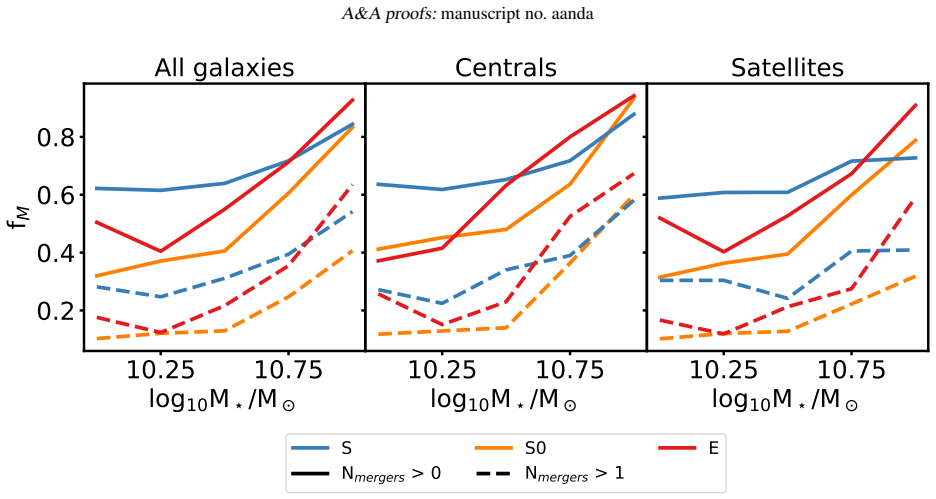
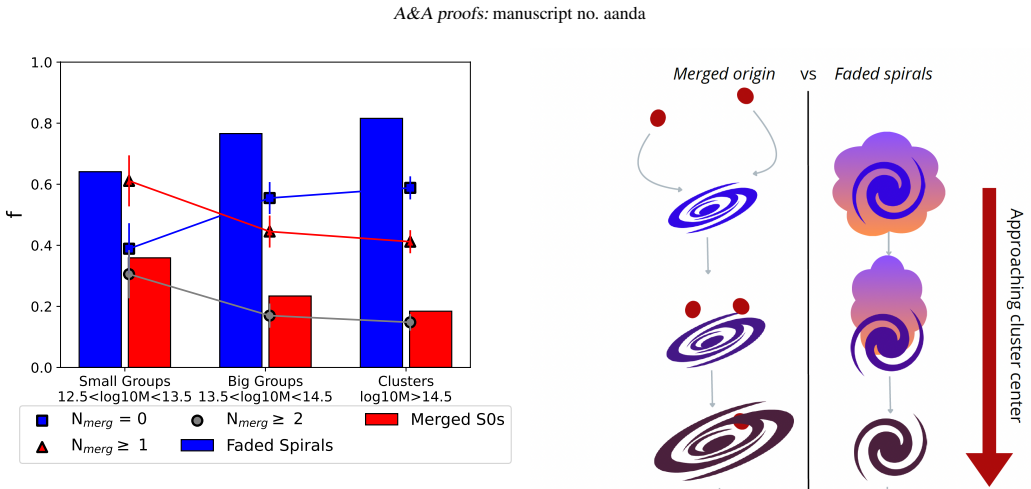
Our results strongly suggest that S0 galaxies predominantly form from faded/stripped spirals in clusters, with a minority forming via mergers in smaller haloes. Satellite S0s exhibit a highly quiescent merging history, with about 60 percent experiencing no significant mergers since z=2, while pre-processing effects in groups influence both quenching and morphological transformation.
What carries the argument
Hydrangea cosmological zoom-in simulation suite used to reconstruct environmental histories of central and satellite quenched disk galaxies classified as S0s.
If this is right
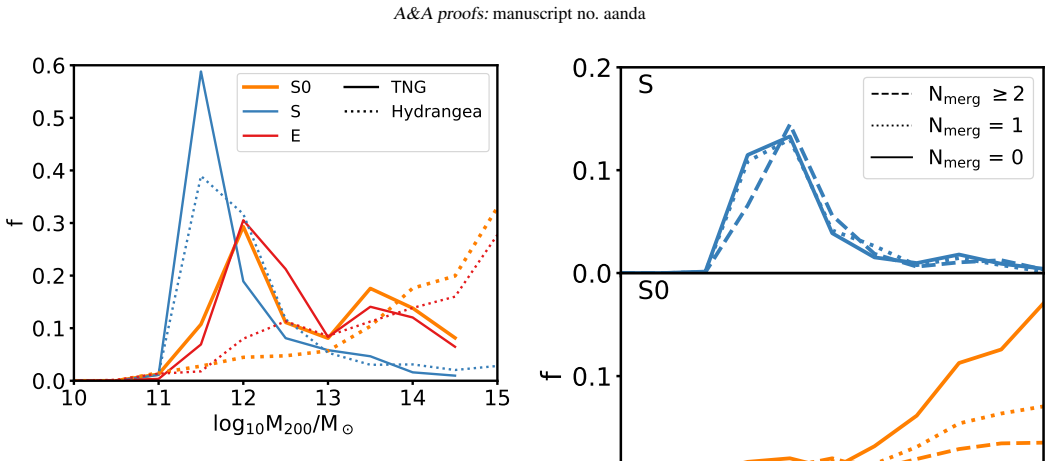
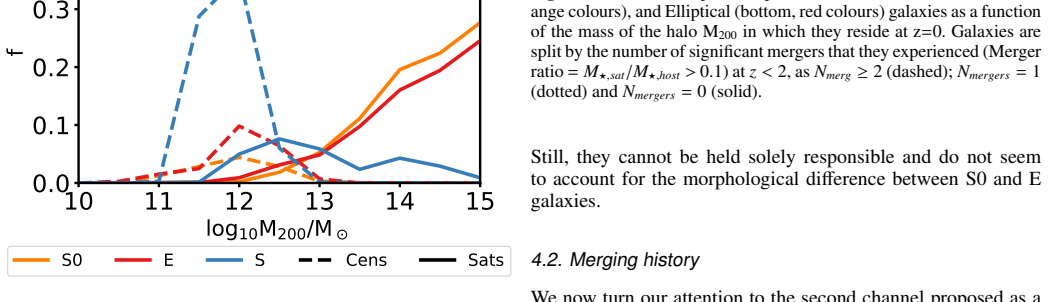
- More than 85 percent of S0s reside as satellites inside halos more massive than 10^13 solar masses.
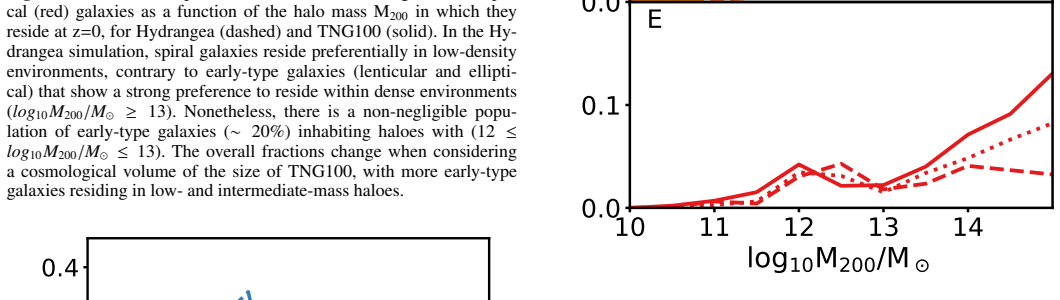
- Roughly 60 percent of satellite S0s have no significant mergers after redshift 2.
- Pre-processing inside groups drives both the loss of star formation and the change in galaxy shape.
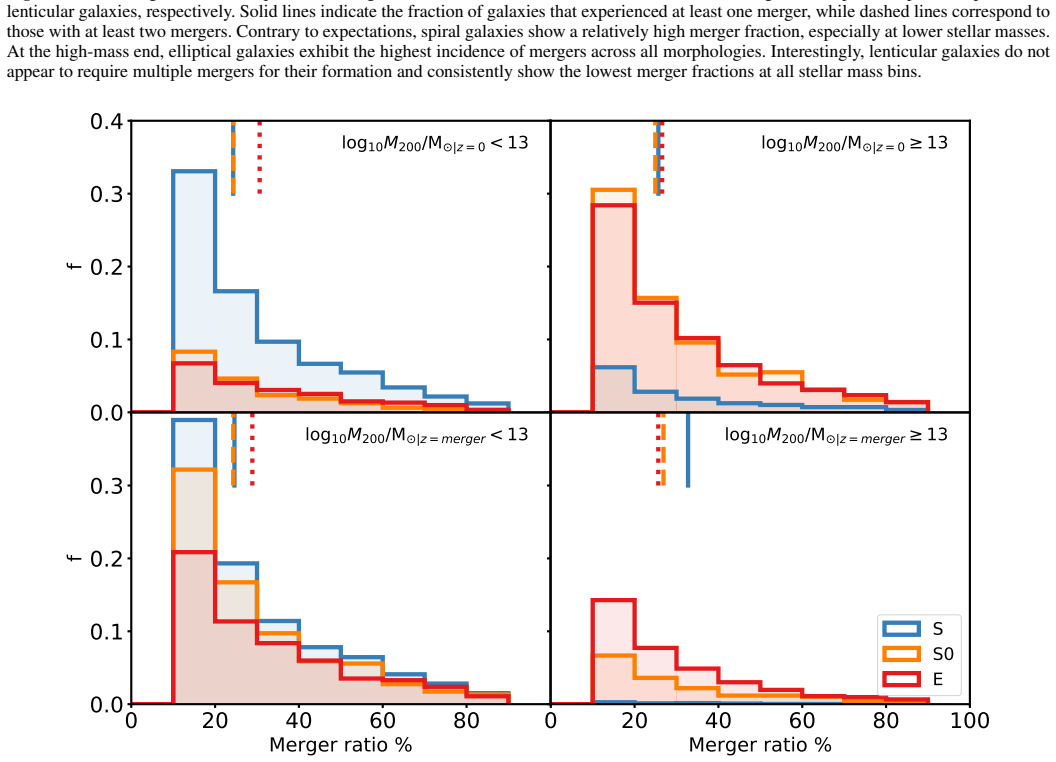
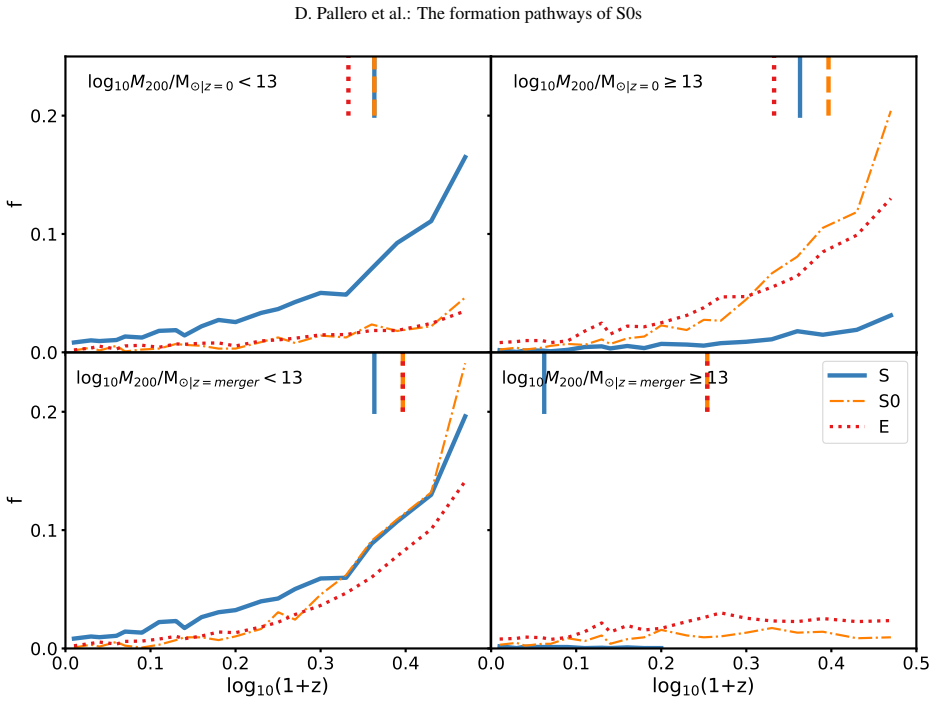
- Mergers that do involve S0 or spiral galaxies occur mainly in low-density regions and tend to be gas-rich.
Where Pith is reading between the lines
- If the pathway holds, many observed S0s in clusters should retain thin-disk structures inherited from spiral ancestors.
- Surveys targeting recently infalling galaxies could search for the transitional stripped-spiral population predicted here.
- Repeating the analysis in independent simulation suites would test whether the dominance of the stripping channel depends on the specific model of gas removal.
Load-bearing premise
The simulations accurately capture real gas-stripping and morphological transformation in clusters and correctly label quenched disks as S0 galaxies.
What would settle it
Direct observations showing that a large fraction of cluster S0 galaxies experienced major mergers after z=1, or simulations with different physics yielding mostly merger-built S0s, would falsify the main pathway.
Figures
read the original abstract
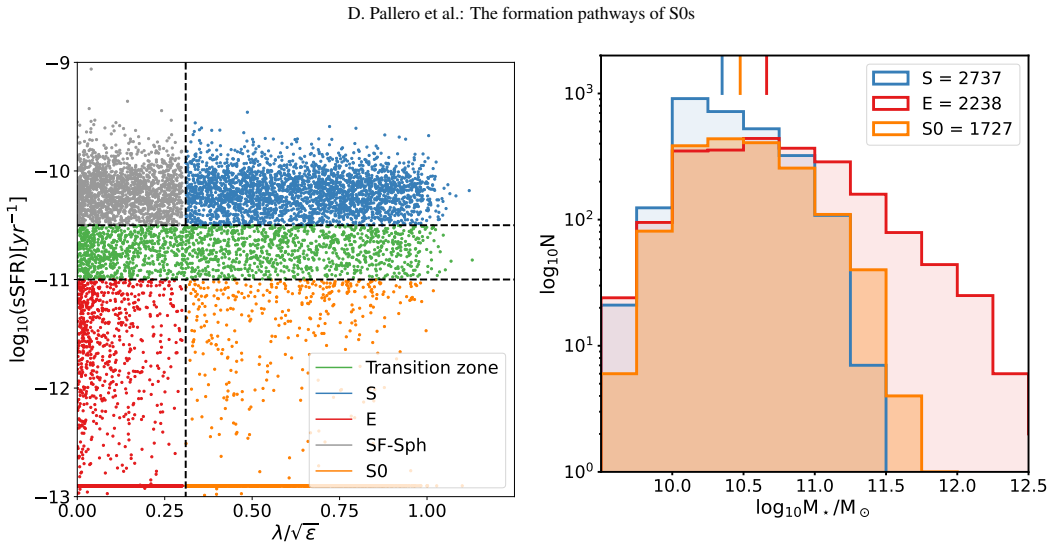
The formation pathways of lenticular galaxies (S0s), which lie morphologically between elliptical and spiral galaxies, remain a topic of active research. Environmental effects, merging histories, and pre-processing mechanisms are often proposed as key factors influencing their transformation. However, the relative importance of these processes remains unclear, particularly when compared with other galaxy types. We use the Hydrangea cosmological zoom-in simulation suite to analyse the environmental histories of S0 galaxies, defined here as central and satellite quenched disk galaxies. We find that the vast majority (>85\%) of our sample of S0s are satellites in massive haloes (log$_{10}$M$_{200}/$M$_\odot$ > 13), while only $\sim10\%$ are centrals in low-mass haloes. Satellite S0s exhibit a highly quiescent merging history, with $\sim60\%$ experiencing no significant mergers since $z=2$. Centrals show more varied merging histories, although our results may be affected by limited sample size. Contrary to expectations, no clear trends in merger ratios with morphology are observed. However, mergers involving lenticular and spiral galaxies tend to occur in low-density environments and are likely gas-rich, enabling disk reformation. Pre-processing effects in groups are critical, influencing both quenching and morphological transformation.} Our results strongly suggest that S0 galaxies predominantly form from faded/stripped spirals in clusters, with a minority forming via mergers in smaller haloes. These results are in agreement with previous observations of lenticular galaxies around galaxy clusters.
Editorial analysis
A structured set of objections, weighed in public.
Referee Report
Summary. The manuscript uses the Hydrangea cosmological zoom-in simulation suite to examine the environmental and merger histories of S0 galaxies, defined as quenched disk galaxies (both centrals and satellites). It reports that >85% of the sample are satellites in haloes with log10(M200/M⊙)>13, ~60% of satellite S0s have no significant mergers since z=2, and concludes that S0s predominantly form via fading/stripping of spirals in clusters, with a minority forming via mergers in smaller haloes; results are stated to agree with prior observations.
Significance. If the kinematic definition of S0s aligns with morphological observations and the simulation accurately captures gas-stripping and morphological transformation, the work supplies quantitative fractions on satellite fractions, merger quiescence, and environmental dependencies that strengthen the case for environmental pathways dominating S0 formation around clusters. The use of a zoom-in suite enables tracking of individual galaxy histories across cosmic time.
major comments (3)
- [Abstract] Abstract: The central claim that >85% of S0s form from faded/stripped spirals rests on classifying 'quenched disk galaxies' as S0s. No cross-check is described against observed morphological criteria (prominent bulge, smooth disk without arms, specific surface-brightness profiles), so the satellite fraction and pathway inference may include galaxies that would be typed differently in observations.
- [Methods] Methods (sample definition and merger identification): The abstract states numerical results on merger histories and satellite fractions but provides no thresholds for quenching, kinematic decomposition parameters (e.g., V/σ), merger mass-ratio or timing criteria, or completeness corrections. Without these, the ~60% no-merger statistic and the distinction between cluster vs group pathways cannot be evaluated for robustness.
- [Results] Results (merger statistics): The statement that satellite S0s exhibit 'highly quiescent merging history' with ~60% experiencing no significant mergers since z=2 is load-bearing for the 'minority via mergers' conclusion, yet no error bars, sensitivity to merger definition, or comparison to control samples of non-S0 galaxies are mentioned.
minor comments (1)
- [Abstract] Abstract contains a stray closing brace ('transformation.} Our results') that should be removed for clarity.
Simulated Author's Rebuttal
We thank the referee for their constructive and detailed comments, which have helped us improve the clarity and robustness of the manuscript. We address each major comment point-by-point below. We have revised the manuscript to incorporate additional details, thresholds, and robustness checks where feasible.
read point-by-point responses
-
Referee: [Abstract] Abstract: The central claim that >85% of S0s form from faded/stripped spirals rests on classifying 'quenched disk galaxies' as S0s. No cross-check is described against observed morphological criteria (prominent bulge, smooth disk without arms, specific surface-brightness profiles), so the satellite fraction and pathway inference may include galaxies that would be typed differently in observations.
Authors: We acknowledge the distinction between our kinematic definition (quenched disks with V/σ above a threshold) and visual morphological classifications used in observations. This definition is standard in simulation analyses to enable direct tracking of evolutionary pathways. In the revised manuscript we will expand the methods and discussion sections to explicitly compare our selection to observational S0 criteria, citing relevant literature on kinematic-morphological correspondence, and note the potential for some contamination. We cannot perform a full visual morphology classification within the current simulation data without additional post-processing, but the environmental trends remain the primary result. revision: partial
-
Referee: [Methods] Methods (sample definition and merger identification): The abstract states numerical results on merger histories and satellite fractions but provides no thresholds for quenching, kinematic decomposition parameters (e.g., V/σ), merger mass-ratio or timing criteria, or completeness corrections. Without these, the ~60% no-merger statistic and the distinction between cluster vs group pathways cannot be evaluated for robustness.
Authors: The full methods section of the manuscript does contain the specific thresholds (quenching via sSFR < 10^{-11} yr^{-1}, V/σ > 0.5 for disks, mergers with mass ratio >1:10 after z=2). However, we agree these should be more prominent. We will revise the abstract and add a dedicated paragraph in methods summarizing all selection criteria, merger definitions, and any completeness considerations for the satellite/central samples. revision: yes
-
Referee: [Results] Results (merger statistics): The statement that satellite S0s exhibit 'highly quiescent merging history' with ~60% experiencing no significant mergers since z=2 is load-bearing for the 'minority via mergers' conclusion, yet no error bars, sensitivity to merger definition, or comparison to control samples of non-S0 galaxies are mentioned.
Authors: We agree that adding these elements will strengthen the result. In the revised manuscript we will include Poisson uncertainties on the ~60% fraction, test sensitivity by varying the merger mass-ratio threshold (1:4 and 1:10), and add a control comparison of merger histories for star-forming disks in the same halo mass bins. These additions can be made from the existing simulation outputs. revision: yes
Circularity Check
No circularity in Hydrangea simulation statistics on S0 pathways
full rationale
The paper defines S0s explicitly as quenched disk galaxies in the Hydrangea simulations and reports direct statistical counts (satellite fractions, merger histories) extracted from those simulation outputs. No parameters are fitted to the target results, no equations reduce claims to inputs by construction, and no self-citations serve as load-bearing uniqueness theorems. The analysis is a straightforward post-processing of external simulation data with interpretive conclusions; the derivation chain is self-contained against the simulation snapshots.
Axiom & Free-Parameter Ledger
axioms (1)
- domain assumption Standard Lambda-CDM cosmology and sub-grid galaxy formation physics implemented in the Hydrangea suite
Forward citations
Cited by 1 Pith paper
-
Characterizing the Formation and Evolution of S0-galaxies (CaFES-0): Revealing the origin of the mass-size relation for S0 galaxies
S0 galaxies exhibit a V-shaped mass-size relation arising from two formation channels: faded low-mass disks and merger-built high-mass systems.
Reference graph
Works this paper leans on
-
[1]
M., Barnes, D
Bahé, Y . M., Barnes, D. J., Dalla Vecchia, C., et al. 2017, MNRAS, 470, 4186 Bahé, Y . M., Crain, R. A., Kauffmann, G., et al. 2016, MNRAS, 456, 1115 Bahé, Y . M., McCarthy, I. G., Balogh, M. L., & Font, A. S. 2013, MNRAS, 430, 3017 Bahé, Y . M., Schaye, J., Barnes, D. J., et al. 2019, MNRAS, 485, 2287
2017
-
[2]
S., McDermid, R
Barsanti, S., Owers, M. S., McDermid, R. M., et al. 2021, ApJ, 906, 100
2021
-
[3]
& Couch, W
Bekki, K. & Couch, W. J. 2011, MNRAS, 415, 1783
2011
-
[4]
Blanton, M. R. & Moustakas, J. 2009, ARA&A, 47, 159
2009
-
[5]
S., et al
Brough, S., van de Sande, J., Owers, M. S., et al. 2017, ApJ, 844, 59
2017
-
[6]
J., Owers, M
Bryant, J. J., Owers, M. S., Robotham, A. S. G., et al. 2015, MNRAS, 447, 2857
2015
-
[7]
A., Law, D
Bundy, K., Bershady, M. A., Law, D. R., et al. 2015, ApJ, 798, 7
2015
-
[8]
& Baes, M
Camps, P. & Baes, M. 2015, Astronomy and Computing, 9, 20
2015
-
[9]
N., Smith, R., Jaffé, Y ., & Cortesi, A
Candlish, G. N., Smith, R., Jaffé, Y ., & Cortesi, A. 2018, MNRAS, 480, 5362
2018
-
[10]
2025, arXiv e-prints, arXiv:2503.02746
Cappellari, M. 2025, arXiv e-prints, arXiv:2503.02746
arXiv 2025
-
[11]
2011, MNRAS, 416, 1680
Cappellari, M., Emsellem, E., Krajnovi´c, D., et al. 2011, MNRAS, 416, 1680
2011
-
[12]
A., et al
Cava, A., Biviano, A., Mamon, G. A., et al. 2017, A&A, 606, A108
2017
-
[13]
2003, PASP, 115, 763
Chabrier, G. 2003, PASP, 115, 763
2003
-
[14]
2025, arXiv e-prints, arXiv:2509.04067
Chaikin, E., Schaye, J., Schaller, M., et al. 2025, arXiv e-prints, arXiv:2509.04067
Pith/arXiv arXiv 2025
-
[15]
Clauwens, B., Schaye, J., Franx, M., & Bower, R. G. 2018, MNRAS, 478, 3994
2018
-
[16]
L., et al
Coccato, L., Fraser-McKelvie, A., Jaffé, Y . L., et al. 2022, MNRAS, 515, 201
2022
-
[17]
L., Cortesi, A., et al
Coccato, L., Jaffé, Y . L., Cortesi, A., et al. 2020, MNRAS, 492, 2955
2020
-
[18]
A., Bahé, Y
Crain, R. A., Bahé, Y . M., Lagos, C. d. P., et al. 2017, MNRAS, 464, 4204
2017
-
[19]
A., Schaye, J., Bower, R
Crain, R. A., Schaye, J., Bower, R. G., et al. 2015, MNRAS, 450, 1937 Dalla Vecchia, C. & Schaye, J. 2012, MNRAS, 426, 140 Davé, R., Anglés-Alcázar, D., Narayanan, D., et al. 2019, MNRAS, 486, 2827 De Lucia, G., Weinmann, S., Poggianti, B. M., Aragón-Salamanca, A., & Zarit- sky, D. 2012, MNRAS, 423, 1277 de Vaucouleurs, G. 1959, Handbuch der Physik, 53, 275
2015
-
[20]
J., Sweet, S
Deeley, S., Drinkwater, M. J., Sweet, S. M., et al. 2021, MNRAS, 508, 895
2021
-
[21]
J., Sweet, S
Deeley, S., Drinkwater, M. J., Sweet, S. M., et al. 2020, MNRAS, 498, 2372
2020
-
[22]
2009, MNRAS, 399, 497 Domínguez Sánchez, H., Bernardi, M., Nikakhtar, F., Margalef-Bentabol, B., &
Dolag, K., Borgani, S., Murante, G., & Springel, V . 2009, MNRAS, 399, 497 Domínguez Sánchez, H., Bernardi, M., Nikakhtar, F., Margalef-Bentabol, B., &
2009
-
[23]
Sheth, R. K. 2020, MNRAS, 495, 2894
2020
-
[24]
1980, ApJ, 236, 351
Dressler, A. 1980, ApJ, 236, 351
1980
-
[25]
2011, MNRAS, 414, 888
Emsellem, E., Cappellari, M., Krajnovi´c, D., et al. 2011, MNRAS, 414, 888
2011
-
[26]
2007, MNRAS, 379, 401
Emsellem, E., Cappellari, M., Krajnovi´c, D., et al. 2007, MNRAS, 379, 401
2007
-
[27]
M., Bettoni, D., et al
Fasano, G., Poggianti, B. M., Bettoni, D., et al. 2015, MNRAS, 449, 3927
2015
-
[28]
2018, MN- RAS, 481, 5580
Fraser-McKelvie, A., Aragón-Salamanca, A., Merrifield, M., et al. 2018, MN- RAS, 481, 5580
2018
-
[29]
2021, MNRAS, 503, 4992
Fraser-McKelvie, A., Cortese, L., van de Sande, J., et al. 2021, MNRAS, 503, 4992
2021
-
[30]
2018, MNRAS, 474, 3976 Article number, page 11 of 13 A&A proofs:manuscript no
Genel, S., Nelson, D., Pillepich, A., et al. 2018, MNRAS, 474, 3976 Article number, page 11 of 13 A&A proofs:manuscript no. aanda Gómez, P. L., Nichol, R. C., Miller, C. J., et al. 2003, ApJ, 584, 210
2018
-
[31]
L., & Solanes, J
Gort, M., Tous, J. L., & Solanes, J. M. 2025, A&A, 697, A163
2025
-
[32]
P., Pereira, M
Haines, C. P., Pereira, M. J., Smith, G. P., et al. 2015, ApJ, 806, 101
2015
-
[33]
Hubble, E. P. 1926, ApJ, 64, 321
1926
-
[34]
2019, MNRAS, 489, 1859 Jaffé, Y
Huertas-Company, M., Rodriguez-Gomez, V ., Nelson, D., et al. 2019, MNRAS, 489, 1859 Jaffé, Y . L., Aragón-Salamanca, A., De Lucia, G., et al. 2011, MNRAS, 410, 280
2019
-
[35]
J., Aragón-Salamanca, A., Fraser-McKelvie, A., et al
Johnston, E. J., Aragón-Salamanca, A., Fraser-McKelvie, A., et al. 2021, MN- RAS, 500, 4193
2021
-
[36]
J., Aragón-Salamanca, A., & Merrifield, M
Johnston, E. J., Aragón-Salamanca, A., & Merrifield, M. R. 2014, MNRAS, 441, 333
2014
-
[37]
Kauffmann, G., White, S. D. M., Heckman, T. M., et al. 2004, MNRAS, 353, 713
2004
-
[38]
M., de Carvalho, R
Kolesnikov, I., Sampaio, V . M., de Carvalho, R. R., & Conselice, C. 2025, MN- RAS, 539, 2765
2025
-
[39]
Lagos, C. d. P., Theuns, T., Stevens, A. R. H., et al. 2017, MNRAS, 464, 3850
2017
-
[40]
2019, ApJ, 878, 69
Liu, C., Hao, L., Wang, H., & Yang, X. 2019, ApJ, 878, 69
2019
-
[41]
2018, MNRAS, 480, 5113 Mendes de Oliveira, C., Ribeiro, T., Schoenell, W., et al
Marinacci, F., V ogelsberger, M., Pakmor, R., et al. 2018, MNRAS, 480, 5113 Mendes de Oliveira, C., Ribeiro, T., Schoenell, W., et al. 2019, MNRAS, 489, 241 Méndez-Hernández, H., Lima-Dias, C., Monachesi, A., et al. 2026, A&A, 706, A34
2018
-
[42]
M., Ellis, R
Moran, S. M., Ellis, R. S., Treu, T., et al. 2007, ApJ, 671, 1503
2007
-
[43]
Muzzin, A., van der Burg, R. F. J., McGee, S. L., et al. 2014, ApJ, 796, 65
2014
-
[44]
Muzzin, A., Wilson, G., Yee, H. K. C., et al. 2012, ApJ, 746, 188
2012
-
[45]
2014, MNRAS, 444, 3357
Naab, T., Oser, L., Emsellem, E., et al. 2014, MNRAS, 444, 3357
2014
-
[46]
P., Pillepich, A., Springel, V ., et al
Naiman, J. P., Pillepich, A., Springel, V ., et al. 2018, MNRAS, 477, 1206
2018
-
[47]
2018, MNRAS, 475, 624
Nelson, D., Pillepich, A., Springel, V ., et al. 2018, MNRAS, 475, 624
2018
-
[48]
H., et al
Oh, S., Kim, K., Lee, J. H., et al. 2018, ApJS, 237, 14
2018
-
[49]
H., Oh, S., et al
Pak, M., Lee, J. H., Oh, S., et al. 2021, ApJ, 921, 49
2021
- [50]
-
[51]
A., Padilla, N
Pallero, D., Gómez, F. A., Padilla, N. D., et al. 2022, MNRAS, 511, 3210
2022
-
[52]
A., Padilla, N
Pallero, D., Gómez, F. A., Padilla, N. D., et al. 2019, MNRAS, 488, 847
2019
-
[53]
2015, Nature, 521, 192
Peng, Y ., Maiolino, R., & Cochrane, R. 2015, Nature, 521, 192
2015
-
[54]
J., Kovaˇc, K., et al
Peng, Y .-j., Lilly, S. J., Kovaˇc, K., et al. 2010, ApJ, 721, 193
2010
-
[55]
2018b, MNRAS, 473, 4077 Planck Collaboration, Ade, P
Pillepich, A., Springel, V ., Nelson, D., et al. 2018b, MNRAS, 473, 4077 Planck Collaboration, Ade, P. A. R., Aghanim, N., et al. 2016, A&A, 594, A13 Planck Collaboration, Ade, P. A. R., Aghanim, N., et al. 2014, A&A, 566, A54
2016
-
[56]
M., Lyubenova, M., et al
Poci, A., McDermid, R. M., Lyubenova, M., et al. 2021, A&A, 647, A145
2021
-
[57]
M., Aragón-Salamanca, A., Zaritsky, D., et al
Poggianti, B. M., Aragón-Salamanca, A., Zaritsky, D., et al. 2009, ApJ, 693, 112
2009
-
[58]
M., von der Linden, A., De Lucia, G., et al
Poggianti, B. M., von der Linden, A., De Lucia, G., et al. 2006, ApJ, 642, 188
2006
-
[59]
M., Bower, R
Rosas-Guevara, Y . M., Bower, R. G., Schaye, J., et al. 2015, MNRAS, 454, 1038
2015
-
[60]
M., Kolesnikov, I., de Carvalho, R
Sampaio, V . M., Kolesnikov, I., de Carvalho, R. R., Ferreras, I., & Silk, J. 2025, arXiv e-prints, arXiv:2506.12205
arXiv 2025
-
[61]
2015, MNRAS, 454, 2277
Schaller, M., Dalla Vecchia, C., Schaye, J., et al. 2015, MNRAS, 454, 2277
2015
-
[62]
2004, ApJ, 609, 667
Schaye, J. 2004, ApJ, 609, 667
2004
-
[63]
2025, arXiv e-prints, arXiv:2508.21126
Schaye, J., Chaikin, E., Schaller, M., et al. 2025, arXiv e-prints, arXiv:2508.21126
Pith/arXiv arXiv 2025
-
[64]
A., Bower, R
Schaye, J., Crain, R. A., Bower, R. G., et al. 2015, MNRAS, 446, 521
2015
-
[65]
& Dalla Vecchia, C
Schaye, J. & Dalla Vecchia, C. 2008, MNRAS, 383, 1210 Sérsic, J. L. 1963, Boletin de la Asociacion Argentina de Astronomia La Plata Argentina, 6, 41 Sifón, C., Finoguenov, A., Haines, C. P., et al. 2025, A&A, 697, A92
2008
-
[66]
2009, A&A, 508, 1141
Simard, L., Clowe, D., Desai, V ., et al. 2009, A&A, 508, 1141
2009
-
[67]
2005, MNRAS, 364, 1105
Springel, V . 2005, MNRAS, 364, 1105
2005
-
[68]
2010, MNRAS, 401, 791
Springel, V . 2010, MNRAS, 401, 791
2010
-
[69]
2018, MNRAS, 475, 676
Springel, V ., Pakmor, R., Pillepich, A., et al. 2018, MNRAS, 475, 676
2018
-
[70]
Springel, V ., White, S. D. M., Tormen, G., & Kauffmann, G. 2001, MNRAS, 328, 726
2001
-
[71]
C., Aceves, H., et al
Tapia, T., Eliche-Moral, M. C., Aceves, H., et al. 2017, A&A, 604, A105
2017
-
[72]
2018, MNRAS, 477, L16
Torrey, P., V ogelsberger, M., Hernquist, L., et al. 2018, MNRAS, 477, L16
2018
-
[73]
L., Solanes, J
Tous, J. L., Solanes, J. M., & Perea, J. D. 2025, MNRAS, 537, 1459 van de Sande, J., Croom, S. M., Bland-Hawthorn, J., et al. 2021, MNRAS, 508, 2307 V ogelsberger, M., Marinacci, F., Torrey, P., et al. 2018, MNRAS, 474, 2073
2025
-
[74]
2023, MNRAS, 526, 4768
Walmsley, M., Géron, T., Kruk, S., et al. 2023, MNRAS, 526, 4768
2023
-
[75]
R., Tinker, J
Wetzel, A. R., Tinker, J. L., & Conroy, C. 2012, MNRAS, 424, 232
2012
-
[76]
R., Tinker, J
Wetzel, A. R., Tinker, J. L., Conroy, C., & van den Bosch, F. C. 2013, MNRAS, 432, 336
2013
-
[77]
R., Tollerud, E
Wetzel, A. R., Tollerud, E. J., & Weisz, D. R. 2015, ApJ, 808, L27
2015
discussion (0)
Sign in with ORCID, Apple, or X to comment. Anyone can read and Pith papers without signing in.