REVIEW 4 major objections 5 minor 59 references
Continuation methods as a tool for parameter inference in electrophysiology modeling
T0 review · 4 major / 5 minor · reviewed 2026-08-10 · deepseek-v4-flash
Pith's one-line read Continuation methods can cut the cost of fitting cardiac action-potential models by 70% by tracking the converged heartbeat as model parameters change.
desk verdict Solid proof-of-concept: continuation tracking cuts MCMC calibration time by 70% on a hand-tuned toy model, with honest caveats about transfer to production-scale cardiac models. read the letter →
The pith
A machine-rendered reading of the paper's core claim, the machinery that carries it, and where it could break.
The reading
What carries the argument
The central object is the stable limit cycle: the converged, beat-to-beat identical action potential. The machinery is shooting-method continuation, which solves the periodic boundary-value problem $\Phi(y,T,\theta)-y=0$ together with a phase condition, using predictor-corrector steps to follow the cycle as parameters change. The key to the speedup is that MCMC and local optimizers propose small parameter steps, so the previously converged limit cycle is a good initial guess and continuation often reaches the new cycle in a single jump without simulating the long transient. Convergence is declared when the L1 norm of the change in all state variables across one orbit falls below $10^{-6}$, and the continuation solution must also satisfy the solver's own residual tolerance.
What would settle it
Run the same small- and large-perturbation benchmarks and the same MCMC calibration on a published stiff concentration-coupled ventricular action potential model with a pacing stimulus, using the identical convergence criterion. If continuation fails to converge, or the 4.7-6.5x perturbation speedups and the 70% MCMC reduction shrink materially, the claimed gain is specific to the slowly converging exemplar model rather than general to cardiac electrophysiology models.
Extended reading notes
Core claim
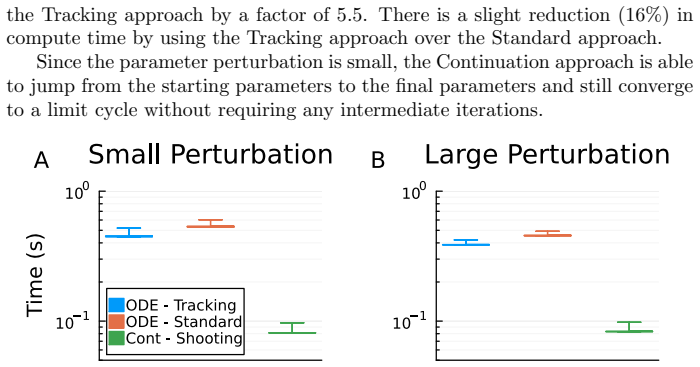
The paper's central claim is that the expensive stage in parameter inference—waiting for the ODE model to converge to a stable action potential—can often be skipped by following the branch of limit cycles from the previously accepted parameters to the newly proposed ones. In head-to-head benchmarks on a Noble-derived concentration model, continuation finds the converged action potential 6.5 times faster than the standard approach for a small parameter perturbation and 5.5 times faster after a large perturbation; for the large perturbation it is still 4.7 times faster than restarting from the previous converged cycle with an ODE solver. Embedded in an adaptive Metropolis-Hastings MCMC run of 40,000 iterations, continuation reduces total computation from 12.41 hours to 3.71 hours while leaving the posterior distribution visually and numerically unchanged. The authors position this as a demonstration on one exemplar model, not a blanket guarantee.
Load-bearing premise
The headline speedup rests on the exemplar model's hand-chosen slow convergence being representative of how real cardiac action potential models converge; the paper asserts this but tests it only on that one derived model.
Editorial extensions
If this is right
- MCMC and multi-start optimization for cardiac action-potential models become several times cheaper, making uncertainty quantification and multi-modal posterior exploration computationally tractable.
- The cost advantage grows when optimization proposes small parameter steps, as MCMC does, because continuation cost grows with parameter-space distance and cycle sensitivity.
- Storing all previously computed limit cycles, rather than only the last accepted one, would let any optimizer start continuation from the nearest previously evaluated parameters, extending the benefit beyond MCMC.
- When continuation is too difficult for the largest stiff models, restarting ODE integration from the previous converged cycle still yields a modest 7% speedup with little added complexity.
- The same convergence-termination scheme that stops ODE simulations once the L1 norm drops below $10^{-6}$ avoids wasted computation and is cheap even when the period is not fixed.
Reading between the lines
- The same continuation-tracking recipe should transfer to other fast-slow biological models calibrated to stable cycles, such as circadian rhythms, calcium oscillations, and neural oscillations, since the only requirement is a stable periodic orbit as the object of comparison.
- The reported divergence between the Standard and Continuation MCMC chains at iteration 30,275, triggered by likelihoods differing in the fourth decimal (-1113.1446 vs -1113.1460), suggests that a stricter orbit-convergence tolerance could eliminate even these rare accept-or-reject discrepancies.
- A practical safeguard the paper mentions but does not test is a hybrid scheme: continue the limit cycle when tracking succeeds, and fall back to a full ODE solve whenever the branch loses stability or a conserved quantity changes, preserving the speedup without silently following an unstable branch.
Editorial analysis
A structured set of objections, weighed in public.
Referee Report
Summary. The paper proposes using numerical continuation methods (specifically shooting-method continuation in BifurcationKit.jl) to track the converged limit cycle of a cardiac action potential model as parameters change during optimization or MCMC, instead of repeatedly integrating the ODE system from scratch or from the previous cycle. The authors introduce an autonomous 'Noble concentration' toy model obtained by adding sodium and potassium concentration dynamics with forcing terms to the Noble 1962 model, with a rate parameter tau=2.5 chosen to mimic typical convergence times of cardiac AP models. They benchmark three approaches (Standard ODE integration, Tracking ODE integration, and Continuation) on small and large parameter perturbations, reporting 5.5-6.5x speedups. They then integrate the approaches into an adaptive Metropolis-Hastings MCMC scheme, reporting a 70% wall-clock reduction for 40,000 iterations (12.41 h vs 3.71 h) with visually indistinguishable posterior distributions. The paper also discusses theoretical caveats: multiple stable limit cycles, extinction of a followed branch, and practical difficulties for stiff, paced production models.
Significance. If the central claim holds, the work would provide a practically useful way to accelerate parameter inference for periodically forced biological models, where repeated convergence to a stable limit cycle is a major computational bottleneck. The manuscript has notable strengths: the comparison is carefully constructed to favor ODE baselines (which stop at an L1 change below 1e-6 while continuation must additionally satisfy BifurcationKit's tighter residual criterion below 1e-10); the MCMC comparison uses identical data, noise, and burn-in across methods; and the posterior distributions from all three approaches are shown to agree. The code and data are provided on GitHub and archived on Zenodo, supporting reproducibility. However, the demonstrated speedup is obtained on a single hand-parameterized, autonomous, unpaced toy model, and the paper itself concedes that applying continuation to the stiff, paced models that motivate the work 'can be challenging'. The transferability of the 70% figure to production cardiac AP models is therefore an open, load-bearing question rather than an established result.
major comments (4)
- [Section 2.3 and Eq. (A7)] The speedup is controlled by the hand-set relaxation rate tau=2.5, which is chosen to make the toy model converge in about 100 s. Because the Standard and Tracking approaches must resolve the entire slow transient while continuation solves a one-period boundary value problem, the measured speedup is largely a function of this arbitrary parameter. The paper provides no sensitivity analysis over tau or over the convergence tolerance (L1 < 1e-6), so the reader cannot tell how the 70% figure changes for faster or slower model equilibration, nor whether the method would remain beneficial for models that converge in a few seconds. This is a load-bearing gap for the generality of the practical claim.
- [Section 2 and Section 7] BifurcationKit.jl does not support non-autonomous ODEs, and the authors note that paced stiff models (e.g., Dutta et al. or Tomek et al.) would require an augmentation such as a harmonic oscillator, which is never implemented or benchmarked. Section 7 states that ensuring continuation convergence for these larger models 'can be challenging'. Since the motivating application is precisely those paced, stiff models, the central claim that continuation 'can more efficiently infer the converged action potential' is not yet demonstrated for the target setting; it remains an existence proof for a favorable autonomous toy model. The paper should either provide such a benchmark, or substantially temper the abstract and framing to clearly state that the benefit is shown only for the exemplar model.
- [Table 2 and Appendix B] The MCMC timing comparison is based on a single run per method. The paper reports 12.41 h, 11.59 h, and 3.71 h for Standard, Tracking, and Continuation, respectively, with no repeated runs or error bars. Given that wall-clock times on a shared HPC node can vary, and that the specific acceptance path can differ (as shown by the divergence at iteration 30275), a single run leaves uncertainty in the exact magnitude of the 70% reduction. At least a few repeated runs, or a sensitivity test with different random seeds, would strengthen the claim.
- [Section 4.1 and Figure 2] The caption states 'The 0th, 25th, 50th, and 75th percentiles overlap', which is unclear and appears inconsistent with standard boxplot summaries. More importantly, the text reports speedup factors as single numbers without reporting the distribution of timings across the repeated benchmark simulations. Since the benchmarks were repeated (whiskers are shown), reporting medians and ranges would give the reader a better sense of the stability of the speedup factors.
minor comments (5)
- [Section 2] The model is attributed to 'Nobel 1962' in the text; the surname should be 'Noble' as in the reference [40].
- [Section 2.2] There is a missing space in 'continuation methods inBifurcationKit.jl'.
- [Algorithm 1] The pseudocode uses 'converge' both to compute a limit cycle from initial conditions and to track from a previous limit cycle; it would be clearer to name these operations differently, e.g., 'converge_from_ic' and 'converge_from_cycle'.
- [Section 7] The sentence beginning 'The fact beat-to-beat variability decreases substantially in tissue...' is grammatically incomplete; it should be reworded.
- [General] The paper would benefit from a short table summarizing the model equations, initial conditions, and convergence tolerances in the main text, since readers of the appendix are forced to cross-reference Eq. (A7), Table A3, and Section 2.2 to reproduce the experiments.
Circularity Check
No circularity: the 70% speedup is an empirical timing benchmark on a hand-tuned toy model, not a derived prediction; scope limitations are acknowledged, not circular.
full rationale
The paper's central claim is an empirical timing comparison, not a derivation: the Continuation approach is benchmarked against Standard and Tracking ODE integration on the Noble concentration model, reporting wall-clock times (Fig. 2, Table 2). The hand-set values (tau = 2.5, L1 convergence tolerance 1e-6) parameterize the exemplar and define convergence; neither is fitted to data and then renamed as a prediction. The MCMC speedup (12.41 h vs 3.71 h for 40,000 iterations) is a direct measurement with identical synthetic data across all three methods, and Appendix B checks that the posterior distributions and MCMC chains agree between approaches, so the speedup is not bought by changing the inference target. No load-bearing self-citation appears: the adaptive Metropolis-Hastings sampler is attributed to Haario et al. and Johnstone et al., but the comparison uses the same sampler with different limit-cycle solvers; the Chaste convergence criterion is cited for motivation only. Section 7's concession that ensuring continuation convergence for larger AP models such as Dutta et al. or Tomek et al. 'can be challenging' is an explicit scope limitation, not a circular step. Therefore no claimed result reduces by construction to its inputs.
Assumptions & free parameters
free parameters (4)
- tau (concentration relaxation rate) =
2.5
- L1 convergence tolerance =
1e-6
- Target reversal potentials for concentration relaxation =
E_Na = 40 mV, E_K = -100 mV
- Relaxation time constant (20 ms denominator) =
20
assumptions (5)
- standard math Shooting method continuation with predictor-corrector steps follows branches of stable and unstable periodic orbits (Eqs. 3-4 hold throughout).
- domain assumption For the parameters explored, the Nobel concentration model has a stable limit cycle representing the converged action potential, and starting the ODE from the Table A3 non-converged initial conditions approaches it.
- domain assumption The synthetic AP data generated from the converged limit cycle of the same model (Appendix B.1) are a sufficient proxy for experimental data when assessing accuracy and speed of the inference.
- ad hoc to paper Concentration relaxation toward fixed target reversal potentials with time constant 20 ms reproduces the slow convergence behavior of real cardiac models (Eq. A7).
- domain assumption The convergence rate tau = 2.5 is representative of 'typical cardiac AP model' convergence (Section 2.3).
Cite this review
Pith. "Pith review of Continuation methods as a tool for parameter inference in electrophysiology modeling." pith.science (2026). https://pith.science/paper/S3LGRL2E
@misc{pith2026250108355,
  author       = {Pith},
  title        = {Pith review of: Continuation methods as a tool for parameter inference in electrophysiology modeling},
  year         = {2026},
  howpublished = {\url{https://pith.science/paper/S3LGRL2E}},
  note         = {Machine review of arXiv:2501.08355}
}
read the original abstract
Parameterizing mathematical models of biological systems often requires fitting to stable periodic data. In cardiac electrophysiology this typically requires converging to a stable action potential through long simulations. We explore this problem through the theory of dynamical systems, bifurcation analysis and continuation methods; under which a converged action potential is a stable limit cycle. Various attempts have been made to improve the efficiency of identifying these limit cycles, with limited success. We demonstrate that continuation methods can more efficiently infer the converged action potential as proposed model parameter sets change during optimization or inference routines. In an example electrophysiology model this reduces parameter inference computation time by 70%. We also discuss theoretical considerations and limitations of continuation method use in place of time-consuming model simulations. The application of continuation methods allows more robust optimization by making extra runs from multiple starting locations computationally tractable, and facilitates the application of inference methods such as Markov Chain Monte Carlo to gain more information on the plausible parameter space.
Figures


Figures from the paper (2 more)


Reference graph
Works this paper leans on
-
[1]
C. Jost and R. Arditi. From pattern to process: identifying predator–prey models from time-series data. Population Ecology, 43(3):229–243, 2001
work page 2001
-
[2]
A. Asgari-Targhi and E. B. Klerman. Mathematical modeling of circadian rhythms. Wiley Interdisciplinary Reviews: Systems Biology and Medicine, 11(2):e1439, 2019
work page 2019
-
[3]
J. M. Han, A. Tanimura, V. Kirk, and J. Sneyd. A mathematical model of calcium dynamics in hsy cells. PLoS computational biology, 13(2):e1005275, 2017
work page 2017
-
[4]
M. C. Mackey and L. Glass. Oscillation and chaos in physiological control systems. Science, 197(4300):287–289, 1977
work page 1977
-
[5]
T. Donoghue, N. Schaworonkow, and B. Voytek. Methodological consider- ations for studying neural oscillations. European journal of neuroscience, 55(11-12):3502–3527, 2022
work page 2022
-
[6]
J. Tomek, A. Bueno-Orovio, E. Passini, X. Zhou, A. Minchole, O. Britton, C. Bartolucci, S. Severi, A. Shrier, L. Virag, A. Varro, and B. Rodriguez. Development, calibration, and validation of a novel human ventricular my- ocyte model in health, disease, and drug block. eLife, 8:e48890, 2019. doi: 10.7554/eLife.48890
-
[7]
S. Dutta, K. C. Chang, K. A. Beattie, J. Sheng, P. N. Tran, W. W. Wu, M. Wu, D. G. Strauss, T. Colatsky, and Z. Li. Optimization of an in silico cardiac cell model for proarrhythmia risk assessment. Frontiers in Physiology, 8:616, 2017. doi: 10.3389/fphys.2017.00616. 27
-
[8]
D. Du, H. Yang, S. A. Norring, and E. S. Bennett. In-silico modeling of glycosylation modulation dynamics in hERG ion channels and cardiac electrical signals. IEEE Journal of Biomedical and Health Informatics, 18 (1):205–214, 2014. doi: 10.1109/JBHI.2013.2260864
arXiv 2014
Show all 59 references
-
[9]
Houston, B
C. Houston, B. Marchand, L. Engelbert, and C. D. Cantwell. Reduc- ing complexity and unidentifiability when modelling human atrial cells. Philosophical Transactions of the Royal Society A: Mathematical, Physical and Engineering Sciences, 378(2173):20190339, 2020. doi: 10.1098/...
2020
-
[10]
D. G. Whittaker, M. Clerx, C. L. Lei, D. J. Christini, and G. R. Mirams. Calibration of ionic and cellular cardiac electrophysiology models. WIREs Systems Biology and Medicine, 12(4):e1482, 2020. doi: 10.1002/wsbm. 1482
2020 doi
-
[11]
Clerx, G
M. Clerx, G. R. Mirams, A. J. Rogers, S. M. Narayan, and W. R. Giles. Immediate and delayed response of simulated human atrial myocytes to clinically-relevant hypokalemia. Frontiers in Physiology, 12:651162, 2021. doi: 10.3389/fphys.2021.651162
2021
-
[12]
Smirnov, A
D. Smirnov, A. Pikunov, R. Syunyaev, R. Deviatiiarov, O. Gusev, K. Aras, A. Gams, A. Koppel, and I. R. Efimov. Genetic algorithm-based per- sonalized models of human cardiac action potential. PLOS ONE, 15(5): e0231695, 2020. doi: 10.1371/journal.pone.0231695
2020 doi
-
[13]
Groenendaal, F
W. Groenendaal, F. A. Ortega, A. R. Kherlopian, A. C. Zygmunt, T. Krogh-Madsen, and D. J. Christini. Cell-specific cardiac electrophys- iology models. PLOS Computational Biology, 11(4):e1004242, 2015. doi: 10.1371/journal.pcbi.1004242
2015 doi
-
[14]
Z. Syed, E. Vigmond, S. Nattel, and L. J. Leon. Atrial cell action potential parameter fitting using genetic algorithms. Medical and Biological Engi- neering and Computing, 43(5):561–571, 2005. doi: 10.1007/BF02351029
2005 doi
-
[15]
Y.-S. H. M. Barral, J. G. Shuttleworth, M. Clerx, D. G. Whittaker, K. Wang, L. Polonchuk, D. J. Gavaghan, and G. R. Mirams. A param- eter representing missing charge should be considered when calibrating action potential models. Frontiers in Physiology, 13:879035, 2022. doi: 1...
2022
-
[16]
C. T. Bot, A. R. Kherlopian, F. A. Ortega, D. J. Christini, and T. Krogh- Madsen. Rapid genetic algorithm optimization of a mouse computational model: Benefits for anthropomorphization of neonatal mouse cardiomy- ocytes. Frontiers in Physiology, 3:421, 2012. doi: 10.3389/fphys...
2012 doi
-
[17]
G. M. Faber and Y. Rudy. Action potential and contractility changes in [Na+]i overloaded cardiac myocytes: A simulation study. Biophysical Journal, 78(5):2392–2404, 2000. doi: 10.1016/S0006-3495(00)76783-X. 28
-
[18]
A. X. Sarkar and E. A. Sobie. Regression analysis for constraining free parameters in electrophysiological models of cardiac cells. PLOS Com- putational Biology, 6(9):e1000914, 2010. doi: 10.1371/journal.pcbi. 1000914
2010 doi
-
[19]
J. S. Umbr ´ ıa and M. Net. Numerical continuation methods for large-scale dissipative dynamical systems. The European Physical Journal Special Top- ics, 225(13):2465–2486, 2016. doi: 10.1140/epjst/e2015-50317-2
2016 doi
-
[20]
Govaerts
W. Govaerts. Numerical bifurcation analysis for ODEs. Journal of Com- putational and Applied Mathematics, 125(1):57–68, 2000. doi: 10.1016/ S0377-0427(00)00458-1
-
[21]
Dankowicz and F
H. Dankowicz and F. Schilder. Recipes for Continuation. Computa- tional Science & Engineering. Society for Industrial and Applied Mathe- matics, Philadelphia, PA, 2013. ISBN 978-1-61197-256-6. doi: 10.1137/ 1.9781611972573
2013
-
[22]
Dhooge, W
A. Dhooge, W. Govaerts, Y. A. Kuznetsov, H. G. Meijer, and B. Sautois. New features of the software MatCont for bifurcation analysis of dynamical systems. Mathematical and Computer Modelling of Dynamical Systems, 14 (2):147–175, 2008. doi: 10.1080/13873950701742754
2008 doi
-
[23]
R. H. Clewley, W. E. Sherwood, M. D. LaMar, and J. M. Guckenheimer. PyDSTool, a software environment for dynamical systems modeling, 2007. URL http://pydstool.sourceforge.net
2007
-
[24]
R. Veltz. BifurcationKit.jl, 2020. URL https://hal.archives-ouvertes. fr/hal-02902346
2020
-
[25]
E. Doedel. AUTO: A program for the automatic bifurcation analysis of autonomous systems. Congressus Numerantium, 30:265–284, 1981
1981
- [26]
-
[27]
Meijer, F
H. Meijer, F. Dercole, and B. Oldeman. Mathematics of complexity and dy- namical systems. In R. A. Meyers, editor, Numerical Bifurcation Analysis, pages 1172–1194. Springer, New York, NY, 2011. ISBN 978-1-4614-1806-1. doi: 10.1007/978-1-4614-1806-1_71
2011 doi
-
[28]
Govaerts and Y
W. Govaerts and Y. A. Kuznetsov. Interactive continuation tools. In B. Krauskopf, H. M. Osinga, and J. Gal´ an-Vioque, editors,Numerical Con- tinuation Methods for Dynamical Systems: Path following and boundary value problems, pages 51–75. Springer Netherlands, Dordrecht, 2007...
2007 doi
-
[29]
Rackauckas and Q
C. Rackauckas and Q. Nie. DifferentialEquations.jl–a performant and feature-rich ecosystem for solving differential equations in Julia. Journal of Open Research Software, 5(1):15, 2017. doi: 10.5334/jors.151
2017 doi
-
[30]
Z. Hu, D. Du, and Y. Du. Generalized polynomial chaos-based uncertainty quantification and propagation in multi-scale modeling of cardiac electro- physiology. Computers in Biology and Medicine, 102:57–74, 2018. doi: 10.1016/j.compbiomed.2018.09.006
2018 doi
-
[31]
Coveney and R
S. Coveney and R. H. Clayton. Fitting two human atrial cell models to experimental data using Bayesian history matching. Progress in Biophysics and Molecular Biology, 139:43–58, 2018. doi: 10.1016/j.pbiomolbio. 2018.08.001
2018 doi
-
[32]
Coveney and R
S. Coveney and R. H. Clayton. Sensitivity and uncertainty analysis of two human atrial cardiac cell models using gaussian process emulators. Frontiers in Physiology, 11:364, 2020. doi: 10.3389/fphys.2020.00364
2020
-
[33]
Pathmanathan, J
P. Pathmanathan, J. M. Cordeiro, and R. A. Gray. Comprehensive un- certainty quantification and sensitivity analysis for cardiac action potential models. Frontiers in Physiology, 10:721, 2019. doi: 10.3389/fphys.2019. 00721
2019 doi
-
[34]
Pathmanathan, S
P. Pathmanathan, S. K. Galappaththige, J. M. Cordeiro, A. Kaboudian, F. H. Fenton, and R. A. Gray. Data-driven uncertainty quantification for cardiac electrophysiological models: Impact of physiological variability on action potential and spiral wave dynamics. Frontiers in Phy...
2020
-
[35]
R. H. Clayton, Y. Aboelkassem, C. D. Cantwell, C. Corrado, T. Delhaas, W. Huberts, C. L. Lei, H. Ni, A. V. Panfilov, C. Roney, and R. W. dos Santos. An audit of uncertainty in multi-scale cardiac electrophysiology models. Philosophical Transactions of the Royal Society A: Math...
2020
-
[36]
D. B. Hitchcock. A history of the Metropolis-Hastings algorithm. The American Statistician, 57(4):254–257, 2003
2003
-
[37]
Haario, E
H. Haario, E. Saksman, and J. Tamminen. An adaptive Metropolis algo- rithm. Bernoulli, 7(2):223–242, 2001. doi: 10.2307/3318737
2001 doi
-
[38]
T. Toni, D. Welch, N. Strelkowa, A. Ipsen, and M. P. Stumpf. Approximate Bayesian computation scheme for parameter inference and model selection in dynamical systems. Journal of The Royal Society Interface, 6(31):187– 202, 2008. doi: 10.1098/rsif.2008.0172
2008
-
[39]
G. Szep, N. Dalchau, and A. Csik´ asz-Nagy. Parameter inference with bi- furcation diagrams. In M. Ranzato, A. Beygelzimer, Y. Dauphin, P. Liang, 30 and J. W. Vaughan, editors, Advances in neural information processing systems, volume 34, pages 5620–5630. Curran Associates, Inc., 2021
2021
-
[40]
D. Noble. A modification of the Hodgkin–Huxley equations applicable to Purkinje fibre action and pace-maker potentials.The Journal of Physiology, 160(2):317–352, 1962. doi: 10.1113/jphysiol.1962.sp006849
1962 doi
-
[41]
F. R. Cooper, R. E. Baker, M. O. Bernabeu, R. Bordas, L. Bowler, A. Bueno-Orovio, H. M. Byrne, V. Carapella, L. Cardone-Noott, J. Cooper, S. Dutta, B. D. Evans, A. G. Fletcher, J. A. Grogan, W. Guo, D. G. Har- vey, M. Hendrix, D. Kay, J. Kursawe, P. K. Maini, B. McMillan, G. R...
2020
-
[42]
Cooper, R
J. Cooper, R. J. Spiteri, and G. R. Mirams. Cellular cardiac electrophys- iology modeling with Chaste and CellML. Frontiers in Physiology, 5:511,
-
[43]
K. F. Decker, J. Heijman, J. R. Silva, T. J. Hund, and Y. Rudy. Properties and ionic mechanisms of action potential adaptation, restitu- tion, and accommodation in canine epicardium. American Journal of Physiology-Heart and Circulatory Physiology, 296(4):H1017–H1026, 2009. doi...
2009
- [44]
-
[45]
R. H. Johnstone, R. Bardenet, D. J. Gavaghan, L. Polonchuk, M. R. Davies, and G. R. Mirams. Hierarchical Bayesian modelling of variability and un- certainty in synthetic action potential traces. Computing in cardiology, 43: 1089, 2016. doi: 10.22489/CinC.2016.313-458
2016 doi
-
[46]
R. H. Johnstone, E. T. Y. Chang, R. Bardenet, T. P. d. Boer, D. J. Gav- aghan, P. Pathmanathan, R. H. Clayton, and G. R. Mirams. Uncertainty and variability in models of the cardiac action potential: Can we build trustworthy models? Journal of Molecular and Cellular Cardiology...
2016 doi
-
[47]
A. N. Ramos, C. J. Herndon, F. H. Fenton, and E. M. Cherry. Quanti- fying distributions of parameters for cardiac action potential models using the Hamiltonian Monte Carlo method. In 2021 Computing in Cardiology (CinC), pages 1–4, 2021. doi: 10.23919/CinC53138.2021.9662836
2021
-
[48]
J. A. Nelder and R. Mead. A simplex method for function minimization. The Computer Journal, 7(4):308–313, 1965. doi: 10.1093/comjnl/7.4. 308. 31
1965 doi
-
[49]
P. K. Mogensen and A. N. Riseth. Optim: A mathematical optimization package for Julia. Journal of Open Source Software, 3(24):615, 2018. doi: 10.21105/joss.00615
2018 doi
-
[50]
Surovyatkina, D
E. Surovyatkina, D. Noble, D. Gavaghan, and A. Sher. Multistability prop- erty in cardiac ionic models of mammalian and human ventricular cells. Progress in biophysics and molecular biology, 103(1):131–141, 2010
2010
-
[51]
Livshitz and Y
L. Livshitz and Y. Rudy. Uniqueness and stability of action potential mod- els during rest, pacing, and conduction using problem-solving environment. Biophysical journal, 97(5):1265–1276, 2009
2009
-
[52]
Babloyantz and A
A. Babloyantz and A. Destexhe. Is the normal heart a periodic oscillator? Biological cybernetics, 58(3):203–211, 1988
1988
-
[53]
Zaniboni, A
M. Zaniboni, A. E. Pollard, L. Yang, and K. W. Spitzer. Beat-to-beat repolarization variability in ventricular myocytes and its suppression by electrical coupling. American Journal of Physiology-Heart and Circulatory Physiology, 278(3):H677–H687, 2000
2000
-
[54]
Heijman, A
J. Heijman, A. Zaza, D. M. Johnson, Y. Rudy, R. L. Peeters, P. G. Volders, and R. L. Westra. Determinants of beat-to-beat variability of repolarization duration in the canine ventricular myocyte: a computational analysis.PLoS computational biology, 9(8):e1003202, 2013
2013
-
[55]
Pueyo, Z
E. Pueyo, Z. Husti, T. Hornyik, I. Baczk´ o, P. Laguna, A. Varr´ o, and B. Rodr ´ ıguez. Mechanisms of ventricular rate adaptation as a predictor of arrhythmic risk. American Journal of Physiology-Heart and Circulatory Physiology, 298(5):H1577–H1587, 2010. doi: 10.1152/ajphear...
2010 doi
-
[56]
Muszkiewicz, O
A. Muszkiewicz, O. J. Britton, P. Gemmell, E. Passini, C. S´ anchez, X. Zhou, A. Carusi, T. A. Quinn, K. Burrage, A. Bueno-Orovio, and B. Ro- driguez. Variability in cardiac electrophysiology: Using experimentally- calibrated populations of models to move beyond the single vir...
2016 doi
-
[57]
J. G. Shuttleworth, C. L. Lei, D. G. Whittaker, M. J. Windley, A. P. Hill, S. P. Preston, and G. R. Mirams. Empirical quantification of predictive un- certainty due to model discrepancy by training with an ensemble of exper- imental designs: an application to ion channel kinet...
2023 doi
-
[58]
Lopez-Perez, R
A. Lopez-Perez, R. Sebastian, M. Izquierdo, R. Ruiz, M. Bishop, and J. M. Ferrero. Personalized cardiac computational models: From clinical data to simulation of infarct-related ventricular tachycardia. Frontiers in Physiol- ogy, 10:580, 2019. doi: 10.3389/fphys.2019.00580. 32
2019
-
[2015]
doi: 10.3389/fphys.2014.00511
2014
Reviewed August 10, 2026 · model on record in the stance chip above.
Discussion (0). Continue with ORCID to comment.