REVIEW 3 major objections 6 minor 46 references
Characterizing the Dynamics of Conspiracy Related German Telegram Conversations during COVID-19
T0 review · 3 major / 6 minor · reviewed 2026-08-06 · deepseek-v4-flash
Pith's one-line read German conspiracy-related Telegram chats during the pandemic are dominated by a small number of spreader channels and carry an unusually high share of untrustworthy links: 42.7% of shared links point to domains that NewsGuard scores below…
desk verdict Solid descriptive map of a German Telegram conspiracy corpus, but the headline misinformation claim leans on an unmatched Twitter comparison. read the letter →
The pith
A machine-rendered reading of the paper's core claim, the machinery that carries it, and where it could break.
The reading
What carries the argument
The analysis rests on three instruments. The Schwurbelarchiv, a snowball-sampled corpus of roughly 6,000 public German-language Telegram chats (an estimated 50% of the relevant discourse), provides messages, forwards, authors, and timestamps from September 2015 to August 2022. A forwarded-message network, built by matching forwarded messages to their originals through author, text, and timestamp, carries the structural analysis. Trustworthiness is operationalized through NewsGuard domain ratings, with scores below 60 counted as untrustworthy, and the same operationalization is used to compare against Twitter data from the cited literature.
What would settle it
Collect an independent census of German-language public Telegram chats from the same period—for example, starting from Telegram's own search or from the larger Mohr corpus—and measure the share of links to NewsGuard-rated untrustworthy domains and the forwarding concentration. If the share drops well below 42.7% or the top-decile concentration falls far below 94% once the snowball seed is removed, the paper's headline claims would be artifacts of sampling rather than properties of the discourse.
Extended reading notes
Core claim
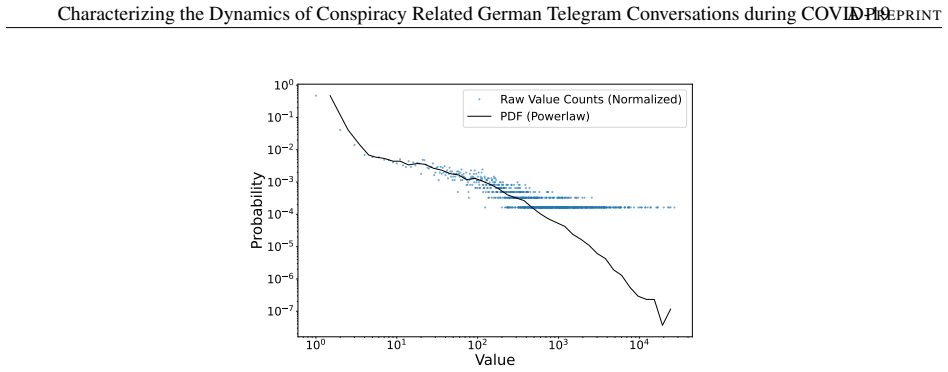
The central discovery, as the authors frame it, is that conspiracy-related German Telegram discourse during the pandemic is not a decentralized many-to-many conversation but a concentrated structure: a small number of broadcast channels produce most forwarded content, while the many groups mostly receive it. The dataset reveals that chats with high out-degree (spreader chats) do not forward much to each other and instead send content to low-traffic groups, while chats that receive many forwards tend to cluster together. At the same time, activity spikes align with real-world events such as the storming of the U.S. Capitol and the inauguration of Joe Biden, and forwarding longevity on Telegram outlasts that on Twitter. The paper's headline figure is that 42.7% of 2,308,880 links in the corpus point to domains that NewsGuard scores below 60 ('not trustworthy'), classifying the ecosystem as a dense misinformation vector.
Load-bearing premise
The central assumption is that the Schwurbelarchiv's snowball collection, with a human selecting conspiracy-related public chats, captures a representative slice of German-language conspiracy Telegram discourse, so that aggregate statistics like the 42.7% untrustworthy-link share and the 94% forwarding concentration generalize beyond the sampled chats.
Editorial extensions
If this is right
- If 42.7% of shared links are untrustworthy, then public Telegram chats in German-speaking countries were a high-density misinformation vector during the pandemic, and the same method could quantify similar ecosystems in other languages.
- Because the top 10% of chats produce 94% of forwarded content, interventions that reach or counter those few channels could plausibly reduce most content diffusion.
- The finding that national and transnational messages are more likely to reach regional chats than the reverse implies that local conspiracy communities are partly seeded by super-regional narratives.
- The slower decay of forwards on Telegram relative to Twitter suggests misinformation lingers longer where algorithmic recommendation is absent.
- The chat-typing heuristic (usernames containing the chat name) and the geographic matching by chat names offer a transferable method for other unmoderated messenger corpora.
Reading between the lines
- The 42.7% figure depends on NewsGuard's binary threshold; applying other domain-quality ratings (which the paper cites) could shift the share significantly, so a multi-rater robustness check would settle how stable the number is.
- Because the corpus covers only about 50% of the discourse and excludes private chats, the untrustworthy-link share could be systematically higher or lower; the paper's own remark that deleted messages likely skew untrustworthy suggests the true share may be understated.
- Re-running the same forwarding-concentration and link-quality analysis on the independent Mohr dataset, which the authors already use for completeness benchmarking, would test whether the snowball-selection procedure biases the headline results.
- The regional flow asymmetry implies a plausible mechanism for narrative spread—national channels broadcast, regional groups adopt—that could be tested by tracking specific conspiracy narratives from their first appearance in a national channel to their echo in local groups.
Editorial analysis
A structured set of objections, weighed in public.
Referee Report
Summary. The paper presents a descriptive, observational analysis of the Schwurbelarchiv, a corpus of German-language Telegram messages from conspiracy-related public chats, spanning roughly 2015 to mid-2022. It addresses four research questions: temporal activity dynamics during COVID-19; the regional, national, and transnational distribution of chats and message flows; the concentration of forwarding activity and its implications for influence; and the prevalence of links to untrustworthy sources as rated by NewsGuard. The main quantitative findings are that message activity peaks coincide with major socio-political events, that 94% of forwarded content originates from the top 10% of spreader chats, that information flows predominantly from transnational and national chats into regional chats, and that 42.7% of the 2,308,880 links in the corpus point to NewsGuard-rated untrustworthy domains. The authors claim this share 'far exceeds' the share seen on other platforms and in other discourse contexts, citing a comparison with links shared by political elites on Twitter.
Significance. If the central descriptive findings are accepted, this would be a valuable large-scale contribution to the empirical literature on conspiracy-related Telegram discourse. The paper uses a novel corpus that is substantially larger than most existing studies, reports descriptive statistics directly from scraped messages without fitted parameters, makes the forwarding network publicly available, and explicitly discusses data coverage and limitations. The regional-to-national flow analysis and the concentration of forwarding activity are concrete, falsifiable descriptions that could inform future work on platform governance and misinformation. The significance of the headline misinformation claim, however, depends on two things the paper does not currently establish: that the snowball-sampled corpus represents German conspiracy Telegram discourse, and that the cross-platform comparison is valid. These issues are fixable, but they are load-bearing for the abstract's strongest claim.
major comments (3)
- [Abstract; Section 4.4] The claim that the 42.7% untrustworthy-link share is 'far exceeding their share on other platforms and in other discourse contexts' is not supported by the comparison offered. The comparison population in Lasser et al. (2022) is political elites on Twitter over 2016-2022, whereas the present corpus is conspiracy-focused Telegram chats over a different time window; the platform, the population, and the possible denominator rules all differ. Any of these differences could account for the gap, so the abstract's cross-platform and cross-context claim overreaches. The authors should either restrict the claim to the sampled corpus or provide a matched comparison, for example by computing the same link-quality statistics on the Mohr (2023) dataset already used for comparison in Section 4.2.
- [Section 4.4] The denominator for the 42.7% figure is ambiguous. The text states that 'among the 2,308,880 links posted in the Telegram chats, 42.7% point to domains classified as not trustworthy by NewsGuard,' but NewsGuard rates news and information domains, not all URLs. If the denominator is all links, the authors should explain how non-news links (e.g., YouTube, Twitter, shopping links) were classified; if the denominator is limited to links to NewsGuard-rated domains, that denominator should be reported explicitly and used consistently when comparing with Lasser et al. (2022), whose denominator rules may differ.
- [Section 3.1; Section 5.0.1] The robustness of the headline 42.7% statistic to sampling selection is not assessed. The paper acknowledges that the Schwurbelarchiv likely contains about 50% of the relevant discourse and that chats were selected via snowball sampling with a human-in-the-loop component focused on conspiracy-related content. If that selection over-represented chats that disproportionately share low-quality links, the in-corpus statistic itself could be inflated. Because RQ4 and the abstract's central claim depend on this number, the authors should provide a sensitivity analysis, for example by computing link-quality statistics on the Mohr (2023) dataset or on clearly defined subsets of the corpus, and should explicitly discuss how selection could affect the estimate.
minor comments (6)
- [Abstract; Section 4.4] The abstract reports '43%' of links while Section 4.4 reports 42.7%; these should be made numerically consistent.
- [Abstract] There is a typo in the first sentence of the abstract: 'the structure of of conspiracy-related.'
- [Figure 2 caption] The caption describes 'active authors' while the y-axis label reads 'Active Groups'; please correct the mismatch.
- [Table 1] The table reports forwarding probabilities but does not specify the denominator; the authors should state explicitly whether probabilities are conditional on all forwarded messages or on messages originating from the source chat type.
- [Section 5.0.1] The text refers to a 'Section Ethics and Data Protection' that does not appear in the manuscript; this cross-reference should be removed or the section added.
- [Section 3.3] Several city names in the appendix lists are concatenated without spaces (e.g., 'BadKreuznach', 'VillingenSchwenningen'); please clarify whether these are intentional matching patterns and how they interact with the space/punctuation boundary rule described in Section 3.3.
Circularity Check
No circularity: all headline statistics are direct corpus aggregates against external NewsGuard ratings and independently published benchmarks.
full rationale
The paper's headline quantities are computed directly from the scraped corpus: the 42.7% untrustworthy-link share is a ratio of 2,308,880 posted links matched to external NewsGuard domain scores, the 94%-of-forwards concentration is a degree aggregation over the forwarding network, and the 75.6%/95.5% decay figures are empirical cumulative distribution values of forward time differences. No model parameter is fitted to any of these outcomes, so none of them is an input renamed as a prediction. The cross-platform comparisons to Lasser et al. (2022) and Pfeffer et al. (2023) use separately published external corpora and are not derived from the Schwurbelarchiv, even though one author overlaps with the Lasser et al. study. The only author-self-citation, Angermaier et al. (2025), supplies dataset cleaning and a coverage estimate (about 50%); that estimate is itself an external comparison against the Mohr and Zehring corpora and does not enter the computation of the reported statistics. Sampling limitations are acknowledged in Section 5.0.1 and are validity concerns, not tautologies. Hence there is no circular step.
Assumptions & free parameters
assumptions (7)
- domain assumption Forward matching of messages: a message text, author, and posting second uniquely identify an original message; one author cannot post the same message in the same second in multiple chats.
- domain assumption Chat type classification: if all usernames in a chat contain the chat's name, the chat is a broadcast channel; otherwise it is a group.
- domain assumption Regional scope is inferred from chat names via city/region lists; names without any such reference are 'transnational'.
- domain assumption The Schwurbelarchiv captures about 50% of relevant German-language conspiracy discourse, per the companion paper (Angermaier et al. 2025), and the sampled chats are representative for aggregate statistics.
- domain assumption NewsGuard score below 60 indicates 'not trustworthy', and this threshold is applied uniformly to all shared links.
- domain assumption Spikes in message activity on the same day as notable real-life events are related to those events (manual matching).
- domain assumption Cross-platform comparison: prevalence of untrustworthy links in political elites' Twitter sharing (Lasser et al. 2022) is a valid baseline for conspiracy Telegram chats.
Cite this review
Pith. "Pith review of Characterizing the Dynamics of Conspiracy Related German Telegram Conversations during COVID-19." pith.science (2026). https://pith.science/paper/S42ZZQ2Q
@misc{pith2026250713398,
  author       = {Pith},
  title        = {Pith review of: Characterizing the Dynamics of Conspiracy Related German Telegram Conversations during COVID-19},
  year         = {2026},
  howpublished = {\url{https://pith.science/paper/S42ZZQ2Q}},
  note         = {Machine review of arXiv:2507.13398}
}
read the original abstract
Conspiracy theories have long drawn public attention, but their explosive growth on platforms like Telegram during the COVID-19 pandemic raises pressing questions about their impact on societal trust, democracy, and public health. We provide a geographical, temporal and network analysis of the structure of of conspiracy-related German-language Telegram chats in a novel large-scale data set. We examine how information flows between regional user groups and influential broadcasting channels, revealing the interplay between decentralized discussions and content spread driven by a small number of key actors. Our findings reveal that conspiracy-related activity spikes during major COVID-19-related events, correlating with societal stressors and mirroring prior research on how crises amplify conspiratorial beliefs. By analysing the interplay between regional, national and transnational chats, we uncover how information flows from larger national or transnational discourse to localised, community-driven discussions. Furthermore, we find that the top 10% of chats account for 94% of all forwarded content, portraying the large influence of a few actors in disseminating information. However, these chats operate independently, with minimal interconnection between each other, primarily forwarding messages to low-traffic groups. Notably, 43% of links shared in the data set point to untrustworthy sources as identified by NewsGuard, a proportion far exceeding their share on other platforms and in other discourse contexts, underscoring the role of conspiracy-related discussions on Telegram as vector for the spread of misinformation.
Figures


Figures from the paper (4 more)


Reference graph
Works this paper leans on
-
[1]
Joseph E. Uscinski. The Study of Conspiracy Theories . Argumenta, 3 0 (2): 0 1--13, 2017. doi:10.23811/53. arg2017.usc. URL https://doi.org/10.23811/53 .arg2017.usc
work page doi:10.23811/53 2017
-
[2]
Oslo and Ut ya attacks of 2011
Michael Ray. Oslo and Ut ya attacks of 2011. Encyclopedia Britannica, 2011
work page 2011
-
[3]
Swiss police believe French family jumped off balcony in 'collective suicide'
AFP. Swiss police believe French family jumped off balcony in 'collective suicide'. Euronews, 2023
work page 2023
-
[4]
Maximilian Zehring and Emese Domahidi. German corona protest mobilizers on telegram and their relations to the far right: A network and topic analysis. Social Media + Society, 9 0 (1): 0 20563051231155106, 2023. doi:10.1177/20563051231155106. URL https://doi.org/10.1177/20563051231155106
-
[5]
Stephan Lewandowsky, Ullrich K. H. Ecker, and John Cook. Beyond Misinformation : Understanding and Coping with the “ Post - Truth ” Era . Journal of Applied Research in Memory and Cognition, 6 0 (4): 0 353--369, December 2017
work page 2017
-
[6]
Bayleigh Elaine Bond and Ryan Neville-Shepard. The rise of presidential eschatology: Conspiracy theories, religion, and the january 6th insurrection. American Behavioral Scientist, 67 0 (5): 0 681--696, 2023
work page 2023
-
[7]
The lockdown effect: Implications of the covid-19 pandemic on internet traffic
Anja Feldmann, Oliver Gasser, Franziska Lichtblau, Enric Pujol, Ingmar Poese, Christoph Dietzel, Daniel Wagner, Matthias Wichtlhuber, Juan Tapiador, Narseo Vallina-Rodriguez, Oliver Hohlfeld, and Georgios Smaragdakis. The lockdown effect: Implications of the covid-19 pandemic on internet traffic. In Proceedings of the ACM Internet Measurement Conference, ...
arXiv 2020
-
[8]
Expert Panel on the Socioeconomic Impacts and of Science and Health Misinformation . Fault Lines . Technical report, The Council of Canadian Academies, 2023. URL https://www.cca-reports.ca/reports/the-socioeconomic-impacts-of-health-and-science-misinformation/
work page 2023
Show all 46 references
-
[9]
Antimasonry, Religious Radicalism , and the Paranoid Style of the 1820's
William Gribbin. Antimasonry, Religious Radicalism , and the Paranoid Style of the 1820's. The History Teacher, 7 0 (2): 0 239--254, 1974. doi:10.2307/491797. URL https://www.jstor.org/stable/491797. Publisher: Society for History Education
1974 doi
-
[10]
Gordon S. Wood. Conspiracy and the Paranoid Style : Causality and Deceit in the Eighteenth Century . The William and Mary Quarterly, 39 0 (3): 0 402--441, 1982. doi:10.2307/1919580. URL https://www.jstor.org/stable/1919580. Publisher: Omohundro Institute of Early American Hist...
1982
-
[11]
Schäfer, and Jing Zeng
Daniela Mahl, Mike S. Schäfer, and Jing Zeng. Conspiracy theories in online environments: An interdisciplinary literature review and agenda for future research. New Media & Society, page 14614448221075759, 2022. doi:10.1177/14614448221075759. URL https://doi.org/10.1177/146144...
2022 doi
-
[12]
Does the platform matter? Social media and COVID -19 conspiracy theory beliefs in 17 countries
Yannis Theocharis, Ana Cardenal, Soyeon Jin, Toril Aalberg, David Nicolas Hopmann, Jesper Str\"omb\"ack, Laia Castro, Frank Esser, Peter Van Aelst, Claes de Vreese, Nicoleta Corbu, Karolina Koc-Michalska, Joerg Matthes, Christian Schemer, Tamir Sheafer, Sergio Splendore, James...
2021 doi
-
[13]
Organization and evolution of the uk far-right network on telegram
Alexandre Bovet and Peter Grindrod. Organization and evolution of the uk far-right network on telegram. Appl. Network Sci., 7 0 (1): 0 76, 2022
2022
-
[14]
Covid-19 protesters and the far right on telegram: Co-conspirators or accidental bedfellows? SM+S, 8 0 (4): 0 20563051221129187, 2022
Cliona Curley, Eugenia Siapera, and Joe Carthy. Covid-19 protesters and the far right on telegram: Co-conspirators or accidental bedfellows? SM+S, 8 0 (4): 0 20563051221129187, 2022
2022
-
[15]
What they do in the shadows: examining the far-right networks on Telegram
Aleksandra Urman and Stefan Katz. What they do in the shadows: examining the far-right networks on Telegram . Inf., Commun. Soc., 25 0 (7): 0 904--923, 2022
2022
-
[16]
How do COVID-19 conspiracy beliefs, exposure to alternative sources and social media correlate in Germany ? SCM, 11: 0 508--535, 2022
Natascha Hetzel, Tilman Klawier, Fabian Prochazka, and Wolfgang Schweiger. How do COVID-19 conspiracy beliefs, exposure to alternative sources and social media correlate in Germany ? SCM, 11: 0 508--535, 2022. doi:10.5771/2192-4007-2022-4-508
2022 doi
-
[17]
Mindsets of conspiracy: A typology of affinities towards conspiracy myths in digital environments
Lisa Schwaiger, J \"o rg Schneider, Adrian Rauchfleisch, and Mark Eisenegger. Mindsets of conspiracy: A typology of affinities towards conspiracy myths in digital environments. Convergence: The International Journal of Research into New Media Technologies, 28: 0 1007--1029, 20...
2022 doi
-
[18]
Ali Mashuri and Esti Zaduqisti. We believe in your conspiracy if we distrust you: the role of intergroup distrust in structuring the effect of islamic identification, competitive victimhood, and group incompatibility on belief in a conspiracy theory. Journal of Tropical Psycho...
2014 doi
-
[19]
Conspiracy theories as part of history: The role of societal crisis situations
Jan-Willem van Prooijen and Karen M Douglas. Conspiracy theories as part of history: The role of societal crisis situations. Memory Studies, 10 0 (3): 0 323--333, 2017. doi:10.1177/1750698017701615. URL https://doi.org/10.1177/1750698017701615. PMID: 29081831
2017 doi
-
[20]
The schwurbelarchiv: a german language telegram dataset for the study of conspiracy theories, 2025
Mathias Angermaier, Elisabeth Hoeldrich, Jana Lasser, and Joao Pinheiro Neto. The schwurbelarchiv: a german language telegram dataset for the study of conspiracy theories, 2025. URL https://arxiv.org/abs/2504.06318
2025 arXiv
-
[21]
Telegram and Digital Methods : Mapping Networked Conspiracy Theories through Platform Affordances
Stijn Peeters and Tom Willaert. Telegram and Digital Methods : Mapping Networked Conspiracy Theories through Platform Affordances . M/C J, 25, 2022. doi:10.5204/mcj.2878
2022 doi
-
[22]
Disinformation networks: A quali-quantitative investigation of antagonistic Dutch-speaking Telegram channels
Tom Willaert, Stijn Peeters, Jasmin Seijbel, and Nathalie Van Raemdonck. Disinformation networks: A quali-quantitative investigation of antagonistic Dutch-speaking Telegram channels. FM, 2022. doi:10.5210/fm.v27i5.12533
2022 doi
-
[23]
Stewart, Carmen Celestini, and Nathan Worku
Ahmed Al-Rawi , Nicole K. Stewart, Carmen Celestini, and Nathan Worku. Delegitimizing the Legitimate : Dark Social Movements on Telegram . global Media Journal Canadian Edition , 14: 0 28--47, 2022
2022
-
[24]
Bodrunova and Dmitry Nepiyuschikh
Svetlana S. Bodrunova and Dmitry Nepiyuschikh. Dynamics of Distrust , Aggression , and Conspiracy Thinking in the Anti-vaccination Discourse on Russian Telegram . In Gabriele Meiselwitz, editor, Social Computing and Social Media : Design , User Experience and Impact , volume 1...
2022 doi
-
[25]
On the Globalization of the QAnon Conspiracy Theory Through Telegram , 2021
Mohamad Hoseini, Philipe Melo, Fabricio Benevenuto, Anja Feldmann, and Savvas Zannettou. On the Globalization of the QAnon Conspiracy Theory Through Telegram , 2021. arXiv:2105.13020 [cs]
2021 arXiv
-
[26]
Fascist cross-pollination of Australian conspiracist Telegram channels
Gerard Gill . Fascist cross-pollination of Australian conspiracist Telegram channels. FM, 2021. doi:10.5210/fm.v26i12.11830
2021 doi
-
[27]
Uncovering the Dark Side of Telegram : Fakes , Clones , Scams , and Conspiracy Movements
Massimo La Morgia, Alessandro Mei, Alberto Maria Mongardini, and Jie Wu. Uncovering the Dark Side of Telegram : Fakes , Clones , Scams , and Conspiracy Movements . arXiv , 2021. doi:10.48550/ARXIV.2111.13530
-
[28]
The online structure and development of posting behaviour in Dutch anti-vaccination groups on Telegram
Anniek Schlette, Jan-Willem van Prooijen , Arjan Blokland, and Fabienne Thijs. The online structure and development of posting behaviour in Dutch anti-vaccination groups on Telegram . New Media & Society, page 146144482211284, 2022. doi:10.1177/14614448221128475
2022 doi
-
[29]
Far-right conspiracy groups on fringe platforms: A longitudinal analysis of radicalization dynamics on Telegram
Heidi Schulze, Julian Hohner, Simon Greipl, Maximilian Girgnhuber, Isabell Desta, and Diana Rieger. Far-right conspiracy groups on fringe platforms: A longitudinal analysis of radicalization dynamics on Telegram . Convergence: The International Journal of Research into New Med...
2022 doi
-
[30]
Hate Speech in a Telegram Conspiracy Channel During the First Year of the COVID-19 Pandemic
Matteo Vergani, Alfonso Martinez Arranz, Ryan Scrivens, and Liliana Orellana. Hate Speech in a Telegram Conspiracy Channel During the First Year of the COVID-19 Pandemic . Social Media + Society, 8: 0 205630512211387, 2022. doi:10.1177/20563051221138758
2022 doi
-
[31]
Conspiracy Narratives in the Protest Movement Against COVID-19 Restrictions in Germany
Manuel Weigand, Maximilian Weber, and Johannes Gruber. Conspiracy Narratives in the Protest Movement Against COVID-19 Restrictions in Germany . A Long-term Content Analysis of Telegram Chat Groups . In Proceedings of the Fifth Workshop on Natural Language Processing and Comput...
2022
-
[32]
Far-right conspiracy groups on fringe platforms: a longitudinal analysis of radicalization dynamics on Telegram
Heidi Schulze, Julian Hohner, Simon Greipl, Maximilian Girgnhuber, Isabell Desta, and Diana Rieger. Far-right conspiracy groups on fringe platforms: a longitudinal analysis of radicalization dynamics on Telegram . Convergence, 28 0 (4): 0 1103--1126, 2022 b
2022
-
[33]
Antisemitic Narratives on YouTube and Telegram as Part of Conspiracy Beliefs about COVID-19
Hendrik Gunz and Isa Schaller. Antisemitic Narratives on YouTube and Telegram as Part of Conspiracy Beliefs about COVID-19 . In Antisemitism on Social Media . Routledge , first edition, 2022. ISBN 978-1-00-320049-9
2022
-
[34]
Inference of modular structures in dynamical systems and the application to telegram data
Sebastian Mohr. Inference of modular structures in dynamical systems and the application to telegram data. Master's thesis, University of Göttingen, Göttingen, Germany, 2023
2023
-
[35]
The conspiracy money machine: Uncovering telegram's conspiracy channels and their profit model, 2024
Vincenzo Imperati, Massimo La Morgia, Alessandro Mei, Alberto Maria Mongardini, and Francesco Sassi. The conspiracy money machine: Uncovering telegram's conspiracy channels and their profit model, 2024. URL https://arxiv.org/abs/2310.15977
2024
-
[36]
The half-life of a tweet
J\" u rgen Pfeffer, Daniel Matter, and Anahit Sargsyan. The half-life of a tweet. Proceedings of the International AAAI Conference on Web and Social Media, 17: 0 1163–1167, June 2023. ISSN 2162-3449. doi:10.1609/icwsm.v17i1.22228. URL http://dx.doi.org/10.1609/icwsm.v17i1.22228
2023 doi
-
[37]
High level of correspondence across different news domain quality rating sets
Hause Lin, Jana Lasser, Stephan Lewandowsky, Rocky Cole, Andrew Gully, David G Rand, and Gordon Pennycook. High level of correspondence across different news domain quality rating sets. PNAS nexus, 2 0 (9): 0 pgad286, 2023
2023
-
[38]
Best practices for source-based research on misinformation and news trustworthiness
Jula L\" u hring, Hannah Metzler, Ruggero Marino Lazzaroni, Apeksha Shetty, and Jana Lasser. Best practices for source-based research on misinformation and news trustworthiness. Journal of Quantitative Description: Digital Media, 5, 2025. doi:10.51685/jqd.2025.003. URL https:/...
2025 doi
-
[39]
Newsguard rating process and criteria (internet archive), 2020
NewsGuard. Newsguard rating process and criteria (internet archive), 2020. URL https://web.archive.org/web/20200630151704/https://www.newsguardtech.com. Online; accessed 2020-06-30
2020
-
[40]
Misinformation on misinformation: Conceptual and methodological challenges
Sacha Altay, Manon Berriche, and Alberto Acerbi. Misinformation on misinformation: Conceptual and methodological challenges. Social media+ society, 9 0 (1): 0 20563051221150412, 2023
2023
-
[41]
Rothschild, Emily Thorson, and Duncan J
Ceren Budak, Brendan Nyhan, David M. Rothschild, Emily Thorson, and Duncan J. Watts. Misunderstanding the harms of online misinformation. Nature, 630 0 (8015): 0 45–53, June 2024. ISSN 1476-4687. doi:10.1038/s41586-024-07417-w. URL http://dx.doi.org/10.1038/s41586-024-07417-w
2024 doi
-
[42]
Higher ground? how groundtruth labeling impacts our understanding of fake news about the 2016 u.s
Lia Bozarth, Aparajita Saraf, and Ceren Budak. Higher ground? how groundtruth labeling impacts our understanding of fake news about the 2016 u.s. presidential nominees. Proceedings of the International AAAI Conference on Web and Social Media, 14: 0 48–59, May 2020. ISSN 2162-3...
2016 doi
-
[43]
Social media sharing of low-quality news sources by political elites
Jana Lasser, Segun Taofeek Aroyehun, Almog Simchon, Fabio Carrella, David Garcia, and Stephan Lewandowsky. Social media sharing of low-quality news sources by political elites. PNAS Nexus, 1 0 (4): 0 pgac186, 09 2022. ISSN 2752-6542. doi:10.1093/pnasnexus/pgac186. URL https://...
2022 doi
-
[44]
Conspiracy theories in the era of covid‐19: A tale of two pandemics
Richard Stein, Oana Ometa, Sarah Shetty, Adi Katz, Mircea Popitiu, and Robert Brotherton. Conspiracy theories in the era of covid‐19: A tale of two pandemics. International Journal of Clinical Practice, 75, 02 2021. doi:10.1111/ijcp.13778
2021 doi
-
[45]
Message deletion on telegram: Affected data types and implications for computational analysis
Kilian Buehling. Message deletion on telegram: Affected data types and implications for computational analysis. Communication Methods and Measures, 18 0 (1): 0 92--114, 2024. doi:10.1080/19312458.2023.2183188. URL https://doi.org/10.1080/19312458.2023.2183188
2024
-
[46]
The i- Frame and the s- Frame
Nick Chater and George Loewenstein. The i- Frame and the s- Frame . Behaviour and Brain Sciences , 2022. doi:10.1017/S0140525X22002023
2022 doi
Reviewed August 6, 2026 · model on record in the stance chip above.
Discussion (0). Continue with ORCID to comment.