REVIEW 3 major objections 6 minor 2 cited by
L1495 Revisited: A PPMAP View of a Star-Forming Filament
T0 review · 3 major / 6 minor · reviewed 2026-08-14 · deepseek-v4-flash
Pith's one-line read Re-analysing the Taurus filament L1495 with a temperature-resolving dust model, this paper finds it sits right at the critical line-density — mass per unit length — for collapse, and that its interior dust has a lower emissivity index…
desk verdict A solid PPMAP re-analysis that revises L1495's width and line density downward, but the trans-critical headline depends on p=2 fits that the paper's own p=4 fits would likely overturn. read the letter →
The pith
A machine-rendered reading of the paper's core claim, the machinery that carries it, and where it could break.
The reading
What carries the argument
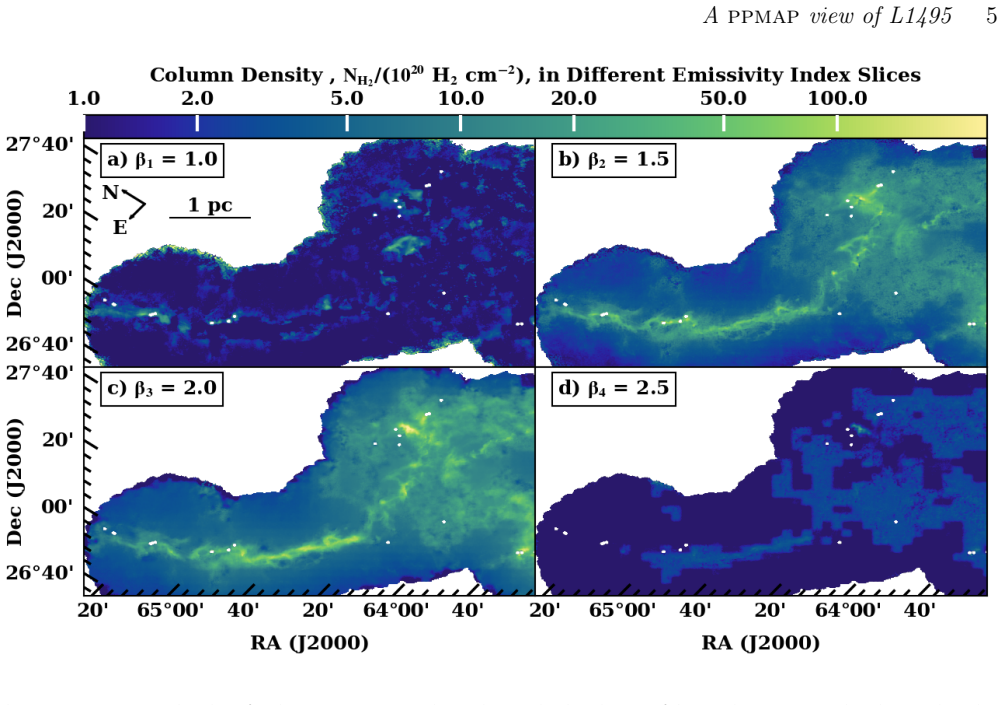
The carrier of the argument is PPMAP, a Bayesian fitting procedure that represents each line of sight as a superposition of dust in twelve temperature bins (7 to 40 K) and four emissivity-index bins ($\beta = 1.0$, 1.5, 2.0, 2.5), returning a four-dimensional cube of optical-depth contributions $\Delta^2\tau_{300:k\ell}$ at the reference wavelength 300 μm. Because the input maps keep their native resolutions and several components are allowed per pixel, this cube separates the warm outer layers from the cold spine gas — which drives the reduction in surface density $\Sigma$ and line-density $\mu$ — and separates dust types — which reveals the interior $\beta \leq 1.5$. A tight Gaussian prior on $\beta$ (mean 2.0, standard deviation 0.25) keeps the procedure from leaving the canonical value unless the data really require it. The resulting profiles are interpreted with Plummer-like fits, $n(r) = n_O[1 + (r/r_O)^2]^{-p/2}$, and judged against the critical line-density $\mu_C = 2c_S^2/G \simeq 16.2\,M_\odot\,\mathrm{pc}^{-1}$ for an isothermal gas at 10 K ($c_S = 0.19$ km s$^{-1}$).
What would settle it
Measure the column density of the L1495 Main Filament by a route that does not assume the dust opacity law, for example near-infrared extinction mapping along the same spine. The reported spine column density, $N_{\mathrm{H_2}} \simeq 6.4\times10^{21}\,\mathrm{H_2\,cm^{-2}}$, corresponds to roughly 6–8 magnitudes of visual extinction, well within reach of existing NIR surveys; if the extinction-based line-density reproduces the earlier single-temperature value ($\mu \simeq 54\,M_\odot\,\mathrm{pc}^{-1}$) instead of the trans-critical median ($\mu \simeq 17.6\,M_\odot\,\mathrm{pc}^{-1}$), then the paper's mass calibration — and with it the trans-critical classification and the association of prestellar cores with supercritical segments — is falsified.
Extended reading notes
Core claim
Re-analysing the Herschel and SCUBA-2 maps of the L1495 Main Filament with PPMAP, we find that previous estimates of the filament's width and line-density need to be revised downward, and that the dust in the filament is not the same as the dust around it. The column-density profile of the whole filament has FWHM $\simeq 0.087 \pm 0.003$ pc, but the closeness of this value to earlier estimates is coincidental: evaluated the way earlier studies evaluate widths (a Gaussian fit to the profile centre), the same data give FWHM $\simeq 0.056$ pc. Because PPMAP separates dust at different temperatures along each line of sight, the warm outer layers of the filament are no longer counted as dense spine gas, and the line-density drops to a median of $\mu = 17.6^{+6.9}_{-6.6}\,M_\odot\,\mathrm{pc}^{-1}$. Adopting the canonical critical line-density $\mu_C \simeq 16.2\,M_\odot\,\mathrm{pc}^{-1}$ for an isothermal filament at 10 K, the filament is trans-critical on average, and the local segments with $\mu > \mu_C$ preferentially host the prestellar cores (median $25.5\,M_\odot\,\mathrm{pc}^{-1}$, versus $16.8\,M_\odot\,\mathrm{pc}^{-1}$ for the remaining segments). The dust in the filament interior also differs from the surroundings: the line-of-sight mean emissivity index is $\bar{\beta} \leq 1.5$ inside and $\bar{\beta} \geq 1.7$ outside, which we attribute to dust growth in the dense medium — mantle accretion whose timescale ($\sim 0.3$ Myr at $n_{\mathrm{H_2}} \sim 10^4\,\mathrm{cm^{-3}}$) is short enough to act before the dynamical timescale.
Load-bearing premise
Every mass and line-density in the paper is obtained by converting the measured dust optical depth into gas mass using fixed assumed values for the dust-to-gas mass ratio ($Z_D = 0.01$) and the dust opacity at 300 μm ($\kappa_{300} = 10\,\mathrm{cm^2\,g^{-1}}$), and the paper itself warns that the very dust changes it detects are likely to be accompanied by changes in both values, of unknown size and sign — if they differ from the assumed constants, the inferred line-density and the trans-critical classification move with them.
Editorial extensions
If this is right
- Previous estimates that the L1495 filament is supercritical throughout its length ($\mu \simeq 54\,M_\odot\,\mathrm{pc}^{-1}$) are replaced by a trans-critical median, so the stability question shifts from the whole filament to its individual segments.
- Fragmentation follows the local line-density: the prestellar cores sit almost exclusively on segments with $\mu > \mu_C$ (median $25.5$ versus $16.8\,M_\odot\,\mathrm{pc}^{-1}$), and a Kolmogorov–Smirnov test gives only a $4\times10^{-6}$ probability that core-bearing and other segments share one line-density distribution.
- Column-density maps of this and other filaments cannot be read off a single opacity law: the interior dust ($\beta \leq 1.5$) and the exterior dust ($\beta \geq 1.7$) require different conversions from optical depth to mass.
- The better fits obtained locally with $p = 4$ (reduced $\chi^2 = 8.35$ versus $29.23$ for $p = 2$) indicate that small segments of the filament approximate isothermal cylinders in hydrostatic equilibrium, even though the averaged global profile looks shallower.
- Mantle accretion inside the filament is viable: at central densities near $10^4\,\mathrm{H_2\,cm^{-3}}$ the accretion timescale ($\sim 0.3$ Myr) is comparable to the local freefall time, which is what is needed for the dust properties to change in place.
Reading between the lines
- The same single-temperature, single-$\beta$ screen that inflated the L1495 mass is common in filament studies, so the bias this paper exposes — counting warm outer layers as dense spine gas — probably lowers the true masses of many other filaments, with the correction growing as the fraction of low-$\beta$ dust near the spine grows.
- If local line-density governs fragmentation, one can predict that in any long filament the positions of prestellar cores should trace the segments where $\mu > \mu_C$, and the coincidence should sharpen as the angular resolution of the dust decomposition approaches the filament's thermal scale length; L1495 is a single-region realisation of that prediction.
- An independent calibration of the optical-depth-to-mass conversion — near-infrared extinction or polarised dust emission across the same spine, neither of which assumes $\kappa_{300} = 10\,\mathrm{cm^2\,g^{-1}}$ or $Z_D = 0.01$ — would settle whether the trans-critical verdict survives the very dust evolution the paper invokes.
- The analysis masks out optically thick protostellar cores (0.08 pc circles) before fitting, and those patches are exactly where a single opacity law fails hardest; a version of the procedure that models optically thick emission would test whether the hidden mass in those patches changes the census of supercritical segments.
Signed reviews
Editorial analysis
A structured set of objections, weighed in public.
Referee Report
Summary. The manuscript re-analyses Herschel and SCUBA-2 observations of the L1495 main filament with the PPMAP procedure, which fits multiple dust temperatures and emissivity indices at native angular resolution rather than smoothing all bands to the 500 micron beam. Section 6 produces total column-density and beta maps; Section 7 fits Plummer-like profiles to a global average profile and to 92 local segments along the filament. With p fixed to 2, the median segment line-density is reported as about 17.6-17.8 M_sun/pc, close to the critical value 16.2 M_sun/pc, and segments above critical preferentially host prestellar cores. Section 7.4 reports that p=4 fits are actually better, and Section 9 argues that synthetic maps generated from PPMAP results reproduce the Herschel maps better than synthetic maps generated from the standard procedure of Palmeirim et al.
Significance. If the central results hold, the paper makes a useful contribution: it supports the idea that standard single-temperature, single-beta fits overestimate filament surface densities and line-densities, and it strengthens the case that local line-density regulates core formation by showing a strong KS association between supercritical segments and prestellar cores. The synthetic-map comparison in Table 2 is a real strength, as is the use of multi-wavelength data at native resolution. However, the trans-critical conclusion is derived from p=2 fits even though the paper's own p=4 fits are better, and the beta dichotomy rests on a strong prior with no sensitivity test; these issues leave the headline claims not yet fully supported.
major comments (3)
- [Section 7.3 (footnote 5) and Section 7.4]
- [Sections 5 and 6 (beta prior)]
- [Sections 3.2-3.3 and 7.3]
minor comments (6)
- [Section 7.3 and Conclusions]
- [Figure 6 and Section 7.3]
- [Abstract]
- [Equation (15)]
- [Section 9.2]
- [Section 7.4]
Circularity Check
No circularity: line-density and beta results are data-driven; fixed p=2 exponent is a model-sensitivity caveat, not a circular reduction.
full rationale
PPMAP maps are fitted directly to the Herschel/SCUBA-2 intensities (Eq. 11); the total optical depth, column-density and line-density follow from the stated conversion factors (Eqs. 3-9). The Plummer fits (Eq. 19) determine N0, r0 and p from the data, and mu is obtained by integrating the fitted profile, not by assuming mu is close to mu_C. The beta result is a regularized Bayesian output with the Gaussian prior stated explicitly, and the paper demonstrates that the resulting maps reproduce the Herschel data better than the standard procedure (Table 2), so the beta contrast is not imposed by construction. The core comparison uses an external catalogue and a KS test, so it is not tautological. Self-citations (Marsh et al., Clarke et al., Whitworth) support the method and interpretive scenario but are not the sole evidence for the central measurements; the synthetic-map comparison provides independent internal validation. The fixed p=2 choice in Sec. 7.3 is a model-sensitivity caveat: footnote 5 asserts little influence on the global parameters, while Sec. 7.4 shows p=4 fits better and returns a larger rO, and no p=4 line-densities are reported. This is a robustness concern, not an equation-level circularity, because mu is not defined in terms of p=2 and no fitted parameter is renamed as a prediction. No circular step is exhibited.
Assumptions & free parameters
free parameters (4)
- kappa_300 (dust absorption opacity at 300 um) =
10 cm^2 g^-1 (assumed canonical value)
- Z_D (dust-to-gas mass ratio) =
0.01 (assumed)
- PPMAP beta prior hyperparameters =
Gaussian mean 2.0, sigma 0.25
- Filament boundary radius r_B =
0.4 pc (assumed)
assumptions (6)
- domain assumption The dust is optically thin at all Herschel and SCUBA-2 wavelengths used.
- domain assumption The filament is locally cylindrically symmetric and the line of sight crosses a single cylindrical structure.
- domain assumption The gas is isothermal at about 10 K for comparison with the critical line-density.
- domain assumption Dust and gas are co-extensive and well-mixed.
- domain assumption A Plummer-like profile (Eqn. 18) describes the filament's true volumetric density cross-section.
- ad hoc to paper The PPMAP beta prior is weak enough that the data dominate the inferred beta distribution.
Cite this review
Pith. "Pith review of L1495 Revisited: A PPMAP View of a Star-Forming Filament." pith.science (2026). https://pith.science/paper/S4AMZGKE
@misc{pith2026190802295,
  author       = {Pith},
  title        = {Pith review of: L1495 Revisited: A PPMAP View of a Star-Forming Filament},
  year         = {2026},
  howpublished = {\url{https://pith.science/paper/S4AMZGKE}},
  note         = {Machine review of arXiv:1908.02295}
}
abstract
We have analysed the Herschel and SCUBA-2 dust continuum observations of the main filament in the Taurus L1495 star forming region, using the Bayesian fitting procedure PPMAP. (i) If we construct an average profile along the whole length of the filament, it has fwhm $\simeq 0.087\pm 0.003\,{\rm pc};\;$, but the closeness to previous estimates is coincidental. (ii) If we analyse small local sections of the filament, the column-density profile approximates well to the form predicted for hydrostatic equilibrium of an isothermal cylinder. (iii) The ability of PPMAP to distinguish dust emitting at different temperatures, and thereby to discriminate between the warm outer layers of the filament and the cold inner layers near the spine, leads to a significant reduction in the surface-density, $\varSigma$, and hence in the line-density, $\mu$. If we adopt the canonical value for the critical line-density at a gas-kinetic temperature of $10\,{\rm K}$, $\mu_{_{\rm CRIT}}\simeq 16\,{\rm M_{_\odot}\,pc^{-1}}$, the filament is on average trans-critical, with ${\bar\mu}\sim \mu_{_{\rm CRIT}};\;$ local sections where $\mu >\mu_{_{\rm CRIT}}$ tend to lie close to pre-stellar cores. (iv) The ability of PPMAP to distinguish different types of dust, i.e. dust characterised by different values of the emissivity index, $\beta$, reveals that the dust in the filament has a lower emissivity index, $\beta\leq1.5$, than the dust outside the filament, $\beta\geq 1.7$, implying that the physical conditions in the filament have effected a change in the properties of the dust.
Figures


Figures from the paper (6 more)


Forward citations
Cited by 2 Pith papers
-
Bipolar HII regions Produced by Cloud-Cloud Collisions
Head-on collisions of 500 M⊙ clouds form hub-filament systems and short-lived bipolar HII regions whose appearance depends strongly on viewing angle, with secondary radio and mid-IR metrics that may flag CCC origins.
-
Sutra : An integrated framework for identification and characterization of filaments in the interstellar medium
Sutra trains a U-Net on the union of DisPerSE and getsf skeletons to predict filament crest-likelihood maps and then filters and characterizes them with beam-scale Plummer fits.
Reference graph
Works this paper leans on
-
[1]
Andr \' e P., et al., 2010, @doi [ ] 10.1051/0004-6361/201014666 , 518, L102
-
[2]
Andr \'e P., et al., 2016, @doi [ ] 10.1051/0004-6361/201628378 , http://adsabs.harvard.edu/abs/2016A
-
[3]
Arzoumanian D., et al., 2011, @doi [ ] 10.1051/0004-6361/201116596 , https://ui.adsabs.harvard.edu/#abs/2011A&A...529L...6A 529, L6
-
[4]
Arzoumanian D., et al., 2019, @doi [ ] 10.1051/0004-6361/201832725 , https://ui.adsabs.harvard.edu/abs/2019A&A...621A..42A 621, A42
-
[5]
Bernard J.-P., et al., 2010, @doi [ ] 10.1051/0004-6361/201014540 , http://adsabs.harvard.edu/abs/2010A
-
[6]
Berry D. S., 2015, @doi [Astronomy and Computing] 10.1016/j.ascom.2014.11.004 , http://adsabs.harvard.edu/abs/2015A
-
[7]
Buckle J. V., et al., 2015, @doi [ ] 10.1093/mnras/stv438 , https://ui.adsabs.harvard.edu/abs/2015MNRAS.449.2472B 449, 2472
-
[8]
Casali M. M., 1986, @doi [ ] 10.1093/mnras/223.2.341 , https://ui.adsabs.harvard.edu/#abs/1986MNRAS.223..341C 223, 341
Show all 75 references
-
[9]
L., Berry D
Chapin E. L., Berry D. S., Gibb A. G., Jenness T., Scott D., Tilanus R. P. J., Economou F., Holland W. S., 2013, @doi [ ] 10.1093/mnras/stt052 , https://ui.adsabs.harvard.edu/abs/2013MNRAS.430.2545C 430, 2545
2013 doi
-
[10]
C., Henning T., Mac Low M.-M., 2018, @doi [ ] 10.1051/0004-6361/201731836 , http://adsabs.harvard.edu/abs/2018A
Chira R.-A., Kainulainen J., Ib \'a \ n ez-Mej \' a J. C., Henning T., Mac Low M.-M., 2018, @doi [ ] 10.1051/0004-6361/201731836 , http://adsabs.harvard.edu/abs/2018A
2018 doi
-
[11]
D., Whitworth A
Clarke S. D., Whitworth A. P., 2015, @doi [ ] 10.1093/mnras/stv393 , http://adsabs.harvard.edu/abs/2015MNRAS.449.1819C 449, 1819
2015 doi
-
[12]
D., Whitworth A
Clarke S. D., Whitworth A. P., Hubber D. A., 2016, @doi [ ] 10.1093/mnras/stw407 , http://adsabs.harvard.edu/abs/2016MNRAS.458..319C 458, 319
2016 doi
-
[13]
D., Whitworth A
Clarke S. D., Whitworth A. P., Duarte-Cabral A., Hubber D. A., 2017, @doi [ ] 10.1093/mnras/stx637 , https://ui.adsabs.harvard.edu/#abs/2017MNRAS.468.2489C 468, 2489
2017 doi
-
[14]
D., Whitworth A
Clarke S. D., Whitworth A. P., Spowage R. L., Duarte-Cabral A., Suri S. T., Jaffa S. E., Walch S., Clark P. C., 2018, @doi [ ] 10.1093/mnras/sty1675 , http://adsabs.harvard.edu/abs/2018MNRAS.479.1722C 479, 1722
2018 doi
-
[15]
Cox N. L. J., et al., 2016, @doi [ ] 10.1051/0004-6361/201527068 , http://adsabs.harvard.edu/abs/2016A
2016 doi
-
[16]
T., 2003, @doi [ ] 10.1146/annurev.astro.41.011802.094840 , http://adsabs.harvard.edu/abs/2003ARA
Draine B. T., 2003, @doi [ ] 10.1146/annurev.astro.41.011802.094840 , http://adsabs.harvard.edu/abs/2003ARA
2003 arXiv
-
[17]
H., 1978, @doi [ ] 10.1086/156436 , https://ui.adsabs.harvard.edu/#abs/1978ApJ...224..857E 224, 857
Elias J. H., 1978, @doi [ ] 10.1086/156436 , https://ui.adsabs.harvard.edu/#abs/1978ApJ...224..857E 224, 857
1978 doi
-
[18]
L., Evans Neal J
Enoch M. L., Evans Neal J. I., Sargent A. I., Glenn J., Rosolowsky E., Myers P., 2008, @doi [ ] 10.1086/589963 , https://ui.adsabs.harvard.edu/abs/2008ApJ...684.1240E 684, 1240
2008 doi
-
[19]
G., 2012, @doi [ ] 10.1051/0004-6361/201218961 , http://adsabs.harvard.edu/abs/2012A
Fischera J., Martin P. G., 2012, @doi [ ] 10.1051/0004-6361/201218961 , http://adsabs.harvard.edu/abs/2012A
2012 doi
-
[20]
Giardino G., Favata F., Micela G., Reale F., 2004, @doi [ ] 10.1051/0004-6361:20034151 , https://ui.adsabs.harvard.edu/\#abs/2004A&A...413..669G 413, 669
2004 doi
-
[21]
J., et al., 2010, @doi [ ] 10.1051/0004-6361/201014519 , http://adsabs.harvard.edu/abs/2010A
Griffin M. J., et al., 2010, @doi [ ] 10.1051/0004-6361/201014519 , http://adsabs.harvard.edu/abs/2010A
2010 doi
-
[22]
Gritschneder M., Heigl S., Burkert A., 2017, @doi [ ] 10.3847/1538-4357/834/2/202 , http://adsabs.harvard.edu/abs/2017ApJ...834..202G 834, 202
2017 doi
-
[23]
Hacar A., Tafalla M., Kauffmann J., Kov \'a cs A., 2013, @doi [ ] 10.1051/0004-6361/201220090 , https://ui.adsabs.harvard.edu/#abs/2013A&A...554A..55H 554, A55
2013 doi
-
[24]
S., 2018, @doi [ ] 10.1051/0004-6361/201731894 , http://adsabs.harvard.edu/abs/2018A
Hacar A., Tafalla M., Forbrich J., Alves J., Meingast S., Grossschedl J., Teixeira P. S., 2018, @doi [ ] 10.1051/0004-6361/201731894 , http://adsabs.harvard.edu/abs/2018A
2018 doi
-
[25]
He J., Acharyya K., Vidali G., 2016, @doi [ ] 10.3847/0004-637X/825/2/89 , https://ui.adsabs.harvard.edu/abs/2016ApJ...825...89H 825, 89
2016 doi
-
[26]
Heigl S., Burkert A., Gritschneder M., 2018, @doi [ ] 10.1093/mnras/stx3145 , http://adsabs.harvard.edu/abs/2018MNRAS.474.4881H 474, 4881
2018 doi
-
[27]
Heitsch F., 2013, @doi [ ] 10.1088/0004-637X/769/2/115 , http://adsabs.harvard.edu/abs/2013ApJ...769..115H 769, 115
2013 doi
-
[28]
III 2017, PACS Handbook
Herschel Explanatory Supplement Vol. III 2017, PACS Handbook . 2.0 edn, https://www.cosmos.esa.int/web/herschel/legacy-documentation-observatory
2017
-
[29]
IV 2017, SPIRE Handbook
Herschel Explanatory Supplement Vol. IV 2017, SPIRE Handbook . 3.1 edn, https://www.cosmos.esa.int/web/herschel/legacy-documentation-observatory
2017
-
[30]
S., et al., 2013, @doi [ ] 10.1093/mnras/sts612 , https://ui.adsabs.harvard.edu/abs/2013MNRAS.430.2513H 430, 2513
Holland W. S., et al., 2013, @doi [ ] 10.1093/mnras/sts612 , https://ui.adsabs.harvard.edu/abs/2013MNRAS.430.2513H 430, 2513
2013 doi
-
[31]
M., 1992, @doi [ ] 10.1086/171162 , http://adsabs.harvard.edu/abs/1992ApJ...388..392I 388, 392
Inutsuka S.-I., Miyama S. M., 1992, @doi [ ] 10.1086/171162 , http://adsabs.harvard.edu/abs/1992ApJ...388..392I 388, 392
1992 doi
-
[32]
M., 1997, @doi [ ] 10.1086/303982 , https://ui.adsabs.harvard.edu/#abs/1997ApJ...480..681I 480, 681
Inutsuka S.-i., Miyama S. M., 1997, @doi [ ] 10.1086/303982 , https://ui.adsabs.harvard.edu/#abs/1997ApJ...480..681I 480, 681
1997 doi
-
[33]
E., Henning T., Stutz A., 2013, @doi [ ] 10.1051/0004-6361/201321760 , http://adsabs.harvard.edu/abs/2013A
Kainulainen J., Ragan S. E., Henning T., Stutz A., 2013, @doi [ ] 10.1051/0004-6361/201321760 , http://adsabs.harvard.edu/abs/2013A
2013 doi
-
[34]
Kainulainen J., Hacar A., Alves J., Beuther H., Bouy H., Tafalla M., 2016, @doi [ ] 10.1051/0004-6361/201526017 , http://adsabs.harvard.edu/abs/2016A
2016 doi
-
[35]
M., Stanke T., Abreu-Vicente J., Beuther H., Henning T., Johnston K
Kainulainen J., Stutz A. M., Stanke T., Abreu-Vicente J., Beuther H., Henning T., Johnston K. G., Megeath S. T., 2017, @doi [ ] 10.1051/0004-6361/201628481 , http://adsabs.harvard.edu/abs/2017A
2017 doi
-
[36]
K \"o nyves V., et al., 2015, @doi [ ] 10.1051/0004-6361/201525861 , http://adsabs.harvard.edu/abs/2015A
2015 doi
-
[37]
T., 2001, @doi [ ] 10.1086/323147 , http://adsabs.harvard.edu/abs/2001ApJ...554..778L 554, 778
Li A., Draine B. T., 2001, @doi [ ] 10.1086/323147 , http://adsabs.harvard.edu/abs/2001ApJ...554..778L 554, 778
2001 doi
-
[38]
A., Whitworth A
Marsh K. A., Whitworth A. P., Lomax O., 2015, @doi [ ] 10.1093/mnras/stv2248 , http://adsabs.harvard.edu/abs/2015MNRAS.454.4282M 454, 4282
2015 doi
-
[39]
A., et al., 2016, @doi [ ] 10.1093/mnras/stw301 , http://adsabs.harvard.edu/abs/2016MNRAS.459..342M 459, 342
Marsh K. A., et al., 2016, @doi [ ] 10.1093/mnras/stw301 , http://adsabs.harvard.edu/abs/2016MNRAS.459..342M 459, 342
2016 doi
-
[40]
S., 1990, @doi [ ] 10.1146/annurev.aa.28.090190.000345 , http://adsabs.harvard.edu/abs/1990ARA
Mathis J. S., 1990, @doi [ ] 10.1146/annurev.aa.28.090190.000345 , http://adsabs.harvard.edu/abs/1990ARA
1990
-
[41]
P., Waters B., Schiebel D., Young W., Golap K., 2007, in Shaw R
McMullin J. P., Waters B., Schiebel D., Young W., Golap K., 2007, in Shaw R. A., Hill F., Bell D. J., eds, Astronomical Society of the Pacific Conference Series Vol. 376, Astronomical Data Analysis Software and Systems XVI. p. 127
2007
-
[42]
Motte F., Andr \'e P., 2001, @doi [ ] 10.1051/0004-6361:20000072 , https://ui.adsabs.harvard.edu/#abs/2001A&A...365..440M 365, 440
2001 doi
-
[43]
Nakamura F., Li Z.-Y., 2008, @doi [ ] 10.1086/591641 , https://ui.adsabs.harvard.edu/#abs/2008ApJ...687..354N 687, 354
2008 doi
-
[44]
B., Ingargiola A., 2014, ] 10.5281/zenodo.11813
Newville M., Stensitzki T., Allen D. B., Ingargiola A., 2014, ] 10.5281/zenodo.11813
2014 doi
-
[45]
M., Stamatellos D., Ward- Thompson D., 2008, @doi [ ] 10.1111/j.1365-2966.2007.12750.x , https://ui.adsabs.harvard.edu/#abs/2008MNRAS.384..755N 384, 755
Nutter D., Kirk J. M., Stamatellos D., Ward- Thompson D., 2008, @doi [ ] 10.1111/j.1365-2966.2007.12750.x , https://ui.adsabs.harvard.edu/#abs/2008MNRAS.384..755N 384, 755
2008
-
[46]
Onishi T., Mizuno A., Kawamura A., Tachihara K., Fukui Y., 2002, @doi [ ] 10.1086/341347 , https://ui.adsabs.harvard.edu/#abs/2002ApJ...575..950O 575, 950
2002 doi
-
[47]
Ossenkopf V., Henning T., 1994, , https://ui.adsabs.harvard.edu/#abs/1994A&A...291..943O 291, 943
1994
-
[48]
Ostriker J., 1964, @doi [ ] 10.1086/148005 , https://ui.adsabs.harvard.edu/#abs/1964ApJ...140.1056O 140, 1056
1964 doi
-
[49]
Palmeirim P., et al., 2013, @doi [ ] 10.1051/0004-6361/201220500 , http://adsabs.harvard.edu/abs/2013A
2013 doi
-
[50]
V., Tassis K., Goldsmith P
Panopoulou G. V., Tassis K., Goldsmith P. F., Heyer M. H., 2014, @doi [ ] 10.1093/mnras/stu1601 , http://adsabs.harvard.edu/abs/2014MNRAS.444.2507P 444, 2507
2014 doi
-
[51]
V., Psaradaki I., Skalidis R., Tassis K., Andrews J
Panopoulou G. V., Psaradaki I., Skalidis R., Tassis K., Andrews J. J., 2017, @doi [ ] 10.1093/mnras/stw3060 , https://ui.adsabs.harvard.edu/#abs/2017MNRAS.466.2529P 466, 2529
2017 doi
-
[52]
Pearson K., 1895, Proceedings of the Royal Society of London. Vol. 58, Taylor & Francis
-
[53]
Peters T., et al., 2017, @doi [ ] 10.1093/mnras/stx341 , https://ui.adsabs.harvard.edu/\#abs/2017MNRAS.467.4322P 467, 4322
2017 doi
-
[54]
Poglitsch A., et al., 2010, @doi [ ] 10.1051/0004-6361/201014535 , http://adsabs.harvard.edu/abs/2010A
2010 doi
-
[55]
E., Pon A., Tafalla M., Hacar A., Bizzocchi L., 2018, @doi [ ] 10.1051/0004-6361/201731159 , https://ui.adsabs.harvard.edu/#abs/2018A&A...617A..27P 617, A27
Punanova A., Caselli P., Pineda J. E., Pon A., Tafalla M., Hacar A., Bizzocchi L., 2018, @doi [ ] 10.1051/0004-6361/201731159 , https://ui.adsabs.harvard.edu/#abs/2018A&A...617A..27P 617, A27
2018 doi
-
[56]
M., et al., 2010, @doi [The Astrophysical Journal Supplement Series] 10.1088/0067-0049/186/2/259 , https://ui.adsabs.harvard.edu/#abs/2010ApJS..186..259R 186, 259
Rebull L. M., et al., 2010, @doi [The Astrophysical Journal Supplement Series] 10.1088/0067-0049/186/2/259 , https://ui.adsabs.harvard.edu/#abs/2010ApJS..186..259R 186, 259
2010 doi
-
[57]
Schmalzl M., et al., 2010, @doi [ ] 10.1088/0004-637X/725/1/1327 , http://adsabs.harvard.edu/abs/2010ApJ...725.1327S 725, 1327
2010 doi
-
[58]
Seifried D., Walch S., 2015, @doi [ ] 10.1093/mnras/stv1458 , http://adsabs.harvard.edu/abs/2015MNRAS.452.2410S 452, 2410
2015 doi
-
[59]
Seifried D., S \'a nchez-Monge \'A ., Suri S., Walch S., 2017, @doi [ ] 10.1093/mnras/stx399 , http://adsabs.harvard.edu/abs/2017MNRAS.467.4467S 467, 4467
2017 doi
-
[60]
M., et al., 2015, @doi [ ] 10.1088/0004-637X/805/2/185 , http://adsabs.harvard.edu/abs/2015ApJ...805..185S 805, 185
Seo Y. M., et al., 2015, @doi [ ] 10.1088/0004-637X/805/2/185 , http://adsabs.harvard.edu/abs/2015ApJ...805..185S 805, 185
2015 doi
-
[61]
A., 2009a, @doi [ ] 10.1088/0004-637X/696/1/676 , https://ui.adsabs.harvard.edu/abs/2009ApJ...696..676S 696, 676
Shetty R., Kauffmann J., Schnee S., Goodman A. A., 2009a, @doi [ ] 10.1088/0004-637X/696/1/676 , https://ui.adsabs.harvard.edu/abs/2009ApJ...696..676S 696, 676
-
[62]
A., Ercolano B., 2009b, @doi [ ] 10.1088/0004-637X/696/2/2234 , https://ui.adsabs.harvard.edu/abs/2009ApJ...696.2234S 696, 2234
Shetty R., Kauffmann J., Schnee S., Goodman A. A., Ercolano B., 2009b, @doi [ ] 10.1088/0004-637X/696/2/2234 , https://ui.adsabs.harvard.edu/abs/2009ApJ...696.2234S 696, 2234
-
[63]
H., Adams F
Shu F. H., Adams F. C., Lizano S., 1987, @doi [Annual Review of Astronomy and Astrophysics] 10.1146/annurev.aa.25.090187.000323 , https://ui.adsabs.harvard.edu/#abs/1987ARA&A..25...23S 25, 23
1987
-
[64]
J., Glover S
Smith R. J., Glover S. C. O., Klessen R. S., 2014, @doi [ ] 10.1093/mnras/stu1915 , http://adsabs.harvard.edu/abs/2014MNRAS.445.2900S 445, 2900
2014 doi
-
[65]
J., Glover S
Smith R. J., Glover S. C. O., Klessen R. S., Fuller G. A., 2016, @doi [ ] 10.1093/mnras/stv2559 , http://adsabs.harvard.edu/abs/2016MNRAS.455.3640S 455, 3640
2016 doi
-
[66]
Sousbie T., 2011, @doi [ ] 10.1111/j.1365-2966.2011.18394.x , 414, 350
2011
-
[67]
M., Strom S
Strom K. M., Strom S. E., 1994, @doi [ ] 10.1086/173886 , http://adsabs.harvard.edu/abs/1994ApJ...424..237S 424, 237
1994 doi
-
[68]
T., et al., 2019, arXiv e-prints, https://ui.adsabs.harvard.edu/\#abs/2019arXiv190100176S p
Suri S. T., et al., 2019, arXiv e-prints, https://ui.adsabs.harvard.edu/\#abs/2019arXiv190100176S p. arXiv:1901.00176
2019 arXiv
-
[69]
Tafalla M., Hacar A., 2015, @doi [ ] 10.1051/0004-6361/201424576 , http://adsabs.harvard.edu/abs/2015A
2015 doi
-
[70]
Ward-Thompson D., et al., 2007, @doi [ ] 10.1086/521277 , http://adsabs.harvard.edu/abs/2007PASP..119..855W 119, 855
2007 doi
-
[71]
Ward-Thompson D., et al., 2016, @doi [ ] 10.1093/mnras/stw1978 , https://ui.adsabs.harvard.edu/#abs/2016MNRAS.463.1008W 463, 1008
2016 doi
-
[72]
P., Jaffa S
Whitworth A. P., Jaffa S. E., 2018, @doi [ ] 10.1051/0004-6361/201731871 , https://ui.adsabs.harvard.edu/abs/2018A&A...611A..20W 611, A20
2018 doi
-
[73]
P., Ward-Thompson D., 2001, @doi [ ] 10.1086/318373 , https://ui.adsabs.harvard.edu/#abs/2001ApJ...547..317W 547, 317
Whitworth A. P., Ward-Thompson D., 2001, @doi [ ] 10.1086/318373 , https://ui.adsabs.harvard.edu/#abs/2001ApJ...547..317W 547, 317
2001 doi
-
[74]
Zhukovska S., Henning T., Dobbs C., 2018, @doi [ ] 10.3847/1538-4357/aab438 , https://ui.adsabs.harvard.edu/\#abs/2018ApJ...857...94Z 857, 94
2018 doi
-
[75]
write newline
" write newline "" before.all 'output.state := FUNCTION fin.entry write newline FUNCTION new.block output.state before.all = 'skip after.block 'output.state := if FUNCTION new.sentence output.state after.block = 'skip output.state before.all = 'skip after.sentence 'output.stat...
Reviewed August 14, 2026 · model on record in the stance chip above.
Discussion (0). Continue with ORCID to comment.