Exact dimer ground states of long-range spin chains and ladders
Pith reviewed 2026-07-02 05:23 UTC · model grok-4.3
The pith
Precise conditions on interaction parameters guarantee that a dimer state is the exact ground state in long-range spin chains and ladders.
A machine-rendered reading of the paper's core claim, the machinery that carries it, and where it could break.
Core claim
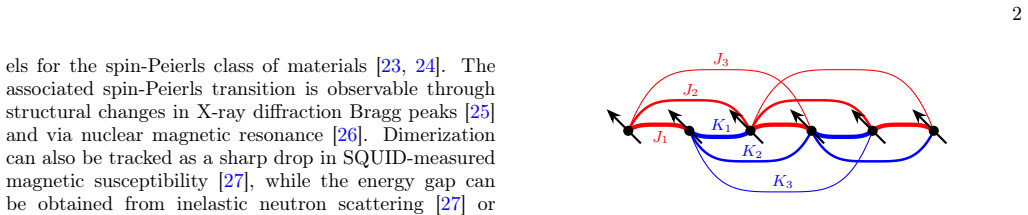
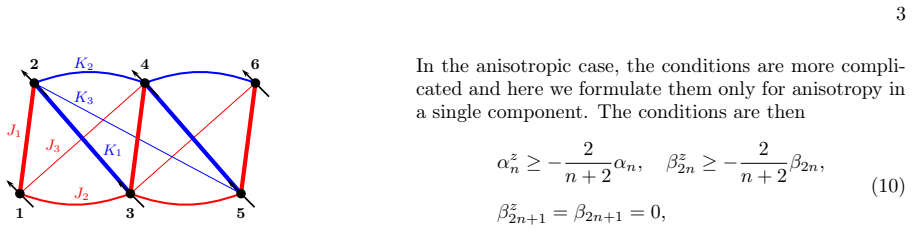
For a broad family of long-range interacting spin models, explicit conditions on the Hamiltonian parameters ensure that a particular dimer product state is the unique ground state. The conditions are derived such that the Hamiltonian can be expressed in a form that is non-negative and vanishes on the dimer state. This holds for both chains and ladders and for anisotropic interactions.
What carries the argument
The explicit conditions on coupling constants derived from requiring that the Hamiltonian annihilates the dimer state while remaining positive on other states, generalizing the projector method used in the Majumdar-Ghosh model.
If this is right
- Provides exact reference points in the phase diagrams of a wide class of spin chains and ladders
- Applies to models with anisotropic and arbitrary-range interactions
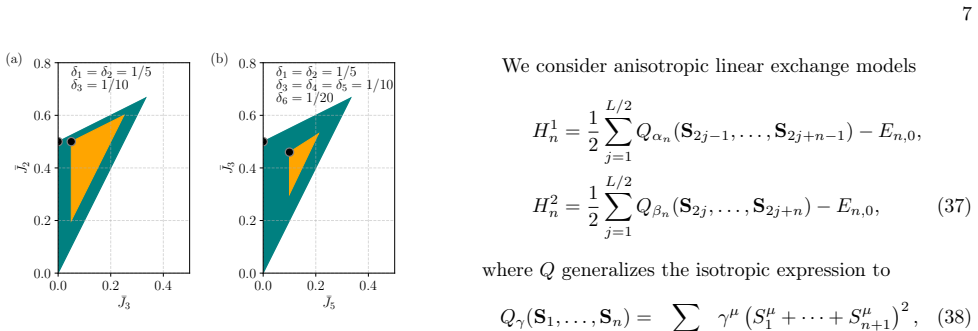
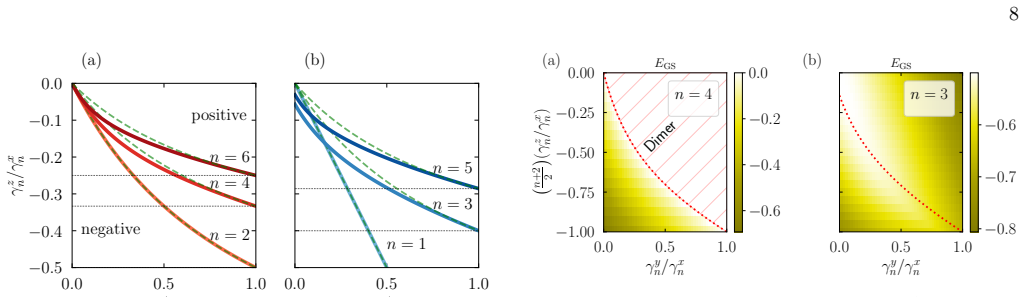
- Validated using exact diagonalization for various generalizations of the Majumdar-Ghosh model
Where Pith is reading between the lines
- Such conditions could help identify exactly solvable limits in other frustrated spin models beyond the Majumdar-Ghosh family
- May allow construction of variational states for approximating ground states in systems where exact conditions are not met
Load-bearing premise
The Hamiltonians are restricted to the specific family of long-range, possibly anisotropic generalizations of the Majumdar-Ghosh model for which the dimer projector conditions can be written explicitly.
What would settle it
Performing exact diagonalization on a finite-size system whose parameters satisfy the stated conditions but finding that the dimer state energy is not the lowest would disprove the guarantee.
Figures

read the original abstract
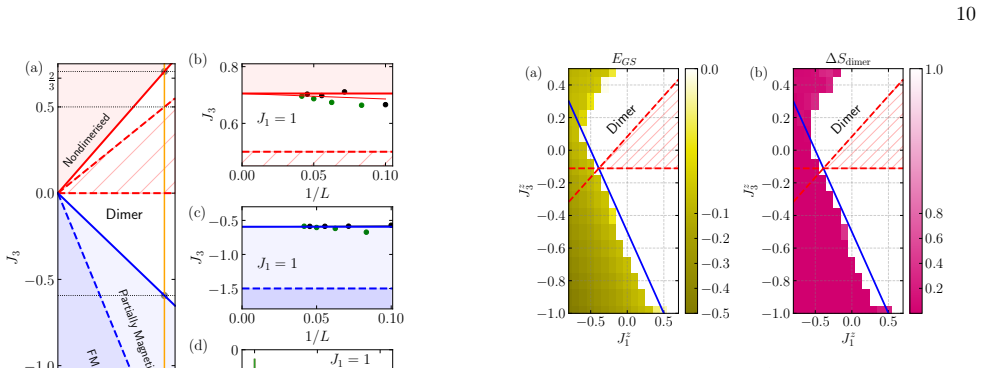
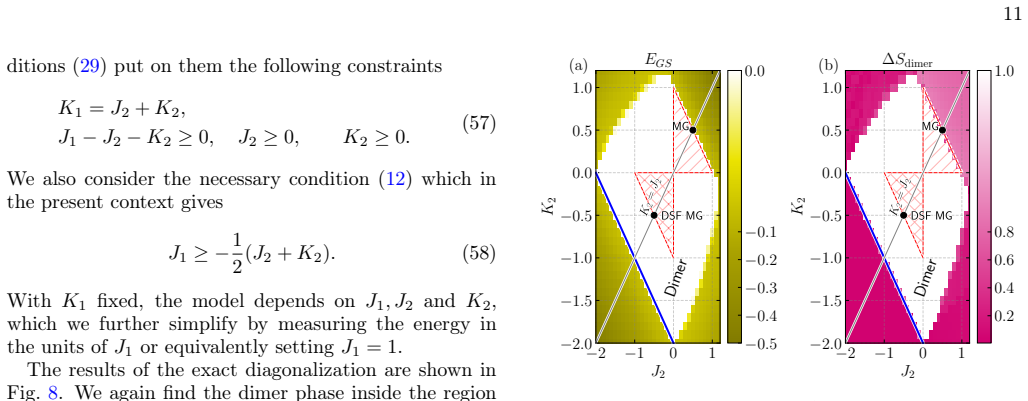
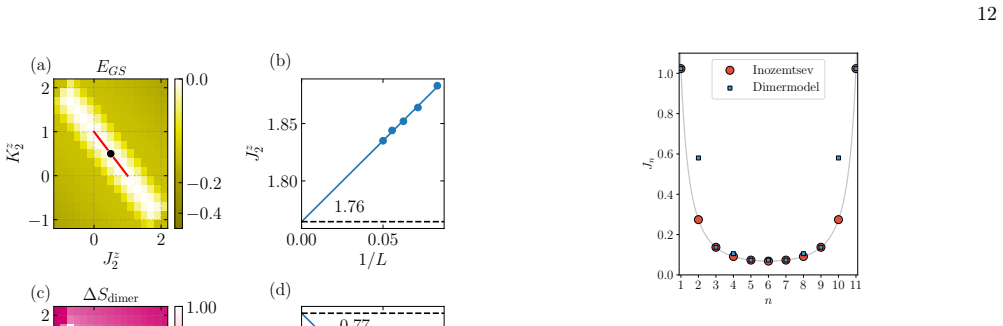
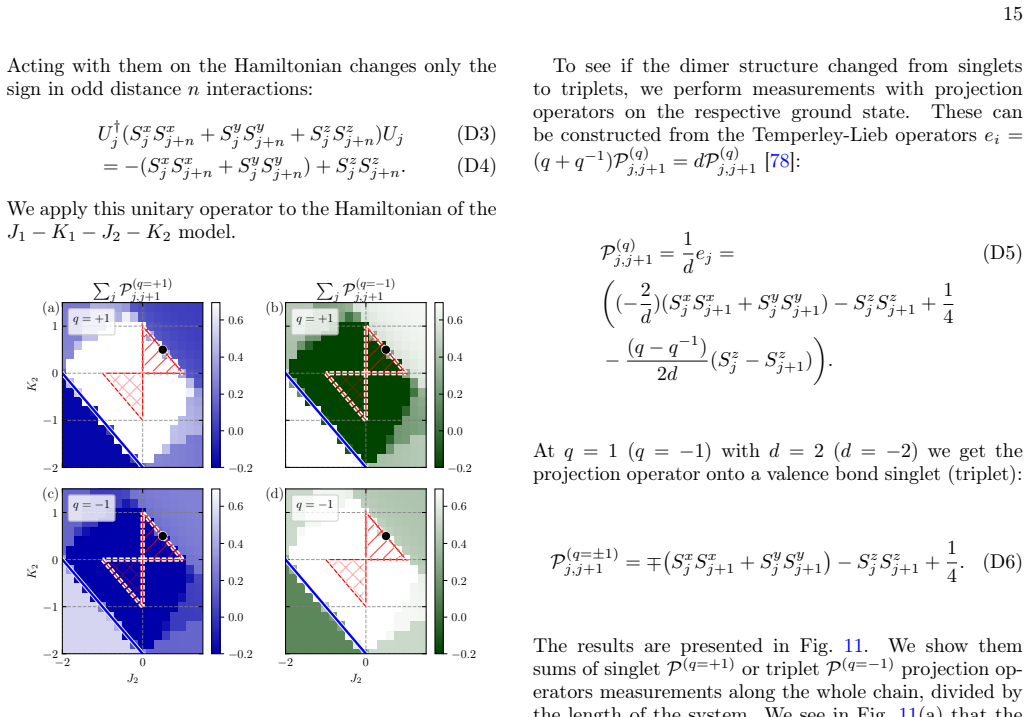
Interacting spin chains and ladders are known to support a plethora of quantum phases with complex ground-state phase diagrams. In this work, we study a large family of such models and determine precise, explicit conditions under which an exact dimer state is guaranteed to be the ground state. These general conditions are validated for various generalizations of the Majumdar-Ghosh model using exact diagonalization. Our results provide exact reference points in the phase diagrams of a wide class of spin chains and ladders, including those with anisotropic and arbitrary-range interactions.
Editorial analysis
A structured set of objections, weighed in public.
Referee Report
Summary. The manuscript derives precise, explicit conditions under which an exact dimer state is guaranteed to be the ground state for a large family of long-range spin chains and ladders, including anisotropic and arbitrary-range interactions. These conditions are presented as generalizations of the Majumdar-Ghosh model and are validated using exact diagonalization on specific cases, with the goal of providing exact reference points in the corresponding phase diagrams.
Significance. If the central conditions are correct and general, the results supply exact benchmarks for a broad class of long-range interacting spin models. This is useful for mapping phase diagrams in quantum magnetism, where long-range interactions appear in both theoretical constructions and experimental platforms such as trapped ions or Rydberg atoms. The explicit, non-fitted nature of the conditions (as described) is a strength.
minor comments (1)
- The abstract states that validation uses exact diagonalization but supplies no system sizes, error metrics, or convergence checks; adding a brief summary of these details in §4 or the caption of the relevant figure would improve reproducibility without altering the central claim.
Simulated Author's Rebuttal
We thank the referee for their positive summary, significance assessment, and recommendation to accept the manuscript. No major comments were raised.
Circularity Check
No significant circularity identified
full rationale
The paper states it derives explicit conditions guaranteeing an exact dimer state as ground state for a family of long-range spin chains/ladders, then validates those conditions via exact diagonalization on Majumdar-Ghosh generalizations. No equations, self-citations, or steps are presented that reduce a claimed prediction or uniqueness result to a fitted input, self-definition, or prior author work by construction. The central claim remains independent of the inputs it is tested against.
Axiom & Free-Parameter Ledger
axioms (1)
- standard math Spin operators obey standard su(2) commutation relations
Reference graph
Works this paper leans on
-
[1]
S. K. Pati, R. Chitra, D. Sen, S. K. Ramasesha, and H. R. Krishnamurthy,JournalofPhysics: CondensedMatter9, 219 (1996)
1996
-
[2]
L. Yang and A. Feiguin, SciPost Physics10, 10.21468/scipostphys.10.5.110 (2021)
-
[3]
T. Hikihara, L. Kecke, T. Momoi, and A. Furusaki, Phys- ical Review B78, 10.1103/physrevb.78.144404 (2008)
-
[4]
C. K. Majumdar and D. K. Ghosh, Journal of Mathe- matical Physics10, 1388 (1969)
1969
-
[5]
C. K. Majumdar, Journal of Physics C: Solid State Physics3, 911 (1970)
1970
-
[6]
Caspers, Physica A: Statistical Mechanics and its Ap- plications115, 275 (1982)
W. Caspers, Physica A: Statistical Mechanics and its Ap- plications115, 275 (1982)
1982
-
[7]
Takano, Journal of Physics A: Mathematical and Gen- eral27, L269–L275 (1994)
K. Takano, Journal of Physics A: Mathematical and Gen- eral27, L269–L275 (1994)
1994
-
[8]
Nakano and M
H. Nakano and M. Takahashi, Journal of the Physical Society of Japan64, 2762 (1995)
1995
-
[9]
Affleck, T
I. Affleck, T. Kennedy, E. H. Lieb, and H. Tasaki, Phys- ical Review Letters59, 799–802 (1987)
1987
-
[10]
Affleck, T
I. Affleck, T. Kennedy, E. H. Lieb, and H. Tasaki, Com- munications in Mathematical Physics115, 477 (1988)
1988
-
[12]
C. E. Agrapidis, S.-L. Drechsler, J. van den Brink, and S. Nishimoto, SciPost Physics6, 019 (2019)
2019
-
[14]
J. Wardyn, S. Nishimoto, and C. E. Agrapidis, Physical Review B108, 10.1103/physrevb.108.205111 (2023)
-
[15]
Hallnäs, Calogero-moser-sutherland systems (2023)
M. Hallnäs, Calogero-moser-sutherland systems (2023)
2023
-
[16]
Ballesteros, I
A. Ballesteros, I. Gutierrez-Sagredo, V. Mariscal, and J. J. Relancio, Journal of Physics A: Mathematical and Theoretical58, 445202 (2025)
2025
-
[17]
Perez-Garcia, F
D. Perez-Garcia, F. Verstraete, M. M. Wolf, and J. I. Cirac, Quantum Information and Computation7, 401 (2007)
2007
-
[18]
M. Asoudeh, V. Karimipour, and A. Sadrolashrafi, Phys- ical Review B76, 10.1103/physrevb.76.064433 (2007)
-
[19]
Qi and D
X.-L. Qi and D. Ranard, Quantum3, 159 (2019). 16
2019
-
[20]
F. Petrovich, R. Rossignoli, and N. Canosa, Physical Re- view A110, 10.1103/physreva.110.052213 (2024)
-
[21]
Sattath, S
O. Sattath, S. C. Morampudi, C. R. Laumann, and R. Moessner, Proceedings of the National Academy of Sciences113, 6433 (2016)
2016
-
[22]
Hikihara, Journal of the Physical Society of Japan95, 10.7566/jpsj.95.024707 (2026)
T. Hikihara, Journal of the Physical Society of Japan95, 10.7566/jpsj.95.024707 (2026)
-
[23]
R. E. Peierls,Quantum theory of solids(Oxford univer- sity press, 1955)
1955
-
[24]
J. B. Clarke, J. W. Hastie, L. H. E. Kihlborg, R. Metse- laar, and M. M. Thackeray, Pure and Applied Chemistry 66, 577–594 (1994)
1994
-
[25]
E. T. Abel, K. Matan, F. C. Chou, E. D. Isaacs, D. E. Moncton, H. Sinn, A. Alatas, and Y. S. Lee, Physical Review B76, 10.1103/physrevb.76.214304 (2007)
-
[26]
Mayaffre, M
H. Mayaffre, M. Horvatić, C. Berthier, M.-H. Julien, P. Ségransan, L. Lévy, and O. Piovesana, Physical Re- view Letters85, 4795 (2000)
2000
-
[27]
Pouget, Magnetochemistry9, 57 (2023)
J.-P. Pouget, Magnetochemistry9, 57 (2023)
2023
-
[28]
C. R. Rotundu, J. Wen, W. He, Y. Choi, D. Haskel, and Y. S. Lee, Physical Review B97, 054415 (2018)
2018
-
[29]
Zhang, A
J. Zhang, A. Wölfel, M. Bykov, A. Schönleber, S. van Smaalen, R. K. Kremer, and H. L. Williamson, Physical Review B90, 014415 (2014)
2014
-
[30]
K. R. O’Neal, A. al Wahish, Z. Li, P. Chen, J. W. Kim, S.-W. Cheong, G. Dhalenne, A. Revcolevschi, X.- T. Chen, and J. L. Musfeldt, Physical Review B96, 10.1103/physrevb.96.075437 (2017)
-
[31]
M. Hase, I. Terasaki, and K. Uchinokura, Physical Re- view Letters70, 3651 (1993)
1993
-
[32]
Meibohm and H
M. Meibohm and H. H. Otto, AJAC9, 311 (2018)
2018
-
[33]
Inagaki, T
Y. Inagaki, T. Kawae, N. Sakai, N. Kawame, T. Goto, J. Yamauchi, Y. Yoshida, Y. Fujii, T. Kambe, Y. Hosokoshi,et al., journal of the physical society of japan86, 113706 (2017)
2017
-
[34]
Pouget, P
J. Pouget, P. Foury-Leylekian, S. Petit, B. Hennion, C. Coulon, and C. Bourbonnais, Physical Review B96, 035127 (2017)
2017
-
[35]
Jeannin, E
O. Jeannin, E. W. Reinheimer, P. Foury-Leylekian, J.- P. Pouget, P. Auban-Senzier, E. Trzop, E. Collet, and M. Fourmigué, IUCrJ5, 361 (2018)
2018
-
[36]
Poirier, M
M. Poirier, M. de Lafontaine, C. Bourbonnais, and J.-P. Pouget, Physical Review B88, 245134 (2013)
2013
-
[37]
M.Fujisawa, H.Kikuchi, Y.Fujii, S.Mitsudo, A.Matsuo, andK.Kindo,JournalofPhysics: ConferenceSeries320, 012031 (2011)
2011
-
[38]
Fujii, H
Y. Fujii, H. Kikuchi, K. Nakagawa, S.-y. Takada, and M. Fujisawa, Physics Procedia75, 589–596 (2015)
2015
-
[39]
Lebernegg, O
S. Lebernegg, O. Janson, I. Rousochatzakis, S. Nishi- moto, H. Rosner, and A. A. Tsirlin, Physical Review B 95, 035145 (2017)
2017
-
[40]
H.-Z. Xu, S.-Y. Zhang, G.-C. Guo, and M. Gong, Scien- tific Reports11, 10.1038/s41598-021-85483-0 (2021)
-
[41]
Miljak, M
M. Miljak, M. Herak, A. Revcolevschi, and G. Dhalenne, EPL (Europhysics Letters)70, 369 (2005)
2005
-
[42]
F. Wang, Y. Xing, Z. Su, and S. Song, Materials Research Bulletin48, 2654 (2013)
2013
-
[43]
Kremer, Solid state communications96, 427 (1995)
R. Kremer, Solid state communications96, 427 (1995)
1995
-
[44]
Kanter, Physical Review B39, 7270–7272 (1989)
I. Kanter, Physical Review B39, 7270–7272 (1989)
1989
-
[45]
Nomura and K
K. Nomura and K. Okamoto, Journal of the Physical So- ciety of Japan62, 1123 (1993)
1993
-
[46]
Gerhardt, K.-H
C. Gerhardt, K.-H. Mütter, and H. Kröger, Physical Re- view B57, 11504–11509 (1998)
1998
-
[47]
J. R. Petta, A. C. Johnson, J. M. Taylor, E. A. Laird, A. Yacoby, M. D. Lukin, C. M. Marcus, M. P. Hanson, and A. C. Gossard, Science309, 2180–2184 (2005)
2005
-
[48]
M. Dalmonte, S. I. Mirzaei, P. R. Muppalla, D. Mar- cos, P. Zoller, and G. Kirchmair, Physical Review B92, 10.1103/physrevb.92.174507 (2015)
-
[49]
T. A. Chowdhury, K. Yu, M. A. Shamim, M. L. Kabir, and R. S. Sufian, Physical Review Research6, 10.1103/physrevresearch.6.033107 (2024)
-
[50]
Graß and M
T. Graß and M. Lewenstein, EPJ Quantum Technology 1, 8 (2014)
2014
-
[51]
Baskaran, Z
G. Baskaran, Z. Zou, and P. Anderson, Solid State Com- munications63, 973–976 (1987)
1987
-
[52]
C. A. Lamas and J. M. Matera, Physical Review B92, 10.1103/physrevb.92.115111 (2015)
-
[53]
V. M. L. Durga Prasad Goli, S. Sahoo, S. Ramasesha, and D. Sen, Journal of Physics: Condensed Matter25, 125603 (2013)
2013
-
[54]
B. Danu, B. Kumar, and R. V. Pai, EPL (Europhysics Letters)100, 27003 (2012)
2012
-
[55]
S. R. White and I. Affleck, Physical Review B54, 9862 (1996)
1996
-
[56]
Nakano and M
H. Nakano and M. Takahashi, Journal of the Physical Society of Japan66, 228 (1997)
1997
-
[57]
F. D. M. Haldane, Phys. Rev. Lett.60, 635 (1988)
1988
-
[58]
B. S. Shastry, Phys. Rev. Lett.60, 639 (1988)
1988
-
[59]
V. I. Inozemtsev, Journal of Statistical Physics59, 1143 (1990)
1990
-
[60]
V. I. Inozemtsev, Regular and Chaotic Dynamics5, 243 (2000), available at arXiv:math-ph/9911022
work page internal anchor Pith review Pith/arXiv arXiv 2000
-
[61]
Klabbers and J
R. Klabbers and J. Lamers, Communications in Mathe- matical Physics390, 827 (2022)
2022
-
[62]
F. D. M. Haldane, Physical Review Letters60, 635–638 (1988)
1988
-
[63]
V. I. Inozemtsev, Physica Scripta53, 516–520 (1996)
1996
-
[64]
F. Michaud, F. Vernay, S. R. Manmana, and F. Mila, Physical Review Letters108, 10.1103/phys- revlett.108.127202 (2012)
-
[65]
F. Michaud, S. R. Manmana, and F. Mila, Physical Re- view B87, 10.1103/physrevb.87.140404 (2013)
-
[66]
J. M. Matera and C. A. Lamas, Journal of Physics: Con- densed Matter26, 326004 (2014)
2014
-
[67]
Hikihara, T
T. Hikihara, T. Tonegawa, K. Okamoto, and T. Sakai, Journal of the Physical Society of Japan86, 054709 (2017)
2017
-
[68]
Fannes, B
M. Fannes, B. Nachtergaele, and R. F. Werner, Commu- nications in Mathematical Physics144, 443–490 (1992)
1992
-
[69]
S. Michalakis and B. Nachtergaele, Physical Review Let- ters97, 10.1103/physrevlett.97.140601 (2006)
-
[70]
Fanizza, N
M. Fanizza, N. Galke, J. Lumbreras, C. Rouzé, and A. Winter, Learning finitely correlated states: stability of the spectral reconstruction (2023)
2023
-
[71]
E. B. Roon and J. H. Schenker, Finitely correlated states driven by topological dynamics (2025)
2025
-
[72]
F. Petrovich, N. Canosa, and R. Rossignoli, Physical Re- view A105, 10.1103/physreva.105.032212 (2022)
-
[73]
Aizenman and B
M. Aizenman and B. Nachtergaele, Communications in Mathematical Physics164, 17 (1994)
1994
-
[74]
J. Chen, Z. Ji, D. Kribs, Z. Wei, and B. Zeng, Journal of Mathematical Physics53, 10.1063/1.4748527 (2012)
-
[75]
H. Zhu, Y. Li, and T. Chen, Quantum8, 1221 (2024)
2024
-
[76]
Takano, Journal of the Physical Society of Japan63, 4565 (1994)
K. Takano, Journal of the Physical Society of Japan63, 4565 (1994)
1994
-
[77]
Zenodo, Exact dimer ground states of long-range spin chains and ladders (2026). 17
2026
-
[78]
Nichols, Journal of Statistical Mechanics: Theory and Experiment2006, P01003–P01003 (2006)
A. Nichols, Journal of Statistical Mechanics: Theory and Experiment2006, P01003–P01003 (2006)
2006
discussion (0)
Sign in with ORCID, Apple, or X to comment. Anyone can read and Pith papers without signing in.