Expansion rate of the young, oxygen-rich supernova remnant G292.0+1.8
Pith reviewed 2026-06-30 04:35 UTC · model grok-4.3
The pith
Chandra observations measure the expansion rate of supernova remnant G292.0+1.8 at 0.016 percent per year.
A machine-rendered reading of the paper's core claim, the machinery that carries it, and where it could break.
Core claim
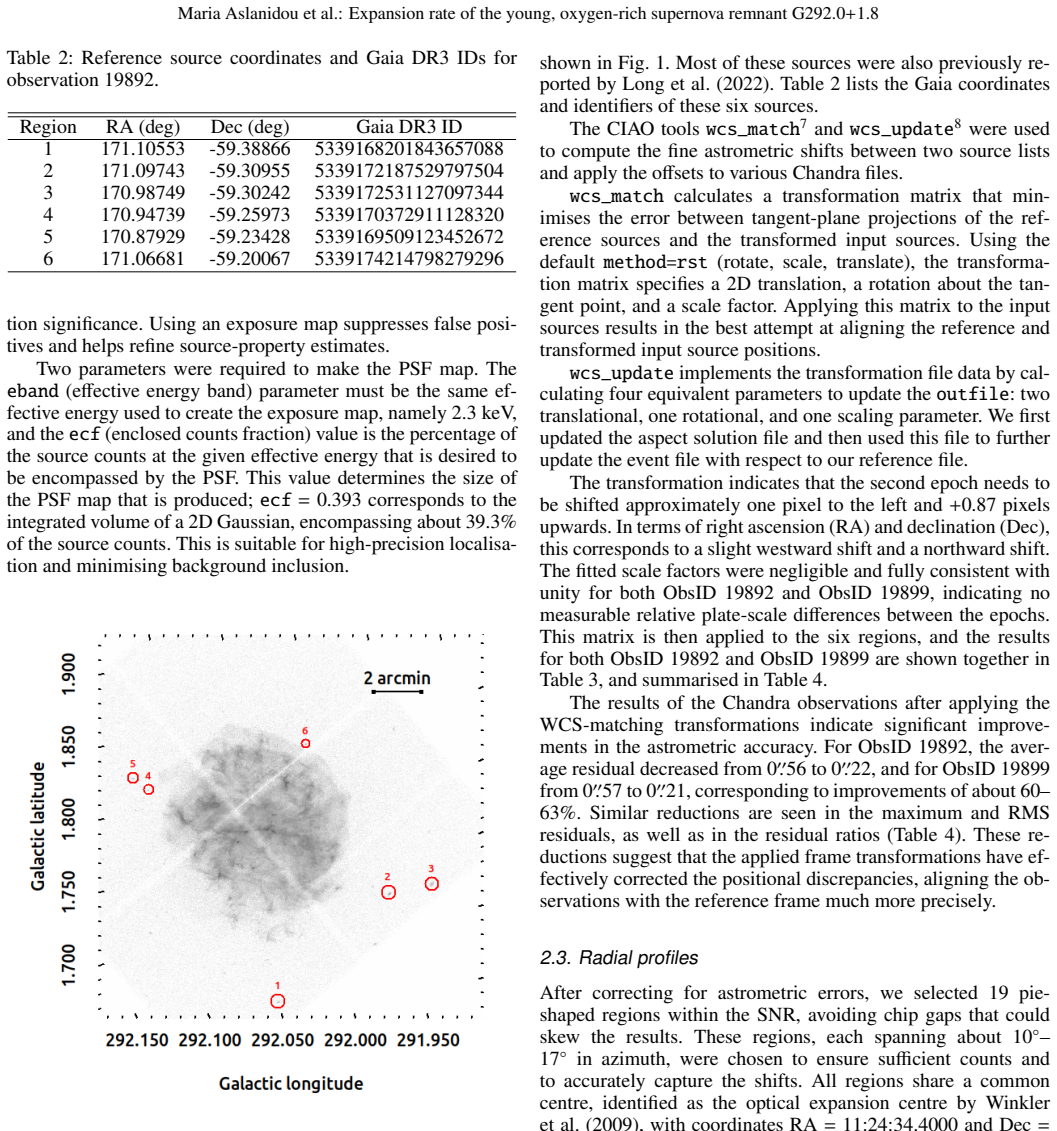
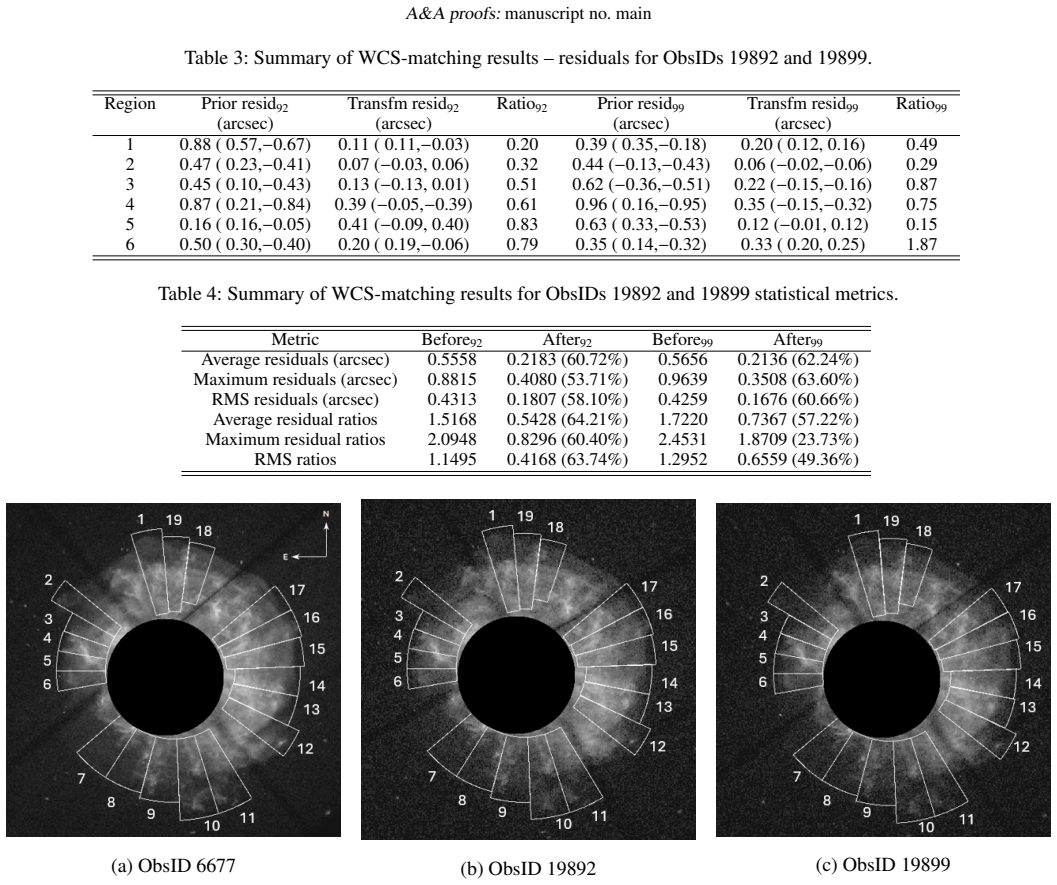
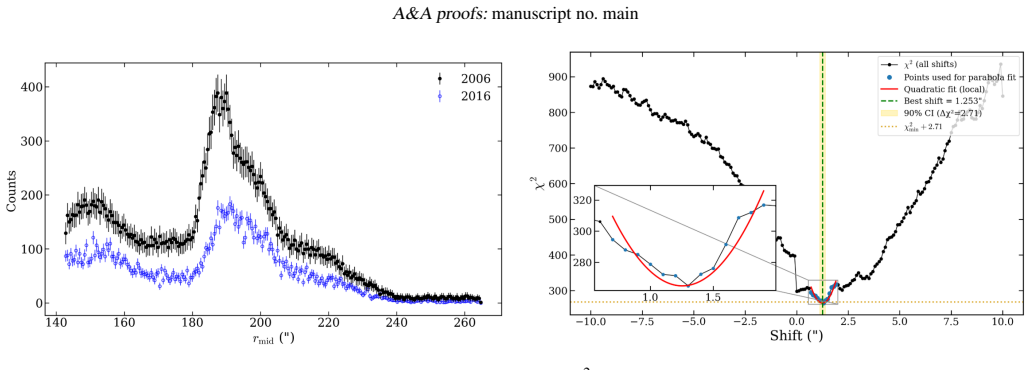
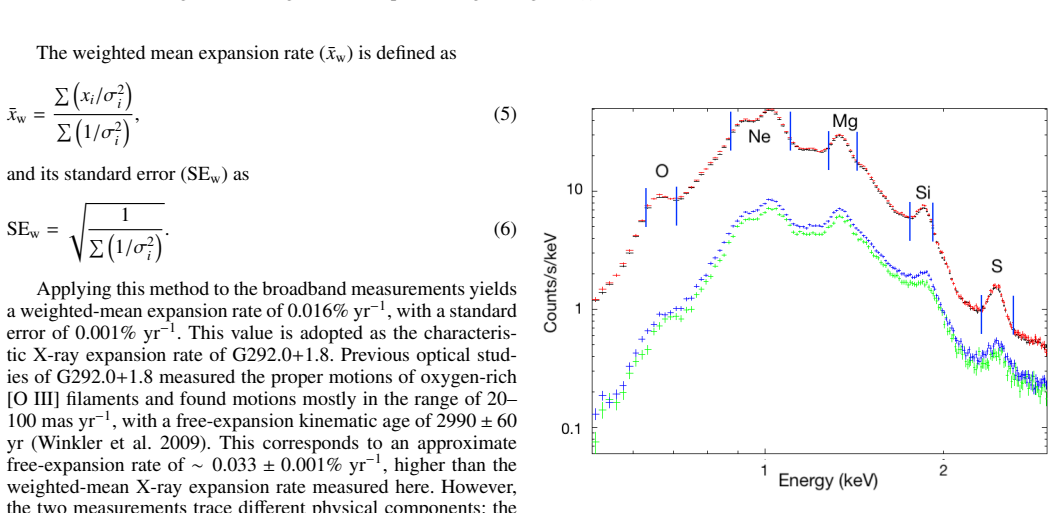
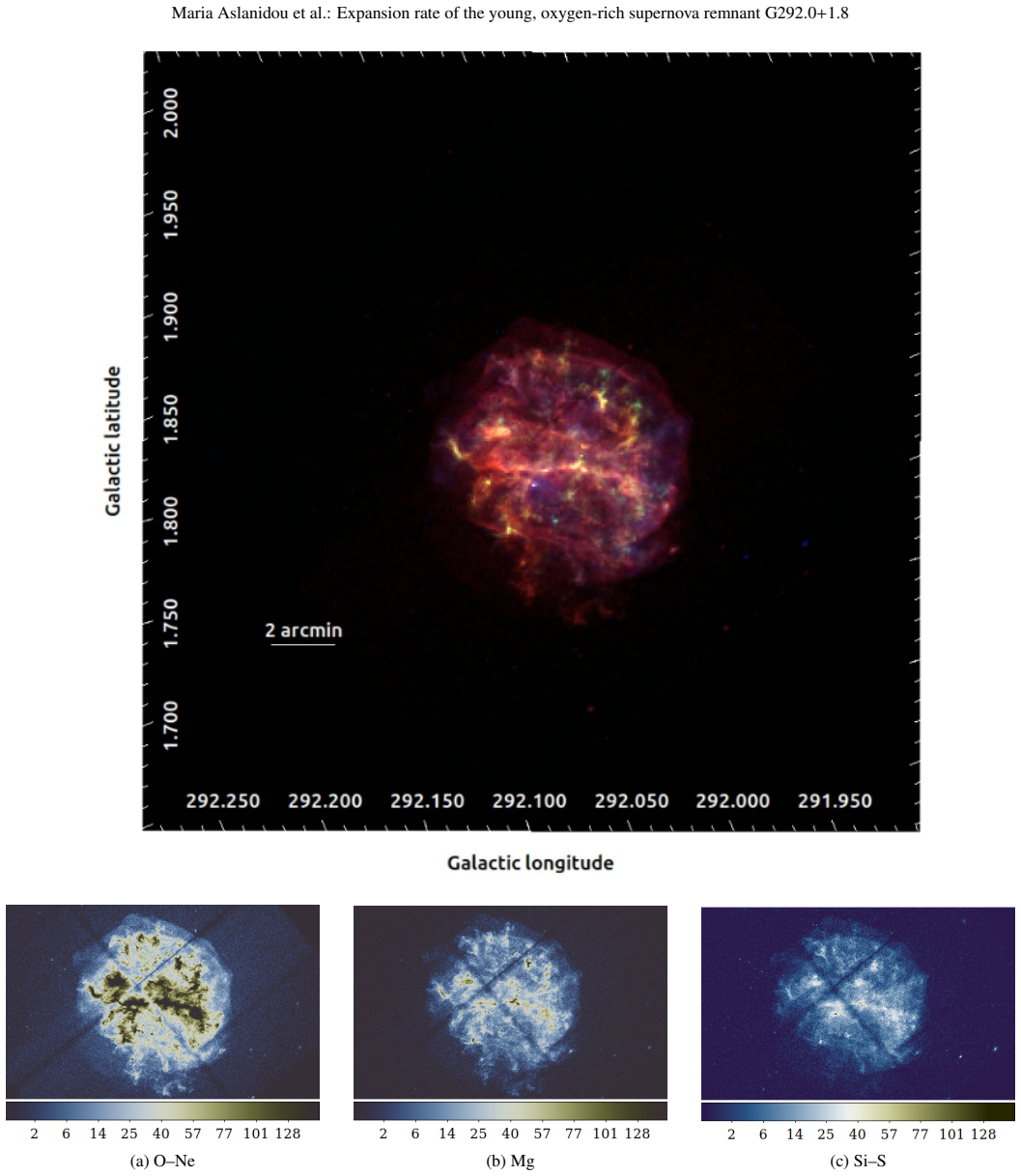
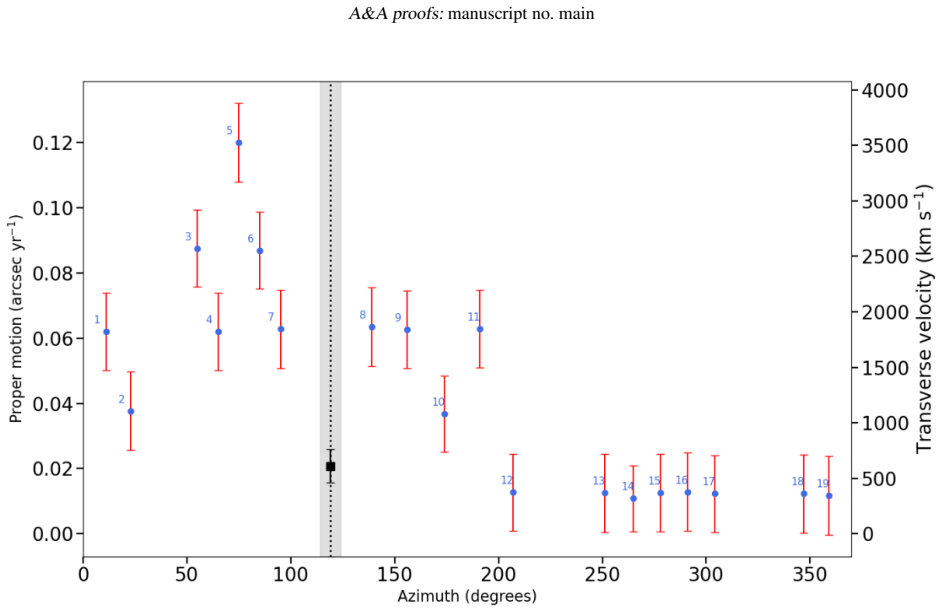
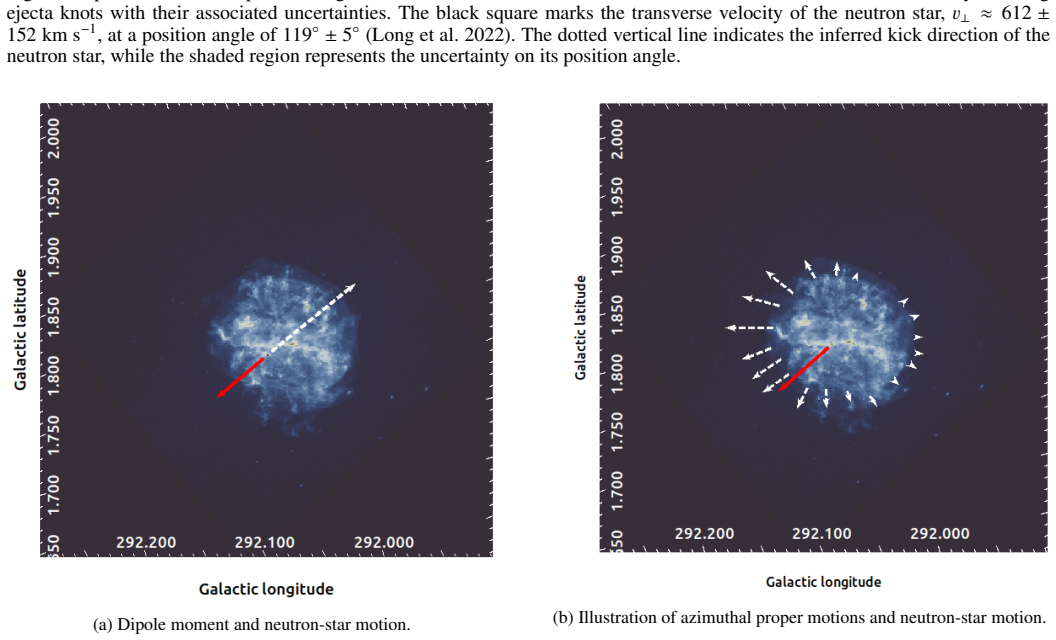
Using two nearly independent ten-year baselines of Chandra ACIS-I data with Gaia DR3 astrometric corrections, radial profiles extracted in nineteen sectors around the forward shock give a broadband weighted-mean expansion rate of 0.016 percent plus or minus 0.001 percent per year. This implies an expansion age of approximately 2500 years for uniform ambient density and 4100 years for a 1/r squared circumstellar profile. Narrow-band images show that O-Ne and Mg follow the broadband rate while Si-S expand more slowly, consistent with their origin in deeper stellar layers. The remnant exhibits pronounced azimuthal asymmetry, with some sectors reaching velocities near 2500 km/s in the direction
What carries the argument
Multi-epoch radial profile fitting of the forward shock position in nineteen azimuthal sectors after Gaia-based astrometric alignment of Chandra images.
If this is right
- The derived age of roughly 2500 years matches earlier estimates between 2000 and 3700 years.
- Heavier alpha elements expand more slowly than lighter ones, matching their deeper origin in the star.
- Expansion speed varies strongly with azimuth around the remnant.
- Some of the fastest-expanding sectors align with the direction of the neutron-star kick.
Where Pith is reading between the lines
- The age difference between uniform and wind-density assumptions could be tested by mapping the actual density profile around the remnant with future observations.
- The slower motion of heavier elements may indicate that reverse-shock heating or mixing affects the apparent expansion of inner ejecta layers.
- Similar multi-epoch studies of other oxygen-rich remnants could reveal whether element-dependent expansion rates are a general feature of core-collapse events.
Load-bearing premise
The measured change in shock radius in each sector directly reflects the actual outward velocity without large errors from projection, sideways motion, or brightness changes that alter the fitted edge.
What would settle it
A third high-resolution X-ray epoch taken in the next decade that yields an average expansion rate outside the quoted 0.016 plus or minus 0.001 percent per year range would falsify the current measurement.
Figures
read the original abstract
Core-collapse supernova remnants (CCSNRs) are ideal targets for studying ejecta--interstellar-medium interactions, shock dynamics, and explosion characteristics. G292.0+1.8 is a classic CCSNR featuring oxygen-rich ejecta, circumstellar material, a rapidly moving pulsar, and a pulsar wind nebula (PWN). We examine its expansion rate using deep Chandra ACIS-I observations over two nearly independent $\sim$10 yr baselines (2006--2016). After applying astrometric corrections based on Gaia DR3 sources, we extracted radial profiles in 19 sectors around the forward shock. The weighted-mean expansion rate is $0.016\% \pm 0.001\%\,\mathrm{yr^{-1}}$ in the broadband, implying an expansion age of ${\sim}2500$ yr for a uniform ambient medium, consistent with previous estimates of 2000--3700 yr. For a $1/r^2$ circumstellar density profile (Wolf-Rayet progenitor wind), the inferred age is ${\sim}4100$ yr. Narrow-band analysis of $\alpha$ elements (O-Ne, Mg, Si-S) shows that lighter elements follow the broadband behaviour, while heavier elements expand more slowly, consistent with their origin in deeper stellar layers. We discuss the pronounced azimuthal asymmetry of the expansion, the apparent paradox that some sectors expand (with $\sim$2500 km/s) preferentially in the direction of the neutron-star kick, and the role of reflected shocks from the reverse-shock--PWN interaction.
Editorial analysis
A structured set of objections, weighed in public.
Referee Report
Summary. The manuscript reports a measurement of the expansion rate of the oxygen-rich supernova remnant G292.0+1.8 using two epochs of deep Chandra ACIS-I observations separated by ~10 years (2006-2016). After Gaia DR3-based astrometric corrections, radial profiles extracted in 19 sectors around the forward shock yield a weighted-mean broadband expansion rate of 0.016% ± 0.001% yr^{-1}. This implies an expansion age of ~2500 yr for uniform ambient medium (or ~4100 yr for 1/r^2 wind profile). Narrow-band analysis shows lighter elements (O-Ne, Mg) follow the broadband rate while heavier elements (Si-S) expand more slowly; the paper discusses pronounced azimuthal asymmetry, possible reflected shocks from PWN interaction, and the apparent alignment of faster expansion with the neutron-star kick direction.
Significance. If robust against systematics, the result supplies a direct, multi-epoch observational anchor for the dynamical age of this young CCSNR, helping reconcile the 2000-3700 yr range from prior work and constraining the role of circumstellar material and reverse-shock/PWN interactions. The element-resolved and azimuthally resolved measurements add value for understanding layered ejecta and asymmetric expansion in oxygen-rich remnants.
major comments (1)
- [Abstract and radial profile extraction paragraph] Abstract, radial profile extraction paragraph: The central claim (weighted-mean rate 0.016% ± 0.001% yr^{-1} from 19 sectors) requires that the fitted radial displacements equal the true shock velocities. No quantitative tests (forward-modeling of line-of-sight projection, non-radial flows, or time-variable brightness that could shift apparent peaks/edges) are described to demonstrate that such effects are smaller than the quoted 0.001% uncertainty; the abstract notes azimuthal asymmetry and reflected shocks but does not bound their impact on the profile fits.
Simulated Author's Rebuttal
We thank the referee for their careful reading of the manuscript and for highlighting an important point regarding the robustness of the expansion-rate measurement. We respond to the major comment below.
read point-by-point responses
-
Referee: [Abstract and radial profile extraction paragraph] Abstract, radial profile extraction paragraph: The central claim (weighted-mean rate 0.016% ± 0.001% yr^{-1} from 19 sectors) requires that the fitted radial displacements equal the true shock velocities. No quantitative tests (forward-modeling of line-of-sight projection, non-radial flows, or time-variable brightness that could shift apparent peaks/edges) are described to demonstrate that such effects are smaller than the quoted 0.001% uncertainty; the abstract notes azimuthal asymmetry and reflected shocks but does not bound their impact on the profile fits.
Authors: We agree that the manuscript does not contain quantitative forward-modeling or explicit bounds on the listed systematics, and that the quoted uncertainty is derived from the profile fits themselves. The radial-profile method in 19 sectors follows the approach used in prior multi-epoch Chandra studies of other young SNRs; the sector width was chosen to balance signal-to-noise against azimuthal variation, and the outermost edge is identified by a consistent functional form across sectors. The pronounced azimuthal asymmetry and possible reflected-shock signatures are already discussed at length in Section 4, where we note that some sectors show faster apparent expansion aligned with the neutron-star kick. To address the referee’s concern directly, we will add a dedicated paragraph (or short subsection) that (i) enumerates the potential biases, (ii) provides geometric estimates of the line-of-sight projection contribution for the observed sector geometry, and (iii) cites hydrodynamic simulations from the literature to argue that non-radial flows and brightness evolution contribute <0.001 % yr^{-1} under the conditions present in G292.0+1.8. We are prepared to perform limited forward-modeling if the referee considers the order-of-magnitude estimates insufficient. revision: yes
Circularity Check
Direct multi-epoch imaging measurement; no derivation reduces to fitted inputs or self-citations
full rationale
The paper measures angular displacements of the forward shock directly from radial profiles extracted in 19 sectors across two Chandra epochs (2006-2016), after Gaia-based astrometric correction. The reported 0.016% ± 0.001% yr^{-1} weighted mean is the arithmetic result of these observed displacements; the implied age is obtained by simple reciprocal scaling (1/rate) under stated assumptions about ambient density. No equations, ansatzes, or self-citations are invoked that would make the measured rate equivalent to its own inputs by construction. The analysis is self-contained against external benchmarks (prior age estimates 2000-3700 yr) and contains no load-bearing self-citation chains or uniqueness theorems.
Axiom & Free-Parameter Ledger
axioms (1)
- domain assumption The measured fractional expansion rate can be converted to a physical age by assuming either a uniform ambient density or a 1/r^2 circumstellar wind profile.
Reference graph
Works this paper leans on
-
[1]
2011, A&A, 528, A143
Abramowski, A., Acero, F., Aharonian, F., et al. 2011, A&A, 528, A143
2011
-
[2]
2015, ApJ, 800, 65
Bhalerao, J., Park, S., Dewey, D., et al. 2015, ApJ, 800, 65
2015
-
[3]
J., Gwynne, P., Reynolds, S
Borkowski, K. J., Gwynne, P., Reynolds, S. P., et al. 2017, ApJL, 837, L7
2017
-
[4]
2002, ApJ, 567, L71
Camilo, F., Manchester, R., Gaensler, B., Lorimer, D., & Sarkissian, J. 2002, ApJ, 567, L71
2002
-
[5]
Chevalier, R. A. 2005, ApJ, 619, 839
2005
-
[6]
D., Kothes, R., Camilo, F., et al
Cotton, W. D., Kothes, R., Camilo, F., et al. 2024, ApJS, 270, 21
2024
-
[7]
& Wallace, B
Gaensler, B. & Wallace, B. 2003, ApJ, 594, 326
2003
-
[8]
1986, ApJ, 303, 336
Gehrels, N. 1986, ApJ, 303, 336
1986
-
[9]
P., & Williams, T
Ghavamian, P., Hughes, J. P., & Williams, T. 2005, ApJ, 635, 365
2005
-
[10]
2023, A&A, 680, A80 Article number, page 11 of 15 A&A proofs:manuscript no
Godinaud, L., Acero, F., Decourchelle, A., & Ballet, J. 2023, A&A, 680, A80 Article number, page 11 of 15 A&A proofs:manuscript no. main
2023
-
[11]
A., Auchettl, K., Temim, T., & Ramirez-Ruiz, E
Holland-Ashford, T., Lopez, L. A., Auchettl, K., Temim, T., & Ramirez-Ruiz, E. 2017, ApJ, 844, 84
2017
-
[12]
Hughes, J. P. 2000, ApJ, 545, L53
2000
-
[13]
P., Slane, P
Hughes, J. P., Slane, P. O., Burrows, D. N., et al. 2001, ApJ, 559, L153
2001
-
[14]
M., Usuda, T., et al
Krause, O., Birkmann, S. M., Usuda, T., et al. 2008, Science, 320, 1195
2008
-
[15]
2009, ApJ, 706, 441
Lee, H.-G., Koo, B.-C., Moon, D.-S., et al. 2009, ApJ, 706, 441
2009
-
[16]
1977, MNRAS, 179, 147
Lockhart, I., Goss, W., Caswell, J., & McAdam, W. 1977, MNRAS, 179, 147
1977
-
[17]
J., Plucinsky, P
Long, X., Patnaude, D. J., Plucinsky, P. P., & Gaetz, T. J. 2022, ApJ, 932, 117
2022
-
[18]
Milisavljevic, D. & Fesen, R. A. 2017, arXiv preprint arXiv:1701.00891
Pith/arXiv arXiv 2017
-
[19]
1961, Aust
Mills, B., Slee, O., & Hill, E. 1961, Aust. J. Phys., 14, 497
1961
-
[20]
1969, Aust
Milne, D. 1969, Aust. J. Phys., 22, 613
1969
-
[21]
1996, A&A, 306, L49
Nicastro, L., Johnston, S., & Koribalski, B. 1996, A&A, 306, L49
1996
-
[22]
P., Slane, P
Park, S., Hughes, J. P., Slane, P. O., et al. 2007, ApJ, 670, L121
2007
-
[23]
P., Slane, P
Park, S., Hughes, J. P., Slane, P. O., et al. 2004, ApJ, 602, L33
2004
-
[24]
W., Hughes, J
Park, S., Roming, P. W., Hughes, J. P., et al. 2001, ApJ, 564, L39
2001
-
[25]
J., Lee, S.-H., Slane, P
Patnaude, D. J., Lee, S.-H., Slane, P. O., et al. 2017, ApJ, 849, 109
2017
-
[26]
J., Sinnott, B., et al
Rest, A., Foley, R. J., Sinnott, B., et al. 2011, ApJ, 732, 3
2011
-
[27]
E., et al
Roper, Q., Filipovic, M., Allen, G. E., et al. 2018, MNRAS, 479, 1800
2018
-
[28]
C., et al
Temim, T., Slane, P., Raymond, J. C., et al. 2022, ApJ, 932, 26
2022
- [29]
-
[30]
2020, Physics and Evolution of Supernova Remnants (Springer)
Vink, J. 2020, Physics and Evolution of Supernova Remnants (Springer)
2020
-
[31]
J., & Castro, D
Vink, J., Patnaude, D. J., & Castro, D. 2022, ApJ, 929, 57
2022
-
[32]
F., Twelker, K., Reith, C
Winkler, P. F., Twelker, K., Reith, C. N., & Long, K. S. 2009, ApJ, 692, 1489
2009
-
[33]
A., Fryer, C
Young, P. A., Fryer, C. L., Hungerford, A., et al. 2006, ApJ, 640, 891 Article number, page 12 of 15 Maria Aslanidou et al.: Expansion rate of the young, oxygen-rich supernova remnant G292.0+1.8 Appendix A: Radial-profile extraction and imple- mentation details Our Python code performs radial-profile analysis of photon events stored in FITS files. The ana...
2006
discussion (0)
Sign in with ORCID, Apple, or X to comment. Anyone can read and Pith papers without signing in.