REVIEW 2 major objections 5 minor 51 references
Synthesizing Voltage Ride-Through Controllers for Data Centers
T0 review · 2 major / 5 minor · reviewed 2026-08-10 · deepseek-v4-flash
Pith's one-line read SolVRT claims a data center's ride-through compliance can be settled at design time by turning the grid code into a temporal-logic synthesis problem.
desk verdict A real and useful STL-based VRT synthesis pipeline, but the 'all possible scenarios' guarantee is unsupported because the worst-case trace reduction (Eq. 7) does not bound the active-power floor clause. read the letter →
The pith
A machine-rendered reading of the paper's core claim, the machinery that carries it, and where it could break.
The reading
What carries the argument
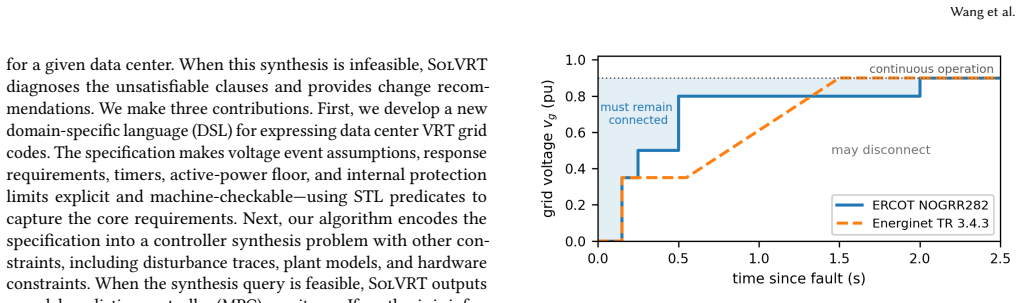
The load-bearing object is the assume-guarantee STL specification: the grid's voltage envelope is the assumption, and the three timed clauses are the guarantees. STL is a temporal logic over real-valued signals that expresses thresholds, deadlines, and nested timing via always and eventually operators, so each clause becomes a formula with event-anchored time windows. The synthesis problem then asks whether a control input $u=(P,Q)$ exists such that the plant output $(v_i,p)$ satisfies the formula for all admissible disturbances. Two derived artifacts carry the argument: the worst-case trace of Eq. (7), which reduces infinitely many sag shapes inside the envelope to a single binding trace, and the conflict frontier, which maps each sag depth to the largest sustainable active-power floor and marks the "conflict edge" where the code's requirement exceeds the facility's capability.
What would settle it
Run the synthesis query against a family of sag traces inside the envelope whose voltage is held just above the floor band, near 0.65 pu where the paper's own conflict frontier crosses the requirement, for the full ride-through duration, and check whether the synthesized controller keeps the internal voltage above the trip level while holding the power floor. If any such trace violates a guarantee, the worst-case reduction in Eq. (7) is not sound and the "guaranteed for all scenarios" claim would fail.
Extended reading notes
Core claim
SolVRT turns a grid code into a synthesis query. The specification language expresses the code's three obligations — stay connected during the sag, hold an active-power floor, and recover within a deadline — as STL clauses anchored at declared fault and recovery events. The plant model, built on LinDistFlow, relates the converter's active and reactive power injections to the internal bus voltage and the aggregate power draw. Against the worst-case voltage trace $v'_g(t)=\min\{v: \mathrm{dur}(v)\ge t\}$, which lower-bounds every sag the envelope admits, the clauses become numeric STL formulas, and the query asks whether a control sequence $u=(P,Q)$ exists inside the converter's apparent-power limit $P^2+Q^2\le S^2$. A feasible answer yields an MPC controller guaranteed to satisfy the requirements under all scenarios the code assumes; an infeasible answer is a certificate that no compliant controller exists for that plant, code, and disturbance set. The paper then derives the conflict frontier, the largest active-power floor the facility can sustain while staying connected at each sag depth, and uses it to isolate the minimal infeasible clause subset and binary-search the smallest converter rating, interconnection reactance, or workload cap that restores compliance.
Load-bearing premise
The central assumption is that the deepest, longest sag inside the code's envelope is the hardest case for every requirement, so a controller certified against that single worst-case trace is certified against all sags the envelope admits.
Editorial extensions
If this is right
- Given a grid code text, a facility topology, and a workload trace, compliance becomes a settled design-time query rather than a hand-tuned control heuristic.
- When the query is feasible, the returned MPC controller is compliant by construction, so both the data center operator and the grid operator can sign off before a fault occurs.
- When it is infeasible, the minimal infeasible clause subset names which requirements conflict, and binary search over the monotone provisioning knobs gives the smallest converter rating, reactance, or workload cap that restores compliance.
- Formalizing the code exposes underspecified terms, such as how "pre-disturbance level" is read and whether recovery means holding the level, forcing code authors to make these choices explicit.
- Because frequency ride-through has the same assume-guarantee shape, the same specification language extends to it with the disturbance signal changed and the plant model and control knobs replaced.
Reading between the lines
- A testable extension of the paper's guarantee claim is whether shallower, longer sags inside the envelope bind the active-power floor clause more tightly than the worst-case trace of Eq. (7); if so, the certificate would need to check those traces as well.
- If the synthesis claim holds, grid operators could use the same machinery to evaluate proposed codes before adopting them: a code that is infeasible for every realistic facility topology is likely unenforceable in practice.
- The conflict frontier could serve as a pre-construction planning tool, letting operators sweep converter ratings, interconnection reactance, and workload caps to find the cheapest design that clears the code, rather than only the minimal single-knob change.
Editorial analysis
A structured set of objections, weighed in public.
Referee Report
Summary. SolVRT formalizes low-voltage ride-through (LVRT) grid codes for data centers as assume-guarantee specifications in Signal Temporal Logic (STL), encodes the specification together with a LinDistFlow-based plant model into a mixed-integer synthesis query, and either returns a model-predictive controller as a witness or, when the query is infeasible, diagnoses the conflicting clauses via a 'conflict frontier' and computes minimal provisioning changes (converter rating, interconnection reactance, or workload cap). The approach is evaluated on a 200 MW data center model connected to a 140-bus transmission system using the ANDES simulator, comparing the synthesized controller with no-controller and penalty-based baselines, and demonstrating the diagnosis and provisioning workflow on an as-built 25 MVA rating.
Significance. The paper addresses a timely and practically important problem: data center ride-through compliance. Its main contribution, if the formal claims hold, is a decidable design-time procedure for grid-code compliance with actionable infeasibility analysis. The DSL/STL encoding is a useful advance over natural-language codes, and the conflict-frontier and provisioning analysis is novel and well demonstrated. The empirical evaluation on an independent grid simulator is a strength, as is the use of a realistic facility model (Vulcan) and cited workload traces. The central limitation is that the formal correctness guarantee rests on an unproven worst-case trace reduction; once this is resolved, the contribution would be strong. The paper does not ship machine-checked proofs or code artifacts, but the evaluation is reproducible in principle from the detailed setup.
major comments (2)
- [Sec. 3.3, Eq. (7); Sec. 3.2] The reduction of the disturbance set to the single pointwise-minimal trace v'_g(t) = min{v: dur(v) >= t} is not a valid worst case for the active-power floor clause phi_flr (Eq. 5). Since the floor mu = v_g * p_pre is increasing in v_g, a shallower sag can demand a higher floor than the deepest part of the staircase: for p_pre = 200 MW, a trace holding v_g = 0.65 pu for 0.5 s (admitted by the [0.5, 0.8) band) requires p >= 130 MW over the whole fault, whereas the staircase v'_g requires only p >= 0 during the first 0.25 s and p >= 100 MW during 0.25-0.5 s. The paper acknowledges that v'_g is 'the binding case for the connection clause' (Sec. 3.3), but the synthesis query (2) is solved against this trace for all three clauses. The conflict frontier of Sec. 3.4 (Fig. 8) shows the requirement mu crossing the capability frontier at v_g approximately 0.65 pu, a depth absent from the staircase, so feasibility on the staircase does not imply existence of a controller for every trace in the assume envelope. Consequently, the Section 3.2 claim that a synthesized controller is 'guaranteed to satisfy the requirements under all possible scenarios' is not supported; the infeasibility direction remains sound (the staircase is one admitted trace), but the positive synthesis claim can return a controller that fails on an admitted trace. The authors should either prove dominance of v'_g for all clauses, or replace the single-trace reduction with a synthesis/verification procedure that accounts for the whole envelope (e.g., robust or parameterized STL), and should restate the 'proof that no such controller exists' claim accordingly.
- [Sec. 3.3 and Sec. 2 (receding-horizon loop)] The synthesis query (2) is solved as a one-shot MILP for a fixed disturbance trace, and the resulting controller is then executed in a receding-horizon loop. The paper does not state the horizon length, nor does it provide terminal constraints or a recursive-feasibility argument establishing that a feasible solution at step k remains feasible at step k+1 along the closed-loop trajectory. Without such an argument, the 'correct-by-construction' guarantee is not established even for the single worst-case trace v'_g; the ANDES results in Sec. 4.1 demonstrate compliance on three simulated faults, not a universal guarantee. Please clarify whether a shrinking-horizon scheme is used (in which case the tail of the previous plan provides a feasible candidate) and state the associated assumptions on disturbance knowledge.
minor comments (5)
- [Abstract / throughout] There are formatting errors in the rendering of the system name, e.g., 'We proposeSolVRT' in the abstract; please fix the LaTeX spacing and ensure consistent use of 'SolVRT' in text.
- [Fig. 3] In the grammar, the metavariable 'e' is used both for events and inside 'expr' productions (e.g., 'expr::=...|e' and 'event e = ...'), which is confusing; renaming one of them would improve readability, and the nonterminal 'dur' is used without a definition.
- [Sec. 5] The discussion of grid-code ambiguity is welcome, but the synthesis results depend on the chosen interpretations of p_pre (instantaneous) and T_hold; a sensitivity analysis over these parameters would strengthen the claims.
- [Sec. 4.1] The reactive injections are reported as 'roughly 70, 170, and 300 MVAr'; please clarify whether these are per-node or facility-total values and ensure the units are consistent with the MVA ratings.
- [Sec. 1] The statement that SolVRT 'will be released in open source' would benefit from an artifact link or a footnote with the repository, since the evaluation currently rests on the description in the paper.
Circularity Check
No significant circularity: the synthesized controllers are derived from the STL specification and plant model, not from fitted data or self-referential definitions.
full rationale
SolVRT's derivation is self-contained: the LVRT code is encoded into STL clauses (Section 3.2), the synthesis query (2) is posed over the plant model, feasible control set, and disturbance trace, and the resulting MPC is validated closed-loop on the independent ANDES grid simulator using facility data from external sources. No fitted constant is renamed as a prediction; p_pre and T_hold are explicitly labeled as interpretations where the code is underspecified, not as calibrated values. The citations to the authors' prior work in Section 2.3 support standard assume-guarantee background and are not load-bearing: the formalization and synthesis would stand without them. The conflict frontier and provisioning recommendations are computed by repeated feasibility checks of the synthesis query, so they report the query's output rather than restating its inputs. The reviewer-identified weakness, that the worst-case trace v'_g of Eq. (7) may not be the binding disturbance for the active-power floor clause, is a potential soundness gap in the all-scenarios guarantee, but it is not circularity: the synthesis solves against a chosen disturbance trace rather than defining that trace as the guarantee. No circular step is exhibited, so the score is 0.
Assumptions & free parameters
free parameters (3)
- T_hold =
unspecified in text
- Robustness margin =
0.005 pu
- MPC sampling period =
0.02 s
assumptions (5)
- ad hoc to paper Worst-case trace dominance
- domain assumption LinDistFlow validity
- domain assumption Sufficient battery SoC
- domain assumption Simplified protection model
- ad hoc to paper Receding-horizon recursive feasibility
Cite this review
Pith. "Pith review of Synthesizing Voltage Ride-Through Controllers for Data Centers." pith.science (2026). https://pith.science/paper/S5DUGP7X
@misc{pith2026260807289,
  author       = {Pith},
  title        = {Pith review of: Synthesizing Voltage Ride-Through Controllers for Data Centers},
  year         = {2026},
  howpublished = {\url{https://pith.science/paper/S5DUGP7X}},
  note         = {Machine review of arXiv:2608.07289}
}
read the original abstract
Data centers are among the power grid's fastest-growing loads. Since data center servers are sensitive electronic components, they need to be protected against the grid's voltage disturbances during grid faults. While disconnecting from the grid achieves this, it can further destabilize the power system if many data centers trip at once. To address this emerging concern, voltage ride-through (VRT) grid codes have been proposed to standardize data center behavior. They require a data center to stay connected for a period of time through the disturbance, hold an active power floor, and recover its draw within a deadline upon restoration. However, systematically designing and certifying controllers that satisfy these coupled temporal and operational requirements remains challenging. We propose SolVRT, a system that synthesizes a grid-code-compliant VRT controller for a given data center using formal methods. We develop a specification language that expresses a grid code in Signal Temporal Logic (STL) as the basis for formal reasoning. Our encoding algorithm takes the specification, along with a model of the data center's power topology, and translates the constraints into a controller synthesis problem. This step produces a correct-by-construction controller if a solution can be found, or a proof that no such controller exists. For the latter case, SolVRT provides a diagnostic step: it traces the facility's "conflict frontier," isolates the conflicting clauses that led to non-compliance, and computes the smallest hardware or workload change that would enable compliance. We evaluate SolVRT through closed-loop simulations of a 200 MW data center connected to a 140-bus transmission system. The results demonstrate that SolVRT can synthesize compliant VRT controllers, certify infeasibility when compliance is unattainable, and identify targeted modifications that enable compliance.
Figures


Figures from the paper (5 more)


Reference graph
Works this paper leans on
-
[1]
Yousef Abudyak, Mohsen Alizadeh, and Wei Sun. 2026. Mitigating Data Centers Load Risks and Enabling Grid Support Functions through Grid-Forming Control. arXiv:2602.01013
arXiv 2026
-
[2]
Fatih Acun, Can Hankendi, Ethan Levine, Hudson Reynolds, Joshua Bardwick, and Ayse K. Coskun. 2026. Investigating Power Consumption Flexibility of AI Data Centers for Demand Response Participation. InProceedings of the 17th ACM International Conference on Future and Sustainable Energy Systems. ACM, Banff , Alberta , Canada, 344–348. doi:10.1145/3744255.3798112
- [3]
-
[4]
Eugene Asarin, Alexandre Donzé, Oded Maler, and Dejan Nickovic. 2012. Parametric Identification of Temporal Properties. InRuntime Verification, Sar- fraz Khurshid and Koushik Sen (Eds.). Springer, Berlin, Heidelberg, 147–160. doi:10.1007/978-3-642-29860-8_12
-
[5]
M.E. Baran and F.F. Wu. 1989. Optimal capacitor placement on radial distribution systems.IEEE Transactions on Power Delivery4, 1 (1989), 725–734. doi:10.1109/ 61.19265
work page 1989
-
[6]
Ezio Bartocci, Jyotirmoy Deshmukh, Alexandre Donzé, Georgios Fainekos, Oded Maler, Dejan Ničković, and Sriram Sankaranarayanan. 2018. Specification-Based Monitoring of Cyber-Physical Systems: A Survey on Theory, Tools and Appli- cations. InLectures on Runtime Verification: Introductory and Advanced Topics, Ezio Bartocci and Yliès Falcone (Eds.). Springer ...
-
[7]
Calin Belta and Sadra Sadraddini. 2019. Formal Methods for Control Synthesis: An Optimization Perspective.Annual Review of Control, Robotics, and Autonomous Systems2 (2019), 115–140
work page 2019
-
[8]
Alberto Bemporad, Manfred Morari, Vivek Dua, and Efstratios N. Pistikopoulos
Show all 51 references
-
[9]
Henzinger, and Kim G
Albert Benveniste, Benoît Caillaud, Dejan Nickovic, Roberto Passerone, Jean- Baptiste Raclet, Philipp Reinkemeier, Alberto Sangiovanni-Vincentelli, Werner Damm, Thomas A. Henzinger, and Kim G. Larsen. 2018. Contracts for System Design.Foundations and Trends in Electronic Desig...
2018
-
[10]
Ames, and Steven H
Yuxiao Chen, James Anderson, Karan Kalsi, Aaron D. Ames, and Steven H. Low
-
[11]
John W Chinneck and Erik W Dravnieks. 1991. Locating minimal infeasible constraint sets in linear programs.ORSA Journal on Computing3, 2 (1991), 157–168
1991
-
[12]
Esha Choukse, Brijesh Warrier, Scot Heath, et al. 2025. Power Stabilization for AI Training Datacenters. arXiv:2508.14318
2025 arXiv
-
[13]
Hantao Cui, Fangxing Li, and Kevin Tomsovic. 2021. Hybrid Symbolic-Numeric Framework for Power System Modeling and Analysis.IEEE Transactions on Power Systems36, 2 (2021), 1373–1384. doi:10.1109/TPWRS.2020.3017019
2021
-
[14]
Alexandre Donzé and Vasumathi Raman. 2015. BluSTL: Controller Synthesis from Signal Temporal Logic Specifications. In1st and 2nd International Workshop on Applied Verification for Continuous and Hybrid Systems (ARCH). 160–168
2015
-
[15]
2024.Technical Regulation 3.4.3 Requirements for Transmission- Connected Demand Facilities, Revision 1
Energinet. 2024.Technical Regulation 3.4.3 Requirements for Transmission- Connected Demand Facilities, Revision 1. Technical Report 3.4.3. En- erginet. https://en.energinet.dk/media/bkpf4hef/technical-regulation-343- requirements-for-transmission-connected-demand-facilities-re...
2024
-
[16]
2026.Board Priority - Large Computational Load Ride-Through Require- ments
ERCOT. 2026.Board Priority - Large Computational Load Ride-Through Require- ments. Nodal Operating Guide Revision Request 282NOGRR-30. Electric Reliabil- ity Council of Texas. https://www.ercot.com/files/docs/2026/05/11/282NOGRR- 30-ERCOT-Comments-051126.docx
2026
-
[17]
Fainekos and George J
Georgios E. Fainekos and George J. Pappas. 2009. Robustness of Temporal Logic Specifications for Continuous-Time Signals.Theoretical Computer Science410, 42 (2009), 4262–4291
2009
-
[18]
Gurobi Optimization, LLC. 2026. Model.computeIIS: Python API Refer- ence.Gurobi Optimizer Reference Manual. Gurobi Optimizer 13.0 documenta- tion. https://docs.gurobi.com/projects/optimizer/en/current/reference/python/ model.html#Model.computeIIS
2026
-
[19]
Bardh Hoxha, Adel Dokhanchi, and Georgios Fainekos. 2018. Mining parametric temporal logic properties in model-based design for cyber-physical systems. International Journal on Software Tools for Technology Transfer20, 1 (Feb. 2018), 79–93. doi:10.1007/s10009-017-0447-4
2018 doi
-
[20]
IEEE. 2022. IEEE Standard 2800-2022: Interconnection and Interoperability of Inverter-Based Resources Interconnecting with Associated Transmission Electric Power Systems
2022
-
[21]
2022.The Algebra of Contracts
Inigo Incer. 2022.The Algebra of Contracts. Ph. D. Dissertation. EECS Depart- ment, University of California, Berkeley. http://www2.eecs.berkeley.edu/Pubs/ TechRpts/2022/EECS-2022-99.html
2022
-
[22]
Inigo Incer, Albert Benveniste, and Alberto Sangiovanni-Vincentelli. 2023. Some Algebraic Aspects of Assume-Guarantee Reasoning.arXiv 2309.08875(2023). arXiv:2309.08875 [cs.LO] https://arxiv.org/abs/2309.08875
2023 arXiv
-
[23]
Ames, and Richard M
Inigo Incer, Noel Csomay-Shanklin, Aaron D. Ames, and Richard M. Murray
-
[24]
Deshmukh, and Sanjit A
Xiaoqing Jin, Alexandre Donzé, Jyotirmoy V. Deshmukh, and Sanjit A. Seshia
-
[25]
Hadas Kress-Gazit, Morteza Lahijanian, and Vasumathi Raman. 2018. Synthesis for Robots: Guarantees and Feedback for Robot Behavior.Annual Review of Control, Robotics, and Autonomous Systems1 (2018), 211–236
2018
-
[26]
Hossain, Sai Pushpak Nandanoori, and Veronica Adetola
Soumya Kundu, Kaustav Chatterjee, Rakib R. Hossain, Sai Pushpak Nandanoori, and Veronica Adetola. 2025. Managing Risks from Large Digital Loads Using Coordinated Grid-Forming Storage Network. arXiv:2508.11080
2025 arXiv
-
[27]
Zhirui Liang, Jae-Won Chung, Mosharaf Chowdhury, Jiasi Chen, and Vladimir Dvorkin. 2026. GPU-to-Grid: Voltage Regulation via GPU Utilization Control. arXiv:2602.05116
2026 arXiv
-
[28]
Zhenhua Liu, Adam Wierman, Yuan Chen, Benjamin Razon, and Niangjun Chen
-
[29]
Oded Maler and Dejan Nickovic. 2004. Monitoring Temporal Properties of Continuous Signals. InFormal Techniques, Modelling and Analysis of Timed and Fault-Tolerant Systems (FORMATS/FTRTFT). 152–166
2004
-
[30]
Sina Mohammadi, Wayne Wang, Marcus Chen I Wada, Rouzbeh Haghighi, Ali Hassan, Hualong Liu, Archit Bhatnagar, Ang Chen, and Wencong Su. 2026. Grid Integration of AI Data Centers: A Critical Review of Energy Storage Solutions. arXiv:2603.00415 [eess.SY] https://arxiv.org/abs/2603.00415
2026 arXiv
-
[31]
2025.Incident Review: Consid- ering Simultaneous Voltage-Sensitive Load Reductions
North American Electric Reliability Corporation. 2025.Incident Review: Consid- ering Simultaneous Voltage-Sensitive Load Reductions. Technical Report. North American Electric Reliability Corporation. https://www.nerc.com/globalassets/ our-work/reports/event-reports/incident_re...
2025
-
[32]
Finn, Alberto L
Pierluigi Nuzzo, Huan Xu, Necmiye Ozay, John B. Finn, Alberto L. Sangiovanni- Vincentelli, Richard M. Murray, Alexandre Donzé, and Sanjit A. Seshia. 2014. A Contract-Based Methodology for Aircraft Electric Power System Design.IEEE Access2 (2014), 1–25
2014
-
[33]
Murray, Alberto Sangiovanni-Vincentelli, and Sanjit A
Vasumathi Raman, Alexandre Donzé, Mehdi Maasoumy, Richard M. Murray, Alberto Sangiovanni-Vincentelli, and Sanjit A. Seshia. 2014. Model Predictive Control with Signal Temporal Logic Specifications. In53rd IEEE Conference on Decision and Control (CDC). 81–87. doi:10.1109/CDC.20...
2014
-
[34]
Murray, and Sanjit A
Vasumathi Raman, Alexandre Donzé, Dorsa Sadigh, Richard M. Murray, and Sanjit A. Seshia. 2015. Reactive Synthesis from Signal Temporal Logic Specifi- cations. InProceedings of the 18th International Conference on Hybrid Systems: Computation and Control (HSCC). 239–248. doi:10....
2015
-
[35]
Nicolas Rouquette, Inigo Incer, and Alessandro Pinto. 2023. Early Design Ex- ploration of Space System Scenarios Using Assume-Guarantee Contracts. In 11 Wang et al. 2023 IEEE International Conference on Space Mission Challenges for Informa- tion Technology (SMC-IT). IEEE, Pasa...
2023
-
[36]
Mohamed Shamseldein. 2025. From Liability to Asset: A Three-Mode Grid-Forming Control Framework for Centralized Data Center UPS Systems. arXiv:2512.16497
2025 arXiv
-
[37]
Marina Tsili and Stavros Papathanassiou. 2009. A Review of Grid Code Technical Requirements for Wind Farms.IET Renewable Power Generation3, 3 (2009), 308–332
2009
-
[38]
Deepthi Vaidhynathan, Kumaraguru Prabakar, Gregory Martin, Anand Ramesh, Ben Wheeler, Christopher Coco, Jimmy Clidaras, Matthieu Monsch, Sangsun Kim, Saurav Talukdar, and Shilpa Marti. 2025. Vulcan Test Platform: Demonstrating the Data Center as a Flexible Grid Asset.Renewable...
2025
-
[39]
Di Wang, Sriram Govindan, Anand Sivasubramaniam, Aman Kansal, Jie Liu, and Badriddine Khessib. 2014. Underprovisioning backup power infrastructure for datacenters. InProceedings of the 19th international conference on Architectural support for programming languages and operati...
2014
-
[40]
Lizhi Wang, Fei Feng, Ella Chou, and Yashen Lin. 2026. Resilient Energy- Based Control for DC Data Centers under Grid and Load Disturbances. arXiv:2605.21691
2026 arXiv
-
[41]
Adam Wierman, Zhenhua Liu, Iris Liu, and Hamed Mohsenian-Rad. 2014. Op- portunities and challenges for data center demand response. InInternational Green Computing Conference. 1–10. doi:10.1109/IGCC.2014.7039172
2014
-
[42]
Yiheng Xie, Wenqi Cui, and Adam Wierman. 2026. Enhancing Data Center Low- Voltage Ride-Through. InProceedings of the 17th ACM International Conference on Future and Sustainable Energy Systems (e-Energy). arXiv:2510.03867
2026
-
[43]
Agung Julius, and Joe H
Zhe Xu, A. Agung Julius, and Joe H. Chow. 2017. Optimal Energy Storage Control for Frequency Regulation under Temporal Logic Specifications. InAmerican Control Conference (ACC). 1874–1879
2017
-
[44]
Agung Julius, and Joe H
Zhe Xu, A. Agung Julius, and Joe H. Chow. 2019. Energy Storage Controller Synthesis for Power Systems with Temporal Logic Specifications.IEEE Systems Journal13, 1 (2019), 748–759
2019
-
[45]
Yichen Zhang, Mohammed Olama, Alexander Melin, Yaosuo Xue, Seddik Djouadi, and Kevin Tomsovic. 2019. Synthesizing Distributed Energy Resources in Mi- crogrids with Temporal Logic Specifications. InIEEE Innovative Smart Grid Technologies (ISGT). 1–5
2019
-
[46]
Hao Zhu and Hao Jan Liu. 2016. Fast Local Voltage Control Under Limited Reactive Power: Optimality and Stability Analysis.IEEE Transactions on Power Systems31, 5 (2016), 3794–3803. doi:10.1109/TPWRS.2015.2504419 A The Encoding Procedure Algorithm 1 lists the full encoding proc...
2016
-
[2002]
2002), 3–20
The explicit linear quadratic regulator for constrained systems.Automatica 38, 1 (Jan. 2002), 3–20. doi:10.1016/S0005-1098(01)00174-1
2002 doi
-
[2013]
InProceedings of the ACM SIGMETRICS/inter- national conference on Measurement and modeling of computer systems
Data center demand response: avoiding the coincident peak via workload shifting and local generation. InProceedings of the ACM SIGMETRICS/inter- national conference on Measurement and modeling of computer systems. ACM, Pittsburgh PA USA, 341–342. doi:10.1145/2465529.2465740
-
[2015]
2015), 1704–1717
Mining Requirements From Closed-Loop Control Models.IEEE Transactions on Computer-Aided Design of Integrated Circuits and Systems34, 11 (Nov. 2015), 1704–1717. doi:10.1109/TCAD.2015.2421907
2015
-
[2019]
InAmerican Control Conference (ACC)
Compositional Set Invariance in Network Systems with Assume-Guarantee Contracts. InAmerican Control Conference (ACC). 1027–1034
-
[2024]
doi:10.1109/LCSYS.2024.3410150
Layered Control Systems Operating on Multiple Clocks.IEEE Control Systems Letters8 (2024), 1211–1216. doi:10.1109/LCSYS.2024.3410150
2024
Reviewed August 10, 2026 · model on record in the stance chip above.
Discussion (0). Continue with ORCID to comment.