REVIEW 4 major objections 4 minor 27 references
Insights from a workshop on gamification of research in mathematics and computer science
T0 review · 4 major / 4 minor · reviewed 2026-08-12 · deepseek-v4-flash
Pith's one-line read Research-level geometry can be packaged as collaborative games, and the Fence Challenge in particular yields exact extremal counts: 1440 optimal pentomino fences enclosing 128 tiles and 21 optimal tetromino fences enclosing 9.
desk verdict An honest outreach write-up with a small new tetromino result that the preprint doesn't actually prove, and a pentomino result deferred to an unpublished companion paper. read the letter →
The pith
A machine-rendered reading of the paper's core claim, the machinery that carries it, and where it could break.
The reading
What carries the argument
The central object is a fence: a polyform made from all poly-elements of a given size in which every piece has two edge-neighbours, enclosing a set of grid cells; the paper also imposes that optimal fences be isotopic to a circle so they enclose one area with no spurious topology. The argument-carrying mechanism in the tetromino proof is a length/protrusion accounting: each tetromino is assigned a direction, a progression (how many tiles it extends in that direction), and a protrusion (how many tiles extend sideways), whose sum gives the piece's contribution to the perimeter. Summing the five contributions caps the perimeter at 18, which forces any enclosing rectangle to be among $5 \times 4$, $4 \times 4$, and $5 \times 3$; the geometric forcing of the o and n pieces then cuts the naive 12-tile interior of the $5 \times 4$ rectangle down to 9.
What would settle it
Run an exhaustive computer search over all rook-connected placements of the five tetrominoes on a $6 \times 6$ or larger grid: if any fence encloses 10 or more unit squares, Proposition A.1 is false; if the number of distinct 9-tile fences is not 21, the enumeration claim fails. The same search could independently verify the pentomino count by enumerating optimal configurations inside a $20 \times 20$ board.
Extended reading notes
Core claim
The paper's central discovery is that a deceptively simple fence-building puzzle, in which a fixed set of tetrominoes or pentominoes must form a rook-connected closed fence around the largest possible enclosed area, carries real extremal geometry. It states that the pentomino fence problem has 1440 distinct optimal solutions, all enclosing 128 tiles, with the proof deferred to the companion manuscript [14]; and it gives a self-contained proof that the five tetrominoes i, l, n, o, t enclose at most 9 tiles, with exactly 21 optimal configurations. The tetromino proof bounds the total perimeter achievable by the pieces at 18, restricts the circumscribing rectangle to $5 \times 4$, $4 \times 4$, or $5 \times 3$, and argues that the geometry of the o and n pieces always sacrifices three perimeter tiles to the interior, leaving 9 as the maximum enclosed area. The same problem becomes a collaborative game, Le Carré du Diable, whose $20 \times 20$ board is justified by the lemma that any optimal pentomino fence isotopic to a circle fits on such a board.
Load-bearing premise
The load-bearing premise is the unproved geometric forcing that the o and n tetrominoes always push three perimeter tiles into the interior of a $5 \times 4$ rectangle, and, for the pentomino result, the unproved lemma that any optimal fence can be assumed circular and placed on a $20 \times 20$ board.
Editorial extensions
If this is right
- If the pentomino count is right, the 128-tile maximum has a complete enumeration of all 1440 optimal fences, settling the count for the classic pentomino farm puzzle.
- The tetromino fence maximum of 9 with 21 solutions becomes a new small extremal result, and the length/protrusion perimeter-bounding technique can be applied to other small polyform sets.
- The $20 \times 20$ board bound justifies the physical game board: any optimal pentomino fence can be played on a standard Blokus-sized board, making the research problem directly playable.
- The game Le Carré du Diable gives a concrete collaborative format in which players collectively search for optimal fences, with 128 as the maximum score and 125 described as exceptional.
- The feedback loop described in the paper, from research questions to game design and back to algorithmic tools, suggests that outreach activities can steer research directions.
Reading between the lines
- As an editorial extension, the same perimeter/protrusion accounting could be turned into a general upper-bound recipe for polyform fences on triangular and hexagonal tessellations, which the paper mentions but does not carry through.
- As an editorial extension, the hand-waved geometric forcing in the tetromino proof is a natural target for a machine-checkable certificate, replacing the verbal step with an exhaustive finite verification.
- As an editorial extension, the collaborative game could serve as a human-guided search heuristic for hard fence instances, and game logs could be mined for near-optimal patterns that an ILP solver might miss.
- As an editorial extension, the feedback-loop claim suggests a testable prediction: systematically recording participant-generated configurations in Fence Challenge sessions should occasionally yield variants that prompt new research questions, not just new game levels.
Editorial analysis
A structured set of objections, weighed in public.
Referee Report
Summary. The manuscript reports on the authors' experiences turning active research topics in discrete and computational geometry and topology into outreach games, presenting three case studies: DominatriX (domination on polyominoes), Cubical Sliding Puzzles, and the Fence Challenge with the collaboratively designed game Le Carré du Diable. In addition to the outreach narrative, the paper states two mathematical results: Proposition 3.3, asserting that the pentomino fence problem has 1440 optimal solutions with enclosed area 128, and Proposition A.1, asserting that the tetromino fence problem has 21 maximal-area solutions with area 9. The proof of the pentomino result is deferred entirely to the unpublished companion paper [14], while Appendix A attempts a proof of the tetromino case. The outreach sections are detailed and include publicly accessible games and software.
Significance. If the stated extremal results are correct, Proposition 3.3 provides a complete enumeration of optimal pentomino fences, strengthening Shimauchi's maximal-area proof, and the tetromino count in Proposition A.1 is a small but novel extremal result. The gamification narrative is a genuine strength: the paper gives concrete, reproducible outreach materials (web games, an area-computation tool, and a workshop protocol) and it is explicit about design principles such as accessibility and horizontality. However, the mathematical content as written is not verifiable: the main pentomino proof is absent, the supporting lemma is unproved, and the appendix's proof contains unsubstantiated geometric assertions and an undocumented brute-force count. The outreach contribution alone could sustain a paper, but the mathematical claims need to be either fully proved and reproducible or explicitly separated from the paper's own contributions.
major comments (4)
- [§3.2] Lemma 3.2 and Proposition 3.3 are the load-bearing mathematical claims of the paper, but neither is proved in the manuscript. The lemma (any optimal pentomino fence isotopic to a circle fits on a 20×20 board) is quoted without proof, and the proof of Proposition 3.3 is deferred entirely to the unpublished companion paper [14]. As written, a reader cannot verify the claimed 1440 optimal solutions or the board-size bound, and the self-citation to work in preparation makes the central result uncheckable. The authors should include a full proof, make [14] publicly available and cited with a stable reference, or clearly label these as external results from work in preparation rather than as new results of this paper.
- [Appendix A] The computation of the maximum perimeter of a tetromino fence as 18, obtained by summing per-piece 'lengths', is not rigorously justified. The definitions of 'progression' and 'protrusion' are informal, and the text does not prove that the perimeter of any valid assembled fence is bounded by the sum of these per-piece quantities. Since the bound 18 is the starting point of the entire upper-bound argument, this step needs a precise statement and proof before the subsequent area bound can be accepted.
- [Appendix A] The proof asserts without derivation that the only circumscribing rectangles to consider are 5×4, 4×4, 5×3, and 3×4. The text does not define whether 'circumscribing rectangle' refers to the bounding box of the fence, of the enclosed area, or of the entire configuration, and it does not explain why other rectangles with the same perimeter, such as 6×3, are excluded. This ambiguity makes the enumeration of cases incomplete and prevents the reader from checking that all possible geometries have been considered.
- [Appendix A] The two steps that separate the upper bound 9 from the possible 12 are the geometric-forcing assertion and the brute-force enumeration. The claim that 'due to the geometry of the pieces o and n, there will always be 3 tiles from the perimeter inside the inner area' is stated without proof, and the subsequent statement that the 21 solutions were found by brute force does not describe the algorithm, the search space, or the verification procedure (footnote 3 defers to [14]). Both steps are load-bearing and must be substantiated for Proposition A.1 to be considered proved.
minor comments (4)
- [§3.2] In Definition 3.1, 'poly-ements' appears to be a typo for 'poly-elements'.
- [§3.1 and references] The name 'Shimaushi' on page 7 is a typo for 'Shimauchi', as used in references [20] and [21].
- [Appendix B] The appendix title contains 'explantations', which should be 'explanations'.
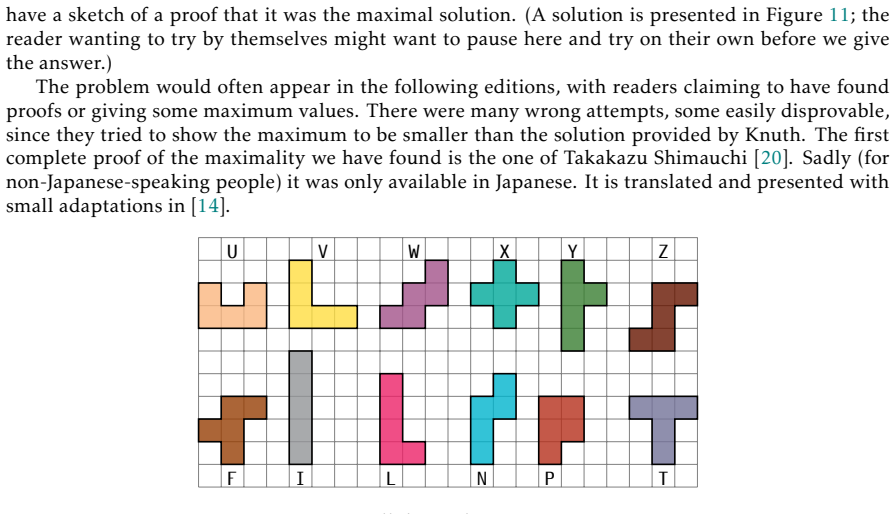
- [§3.1] Figure 11 is referenced in Section 3.1 but appears only in Appendix B; consider adding an explicit cross-reference at the first mention.
Circularity Check
Partial circularity: the extremal-fence counts are deferred to the authors' own unpublished companion paper [14], while the outreach/gamification content is self-contained.
-
self citation load bearing
[Section 3.2, Proposition 3.3; reference [14]]
"Proposition 3.3. The pentomino fence problem has 1440 solutions with optimal enclosed area of 128 tiles. The proof of this proposition can be found in [14], and we will not repeat it here. ... [14] A. Langlois-Rémillard, M. Müßig, and É. Roldán. Extremal fence problems with polyforms. Work in preparation. 2023+"
The paper's central extremal claim is justified only by a citation to the authors' own unpublished companion paper. No proof, enumeration procedure, or reproducible algorithm is supplied in this preprint, so the asserted 1440-solution count and 128-tile maximum are not derivable from the material presented; the only cited support is the self-cited work in preparation. This is load-bearing because Proposition 3.3 is presented as a new result of this paper.
-
self citation load bearing
[Appendix A, proof of Proposition A.1 (final sentence)]
"The 21 solutions were then found by brute force, looking at all possible configurations in the 5×4 and 4×4 rectangles. Computational results presented in [14]."
The tetromino count of 21 maximal solutions depends on a brute-force enumeration that is not described (no search code, no bounds, no reproducibility), and the paper itself attributes the computational results to the same unpublished companion paper [14]. Thus the appendix's concluding count rests on the authors' own self-citation rather than on an exhibited computation, making the stated result unverifiable from the manuscript alone.
full rationale
The paper does not exhibit any definitional circularity, fitted-parameter-as-prediction, ansatz-smuggling, or renaming of a known result. The two extremal-count claims, however, are load-bearing self-citations: Proposition 3.3's proof is deferred entirely to the authors' own 'Work in preparation' [14], and Appendix A's 21-solution tetromino enumeration is likewise attributed to [14]. Because both counts are the paper's substantive mathematical outputs, the derivation chain is not self-contained. The appendix also contains unproved geometric assertions (the rectangle classification and the forced 3 interior tiles from pieces o and n) and an unproved Lemma 3.2 fixing the 20×20 board; these are proof gaps and correctness risks rather than circular reductions, and they further weaken verifiability. The gamification and outreach content (DominatriX, Cubical Sliding Puzzles, Le Carré du Diable, workshop design) is independent, self-contained, and does not depend on the self-cited results, and the known 128-tile maximum has external support in Shimauchi's work [20]. Weighing these, the circularity burden is partial: some self-citation in the mathematical claims, but a largely independent central narrative, so the score is 4 rather than 6 or 8.
Assumptions & free parameters
assumptions (4)
- ad hoc to paper The maximum outer perimeter of a valid tetromino fence is 18, obtained by summing maximal per-piece contributions.
- ad hoc to paper In any optimal 5x4 circumscribed configuration, the o and n tetrominoes force exactly 3 tile-defects into the interior.
- ad hoc to paper An optimal pentomino fence can be assumed isotopic to a circle and fits on a 20x20 board.
- ad hoc to paper The brute-force search over 5x4 and 4x4 rectangles is exhaustive for the tetromino fence problem.
Cite this review
Pith. "Pith review of Insights from a workshop on gamification of research in mathematics and computer science." pith.science (2026). https://pith.science/paper/S5QTGYB2
@misc{pith2026241110207,
  author       = {Pith},
  title        = {Pith review of: Insights from a workshop on gamification of research in mathematics and computer science},
  year         = {2026},
  howpublished = {\url{https://pith.science/paper/S5QTGYB2}},
  note         = {Machine review of arXiv:2411.10207}
}
abstract
Can outreach inspire and lead to research and vice versa? In this work, we introduce our approach to the gamification of research in mathematics and computer science through three illustrative examples. We discuss our primary motivations and provide insights into what makes our proposed gamification effective for three research topics in discrete and computational geometry and topology: (1) DominatriX, an art gallery problem involving polyominoes with rooks and queens; (2) Cubical Sliding Puzzles, an exploration of the discrete configuration spaces of sliding puzzles on the $d$-cube with topological obstructions; and (3) The Fence Challenge, a participatory isoperimetric problem based on polyforms. Additionally, we report on the collaborative development of the game Le Carr\'e du Diable, inspired by The Fence Challenge and created during the workshop Let's talk about outreach!, held in October 2022 in Les Diablerets, Switzerland. All of our outreach encounters and creations are designed and curated with an inclusive culture and a strong commitment to welcoming the most diverse audience possible.
Figures


Figures from the paper (8 more)



Reference graph
Works this paper leans on
-
[14]
A. Langlois-Rémillard, M. Müßig, and É. Roldán. Extremal fence problems with polyforms. Work in preparation. 2023+ (cit. on pp. 2, 6, 7, 10, 14)
work page 2023
-
[1]
Art Gallery Problem with Rook and Queen Vision
H. Alpert and É. Roldán. “Art Gallery Problem with Rook and Queen Vision”. Graphs and Combinatorics 37 (2021), pp. 621–642. doi: 10.1007/s00373-020-02272-8 (cit. on pp. 3, 11)
-
[2]
E. R. Berlekamp, J. H. Conway, and R. K. Guy. Winning ways for your mathematical plays . AK Peters/CRC Press, 2004 (cit. on p. 3)
work page 2004
-
[3]
M. Beyer et al. Higher-dimensional cubical sliding puzzles. 2023. arXiv: 2307.14143 [math.CO] (cit. on pp. 3, 5)
arXiv 2023
-
[4]
Learning and Mathematics Games
G. W. Bright, J. G. Harvey, and M. M. Wheeler. “Learning and Mathematics Games”. Journal for Research in Mathematics Education. Monograph1 (1985), pp. i–189. url: http://www.jstor. org/stable/749987 (cit. on p. 3)
work page 1985
-
[5]
K. Buzzard and M. Pedramfar. Natural Number Game. https://github.com/ImperialColleg eLondon/natural_number_game (cit. on p. 3)
-
[6]
Contributing factors of secondary students’ attitude towards mathematics
S. Dewi Davadas and Y. F. Lay. “Contributing factors of secondary students’ attitude towards mathematics”. European Journal of Educational Research 9.2 (2020), pp. 489–498 (cit. on p. 3)
work page 2020
-
[7]
F. V. Feser. “Pentomino farms”. Journal of Recreational Mathematics 1 (1968), pp. 675–682 (cit. on p. 6)
work page 1968
Show all 27 references
-
[8]
García-Colín et al
N. García-Colín et al. There is no perfect Mondrian partition for squares of side lengths less than
-
[9]
Mathematical Games
M. Gardner. “Mathematical Games”. Scientific American 228.5 (1973), pp. 102–107. url: http://www.jstor.org/stable/24923053 (cit. on p. 6)
1973
-
[10]
Mathematical Games
M. Gardner. “Mathematical Games”. Scientific American (1956–81) (cit. on p. 3)
1956
-
[11]
Notes on the
W. W. Johnson and W. E. Story. “Notes on the "15" Puzzle”. American Journal of Mathematics 2.4 (1879), pp. 397–404 (cit. on p. 5)
-
[12]
Parity Property of Hexagonal Sliding Puzzles
R. Karpman and E. Roldan. “Parity Property of Hexagonal Sliding Puzzles”. arXiv preprint arXiv:2201.00919 (2022) (cit. on p. 5)
2022 arXiv
-
[13]
Langlois-Rémillard, M
A. Langlois-Rémillard, M. Müßig, and É. Roldán. Complexity of Chess Domination Problems
-
[15]
K. Lee, J. Hua, and B. Chan. The HoTT game. website (cit. on p. 3)
-
[16]
Parents’ Attitudes Toward Mathematics and the Influence on Their Students’ Attitudes toward Mathematics: A Quantitative Study
M. J. Mohr-Schroeder et al. “Parents’ Attitudes Toward Mathematics and the Influence on Their Students’ Attitudes toward Mathematics: A Quantitative Study”. School Science and Mathemat- ics 117.5 (2017), pp. 214–222. doi: https://doi.org/10.1111/ssm.12225 (cit. on p. 3)
2017 doi
-
[17]
Pajitnov
A. Pajitnov. Tetris. Video game. 1984 (cit. on p. 2)
1984
-
[18]
Social class inequalities in attitudes towards mathematics and achievement in mathematics cross generations: a quantitative Bourdieusian analysis
J. Quaye and D. Pomeroy. “Social class inequalities in attitudes towards mathematics and achievement in mathematics cross generations: a quantitative Bourdieusian analysis”. Educ Stud Mat 109 (2022), pp. 155–175. doi: 10.1007/s10649-021-10078-5 (cit. on p. 3)
2022 doi
-
[19]
Rousseau
J.-J. Rousseau. Émile ou de l’Éducation. (2009) Paris : Flammarion, 1762 (cit. on p. 3)
2009
-
[20]
Pentomino farm
T. Shimauchi. “Pentomino farm”. Sugaku Seminar (1978), pp. 11–16 (cit. on pp. 7, 11)
1978
-
[21]
Shimauchi
T. Shimauchi. Rubics Cubes and Math Puzzles. Second. 2008 (cit. on p. 7)
2008
-
[22]
Embodied instrumentation in learning mathematics as the genesis of a body- artifact functional system
A. Shvarts et al. “Embodied instrumentation in learning mathematics as the genesis of a body- artifact functional system”. Educational Studies in Mathematics 107.3 (2021), pp. 447–469. doi: 10.1007/s10649-021-10053-0 (cit. on p. 6)
2021 doi
-
[23]
Reifying actions into artifacts: process–object duality from an embodied perspective on mathematics learning
A. Shvarts et al. “Reifying actions into artifacts: process–object duality from an embodied perspective on mathematics learning”. Educational Studies in Mathematics (2024), pp. 1–22. doi: 10.1007/s10649-024-10310-y (cit. on p. 6). 12
2024 doi
-
[24]
Tavitian
B. Tavitian. Blokus. Ed. by Sekkoïa. 2000 (cit. on p. 8)
2000
-
[25]
i” tetromino is the simplest, it progresses straight for 3 more tiles. Progression: 3, protru- sion: 0, length: 4. • The “ l
R. Vakil. Puzzling through exact sequences. Hosted on 3Blue1Brown website. 2021. url: https: //www.3blue1brown.com/blog/exact-sequence-picturebook (cit. on p. 3). A Proof of the tetromino fence problem In this appendix, we solve the introduction problem. This presents the idea...
2021
- [1001]
-
[2022]
arXiv: 2211.05651 [math.CO] (cit. on pp. 3, 4, 11)
Reviewed August 12, 2026 · model on record in the stance chip above.
Discussion (0). Continue with ORCID to comment.