REVIEW 3 major objections 4 minor 2 cited by
Kernel-based Greedy Approximation of Parametric Elliptic Boundary Value Problems
T0 review · 3 major / 4 minor · reviewed 2026-08-06 · deepseek-v4-flash
Pith's one-line read For smooth elliptic boundary value problems, the PDE-β-greedy collocation scheme is proven to converge exponentially in the number of selected collocation conditions, and the same scheme builds parametric surrogates over product…
desk verdict The parametric extension is new and the paper is honest, but the exponential-convergence claim is imported from an unpublished thesis and the smooth experiments sit outside the RKHS assumption. read the letter →
The pith
A machine-rendered reading of the paper's core claim, the machinery that carries it, and where it could break.
The reading
What carries the argument
The machinery is the generalized $\beta$-greedy selection rule over Riesz representers of collocation functionals. At each step it chooses the functional $\lambda\in\Lambda_N$ maximizing $\eta_i(\lambda)=w(\lambda)|\lambda(e_{i-1})|^\beta P_{\Lambda_{i-1}}(\lambda)^{1-\beta}$, where $e_{i-1}$ is the current residual and $P_{\Lambda_{i-1}}$ is the generalized power function, i.e. the worst-case normalized error of the best approximation in the current trial space. The power function simultaneously drives the error bound $|\lambda(u-s_n)|\le P_{\Lambda_n}(\lambda)\|u\|_{H_k}$ and controls numerical stability as a Cholesky pivot. The exponential-rate input is the Gaussian kernel's native space combined with known greedy point-selection estimates for analytic kernels; in the parametric case, the product-kernel structure lets the differential operator act on the position factor only, so the collocation matrix is assembled from simple kernel-factor evaluations.
What would settle it
Compute whether the exact solutions used in the experiments belong to the Gaussian kernel's native space: for $u(x,\mu)=\tfrac12(\|x\|^2+\mu^2)$ the Fourier transform is a distribution rather than a function with the required decay, so the assumption behind Proposition 5 fails even though the experiment decays exponentially; a controlled run with a target provably inside the native space, such as a finite sum of kernel translates, and a comparison of the slope of $\log\min_i\sup_{\Lambda}|\lambda(u-s_i)|$ against $n^{1/(2d)}$ would expose how much of the observed rate is guaranteed by the theorem and how much depends on the target's extra structure.
Extended reading notes
Core claim
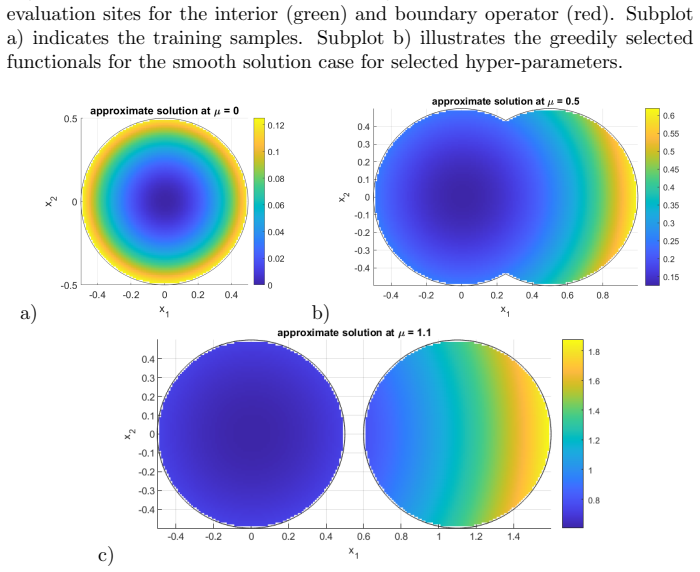
The paper's central claim is that greedy kernel collocation achieves exponential convergence with a provable constant and exponent, not merely an existence statement. Specifically, Proposition 5 states that for the Gaussian kernel on a polygonal domain $\overline{\Omega}\subset\mathbb{R}^d$, with $\beta=1$ and with the solution $u$ in the reproducing kernel Hilbert space $H_k(\overline{\Omega})$, the PDE-$\beta$-greedy iterates satisfy $$ \min_{i=1,\dots,n}\sup_{\$\lambda$\in\Lambda}|\$\lambda$(u-s_i)| \le C $n^{{-1/2}}$$e^{{-c_1 n^{1/(2d)}}$}\|u\|_{H_k(\overline{\$\Omega$})} $$ for $n\ge6$, and the same rate transfers to the $L^\infty$ error through the problem's well-posedness estimate. The parametric extension declares the parameter $\mu$ a second coordinate, forms the product kernel $k_x\otimes k_\mu$ on the combined position-parameter domain, and runs the same greedy search over interior and boundary functionals, producing a global surrogate $s_n(x,\mu)$ with point-evaluation online cost. The paper presents this as a constructive a priori model-reduction method: no solution snapshots are needed, and after a stated number of iterations the approximant is guaranteed by the proof rather than by an optimization heuristic.
Load-bearing premise
The theorems assume the true solution is one of the very smooth functions contained in the chosen kernel's native space, and for a Gaussian kernel that space is narrow; the paper never verifies this membership for its polynomial or sinusoidal test solutions.
Editorial extensions
If this is right
- For infinitely smooth problems, reaching accuracy $\varepsilon$ requires $n$ growing like $(\log(1/\varepsilon))^{2d}$, so high dimension slows the rate but does not destroy exponential convergence.
- Choosing $\beta>0$ adds a dimension-independent $n^{-\beta/2}$ factor, so target-adaptive selection is provably preferable to kernel-only selection with $\beta=0$.
- The parametric surrogate is built in one offline pass from sampled functionals and can be evaluated pointwise; there is no offline-online separation and no multiplicative growth from combining snapshots.
- The method applies to problems with non-affine geometry, topology changes, moving sources, and high-dimensional state spaces, which the experiments demonstrate.
- The $L^\infty$ error inherits the same exponential rate through the well-posedness estimate, so the guarantee is in the maximum norm over the whole domain, not only at collocation points.
Reading between the lines
- Beyond the proven scope: the experiments' exponential decay for polynomial and sinusoidal targets suggests the rate is robust for analytic functions outside the Gaussian native space, so an extension replacing the native-space assumption by a milder analyticity assumption would likely capture the observed behavior.
- Treating time as an additional parameter coordinate would apply the same construction to parabolic and hyperbolic problems, giving space-time surrogates that sidestep the slow Kolmogorov n-width decay mentioned in the outlook.
- Reading the greedy selection as partial pivoted Cholesky suggests a practical byproduct: the selected functionals form a well-conditioned sparse subset of a dense kernel collocation system, so the method could seed or precondition iterative solvers for the full system.
Editorial analysis
A structured set of objections, weighed in public.
Referee Report
Summary. The paper develops a parametric extension of the PDE-β-greedy kernel collocation method, representing the parametric solution as a function on a state-parameter domain and approximating it by generalized interpolation with product kernels. The main theoretical novelty is Proposition 5, which states a constructive exponential convergence rate in the expansion size n for Gaussian kernels when the solution lies in the associated reproducing kernel Hilbert space; the proof is relegated to an appendix that invokes an unpublished B.Sc. thesis. The paper also reports experiments on non-affine geometry parametrizations, moving sources, and high-dimensional sinusoidal problems, and it emphasizes that the method is an a priori surrogate approach that avoids precomputed snapshots.
Significance. If Proposition 5 and its parametric analogue are established rigorously, the paper would provide a constructive exponential-convergence guarantee for kernel-based collocation of smooth elliptic problems, in contrast to non-constructive expression-rate results for neural networks. The parametric product-kernel formulation is attractive because it avoids snapshot-based tensor-product constructions and can handle non-affine geometries, topology changes, and moving sources. The availability of the reference code is a strength. However, the central exponential-rate theorem is not self-contained, and the numerical experiments that are presented as confirming exponential convergence use target functions that fall outside the Gaussian native space required by the theorem; these issues substantially limit the current confidence in the paper's central claims.
major comments (3)
- [§2.5, Proposition 5 and Appendix A] The exponential convergence bound (8) is the paper's central theoretical result, but its proof is not self-contained. The appendix explicitly starts from a bound obtained in [41], an unpublished B.Sc. thesis, and only rescales the index range and constants. Since [41] is not publicly available in a peer-reviewed venue, the reader cannot verify the key estimate. The authors should either provide a complete proof of the underlying exponential bound in the appendix or replace the reference with a published and accessible source.
- [§4.1 and §4.3, Figures 3 and 10] The smooth test functions used to 'experimentally verify' Proposition 5 do not satisfy its hypothesis u ∈ H_k(Ωbar). For the Gaussian kernel on a bounded domain, the native space consists of restrictions of entire functions with Gaussian-weighted Fourier decay, while the polynomial u(x,μ)=1/2(||x||²+μ²) in §4.1 and the sinusoid u(x,μ)=sin(⟨x,κ(μ)⟩) in §4.3 have Fourier transforms that are not square-integrable against exp(||ω||²/(4ε²)). Consequently, Figures 3 and 10 demonstrate behavior outside the assumptions of Proposition 5 and cannot be used as verification of that theorem. The experiments should either use target functions that genuinely lie in the Gaussian RKHS, such as Gaussian bumps, or be explicitly labelled as out-of-assumption heuristic demonstrations, and the wording in the summary that the exponential rates were 'experimentally verified' should be softened accordingly.
- [§3, parametric extension] No parametric analogue of Proposition 5 is stated or proved. The state-parameter domain Ω with its boundary ∂Ω is not polygonal, the product Gaussian kernel is not an isotropic Gaussian on Ω, and the operator is degenerate in the parameter direction, so uniform ellipticity fails on the full state-parameter domain. The discussion after Eq. (10) only transfers L∞-error bounds from functional residuals via the well-posedness estimate (1); it does not establish the greedy convergence rate for the parametric setting. The authors should either state and prove a precise parametric exponential-convergence theorem or restrict the exponential-convergence claims to the nonparametric case.
minor comments (4)
- [§4.1, §4.2, §4.3] All numerical results are based on a single random training set per configuration, and no variance or repeatability statistics are reported. Since the greedy selection and hyperparameter choices can depend on the random sample, reporting means and standard deviations over several seeds would make the empirical claims more robust.
- [Appendix A, proof of Proposition 3] The sentence 'On the left hand side the minimum can be lower bounded by taking the minimum over all i = 1, . . . ,2¯n' is misleading: the inequality min_{i=1,...,n} ≤ min_{i=¯n+1,...,2¯n} bounds the left-hand side from above, not from below. This is a wording issue, not a mathematical error.
- [§2.3, Eq. (4)] The symbol C'' is introduced in the line following Eq. (4) only after being used in the display; moving the definition before the display would improve readability.
- [§4.2, Table 1] The table would benefit from a column specifying the number of repetitions or the uncertainty of the L∞-error estimates, especially because the greedy algorithm is stochastic in the candidate set and the FEM reference error is computed on a fixed mesh.
Circularity Check
No construction-level circularity: Prop. 5 faithfully cites the same-group thesis [41] (core bound quoted verbatim, only index relabeling follows), and the 'verification' experiments run outside the theorem's u ∈ H_k hypothesis — these are citation and support risks, not a reduction of the result to its own inputs.
-
self citation load bearing
[Sec. 2.5 (Prop. 5) and Appendix A (Proof of Prop. 5)]
"For the case of infinitely smooth kernel and solution, exponential convergence can be proven, cf. Thm. 3.18 in [41], which we slightly simplify similarly to Prop. 3, as presented in the proof in the appendix. ... We start with a bound obtained in [41] using ¯n, etc. to discriminate from the present notation: min_{i=¯n+1,...,2¯n} sup_{λ∈Λ} |λ(u − s_i)| ≤ ¯C ¯n^{−1/2} ∥u − s_{¯n+1}∥_{H_k(¯Ω)} e^{−¯c1 ¯n^{1/(2d)}}."
Prop. 5, the headline exponential-convergence claim, is not derived here: the appendix proof says 'We start with a bound obtained in [41]' and only relabels indices (c1 := ¯c1(1/2)^{1/(2d)}), so the core estimate min_i sup_λ |λ(u−s_i)| ≤ ¯C ¯n^{−1/2} ‖u−s_{¯n+1}‖ e^{−¯c1 ¯n^{1/(2d)}} is the cited bound by construction. Prop. 3 is likewise imported from the authors' own [48, Thm 5.1], and [41] is an unpublished B.Sc. thesis from the first author's institute, giving no independent verification. The cited theorems' assumptions (Gaussian kernel, polygonal Ω, β=1, u∈H_k) do not contain the conclusion, so this is load-bearing same-group citation rather than a definitional identity; the derivation chain terminates in an unverified source.
-
other
[Sec. 4.1 (smooth solution case), Sec. 4.3, Sec. 5 Summary]
"Anticipating the C ∞ regularity of the solution, we choose as kernel a product of Gaussian kernels ... The exponential convergence rates were experimentally verified in different scenarios."
Missing-support flag, not an equation-level reduction. The experiments claimed as verification use u(x,μ)=1/2(‖x‖²+μ²) (Sec. 4.1) and u=sin(⟨x,κ(μ)⟩) (Sec. 4.3); for a Gaussian kernel the native space H_k on a bounded domain is a space of real-analytic functions with Gaussian-weighted Fourier decay, so neither the polynomial nor the pure frequency is in H_k, the stated hypothesis of Prop. 5. The paper itself concedes the hypothesis matters for the Matérn case ('this clearly is an example where the target function u is outside the RKHS H_k(¯Ω), hence we do not expect the convergence rates') but never checks membership for the smooth Gaussian cases before asserting 'the exponential convergence rates were experimentally verified.' Figs.
full rationale
The derivation chain was walked step by step. (1) The basic error bound (4) is a genuine a priori bound obtained from the power-function definition and the well-posedness estimate (1); it is not an identity engineered to produce the convergence claim. (2) For β=1 the greedy criterion (5) maximizes |λ(e_{i−1})|, so the training residual plotted in Figs. 3, 8d and 10 is exactly the quantity the algorithm drives down; its decay is partly the objective of the selection rule, but the claimed exponential rate C n^{−β/2} e^{−c1 n^{1/(2d)}} is a theorem about power-function decay in the Gaussian RKHS, not a rate forced by the selection criterion alone. (3) No fitted parameter is renamed as a prediction: the hyperparameters (ε²_x, ε²_μ, w_B) are selected on validation sets by minimizing (11), while the reported errors are measured on independently drawn test sets or against a FEM reference, so those numbers are honest evaluations. (4) The main weakness is that the central rate statements are imported: Prop. 3 comes from the authors' own [48, Thm 5.1], and Prop. 5 from the same-institute unpublished B.Sc. thesis [41, Thm 3.18], whose core inequality the appendix quotes verbatim and then only relabels. Because these cited results are parameter-free theorems whose assumptions (Gaussian kernel, polygonal domain, β=1, u ∈ H_k) do not include the target rate, rule 4 treats them as real evidence; however, [41] is not independently verifiable here, so the proof chain terminates in an unverified source. (5) The numerical experiments presented as confirmation of Prop. 5 use smooth polynomial and sinusoidal solutions that lie outside the Gaussian RKHS required by the theorem, so the claim of experimental verification exceeds what the hypothesis allows; this is an over-claim and a correctness risk rather than a circular reduction. No equation in the paper reduces to its own input, and no fitted value is presented as a prediction, so the appropriate score is 2.
Assumptions & free parameters
free parameters (5)
- ε_x (position kernel shape parameter) =
ε_x^2=0.0063096 (smooth circles), ε_x=5.0 (moving source), ε_x^2=5/dx (high-dim)
- ε_μ (parameter kernel shape parameter) =
ε_μ^2=0.01 (smooth circles), ε_μ=15.8114 (moving source), ε_μ^2=2.5 (high-dim)
- w_B (boundary functional weight) =
1.0 (smooth circles), 1000 (moving source), 100 (high-dim)
- γ_L, γ_B (validation loss weights) =
γ_L=0.005, γ_B=1 (moving source); γ_L=γ_B=1 elsewhere
- β (greedy adaptivity parameter) =
1 (smooth examples), 0 (singular example), 0/0.5/0.75/1 (moving source comparison)
assumptions (6)
- domain assumption The BVP is well-posed with stability estimate (1): existence, uniqueness, and continuous dependence of the solution on f and g with constants CL, CB.
- domain assumption The solution lies in the RKHS of the chosen kernel, u ∈ H_k(Ω-bar), and the kernel is strictly positive definite.
- domain assumption The set of functionals Λ is bounded in H_k' so the power function is uniformly bounded.
- domain assumption For the parametric L∞-error bound, the operator is uniformly elliptic and the coefficients and RHS data are uniformly bounded with respect to µ.
- domain assumption For Prop. 5, the kernel is Gaussian on a polygonal domain and β=1.
- standard math The greedy convergence bounds of Thm. 17 in [48] and Thm. 3.18 in [41] are correct.
Cite this review
Pith. "Pith review of Kernel-based Greedy Approximation of Parametric Elliptic Boundary Value Problems." pith.science (2026). https://pith.science/paper/S6VDHP6C
@misc{pith2026250706731,
  author       = {Pith},
  title        = {Pith review of: Kernel-based Greedy Approximation of Parametric Elliptic Boundary Value Problems},
  year         = {2026},
  howpublished = {\url{https://pith.science/paper/S6VDHP6C}},
  note         = {Machine review of arXiv:2507.06731}
}
abstract
We recently introduced a scale of kernel-based greedy schemes for approximating the solutions of elliptic boundary value problems. The procedure is based on a generalized interpolation framework in reproducing kernel Hilbert spaces and was coined PDE-$\beta$-greedy procedure, where the parameter $\beta \geq 0$ is used in a greedy selection criterion and steers the degree of function adaptivity. Algebraic convergence rates have been obtained for Sobolev-space kernels and solutions of finite smoothness. We now report a result of exponential convergence rates for the case of infinitely smooth kernels and solutions. We furthermore extend the approximation scheme to the case of parametric PDEs by the use of state-parameter product kernels. In the surrogate modelling context, the resulting approach can be interpreted as an a priori model reduction approach, as no solution snapshots need to be precomputed. Numerical results show the efficiency of the approximation procedure for problems which occur as challenges for other parametric MOR procedures: non-affine geometry parametrizations, moving sources or high-dimensional domains.
Figures


Figures from the paper (7 more)


Forward citations
Cited by 2 Pith papers
-
On Symmetric Kernel Collocation for Nonlinear PDEs
Convergence of symmetric kernel collocation for nonlinear PDEs is established in the RKHS norm for both fill-distance and residual-greedy point selection, without assuming solution uniqueness.
-
Extending Data to Improve Stability and Error Estimates Using Asymmetric Kansa-like Methods to Solve PDEs
Over-sampling with norming sets stabilizes the Kansa collocation matrix for elliptic PDEs on spheres and yields proven error estimates for least-squares and QR-thinned square systems.
Reference graph
Works this paper leans on
-
[41]
P. Vogel. Target dependent greedy sampling for Gaussian kernel PDE collocation, 2024. SimTech B.Sc. Thesis, University of Stuttgart
work page 2024
- [48]
-
[1]
K. Albrecht, J. Entzian, and A. Iske. Product kernels are efficient and flexible tools for high-dimensional scattered data interpolation. Advances in Computational Mathematics , 51(2):14, Mar 2025
work page 2025
-
[2]
K. Albrecht and A. Iske. On the convergence of generalized kernel-based interpolation by greedy data selection algorithms. BIT Numerical Mathe- matics, 65(1):5, Dec 2024
work page 2024
- [3]
- [4]
- [5]
-
[6]
Y. Chen and S. Gottlieb. Reduced collocation methods: Reduced basis methods in the collocation framework. Journal of Scientific Computing , 55:718–737, 2013
work page 2013
Show all 49 references
-
[7]
Y. Chen, B. Hosseini, H. Owhadi, and A. M. Stuart. Solving and learn- ing nonlinear PDEs with Gaussian processes. Journal of Computational Physics, 447:110668, 2021
2021
-
[8]
Constantine
P. Constantine. Active Subspaces: Emerging Ideas for Dimension Reduction in Parameter Studies . Spotlights. SIAM, Philadelphia, USA, 2015
2015
-
[9]
Davydov and D
O. Davydov and D. T. Oanh. Adaptive meshless centres and RBF stencils for Poisson equation. Journal of Computational Physics , 230(2):287–304, 2011
2011
-
[10]
De Marchi, R
S. De Marchi, R. Schaback, and H. Wendland. Near-optimal data- independent point locations for radial basis function interpolation. Ad- vances in Computational Mathematics , 23(3):317–330, 2005
2005
-
[11]
Dutta, M
S. Dutta, M. W. Farthing, E. Perracchione, G. Savant, and M. Putti. A greedy non-intrusive reduced order model for shallow water equations. Journal of Computational Physics , 439:110378, 2021
2021
-
[12]
G. E. Fasshauer. Solving partial differential equations by collocation with radial basis functions. In Surface Fitting and Multiresolution Methods , pages 131–138. Vanderbilt University Press, Nashville, USA, 1997
1997
-
[13]
G. E. Fasshauer, F. J. Hickernell, and H. Wozniakowski. On dimension- independent rates of convergence for function approximation with Gaussian kernels. SIAM Journal on Numerical Analysis , 50(1):247–271, 2012
2012
-
[14]
Fuselier, F
E. Fuselier, F. Narcowich, J. Ward, and G. Wright. Error and stabil- ity estimates for surface-divergence free RBF interpolants on the sphere. Mathematics of Computation , 78(268):2157–2186, 2009
2009
-
[15]
Greif and K
C. Greif and K. Urban. Decay of the Kolmogorov N-width for wave prob- lems. Applied Mathematics Letters , 96:216–222, 2019
2019
-
[16]
Haasdonk
B. Haasdonk. Reduced Basis Methods for Parametrized PDEs – A Tuto- rial Introduction for Stationary and Instationary Problems. In P. Benner, A. Cohen, M. Ohlberger, and K. Willcox, editors, Model Reduction and Ap- proximation: Theory and Algorithms , pages 65–136. SIAM, Philad...
2017
-
[17]
Haasdonk and G
B. Haasdonk and G. Santin. Approximation and data-analysis with kernels, 2025
2025
-
[18]
Hesthaven, G
J. Hesthaven, G. Rozza, and B. Stamm. Certified Reduced Basis Methods for Parametrized Partial Differential Equations . SpringerBriefs in Mathe- matics. Springer, Switzerland, 2016. 26
2016
-
[19]
E. J. Kansa. Multiquadrics — A scattered data approximation scheme with applications to computational fluid-dynamics. II. Solutions to parabolic, hyperbolic and elliptic partial differential equations. Computers & Mathe- matics with Applications , 19(8-9):147–161, 1990
1990
-
[20]
C.-F. Lee, L. Ling, and R. Schaback. On convergent numerical algorithms for unsymmetric collocation. Adv. Comput. Math. , 30(4):339–354, 2009
2009
-
[21]
Lehto, V
E. Lehto, V. Shankar, and G. B. Wright. A radial basis function (RBF) com- pact finite difference (FD) scheme for reaction-diffusion equations on sur- faces. SIAM Journal on Scientific Computing , 39(5):A2129–A2151, 2017
2017
-
[22]
L. Ling, R. Opfer, and R. Schaback. Results on meshless collocation tech- niques. Engineering Analysis with Boundary Elements , 30(4):247 – 253, 2006
2006
-
[23]
Ling and R
L. Ling and R. Schaback. On adaptive unsymmetric meshless collocation. In Proceedings of the 2004 International Conference on Computational & Experimental Engineering and Sciences (Forsyth, USA) , 2004
2004
-
[24]
Ling and R
L. Ling and R. Schaback. Stable and convergent unsymmetric meshless collocation methods. SIAM J. Numer. Anal. , 46(3):1097–1115, 2008
2008
-
[25]
Ling and R
L. Ling and R. Schaback. An improved subspace selection algorithm for meshless collocation methods. Internat. J. Numer. Methods Engrg. , 80(13):1623–1639, 2009
2009
-
[26]
Maday, O
Y. Maday, O. Mula, and G. Turinici. Convergence analysis of the general- ized empirical interpolation method. SIAM Journal on Numerical Analysis, 54(3):1713–1731, 2016
2016
-
[27]
M¨ uller
S. M¨ uller. Komplexit¨ at und Stabilit¨ at von kernbasierten Rekonstruktions- methoden (Complexity and Stability of Kernel-based Reconstructions). PhD thesis, Fakult¨ at f¨ ur Mathematik und Informatik, Georg-August-Universit¨ at G¨ ottingen, 2009
2009
-
[28]
F. J. Narcowich, J. D. Ward, and H. Wendland. Sobolev error estimates and a Bernstein inequality for scattered data interpolation via radial basis functions. Constructive Approximation, 24(2):175–186, Sep 2006
2006
-
[29]
A. Nouy. A priori model reduction through Proper Generalized Decom- position for solving time dependent partial differential equations. Com- puter Methods in Applied Mechanics and Engineering , 199(23–24):1603– 1626, 2010
2010
-
[30]
D. T. Oanh, O. Davydov, and H. X. Phu. Adaptive RBF-FD method for elliptic problems with point singularities in 2d. Applied Mathematics and Computation, 313:474–497, 2017
2017
-
[31]
Ohlberger and S
M. Ohlberger and S. Rave. Reduced basis methods: Success, limitations and future challenges. Proceedings of the Conference Algoritmy, pages 1–12, 2016. 27
2016
-
[32]
Raissi, P
M. Raissi, P. Perdikaris, and G. E. Karniadakis. Physics informed neu- ral networks: A deep learning framework for solving forward and inverse problems involving nonlinear partial differential equations.Journal of Com- putational Physics , 378:686–707, 2019
2019
-
[33]
Renardy and R
M. Renardy and R. C. Rogers. An introduction to partial differential equa- tions, volume 13. Springer Science & Business Media, New York, USA, 2006
2006
-
[34]
Santin, T
G. Santin, T. Wenzel, and B. Haasdonk. On the optimality of target- data-dependent kernel greedy interpolation in Sobolev reproducing kernel Hilbert spaces. SIAM Journal on Numerical Analysis , 62(5):2249–2275, 2024
2024
-
[35]
Schaback
R. Schaback. Convergence of unsymmetric kernel-based meshless colloca- tion methods. SIAM Journal on Numerical Analysis , 45(1):333–351, 2007
2007
-
[36]
Schaback
R. Schaback. A greedy method for solving classes of PDE problems. arXiv preprint arXiv:1903.11536, 2019
1903 arXiv
-
[37]
Schaback and H
R. Schaback and H. Wendland. Adaptive greedy techniques for approximate solution of large RBF systems. Numerical Algorithms, 24(3):239–254, 2000
2000
-
[38]
Shankar, R
V. Shankar, R. M. Kirby, and A. L. Fogelson. Robust node generation for mesh-free discretizations on irregular domains and surfaces. SIAM Journal on Scientific Computing , 40(4):A2584–A2608, 2018
2018
-
[39]
Suchde, T
P. Suchde, T. Jacquemin, and O. Davydov. Point cloud generation for meshfree methods: An overview. Archives of Computational Methods in Engineering, 30(2):889–915, Mar 2023
2023
-
[40]
Vlasiuk, T
O. Vlasiuk, T. Michaels, N. Flyer, and B. Fornberg. Fast high-dimensional node generation with variable density. Computers & Mathematics with Applications, 76(7):1739–1757, 2018
2018
-
[42]
Wendland
H. Wendland. Scattered Data Approximation , volume 17 of Cambridge Monographs on Applied and Computational Mathematics . Cambridge Uni- versity Press, Cambridge, 2005
2005
-
[43]
Wendland
H. Wendland. Divergence-free kernel methods for approximating the Stokes problem. SIAM Journal on Numerical Analysis , 47(4):3158–3179, 2009
2009
-
[44]
Wenzel, B
T. Wenzel, B. Haasdonk, H. Kleikamp, M. Ohlberger, and F. Schindler. Application of deep kernel models for certified and adaptive RB-ML-ROM surrogate modeling. In Large-Scale Scientific Computations, number 13952 in LNCS, pages 117–125. Springer, Cham, Switzerland, 2024
2024
-
[45]
Wenzel, F
T. Wenzel, F. Marchetti, and E. Perracchione. Data-driven kernel designs for optimized greedy schemes: A machine learning perspective. SIAM Jour- nal on Scientific Computing , 46(1):C101–C126, 2024. 28
2024
-
[46]
Wenzel, G
T. Wenzel, G. Santin, and B. Haasdonk. A novel class of stabilized greedy kernel approximation algorithms: Convergence, stability and uniform point distribution. Journal of Approximation Theory , 262:105508, 2021
2021
-
[47]
Wenzel, G
T. Wenzel, G. Santin, and B. Haasdonk. Analysis of target data-dependent greedy kernel algorithms: Convergence rates for f -, f · P -and f /P-greedy. Constructive Approximation, 57(1):45–74, 2023
2023
-
[49]
Wirtz and B
D. Wirtz and B. Haasdonk. A vectorial kernel orthogonal greedy algorithm. Dolomites Research Notes on Approximation , 6:83–100, 2013. 29
2013
Reviewed August 6, 2026 · model on record in the stance chip above.
Discussion (0). Continue with ORCID to comment.