The reverse mathematics of the Ordered Variable Word theorem
Pith reviewed 2026-07-04 00:01 UTC · model grok-4.3
The pith
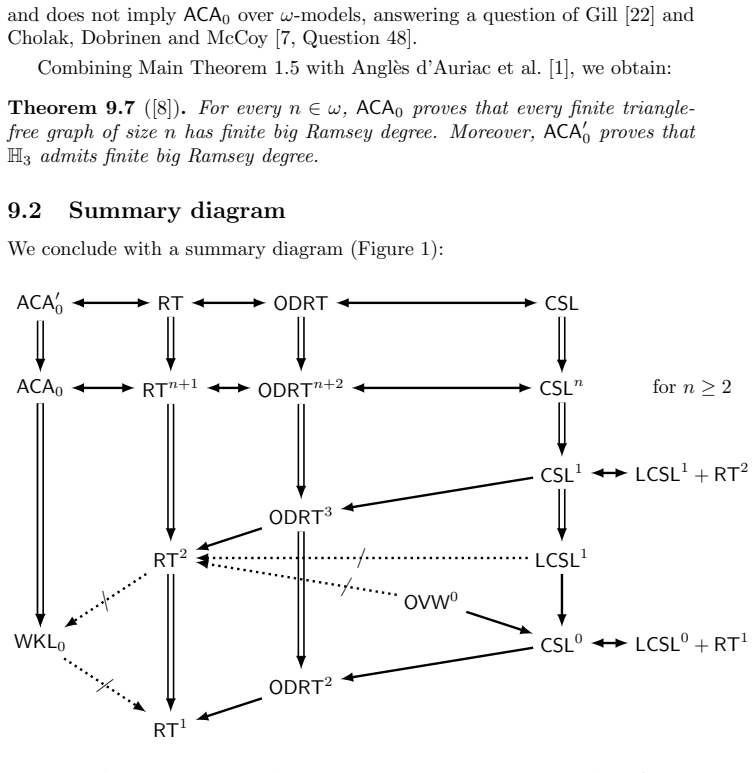
The Ordered Variable Word theorem does not imply Ramsey's theorem for pairs.
A machine-rendered reading of the paper's core claim, the machinery that carries it, and where it could break.
Core claim
The Ordered Variable Word theorem does not imply Ramsey's theorem for pairs, and every computable instance admits a solution of low2 degree. This is used to prove the Carlson-Simpson Lemma and the Open Dual Ramsey theorem over ACA0.
What carries the argument
The Ordered Variable Word theorem, a combinatorial principle asserting the existence of variable words satisfying certain homogeneity conditions in colorings, whose logical strength is measured by non-implication and computability results.
If this is right
- The Carlson-Simpson Lemma holds over ACA0.
- The Open Dual Ramsey theorem holds over ACA0.
- Certain statements in structural Ramsey theory become provable in ACA0 rather than requiring stronger systems.
Where Pith is reading between the lines
- The separation shows that some combinatorial principles used to prove Dual Ramsey theorems can be strictly weaker than Ramsey's theorem for pairs.
- Low2 solutions for computable instances provide a uniform way to obtain solutions without increasing the Turing degree beyond the arithmetic hierarchy.
- Similar degree analyses may apply to other variable-word or partition principles in the same family.
Load-bearing premise
The Ordered Variable Word theorem and the related statements are correctly formalized inside second-order arithmetic so that the non-implication and computability results transfer to the stated consequences for ACA0.
What would settle it
A computable instance of the Ordered Variable Word theorem whose every solution has Turing degree strictly above low2 would falsify the computability claim.
Figures
read the original abstract
In this article, we study the reverse mathematics of variable word theorems used in the proof of the Dual Ramsey theorem. We prove that the Ordered Variable Word theorem does not imply Ramsey's theorem for pairs and that every computable instance admits a solution of low${}_2$ degree. This is used to prove the Carlson-Simpson Lemma and the Open Dual Ramsey theorem over~$\mathsf{ACA}_0$, thereby answering some 40-years old open questions. These results have consequences in the reverse mathematics of structural Ramsey theory.
Editorial analysis
A structured set of objections, weighed in public.
Referee Report
Summary. The paper studies the reverse mathematics of variable word theorems appearing in proofs of the Dual Ramsey theorem. It proves that the Ordered Variable Word theorem does not imply Ramsey's theorem for pairs and that every computable instance admits a low₂ solution; these facts are then used to derive the Carlson-Simpson Lemma and the Open Dual Ramsey theorem over ACA₀, thereby settling questions open for roughly forty years, with further consequences for the reverse mathematics of structural Ramsey theory.
Significance. If the formalizations are correct, the separation from RT²₂ together with the low₂ bound supply the missing ingredients needed to place the Carlson-Simpson Lemma and Open Dual Ramsey theorem inside ACA₀. The work therefore resolves long-standing questions about the logical strength of these combinatorial statements and supplies concrete computability information that can be reused in other parts of structural Ramsey theory.
major comments (2)
- [§2] The central non-implication and low₂ claims rest on the assumption that the Ordered Variable Word theorem has been correctly formalized as a sentence of second-order arithmetic so that the computability and implication results transfer to the stated ACA₀ derivations; this formalization step is load-bearing for every subsequent application and must be verified explicitly.
- [§4] The derivations of the Carlson-Simpson Lemma and Open Dual Ramsey theorem over ACA₀ (presumably in §4 or §5) rely on the low₂ solutions; any gap in the reduction from the variable-word statement to these lemmas would undermine the claim that the questions are settled in ACA₀.
minor comments (2)
- [Abstract] The abstract refers to “some 40-years old open questions” without naming them; a brief enumeration in the introduction would improve readability.
- Notation for the various variable-word statements should be introduced once and used consistently; occasional shifts between “Ordered Variable Word theorem” and its acronym can be clarified.
Simulated Author's Rebuttal
We thank the referee for the careful reading and the recommendation for minor revision. The comments correctly identify the formalization and the reductions as central to the results; we address both points explicitly below and will strengthen the manuscript accordingly.
read point-by-point responses
-
Referee: [§2] The central non-implication and low₂ claims rest on the assumption that the Ordered Variable Word theorem has been correctly formalized as a sentence of second-order arithmetic so that the computability and implication results transfer to the stated ACA₀ derivations; this formalization step is load-bearing for every subsequent application and must be verified explicitly.
Authors: We agree that explicit verification of the formalization is necessary. In §2 we define OVWT as the Π¹₁ sentence asserting that every computable coloring c : [ω]<ω → 2 admits an infinite variable word w such that the set of finite variable substitutions is monochromatic. The non-implication and low₂ results are proved directly in the standard model of second-order arithmetic; because the constructions are effective (using only recursive approximations and finite injury), they relativize and therefore hold in any model of ACA₀. In the revision we will add a short subsection (new §2.4) that records the precise sentence of L₂ and confirms that the computability proofs remain valid inside ACA₀. revision: yes
-
Referee: [§4] The derivations of the Carlson-Simpson Lemma and Open Dual Ramsey theorem over ACA₀ (presumably in §4 or §5) rely on the low₂ solutions; any gap in the reduction from the variable-word statement to these lemmas would undermine the claim that the questions are settled in ACA₀.
Authors: The reductions appear in Theorems 4.2 and 4.4. Given a low₂ solution H to an OVWT instance, we construct (inside ACA₀) a homogeneous set for the corresponding Carlson-Simpson or Open Dual Ramsey instance by a single application of the low₂ set’s jump and the arithmetic comprehension already available in ACA₀. The argument uses only the fact that low₂ sets are closed under Turing join with 0′ and that the variable-word homogeneity can be decoded arithmetically from H. We will insert an additional paragraph after each theorem spelling out the arithmetic comprehension steps to eliminate any possible ambiguity. revision: yes
Circularity Check
No significant circularity identified
full rationale
The paper establishes non-implications (OVWT does not imply RT^2_2) and computability bounds (low2 solutions for computable instances) via direct constructions in second-order arithmetic, then derives consequences for the Carlson-Simpson Lemma and Open Dual Ramsey theorem over ACA0. No step reduces a claimed result to a fitted parameter, self-defined quantity, or load-bearing self-citation chain; the formalization of OVWT as a sentence in the language of second-order arithmetic is a standard prerequisite rather than a circular dependency, and the proofs remain independent of the target conclusions.
Axiom & Free-Parameter Ledger
axioms (1)
- standard math Axioms of second-order arithmetic (RCA0, ACA0)
Forward citations
Cited by 1 Pith paper
-
The finite big Ramsey degrees of Henson graphs are provable in $\mathrm{ACA}_0$
The finite big Ramsey degrees of Henson graphs are provable in ACA₀', with equivalence to ACA₀' over RCA₀.
Reference graph
Works this paper leans on
-
[1]
Carlson-Simpson’s lemma and applications in reverse mathematics.Ann
Paul-Elliot Angles d’Auriac, Lu Liu, Bastien Mignoty, and Ludovic Patey. Carlson-Simpson’s lemma and applications in reverse mathematics.Ann. Pure Appl. Logic, 174(9):Paper No. 103287, 16, 2023
2023
-
[2]
Exact big ramsey degrees via coding trees.arXiv preprint arXiv:2110.08409, page 97, 2021
Martin Balko, David Chodounsk` y, Natasha Dobrinen, Jan Hubiˇ cka, Matˇ ej Koneˇ cn` y, Lluis Vena, and Andy Zucker. Exact big ramsey degrees via coding trees.arXiv preprint arXiv:2110.08409, page 97, 2021
-
[3]
Exact big ramsey degrees for finitely constrained binary free amalgamation classes.Journal of the Eu- ropean Mathematical Society, 53, 2024
Martin Balko, David Chodounsk` y, Natasha Dobrinen, Jan Hubicka, Matej Konecn` y, Llu´ ıs Vena, and Andy Zucker. Exact big ramsey degrees for finitely constrained binary free amalgamation classes.Journal of the Eu- ropean Mathematical Society, 53, 2024
2024
-
[4]
The reverse mathematics of Carlson’s theorem for located words.arXiv preprint arXiv:2208.03152, 2022
Tristan Bompard, Lu Liu, and Ludovic Patey. The reverse mathematics of Carlson’s theorem for located words.arXiv preprint arXiv:2208.03152, 2022
-
[5]
Timothy J. Carlson. Some unifying principles in Ramsey theory.Discrete Math., 68(2-3):117–169, 1988
1988
-
[6]
Carlson and Stephen G
Timothy J. Carlson and Stephen G. Simpson. A dual form of Ramsey’s theorem.Adv. in Math., 53(3):265–290, 1984
1984
-
[7]
The henson graphs: colorings and codings, 2026
Peter Cholak, Natasha Dobrinen, and Charlie McCoy. The henson graphs: colorings and codings, 2026
2026
-
[8]
The finite big ram- sey degrees of henson graphs are provable in ACA 0, 2026
Peter Cholak, Natasha Dobrinen, and Henry Towsner. The finite big ram- sey degrees of henson graphs are provable in ACA 0, 2026
2026
-
[9]
Cholak, Carl G
Peter A. Cholak, Carl G. Jockusch, and Theodore A. Slaman. On the strength of Ramsey’s theorem for pairs.J. Symbolic Logic, 66(1):1–55, 2001
2001
-
[10]
ProQuest LLC, Ann Arbor, MI, 1980
Denis Campau Devlin.SOME PARTITION THEOREMS AND ULTRA- FILTERS ON OMEGA. ProQuest LLC, Ann Arbor, MI, 1980. Thesis (Ph.D.)–Dartmouth College
1980
-
[11]
The Ramsey theory of the universal homogeneous triangle-free graph.Journal of Mathematical Logic, 20(2):2050012, 75,
Natasha Dobrinen. The Ramsey theory of the universal homogeneous triangle-free graph.Journal of Mathematical Logic, 20(2):2050012, 75,
-
[12]
tex.fjournal: Journal of Mathematical Logic tex.mrclass: 03E02 (03C15 03E05 03E40 03E75 05C05 05C55) tex.mrnumber: 4128725 tex.mrreviewer: G.Cherlin
-
[13]
Natasha Dobrinen. The ramsey theory of the universal homogeneous triangle-free graph part ii: exact big ramsey degrees.arXiv preprint arXiv:2009.01985, 2020
-
[14]
The Ramsey theory of Henson graphs.J
Natasha Dobrinen. The Ramsey theory of Henson graphs.J. Math. Log., 23(1):Paper No. 2250018, 88, 2023. 55
2023
-
[15]
A den- sity version of the Carlson-Simpson theorem.J
Pandelis Dodos, Vassilis Kanellopoulos, and Konstantinos Tyros. A den- sity version of the Carlson-Simpson theorem.J. Eur. Math. Soc. (JEMS), 16(10):2097–2164, 2014
2097
-
[16]
Relationships between computability-theoretic proper- ties of problems.J
Rod Downey, Noam Greenberg, Matthew Harrison-Trainor, Ludovic Patey, and Dan Turetsky. Relationships between computability-theoretic proper- ties of problems.J. Symb. Log., 87(1):47–71, 2022
2022
-
[17]
Effectiveness for the dual Ramsey theorem.Notre Dame J
Damir Dzhafarov, Stephen Flood, Reed Solomon, and Linda Westrick. Effectiveness for the dual Ramsey theorem.Notre Dame J. Form. Log., 62(3):455–490, 2021
2021
-
[18]
Dzhafarov and Carl G
Damir D. Dzhafarov and Carl G. Jockusch. Ramsey’s theorem and cone avoidance.Journal of Symbolic Logic, 74(2):557–578, 2009
2009
-
[19]
Dzhafarov and Carl Mummert.Reverse mathematics—problems, reductions, and proofs
Damir D. Dzhafarov and Carl Mummert.Reverse mathematics—problems, reductions, and proofs. Theory and Applications of Computability. Springer, Cham, [2022]©2022
2022
-
[20]
El-Zahar and N
M. El-Zahar and N. Sauer. The indivisibility of the homogeneousK n-free graphs.J. Combin. Theory Ser. B, 47(2):162–170, 1989
1989
-
[21]
PhD thesis, UC Berkeley, 2013
Julia Christina Erhard.The Carlson-Simpson Lemma in Reverse Mathe- matics. PhD thesis, UC Berkeley, 2013
2013
-
[22]
Some systems of second order arithmetic and their use
Harvey Friedman. Some systems of second order arithmetic and their use. Inin Proceedings of the International Congress of Mathematicians, Van- couver 1974, pages 235–242, 1975
1974
-
[23]
A note on the indivisibility of the henson graphs, 2023
Kenneth Gill. A note on the indivisibility of the henson graphs, 2023
2023
-
[24]
S. S. Gonˇ carov and A. T. Nurtazin. Constructive models of complete de- cidable theories.Algebra i Logika, 12:125–142, 243, 1973
1973
-
[25]
A. W. Hales and R. I. Jewett. Regularity and positional games.Trans. Amer. Math. Soc., 106:222–229, 1963
1963
-
[26]
Partition theorems for left and right variable words.Combinatorica, 24(2):271–286, 2004
Neil Hindman and Randall McCutcheon. Partition theorems for left and right variable words.Combinatorica, 24(2):271–286, 2004
2004
-
[27]
Hirschfeldt.Slicing the truth, volume 28 ofLecture Notes Se- ries
Denis R. Hirschfeldt.Slicing the truth, volume 28 ofLecture Notes Se- ries. Institute for Mathematical Sciences. National University of Singapore. World Scientific Publishing Co. Pte. Ltd., Hackensack, NJ, 2015. On the computable and reverse mathematics of combinatorial principles, Edited and with a foreword by Chitat Chong, Qi Feng, Theodore A. Slaman, W...
2015
-
[28]
Hirschfeldt and Richard A
Denis R. Hirschfeldt and Richard A. Shore. Combinatorial principles weaker than Ramsey’s theorem for pairs.J. Symbolic Logic, 72(1):171– 206, 2007. 56
2007
-
[29]
Hirschfeldt, Richard A
Denis R. Hirschfeldt, Richard A. Shore, and Theodore A. Slaman. The atomic model theorem and type omitting.Trans. Amer. Math. Soc., 361(11):5805–5837, 2009
2009
-
[30]
Big ramsey degrees using parameter spaces.arXiv preprint arXiv:2009.00967, page 20, 2020
Jan Hubiˇ cka. Big ramsey degrees using parameter spaces.arXiv preprint arXiv:2009.00967, page 20, 2020
-
[31]
Jockusch, Jr
Carl G. Jockusch, Jr. Semirecursive sets and positive reducibility.Trans. Amer. Math. Soc., 131:420–436, 1968
1968
-
[32]
Jockusch, Jr
Carl G. Jockusch, Jr. Ramsey’s theorem and recursion theory.J. Symbolic Logic, 37:268–280, 1972
1972
-
[33]
Jockusch, Jr
Carl G. Jockusch, Jr. and Robert I. Soare. Π 0 1 classes and degrees of theo- ries.Trans. Amer. Math. Soc., 173:33–56, 1972
1972
-
[34]
Coloring of universal graphs.Graphs Combin., 2(1):55–60, 1986
P´ eter Komj´ ath and Vojtˇ ech R¨ odl. Coloring of universal graphs.Graphs Combin., 2(1):55–60, 1986
1986
-
[35]
Laflamme, N
C. Laflamme, N. W. Sauer, and V. Vuksanovic. Canonical partitions of universal structures.Combinatorica, 26(2):183–205, 2006
2006
-
[36]
A computable analysis of vari- able words theorems.Proc
Lu Liu, Benoit Monin, and Ludovic Patey. A computable analysis of vari- able words theorems.Proc. Amer. Math. Soc., 147(2):823–834, 2019
2019
-
[37]
Paris-Harrington incompleteness and progressions of theories
Kenneth McAloon. Paris-Harrington incompleteness and progressions of theories. InRecursion theory (Ithaca, N.Y., 1982), volume 42 ofProc. Sympos. Pure Math., pages 447–460. Amer. Math. Soc., Providence, RI, 1985
1982
-
[38]
Miller and Reed Solomon
Joseph S. Miller and Reed Solomon. Effectiveness for infinite variable words and the dual Ramsey theorem.Arch. Math. Logic, 43(4):543–555, 2004
2004
-
[39]
Open questions in reverse mathematics.Bull
Antonio Montalb´ an. Open questions in reverse mathematics.Bull. Symbolic Logic, 17(3):431–454, 2011
2011
-
[40]
Leonardo Pacheco and Keita Yokoyama. Determinacy and reflection prin- ciples in second-order arithmetic.arXiv preprint arXiv:2209.04082, 2022
-
[41]
PhD thesis, Universit´ e Paris Diderot (Paris 7) Sorbonne Paris Cit´ e, 2016
Ludovic Patey.The reverse mathematics of Ramsey-type theorems. PhD thesis, Universit´ e Paris Diderot (Paris 7) Sorbonne Paris Cit´ e, 2016
2016
-
[42]
Iterative forcing and hyperimmunity in reverse mathemat- ics.Computability, 6(3):209–221, 2017
Ludovic Patey. Iterative forcing and hyperimmunity in reverse mathemat- ics.Computability, 6(3):209–221, 2017
2017
-
[43]
Lowness and avoidance
Ludovic Levy Patey. Lowness and avoidance. Available at https://hal.science/hal-05343144/, 2025
2025
-
[44]
F. P. Ramsey. On a Problem of Formal Logic.Proc. London Math. Soc. (2), 30(4):264–286, 1929. 57
1929
-
[45]
Rosenstein.Linear orderings, volume 98 ofPure and Applied Mathematics
Joseph G. Rosenstein.Linear orderings, volume 98 ofPure and Applied Mathematics. Academic Press, Inc. [Harcourt Brace Jovanovich, Publish- ers], New York-London, 1982
1982
-
[46]
N. W. Sauer. Coloring subgraphs of the Rado graph.Combinatorica, 26(2):231–253, 2006
2006
-
[47]
Edge partitions of the countable triangle free homogeneous graph.Discrete Math., 185(1-3):137–181, 1998
Norbert Sauer. Edge partitions of the countable triangle free homogeneous graph.Discrete Math., 185(1-3):137–181, 1998
1998
-
[48]
David Seetapun and Theodore A. Slaman. On the strength of Ramsey’s theorem.Notre Dame J. Formal Logic, 36(4):570–582, 1995. Special Issue: Models of arithmetic
1995
-
[49]
Primitive recursive bounds for van der Waerden numbers
Saharon Shelah. Primitive recursive bounds for van der Waerden numbers. J. Amer. Math. Soc., 1(3):683–697, 1988
1988
-
[50]
J. R. Shoenfield. On degrees of unsolvability.Ann. of Math. (2), 69:644– 653, 1959
1959
-
[51]
Simpson.Subsystems of second order arithmetic
Stephen G. Simpson.Subsystems of second order arithmetic. Perspectives in Logic. Cambridge University Press, Cambridge; Association for Symbolic Logic, Poughkeepsie, NY, second edition, 2009
2009
-
[52]
Theodore A. Slaman. A note on dual Ramsey theorem. January 1997
1997
-
[53]
Soare.Turing Computability
Robert I. Soare.Turing Computability. Theory and Applications of Com- putability. Springer Berlin Heidelberg, Berlin, Heidelberg, 2016
2016
-
[54]
A simple proof and some difficult examples for Hindman’s theorem.Notre Dame J
Henry Towsner. A simple proof and some difficult examples for Hindman’s theorem.Notre Dame J. Form. Log., 53(1):53–65, 2012
2012
-
[55]
The Paris-Harrington principle and second-order arithmetic-bridging the finite and infinite Ramsey theorem
Keita Yokoyama. The Paris-Harrington principle and second-order arithmetic-bridging the finite and infinite Ramsey theorem. InICM— International Congress of Mathematicians. Vol. 3. Sections 1–4, pages 1504–1528. EMS Press, Berlin, [2023]©2023. 58
2023
discussion (0)
Sign in with ORCID, Apple, or X to comment. Anyone can read and Pith papers without signing in.