REVIEW 3 major objections 4 minor 27 references
Full 3D+1 modelling of the tilted-pulse-front setups for single-cycle terahertz generation
T0 review · 3 major / 4 minor · reviewed 2026-08-14 · deepseek-v4-flash
Pith's one-line read Few-cycle terahertz pulses are generated only near the prism apex in tilted-pulse-front sources.
desk verdict First systematic 1D/2D/3D+1 comparison of tilted-pulse-front THz generation that is genuinely useful for experiment design, but the quantitative efficiency numbers need a convergence check before I fully trust them. read the letter →
The pith
A machine-rendered reading of the paper's core claim, the machinery that carries it, and where it could break.
The reading
What carries the argument
The machinery is a 3D+1 coupled-wave model that evolves the optical pump and terahertz fields in $(x,y,z,t)$ using the fast-Fourier-transform beam propagation method with split-step integration. It retains diffraction in both transverse directions, the spatial walk-off term $2ik_{x0}(\omega)\,\partial/\partial x$ that lower-dimensional models drop, cascading back-conversion between terahertz and pump, third-order nonlinearities such as self-phase modulation and stimulated Raman scattering, and frequency-dependent terahertz absorption. A second load-bearing piece is the analytic expansion of the grating angular dispersion to second order, whose coefficient $F_2$ enters the nonlinear polarization through a term proportional to $x'^2 (F_2/F_1)^2$ and produces a position-dependent terahertz bandwidth even before nonlinear propagation.
What would settle it
Measure the spatially resolved terahertz waveform at the exit face of a lithium-niobate crystal for a pump size $\sigma_x' = 1.32$ mm at the stated fluence; the model predicts 25% of the terahertz energy lies in the region with $\Delta t > 2\Delta t(x_p,y_p)$ and predicts a conversion efficiency near 0.46%. A substantially smaller non-single-cycle fraction, or an efficiency close to the 2D+1 value rather than about 25% lower, would indicate the 3D+1 model's central spatial predictions are wrong.
Extended reading notes
Core claim
The central discovery is that the terahertz waveform generated in a grating-based tilted-pulse-front setup is spatially inhomogeneous in a specific, predictable way: the few-cycle character is confined to the vicinity of the crystal apex, and the fraction of energy outside this single-cycle region grows with the pump beam size in the pulse-front-tilt plane. The paper derives analytically that second-order angular dispersion from the grating alone makes the terahertz bandwidth decrease away from the pump center, and it shows numerically that the full 3D+1 model predicts conversion efficiency about 25% lower than the 2D+1 model because only the full model accounts for pump depletion and fluence reduction along the third dimension.
Load-bearing premise
The model assumes the terahertz field's envelope changes slowly compared with its carrier oscillation, even though the terahertz pulse is only one-to-few cycles; if that slowly-varying-envelope approximation is inaccurate for the broadband terahertz field, the predicted spatial fractions and efficiency numbers would shift.
Editorial extensions
If this is right
- The 2D+1 model is adequate for predicting optical and terahertz spectra, but any quantitative conversion-efficiency claim must come from a 3D+1 calculation; 2D+1 overestimates efficiency by about 25%.
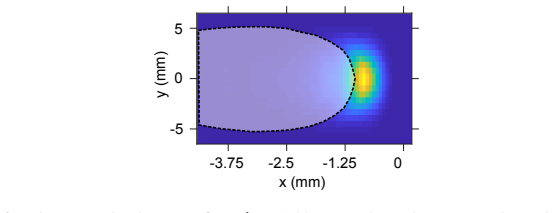
- For the simulated parameters, the non-single-cycle region, defined as $\Delta t(x,y) > 2\Delta t(x_p,y_p)$, contains 4%, 20%, and 25% of the terahertz energy for pump sizes $\sigma_x' = 0.44$, 0.88, and 1.32 mm.
- The terahertz beam size in the direction perpendicular to the pulse-front-tilt plane scales as $\sigma_y/\sqrt{2}$ and is insensitive to diffraction for $\sigma_y$ between 0.5 and 4.5 mm, so the 2D+1 approximation is good for spectral studies in that regime.
- Keeping the pump small in the pulse-front-tilt plane while enlarging it in the perpendicular direction preserves single-cycle content while still scaling up total energy.
- Carrier-envelope-phase-sensitive terahertz experiments should not treat the generated pulse as a single uniform few-cycle field; the energy generated away from the apex is temporally chirped and multi-cycle.
Reading between the lines
- The same spatial-inhomogeneity mechanism should appear in other prism-shaped nonlinear crystals and at other pump wavelengths, so the qualitative recommendation to keep the tilt-plane beam small is likely transferable beyond lithium niobate.
- The analytic $F_2$ term predicts a specific spatial chirp of the terahertz spectrum across the output face; a spatially resolved measurement of terahertz spectra could be fitted to that $x'$ dependence as a direct test of the model independent of efficiency measurements.
- The predicted 4%, 20%, and 25% non-single-cycle energy fractions could be checked by imaging the terahertz beam onto a segmented detector and comparing the pulse duration map; a large discrepancy would point to the slowly-varying-envelope approximation as the limiting assumption.
- The paper's recommendation implies elliptical pump beams as an optimization strategy: small in the tilt plane for waveform quality, large in the perpendicular direction for energy scaling.
Signed reviews
Editorial analysis
A structured set of objections, weighed in public.
Referee Report
Summary. The manuscript presents a 3D+1 numerical model of tilted-pulse-front terahertz generation in lithium niobate, based on coupled-wave equations solved with FFT-BPM and split-step Fourier methods. It first derives analytically that the grating's second-order angular dispersion produces a spatial narrowing of the generated terahertz bandwidth (Eq. 4), then compares 1D+1, 2D+1, and 3D+1 simulations. The central claims are that the pump beam size in the pulse-front-tilt plane strongly affects the spatio-temporal THz field, that few-cycle pulses occur only near the prism apex, that the 1D+1 and 2D+1 models overestimate conversion efficiency, with 2D+1 overestimating by about 25% relative to 3D+1, and that the non-single-cycle region contains 4%, 20%, and 25% of the THz energy for the three studied pump sizes. No code or data are shipped, and no numerical convergence or validation tests are reported.
Significance. If the quantitative results hold, the paper makes a useful contribution to the design of tilted-pulse-front THz sources: it identifies a practical limitation of reduced-dimensional models and quantifies the spatial inhomogeneity that matters for strong-field and carrier-envelope-phase-sensitive applications. The analytic derivation in Section 2 is clean and dimensionally consistent, and the numerical model includes relevant physics: χ(2) generation and back-conversion, cascading, n2, self-steepening, and stimulated Raman effects. The comparison of 1D+1, 2D+1, and 3D+1 models is timely and likely of interest to the community. However, the paper's quantitative conclusions rest entirely on an undocumented numerical implementation, which limits confidence until convergence and validation evidence is provided.
major comments (3)
- [Section 3, Eqs. (5)-(6)] The central quantitative claims—the ~25% efficiency gap between 2D+1 and 3D+1, and the 4%/20%/25% non-single-cycle energy fractions in Fig. 6—depend on the numerical accuracy of the FFT-BPM/split-step solution, but the manuscript reports no grid sizes, step sizes, spectral windows, absorption-boundary settings, or convergence tests. Without a resolution study or a comparison to an independent solver or experimental data, it is unclear whether the sharp spatial features near the prism apex and the grey-region energy fractions are physical or numerical artifacts. A convergence analysis, at least for the key reported quantities, is required before these numbers can be accepted.
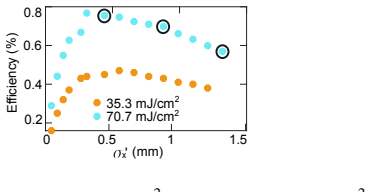
- [Section 4, first paragraph] The claim that y-diffraction has negligible effect on THz generation for σy in [0.5, 4.5] mm is stated as '(not shown)'. This assertion is load-bearing because it justifies the use of the 2D+1 model for the beam-size scan in Fig. 3 and the conclusion that a 2D calculation is a good approximation. The supporting data or an analytic estimate should be shown, or the claim should be softened.
- [Eqs. (5)-(6) and Fig. 5] The coupled-wave model applies the slowly varying amplitude approximation to the THz field. For single- to few-cycle THz pulses the envelope changes on the same timescale as the carrier, so SVEA may be inaccurate for the broadband THz field. The paper does not discuss or test this approximation, even though the quantitative spatial profiles depend on it. A concrete test would be to compare with a unidirectional pulse propagation formulation without the SVEA, or to check the validity condition |∂zE| << k0|E| over the THz spectrum for the simulated parameters.
minor comments (4)
- [Eq. (7)] Equation (7) contains a typo in the reference ('see Eq.7)' missing a space) and the notation t(x,y)p should be defined more clearly, since t is used both as the time coordinate and in the subscript p.
- [Fig. 3 caption] The caption says 'calculated by the 2D model' while the text uses '2D+1 model' consistently elsewhere; the caption should match the text.
- [Table 1] The parameter 'focal length f2' is given as '0.613× f1 mm [15]'; the formatting is confusing and the unit mm appears to apply to f1 only. Please clarify the value and the reference.
- [Section 4, Fig. 4] The phrase 'wasted' in the discussion of large OP beam sizes is fine colloquially, but the preceding sentence about absorption would be clearer if it stated that the THz generated near the base is reabsorbed before reaching the output surface, which is already mentioned and needs no change; this is a wording suggestion only.
Circularity Check
No significant circularity; the central claims are outputs of a forward numerical model with independently sourced material parameters.
full rationale
The paper's central claims—the spatial inhomogeneity of the generated terahertz field, the few-cycle region near the prism apex, and the 1D/2D/3D model comparison—are outputs of the coupled-wave simulations in Eqs. (5)–(6). No parameter is fitted to the target terahertz spatial profile or to the reported conversion efficiencies. Material parameters (refractive index, absorption, nonlinear index, pulse duration, focal lengths) are taken from independent external literature (refs. 15, 21, 24, 25) or stated as simulation inputs. The analytic inhomogeneity argument in Eq. (4) is derived from the grating equation and the second-order nonlinear polarization; it is not assumed as a conclusion. Self-citations to refs. 14, 20, and 23 provide prior formalism and an estimated damage threshold, but the relevant angular-dispersion term is re-derived in the paper, and the damage threshold enters only as an input fluence choice, not as a predicted result. The comparison of 1D+1, 2D+1, and 3D+1 models is a new computation whose equations are presented in the paper, and the 25% efficiency gap emerges from that computation rather than being imposed. Concerns about numerical convergence, grid resolution, or the slowly varying amplitude approximation are legitimate correctness or validation risks, but they are not circularity: an inaccurate forward solve does not make the derivation equivalent to its inputs. The 'not shown' assertion about y-diffraction being negligible is an evidentiary gap, not a self-referential reduction. Overall, the derivation chain is self-contained, and no prediction reduces by construction to a fitted parameter or a self-citation.
Assumptions & free parameters
free parameters (4)
- OP beam waist in tilt plane (σx') =
0.44, 0.88, 1.32 mm (three values chosen for 3D+1 runs)
- OP beam waist perpendicular to tilt plane (σy) =
3.5 mm
- Peak OP fluence =
70.7 mJ/cm2 (and 35.3 mJ/cm2)
- OP pulse duration (FWHM τ0) =
0.5 ps
assumptions (6)
- domain assumption The slowly varying amplitude approximation is valid for both the optical pump and the terahertz field in Eqs. (5)-(6).
- domain assumption The telescope images the grating onto the pulse-front-tilt plane inside the LN crystal with magnification -f1/f2 and negligible aberrations.
- domain assumption Material parameters (n(ω), α(ω), n2) from the cited literature at 300 K are accurate for the simulated conditions.
- domain assumption FFT-BPM and split-step Fourier methods converge for the chosen step sizes; no convergence tests are reported.
- domain assumption The input OP is a collimated Gaussian beam.
- standard math Grating dispersion follows the standard grating equation; higher-order angular dispersion is correctly represented by Eq. (2).
Cite this review
Pith. "Pith review of Full 3D+1 modelling of the tilted-pulse-front setups for single-cycle terahertz generation." pith.science (2026). https://pith.science/paper/SAYHD4G7
@misc{pith2026190809581,
  author       = {Pith},
  title        = {Pith review of: Full 3D+1 modelling of the tilted-pulse-front setups for single-cycle terahertz generation},
  year         = {2026},
  howpublished = {\url{https://pith.science/paper/SAYHD4G7}},
  note         = {Machine review of arXiv:1908.09581}
}
read the original abstract
The tilted-pulse-front setup utilizing a diffraction grating is one of the most successful methods to generate single- to few-cycle terahertz pulses. However, the generated terahertz pulses have a large spatial inhomogeneity, due to the noncollinear phase matching condition and the asymmetry of the prism-shaped nonlinear crystal geometry, especially when pushing for high optical-to-terahertz conversion efficiency. A 3D+1 (x,y,z,t) numerical model is necessary in order to fully investigate the terahertz generation problem in the tilted-pulse-front scheme. We compare in detail the differences between 1D+1, 2D+1 and 3D+1 models. The simulations show that the size of the optical beam in the pulse-front-tilt plane sensitively affects the spatio-temporal properties of the terahertz electric field. The terahertz electric field is found to have a strong spatial dependence such that a few-cycle pulse is only generated near the apex of the prism. The part of the beam farther from the apex contains a large fraction of the energy but has a waveform that deviates from a few-cycle. This strong spatial dependence must be accounted for when using the terahertz pulses for strong-field physics and carrier-envelope-phase sensitive experiments such as terahertz acceleration, coherent control of antiferromagnetic spin waves and terahertz high-harmonic generation.
Figures

Figures from the paper (3 more)


Reference graph
Works this paper leans on
-
[1]
The development of terahertz sources and their applications,
A. Davies, E. H. Linfield, and M. B. Johnston, “The development of terahertz sources and their applications,” Phys. Medicine & Biol.47, 3679 (2002)
work page 2002
-
[2]
Coherent terahertz control of antiferromagnetic spin waves,
T. Kampfrath, A. Sell, G. Klatt, A. Pashkin, S. Mährlein, T. Dekorsy, M. Wolf, M. Fiebig, A. Leitenstorfer, and R. Huber, “Coherent terahertz control of antiferromagnetic spin waves,” Nat. Photonics5, 31 (2011)
work page 2011
-
[3]
Sub-cycle control of terahertz high-harmonic generation by dynamical bloch oscillations,
O. Schubert, M. Hohenleutner, F. Langer, B. Urbanek, C. Lange, U. Huttner, D. Golde, T. Meier, M. Kira, S. W. Koch, and R. Huber, “Sub-cycle control of terahertz high-harmonic generation by dynamical bloch oscillations,” Nat. Photonics 8, 119 (2014)
work page 2014
-
[4]
Segmented terahertz electron accelerator and manipulator (steam),
D. Zhang, A. Fallahi, M. Hemmer, X. Wu, M. Fakhari, Y. Hua, H. Cankaya, A.-L. Calendron, L. E. Zapata, N. H. Matlis, and F. X. Kärtner, “Segmented terahertz electron accelerator and manipulator (steam),” Nat. photonics p. 1 (2018)
work page 2018
-
[5]
Observation of thz phonon-polariton beats in LiTaO3,
H. Bakker, S. Hunsche, and H. Kurz, “Observation of thz phonon-polariton beats in LiTaO3,” Phys. review letters69, 2823 (1992)
work page 1992
-
[6]
Terahertz radiation sources based on free electron lasers and their applications,
P. Tan, J. Huang, K. Liu, Y. Xiong, and M. Fan, “Terahertz radiation sources based on free electron lasers and their applications,” Sci. China Inf. Sci.55, 1–15 (2012)
work page 2012
-
[7]
Generation of 1.5-kw, 1-thz coherent radiation from a gyrotron with a pulsed magnetic field,
M. Y. Glyavin, A. G. Luchinin, and G. Y. Golubiatnikov, “Generation of 1.5-kw, 1-thz coherent radiation from a gyrotron with a pulsed magnetic field,” Phys. review letters100, 015101 (2008)
work page 2008
-
[8]
Large-orbit gyrotron operation in the terahertz frequency range,
V. Bratman, Y. K. Kalynov, and V. Manuilov, “Large-orbit gyrotron operation in the terahertz frequency range,” Phys. review letters102, 245101 (2009)
work page 2009
Show all 27 references
-
[9]
Gyrotron development for high power thz technologies at iap ras,
V. Bratman, A. Bogdashov, G. Denisov, M. Y. Glyavin, Y. K. Kalynov, A. Luchinin, V. Manuilov, V. Zapevalov, N. Zavolsky, and V. Zorin, “Gyrotron development for high power thz technologies at iap ras,” J. Infrared, Millimeter, Terahertz Waves33, 715–723 (2012)
2012
-
[10]
Velocity matching by pulse front tilting for large-area thz-pulse generation,
J. Hebling, G. Almasi, I. Z. Kozma, and J. Kuhl, “Velocity matching by pulse front tilting for large-area thz-pulse generation,” Opt. Express10, 1161–1166 (2002)
2002
-
[11]
Efficient generation of thz pulses with 0.4 mj energy,
J. A. Fülöp, Z. Ollmann, C. Lombosi, C. Skrobol, S. Klingebiel, L. Pálfalvi, F. Krausz, S. Karsch, and J. Hebling, “Efficient generation of thz pulses with 0.4 mj energy,” Opt. express22, 20155–20163 (2014)
2014
-
[12]
Terahertz emission from a laser pulse with tilted front: Phase-matching versus cherenkov effect,
M. Bakunov, S. Bodrov, and M. Tsarev, “Terahertz emission from a laser pulse with tilted front: Phase-matching versus cherenkov effect,” J. Appl. Phys.104, 073105 (2008)
2008
-
[13]
Terahertz generation with tilted-front laser pulses: dynamic theory for low-absorbing crystals,
M. I. Bakunov, S. B. Bodrov, and E. A. Mashkovich, “Terahertz generation with tilted-front laser pulses: dynamic theory for low-absorbing crystals,” JOSA B28, 1724–1734 (2011)
2011
-
[14]
Theory of terahertz generation by optical rectification using tilted-pulse-fronts,
K. Ravi, W. R. Huang, S. Carbajo, E. A. Nanni, D. N. Schimpf, E. P. Ippen, and F. X. Kärtner, “Theory of terahertz generation by optical rectification using tilted-pulse-fronts,” Opt. express23, 5253–5276 (2015)
2015
-
[15]
Optimization of the tilted-pulse-front terahertz excitation setup containing telescope,
L. Tokodi, J. Hebling, and L. Pálfalvi, “Optimization of the tilted-pulse-front terahertz excitation setup containing telescope,” J. Infrared, Millimeter, Terahertz Waves38, 22–32 (2017)
2017
-
[16]
Light propagation in graded-index optical fibers,
M. Feit and J. Fleck, “Light propagation in graded-index optical fibers,” Appl. optics17, 3990–3998 (1978)
1978
-
[17]
Designofhigh-energyterahertzsourcesbasedonopticalrectification,
J.Fülöp,L.Pálfalvi,G.Almási,andJ.Hebling,“Designofhigh-energyterahertzsourcesbasedonopticalrectification,” Opt. express18, 12311–12327 (2010)
2010
-
[18]
Matrix formalism for pulse compressors,
O. E. Martinez, “Matrix formalism for pulse compressors,” IEEE journal quantum electronics24, 2530–2536 (1988)
1988
-
[19]
Grating and prism compressors in the case of finite beam size,
O. E. Martinez, “Grating and prism compressors in the case of finite beam size,” JOSA B3, 929–934 (1986)
1986
-
[20]
Analysis of terahertz generation using tilted pulse fronts,
K. Ravi and F. Kärtner, “Analysis of terahertz generation using tilted pulse fronts,” Opt. express27, 3496–3517 (2019)
2019
-
[21]
Third-order optical susceptibilities of liquids and solids,
R. Hellwarth, “Third-order optical susceptibilities of liquids and solids,” Prog. Quantum Electron.5, 1–68 (1977)
1977
-
[22]
Tunable light scattering from transverse optical modes in lithium niobate,
S. S. Sussman, “Tunable light scattering from transverse optical modes in lithium niobate,” Tech. rep., STANFORD UNIV CA MICROWAVE LAB (1970)
1970
-
[23]
Pulse sequences for efficient multi-cycle terahertz generation in periodically poled lithium niobate,
K. Ravi, D. N. Schimpf, and F. X. Kärtner, “Pulse sequences for efficient multi-cycle terahertz generation in periodically poled lithium niobate,” Opt. express24, 25582–25607 (2016)
2016
-
[24]
Generation of sub-mj terahertz pulses by optical rectification,
J. Fülöp, L. Pálfalvi, S. Klingebiel, G. Almási, F. Krausz, S. Karsch, and J. Hebling, “Generation of sub-mj terahertz pulses by optical rectification,” Opt. letters37, 557–559 (2012)
2012
-
[25]
Measurement of refractive index and absorption coefficient of congruent and stoichiometric lithium niobate in the terahertz range,
M. Unferdorben, Z. Szaller, I. Hajdara, J. Hebling, and L. Pálfalvi, “Measurement of refractive index and absorption coefficient of congruent and stoichiometric lithium niobate in the terahertz range,” J. Infrared, Millimeter, Terahertz Waves 36, 1203–1209 (2015)
2015
-
[26]
Nonlinear distortion of intense thz beams,
C. Lombosi, G. Polónyi, M. Mechler, Z. Ollmann, J. Hebling, and J. Fülöp, “Nonlinear distortion of intense thz beams,” New J. Phys.17, 083041 (2015)
2015
-
[27]
Numerical investigation of a scalable setup for efficient terahertz generation using a segmented tilted-pulse-front excitation,
L. Pálfalvi, G. Tóth, L. Tokodi, Z. Márton, J. A. Fülöp, G. Almási, and J. Hebling, “Numerical investigation of a scalable setup for efficient terahertz generation using a segmented tilted-pulse-front excitation,” Opt. express25, 29560–29573 (2017)
2017
Reviewed August 14, 2026 · model on record in the stance chip above.
Discussion (0). Continue with ORCID to comment.