Waveform Design for Underwater Simultaneous Acoustic Information and Power Transfer
Pith reviewed 2026-07-03 00:21 UTC · model grok-4.3
The pith
Joint optimization of multicarrier waveforms for underwater SAIPT improves acoustic energy transfer efficiency when transducer frequency response and rectifier nonlinearity are included.
A machine-rendered reading of the paper's core claim, the machinery that carries it, and where it could break.
Core claim
By incorporating the frequency-dependent characteristics of acoustic transducers and the nonlinear behavior of rectifier circuits into the waveform optimization for multicarrier SAIPT systems, the proposed SCA and AO methods achieve higher acoustic energy transfer efficiency compared to designs that ignore these effects.
What carries the argument
Successive convex approximation (SCA) for waveform vector optimization under power constraints, extended to alternating optimization (AO) for joint power splitting and waveform design in SAIPT.
Load-bearing premise
The frequency-dependent transducer model and nonlinear rectifier model accurately represent real underwater hardware behavior.
What would settle it
An experiment measuring the DC output power from a real rectifier driven by the optimized multicarrier acoustic signal versus a non-optimized one in an underwater channel.
Figures



read the original abstract
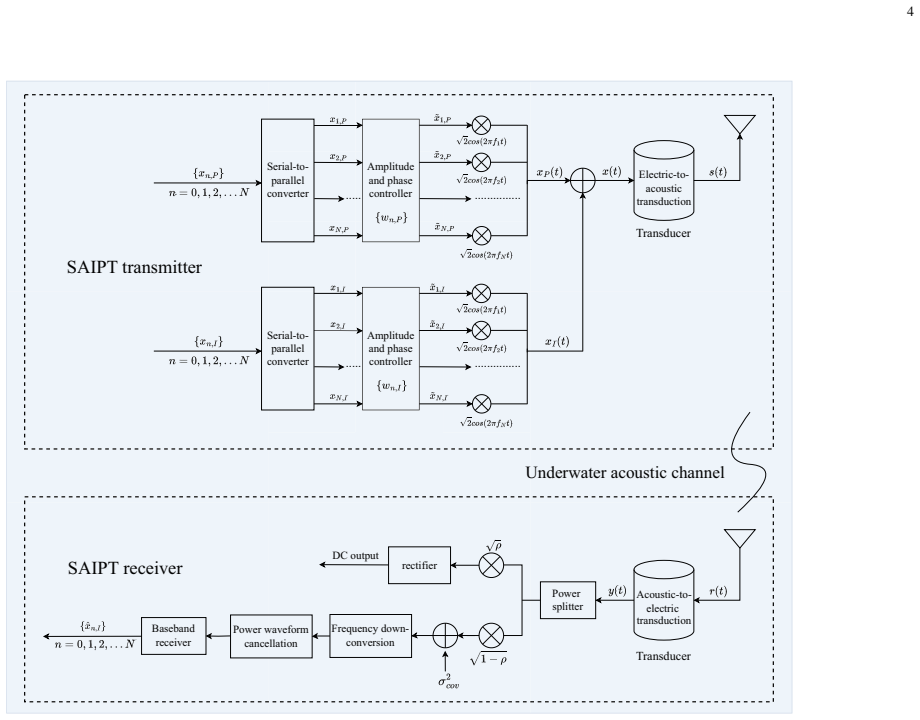
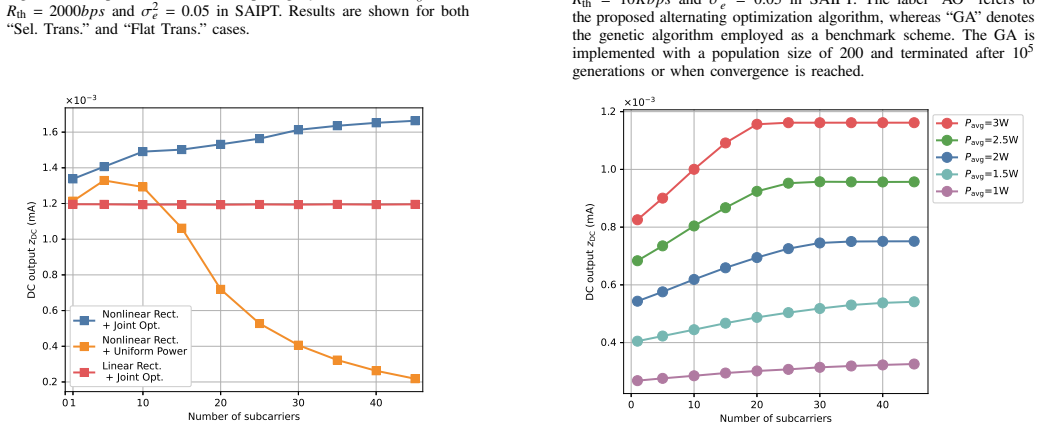
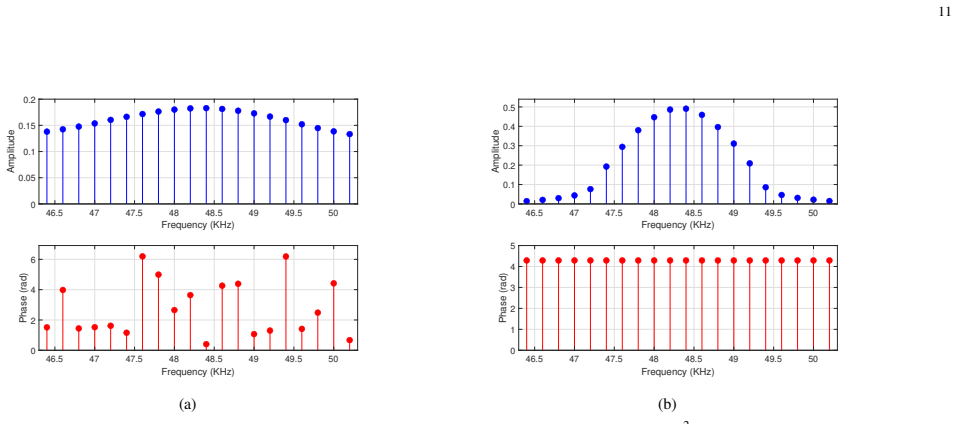
Simultaneous acoustic information and power transfer (SAIPT) plays a crucial role in enabling self-sustainable and maintenance-free Internet of Underwater Things (IoUT) networks. This paper studies a multicarrier underwater SAIPT system that jointly considers the frequency-dependent characteristics of acoustic transducers and the nonlinear behavior of rectifier circuits. The waveform vector is firstly optimized using the successive convex approximation (SCA) method under constraints on average and peak transmit power for acoustic power transfer (APT). Then, in the SAIPT scenario, both the power splitting factor and waveform vectors are jointly optimized through an alternating optimization (AO) framework based on SCA, subject to transmit power and achievable rate constraints. Simulation results demonstrate that incorporating the transducer's frequency response, rectifier nonlinearity, and the high peak-to-average power ratio (PAPR) of multicarrier waveforms leads to a significant improvement in acoustic energy transfer efficiency. The results also show that the energy harvesting DC output can be further enhanced by properly choosing system parameters, such as the number of subcarriers and subcarrier spacing.
Editorial analysis
A structured set of objections, weighed in public.
Referee Report
Summary. The manuscript studies multicarrier waveform design for underwater simultaneous acoustic information and power transfer (SAIPT). It first optimizes the waveform vector via successive convex approximation (SCA) under average and peak transmit power constraints for acoustic power transfer (APT). It then jointly optimizes the power splitting factor and waveform vectors via an alternating optimization (AO) framework based on SCA, subject to transmit power and rate constraints. The abstract claims that simulation results show significant improvement in acoustic energy transfer efficiency when the transducer frequency response, rectifier nonlinearity, and high PAPR of multicarrier waveforms are incorporated, with further gains possible by tuning the number of subcarriers and subcarrier spacing.
Significance. If the claimed simulation improvements hold under validated models, the work could support more efficient self-sustainable IoUT networks by enabling better acoustic energy harvesting while maintaining information transfer. The use of standard SCA and AO methods on realistic frequency-dependent and nonlinear models is a reasonable direction, but the absence of any quantitative results, baselines, or hardware validation in the provided text prevents determining whether the approach yields practically meaningful gains over existing designs.
major comments (2)
- [Abstract] Abstract: The central claim that 'simulation results demonstrate... a significant improvement in acoustic energy transfer efficiency' is unsupported by any quantitative data, specific efficiency deltas, baseline comparisons, error bars, or verification that the SCA/AO solutions achieve the stated gains. This evidence gap directly undermines assessment of the headline result.
- [Abstract] Abstract: No equations, explicit objective functions, or constraint formulations are supplied for the SCA optimization (APT case) or the AO framework (SAIPT case), nor is any convergence analysis or sensitivity study to the transducer/rectifier model parameters provided. These elements are load-bearing for the efficiency claims.
minor comments (1)
- [Abstract] The abstract would be strengthened by including at least one concrete numerical result (e.g., efficiency improvement percentage or harvested DC power value) to substantiate the 'significant improvement' statement.
Simulated Author's Rebuttal
We thank the referee for the constructive comments on our manuscript. We address each major comment below, agreeing where the abstract can be strengthened and proposing targeted revisions.
read point-by-point responses
-
Referee: [Abstract] Abstract: The central claim that 'simulation results demonstrate... a significant improvement in acoustic energy transfer efficiency' is unsupported by any quantitative data, specific efficiency deltas, baseline comparisons, error bars, or verification that the SCA/AO solutions achieve the stated gains. This evidence gap directly undermines assessment of the headline result.
Authors: We agree that the abstract would benefit from quantitative support to substantiate the efficiency claims. We will revise the abstract to include specific simulation outcomes, such as the observed percentage gains in DC output power relative to baselines that omit transducer frequency response or rectifier nonlinearity, along with the subcarrier configurations used. revision: yes
-
Referee: [Abstract] Abstract: No equations, explicit objective functions, or constraint formulations are supplied for the SCA optimization (APT case) or the AO framework (SAIPT case), nor is any convergence analysis or sensitivity study to the transducer/rectifier model parameters provided. These elements are load-bearing for the efficiency claims.
Authors: Abstracts are conventionally high-level summaries and do not contain equations or detailed formulations, which appear in Sections III and IV of the manuscript. To improve clarity, we will revise the abstract to explicitly name the SCA and AO methods, the power and rate constraints, and note that convergence behavior and parameter sensitivity are analyzed in the full text. revision: partial
Circularity Check
No circularity; standard optimization applied to external models
full rationale
The abstract describes waveform optimization via successive convex approximation (SCA) under power constraints, followed by alternating optimization (AO) jointly with power splitting under rate constraints. Simulation results are reported as direct outputs of these standard numerical methods applied to given parametric models of transducer frequency response and rectifier nonlinearity. No equations, self-citations, fitted parameters, or uniqueness theorems appear in the text that would reduce any claimed result to its inputs by construction. The derivation chain is therefore self-contained.
Axiom & Free-Parameter Ledger
Reference graph
Works this paper leans on
-
[1]
C. Lin, G. Han, J. Jiang, C. Li, S. B. H. Shah, and Q. Liu, “Un derwater Pollution Tracking Based on Software-Defined Multi-Tier Ed ge Com- puting in 6G-Based Underwater Wireless Networks,” IEEE J. Sel. Areas Commun., vol. 41, no. 2, pp. 491–503, Feb. 2023
work page 2023
-
[2]
Binocular Underwater Measurem ent With Multicolor Structured Light,
S. Li, X. Gao, and Z. Xie, “Binocular Underwater Measurem ent With Multicolor Structured Light,” IEEE J. Ocean. Eng. , vol. 49, no. 2, pp. 649–666, Apr. 2024
work page 2024
-
[3]
Y . Liu, H. Wang, L. Cai, X. Shen, and R. Zhao, “Fundamental s and Advancements of Topology Discovery in Underwater Acoustic Sensor Networks: A Review,” IEEE Sensors J. , vol. 21, no. 19, pp. 21 159– 21 174, Oct. 2021
work page 2021
-
[4]
M. Chaudhary, N. Goyal, A. Benslimane, L. K. Awasthi, A. A lwadain, and A. Singh, “Underwater Wireless Sensor Networks: Enabli ng Tech- nologies for Node Deployment and Data Collection Challenge s,” IEEE Internet Things J. , vol. 10, no. 4, pp. 3500–3524, Feb. 2023
work page 2023
-
[5]
Sta te- of-the-Art Security Schemes for the Internet of Underwater Things: A Holistic Survey,
N. Adam, M. Ali, F. Naeem, A. S. Ghazy, and G. Kaddoum, “Sta te- of-the-Art Security Schemes for the Internet of Underwater Things: A Holistic Survey,” IEEE Open J. Commun. Soc. , vol. 5, pp. 6561–6592, 2024
work page 2024
-
[6]
S. Sendra, J. Lloret, J. M. Jimenez, and L. Parra, “Underw ater Acoustic Modems,” IEEE Sensors J. , vol. 16, no. 11, pp. 4063–4071, Jun. 2016
work page 2016
-
[7]
Y . Luo, Y . Y ang, H. Hong, and Z. Dai, “A Simultaneous Wirel ess Power and Data Transfer System With Full-Duplex Mode for Underwat er Wireless Sensor Networks,” IEEE Sensors J. , vol. 24, no. 8, pp. 12 570– 12 583, Apr. 2024
work page 2024
-
[8]
Wireless Information and Power Tran sfer in Un- derwater Acoustic Sensor Networks,
F. Yizhi and J. Fei, “Wireless Information and Power Tran sfer in Un- derwater Acoustic Sensor Networks,” China Commun. , vol. 21, no. 10, pp. 1–11, Oct. 2024
work page 2024
-
[9]
Communication for Underwater Sensor Networks: A Co mpre- hensive Summary,
A. Pal, F. Campagnaro, K. Ashraf, M. R. Rahman, A. Ashok, a nd H. Guo, “Communication for Underwater Sensor Networks: A Co mpre- hensive Summary,” ACM Trans. Sens. Netw. , vol. 19, no. 1, pp. 1–44, Feb. 2023
work page 2023
-
[10]
Underwater Acousti c Commu- nications Based on OCDM for Internet of Underwater Things,
B. Wang, Y . Wang, Y . Li, and X. Guan, “Underwater Acousti c Commu- nications Based on OCDM for Internet of Underwater Things,” IEEE Internet Things J. , vol. 10, no. 24, pp. 22 128–22 142, Dec. 2023
work page 2023
-
[11]
D. Sun, X. Hong, H. Cui, and L. Liu, “A Symbol-Based Passb and Doppler Tracking and Compensation Algorithm for Underwate r Acous- tic DSSS Communications,” J. Commun. Inf. Netw. , vol. 5, no. 2, pp. 168–176, Jun. 2020
work page 2020
-
[12]
Energy harvesting for tds-ofdm i n noma-based underwater communication systems,
H. Esmaiel and H. Sun, “Energy harvesting for tds-ofdm i n noma-based underwater communication systems,” Sensors, vol. 22, no. 15, p. 5751, 2022
work page 2022
-
[13]
Densenet- based robust channel estimation in ofdm for improving underwater acoustic communication,
S. Liu, M. Adil, L. Ma, S. Mazhar, and G. Qiao, “Densenet- based robust channel estimation in ofdm for improving underwater acoustic communication,” IEEE J. Oceanic Eng. , vol. 50, no. 2, pp. 1518–1537, April 2025
work page 2025
-
[14]
C.-C. Chen and Y .-K. Chu, “Hall Sensor-Based Remote Con trol in Twin Square Compensation Magnetic Module Design for Dynami c Misalignment in Underwater Wireless Power Transfer for AUV s,” IEEE Sensors J. , vol. 25, no. 17, pp. 33 810–33 821, Sep. 2025
work page 2025
-
[15]
A Survey on Underwater Wireless Power and Data Transfer System,
A. Wibisono, M. H. Alsharif, H.-K. Song, and B. M. Lee, “A Survey on Underwater Wireless Power and Data Transfer System,” IEEE Access , vol. 12, pp. 34 942–34 957, 2024
work page 2024
-
[16]
An Acoustically Powered Battery-less Internet of Underwater Things Plat- form,
R. Guida, E. Demirors, N. Dave, J. Rodowicz, and T. Melod ia, “An Acoustically Powered Battery-less Internet of Underwater Things Plat- form,” in Proc. 4th Underwater Commun. Netw. Conf. , Aug. 2018, pp. 1–5
work page 2018
-
[17]
R. Guida, E. Demirors, N. Dave, and T. Melodia, “Underwa ter Ultra- sonic Wireless Power Transfer: A Battery-Less Platform for the Internet of Underwater Things,” IEEE Trans. Mobile Comput. , vol. 21, no. 5, pp. 1861–1873, May 2022
work page 2022
-
[18]
L. Zhang, Y . Zhao, H. Y ang, G. Liang, and J. Hu, “Energy-E fficient Port Selection and Beamforming Design for Integrated Data a nd Energy Transfer Assisted by Fluid Antennas,” IEEE J. Sel. Areas Commun. , pp. 1–1, 2025
work page 2025
-
[19]
QoS-Aware Ene rgy Storage Maximization in the RIS-Aided Joint-SWIPT-MEC Sys tem,
M. Bian, Y . Shi, Y . Huang, and X.-W. Tang, “QoS-Aware Ene rgy Storage Maximization in the RIS-Aided Joint-SWIPT-MEC Sys tem,” IEEE Commun. Lett. , vol. 27, no. 12, pp. 3434–3438, Dec. 2023
work page 2023
-
[20]
Holographic Integ rated Data and Energy Transfer,
Q. Huang, J. Hu, Y . Zhao, and K. Y ang, “Holographic Integ rated Data and Energy Transfer,” IEEE Trans. Wireless Commun. , vol. 23, no. 12, pp. 18 987–19 002, Dec. 2024
work page 2024
-
[21]
Y . Li, Y . Wu, Y . Song, L. Qian, and W. Jia, “Dynamic User-S cheduling and Power Allocation for SWIPT Aided Federated Learning: A D eep Learning Approach,” IEEE Trans. Mobile Comput. , vol. 22, no. 12, pp. 6956–6969, Dec. 2023
work page 2023
-
[22]
Reflective Index Mo dulation for IRS Assisted Integrated Data and Energy Transfer,
Y . Zhao, L. Zhang, J. Hu, and K. Y ang, “Reflective Index Mo dulation for IRS Assisted Integrated Data and Energy Transfer,” IEEE Trans. Wireless Commun., vol. 23, no. 9, pp. 11 508–11 520, Sep. 2024
work page 2024
-
[23]
K. Y e, C. Zou, and F. Y ang, “Dual-Hop Underwater Optical Wireless Communication System With Simultaneous Lightwave Informa tion and Power Transfer,” IEEE Photon. J. , vol. 13, no. 6, pp. 1–7, Dec. 2021
work page 2021
-
[24]
H. Guo, Z. Sun, and P . Wang, “Joint Design of Communicati on, Wireless Energy Transfer, and Control for Swarm Autonomous Underwat er V ehicles,” IEEE Trans. V eh. Technol. , vol. 70, no. 2, pp. 1821–1835, Feb. 2021
work page 2021
-
[25]
Performance Analy sis of a WPCN-Based Underwater Acoustic Communication System,
R. Xing, Y . Zhang, Y . Feng, and F. Ji, “Performance Analy sis of a WPCN-Based Underwater Acoustic Communication System,” J. Mar . Sci. Eng. , vol. 12, no. 1, p. 43, 2023
work page 2023
-
[26]
Wireless Information and Power Transfer for Underwater Ac oustic Time-Reversed NOMA,
H. Esmaiel, Z. A. H. Qasem, H. Sun, J. Qi, J. Wang, and Y . Gu , “Wireless Information and Power Transfer for Underwater Ac oustic Time-Reversed NOMA,” IET Commun., vol. 14, no. 19, pp. 3394–3403, 2023. 13
work page 2023
-
[27]
Toward a Sustainable Internet of Underwater Things Based on AUVs, SWIPT, and Reinforcement Learning,
K. G. Omeke, M. Mollel, S. T. Shah, L. Zhang, Q. H. Abbasi, and M. A. Imran, “Toward a Sustainable Internet of Underwater Things Based on AUVs, SWIPT, and Reinforcement Learning,” IEEE Internet Things J. , vol. 11, no. 5, pp. 7640–7651, Mar. 2024
work page 2024
-
[28]
R. Deepa, V . P . Harigovindan, V . Goutham, and S. Kalathi l, “Enhanced SWIPT With Cooperative Relaying for Energy E fficient and Reliable NOMA-Based Underwater Acoustic Sensor Networks,” IEEE Access , vol. 13, pp. 142 089–142 102, 2025
work page 2025
-
[29]
AUV Trajecto ry Learning for Underwater Acoustic Energy Transfer and Age Minimizati on,
M. A. Melki, M. Shehab, and M.-S. Alouini, “AUV Trajecto ry Learning for Underwater Acoustic Energy Transfer and Age Minimizati on,” IEEE Internet Things J. , vol. 12, no. 12, pp. 20 435–20 447, Jun. 2025
work page 2025
-
[30]
On the relationship between capacity a nd distance in an underwater acoustic communication channel,
M. Stojanovic, “On the relationship between capacity a nd distance in an underwater acoustic communication channel,” ACM SIGMOBILE Mobile Comput. Commun. Rev. , vol. 11, no. 4, pp. 34–43, 2007
work page 2007
-
[31]
Advances in Underwater Acoustic Networking,
S. Basagni, M. Conti, S. Giordano, and I. Stojmenovic, “ Advances in Underwater Acoustic Networking,” in Mobile Ad Hoc Networking: The Cutting Edge Directions , 2nd ed. Hoboken, NJ, USA: Wiley-IEEE Press, Mar. 2013, pp. 807–814
work page 2013
-
[32]
R. Wang, A. Y adav, E. A. Makled, O. A. Dobre, R. Zhao, and P . K. V arshney, “Optimal Power Allocation for Full-Duplex U nderwater Relay Networks With Energy Harvesting: A Reinforcement Lea rning Approach,” IEEE Wireless Commun. Lett. , vol. 9, no. 2, pp. 223–227, Feb. 2020
work page 2020
-
[33]
The Underwater Backsca tter Chan- nel: Theory, Link Budget, and Experimental V alidation,
W. Akbar, A. Allam, and F. Adib, “The Underwater Backsca tter Chan- nel: Theory, Link Budget, and Experimental V alidation,” in Proc. 29th Annu. Int. Conf. Mobile Comput. Netw. Madrid, Spain: ACM, Oct. 2023, pp. 1–15
work page 2023
-
[34]
Waveform Design for Wirel ess Power Transfer,
B. Clerckx and E. Bayguzina, “Waveform Design for Wirel ess Power Transfer,” IEEE Trans. Signal Process. , vol. 64, no. 23, pp. 6313–6328, Dec. 2016
work page 2016
-
[35]
Demo: Underwater Backs catter Link Budget Tool,
A. Allam, W. Akbar, and F. Adib, “Demo: Underwater Backs catter Link Budget Tool,” in Proc. ACM SIGCOMM 2023 Conf. , New Y ork, NY , USA, Sep. 2023, pp. 1191–1192
work page 2023
-
[36]
Inc., Cranbrook, Canada, 2025, accessed: Sep
BII-7511 Transducer Datasheet , Benthowave Instrum. Inc., Cranbrook, Canada, 2025, accessed: Sep. 18, 2025. [Online]. Available : https://www.benthowave.com/BII-7511.pdf
work page 2025
-
[37]
Cvx: Matlab software for discipli ned convex programming,
M. Grant and S. Boyd, “Cvx: Matlab software for discipli ned convex programming,” 2014. [Online]. Available: http: //cvxr.com/cvx
work page 2014
-
[38]
Interior Point Methods for No nlinear Optimiza- tion,
I. P’olik and T. Terlaky, “Interior Point Methods for No nlinear Optimiza- tion,” in Nonlinear Optimization (Lectures Held in Cetraro, Italy, J uly 1–7, 2007) . Berlin, Germany: Springer-V erlag, Jan. 2010, pp. 215–276
work page 2007
discussion (0)
Sign in with ORCID, Apple, or X to comment. Anyone can read and Pith papers without signing in.