REVIEW 3 major objections 4 minor 6 references
Relationships Between Six Incircles
T0 review · 3 major / 4 minor · reviewed 2026-08-14 · deepseek-v4-flash
Pith's one-line read When P is the circumcenter, alternating reciprocal inradii balance exactly.
desk verdict Theorem 5.1 is a clean, fully proved new result, but several other claimed identities rest on omitted CAS details that a referee should require before acceptance. read the letter →
The pith
A machine-rendered reading of the paper's core claim, the machinery that carries it, and where it could break.
The reading
What carries the argument
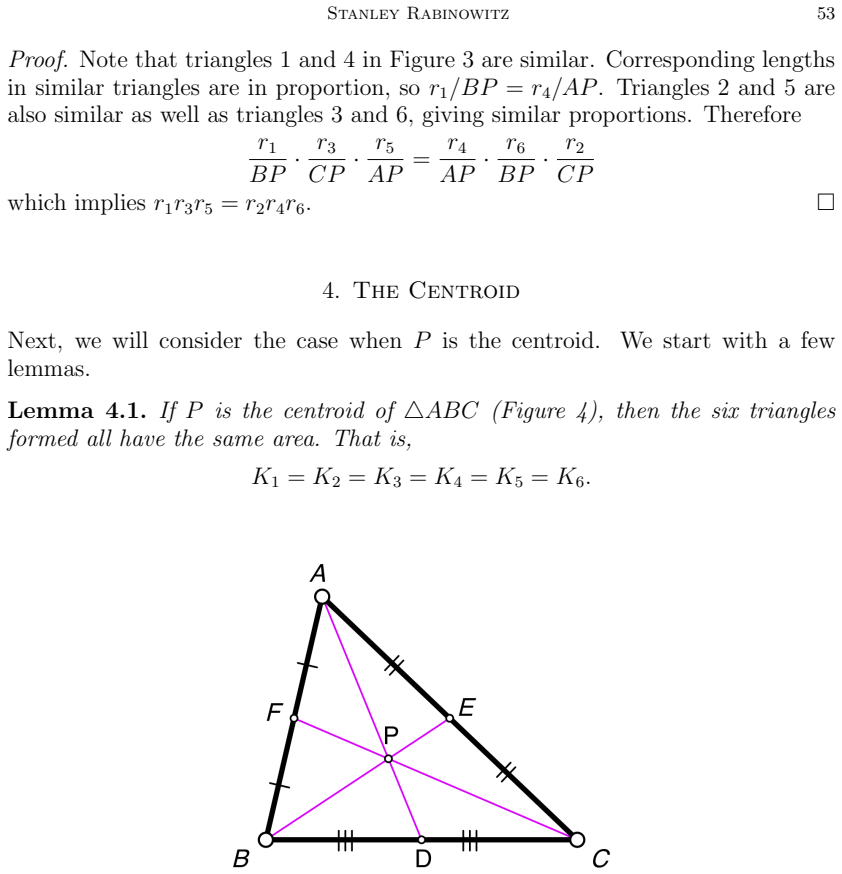
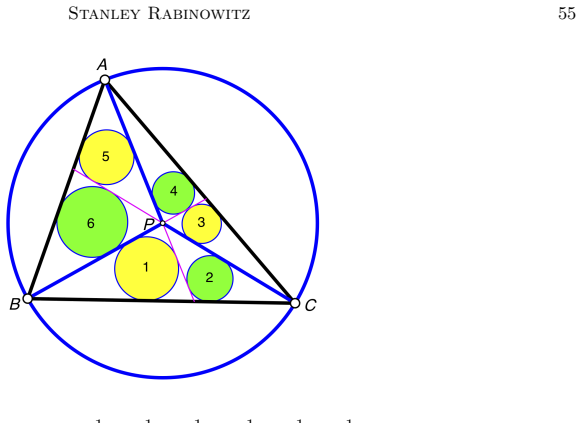
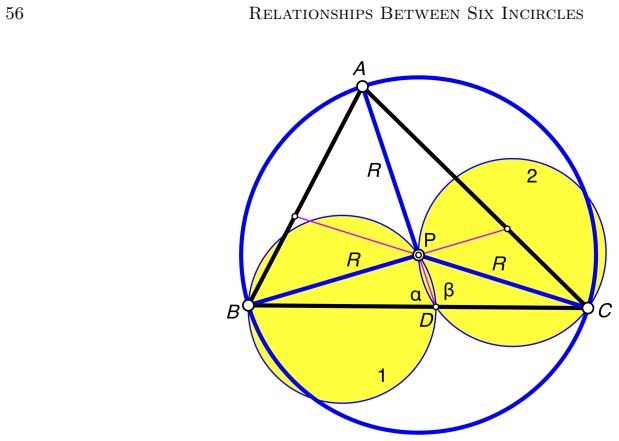
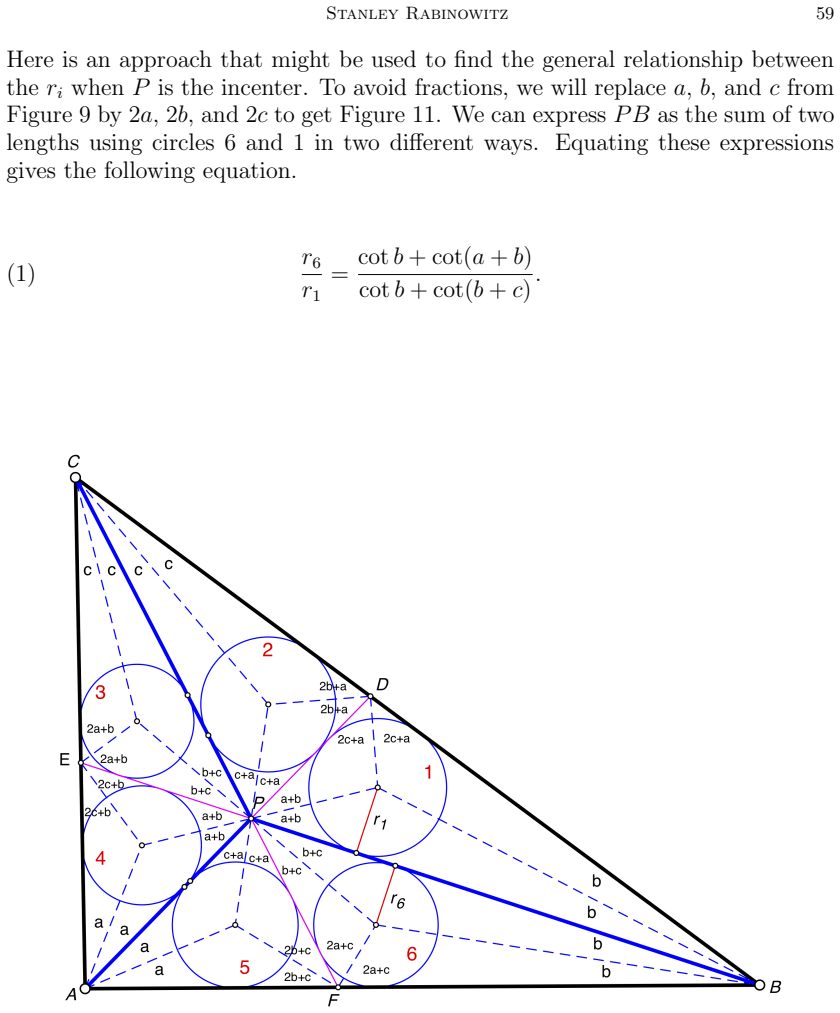
The key mechanism is Lemma 5.1, a local cotangent decomposition: if $P$ is the circumcenter and $R$ is the circumradius, then for each small triangle the parent radius is split into $R = r_1(\cot\alpha + \cot(\beta/2))$, so $R/r_1 = \cot\alpha + \cot(\beta/2)$, where $\alpha$ is the base angle at $A$ and $\beta$ is the angle at $B$ along the cevian. Writing the analogous six equations, the alternating sum of the reciprocal inradii becomes a sum of cotangent terms that cancels pairwise. For the centroid case, the machinery is different: the six small triangles have equal area and the semiperimeters satisfy $s_1+s_3+s_5 = s_2+s_4+s_6$, so the identity $r=K/s$ converts that semiperimeter balance into the reciprocal-sum identity.
What would settle it
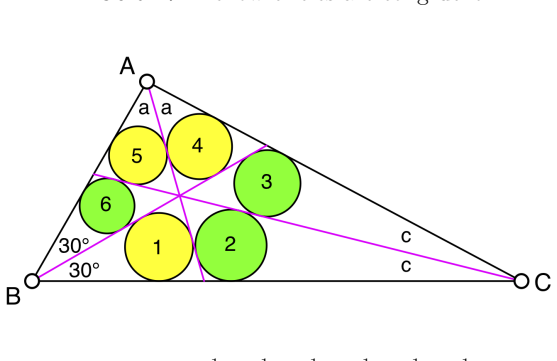
Compute the six inradii for a triangle with $P$ at the incenter and $\angle B = 120^\circ$, substitute into $r_1r_2r_3+r_3r_4r_5+r_3r_4r_6 = r_1r_3r_4+r_2r_3r_4+r_4r_5r_6$, and check that the difference is zero; a nonzero value disproves Theorem 6.2. Equivalently, evaluate any random scalene triangle with $P$ at the circumcenter and test $1/r_1+1/r_3+1/r_5 = 1/r_2+1/r_4+1/r_6$.
Extended reading notes
Core claim
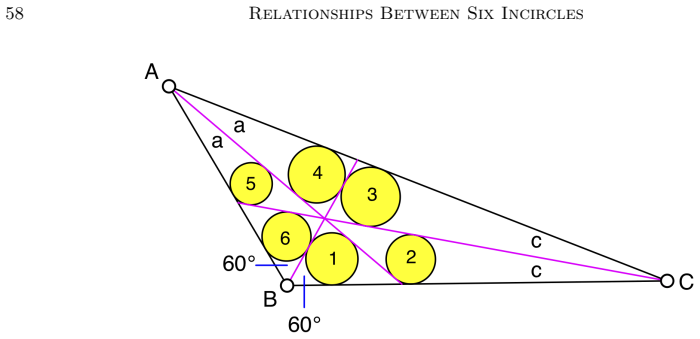
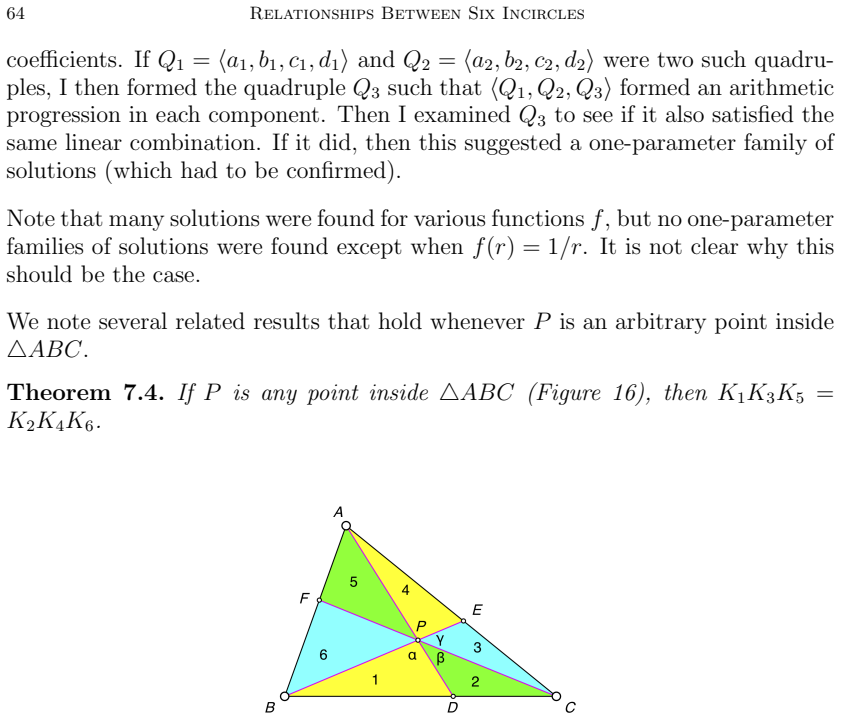
The paper's load-bearing new discovery is Theorem 5.1: for any triangle, if $P$ is the circumcenter, then $1/r_1 + 1/r_3 + 1/r_5 = 1/r_2 + 1/r_4 + 1/r_6$. The proof decomposes the circumradius $R$ along a cevian into two pieces involving cotangents of the local angles; the six equations then cancel in alternating pairs. Around this, the paper assembles a family of analogous results: for the orthocenter, $r_1r_3r_5 = r_2r_4r_6$; for the centroid, the same reciprocal-sum identity as the circumcenter, plus $R_1R_3R_5=R_2R_4R_6$; for the incenter under special angle conditions, polynomial identities such as $r_1r_2r_3+r_3r_4r_5+r_3r_4r_6 = r_1r_3r_4+r_2r_3r_4+r_4r_5r_6$; and for arbitrary $P$, the area identities $K_1K_3K_5=K_2K_4K_6$ and $1/K_1+1/K_3+1/K_5=1/K_2+1/K_4+1/K_6$. The special-angle identities are verified by computer algebra, with several proofs omitted.
Load-bearing premise
The load-bearing premise is that the symbolic algebra simplifications omitted from Theorems 6.2, 7.2, and 7.3 are exactly correct; if any of those unshown reductions contains an error, those specific identities fail.
Editorial extensions
If this is right
- For any triangle, if Theorem 5.1 is correct, the identity $1/r_1 + 1/r_3 + 1/r_5 = 1/r_2 + 1/r_4 + 1/r_6$ holds at the circumcenter and is invariant under scaling and rotation.
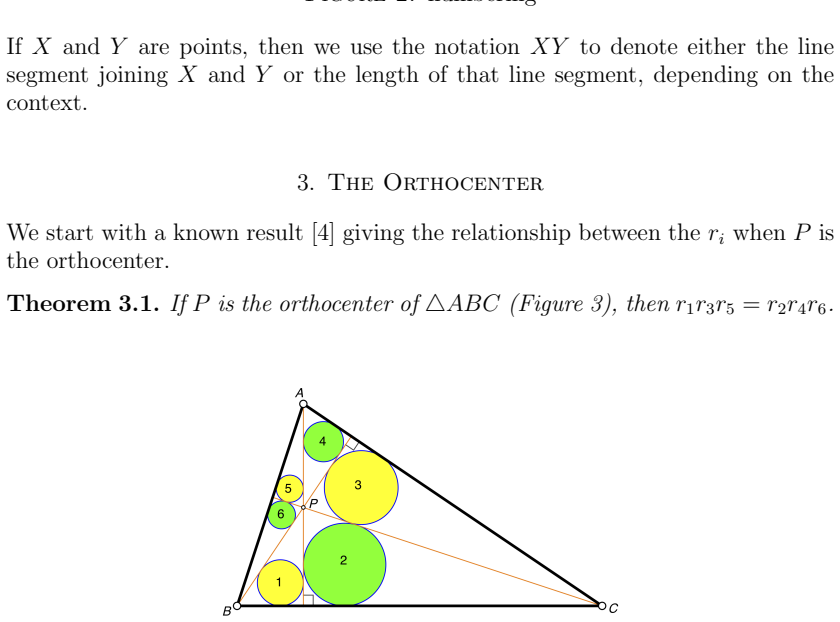
- The classical centers pair up: the orthocenter gives a product identity, while the centroid and circumcenter give the same reciprocal-sum identity, showing that the algebraic form of the relation encodes which center is chosen.
- For the $30^\circ$--$60^\circ$--$90^\circ$ incenter configuration, the six inradii have explicit radical closed forms, so the five displayed identities among them can be checked exactly, not merely numerically.
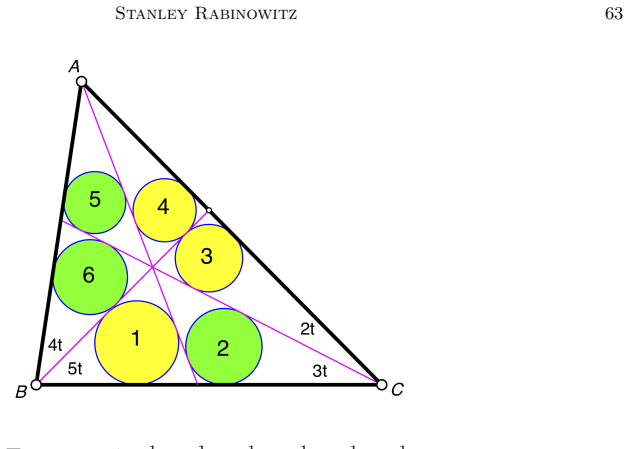
- If the omitted computations in Theorems 7.2 and 7.3 are valid, there are one-parameter families of interior points, not just classical centers, for which alternating reciprocal-sum identities hold.
- Taken with the area identities $K_1K_3K_5=K_2K_4K_6$ and $1/K_1+1/K_3+1/K_5=1/K_2+1/K_4+1/K_6$, the radius identities suggest that the alternating pattern is a general feature of the cevian configuration, with the semiperimeter deciding when it passes from areas to radii.
Reading between the lines
- Generalizing the cotangent cancellation in Lemma 5.1 suggests that any point $P$ whose six local angles pair to equal alternating sums will also satisfy the reciprocal-sum identity; the circumcenter is one such point. The paper does not state this characterization.
- The explicit radical values for the $30^\circ$--$60^\circ$--$90^\circ$ incenter case give a ready-made numerical testbed for conjectures about other points $P$; searching for points where the displayed linear or polynomial identities hold could reveal more families, as the paper's open question about straight-line loci hints.
- The absence of one-parameter families for functions other than $1/r$, which the paper reports, is itself a clue: reciprocal inradii, not radii or squared radii, are the natural coordinates for this configuration, possibly because they linearize the angle relations.
Signed reviews
Editorial analysis
A structured set of objections, weighed in public.
Referee Report
Summary. The paper studies the six small triangles obtained by drawing the cevians through an interior point P of a triangle ABC, and the inradii r1,...,r6 of their incircles. It proves several identities: for P the orthocenter (r1r3r5 = r2r4r6), for P the centroid (1/r1 + 1/r3 + 1/r5 = 1/r2 + 1/r4 + 1/r6), and a new theorem for P the circumcenter (Theorem 5.1, the same reciprocal-sum identity). It also states special-case identities when P is the incenter and when P is defined by specified angles, and it closes with open questions. The central new result, Theorem 5.1, is proved by a self-contained geometric argument; several of the additional identities are asserted with proofs that say 'the details are omitted' or rely on unshown symbolic algebra simplifications.
Significance. If all claims are correct, the paper makes a pleasing and useful contribution to elementary triangle geometry. The proof of Theorem 5.1 is genuinely elegant and fully self-contained, and it does not depend on the computational steps used elsewhere. The special-angle identities in Sections 6 and 7 are exact, checkable statements that would be of interest to the sangaku/triangle-geometry community. The paper is also honest about its computational discovery procedure and its open questions. However, the load-bearing exact identities beyond Theorem 5.1 are not actually verified in the manuscript: several proofs are explicitly omitted, and no machine-readable check or detailed algebraic certificate is supplied. The central theorem is sound, but the paper as it stands requires the reader to accept a substantial amount of unshown symbolic algebra.
major comments (3)
- [Section 6, Theorem 6.2] The proof of Theorem 6.2 consists of the sentence 'This theorem can be proven using the same procedure that was used to prove Theorem 6.1. The details are omitted.' The theorem is a non-obvious polynomial identity in the six inradii for the one-parameter family with angle ABC = 120 degrees, so the missing derivation is load-bearing. The authors should supply the explicit expressions for r1,...,r6 in terms of the remaining angle and show the reduced identity after substitution, or provide an exact symbolic algebra certificate (for example, a notebook or a file with the full simplification).
- [Section 7, Theorems 7.2 and 7.3] The text states that the proofs of Theorems 7.2 and 7.3 are 'similar to the proof of Theorem 7.1' and that 'the details are omitted.' Moreover, the discovery procedure described later in Section 7 used FindIntegerNullVector on data sampled at integral-degree angles, which is heuristic and cannot by itself prove an identity for arbitrary parameter t. Since these theorems claim exact one-parameter families, the authors need to provide a complete derivation or at least a verification that works at the symbolic level for arbitrary t, rather than for finitely many sampled angles.
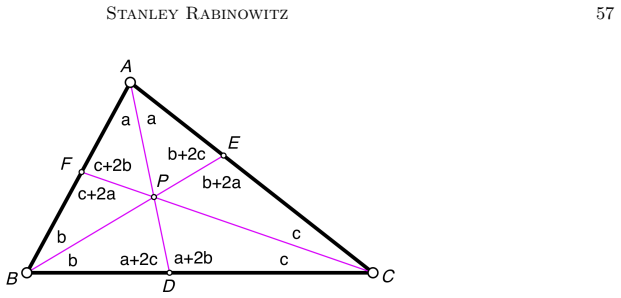
- [Section 6, Theorem 6.1] In the proof of Theorem 6.1 all segment lengths are expressed in terms of a, b, c, and the reduction to a function of c alone is described as 'Simplifying this expression (using a symbolic algebra system), we find that the result is 0.' No simplified expression is displayed. This is a local gap rather than a fatal one, but it would substantially improve the paper to show the reduced expression after substituting a = pi/2 - b - c and b = pi/6, or to include a CAS verification file for this step as well.
minor comments (4)
- [Section 8] There is a typo in the opening sentence of Section 8: 'cirumcircle' should be 'circumcircle.'
- [References] In reference [6], the French title 'Transformation des propiétés métriques des figures' appears to contain a typo; it should be 'propriétés.'
- [Section 6, Theorem 6.3] The exact radical values of r1,...,r6 in Theorem 6.3 are stated without derivation, and the verification is described only as substitution with 'computer simplification, as necessary.' Since this is a concrete example rather than a general theorem, this is acceptable, but a short explanation of how the values were obtained would be helpful.
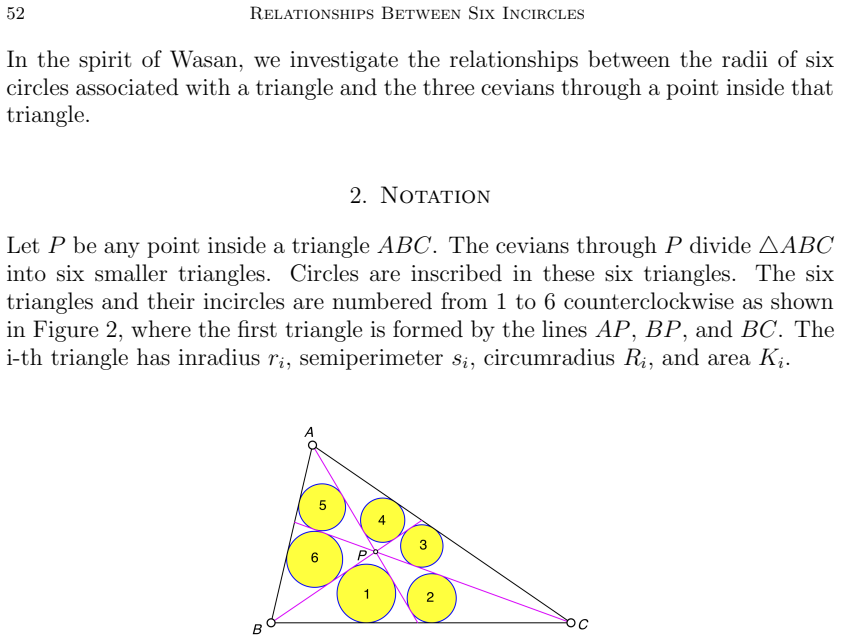
- [Section 2, Figure 2] The numbering convention for the six triangles and their incircles is clear in the text but would be easier to follow if Figure 2 explicitly labeled the incenter of one triangle, such as X in the proof of Lemma 5.1.
Circularity Check
No circularity found; the main derivations are self-contained geometric arguments.
full rationale
The paper's central new result, Theorem 5.1, is proved from Lemma 5.1, which expresses R/r_i as a sum of cotangents based on angle bisectors and right-triangle trigonometry; adding the six displayed equations exhibits the desired identity without assuming it. Earlier results for the orthocenter and centroid are likewise proved from elementary similarity, area, and semiperimeter arguments, with external attributions that are not load-bearing. The incenter and special-point theorems are discovered using numerical search (FindIntegerNullVector) and then asserted to be verified by symbolic algebra, with some details omitted; this is an evidentiary gap in the verification of those identities, not circular reasoning, because the radii are computed from independent side-length and area formulas rather than defined in terms of the target equations. No step in the paper reduces a claimed prediction to a fitted parameter, a self-citation chain, or a definitional equivalence involving the radii under study. Accordingly, the paper merits a circularity score of 0.
Assumptions & free parameters
assumptions (4)
- standard math Standard Euclidean plane geometry axioms, including parallel postulate and area formulas.
- standard math Extended Law of Sines, Law of Cosines, Ceva's theorem, and Menelaus's theorem are valid.
- domain assumption The point P is strictly inside the triangle, so all six cevians and triangles are nondegenerate.
- domain assumption The symbolic algebra system (e.g., Mathematica) performs exact simplification without error.
Cite this review
Pith. "Pith review of Relationships Between Six Incircles." pith.science (2026). https://pith.science/paper/SC6DVQ65
@misc{pith2026190802151,
  author       = {Pith},
  title        = {Pith review of: Relationships Between Six Incircles},
  year         = {2026},
  howpublished = {\url{https://pith.science/paper/SC6DVQ65}},
  note         = {Machine review of arXiv:1908.02151}
}
read the original abstract
If P is a point inside triangle ABC, then the cevians through P divide triangle ABC into six smaller triangles. We give theorems about the relationship between the radii of the circles inscribed in these triangles.
Figures
Figures from the paper (15 more)






Reference graph
Works this paper leans on
-
[1]
Antoine Dalle, 2000 Th´ eor` emes et Probl` emes de G´ eom´ etrie avec Solutions, 8th edition, Wesmael-Charlier, Bruxelles, 1961
work page 2000
-
[2]
Tohoku University Digital Collection
Teisi Fujita, Seiy¯ o Samp¯ o, 1781. Tohoku University Digital Collection. https://www.i-repository.net/il/meta_pub/G0000398tuldc_4100001974
-
[3]
Hidetosi Fukagawa and Dan Pedoe, Japanese Temple Geometry Problems , Winnipeg, Canada, Charles Babbage Research Center, 1989
work page 1989
-
[4]
Antonio Gutierrez, Geometry Problem 79, 2008, Geometry from the Land of the Incas, http: //www.gogeometry.com/problem/p079_triangle_similarity_altitude_circle.htm
work page 2008
-
[5]
Hexram, Solution to Geometry Problem 79 , 2012, Geometry from the Land of the Incas, https://gogeometry.blogspot.com/2008/05/elearn-geometry-problem-79.html
work page 2012
-
[6]
https://books.google.com/books?id=B-gDAAAAQAAJ
Victor Mayer Am´ ed´ ee Mannheim,Transformation des propi´ et´ es m´ etriques des figures ` a l’aide de la th´ eorie des polaires r´ eciproques, Mallet-Bachelier, Paris, 1857. https://books.google.com/books?id=B-gDAAAAQAAJ
Reviewed August 14, 2026 · model on record in the stance chip above.
Discussion (0). Continue with ORCID to comment.