A Simple Numerical Method for Non-Gaussian Signal Ensembles in Nonlinear Power Amplifiers
Pith reviewed 2026-06-25 19:27 UTC · model grok-4.3
The pith
Fourier series representation of memoryless nonlinearities converts output correlation integrals into summations for non-Gaussian inputs.
A machine-rendered reading of the paper's core claim, the machinery that carries it, and where it could break.
Core claim
By writing the memoryless nonlinearity as a Fourier series whose coefficients discretely parameterize the generalized characteristic function, the evaluation of output correlation functions reduces from computationally heavy double or triple improper integrals to ordinary summations that preserve full generality for non-Gaussian signal ensembles.
What carries the argument
Fourier-series expansion of the memoryless nonlinearity, which yields a discrete parameterization of the generalized characteristic function and converts correlation integrals into summations.
If this is right
- Output statistics become computable for any combination of sinusoidal carriers and non-Gaussian noise without numerical quadrature.
- The framework applies unchanged to one or more deterministic signals plus arbitrary noise processes.
- Distortion-induced beam-pattern deviations and array-gain loss in mmWave systems can be evaluated with far lower computational cost.
- The same formulation supplies closed-form expressions for higher-order moments when the input distributions are known.
Where Pith is reading between the lines
- The summation form may be inserted directly into link-level simulators that already track characteristic functions.
- Extension to mildly memory-dependent amplifiers would require only an additional convolution step outside the series.
- The discrete parameterization invites pre-computation of coefficient tables for common amplifier curves, enabling real-time impairment prediction.
Load-bearing premise
The nonlinearity is memoryless and can be represented to sufficient accuracy by a Fourier series.
What would settle it
Direct Monte-Carlo simulation of the nonlinear device with a non-Gaussian input ensemble produces output autocorrelation values that differ from those obtained by the proposed summations.
Figures

read the original abstract
Beam tracking in vehicular communication systems is inherently challenging due to high mobility and the use of narrow millimeter-wave (mmWave) beams. These challenges are further exacerbated by power amplifier (PA) nonlinearities, which introduce distortion-induced beam pattern deviations, array-gain loss, and non-Gaussian signal distortions. Motivated by the need for analytical tools capable of characterizing such effects, this paper extends Rice characteristic-function (ch. f.) method for the stochastic analysis of signals and noise in memoryless nonlinear systems. The proposed approach represents the nonlinearity using a Fourier series rather than a Fourier transform, transforming the evaluation of output correlation functions from computationally intensive double or triple improper integrals into tractable summations. The resulting framework preserves the generality of the original method, supporting one or more sinusoidal signals and noise processes that are not restricted to Gaussian distributions. A new fundamental ch. f.-based formulation is derived in terms of Fourier-series coefficients and a discrete parameterization of the generalized characteristic function. Numerical results are presented for a nonlinear GaN HEMT transconductance characteristic driven by a sinusoidal signal and Gaussian noise, demonstrating the applicability of the proposed method. The framework provides a computationally efficient tool for analyzing nonlinear RF front-end impairments and their impact on future wireless and vehicular communication systems.
Editorial analysis
A structured set of objections, weighed in public.
Referee Report
Summary. The manuscript extends Rice's characteristic-function method for the stochastic analysis of signals and noise through memoryless nonlinear systems. It replaces the Fourier-transform representation of the nonlinearity with a Fourier-series expansion, converting the evaluation of output correlation functions from double or triple improper integrals into finite summations. The resulting formulation retains generality for one or more sinusoids plus non-Gaussian noise via a discrete parameterization of the generalized characteristic function; a concrete numerical demonstration is given for a GaN HEMT transconductance driven by a sinusoid plus Gaussian noise.
Significance. If the claimed integral-to-summation reduction holds with controllable truncation error, the method supplies a computationally lighter tool for characterizing nonlinear RF impairments (beam-pattern deviation, array-gain loss) in mmWave vehicular systems while preserving the original method's applicability to non-Gaussian ensembles. The explicit construction in terms of Fourier-series coefficients and the discrete ch.f. parameterization is a clear strength.
minor comments (3)
- [Abstract / §1] The abstract and introduction should explicitly state the truncation criterion or error bound used for the Fourier-series representation of the nonlinearity (e.g., number of harmonics retained and residual error metric).
- [§2] Notation for the discrete parameterization of the generalized characteristic function should be introduced once, with a clear mapping to the continuous Rice ch.f., to avoid reader confusion between the original and new formulations.
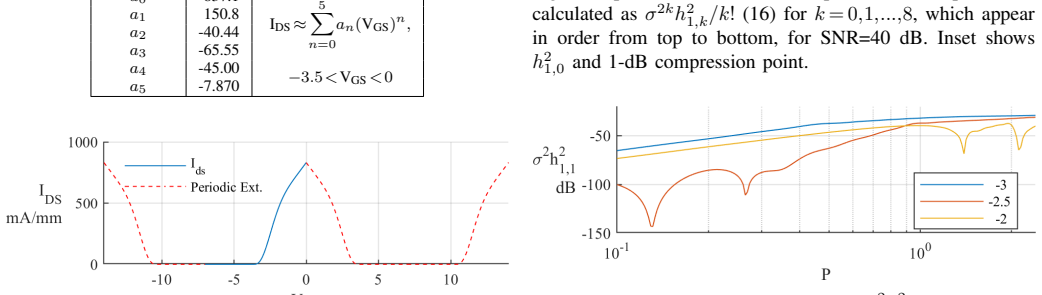
- [§4] Figure captions for the numerical GaN HEMT example should report the number of retained Fourier coefficients, the sampling grid for the ch.f., and a direct comparison of run-time against the classical integral formulation.
Simulated Author's Rebuttal
We thank the referee for the positive summary and significance assessment of our manuscript, as well as the recommendation for minor revision. No specific major comments were provided in the report.
Circularity Check
No significant circularity
full rationale
The derivation extends the external Rice ch.f. method by substituting a Fourier-series representation of the memoryless nonlinearity for the Fourier transform. This substitution converts the output-correlation integrals into summations via the stated discrete parameterization of the generalized characteristic function. No equation reduces to a fitted parameter renamed as a prediction, no self-citation supplies a load-bearing uniqueness theorem, and the ansatz is introduced explicitly in the present work rather than smuggled via prior author citation. The numerical GaN HEMT example is presented as verification, not as the source of the claimed reduction. The framework therefore remains self-contained against external benchmarks.
Axiom & Free-Parameter Ledger
axioms (1)
- domain assumption The nonlinearity is memoryless
Reference graph
Works this paper leans on
-
[1]
On the power amplifier nonlinearity in MIMO transmit beamforming systems,
J. Qi and S. Aissa, “On the power amplifier nonlinearity in MIMO transmit beamforming systems,”IEEE Trans. Commun., vol. 60, no. 3, pp. 876–887, Mar. 2012
2012
-
[2]
Fast channel estimation and beam tracking for millimeter wave vehic- ular communications,
S. Shaham, M. Ding, M. Kokshoorn, Z. Lin, S. Dang, and R. Abbas, “Fast channel estimation and beam tracking for millimeter wave vehic- ular communications,”IEEE Access, vol. 7, pp. 141 104–141 118, 2019
2019
-
[3]
Extended Kalman filter beam tracking for millimeter wave vehicular communications,
S. Shaham, M. Kokshoorn, M. Ding, Z. Lin, and M. Shirvanimoghad- dam, “Extended Kalman filter beam tracking for millimeter wave vehicular communications,”IEEE Commun. Lett., vol. 24, no. 4, pp. 839–842, Apr. 2020
2020
-
[4]
A compact, low-power, low-NF, millimeter-wave cascode LNA with magnetic coupling feedback in 22-nm FD-SOI CMOS for 5G applications,
E. Kobal, T. Siriburanon, R. B. Staszewski, and A. Zhu, “A compact, low-power, low-NF, millimeter-wave cascode LNA with magnetic coupling feedback in 22-nm FD-SOI CMOS for 5G applications,”IEEE Trans. Circuits Syst. II, Exp. Briefs, vol. 70, no. 4, pp. 1331–1335, 2023
2023
-
[5]
A wideband 2–5 GHz noise canceling subthreshold low noise amplifier,
A. R. A. Kumar, B. D. Sahoo, and A. Dutta, “A wideband 2–5 GHz noise canceling subthreshold low noise amplifier,”IEEE Trans. Circuits Syst. II, Exp. Briefs, vol. 65, no. 7, pp. 834–838, 2018
2018
-
[6]
A Gm-boosting technique for millimeter-wave low-noise amplifiers in 28-nm triple-well bulk CMOS using floating resistor in body biasing,
E. Kobal, T. Siriburanon, X. Chen, H. M. Nguyen, R. B. Staszewski, and A. Zhu, “A Gm-boosting technique for millimeter-wave low-noise amplifiers in 28-nm triple-well bulk CMOS using floating resistor in body biasing,”IEEE Trans. Circuits Syst. I, Regul. Pap., vol. 69, no. 12, pp. 5007–5017, Dec. 2022
2022
-
[7]
Channel estimation and performance analysis of one-bit massive MIMO systems,
Y . Li, C. Tao, G. Seco-Granados, A. Mezghani, A. L. Swindlehurst, and L. Liu, “Channel estimation and performance analysis of one-bit massive MIMO systems,”IEEE Trans. Signal Process., vol. 65, no. 15, pp. 4075–4089, Aug. 2017
2017
-
[8]
Hardware distortion corre- lation has negligible impact on UL massive MIMO spectral efficiency,
E. Bj ¨ornson, L. Sanguinetti, and J. Hoydis, “Hardware distortion corre- lation has negligible impact on UL massive MIMO spectral efficiency,” IEEE Trans. Commun., vol. 67, no. 2, pp. 1085–1098, Feb. 2018
2018
-
[9]
On optimal MMSE channel estimation for one-bit quantized MIMO systems,
M. Ding, I. Atzeni, A. T ¨olli, and A. L. Swindlehurst, “On optimal MMSE channel estimation for one-bit quantized MIMO systems,”IEEE Trans. Signal Process., vol. 73, pp. 617–632, Mar. 2025
2025
-
[10]
Distortion-aware linear precoding for massive MIMO downlink systems with nonlinear power amplifiers,
S. R. Aghdam, S. Jacobsson, U. Gustavsson, G. Durisi, C. Studer, and T. Eriksson, “Distortion-aware linear precoding for massive MIMO downlink systems with nonlinear power amplifiers,”IEEE Trans. Signal Process., vol. 69, pp. 3699–3713, 2021
2021
-
[11]
Mathematical analysis of random noise,
S. O. Rice, “Mathematical analysis of random noise,”Bell Syst. Tech. J., vol. 23, no. 3, pp. 282–332, Jul. 1944
1944
-
[12]
Mathematical analysis of random noise,
——, “Mathematical analysis of random noise,”Bell Syst. Tech. J., vol. 24, no. 1, pp. 46–156, Jan. 1945
1945
-
[13]
N. M. Blachman,Noise and its Effect on Communication, 2nd ed. Malabar, FL: Robert E. Krieger Publ. Co., 1982
1982
-
[14]
K. W. Cattermole,Mathematical Topics in Telecommunications, V ol. 2: Problems of Randomness in Communication Engineering. John Wiley, 1984
1984
-
[15]
Interference suppression by biased nonlinearities,
P. C. Jain, N. M. Blachman, and P. M. Chapell, “Interference suppression by biased nonlinearities,”IEEE Trans. Inf. Theory, vol. 41, no. 2, pp. 496–507, Mar. 1995
1995
-
[16]
Intermodulation performance of biased- nonlinearities,
M. T. Abuelma’atti, “Intermodulation performance of biased- nonlinearities,”Appl. Math. Comput., vol. 107, no. 2–3, pp. 211–224, Jan. 2000
2000
-
[17]
Performance analysis and comparison of multi-level hard limiters,
M. T. Abuelma’atti and A. M. T. Abuelma’atti, “Performance analysis and comparison of multi-level hard limiters,”Int. J. Electron., vol. 97, no. 9, p. 1021, 2010
2010
-
[18]
Analytical and experimental evaluation of SSB phase noise reduction in self-injection locked oscillators using optical delay loops,
L. Zhang, A. Poddar, U. Rohde, and A. Daryoush, “Analytical and experimental evaluation of SSB phase noise reduction in self-injection locked oscillators using optical delay loops,”IEEE Photon. J., vol. 5, no. 6, p. 6602217, Dec. 2013
2013
-
[19]
The Bussgang decomposition of nonlinear systems: Basic theory and MIMO extensions [Lecture Notes],
O. T. Demir and E. Bj ¨ornson, “The Bussgang decomposition of nonlinear systems: Basic theory and MIMO extensions [Lecture Notes],”IEEE Signal Process. Mag., vol. 38, no. 1, pp. 131–136, Jan. 2020
2020
-
[20]
A class of nonlinear signal-processing schemes for bandwidth-efficient OFDM transmission with low envelope fluctuation,
R. Dinis and A. Gusmao, “A class of nonlinear signal-processing schemes for bandwidth-efficient OFDM transmission with low envelope fluctuation,”IEEE Trans. Commun., vol. 52, no. 11, pp. 2009–2018, Nov. 2004
2009
-
[21]
Optimum performance analysis and receiver design for OFDM-based frequency-splitting SWIPT with strong nonlinear effects,
A. Rajaram, J. Guerreiro, R. Dinis, D. N. K. Jayakody, and M. Beko, “Optimum performance analysis and receiver design for OFDM-based frequency-splitting SWIPT with strong nonlinear effects,”IEEE Internet Things J., vol. 10, no. 23, pp. 20 928–20 940, Dec. 2023
2023
-
[22]
Crosscorrelation functions of amplitude-distorted gaussian signals,
J. J. Bussgang, “Crosscorrelation functions of amplitude-distorted gaussian signals,” Res. Lab. Electron., MIT, Cambridge, MA, Tech. Rep. 216, Mar. 1952
1952
-
[23]
A useful theorem for nonlinear devices having gaussian inputs,
R. Price, “A useful theorem for nonlinear devices having gaussian inputs,”IRE Trans. Inf. Theory, vol. 4, no. 2, pp. 69–72, Jun. 1958
1958
-
[24]
R. V . Churchill and J. W. Brown,F ourier Series and Boundary V alue Problems, 3rd ed. McGraw-Hill, 1978
1978
-
[25]
Cascaded dual drive MZM and dual parallel MZM architecture for optical linearization of MZM nonlinearity,
S. Duraikannan, S. B. B. A. Anas, B. M. Ali, Z. B. Zan, S. Duraikannan, and V . Thiruchelvam, “Cascaded dual drive MZM and dual parallel MZM architecture for optical linearization of MZM nonlinearity,” in Proc. IEEE Int. Conf. Photonics (ICP), Langkawi, Malaysia, 2018, pp. 1–4
2018
-
[26]
J. P. Z. Peebles,Probability, Random V ariables, and Random Signal Principles, 2nd ed. McGraw-Hill, 1987
1987
-
[27]
Watson,A Treatise on the Theory of Bessel Functions
G. Watson,A Treatise on the Theory of Bessel Functions. Cambridge, U.K.: Cambridge Univ. Press, 1922
1922
-
[28]
Impact of source resistance on linearity of AlGaN/GaN HEMTs at Ka-band,
P.-H. Lee, Y .-C. Lin, C.-C. Chiang, K.-H. Lai, H.-T. Hsu, P. Su, and E. Y . Chang, “Impact of source resistance on linearity of AlGaN/GaN HEMTs at Ka-band,”ECS J. Solid State Sci. Technol., vol. 12, 2023
2023
discussion (0)
Sign in with ORCID, Apple, or X to comment. Anyone can read and Pith papers without signing in.