REVIEW 2 minor 1 cited by
Trees and treelike structures in dense digraphs
T0 review · 0 major / 2 minor · reviewed 2026-05-24 · grok-4.3
Pith's one-line read Every oriented tree on n vertices with bounded maximum degree is a spanning subdigraph of every n-vertex digraph whose minimum semidegree is at least n/2 + o(n).
desk verdict The paper gives the first explicit directed analogue of the Komlós–Sárközy–Szemerédi theorem for bounded-degree oriented trees and a few other tree-like spanning structures under the natural semidegree condition. read the letter →
The pith
A machine-rendered reading of the paper's core claim, the machinery that carries it, and where it could break.
The reading
What carries the argument
The minimum semidegree condition, which forces every vertex to have sufficiently many in-neighbors and out-neighbors to support inductive embedding of the oriented tree-like structures.
What would settle it
A single n-vertex digraph with minimum semidegree at least n/2 + o(n) that contains no spanning copy of some fixed bounded-degree oriented tree on n vertices.
Extended reading notes
Core claim
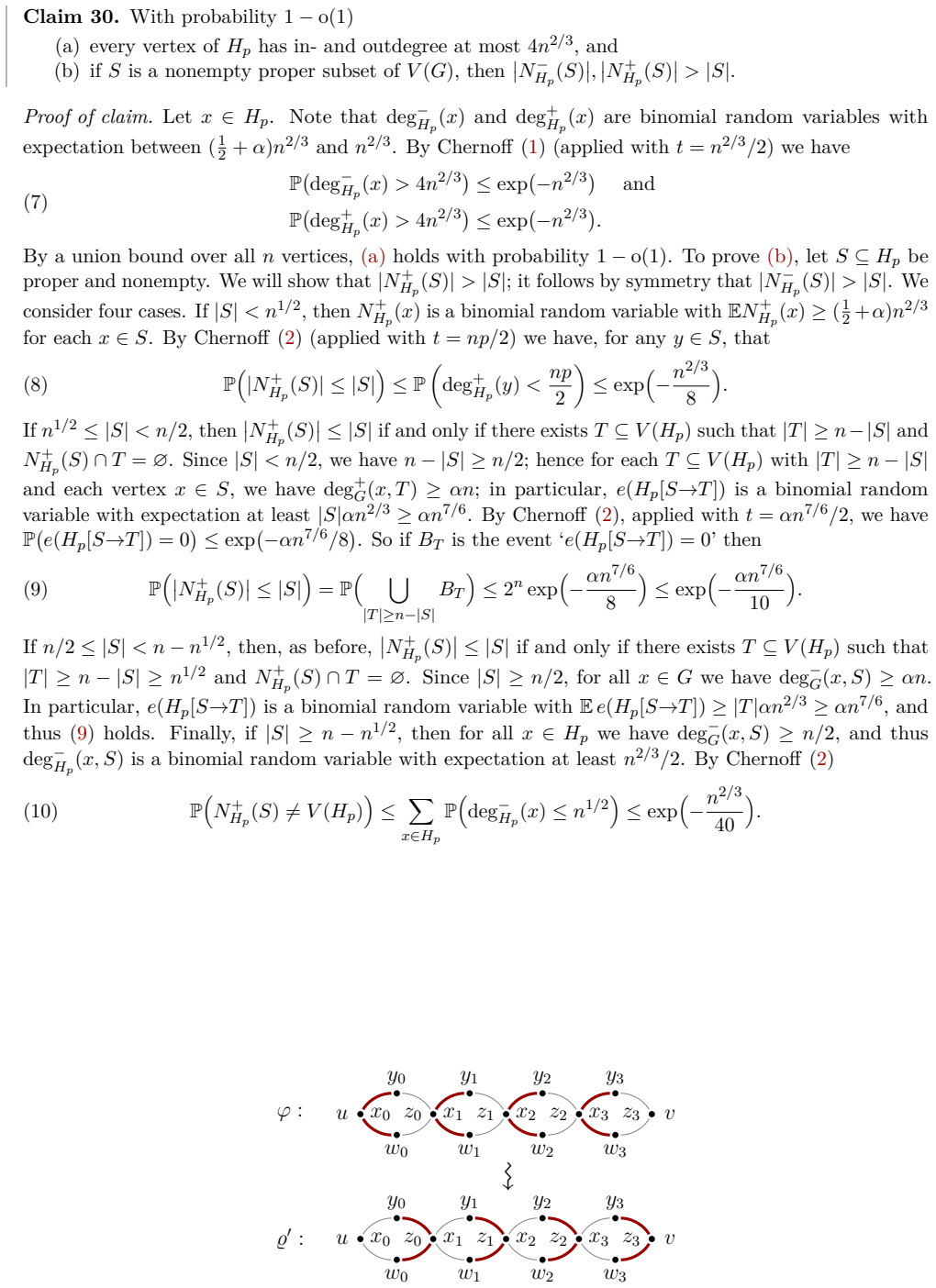
We prove that every oriented tree on n vertices with bounded maximum degree appears as a spanning subdigraph of every directed graph on n vertices with minimum semidegree at least n/2+o(n). This can be seen as a directed graph analogue of a well-known theorem of Komlós, Sárközy and Szemerédi. Our result for trees follows from a more general result, allowing the embedding of arbitrary orientations of a much wider class of spanning “tree-like” structures, such as collections of at most O(n^{0.99}) pairwise vertex-disjoint cycles and subdivisions of graphs H with |H| < exp (√O(log n)) in which each edge is subdivided at least once.
Load-bearing premise
The tree-like structures being embedded must obey the stated quantitative restrictions on degree, number of cycles, or size of the base graph H.
Editorial extensions
If this is right
- Every bounded-degree oriented tree on n vertices embeds as a spanning subdigraph under the semidegree hypothesis.
- Arbitrary orientations of any collection of at most O(n^{0.99}) vertex-disjoint cycles embed as spanning subdigraphs.
- Arbitrary orientations of subdivisions of any H with |H| < exp(sqrt(O(log n))) and each edge subdivided at least once embed as spanning subdigraphs.
Reading between the lines
- The same semidegree threshold may suffice for embedding other families of oriented graphs whose underlying undirected graphs have bounded treewidth.
- The result supplies a uniform way to obtain directed analogues of many classical spanning-tree theorems once the appropriate degree or size bounds are verified.
- In the special case of tournaments the same semidegree condition immediately yields the corresponding oriented-tree embeddings.
Signed reviews
Editorial analysis
A structured set of objections, weighed in public.
Referee Report
Summary. The manuscript proves that every oriented tree on n vertices with bounded maximum degree appears as a spanning subdigraph of every directed graph on n vertices with minimum semidegree at least n/2 + o(n). This is presented as a directed analogue of the Komlós–Sárközy–Szemerédi theorem. The tree result is derived from a more general theorem allowing embeddings of arbitrary orientations of collections of at most O(n^{0.99}) pairwise vertex-disjoint cycles and subdivisions of graphs H with |H| < exp(√O(log n)) in which each edge is subdivided at least once.
Significance. If the result holds, it supplies a combinatorial proof of an asymptotic directed embedding theorem for bounded-degree oriented trees and certain tree-like spanning structures in dense digraphs. The explicit quantitative restrictions on the number of cycles and the size of H are stated clearly, and the argument is framed as building on a cited undirected theorem without reduction to fitted parameters. This strengthens the toolkit for extremal problems in oriented graphs.
minor comments (2)
- [Abstract and §1] The o(n) error term in the semidegree hypothesis is stated in the abstract and introduction but would benefit from an explicit remark on whether the implicit constant depends on the maximum degree bound of the tree (or on the parameters of the general structures).
- [§1] Notation for semidegree (minimum of in- and out-degree) is used without a dedicated definition paragraph; a short preliminary section collecting all degree and embedding notation would improve readability.
Simulated Author's Rebuttal
We thank the referee for the positive summary, the recognition of the result as a directed analogue of the Komlós–Sárközy–Szemerédi theorem, and the recommendation of minor revision. The report highlights the combinatorial proof and the explicit quantitative bounds on cycles and subdivided graphs, which aligns with the framing in our manuscript.
Circularity Check
No significant circularity identified
full rationale
The paper states a combinatorial embedding theorem for bounded-degree oriented trees (and extensions to limited cycles and small subdivided graphs) as spanning subdigraphs of dense digraphs, explicitly framed as an analogue of the external Komlós–Sárközy–Szemerédi theorem. The abstract and claim description contain no fitted parameters renamed as predictions, no self-definitional equations, and no load-bearing self-citations; the cited undirected result is by independent authors. The quantitative restrictions are stated explicitly rather than smuggled in, and the derivation is presented as an independent proof rather than a reduction to its own inputs.
Assumptions & free parameters
assumptions (1)
- domain assumption The undirected Komlós–Sárközy–Szemerédi theorem on spanning trees in dense graphs holds and can be adapted to the directed setting.
Cite this review
Pith. "Pith review of Trees and treelike structures in dense digraphs." pith.science (2026). https://pith.science/paper/SCV4EEE3
@misc{pith2026201209201,
  author       = {Pith},
  title        = {Pith review of: Trees and treelike structures in dense digraphs},
  year         = {2026},
  howpublished = {\url{https://pith.science/paper/SCV4EEE3}},
  note         = {Machine review of arXiv:2012.09201}
}
abstract
We prove that every oriented tree on $n$ vertices with bounded maximum degree appears as a spanning subdigraph of every directed graph on $n$ vertices with minimum semidegree at least $n/2+o(n)$. This can be seen as a directed graph analogue of a well-known theorem of Koml\'os, S\'ark\"ozy and Szemer\'edi. Our result for trees follows from a more general result, allowing the embedding of arbitrary orientations of a much wider class of spanning ``tree-like'' structures, such as collections of at most $O(n^{0.99})$ pairwise vertex-disjoint cycles and subdivisions of graphs $H$ with $|H| < \exp (\sqrt{O(\log n)})$ in which each edge is subdivided at least once.
Figures


Figures from the paper (1 more)

Forward citations
Cited by 1 Pith paper
-
Embedding loose trees in $k$-uniform hypergraphs
For k at least 4, sufficiently large k-uniform hypergraphs with minimum (k-2)-degree at least (1/2+gamma) binom(n,k-2) contain every spanning loose tree of maximum degree at most Delta.
Reference graph
Works this paper leans on
-
[1]
N. Alon, R. A. Duke, H. Lefmann, V. Rödl, and R. Yuster. The algorithmic aspects of the regularity lemma.Journal of Algorithms, 16(1):80–109, 1994
work page 1994
- [2]
-
[3]
J. A. Bondy and U.S.R. Murty.Graph theory, volume 244 ofGraduate Texts in Mathematics . Springer-Verlag, New York, 2008
work page 2008
-
[4]
J. Böttcher, J. Han, Y. Kohayakawa, R. Montgomery, O. Parczyk, and Y. Person. Universality for bounded degree spanning trees in randomly perturbed graphs.Random Structures & Algorithms , 55(4):854–864, 2019
work page 2019
-
[5]
J. Böttcher, M. Schacht, and A. Taraz. Proof of the bandwidth conjecture of Bollobás and Komlós.Mathematische Annalen, 343(1):175–205, 2009
work page 2009
-
[6]
D. Clemens, A. Ferber, R. Glebov, D. Hefetz, and A. Liebenau. Building spanning trees quickly in maker-breaker games. SIAM Journal on Discrete Mathematics , 29(3):1683–1705, 2015
work page 2015
-
[7]
L. DeBiasio, D. Kühn, T. Molla, T. Osthus, and A. Taylor. Arbitrary orientations of hamilton cycles in digraphs.SIAM Journal on Discrete Mathematics , 29(3):1553–1584, 2015
work page 2015
-
[8]
L. DeBiasio and T. Molla. Semi-degree threshold for anti-directed Hamiltonian cycles.Electronic Journal of Combina- torics, 22(4), 2015
work page 2015
Show all 21 references
-
[9]
R. Diestel. Graph theory, volume 173 ofGraduate Texts in Mathematics . Springer-Verlag, New York, 1997. Translated from the 1996 German original
1997
-
[10]
Ghouila-Houri
M.A. Ghouila-Houri. Une condition suffisante d’existence d’un circuit Hamiltonien.Comptes Rendus de l’Académie des Sciences, 25:495–497, 1960
1960
-
[11]
Janson, T
S. Janson, T. Łuczak, and A. Ruciński.Random graphs. Wiley-Interscience, New York, 2000
2000
-
[12]
Komlós, G.N
J. Komlós, G.N. Sárközy, and E. Szemerédi. Proof of a packing conjecture of Bollobás.Combinatorics, Probability, and Computing, 4(3):241–255, 1995
1995
-
[13]
Komlós, G.N
J. Komlós, G.N. Sárközy, and E. Szemerédi. Spanning trees in dense graphs.Combinatorics, Probability, and Computing , 10:397–416, 2001
2001
-
[14]
Krivelevich, M
M. Krivelevich, M. Kwan, and B. Sudakov. Bounded-degree spanning trees in randomly perturbed graphs.SIAM J. Discrete Math., 31(1):155––171, 2017
2017
-
[15]
D. Kühn, R. Mycroft, and D. Osthus. An approximate version of Sumner’s universal tournament conjecture.Journal of Combinatorial Theory, Series B , 101(6):415–447, 2011
2011
-
[16]
McDiarmid
C. McDiarmid. Concentration. InProbabilistic methods for algorithmic discrete mathematics , volume 16 ofAlgorithms Combin., pages 195–248. Springer, Berlin, 1998
1998
-
[17]
J.W. Moon. Counting labelled trees . Number 1 in Canadian Mathematical Monographs. Canadian Mathematical Congress, 1970
1970
-
[18]
Mycroft and T
R. Mycroft and T. Naia. Unavoidable trees in tournaments.Random Structures & Algorithms , 53(2):352–385, 2018
2018
-
[19]
Sudakov and J
B. Sudakov and J. Vondrák. A randomized embedding algorithm for trees.Combinatorica, 30(4):445–470, 2010
2010
-
[20]
Szemerédi
E. Szemerédi. On sets of integers containing nok elements in arithmetic progression.Acta Arith., 27:199–245, 1975. Collection of articles in memory of Juri˘ ı VladimiroviŁ Linnik
1975
-
[21]
Szemerédi
E. Szemerédi. Regular partitions of graphs. InProblèmes combinatoires et théorie des graphes (Colloq. Internat. CNRS, Univ. Orsay, Orsay, 1976) , pages 399–401. CNRS, Paris, 1978. Richard Mycroft, University of Birmingham, Birmingham, B15 2TT, United Kingdom Email address: r.m...
1976
Reviewed May 24, 2026 · model on record in the stance chip above.
Discussion (0). Continue with ORCID to comment.