A Manifold-Based Framework for Coupling-Aware Surrogate Optimization of Antenna Arrays Using Characteristic Modes
Pith reviewed 2026-05-25 03:00 UTC · model grok-4.3
The pith
A manifold-based surrogate using characteristic modes and global coupling models enables fast optimization of antenna arrays that accounts for mutual coupling.
A machine-rendered reading of the paper's core claim, the machinery that carries it, and where it could break.
Core claim
The framework combines a common characteristic-mode basis, a global modal coupling model, and element-wise generalized scattering matrices (GSMs) whose design variables are optimized on the manifold of unitary symmetric matrices. For an 8x8 left-handed circularly polarized patch array, different degree-of-freedom strategies show that non-identical element classes can meet strict sidelobe and cross-polarization requirements where identical elements cannot. The optimization runs in seconds, and full-wave checks confirm the predicted sidelobe levels with good accuracy and cross-polarization with useful accuracy.
What carries the argument
Optimization of element generalized scattering matrices on the manifold of unitary symmetric matrices, combined with a global modal coupling model based on a common characteristic-mode basis.
If this is right
- Optimization of an 8x8 array converges in seconds on one CPU core.
- Non-identical element classes satisfy pattern constraints that equal-element designs cannot.
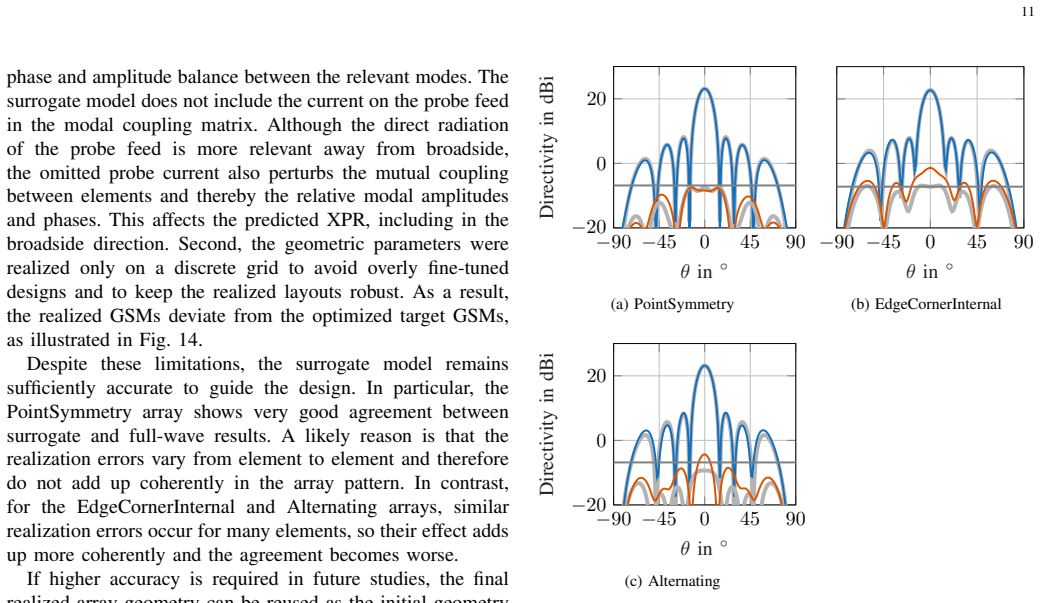
- Full-wave verification matches the surrogate for sidelobe level and provides useful accuracy for cross-polarization ratio.
- The approach scales to practical array synthesis while incorporating coupling.
Where Pith is reading between the lines
- The method may allow rapid redesign for varying scan angles or frequencies by reusing the modal basis.
- Extending the manifold to include loss could broaden applicability to real antennas with dissipation.
- Application to arrays with irregular layouts might test the generality of the global coupling model.
- Comparison with gradient-based or evolutionary surrogates could show whether the manifold constraint reduces the evaluations needed for convergence.
Load-bearing premise
The characteristic-mode basis and modal coupling model are assumed to represent mutual coupling effects accurately enough that the surrogate optimization yields arrays whose full-wave performance matches the predictions, based on demonstration with a single array.
What would settle it
Demonstrating a second array where the surrogate-optimized design shows substantially worse sidelobe levels or cross-polarization in full-wave simulation than predicted would indicate the coupling model is insufficient.
Figures





read the original abstract
A surrogate-based synthesis framework for antenna arrays is presented that incorporates mutual coupling while keeping optimization computationally efficient. The method combines a common characteristic-mode basis, a global modal coupling model, and element-wise generalized scattering matrices (GSMs). Array design variables are formulated and optimized on physically meaningful manifolds, in particular the manifold of unitary symmetric matrices for reciprocal and lossless element GSMs. A staged penalty strategy is used to progressively enforce sidelobe and cross-polarization constraints during multi-beam optimization. The framework is demonstrated for an 8x8 left-handed circularly polarized patch phased array with scan behavior in one principal plane. Different degree-of-freedom assignment strategies are compared, showing that constrained non-identical element classes can satisfy stringent pattern requirements where equal-element designs fail. For the demonstrated case, the optimization converges within seconds on a single CPU core, and full-wave verification of the realized arrays confirms the predicted trends, with good agreement for the SLL and useful accuracy for the XPR. The results indicate that the proposed formulation is a practical and scalable route for coupling-aware array synthesis and realization.
Editorial analysis
A structured set of objections, weighed in public.
Referee Report
Summary. The paper presents a surrogate-based synthesis framework for antenna arrays incorporating mutual coupling via a common characteristic-mode basis, global modal coupling model, and element-wise generalized scattering matrices (GSMs). Array variables are optimized on manifolds (e.g., unitary symmetric matrices for reciprocal lossless GSMs) using a staged penalty strategy for sidelobe and cross-polarization constraints. The method is demonstrated on an 8x8 left-handed circularly polarized patch phased array with one-plane scan, where optimization is fast and full-wave verification shows good SLL agreement and useful XPR accuracy; different DOF assignment strategies are compared, with constrained non-identical elements succeeding where equal-element designs fail. The results suggest the approach is a practical route for coupling-aware array synthesis.
Significance. If the reduced-order model proves accurate beyond the demonstrated case, the framework would provide an efficient, manifold-constrained alternative to full-wave array optimization, enabling designs with non-identical elements under coupling effects. The combination of established CM and GSM concepts with manifold optimization is a coherent extension, though the single-configuration verification limits the strength of the scalability claim.
major comments (1)
- [Demonstration section (abstract and results)] Demonstration section (abstract and results): Full-wave verification is reported only for the single 8x8 LHCP patch array with scan in one principal plane, showing 'good agreement' for SLL and 'useful accuracy' for XPR. This narrow regime is load-bearing for the central claim that the CM-basis + global modal coupling + element-wise GSM surrogate produces realizable arrays matching full-wave behavior; without additional geometries, frequencies, or scan ranges, it remains unclear whether model discrepancies grow outside this case or whether the optimization exploits inaccuracies.
minor comments (1)
- [Abstract] The abstract states that 'different degree-of-freedom assignment strategies are compared' but provides no explicit enumeration or definition of the strategies (e.g., identical vs. non-identical element classes) before the results are summarized.
Simulated Author's Rebuttal
We thank the referee for the constructive feedback on the demonstration and verification aspects of the manuscript. We address the major comment below.
read point-by-point responses
-
Referee: Demonstration section (abstract and results): Full-wave verification is reported only for the single 8x8 LHCP patch array with scan in one principal plane, showing 'good agreement' for SLL and 'useful accuracy' for XPR. This narrow regime is load-bearing for the central claim that the CM-basis + global modal coupling + element-wise GSM surrogate produces realizable arrays matching full-wave behavior; without additional geometries, frequencies, or scan ranges, it remains unclear whether model discrepancies grow outside this case or whether the optimization exploits inaccuracies.
Authors: We acknowledge that the full-wave verification is confined to a single 8x8 LHCP patch array with one-plane scanning, which limits the strength of broader claims about scalability and robustness across regimes. This configuration was chosen to enable detailed comparison of DOF assignment strategies under realistic coupling, with the surrogate derived from general CM and GSM principles. We will revise the manuscript to explicitly state the verification scope, discuss potential model discrepancies outside this case, and qualify the scalability claim accordingly. No additional full-wave cases will be added at this stage, as the current results already demonstrate the framework's practical utility for the reported setting. revision: yes
Circularity Check
No significant circularity; framework builds on independent CM/GSM models with external full-wave verification
full rationale
The manuscript derives its surrogate model from standard characteristic-mode theory and generalized scattering matrices, then performs manifold-constrained optimization and reports independent full-wave validation on the realized 8x8 array. No step reduces a claimed prediction to a quantity defined by the same fitted parameters or to a self-citation whose content is unverified. The central result (realizable arrays matching full-wave trends) rests on the physical modeling assumptions rather than tautological re-use of its own outputs.
Axiom & Free-Parameter Ledger
axioms (2)
- domain assumption Characteristic modes form a suitable common basis for modeling array elements and their mutual coupling.
- domain assumption Optimization on the manifold of unitary symmetric matrices preserves physical properties of reciprocal lossless GSMs.
Reference graph
Works this paper leans on
-
[1]
T. S. Bird,Mutual Coupling Between Antennas. Wiley, 2021
work page 2021
-
[2]
T. H. Nguyen, H. Morishita, Y . Koyanagi, K. Izui, and S. Nishiwaki, “A Multi-Level Optimization Method Using PSO for the Optimal Design of an L-Shaped Folded Monopole Antenna Array,”IEEE Transactions on Antennas and Propagation, vol. 62, no. 1, pp. 206–215, Jan. 2014. [Online]. Available: https://ieeexplore.ieee.org/document/6655892
-
[3]
Performance-Based Nested Surrogate Modeling of Antenna Input Characteristics,
S. Koziel and A. Pietrenko-Dabrowska, “Performance-Based Nested Surrogate Modeling of Antenna Input Characteristics,” IEEE Transactions on Antennas and Propagation, vol. 67, no. 5, pp. 2904–2912, May 2019. [Online]. Available: https://ieeexplore.ieee.org/abstract/document/8631127
-
[4]
Multi-Objective Design of Antennas Using Variable-Fidelity Simulations and Surrogate Models,
S. Koziel and S. Ogurtsov, “Multi-Objective Design of Antennas Using Variable-Fidelity Simulations and Surrogate Models,”IEEE Transactions on Antennas and Propagation, vol. 61, no. 12, pp. 5931–5939, Dec
-
[5]
Available: https://ieeexplore.ieee.org/document/6612670
[Online]. Available: https://ieeexplore.ieee.org/document/6612670
-
[6]
Evolutionary Programming in Electromagnetic Optimization: A Review,
A. Hoorfar, “Evolutionary Programming in Electromagnetic Optimization: A Review,”IEEE Transactions on Antennas and Propagation, vol. 55, no. 3, pp. 523–537, Mar. 2007. [Online]. Available: https://ieeexplore.ieee.org/document/4120264
-
[7]
Solving Some Array Synthesis Problems by Means of an Effective Hybrid Approach,
M. D’Urso and T. Isernia, “Solving Some Array Synthesis Problems by Means of an Effective Hybrid Approach,”IEEE Transactions on Antennas and Propagation, vol. 55, no. 3, pp. 750–759, Mar. 2007. [Online]. Available: https://ieeexplore.ieee.org/document/4120250/
-
[8]
S. Koziel and S. Ogurtsov,Antenna Design by Simulation- Driven Optimization, ser. SpringerBriefs in Optimization. Cham: Springer International Publishing, 2014. [Online]. Available: https://link.springer.com/10.1007/978-3-319-04367-8
-
[9]
Grating-Lobe Mitigation Using Parasitic Scatterers and Principal Com- ponent Analysis,
A. Salmi, J. Bergman, A. Lehtovuori, J. Ala-Laurinaho, and V . Viikari, “Grating-Lobe Mitigation Using Parasitic Scatterers and Principal Com- ponent Analysis,”IEEE Trans. Antennas Propag., vol. 72, no. 2, pp. 1995–2000, Feb. 2024
work page 1995
-
[10]
Synthesis of Reactively Loaded Sparse Antenna Arrays Using Optimization on Riemannian Manifold,
A. Salmi, A. Lehtovuori, and V . Viikari, “Synthesis of Reactively Loaded Sparse Antenna Arrays Using Optimization on Riemannian Manifold,” IEEE Open J. Antennas Propag., pp. 1–1, 2024
work page 2024
-
[11]
Design of microstrip antenna subarrays: A simulation-driven surrogate-based approach,
A. Bekasiewicz, W. Zieniutycz, S. Koziel, and S. Ogurtsov, “Design of microstrip antenna subarrays: A simulation-driven surrogate-based approach,” in2014 20th International Conference on Microwaves, Radar and Wireless Communications (MIKON), Jun. 2014, pp. 1–4. [Online]. Available: https://ieeexplore.ieee.org/document/6899849
-
[12]
Microstrip antenna subarray design through simulation-driven surrogate optimization,
S. Koziel, S. Ogurtsov, and W. Zieniutycz, “Microstrip antenna subarray design through simulation-driven surrogate optimization,” in2014 IEEE Antennas and Propagation Society International Symposium (APSURSI), Jul. 2014, pp. 1724–1725. [Online]. Available: https://ieeexplore.ieee.org/document/6905188
-
[13]
B. Qian, X. Huang, X. Chen, M. Abdullah, L. Zhao, and A. A. Kishk, “Surrogate-Assisted Defected Ground Structure Design for Reducing Mutual Coupling in 2 × 2 Microstrip Antenna Array,”IEEE Antennas and Wireless Propagation Letters, vol. 21, no. 2, pp. 351–355, Feb
-
[14]
Available: https://ieeexplore.ieee.org/document/9629326
[Online]. Available: https://ieeexplore.ieee.org/document/9629326
-
[15]
Simulation driven design of a microstrip antenna array by means of surrogate-based optimization,
S. Koziel and S. Ogurtsov, “Simulation driven design of a microstrip antenna array by means of surrogate-based optimization,” in2013 7th European Conference on Antennas and Propagation (EuCAP), Apr. 2013, pp. 2182–2185. [Online]. Available: https://ieeexplore.ieee.org/document/6546679
-
[16]
Expedited microstrip linear antenna array design using radiation response surrogates,
——, “Expedited microstrip linear antenna array design using radiation response surrogates,” in2015 IEEE International Symposium on Antennas and Propagation & USNC/URSI National Radio Science Meeting, Jul. 2015, pp. 2457–2458. [Online]. Available: https://ieeexplore.ieee.org/document/7305617
-
[17]
S. Koziel, S. Ogurtsov, and J. P. Jacobs, “Rapid simulation-based design of covered planar microstrip patch antenna arrays by means of radiation response surrogates,” in2015 Loughborough Antennas & Propagation Conference (LAPC), Nov. 2015, pp. 1–4. [Online]. Available: https://ieeexplore.ieee.org/document/7366081
-
[18]
Rapid Design Closure of Linear Microstrip Antenna Array Apertures Using Response Features,
S. Koziel and S. Ogurtsov, “Rapid Design Closure of Linear Microstrip Antenna Array Apertures Using Response Features,”IEEE Antennas and Wireless Propagation Letters, vol. 17, no. 4, pp. 645–648, Apr
-
[19]
Available: https://ieeexplore.ieee.org/document/8301557
[Online]. Available: https://ieeexplore.ieee.org/document/8301557
-
[20]
Design optimization of microstrip antenna arrays using surrogate- based methodology,
——, “Design optimization of microstrip antenna arrays using surrogate- based methodology,” in2013 IEEE Antennas and Propagation Society International Symposium (APSURSI), Jul. 2013, pp. 1228–1229. [Online]. Available: https://ieeexplore.ieee.org/document/6711274
-
[21]
Phase-spacing optimization of linear microstrip antenna arrays by EM-based superposition models,
——, “Phase-spacing optimization of linear microstrip antenna arrays by EM-based superposition models,” in2014 Loughborough Antennas and Propagation Conference (LAPC), Nov. 2014, pp. 26–30. [Online]. Available: https://ieeexplore.ieee.org/document/6996312
-
[22]
Fast Full-Wave Synthesis of Printed Antenna Arrays Including Mutual Coupling,
H. V . Bui, S. N. Jha, and C. Craeye, “Fast Full-Wave Synthesis of Printed Antenna Arrays Including Mutual Coupling,”IEEE Transactions on Antennas and Propagation, vol. 64, no. 12, pp. 5163–5171, Dec
-
[23]
Available: https://ieeexplore.ieee.org/document/7590001
[Online]. Available: https://ieeexplore.ieee.org/document/7590001
-
[24]
H. B. Van, S. N. Jha, and C. Craeye, “Fast optimization of large antenna arrays on dielectric layers using surrogate Macro- Basis-Function representations,” in2016 IEEE Symposium Series on Computational Intelligence (SSCI), Dec. 2016, pp. 1–4. [Online]. Available: https://ieeexplore.ieee.org/document/7849901
-
[25]
Array Synthesis in Terms of Characteristic Modes and Generalized Scattering Matrices,
L. M ¨orlein and D. Manteuffel, “Array Synthesis in Terms of Characteristic Modes and Generalized Scattering Matrices,”IEEE Trans. Antennas Propag., vol. 73, no. 2, pp. 986–997, Feb. 2025. [Online]. Available: https://ieeexplore.ieee.org/document/10806475
-
[26]
Deembedding and Optimiza- tion of a Decoupling Structure Using a Modal Coupling Matrix,
L. M ¨orlein, P. Gentner, and D. Manteuffel, “Deembedding and Optimiza- tion of a Decoupling Structure Using a Modal Coupling Matrix,” in2025 19th European Conference on Antennas and Propagation (EuCAP), Stockholm, 2025
work page 2025
-
[27]
On the Relation of Characteristic Modes of Different Conducting Structures,
L. M ¨orlein and D. Manteuffel, “On the Relation of Characteristic Modes of Different Conducting Structures,” Dec. 2025. [Online]. Available: http://arxiv.org/abs/2509.09282
-
[28]
Manopt, a Matlab toolbox for optimization on manifolds,
N. Boumal, B. Mishra, P.-A. Absil, and R. Sepulchre, “Manopt, a Matlab toolbox for optimization on manifolds,”Journal of Machine Learning Research, vol. 15, no. 42, pp. 1455–1459, 2014. [Online]. Available: https://www.manopt.org
work page 2014
-
[29]
A Generalized Expansion For Radiated And Scattered Fields,
R. J. Garbacz, “A Generalized Expansion For Radiated And Scattered Fields,” Ph.D. dissertation, The Ohio State University, Columbus, Ohio, 1968
work page 1968
-
[30]
Theory of characteristic modes for conducting bodies,
R. Harrington and J. Mautz, “Theory of characteristic modes for conducting bodies,”IEEE Trans. Antennas Propag., vol. 19, no. 5, pp. 622–628, Sep. 1971
work page 1971
-
[31]
Characteristic modes for dielectric and magnetic bodies,
R. Harrington, J. Mautz, and Y . Chang, “Characteristic modes for dielectric and magnetic bodies,”IEEE Trans. Antennas Propag., vol. 20, no. 2, pp. 194–198, Mar. 1972
work page 1972
-
[32]
In-house Software CMC – Institute of Microwave and Wireless Systems – Leibniz University Hannover
“In-house Software CMC – Institute of Microwave and Wireless Systems – Leibniz University Hannover.” [Online]. Available: https://www.hft.uni- hannover.de/en/forschung/projektbeispiele/characteristic-modes/in- house-software-cmc
-
[33]
On Characteristic Modes in the Presence of a Grounded Dielectric Slab,
A. Mrochen, L. M ¨orlein, and D. Manteuffel, “On Characteristic Modes in the Presence of a Grounded Dielectric Slab,” in2025 19th European Conference on Antennas and Propagation (EuCAP), Mar. 2025, pp. 1–5
work page 2025
-
[34]
PMCHWT-Based Characteristic Mode Formulations for Material Bodies,
P. Yl ¨a-Oijala and H. Wall ´en, “PMCHWT-Based Characteristic Mode Formulations for Material Bodies,”IEEE Transactions on Antennas and Propagation, vol. 68, no. 3, pp. 2158–2165, Mar. 2020. [Online]. Available: https://ieeexplore.ieee.org/document/8883187
-
[35]
Analysis of finite phase arrays of microstrip patches,
A. Skrivervik and J. Mosig, “Analysis of finite phase arrays of microstrip patches,”IEEE Transactions on Antennas and Propagation, vol. 41, no. 8, pp. 1105–1114, Aug. 1993. [Online]. Available: https://ieeexplore.ieee.org/document/244652/
work page 1993
-
[36]
E. Bleszynski, M. Bleszynski, and T. Jaroszewicz, “Block-Toeplitz fast integral equation solver for large finite periodic and partially periodic antenna arrays,” in2003 IEEE Topical Conference on Wireless Communication Technology, Oct. 2003, pp. 428–429. [Online]. Available: https://ieeexplore.ieee.org/document/1321590
-
[37]
Compact Multimode Multielement Antenna for Indoor UWB Massive MIMO,
D. Manteuffel and R. Martens, “Compact Multimode Multielement Antenna for Indoor UWB Massive MIMO,”IEEE Trans. Antennas Propag., vol. 64, no. 7, pp. 2689–2697, Jul. 2016
work page 2016
-
[38]
Computing and Visualizing the Input Parameters of Arbitrary Planar Antennas via Eigenfunctions,
B. Yang and J. J. Adams, “Computing and Visualizing the Input Parameters of Arbitrary Planar Antennas via Eigenfunctions,”IEEE Trans. Antennas Propag., vol. 64, no. 7, pp. 2707–2718, Jul. 2016. 14 Leonardo M ¨orleinLeonardo M ¨orlein (Graduate Student Member, IEEE) was born in 1994 in W¨urzburg, Germany. He received the B.Sc. and M.Sc. degrees in electric...
work page 2016
discussion (0)
Sign in with ORCID, Apple, or X to comment. Anyone can read and Pith papers without signing in.