REVIEW 4 major objections 7 minor 55 references
FramePrompt: In-context Controllable Animation with Zero Structural Changes
T0 review · 4 major / 7 minor · reviewed 2026-08-07 · deepseek-v4-flash
Pith's one-line read Pretrained video diffusion transformers can animate characters without architectural changes, FramePrompt argues.
desk verdict A clean and plausible recipe for skeleton-driven animation without new modules, but the quantitative case rests on a small test set and one overreaching attention claim. read the letter →
The pith
A machine-rendered reading of the paper's core claim, the machinery that carries it, and where it could break.
The reading
What carries the argument
The central mechanism is Unified Sequential Prompting: the input is arranged as $X = [I_{\text{ref}}, S_1, \ldots, S_T, Z_1, \ldots, Z_T]$, a single sequence of reference, skeleton, and placeholder target frames, with a binary mask $M$ that freezes context tokens and noises only prediction tokens. The pretrained transformer's causal attention naturally restricts target tokens to attending to preceding context, so the model learns to extend the reference and skeleton into coherent animation. Only the denoised target segment is decoded, and applying the loss only on those frames (half-frame loss) is the key training choice.
What would settle it
Run FramePrompt and the leading baseline on a large held-out set of real videos (several hundred clips) with multiple training seeds, and compute confidence intervals for SSIM, PSNR, LPIPS, and FVD; a failure to beat the baseline beyond the interval would refute the paper's central performance claim.
Extended reading notes
Core claim
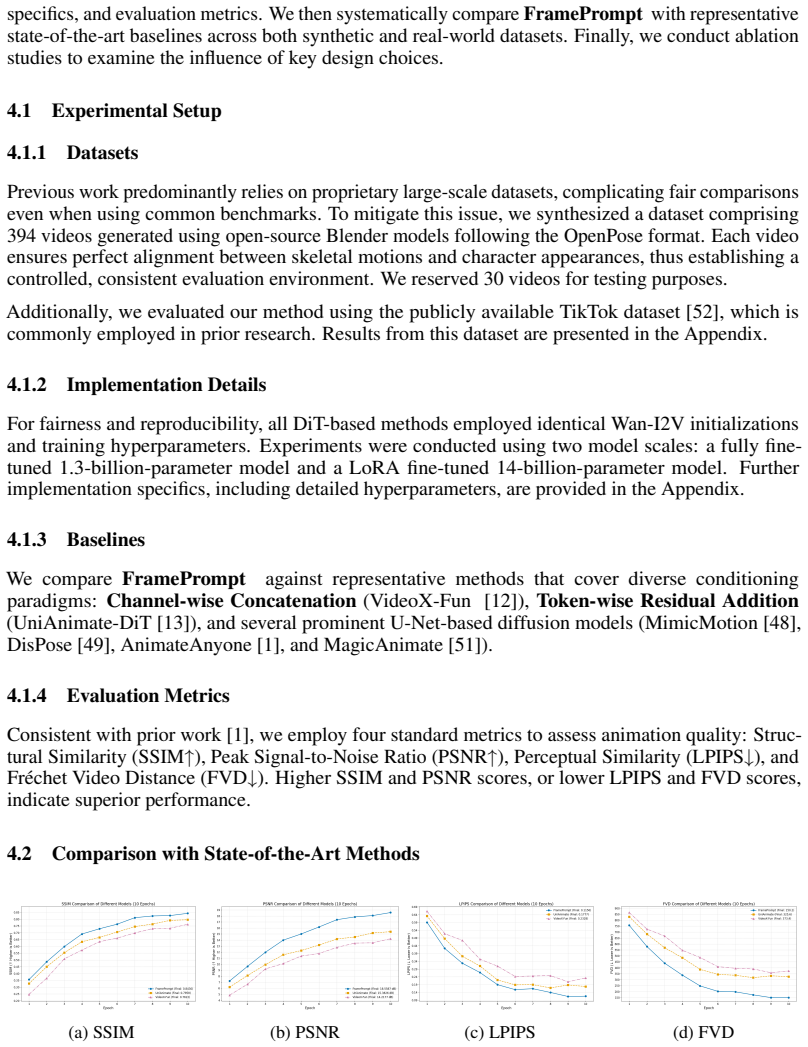
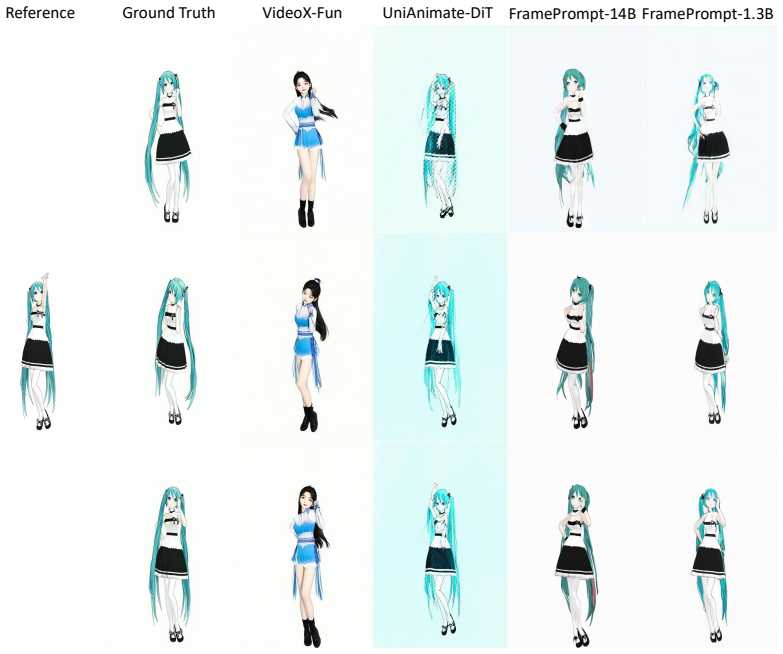
FramePrompt discovers that pretrained video diffusion transformers inherently possess contextual understanding for heterogeneous visual input, needing no architectural modifications or extra conditioning mechanisms. The model treats the reference image, skeleton sequence, and target frames as a unified visual sequence and applies selective noise diffusion only to target tokens, effectively reformulating animation as conditional future prediction. Under the best configuration, the paper reports improvements of roughly 5.93% in SSIM, 20.65% in PSNR, 34.95% in LPIPS, and 53.87% in FVD over the UniAnimate-DiT 1.3B baseline.
Load-bearing premise
The reported superiority rests on a test set of only 30 synthetic videos; if those clips do not give low-variance estimates of FVD and other metrics, the claimed margins over baselines may evaporate.
Editorial extensions
If this is right
- Character animation becomes a data-organization problem: the same pretrained weights can be reused without adding trainable modules.
- Training can be far more data-efficient: the paper uses 394 synthetic videos, while baselines use over 10,000, yet FramePrompt still leads on metrics.
- Applying denoising loss only on target frames improves results over all-frame loss across all reported metrics.
- On the synthetic benchmark the smaller 1.3B model matches or beats the 14B model, suggesting capacity should be matched to data scale.
- Validation on the real-world TikTok dataset shows the advantage transfers beyond synthetic data.
Reading between the lines
- If the central claim holds, other conditional video tasks such as video inpainting, camera control, or multi-character interaction may be solvable by the same prompting trick, since the underlying capability is general context modeling rather than task-specific modules.
- The 30-video test set leaves room for a larger benchmark; a natural next step is measuring FramePrompt against baselines on hundreds of real clips to verify the reported margins.
- The method's ceiling is the pretrained model's context length, so extending effective sequence length or handling boundary frames would likely become the main research bottleneck.
- A controlled comparison with the same data and fine-tuning budget would clarify how much of the gain comes from sequence organization versus fine-tuning itself.
Editorial analysis
A structured set of objections, weighed in public.
Referee Report
Summary. FramePrompt proposes a minimalist framework for controllable character animation from a reference image and skeleton guidance. Instead of adding specialized encoder modules or architectural modifications, the method concatenates the reference image, skeleton frames, and target video frames into a single spatio-temporal sequence, feeds this sequence into a pretrained video diffusion transformer (Wan-I2V), and applies masked denoising so that only the target frames are generated. The paper claims that this reformulation of animation as future-sequence prediction lets pretrained video diffusion transformers perform the task without structural changes, and that it outperforms representative baselines (U-Net and DiT-based) on SSIM, PSNR, LPIPS, and FVD. The main evidence is in Table 1 and Figure 3, with additional TikTok results in the appendix and ablations over loss design, model size, and fine-tuning strategy.
Significance. If the quantitative claims hold, FramePrompt is a useful and striking simplification: it suggests that a single pretrained video DiT can handle heterogeneous visual conditioning inputs by sequence organization alone, avoiding the architectural overhead of prior human-animation methods. The paper is clearly written, the ablations are internally consistent, and the idea of reformulating animation as masked future prediction is elegant and likely to be of interest to the video-generation community. However, the significance is currently constrained by the small evaluation set, the lack of statistical rigor, and the fairness of the baseline comparisons; the headline outperformance claims need stronger evidence before the central conclusion can be accepted.
major comments (4)
- [Sec. 4.1.1, Table 1] The quantitative superiority claim rests on a test set of only 30 synthetic videos, with no confidence intervals, standard deviations, or multiple-seed runs reported. This is especially problematic for FVD, a distributional metric estimated from video embeddings; with 30 clips, the FVD estimates and covariance terms are high-variance, so the reported margin (e.g., FVD 150.21 vs. 325.62, a 53.87% improvement) may not be statistically meaningful. The authors should provide bootstrap confidence intervals, run multiple seeds, or use a substantially larger held-out test set; without this, the central claim that FramePrompt 'significantly outperforms' baselines is not established.
- [Sec. 4.1.3, Table 1] The comparison to U-Net baselines is not fair: MimicMotion, DisPose, AnimateAnyone, and MagicAnimate are evaluated zero-shot without fine-tuning, while FramePrompt and the DiT baselines are fine-tuned (full or LoRA) on the target domain. Additionally, the synthetic test set is drawn from the same Blender pipeline used for training, which can inflate performance for methods trained on that distribution. The authors should either fine-tune the U-Net baselines on the same data or clearly label the comparison as zero-shot and provide a matched fine-tuning comparison for at least one strong U-Net baseline.
- [Sec. 3.1, Sec. 3.5] The novelty framing needs sharper positioning. Wan-I2V already supports masked temporal completion (video continuation, first-last interpolation), and FramePrompt essentially applies this masking mechanism to skeleton-guided animation with a specific sequence arrangement. The claim to demonstrate 'for the first time' that pretrained video diffusion transformers possess contextual understanding for heterogeneous visual input is too strong without a direct comparison to a Wan-I2V baseline that uses its default masking and conditioning; the paper should include such a baseline or soften the claim.
- [Sec. A.1.1] All experiments use a single random seed (42). Given the small test set and the stochastic nature of diffusion generation, the reported metric differences between configurations (e.g., half-frame vs. all-frame loss) may not be stable. Reporting mean and variance over at least three seeds, or providing per-video metric distributions, would substantially strengthen the empirical claims.
minor comments (7)
- [Abstract (first sentence)] The sentence 'The project website are available at: Website' contains a grammatical error and an incomplete reference; it should be revised.
- [Figure 2] The label '3D VA E' has a spacing error ('VA E' should be 'VAE').
- [Sec. 4.1.1] The dataset description states 394 videos and 30 reserved for testing, but it is not specified how many are used for training versus validation; please clarify the exact train/validation/test split and whether validation was used for early stopping.
- [Sec. 3.3, Eq. (1)] In Eq. (1), the dimensions of Iref, St, and Zt are not explicitly defined before use; please add a sentence clarifying that each is in RC×1×H×W and that the concatenation is along the temporal dimension.
- [Sec. 4.3.1] The reported relative improvements for half-frame loss over all-frame loss (0.78% SSIM, 2.39% PSNR, 8.98% LPIPS, 22.06% FVD) are consistent with Table 1, but the FVD improvement is large and should be discussed in light of the small test set.
- [Sec. 4.2] Figure 3 shows training curves over 10 epochs, but does not include error bars or multiple runs; without this, the 'faster convergence' and 'better final performance' claims are not statistically supported.
- [Sec. B.1, Table 3] The TikTok dataset results are reported without specifying the number of test videos or the test split; please provide this information so the reader can judge the reliability of these numbers.
Circularity Check
No significant circularity: the central claim is an empirical, out-of-sample measurement, and the only self-citation (MagicAnimate as a baseline) is not load-bearing.
full rationale
FramePrompt is an empirical methods paper, not a derivation, and its central claim does not reduce to its own inputs. The method (Eqs. 1-8) is a standard masked noise-prediction pipeline: the reference image and skeleton frames serve as context tokens, the target segment is masked and noised, and the model is trained to predict the noise on the target segment (Eqs. 4-5); at inference (Eqs. 6-7) the denoised target segment is decoded and compared against held-out ground truth. No parameter is fitted to the reported metrics and then renamed as a prediction; the SSIM/PSNR/LPIPS/FVD numbers in Tables 1 and 3 are measured on reserved test videos (30 synthetic clips per Sec. 4.1.1, plus the TikTok dataset) with the trained model frozen, so the claimed gains over UniAnimate-DiT and VideoX-Fun are out-of-sample measurements rather than consequences of the paper's own assumptions. The framing as 'future sequence prediction' consciously extends Wan-I2V's masked temporal completion (cited explicitly in Sec. 3.1 as 'the conceptual basis'), so the presentation does not disguise a prior result as a new one. The only self-citation is MagicAnimate ([2],[51], co-authored by M.Z. Shou), used solely as one of six Table 1 baselines and in Related Work; the central claim that pretrained DiTs handle heterogeneous sequences without structural change does not rest on MagicAnimate's results, so this is a minor, non-load-bearing self-citation. Acknowledged weaknesses - the 30-video test set with no confidence intervals (Sec. 4.1.1), in-distribution synthetic testing, zero-shot U-Net baselines, and the 'inherently possess' wording despite fine-tuning - are statistical-validity and claim-precision concerns, not circularity; they belong in a correctness review rather than this pass. No equation equals its own input, no fitted value is relabeled as a prediction, and no uniqueness theorem or ansatz is imported from the authors' own prior work. Verdict: no significant circularity, with the score reflecting only the minor non-load-bearing MagicAnimate self-citation.
Assumptions & free parameters
assumptions (4)
- standard math The latent diffusion forward and reverse processes (Eqs. 4-6) are valid for the masked target segment.
- domain assumption The pretrained Wan-I2V video diffusion transformer can process heterogeneous visual inputs (reference image, skeleton frames) as ordinary video frames in a single sequence.
- domain assumption The 3D VAE can faithfully encode skeleton frames and reference images into latents that retain sufficient appearance and motion information.
- domain assumption The pretrained transformer uses causal attention that enforces temporal directionality, as stated in Eq. 8.
Cite this review
Pith. "Pith review of FramePrompt: In-context Controllable Animation with Zero Structural Changes." pith.science (2026). https://pith.science/paper/SEUK7SC5
@misc{pith2026250617301,
  author       = {Pith},
  title        = {Pith review of: FramePrompt: In-context Controllable Animation with Zero Structural Changes},
  year         = {2026},
  howpublished = {\url{https://pith.science/paper/SEUK7SC5}},
  note         = {Machine review of arXiv:2506.17301}
}
read the original abstract
Generating controllable character animation from a reference image and motion guidance remains a challenging task due to the inherent difficulty of injecting appearance and motion cues into video diffusion models. Prior works often rely on complex architectures, explicit guider modules, or multi-stage processing pipelines, which increase structural overhead and hinder deployment. Inspired by the strong visual context modeling capacity of pre-trained video diffusion transformers, we propose FramePrompt, a minimalist yet powerful framework that treats reference images, skeleton-guided motion, and target video clips as a unified visual sequence. By reformulating animation as a conditional future prediction task, we bypass the need for guider networks and structural modifications. Experiments demonstrate that our method significantly outperforms representative baselines across various evaluation metrics while also simplifying training. Our findings highlight the effectiveness of sequence-level visual conditioning and demonstrate the potential of pre-trained models for controllable animation without architectural changes.
Figures


Figures from the paper (3 more)


Reference graph
Works this paper leans on
-
[1]
Animate anyone: Consistent and controllable image-to-video synthesis for character animation
Li Hu, Xin Gao, Peng Zhang, Ke Sun, Bang Zhang, and Liefeng Bo. Animate anyone: Consistent and controllable image-to-video synthesis for character animation. In IEEE/CVF Conference on Computer Vision and Pattern Recognition, pages 8153–8163, 2024
work page 2024
-
[2]
Magicanimate: Temporally consistent human image animation using diffusion model
Zhongcong Xu, Jianfeng Zhang, Jun Hao Liew, Hanshu Yan, Jia-Wei Liu, Chenxu Zhang, Jiashi Feng, and Mike Zheng Shou. Magicanimate: Temporally consistent human image animation using diffusion model. In IEEE/CVF Conference on Computer Vision and Pattern Recognition , pages 1481–1490, 2024
work page 2024
-
[3]
Animate anyone 2: High-fidelity character image animation with environment affordance
Li Hu, Guangyuan Wang, Zhen Shen, Xin Gao, Dechao Meng, Lian Zhuo, Peng Zhang, Bang Zhang, and Liefeng Bo. Animate anyone 2: High-fidelity character image animation with environment affordance. arXiv preprint arXiv:2502.06145, 2025
arXiv 2025
-
[4]
Champ: Controllable and consistent human image animation with 3d parametric guidance
Shenhao Zhu, Junming Leo Chen, Zuozhuo Dai, Zilong Dong, Yinghui Xu, Xun Cao, Yao Yao, Hao Zhu, and Siyu Zhu. Champ: Controllable and consistent human image animation with 3d parametric guidance. In European Conference on Computer Vision, volume 15113, pages 145–162, 2024
work page 2024
-
[5]
Disco: Disentangled control for realistic human dance generation
Tan Wang, Linjie Li, Kevin Lin, Yuanhao Zhai, Chung-Ching Lin, Zhengyuan Yang, Hanwang Zhang, Zicheng Liu, and Lijuan Wang. Disco: Disentangled control for realistic human dance generation. In IEEE/CVF Conference on Computer Vision and Pattern Recognition , pages 9326–9336, 2024
work page 2024
-
[7]
Musepose: a pose- driven image-to-video framework for virtual human generation
Zhengyan Tong, Chao Li, Zhaokang Chen, Bin Wu, and Wenjiang Zhou. Musepose: a pose- driven image-to-video framework for virtual human generation. arxiv, 2024
work page 2024
-
[8]
https://github.com/MooreThreads/Moore-AnimateAnyone, 2024
Moore-animateanyone. https://github.com/MooreThreads/Moore-AnimateAnyone, 2024
work page 2024
-
[9]
Realisdance: Equip controllable character animation with realistic hands
Jingkai Zhou, Benzhi Wang, Weihua Chen, Jingqi Bai, Dongyang Li, Aixi Zhang, Hao Xu, Mingyang Yang, and Fan Wang. Realisdance: Equip controllable character animation with realistic hands. arXiv preprint arXiv:2409.06202, 2024
arXiv 2024
Show all 55 references
-
[10]
https://viggleai.io/, 2024
Viggle ai. https://viggleai.io/, 2024
2024
-
[11]
Con- trolnext: Powerful and efficient control for image and video generation
Bohao Peng, Jian Wang, Yuechen Zhang, Wenbo Li, Ming-Chang Yang, and Jiaya Jia. Con- trolnext: Powerful and efficient control for image and video generation. arXiv preprint arXiv:2408.06070, 2024
2024 arXiv
-
[12]
https://github.com/aigc-apps/VideoX-Fun, 2025
Moore-animateanyone. https://github.com/aigc-apps/VideoX-Fun, 2025
2025
-
[13]
Unianimate: Taming unified video diffusion models for consistent human image animation
Xiang Wang, Shiwei Zhang, Changxin Gao, Jiayu Wang, Xiaoqiang Zhou, Yingya Zhang, Luxin Yan, and Nong Sang. Unianimate: Taming unified video diffusion models for consistent human image animation. Science China Information Sciences , 2025
2025
-
[14]
Skyreels-a1: Expressive portrait animation in video diffusion transformers
Di Qiu, Zhengcong Fei, Rui Wang, Jialin Bai, Changqian Yu, Mingyuan Fan, Guibin Chen, and Xiang Wen. Skyreels-a1: Expressive portrait animation in video diffusion transformers. arXiv preprint arXiv:2502.10841, 2025
2025 arXiv
-
[15]
Experiment with gemini 2.0 flash native image generation, 2025
Google Gemini2. Experiment with gemini 2.0 flash native image generation, 2025
2025
-
[16]
Introducing 4o image generation, 2025
OpenAI. Introducing 4o image generation, 2025
2025
-
[17]
Step1x-edit: A practical framework for general image editing
Shiyu Liu, Yucheng Han, Peng Xing, Fukun Yin, Rui Wang, Wei Cheng, Jiaqi Liao, Yingming Wang, Honghao Fu, Chunrui Han, Guopeng Li, Yuang Peng, Quan Sun, Jingwei Wu, Yan Cai, Zheng Ge, Ranchen Ming, Lei Xia, Xianfang Zeng, Yibo Zhu, Binxing Jiao, Xiangyu Zhang, Gang Yu, and Dax...
2025 arXiv
-
[18]
Nexus- gen: A unified model for image understanding, generation, and editing
Hong Zhang, Zhongjie Duan, Xingjun Wang, Yingda Chen, Yuze Zhao, and Yu Zhang. Nexus- gen: A unified model for image understanding, generation, and editing. arXiv preprint arXiv:2504.21356, 2025
2025 arXiv
-
[19]
Video diffusion models
Jonathan Ho, Tim Salimans, Alexey Gritsenko, William Chan, Mohammad Norouzi, and David J Fleet. Video diffusion models. arXiv preprint arXiv:2204.03458, 2022
2022 arXiv
-
[20]
Scalable diffusion models with transformers
William Peebles and Saining Xie. Scalable diffusion models with transformers. In Int. Conf. Comput. Vis., pages 4195–4205, 2023
2023
-
[21]
Pixart- α: Fast training of diffusion transformer for photorealistic text-to-image synthesis
Junsong Chen, Jincheng Yu, Chongjian Ge, Lewei Yao, Enze Xie, Yue Wu, Zhongdao Wang, James Kwok, Ping Luo, Huchuan Lu, et al. Pixart- α: Fast training of diffusion transformer for photorealistic text-to-image synthesis. arXiv preprint arXiv:2310.00426, 2023
-
[22]
Magicvideo: Efficient video generation with latent diffusion models
Daquan Zhou, Weimin Wang, Hanshu Yan, Weiwei Lv, Yizhe Zhu, and Jiashi Feng. Magicvideo: Efficient video generation with latent diffusion models. arXiv preprint arXiv:2211.11018, 2022
2022 arXiv
-
[23]
Modelscope text-to-video technical report
Jiuniu Wang, Hangjie Yuan, Dayou Chen, Yingya Zhang, Xiang Wang, and Shiwei Zhang. Modelscope text-to-video technical report. arXiv preprint arXiv:2308.06571, 2023
2023 arXiv
-
[24]
Animatediff: Animate your personalized text-to-image diffusion models without specific tuning.International Conference on Learning Representations, 2024
Yuwei Guo, Ceyuan Yang, Anyi Rao, Zhengyang Liang, Yaohui Wang, Yu Qiao, Maneesh Agrawala, Dahua Lin, and Bo Dai. Animatediff: Animate your personalized text-to-image diffusion models without specific tuning.International Conference on Learning Representations, 2024
2024
-
[25]
GenmoTeam. Mochi 1. https://github.com/genmoai/models, 2024
2024
-
[26]
Hunyuanvideo: A systematic framework for large video generative models
Weijie Kong, Qi Tian, Zijian Zhang, Rox Min, Zuozhuo Dai, Jin Zhou, Jiangfeng Xiong, Xin Li, Bo Wu, Jianwei Zhang, et al. Hunyuanvideo: A systematic framework for large video generative models. arXiv preprint arXiv:2412.03603, 2024
2024 arXiv
-
[27]
Wan: Open and advanced large-scale video generative models
Ang Wang, Baole Ai, Bin Wen, Chaojie Mao, Chen-Wei Xie, Di Chen, Feiwu Yu, Haiming Zhao, Jianxiao Yang, Jianyuan Zeng, Jiayu Wang, Jingfeng Zhang, Jingren Zhou, Jinkai Wang, Jixuan Chen, Kai Zhu, Kang Zhao, Keyu Yan, Lianghua Huang, Mengyang Feng, Ningyi Zhang, Pandeng Li, Pin...
2025 arXiv
-
[28]
Ltx-video: Realtime video latent diffusion
Yoav HaCohen, Nisan Chiprut, Benny Brazowski, Daniel Shalem, Dudu Moshe, Eitan Richard- son, Eran Levin, Guy Shiran, Nir Zabari, Ori Gordon, Poriya Panet, Sapir Weissbuch, Victor Kulikov, Yaki Bitterman, Zeev Melumian, and Ofir Bibi. Ltx-video: Realtime video latent diffusion....
2024 arXiv
-
[29]
Open-sora: Democratizing efficient video production for all, March 2024
Zangwei Zheng, Xiangyu Peng, Tianji Yang, Chenhui Shen, Shenggui Li, Hongxin Liu, Yukun Zhou, Tianyi Li, and Yang You. Open-sora: Democratizing efficient video production for all, March 2024
2024
-
[30]
Open-sora plan: Open-source large video generation model
Bin Lin, Yunyang Ge, Xinhua Cheng, Zongjian Li, Bin Zhu, Shaodong Wang, Xianyi He, Yang Ye, Shenghai Yuan, Liuhan Chen, et al. Open-sora plan: Open-source large video generation model. arXiv preprint arXiv:2412.00131, 2024
2024 arXiv
-
[31]
Pyramidal flow matching for efficient video generative modeling
Yang Jin, Zhicheng Sun, Ningyuan Li, Kun Xu, Kun Xu, Hao Jiang, Nan Zhuang, Quzhe Huang, Yang Song, Yadong Mu, and Zhouchen Lin. Pyramidal flow matching for efficient video generative modeling. arXiv preprint arXiv:2410.05954, 2024
-
[32]
CogVideoX: Text-to-Video Diffusion Models with An Expert Transformer
Zhuoyi Yang, Jiayan Teng, Wendi Zheng, Ming Ding, Shiyu Huang, Jiazheng Xu, Yuanming Yang, Wenyi Hong, Xiaohan Zhang, Guanyu Feng, Da Yin, Xiaotao Gu, Yuxuan Zhang, Weihan Wang, Yean Cheng, Ting Liu, Bin Xu, Yuxiao Dong, and Jie Tang. CogVideoX: Text-to-Video Diffusion Models ...
2025
-
[33]
First order motion model for image animation
Aliaksandr Siarohin, Stéphane Lathuilière, Sergey Tulyakov, Elisa Ricci, and Nicu Sebe. First order motion model for image animation. In Advances in Neural Information Processing Systems, volume 32, pages 7135–7145, 2019
2019
-
[34]
Woodford, Jian Ren, Menglei Chai, and Sergey Tulyakov
Aliaksandr Siarohin, Oliver J. Woodford, Jian Ren, Menglei Chai, and Sergey Tulyakov. Motion representations for articulated animation. In IEEE/CVF Conference on Computer Vision and Pattern Recognition, pages 13653–13662, 2021
2021
-
[35]
Animate-x: Universal character image animation with enhanced motion representation
Shuai Tan, Biao Gong, Xiang Wang, Shiwei Zhang, Dandan Zheng, Ruobing Zheng, Kecheng Zheng, Jingdong Chen, and Ming Yang. Animate-x: Universal character image animation with enhanced motion representation. arXiv preprint arXiv:2410.10306, 2024
-
[36]
Humanvid: Demystifying training data for camera-controllable human image animation
Zhenzhi Wang, Yixuan Li, Yanhong Zeng, Youqing Fang, Yuwei Guo, Wenran Liu, Jing Tan, Kai Chen, Tianfan Xue, Bo Dai, and Dahua Lin. Humanvid: Demystifying training data for camera-controllable human image animation. In The Thirty-eight Conference on Neural Information Processi...
2024
-
[37]
Omnihuman-1: Rethinking the scaling-up of one-stage conditioned human animation models
Gaojie Lin, Jianwen Jiang, Jiaqi Yang, Zerong Zheng, and Chao Liang. Omnihuman-1: Rethinking the scaling-up of one-stage conditioned human animation models. arXiv preprint arXiv:2502.01061, 2025
2025 arXiv
-
[38]
Humandit: Pose-guided diffusion transformer for long-form human motion video generation
Qijun Gan, Yi Ren, Chen Zhang, Zhenhui Ye, Pan Xie, Xiang Yin, Zehuan Yuan, Bingyue Peng, and Jianke Zhu. Humandit: Pose-guided diffusion transformer for long-form human motion video generation. arXiv preprint arXiv:2502.04847, 2025
2025 arXiv
-
[39]
Vace: All-in-one video creation and editing
Zeyinzi Jiang, Zhen Han, Chaojie Mao, Jingfeng Zhang, Yulin Pan, and Yu Liu. Vace: All-in-one video creation and editing. arXiv preprint arXiv:2503.07598, 2025
2025 arXiv
-
[40]
Humandit: Pose-guided diffusion transformer for long-form human motion video generation, 2025
Qijun Gan, Yi Ren, Chen Zhang, Zhenhui Ye, Pan Xie, Xiang Yin, Zehuan Yuan, Bingyue Peng, and Jianke Zhu. Humandit: Pose-guided diffusion transformer for long-form human motion video generation, 2025
2025
-
[41]
Ominicontrol: Minimal and universal control for diffusion transformer
Zhenxiong Tan, Songhua Liu, Xingyi Yang, Qiaochu Xue, and Xinchao Wang. Ominicontrol: Minimal and universal control for diffusion transformer. arXiv preprint arXiv:2411.15098 , 2024
2024 arXiv
-
[42]
Ace: All-round creator and editor following instructions via diffusion transformer
Zhen Han, Zeyinzi Jiang, Yulin Pan, Jingfeng Zhang, Chaojie Mao, Chenwei Xie, Yu Liu, and Jingren Zhou. Ace: All-round creator and editor following instructions via diffusion transformer. arXiv preprint arXiv:2410.00086, 2024
-
[43]
Lumina-omnilv: A unified multimodal framework for general low-level vision
Yuandong Pu, Le Zhuo, Kaiwen Zhu, Liangbin Xie, Wenlong Zhang, Xiangyu Chen, Pneg Gao, Yu Qiao, Chao Dong, and Yihao Liu. Lumina-omnilv: A unified multimodal framework for general low-level vision. arXiv preprint arXiv:2504.04903, 2025
2025 arXiv
-
[44]
I2vgen-xl: High-quality image-to-video synthesis via cascaded diffusion models
Shiwei Zhang, Jiayu Wang, Yingya Zhang, Kang Zhao, Hangjie Yuan, Zhiwu Qin, Xiang Wang, Deli Zhao, and Jingren Zhou. I2vgen-xl: High-quality image-to-video synthesis via cascaded diffusion models. arXiv preprint arXiv:2311.04145, 2023
2023 arXiv
-
[45]
Stable video diffusion: Scaling latent video diffusion models to large datasets
Andreas Blattmann, Tim Dockhorn, Sumith Kulal, Daniel Mendelevitch, Maciej Kilian, Do- minik Lorenz, Yam Levi, Zion English, Vikram V oleti, Adam Letts, et al. Stable video diffusion: Scaling latent video diffusion models to large datasets. arXiv preprint arXiv:2311.15127, 2023
2023 arXiv
-
[46]
Learning transferable visual models from natural language supervision
Alec Radford, Jong Wook Kim, Chris Hallacy, Aditya Ramesh, Gabriel Goh, Sandhini Agarwal, Girish Sastry, Amanda Askell, Pamela Mishkin, Jack Clark, et al. Learning transferable visual models from natural language supervision. In Int. Conf. Mach. Learn. , pages 8748–8763. PMLR, 2021
2021
-
[47]
Ip-adapter: Text compatible image prompt adapter for text-to-image diffusion models
Hu Ye, Jun Zhang, Sibo Liu, Xiao Han, and Wei Yang. Ip-adapter: Text compatible image prompt adapter for text-to-image diffusion models. arXiv preprint arXiv:2308.06721, 2023
2023 arXiv
-
[48]
Mimicmotion: High-quality human motion video generation with confidence-aware pose guidance
Yuang Zhang, Jiaxi Gu, Li-Wen Wang, Han Wang, Junqi Cheng, Yuefeng Zhu, and Fangyuan Zou. Mimicmotion: High-quality human motion video generation with confidence-aware pose guidance. arXiv preprint arXiv:2406.19680, 2024. 12
2024 arXiv
-
[49]
Dispose: Disentangling pose guidance for controllable human image animation
Hongxiang Li, Yaowei Li, Yuhang Yang, Junjie Cao, Zhihong Zhu, Xuxin Cheng, and Chen Long. Dispose: Disentangling pose guidance for controllable human image animation. arXiv preprint arXiv:2412.09349, 2024
2024 arXiv
-
[50]
Animateanyone: Consistent human motion transfer in realistic videos
Moore Threads. Animateanyone: Consistent human motion transfer in realistic videos. https: //github.com/MooreThreads/Moore-AnimateAnyone, 2024. Accessed: 2025-05-15
2024
-
[51]
Magicanimate: Temporally consistent human image animation using diffusion model
Zhongcong Xu, Jianfeng Zhang, Jun Hao Liew, Hanshu Yan, Jia-Wei Liu, Chenxu Zhang, Jiashi Feng, and Mike Zheng Shou. Magicanimate: Temporally consistent human image animation using diffusion model. In arXiv, 2023
2023
-
[52]
Learning high fidelity depths of dressed humans by watching social media dance videos
Yasamin Jafarian and Hyun Soo Park. Learning high fidelity depths of dressed humans by watching social media dance videos. In Proceedings of the IEEE/CVF Conference on Computer Vision and Pattern Recognition (CVPR), pages 12753–12762, June 2021. 13 A Experimental Details A.1 I...
2021
-
[53]
15 Figure 5: Showcase of our FramePrompt approach generating diverse animations from the TikTok dataset
Motion Diversity: Our model effectively handles a wide range of motion patterns, from expressive hand gestures and facial movements to full-body dancing motions, demonstrating its adaptability to different animation scenarios. 15 Figure 5: Showcase of our FramePrompt approach ...
-
[54]
Temporal Consistency: Across all examples, our method maintains smooth transitions between frames with minimal flickering or jitter, producing natural-looking animations that preserve the temporal coherence of human movements
-
[55]
Identity Preservation: The character appearance remains consistent throughout the anima- tion sequences, with accurate preservation of facial features, hairstyles, clothing details, and other distinctive attributes from the reference images
-
[56]
These visual results complement our quantitative findings, providing concrete evidence of our method’s effectiveness in generating high-quality character animations
Cross-Domain Performance: The consistent quality across both synthetic and real-world examples demonstrates our method’s robustness to domain shifts and its effectiveness in diverse visual contexts. These visual results complement our quantitative findings, providing concrete ...
Reviewed August 7, 2026 · model on record in the stance chip above.
Discussion (0). Sign in to comment.