A degree version of the Burr-ErdH{o}s conjecture on trees
Pith reviewed 2026-06-28 13:50 UTC · model grok-4.3
The pith
Any graph on 2n vertices with minimum degree at least three-quarters of its order forces a monochromatic copy of every bounded-degree n-vertex tree in any 2-edge-coloring.
A machine-rendered reading of the paper's core claim, the machinery that carries it, and where it could break.
Core claim
The central claim is that for every Delta greater than or equal to 2, every graph G on N greater than or equal to 2n vertices with minimum degree at least floor(3N/4) has the property that every 2-edge-coloring of G contains a monochromatic copy of every n-vertex tree with maximum degree at most Delta.
What carries the argument
The floor(3N/4) minimum-degree threshold on a host graph of order at least 2n, which carries the argument by enabling monochromatic embeddings of all bounded-degree trees.
If this is right
- The extra epsilon n term in the host-graph size is unnecessary.
- The monochromatic-tree guarantee holds at the exact conjectured size N = 2n.
- The result applies uniformly for every fixed maximum degree bound Delta greater than or equal to 2.
Where Pith is reading between the lines
- The same degree threshold may suffice for other sparse host graphs in related Ramsey settings.
- Techniques developed here could be tested on trees whose maximum degree grows with n.
- The boundary case N = 2n might allow removal of the bounded-degree restriction in some extensions.
Load-bearing premise
An embedding technique succeeds exactly at the three-quarters minimum-degree threshold without requiring extra slack vertices.
What would settle it
A single graph on exactly 2n vertices with minimum degree floor(3N/4) and a 2-edge-coloring that avoids a monochromatic copy of some n-vertex tree with maximum degree at most Delta would disprove the claim.
Figures
read the original abstract
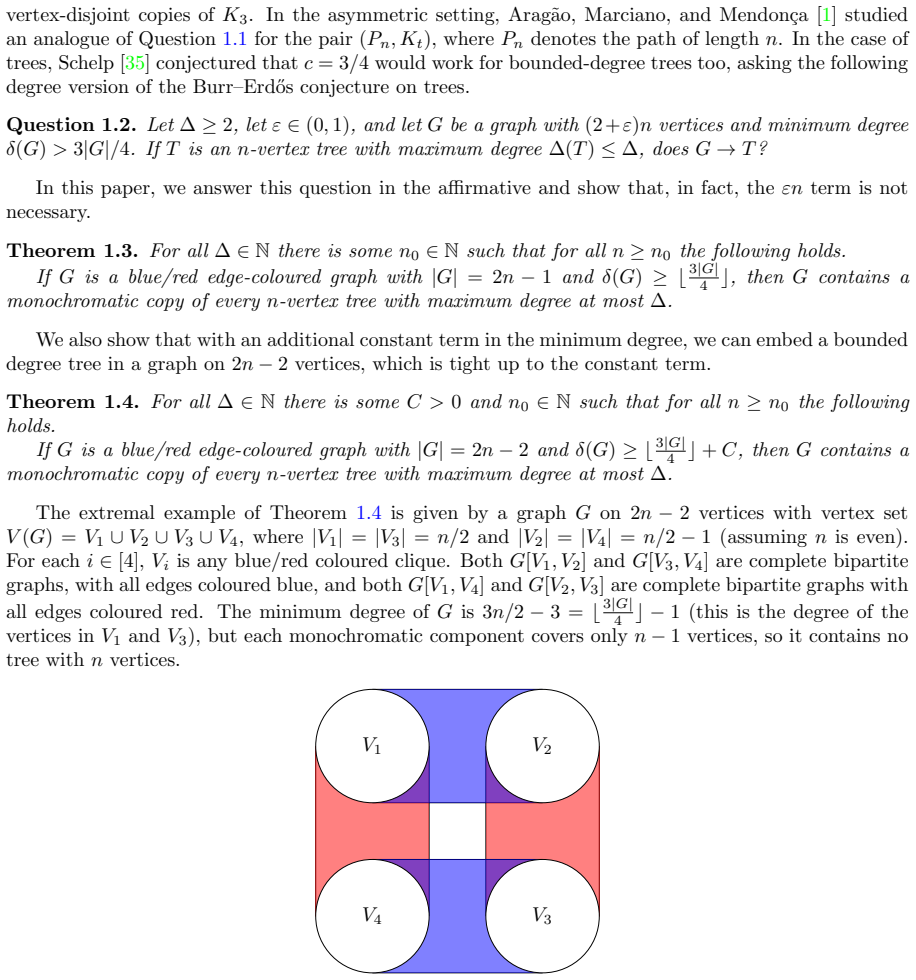
An old conjecture of Burr and Erd\H os states that the Ramsey number of any $n$-vertex tree $T$ is at most $2n-2$. In 2012, Schelp asked whether a degree version of the Burr--Erd\H{o}s conjecture holds. More precisely, Schelp asked if is it true that for any $\varepsilon>0$ and $\Delta\ge 2$, if $G$ is a graph on $N\ge (2+\varepsilon)n$ vertices and minimum degree $\delta(G)\ge \lfloor 3N/4\rfloor$, then every blue/red colouring of the edges of $G$ yields a monochromatic copy of each $n$-vertex tree with maximum degree at most $\Delta$. We prove this conjecture in a strong form, showing that it is true even if one removes the extra $\varepsilon n$ term in the size of the host graph.
Editorial analysis
A structured set of objections, weighed in public.
Referee Report
Summary. The manuscript proves a strong form of Schelp's degree version of the Burr-Erdős conjecture: for every Δ ≥ 2, every n-vertex tree T with maximum degree at most Δ, and every 2-edge-coloring of an N-vertex graph G with N = 2n and δ(G) ≥ ⌊3N/4⌋, G contains a monochromatic copy of T.
Significance. If correct, the result is significant: it resolves the degree analogue of the Burr-Erdős conjecture at the exact numerical threshold N = 2n without an εn slack term, yielding a sharp, parameter-free statement for bounded-degree trees in 2-colored graphs under a minimum-degree condition.
major comments (1)
- [Main embedding argument (post-abstract proof section)] The central claim requires an embedding argument that succeeds with zero slack precisely at δ(G) = ⌊3N/4⌋ and N = 2n. Standard tree-embedding or regularity lemmas in this area typically produce o(N) error terms that are absorbed only by taking N ≥ (2 + ε)n or δ > (3/4 + ε)N; the manuscript must demonstrate explicitly how all such error terms are cancelled or avoided while remaining inside the exact threshold (see the main embedding lemma after the abstract).
minor comments (1)
- Clarify the precise statement of the result for even/odd n in the definition of ⌊3N/4⌋ to avoid ambiguity in the threshold.
Simulated Author's Rebuttal
We thank the referee for the positive assessment of the result's significance and for the detailed comment on the embedding argument. We address the major comment point by point below.
read point-by-point responses
-
Referee: [Main embedding argument (post-abstract proof section)] The central claim requires an embedding argument that succeeds with zero slack precisely at δ(G) = ⌊3N/4⌋ and N = 2n. Standard tree-embedding or regularity lemmas in this area typically produce o(N) error terms that are absorbed only by taking N ≥ (2 + ε)n or δ > (3/4 + ε)N; the manuscript must demonstrate explicitly how all such error terms are cancelled or avoided while remaining inside the exact threshold (see the main embedding lemma after the abstract).
Authors: Our proof of the main embedding result (Lemma 3.2) deliberately avoids regularity lemmas and standard blow-up arguments that introduce o(N) slack. Instead, it proceeds by induction on the number of vertices in the target tree T, combined with a direct greedy embedding that tracks the exact number of available blue and red neighbors under the minimum-degree hypothesis δ(G) ≥ ⌊3N/4⌋. At each step the degree condition guarantees that the number of candidate vertices in the appropriate color class is at least the number required by the remaining tree, with equality cases handled by a separate potential-function argument that uses the global relation N = 2n to cancel any local deficit. Because the host graph size is exactly twice the tree order, the total number of vertices removed in previous steps is accounted for exactly rather than asymptotically. We acknowledge that the current write-up of this cancellation could be expanded for clarity and will add a short dedicated paragraph (or subsection) immediately after the statement of Lemma 3.2 that isolates the zero-slack bookkeeping. revision: yes
Circularity Check
No circularity: independent proof of external conjecture
full rationale
The paper states a proof of Schelp's 2012 conjecture (an external claim) in strengthened form, removing the εn slack from the host graph size. No self-citations, fitted parameters, or ansatzes are invoked as load-bearing steps in the provided abstract or description. The central claim is a direct embedding result at the exact threshold δ(G) ≥ ⌊3N/4⌋ for N=2n, presented without reduction to prior author work or redefinition of inputs. This matches the default expectation of a non-circular derivation chain.
Axiom & Free-Parameter Ledger
axioms (1)
- standard math Standard axioms and definitions of graph theory, edge colorings, and Ramsey numbers for trees.
Reference graph
Works this paper leans on
-
[1]
L. Arag˜ ao, J. P. Marciano, and W. Mendon¸ ca. Degree conditions for Ramsey goodness of paths. European J. Combin., 124:Paper No. 104082, 2025. doi:10.1016/j.ejc.2024.104082
-
[2]
P. Balister, B. Bollob´ as, M. Campos, S. Griffiths, E. Hurley, R. Morris, J. Sahasrabudhe, and M. Tiba. Upper bounds for multicolour Ramsey numbers, 2024, arxiv:2410.17197. doi:10.48550/arXiv.2410.17197
-
[3]
J. Balogh, A. Freschi, and A. Treglown. Ramsey-type problems for tilings in dense graphs.European J. Combin., 131:Paper No. 104228, 2026. doi:10.1016/j.ejc.2025.104228
-
[4]
J. Balogh, A. Kostochka, M. Lavrov, and X. Liu. Monochromatic paths and cycles in 2-edge- coloured graphs with large minimum degree.Combin. Probab. Comput., 31(1):109–122, 2022. doi:10.1017/s0963548321000201
-
[5]
F. S. Benevides, T. Luczak, A. Scott, J. Skokan, and M. White. Monochromatic cycles in 2-coloured graphs.Combin. Probab. Comput., 21(1-2):57–87, 2012. doi:10.1017/S0963548312000090
-
[6]
G. Besomi, M. Pavez-Sign´ e, and M. Stein. Degree conditions for embedding trees.SIAM J. Discrete Math., 33(3):1521–1555, 2019. doi:10.1137/18M1210861
-
[7]
Bondy and P
J. Bondy and P. Erd˝ os. Ramsey numbers for cycles in graphs.J. Combin. Theory Ser. B, 14:46–54,
-
[8]
doi:10.1016/s0095-8956(73)80005-x
-
[9]
J. A. Bondy. Pancyclic graphs. I.J. Combin. Theory Ser. B, 11:80–84, 1971. doi:10.1016/0095- 8956(71)90016-5
-
[10]
J. B¨ ottcher, J. Hladk` y, and D. Piguet. The tripartite Ramsey number for trees.J. Graph Theory, 69(3):264–300, 2012. doi:10.1002/jgt.20582
-
[11]
J. B¨ ottcher, R. Montgomery, O. Parczyk, and Y. Person. Embedding spanning bounded degree graphs in randomly perturbed graphs.Mathematika, 66(2):422–447, 2020. doi:10.1112/mtk.12005
-
[12]
M. Buci´ c and B. Sudakov. Tight Ramsey bounds for multiple copies of a graph.Adv. Comb., 1:22pp., 3 Feb 2023. doi:10.19086/aic.2023.1
-
[13]
S. A. Burr. Generalized Ramsey theory for graphs—a survey. InGraphs and combinatorics (Proc. Capital Conf., George Washington Univ., Washington, D.C., 1973), volume Vol. 406 ofLecture Notes in Math., pages 52–75. Springer, Berlin-New York, 1974
1973
-
[14]
S. A. Burr and P. Erd˝ os. Extremal Ramsey theory for graphs.Utilitas Math., 9:247–258, 1976
1976
-
[15]
M. Campos, S. Griffiths, R. Morris, and J. Sahasrabudhe. An exponential improvement for diagonal Ramsey.Ann. of Math. (2), 2025. doi:10.48550/arXiv.2303.09521. to appear
-
[16]
Y. Chen and A. Lo. Embedding loose trees ink-uniform hypergraphs, 2025, arXiv:2502.04783. doi:10.48550/arXiv.2502.04783
-
[17]
G. A. Dirac. Some theorems on abstract graphs.Proc. London Math. Soc. (3), 2:69–81, 1952. doi:10.1112/plms/s3-2.1.69
-
[18]
F. F. Dub´ o and M. Stein. On the Ramsey number of the double star.Discrete Math., 348(1):Paper No. 114227, 4, 2025. doi:10.1016/j.disc.2024.114227
-
[19]
R. J. Faudree and R. H. Schelp. All Ramsey numbers for cycles in graphs.Discrete Math., 8(4):313– 329, 1974. doi:10.1016/0012-365X(74)90151-4
-
[20]
Gerencs´ er and A
L. Gerencs´ er and A. Gy´ arf´ as. On Ramsey-type problems.Ann. Univ. Sci. Budapest. E¨ otv¨ os Sect. Math., 10:167–170, 1967
1967
-
[21]
P. Gupta, N. Ndiaye, S. Norin, and L. Wei. Optimizing the CGMS upper bound on Ramsey numbers, 2024, arxiv:2407.19026. doi:10.48550/arXiv.2407.19026. 28
-
[22]
A. Gy´ arf´ as and G. N. S´ ark¨ ozy. Star versus two stripes Ramsey numbers and a conjecture of Schelp. Combin. Probab. Comput., 21(1-2):179–186, 2012. doi:10.1017/S0963548311000599
-
[23]
F. Harary. Recent results on generalized Ramsey theory for graphs. InGraph theory and applications (Proc. Conf., Western Michigan Univ., Kalamazoo, Mich., 1972; dedicated to the memory of J. W. T. Youngs), volume Vol. 303 ofLecture Notes in Math., pages 125–138. Springer, Berlin-New York, 1972
1972
-
[24]
S. Janson, T. Luczak, and A. Ruci´ nski.Random graphs. Wiley-Interscience Series in Discrete Mathematics and Optimization. Wiley-Interscience, New York, 2000. doi:10.1002/9781118032718
-
[25]
A. Kathapurkar and R. Montgomery. Spanning trees in dense directed graphs.J. Combin. Theory Ser. B, 156:223–249, 2022. doi:10.1016/j.jctb.2022.04.007
-
[26]
J. Koml´ os, G. N. S´ ark¨ ozy, and E. Szemer´ edi. Spanning trees in dense graphs.Combin. Probab. Comput., 10(5):397–416, 2001. doi:10.1017/S0963548301004849
-
[27]
H. Li, V. Nikiforov, and R. H. Schelp. A new class of Ramsey-Tur´ an problems.Discrete Math., 310(24):3579–3583, 2010. doi:10.1016/j.disc.2010.09.009
-
[28]
Luczak.R(C n, Cn, Cn)≤(4 +o(1))n.J
T. Luczak.R(C n, Cn, Cn)≤(4 +o(1))n.J. Combin. Theory Ser. B, 75(2):174–187, 1999. doi:10.1006/jctb.1998.1874
-
[29]
McDiarmid
C. McDiarmid. On the method of bounded differences. InSurveys in combinatorics, 1989 (Norwich, 1989), volume 141 ofLondon Math. Soc. Lecture Note Ser., pages 148–188. Cambridge Univ. Press, Cambridge, 1989
1989
-
[30]
R. Montgomery, M. Pavez-Sign´ e, and J. Yan. Ramsey numbers of trees, 2025, arxiv:2509.07934. doi:10.48550/arXiv.2509.07934
-
[31]
V. Nikiforov and R. Schelp. Cycles and stability.J. Combin. Theory Ser. B, 98(1):69–84, 2008. doi:10.1016/j.jctb.2007.05.001
-
[32]
Asymptotics of Ramsey numbers of double stars
S. Norin, Y. R. Sun, and Y. Zhao. Asymptotics of Ramsey numbers of double stars, 2016, arxiv:1605.03612. doi:10.48550/arXiv.1605.03612
work page internal anchor Pith review Pith/arXiv arXiv doi:10.48550/arxiv.1605.03612 2016
-
[33]
A. Pokrovskiy, L. Versteegen, and E. Williams. Embedding trees using minimum and maximum degree conditions, 2025, arXiv:2512.16799. doi:10.48550/arXiv.2512.16799
-
[34]
F. P. Ramsey. On a Problem of Formal Logic.Proc. London Math. Soc. (2), 30(4):264–286, 1929. doi:10.1112/plms/s2-30.1.264
-
[35]
V. Rosta. On a Ramsey-type problem of J. A. Bondy and P. Erd˝ os. I, II.J. Combinatorial Theory Ser. B, 15(1):94–104; ibid. 15 (1973), 105–120, 1973. doi:10.1016/0095-8956(73)90035-x
-
[36]
R. H. Schelp. Some Ramsey-Tur´ an type problems and related questions.Discrete Math., 312(14):2158–2161, 2012. doi:10.1016/j.disc.2011.09.015
-
[37]
N. C. Wormald. The differential equation method for random graph processes and greedy algorithms. In M. Karo´ nski and H. J. Pr¨ omel, editors,Lectures on approximation and randomized algorithms, pages 73–155. Wydawnictwo Naukowe Pwn, 1999
1999
-
[38]
Y. Zhao. Proof of the (n/2−n/2−n/2) conjecture for largen.Electron. J. Combin., 18(1):Paper 27, 61pp., 2011. doi:10.37236/514. 29
discussion (0)
Sign in with ORCID, Apple, or X to comment. Anyone can read and Pith papers without signing in.