Modeling and prediction of the peak radiated sound in sub-sonic axisymmetric air jets using acoustic analogy based asymptotic analysis
Pith reviewed 2026-05-24 22:26 UTC · model grok-4.3
The pith
Asymptotic analysis of the acoustic analogy predicts peak jet noise at subsonic speeds using RANS flows and modeled turbulence sources.
A machine-rendered reading of the paper's core claim, the machinery that carries it, and where it could break.
Core claim
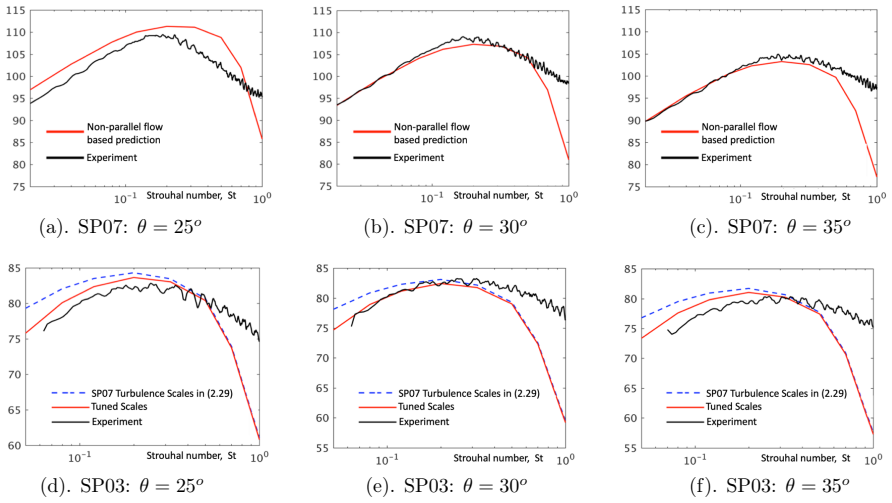
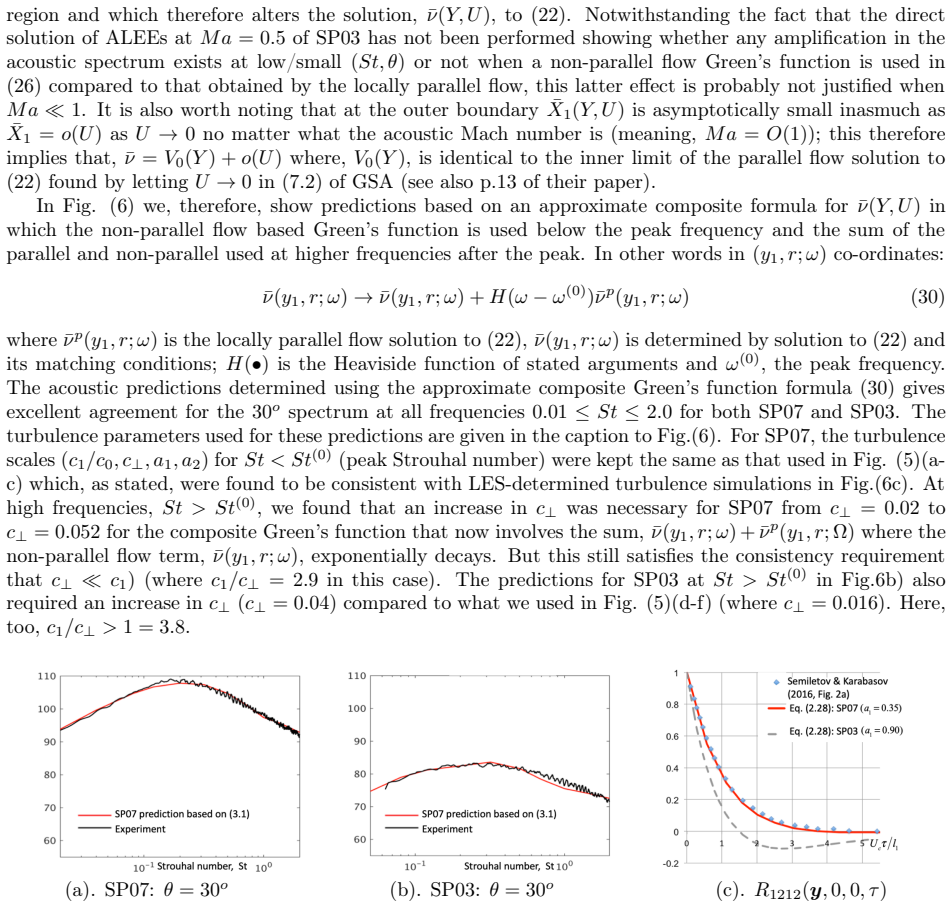
The exact acoustic pressure is expressed as the convolution of a propagator tensor (from the adjoint linearized Euler equations) and a generalized source term; a low-frequency/small-spread-rate asymptotic expansion yields a hyperbolic PDE whose lowest-order solution, when inserted into the analogy together with RANS mean flows and a calibrated turbulence model, produces noise spectra that agree with experiment in the peak direction for the stated Mach and frequency ranges.
What carries the argument
Low-frequency/small-spread-rate asymptotic expansion of the vector Green's function for the adjoint linearized Euler equations, which enters mean-flow non-parallelism via the streamwise advection term in a hyperbolic PDE.
If this is right
- Noise predictions achieve reasonable accuracy in the peak direction at Mach 0.9 for Strouhal numbers up to about 0.6.
- At Mach 0.5 the same framework requires modified source coefficients to maintain accuracy.
- An approximate composite asymptotic formula for the vector Green's function extends usable predictions beyond Strouhal number one.
- The method relies on convolution of the propagator tensor with the generalized source term inside the acoustic analogy.
Where Pith is reading between the lines
- If the source model remains valid across jet operating conditions, the approach could reduce the need for expensive large-eddy simulations in preliminary design.
- The hyperbolic PDE structure might be reused for other axisymmetric shear flows where non-parallel effects matter at low frequencies.
- Extending the composite formula to include weak azimuthal dependence could address noise from slightly non-axisymmetric nozzles without changing the core framework.
Load-bearing premise
The turbulence source structure is represented by an experimentally verified model whose coefficients can be adjusted and that this model combined with RANS mean flows faithfully represents the actual jet turbulence field.
What would settle it
Compare the model's far-field spectra at Mach 0.9 and Strouhal numbers above 0.6 against measured data when the composite asymptotic formula is deliberately omitted.
Figures
read the original abstract
This paper uses asymptotic analysis within the generalized acoustic analogy formulation (Goldstein. J. Fluid Mech 488, pp. 315-333, 2003) to develop a noise prediction model for the peak sound of axisymmetric round jets at subsonic acoustic Mach numbers ($Ma$). The analogy shows that the exact formula for the acoustic pressure is given by a convolution product of a propagator tensor (determined by the vector Green's function of the adjoint linearized Euler equations for a given jet mean flow) and a generalized source term representing the jet turbulence field. Using a low frequency/small spread rate asymptotic expansion of the propagator, mean flow non-parallelism enters the lowest order Green's function solution via the streamwise component of the mean flow advection vector in a hyperbolic partial differential equation (PDE). We then address the predictive capability of the solution to this PDE when used in the analogy through first-of-its-kind numerical calculations when an experimentally-verified model of the turbulence source structure is used together with Reynolds-averaged Navier Stokes solutions for the jet mean flow. Our noise predictions show a reasonable level of accuracy in the peak noise direction at $Ma=0.9$, for Strouhal number up to about $0.6$, and at $Ma=0.5$ using modified source coefficients. Possible reasons for this are discussed. Moreover, the prediction range can be extended beyond unity Strouhal number by using an approximate composite asymptotic formula for the vector Green's function that reduces to the locally parallel flow limit at high frequencies.
Editorial analysis
A structured set of objections, weighed in public.
Referee Report
Summary. The paper develops a low-frequency asymptotic analysis of the propagator tensor within the generalized acoustic analogy (Goldstein 2003) for subsonic axisymmetric jet noise. Non-parallel mean flow effects enter the leading-order adjoint LEE Green's function through a hyperbolic PDE; this is combined with an experimentally verified turbulence source model and RANS mean flows to produce numerical predictions. The abstract reports reasonable accuracy in the peak noise direction at Ma=0.9 for Strouhal numbers up to ~0.6, and at Ma=0.5 after modifying the source coefficients; a composite asymptotic formula is proposed to extend the range beyond St=1.
Significance. If the unmodified source model plus RANS flows can be shown to yield accurate predictions across the Mach range without case-specific retuning, the approach would offer an efficient, asymptotically grounded method for incorporating non-parallel flow effects into jet noise prediction while bridging low- and high-frequency regimes. The first-of-its-kind numerical implementation of the asymptotic propagator is a methodological strength, but its value depends on quantitative validation of the predictive (rather than fitted) capability.
major comments (2)
- [Abstract (numerical calculations paragraph)] Abstract (numerical calculations paragraph): the claim of predictive capability at Ma=0.5 rests on modified source coefficients rather than the unmodified experimentally verified model. This directly tests the load-bearing assumption that the turbulence source structure plus RANS mean flows faithfully represents the actual jet without case-specific adjustment; if the unmodified coefficients produce substantially larger errors, the predictive (as opposed to post-hoc) nature of the construction is not demonstrated.
- [Abstract] Abstract: the statement that the predictions show 'reasonable accuracy' supplies no quantitative metrics (e.g., dB error, R², or frequency-dependent error bars), no description of the experimental data sets used for comparison, and no information on data exclusion or uncertainty quantification, preventing assessment of whether the numerical results actually support the central accuracy claim.
Simulated Author's Rebuttal
We thank the referee for their careful review and constructive feedback on our manuscript. We address each major comment below and indicate the revisions that will be incorporated.
read point-by-point responses
-
Referee: Abstract (numerical calculations paragraph): the claim of predictive capability at Ma=0.5 rests on modified source coefficients rather than the unmodified experimentally verified model. This directly tests the load-bearing assumption that the turbulence source structure plus RANS mean flows faithfully represents the actual jet without case-specific adjustment; if the unmodified coefficients produce substantially larger errors, the predictive (as opposed to post-hoc) nature of the construction is not demonstrated.
Authors: We agree that the Ma=0.5 results rely on adjusted source coefficients, as already stated in the abstract, while the Ma=0.9 results use the unmodified experimentally verified model. This indicates that the source model combined with RANS flows does not fully capture the jet without adjustment at lower Mach numbers. We will revise the abstract to explicitly qualify the predictive scope, noting the unmodified model applies at Ma=0.9 and that modification is required at Ma=0.5, and we will expand the discussion of possible reasons (e.g., RANS limitations or Mach-dependent turbulence statistics) to better address the concern. revision: yes
-
Referee: Abstract: the statement that the predictions show 'reasonable accuracy' supplies no quantitative metrics (e.g., dB error, R², or frequency-dependent error bars), no description of the experimental data sets used for comparison, and no information on data exclusion or uncertainty quantification, preventing assessment of whether the numerical results actually support the central accuracy claim.
Authors: We concur that the abstract lacks specific quantitative support for the accuracy claim. In the revised manuscript, we will add quantitative metrics (such as average dB deviation in the peak direction) and identify the experimental datasets used for comparison. While detailed uncertainty quantification and data processing appear in the main text, we will include a brief reference in the abstract to allow readers to assess the claim directly. revision: yes
Circularity Check
Accuracy at Ma=0.5 achieved only after modifying source coefficients of the turbulence model
specific steps
-
fitted input called prediction
[Abstract]
"Our noise predictions show a reasonable level of accuracy in the peak noise direction at Ma=0.9, for Strouhal number up to about 0.6, and at Ma=0.5 using modified source coefficients."
The source coefficients belong to the 'experimentally-verified model of the turbulence source structure' that is supposed to be fixed input. Reporting accuracy at Ma=0.5 only after modifying those coefficients means the result is obtained by adjusting the input to match the target data, rendering the claim of prediction circular for that case.
full rationale
The paper derives an asymptotic low-frequency propagator from the adjoint LEE Green's function and combines it with an experimentally-verified turbulence source model plus RANS mean flows to claim predictive capability. However, the abstract explicitly states that reasonable accuracy at Ma=0.5 holds only 'using modified source coefficients,' while Ma=0.9 uses the unmodified model. This directly reduces the 'prediction' at the lower Mach number to a post-hoc fit of the source coefficients rather than an unmodified forecast from the derived propagator and fixed model. The derivation chain itself (asymptotic expansion of the propagator) shows no circularity and is independent of the data; the circularity is confined to the validation step for one of the two reported cases.
Axiom & Free-Parameter Ledger
free parameters (1)
- modified source coefficients
axioms (2)
- domain assumption Generalized acoustic analogy formulation (Goldstein JFM 2003) supplies the exact convolution expression for acoustic pressure
- domain assumption Low-frequency/small-spread-rate asymptotic expansion of the propagator is valid for the jets considered
Reference graph
Works this paper leans on
-
[1]
Goldstein, M. E. 2003. A generalized acoustic analogy.J. Fluid Mech., 488, pp. 315–333
work page 2003
-
[2]
Crow, S. C., Champagne, F. H., 1971. Orderly Structures of Jet Turbulence.J. Fluid Mech., 48, pp. 547–591
work page 1971
-
[3]
Lele, S. K., Nichols, J.W. 2014. A second golden age of aeroacoustics? Phil. Trans. R. Soc. A372: 20130321. http://dx.doi.org/10.1098/rsta.2013.0321
-
[4]
Suzuki, T. 2013. Coherent noise sources of a subsonic round jet investigated using hydrodynamic and acoustic phased-microphone arrays.J. Fluid Mech., 730, pp. 659–698
work page 2013
-
[5]
Jordan, P., Colonius, T. (2013). Wave Packets and Turbulent Jet Noise.Ann. Rev. Fluid Mech.. 45, pp. 173-195
work page 2013
-
[6]
Lighthill, M.J. 1952. On Sound Generated Aerodynamically: I. General Theory,Proc. R. Soc. Lon., A, 211, pp. 564-587
work page 1952
-
[7]
Lilley, G. M. 1972. On the Noise from Jets.,”AGARD CP-131, pp. 13.1–13.12
work page 1972
-
[8]
Karabasov, S. A., Afsar, M. Z., Hynes, T. P., Dowling, A.P., McMullan, W. A., Pokora, C. D., Page, G. J., McGuirk, J. J.2010. Jet Noise: Acoustic Analogy Informed by Large Eddy Simulation.AIAA J., 48, No. 7, pp. 1312–1325. 16
work page 2010
-
[9]
K., Mendez, S., Ryu, J., Nichols, J., Shoeybi, M., Moin , P
Lele, S. K., Mendez, S., Ryu, J., Nichols, J., Shoeybi, M., Moin , P. 2010. Sources of high-speed jet nosie: analysis of LES data and modelingProcedia Engineering, 6, pp. 84–93
work page 2010
-
[10]
Goldstein, M. E. and Leib, S.J. 2008. The Aero-acoustics of slowly diverging supersonic jets.J. Fluid Mech., 600, pp. 291–337
work page 2008
-
[11]
Afsar, M. Z. 2010. Asymptotic properties of the overall sound pressure level of sub-sonic air jets using isotropy as a paradigm.J. Fluid Mech., 664, pp. 510-539
work page 2010
-
[12]
Afsar M. Z., Goldstein, M. E., Fagan, A. M (2011), Enthalpy flux/Momentum flux Coupling in the Acoustic Spectrum of Heated Jets.AIAA J., 49, No. 11, pp. 2522-2531
work page 2011
-
[13]
Goldstein, M. E., Sescu, A., Afsar, M.Z. 2012, Effect of non-parallel mean flow on the Green’s function for predicting the low-frequency sound from turbulent air jets.J. Fluid Mech., 695, pp. 199-234
work page 2012
-
[14]
Karabasov, S. A., Bogey, C and Hynes, T. P. 2013. An investigation of the mechanisms of sound generation in initially laminar subsonic jets using the Goldstein acoustic analogy.J. Fluid Mech., 714, pp. 24-57
work page 2013
-
[15]
Afsar, M. Z., Sescu, A., Leib, S. J. 2016. Predictive Capability of Low Frequency Jet Noise using an Asymptotic Theory for the Adjoint Vector Green‘s Function in Non-parallel Flow.22nd AIAA/CEAS Aeroacoustics Conference, AIAA 2016-2804
work page 2016
-
[16]
Bridges, J. 2006. Effect of heat on space-time correlations in jets. AIAA 2006-2534
work page 2006
-
[17]
Tanna, H. K. 1977. An Experimental Study of Jet Noise. Part I: Turbulent Mixing Noise.J. of Sound and Vib., 50, No. 3, pp. 405-428
work page 1977
-
[18]
Leib, S.J., Goldstein, M.E. 2011. Hybrid Source Model for Predicting High-Speed Jet Noise.AIAA Journal, 49, No. 7. pp. 1324–1335
work page 2011
-
[19]
Nelson, C. C. and Power, G.D. 2001. CHSSI Project CFD-7:The NPARC Alliance Flow Simulation System. AIAA Paper, 2001-0594
work page 2001
-
[20]
Nelson, C. C. 2010. An Overview of the NPARC Alliance’s Wind-US Flow Solver.AIAA Paper, 2010-27
work page 2010
-
[21]
Morse, P. M., Feshbach, H. 1953, Methods of Theoretical Physics. McGraw-Hill, USA
work page 1953
-
[22]
Afsar, M. Z., Sescu, A., Sassanis, V.G. 2019. Effect of non-parallel mean flow on the acoustic spectrum of heated supersonic jets: explanation of ‘jet quietening’.Submitted to Phys. Fluids
work page 2019
-
[23]
Panchapakesan, N. R. and Lumley,J. L. 1993. Turbulence measurements in axisymmetric jets of air and helium. Part 1. Air jet.J. Fluid Mech. 246, pp. 197–223
work page 1993
-
[24]
Pope, S. B. 2000.Turbulence. Cambridge University Press, UK
work page 2000
-
[25]
Garebedian, P. R. 1998,Partial Differential Equations. AMS Chelsea Publishing, Providence, Rhode Island, USA
work page 1998
-
[26]
1975.Perturbation Methods in Fluid Mechanics
Van Dyke, M. 1975.Perturbation Methods in Fluid Mechanics. The Parabolic Press, Stanford, California, USA
work page 1975
-
[27]
Pokora, C. D., McGuirk, J. J. 2015, Stereo-PIV measurements of spatio-temporal turbulence correlations in an axisymmetric jet.J. Fluid Mech., 778, pp. 216–252
work page 2015
-
[28]
Morris, P. and Zaman, K. 2010. Velocity Measurements in Jets with Application to Noise Source Mod- eling. J. Sound and Vib., 329, pp. 394-414
work page 2010
-
[29]
Semiletov, V. A. and Karabasov, S. A. 2016. On the properties of fluctuating turbulent stress sources for high-speed jet noise.22nd AIAA/CEAS Aeroacoustics Conference, Aeroacoustics Conference, AIAA 2016-2867
work page 2016
-
[30]
Harper-Bourne, M. 2003. Jet noise turbulence measurements.9th AIAA/CEAS Aero-acoustics confer- ence. AIAA 2003-3214. 17
work page 2003
-
[31]
Goldstein, M. E. and Leib, S. J. 2018. Azimuthal Source Noncompactness and Mode Coupling in Sound Radiation from High-Speed Axisymmetric Jets.AIAAJ. 56, pp. 3915-3926. 18
work page 2018
discussion (0)
Sign in with ORCID, Apple, or X to comment. Anyone can read and Pith papers without signing in.