REVIEW 4 major objections 6 minor 19 references
Abstract Fractals
T0 review · 4 major / 6 minor · reviewed 2026-08-14 · deepseek-v4-flash
Pith's one-line read Four subdivision conditions can define a fractal without any dimension calculation.
desk verdict A plausible new formal definition of fractals via porosity, but the central chaos theorem rests on an unpublished preprint and an unproved injectivity of the coding map. read the letter →
The pith
A machine-rendered reading of the paper's core claim, the machinery that carries it, and where it could break.
The reading
What carries the argument
The machinery is the indexed limit-point construction $F_{i_1i_2\ldots i_n\ldots}$: a point of the abstract fractal is determined by an infinite sequence over $m$ symbols, and each finite prefix $i_1\ldots i_n$ corresponds to a subset $F_{i_1\ldots i_n}$ of the metric space. The four conditions govern how those subsets are generated: the ratio condition encodes porosity as a bounded mass ratio, the adjacent condition forces the retained structure to touch the pores, the accumulation condition controls complement limits, and the diameter condition guarantees convergence of the nested sets. The same indexing defines the similarity map $\phi(F_{i_1i_2i_3\ldots})=F_{i_2i_3\ldots}$, which turns the abstract fractal into a dynamical system; Theorem 1 asserts this map is chaotic when the separation condition holds.
What would settle it
Subdivide a square into nine equal subsquares and at every stage keep only the three bottom subsquares. The ratio condition holds with ratio $1/2$, the adjacent condition holds through shared boundaries, and the diameters shrink to zero, so if the accumulation condition is read in the natural way the resulting abstract fractal is a one-dimensional line segment, which is not a fractal in the usual sense. Checking whether this construction actually satisfies the stated conditions decides whether the definition is too broad.
Extended reading notes
Core claim
The central claim is that the set $F=\{F_{i_1i_2\ldots i_n\ldots}: i_k=1,\ldots,m\}$ defined by Eq. (4) is a legitimate mathematical object—an abstract fractal—provided four conditions hold: (1) the ratio of the measure of the $m$ kept pieces to the measure of the discarded pieces stays between fixed positive bounds $r$ and $R$; (2) each kept piece touches at least one discarded complement piece; (3) accumulation points of pairs of complement pieces belong to none of them; and (4) the maximal diameter of the $n$-th level pieces tends to zero. Under these conditions the nested sets converge to points, and the collection of all such points is the abstract fractal. The paper claims that every abstract fractal is an abstract self-similar set in the sense of the companion paper, and that, if a separation condition holds, the similarity map $\phi(F_{i_1i_2\ldots})=F_{i_2\ldots}$ is chaotic in the Poincaré, Li-Yorke, and Devaney senses.
Load-bearing premise
The chain of results depends on the separation condition and on the companion paper's chaos proofs being transferable, neither of which is checked here, and the accumulation condition is stated too vaguely to verify, so the definition's consistency rests on an unstated reading.
Editorial extensions
If this is right
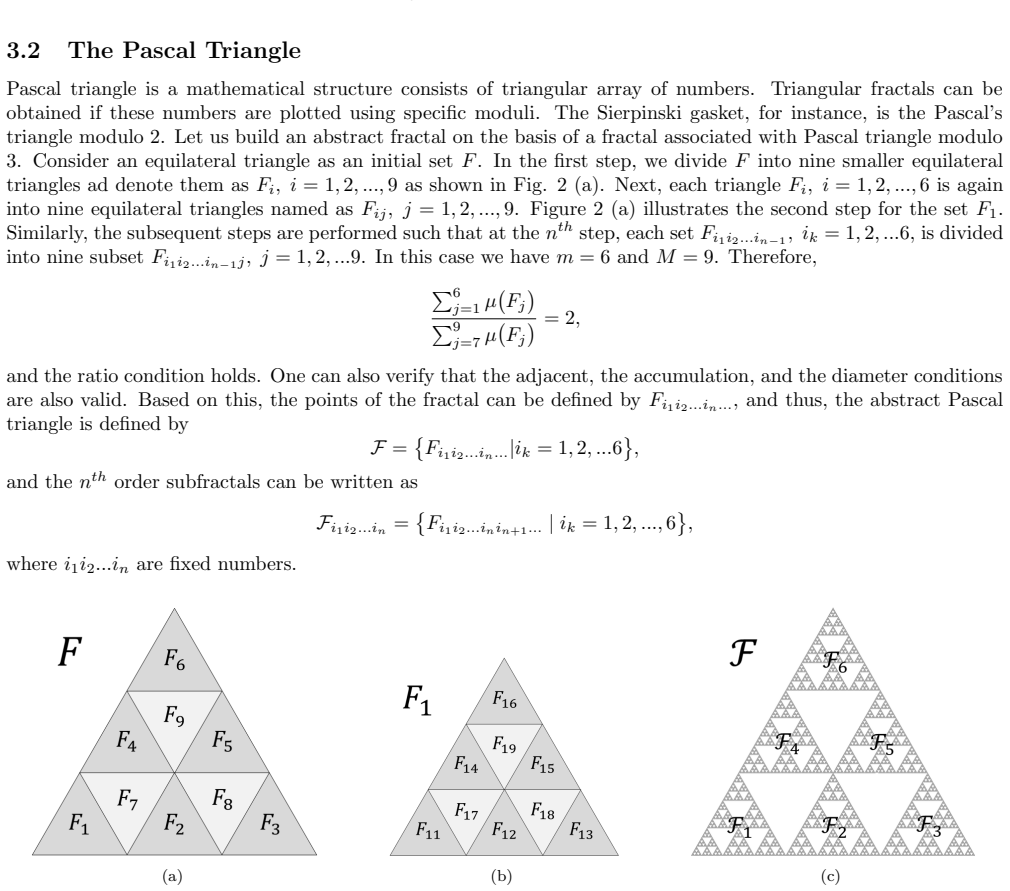
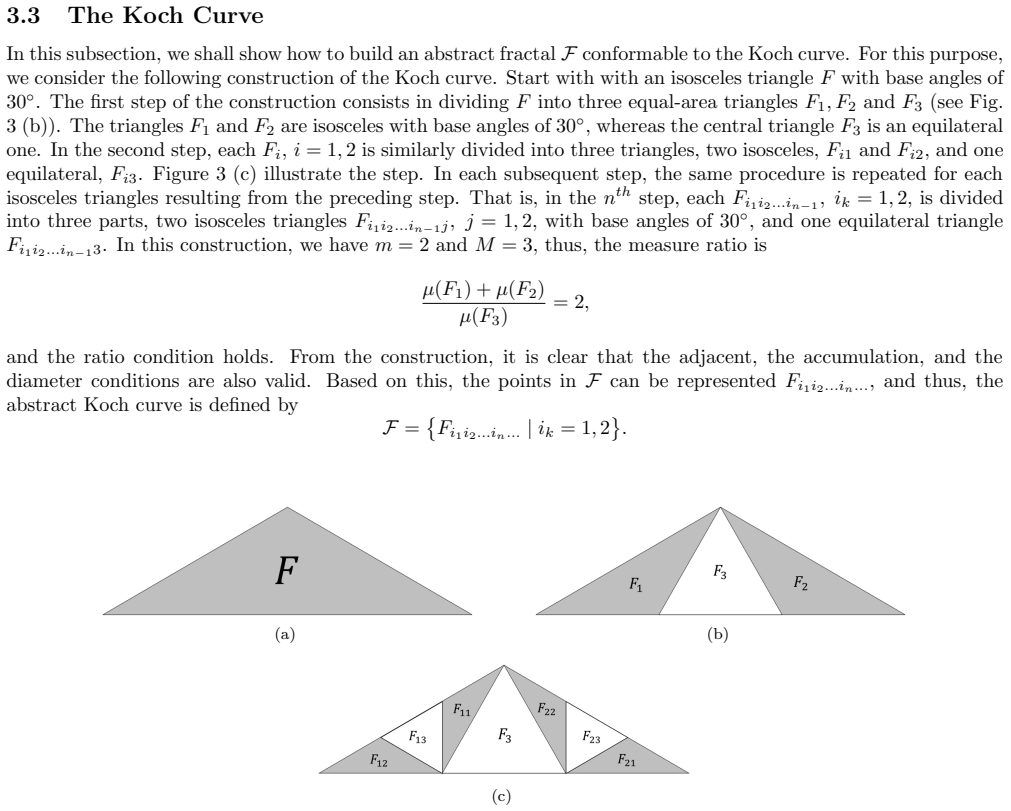
- The classic carpet, Pascal-triangle modulo 3, and Koch-curve constructions each satisfy the four conditions, so all three are abstract fractals with explicit parameters $m$, $M$, and ratio bounds.
- Every abstract fractal is an abstract self-similar set in the sense of the companion paper, making self-similarity a special case of the new structure.
- If the separation condition holds, the similarity map on $F$ is chaotic in the Poincaré, Li-Yorke, and Devaney senses, so the fractal itself carries complex dynamics.
- The new definition gives porosity a role in fractal theory comparable to self-similarity and dimension, and offers a route to a self-similar dimension for abstract fractals.
- Because the construction lives in an arbitrary compact metric measure space, the definition applies to porous media and symbolic spaces where exact self-similarity is not readily visible.
Reading between the lines
- The paper leaves implicit that a dimension theory for abstract fractals is still missing; if the ratio constants $r,R$ could be turned into a dimension formula, the abstract definition could be checked against the usual dimension-based one.
- A testable extension is to compute the separation constant for the three worked examples; if none of them has a positive separation constant, the chaos theorem applies only to other, possibly symbolic, abstract fractals rather than to the classical ones.
- The bottom-row construction—keep only the three lower subsquares of a $3\times3$ subdivision at every stage—appears to satisfy ratio, adjacent, and diameter conditions while converging to a one-dimensional line segment; if so, the definition as written is broader than the usual notion of fractal and may need an extra condition.
- One could randomize the construction, replacing the fixed ratio bounds by almost-sure bounds, which would connect the definition to statistically self-similar porous structures.
Signed reviews
Editorial analysis
A structured set of objections, weighed in public.
Referee Report
Summary. The paper proposes a new definition of fractals, called 'abstract fractal,' in a compact metric-measure space. Starting from a set F partitioned into M disjoint subsets (only m of which are retained at each stage), the authors impose four conditions: a ratio condition bounding the measure of retained cells against removed cells (Eq. (1)), an adjacent condition requiring each retained cell to touch some removed cell, an informally stated accumulation condition, and a diameter condition (Eq. (3)). The abstract fractal is then defined as the set of limit points of all infinite sequences of retained indices (Eq. (4)). The paper gives three examples (Sierpinski carpet, Pascal triangle modulo 3, and a Koch-type construction) and, in Section 4, claims that under a separation condition the associated shift map is chaotic in the senses of Poincare, Li-Yorke, and Devaney (Theorem 1), with the proof deferred to the authors' unpublished preprint [1]. Section 5 sketches a relation to iterated function systems and Section 6 discusses the definition's potential as a 'third definition' of fractals.
Significance. If the proposed definition could be made rigorous, it would offer a porosity-based, construction-oriented alternative to the usual IFS and Hausdorff-dimension characterizations of self-similar fractals, potentially covering examples such as the Sierpinski carpet where standard totally disconnected assumptions fail. The paper is honest about the fact that a Hausdorff-dimension theory for abstract fractals has not yet been developed (Section 6). However, as it stands, the significance is limited by (i) the lack of a precise statement and use of the accumulation condition, (ii) the unproved and possibly false coding injectivity needed for the shift map, and (iii) the reliance on an inaccessible preprint [1] for the main theorem. The examples are presented informally and one appears mislabeled. The paper does not yet establish that its definition is a meaningful new criterion rather than a restatement of coding-map dynamics on a subshift.
major comments (4)
- [Section 2, Eq. (4) and Section 3.1] The construction at the beginning of Section 2 requires F = union_{i=1}^M F_i with the F_i nonempty and disjoint, but the Sierpinski carpet example uses closed sub-squares with common boundaries; closed squares are not disjoint, while open squares would not have union equal to the initial closed square F. This makes it unclear whether the defining conditions are ever satisfied simultaneously, and it also means that Eq. (5), which identifies a subfractal with the set of limit points of infinite sequences, may fail because limit points of open cells can lie outside the cells. The paper needs to specify the topological status of the cells (open, closed, or half-open) and prove the identity in Eq. (5) under that specification.
- [Section 2, accumulation condition] The accumulation condition is stated only verbally and is not defined mathematically. As a result, it is impossible to verify it in the examples, and indeed Section 3 merely says it is 'clear' or 'valid' without demonstration. Since it is one of the four conditions in the definition, a reader cannot determine whether a given construction qualifies as an abstract fractal. Moreover, the condition is never used in the rest of the paper, including the proof of Theorem 1, so its role in the definition is unclear.
- [Section 4, Theorem 1] The similarity map phi is defined by phi(F_{i1 i2 ...}) = F_{i2 i3 ...}; this is a well-defined function only if each infinite index sequence corresponds to a unique point and distinct sequences correspond to distinct points. The paper never proves either statement, and the separation condition stated in Section 4 is far too weak to imply injectivity: it only says that for each n-cylinder there exists some other n-cylinder at distance at least epsilon0, which is compatible with overlapping cylinders and with boundary points admitting multiple addresses. In the standard Sierpinski carpet with closed cells, boundary points do have multiple addresses, so phi is not well-defined on F as given in Eq. (4). Consequently, Theorem 1 is not proven; the asserted transfer of results from the unpublished preprint [1] is not verifiable, and the separation condition is not checked for any of the examples.
- [Section 3.3] The construction described for the Koch curve retains only two of the three subtriangles at each stage (m=2), yielding a set that is at best a Cantor-type set, not the standard Koch curve, which is generated by four contractions and is connected. Unless a precise definition of 'Koch curve' is supplied that matches this construction, this example does not support the claim that the definition captures the usual self-similar fractals.
minor comments (6)
- [Section 3.1] The abstract Sierpinski carpet is written as F = {F_{i1 i2 ...} | ik = 1,2,...,5}, but the construction uses m=8; this is likely a typo and should be corrected to ik = 1,2,...,8.
- [Section 2, Eq. (1)] The ratio condition involves F_{i1...i_{n-1}j} for n=1, where the multi-index i1...i0 is undefined; the condition should be stated for n >= 2 or the base case n=1 defined separately.
- [Section 3.3] There is a duplicated word 'with' in 'Start with with an isosceles triangle' and the caption of Figure 4 is missing; the phrase 'Figure illustrats' should read 'Figure illustrates'.
- [Section 4 and references] Theorem 1 is stated with a double period after 'Devaney..' and the proof is deferred to the unpublished preprint [1]; the authors should either supply a self-contained proof or make [1] available, and the reference should be updated with publication status.
- [Section 6] The discussion claims that Cantor sets and Sierpinski fractals 'are also satisfied the Mandelbrot definition,' but the paper has not provided a Hausdorff-dimension computation for abstract fractals and later states that this dimension is 'not yet developed'; this apparent contradiction should be resolved.
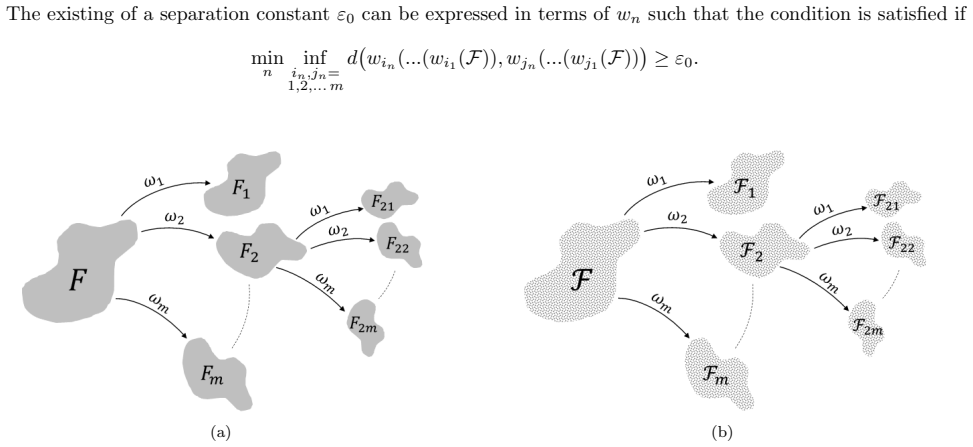
- [Section 5] The definition of the separation constant in Section 5, min_n inf_{i_n,j_n} d(w_{i_n}(...), w_{j_n}(...)) >= epsilon0, is not precise; the infimum should range over all admissible words of length n, and it is not clear why a single n suffices.
Circularity Check
Central chaos theorem is imported from the authors' own unpublished preprint [1]; the abstract-fractal definition itself is not circular.
-
self citation load bearing
[Section 4, Theorem 1]
"In paper [1], we have introduced the notion of the abstract self-similarity ... Considering the results on chaos for self-similar set provided in [1], it can be proven that the similarity map ϕ possesses the three ingredients of Devaney chaos, namely density of periodic points, transitivity and sensitivity. ... These results are summarized in the next theorem which can be proven in the similar way that explained in [1]. Theorem 1. If the separation condition holds, then the similarity map possesses chaos in the sense of Poincar´e, Li-Yorke and Devaney."
Theorem 1, the paper's main dynamical claim, is not proved in this paper. Its only justification is 'the results on chaos for self-similar set provided in [1]' and the statement that it 'can be proven in the similar way that explained in [1]'. Reference [1] is by the same two authors and is listed as 'submitted', so it is not an external, independently verified source. The load-bearing support for the theorem is therefore a self-citation chain, and the paper's conclusion about chaos stands or falls entirely on that unpublished companion work.
full rationale
The paper's new definition of an abstract fractal, together with the ratio, adjacent, accumulation, and diameter conditions, is a self-contained construction: no parameters are fitted to data, no empirical quantity is called a prediction, and the examples (Sierpinski carpet, Pascal triangle, Koch curve) are direct verifications of the stated conditions rather than consequences of a fitted model. I found no step where an equation is defined in terms of the very quantity it is supposed to derive, and no renaming of a known empirical result is presented as a derivation. The main circularity concern is isolated to Section 4: the chaos theorem is explicitly delegated to the authors' own unpublished preprint [1], and the separation condition is assumed rather than verified, so the paper's central dynamical result is not independently established within the manuscript. Because the abstract-fractal definition itself has independent content, the appropriate score is moderate rather than high.
Assumptions & free parameters
free parameters (2)
- subdivision counts m and M =
carpet: 8,9; Pascal: 6,9; Koch: 2,3
- porosity bounds r and R =
not specified (assumed to exist)
assumptions (4)
- domain assumption The initial set F is partitioned into M disjoint subsets, and every retained subset is again partitioned into M disjoint subsets at each level.
- standard math Compactness of X and the diameter condition imply every infinite chain of nested subsets converges to a unique point.
- ad hoc to paper The accumulation condition, stated as 'an accumulation point of any couple of complement sets does not belong to any of them', is meaningful and holds in the examples.
- ad hoc to paper The separation condition and the results of [1] imply chaos of the similarity map.
invented entities (1)
-
abstract fractal
Cite this review
Pith. "Pith review of Abstract Fractals." pith.science (2026). https://pith.science/paper/SGIID3ZO
@misc{pith2026190804273,
  author       = {Pith},
  title        = {Pith review of: Abstract Fractals},
  year         = {2026},
  howpublished = {\url{https://pith.science/paper/SGIID3ZO}},
  note         = {Machine review of arXiv:1908.04273}
}
read the original abstract
We develop a new definition of fractals which can be considered as an abstraction of the fractals determined through self-similarity. The definition is formulated through imposing conditions which are governed the relation between the subsets of a metric space to build a porous self-similar structure. Examples are provided to confirm that the definition is satisfied by large class of self-similar fractals. The new concepts create new frontiers for fractals and chaos investigations.
Figures

Figures from the paper (2 more)

Reference graph
Works this paper leans on
-
[1]
Akhmet, M. and Alejaily E. M. 2018, Abstract Similarity, Chaos and Fractals. (submitted)
work page 2018
-
[2]
Mandelbrot, B. B. 1983, The Fractal Geometry of Nature, Freeman, New York
1983
-
[3]
Addison, P. S. 1997, Fractals and Chaos: An Illustrated Course, Institute of Physics Publishing, Bristol, UK
work page 1997
-
[4]
1981, Fractals and self-similarity
Hutchinson J. 1981, Fractals and self-similarity. Indiana Univ. J. Math. 30 713–47
work page 1981
-
[5]
Barnsley, M. F. and Demko, S. 1985, Iterated function systems and the global construction of fractals, Proc. Roy. Soc. London Ser. A. 399 243-275
work page 1985
-
[6]
Barnsley, M. F. 1998, Fractals Everywhere. Academic Press, New York
work page 1998
-
[7]
and Fen, M
Akhmet, M. and Fen, M. O. 2016, Unpredictable points and chaos. Commun. Nonlinear Sci. Numer. Simulat. 40 1-5
2016
-
[8]
Akhmet, M., Fen and M. O. 2016, Poincar´ e chaos and unpredictable functions. Commun. Nonlinear Sci. Numer. Simulat. 48 85-94
work page 2016
Show all 19 references
-
[9]
and Vesely M
Zmeskal, O., Dzik P. and Vesely M. 2013, Entropy of fractal systems. Comput. Math. Appl. 66 135–146
2013
-
[10]
Anovitz, L. M. and Cole, D. R. 2015, Characterization and analysis of porosity and pore structures. Rev. Mineral. Geochem. 80 61–164
2015
-
[11]
Ganji, D. D. and Kachapi S. H. H. 2015, Application of Nonlinear Systems in Nanomechanics and Nanofluids: Analytical Methods and Applications. Elsevier Inc. New York
2015
-
[12]
Davis, H. T. 1989, On the fractal character of the porosity of natural sandstone. Europhys. Lett. 8 629-632
1989
-
[13]
and Liu, W
Yu, B. and Liu, W. 2004, Fractal analysis of permeabilities for porous media. AIChE J. 50(1) 46-57
2004
-
[14]
1993, Porosity-size relationship of drilling mud flocs: Fractal structure, Clay Clay Minerals
Huang, H. 1993, Porosity-size relationship of drilling mud flocs: Fractal structure, Clay Clay Minerals. 41 373-379
1993
-
[15]
D., Hulin, J
Guyon, E., Mitescu, C. D., Hulin, J. P. and Roux, S. 1989, Fractals and percolation in porous media and flows?. Physica D. 38 172-178
1989
-
[16]
C., Yu, B
Cai, J. C., Yu, B. M., Zuo, M. Q., and Mei, M. F. 2010, Fractal analysis of surface roughness of particles in porous media. CHIN. PHYS. LETT. 27(2) 024705
2010
-
[17]
and Feldman, Y
Puzenko, A., Kozlovich, N., Gutina, A. and Feldman, Y. 1999, Determination of pore fractal dimensions and porosity of silica glasses from the dielectric response at percolation. Phys. Rev. B. 60 14348
1999
-
[18]
P., Wang, J
Tang, H. P., Wang, J. Z., Zhu, J. L., Ao, Q. B., Wang, J. Y., Yang, B. J. and Li, Y. N. 2012, Fractal dimension of pore-structure of porous metal materials made by stainless steel powder. Powder Technol. 217 383-387
2012
-
[19]
Xia, Y., Cai, J., Wei, W., Hu, X., Wang, X. I. N. and Ge, X. 2018, A new method for calculating fractal dimensions of porous media based on pore size distribution. Fractals. 26 1850006. 7
2018
Reviewed August 14, 2026 · model on record in the stance chip above.
Discussion (0). Continue with ORCID to comment.