REVIEW 3 major objections 5 minor 1 cited by
Affine Frequency Division Multiplexing with Index Modulation: Full Diversity Condition, Performance Analysis, and Low-Complexity Detection
T0 review · 3 major / 5 minor · reviewed 2026-08-12 · deepseek-v4-flash
Pith's one-line read The paper claims that combining cyclic delay diversity with index modulation in affine frequency division multiplexing (AFDM) can achieve full transmit diversity in high-mobility channels, provided the normalized delay and Doppler paths…
desk verdict Real new AFDM-IM + CDD schemes and a practical detector, but the fractional-Doppler full-diversity proof is not established and the PEP bound has a missing factor. read the letter →
The pith
A machine-rendered reading of the paper's core claim, the machinery that carries it, and where it could break.
The reading
What carries the argument
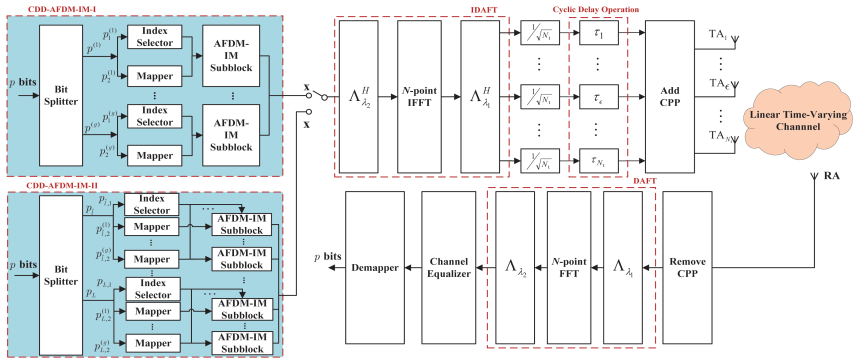
The load-bearing object is the DAF-domain effective channel matrix $\mathbf{H}_{\epsilon,\ell}$ of each antenna-path pair, whose non-zero entries sit on a band centered at $\mathrm{loc}_{\epsilon,\ell}=-\alpha_{\epsilon,\ell}+2N\lambda_1(l_{\epsilon,\ell}+l_\epsilon)$. Choosing the chirp parameter $\lambda_1=(2\alpha_{\max}+1)/(2N)$ in the integer Doppler case, or $\lambda_1=(2\alpha_{\max}+2k_\alpha+1)/(2N)$ in the fractional case, and a cyclic delay interval $\Delta_{\min}=l_{\max}+1$ between adjacent antennas pushes those bands apart, turning the non-overlap of the sets $A_{\epsilon,\ell}$ or $B_{\epsilon,\ell}$ into the full-diversity condition. Diversity itself is read from the rank of the difference matrix $\Upsilon_{\mathbf{x}_i}-\Upsilon_{\mathbf{x}_j}$: the minimum rank over distinct transmitted vectors is the diversity order, and the BER upper bound (31) is the pairwise-error-probability average that carries that rank to the error-rate curve. The double-layer message passing detector replaces exponential ML search by factor-graph messages that separate symbol likelihoods from activation-state constraints.
What would settle it
Take a channel whose fractional Doppler shifts produce leakage outside the assumed $2k_\alpha+1$ band (for example, two paths whose band centers satisfy (22) but whose true sinc-like tails overlap), simulate ML detection without truncating $\mathbf{H}_{\epsilon,\ell}$, and check whether the high-SNR BER slope still equals $P N_t$; if the slope is shallower than the rank bound predicts, the truncation in (12) is doing the diversity work rather than the physical channel.
Extended reading notes
Core claim
The central claim is a set of parameter rules under which the proposed CDD-AFDM-IM schemes make every resolvable path in the effective channel matrix occupy its own non-zero band, so the matrix collecting all path responses has full column rank. For integer Doppler shifts the requirement is $(l_{\max}+1)(2\alpha_{\max}+1)N_t \le N$; for fractional Doppler shifts it becomes $(l_{\max}+1)(2\alpha_{\max}+2k_\alpha+1)N_t \le N$, where $N$ is the number of chirp subcarriers, $l_{\max}$ and $\alpha_{\max}$ are normalized delay and Doppler bounds, $N_t$ is the number of transmit antennas, and $k_\alpha$ defines the assumed width of fractional-Doppler leakage. When this condition fails, the paper proves by a rank argument that the index bits still earn a diversity bonus: different activation patterns differ in at least two positions, so the diversity order of the index bits stays above that of ordinary modulated bits. The derived BER upper bound (31), built from the rank of the difference matrix, is what makes the diversity order visible before simulation.
Load-bearing premise
The analysis treats fractional Doppler interference as if it were confined to a band of width $2k_\alpha+1$ around each path's nominal position, so the full-diversity conditions for fractional Doppler hold only if real leakage tails outside that band remain negligible, and the paper does not give the $k_\alpha$ value used in its fractional-Doppler simulations.
Editorial extensions
If this is right
- When (21) or (22) holds, the CDD-AFDM-IM-I/II schemes reach the full diversity order $P N_t$, and the closed-form bound (31) predicts the high-SNR BER slope without Monte Carlo simulation.
- When the path-antenna product exceeds $N$, the index bits retain a higher diversity order than the modulation bits, so the schemes degrade more gracefully than CDD-AFDM as antennas are added.
- CDD-AFDM-IM-II, by forcing all groups to share one activation pattern, multiplies the number of non-zero entries in the difference vector by $g$ and therefore raises the ceiling on index-bit diversity.
- The DLMP detector brings the complexity of large-$N$ systems down from exponential ML search to a polynomial iteration count, with only a few percent more floating-point operations than single-layer message passing but better BER.
- In fractional Doppler channels, the same design works if the leakage is modelled as confined to $2k_\alpha+1$ slots; increasing $k_\alpha$ widens the guard bands and tightens condition (22).
Reading between the lines
- Implicit in the analysis is that $k_\alpha$, the assumed fractional-Doppler leakage width, governs a trade-off between diversity and spectral efficiency; making $k_\alpha$ adapt to the actual Doppler spread could recover capacity when the channel has few fractional taps.
- The same band-non-overlap logic could be re-applied to OTFS-style two-dimensional representations, where the equivalent condition would involve the product of delay and Doppler resolutions rather than a one-dimensional chirp index; if that analogy holds, the counting inequalities transfer to delay-Doppler grids.
- Because the full-diversity condition is purely combinatorial in $N$, $l_{\max}$, $\alpha_{\max}$, and $N_t$, it offers a testable design rule for other delay-Doppler waveforms that chirp a single time axis, including OCDM with an added cyclic delay.
- The Jakes model used in simulations produces continuous Doppler values, so the reported fractional-Doppler gains depend on the unstated $k_\alpha$ choice; a fairness benchmark should fix $k_\alpha$ and report sensitivity.
Signed reviews
Editorial analysis
A structured set of objections, weighed in public.
Referee Report
Summary. The paper proposes two index-modulation-assisted AFDM schemes with multiple transmit antennas, CDD-AFDM-IM-I and CDD-AFDM-IM-II, using cyclic delay diversity to obtain transmit diversity over linear time-varying channels. It analyzes parameter settings for full diversity in both integer- and fractional-Doppler cases, derives closed-form BER upper bounds under ML detection, and develops a double-layer message-passing (DLMP) detector for large-dimensional signal detection. Simulation results compare the proposed schemes and detector against AFDM, OTFS, CDD-AFDM, MP, and MMSE benchmarks in terms of BER and computational complexity.
Significance. If the theoretical claims are correct, the paper provides useful design rules for extending AFDM to multi-antenna index-modulation transmission and a practical low-complexity detector. The integer-Doppler disjoint-support argument is clear, the DLMP detector is evaluated against standard benchmarks with explicit FLOP counts, and the simulated BER curves in Figs. 4 and 5 confirm the predicted diversity slopes. However, the fractional-Doppler full-diversity analysis relies on an unquantified truncation of the DAF-domain channel, and the IM-diversity example omits same-activation error events. These gaps affect the central claims about full diversity and the diversity protection provided by index modulation.
major comments (3)
- [Section III, Eq. (12)] The fractional-Doppler full-diversity analysis replaces the exact DAF-domain response F_{e,l}[bar v, v] in Eq. (8), a Dirichlet kernel with nonzero values for every v, by a truncated response supported only on a band of width 2k_alpha+1 around each nominal location. Conditions (16), (18), (20), and (22) are therefore conditions on a truncated channel matrix, not on the true channel matrix H_{e,l}. The paper does not specify k_alpha for the fractional-Doppler simulations in Figs. 8(b) and 10(b), nor does it bound the out-of-band tail. Because the rank of the true difference matrix Upsilon_{xi-xj} can be smaller than that of its truncated version when sidelobe overlaps make the P*Nt columns dependent, the full-diversity claim for the fractional-Doppler channel modeled by Eq. (4) is not established. Please provide a rigorous tail bound showing that the truncation cannot change the rank, or specify k_alpha and prove that the diversity order is preserved for all channel realizations in the chosen parameter regime.
- [Section IV, Eq. (30)] The high-SNR approximation in Eq. (30) omits the factor (PNt)^d that follows from Eq. (29). With q1=1/(4N0) and q2=1/(3N0), each product in Eq. (29) tends to (PNt)^d (4N0)^d / prod(kappa_i^2) and (PNt)^d (3N0)^d / prod(kappa_i^2), respectively. The displayed result should contain (PNt)^d SNR^{-d}(4^d/12 + 3^d/4)/prod(kappa_i^2). The diversity order d is unchanged, but the claimed asymptotically tight upper bound in Eq. (31) has the wrong multiplicative constant, so the theoretical curves in Figs. 4 and 5 do not correspond to the stated bound.
- [Section IV-A, Eqs. (32)-(35)] The proof that index modulation can provide additional diversity when the full-diversity condition in (21) fails considers only pairs with different IM activation states. For a pair with the same activation state but different modulated symbols, the difference vector xi-xj contains only m nonzero entries, so the rank of Upsilon_{xi-xj} is at most m; in the N=4, m=1 example this rank is 1. Since the diversity order in Lemma 1 is the minimum over all pairs xi != xj, these same-activation symbol-error pairs determine the overall diversity order of the scheme. The example therefore does not show that CDD-AFDM-IM-I has a higher diversity order than CDD-AFDM when the full-diversity condition is violated; it shows only that index bits enjoy a larger rank when the index decision is wrong. The diversity-order claim for the whole scheme needs to be re-evaluated over all pairwise error events, and the comparison in Fig. 6 should be interpreted accordingly.
minor comments (5)
- [Section IV-A, after Eq. (37)] The sentence 'where each group in xj and xj carriers the same index bits' should read 'where each group in xi and xj carries the same index bits.'
- [Section VI] The phrase 'prefect CSIs' should be 'perfect CSI.'
- [Section I, contributions] The acronym 'CDD-AFM-IM' appears in the contribution list; it should be 'CDD-AFDM-IM' for consistency.
- [Section V, Eq. (49)] The message from the constraint node to the indicator node is denoted both 'uc' and 'u_c^{niter}' in the surrounding text; please unify the notation.
- [Fig. 2 caption] The caption contains garbled text '´eff H xy'; it should display the relation y = H_eff x.
Circularity Check
No circular derivation chain: the full-diversity conditions and BER bounds are derived from the channel/DAFT model and checked against external benchmarks; only minor, non-load-bearing self-citations appear.
full rationale
No load-bearing circular step was found. The full-diversity conditions (19)-(22) are derived from the non-overlap of the support sets A_e,l and B_e,l defined from the channel matrices in (11) and (12), with lambda1 chosen algebraically; they are not fitted to the BER curves. The PEP and ABEP analysis in (29)-(31) uses the standard Q-function approximation and the rank of the difference matrix, with the rank computed from the channel matrices; the agreement with simulation in Figs. 4-5 is an independent consistency check rather than a fitted prediction. The self-citations that appear, notably [11], [30], [32], [34], and [35], are used as baselines or as sources of standard techniques (PEP approximation, CDD/IM designs, damping factors), and they do not supply the paper's central diversity or BER claims. The fractional-Doppler band truncation in Eq. (12), imported from [20], is a modeling approximation whose validity is debatable because the exact Dirichlet kernel in Eq. (8) has full support; however, this is a correctness risk about whether the condition characterizes the true fractional-Doppler channel, not a circular reduction, since the paper's conditions are stated for the truncated model rather than being assumed equal to the conclusion. Overall, the central derivations are self-contained with respect to their stated channel model, so the circularity score is low.
Assumptions & free parameters
free parameters (4)
- k_alpha
- DLMP damping factor omega =
0.2
- DLMP maximum iterations n_max_iter =
20
- DLMP convergence threshold P
assumptions (5)
- domain assumption Non-overlap of non-zero entries in the DAF-domain channel matrices implies full diversity.
- ad hoc to paper Fractional Doppler interference is effectively confined to an interval of width 2k_alpha+1.
- domain assumption The channel between each transmit antenna and the receiver is an independent P-path LTV channel with perfect CSI at the receiver.
- standard math The PEP derivation uses the two-term Gaussian Q approximation of Eq. (27) and the union bound of Eq. (31).
- domain assumption DLMP treats the combined residual interference and noise as Gaussian at each observation node.
Cite this review
Pith. "Pith review of Affine Frequency Division Multiplexing with Index Modulation: Full Diversity Condition, Performance Analysis, and Low-Complexity Detection." pith.science (2026). https://pith.science/paper/SGVRYSXX
@misc{pith2026241109938,
  author       = {Pith},
  title        = {Pith review of: Affine Frequency Division Multiplexing with Index Modulation: Full Diversity Condition, Performance Analysis, and Low-Complexity Detection},
  year         = {2026},
  howpublished = {\url{https://pith.science/paper/SGVRYSXX}},
  note         = {Machine review of arXiv:2411.09938}
}
read the original abstract
Affine frequency division multiplexing (AFDM) is a novel modulation technique based on chirp signals that has been recently proposed as an effective solution for highly reliable communications in high-mobility scenarios. In this paper, we focus on the design of robust index modulation (IM) schemes under the multiple-antenna AFDM transmission framework. To this end, the cyclic delay diversity (CDD) technique is employed to harvest the transmit diversity gain. As a result, we propose two novel AFDM-IM schemes with transmit diversity, termed as CDD-AFDM-IM-I and CDD-AFDM-IM-II. We analyze the full diversity conditions and parameter settings of the proposed CDD-AFDM-IM schemes for both integer and fractional Doppler cases over linear time-varying (LTV) channels. Moreover, we prove that IM enables AFDM to have stronger diversity protection when the full diversity condition is not satisfied. Asymptotically tight upper bounds on the average bit error rates (BERs) of the proposed schemes with maximum-likelihood (ML) detection are derived in closed-form. Furthermore, we propose a low-complexity double-layer message passing (DLMP) algorithm for practical large-dimensional signal detection in the proposed CDD-AFDM-IM systems. Comparison with existing detections shows that the proposed DLMP algorithm achieves a better tradeoff between the BER performance and the computational complexity. Finally, BER simulation results confirm that our proposed CDD-AFDM-IM schemes with both the ML and DLMP detections outperform the benchmark schemes over the LTV channels.
Figures


Figures from the paper (7 more)


Forward citations
Cited by 1 Pith paper
-
Affine Frequency Division Multiplexing: Extending OFDM for Scenario-Flexibility and Resilience
A survey of affine frequency division multiplexing, a chirp-based waveform claimed to outperform OFDM in doubly dispersive channels and match OTFS performance.
Reference graph
Works this paper leans on
-
[30]
Affine Frequency Division Multiplexing With Index Modulation
Y . Tao, M. Wen, Y . Ge, and J. Li, “Affine frequency divisio n mul- tiplexing with index modulation,” in Proc. IEEE Wireless Commun. Netw. Conf. (WCNC) , Dubai, UAE, Apr. 2024, pp. 1–6, accepted. arXiv:2310.05475
work page Pith review arXiv 2024
-
[33]
H. Yin, J. Xiong, Y . Zhou, C. Zhang, D. Zhang, X. Wei, and Y . Tang, “Cyclic delay-doppler shift: A simple transmit diversity t echnique for delay-doppler waveforms in doubly selective channels, ” in Proc. IEEE Int. Conf. Acoust. Speech Signal Process. W orkshops (I CASSPW), Rhodes Island, Greece, Jun. 2023, pp. 1–5
work page 2023
-
[1]
J. G. Andrews, S. Buzzi, W. Choi, S. V . Hanly, A. Lozano, A. C. K. Soong, and J. C. Zhang, “What will 5G be?” IEEE J. Sel. Areas in Commun., vol. 32, no. 6, pp. 1065–1082, Jun. 2014
work page 2014
-
[2]
Evolution of non-terrestria l networks from 5G to 6G: A survey,
M. M. Azari, S. Solanki, S. Chatzinotas, O. Kodheli, H. Sa llouha, A. Colpaert, J. F. M. Montoya, S. Pollin, A. Haqiqatnejad, A. Mostaani, E. Lagunas, and B. Ottersten, “Evolution of non-terrestria l networks from 5G to 6G: A survey,” IEEE Commun. Surv. Tuts. , vol. 24, no. 4, pp. 2633–2672, Fourthquarter 2022
work page 2022
-
[3]
Vision, requirements and network architecture of 6G mobile network beyond 2030,
G. Liu, Y . Huang, N. Li, J. Dong, J. Jin, Q. Wang, and N. Li, “ Vision, requirements and network architecture of 6G mobile network beyond 2030,” China Commun. , vol. 17, no. 9, pp. 92–104, Sept. 2020
work page 2020
-
[4]
Outage pr obability for OTFS based downlink LEO satellite communication,
J. Shi, J. Hu, Y . Y ue, X. Xue, W. Liang, and Z. Li, “Outage pr obability for OTFS based downlink LEO satellite communication,” IEEE Trans. V eh. Technol., vol. 71, no. 3, pp. 3355–3360, Mar. 2022
work page 2022
-
[5]
Wireless communication s with unmanned aerial vehicles: opportunities and challenges,
Y . Zeng, R. Zhang, and T. J. Lim, “Wireless communication s with unmanned aerial vehicles: opportunities and challenges,” IEEE Commun. Mag., vol. 54, no. 5, pp. 36–42, May 2016
2016
-
[6]
Channel sou nding for high-speed railway communication systems,
T. Zhou, C. Tao, S. Salous, L. Liu, and Z. Tan, “Channel sou nding for high-speed railway communication systems,” IEEE Commun. Mag. , vol. 53, no. 10, pp. 70–77, Oct. 2015
work page 2015
Show all 39 references
-
[7]
Li and G
Y . Li and G. Stuber, Orthogonal Frequency Division Multiplexing (OFDM). Springer Science & Business Media, 2011
2011
-
[8]
Cell-f ree massive MIMO-OFDM for high-speed train communications,
J. Zheng, J. Zhang, E. Bj¨ ornson, Z. Li, and B. Ai, “Cell-f ree massive MIMO-OFDM for high-speed train communications,” IEEE J. Sel. Areas Commun., vol. 40, no. 10, pp. 2823–2839, Oct. 2022
2022
-
[9]
Orthogonal time frequency spa ce modu- lation,
R. Hadani, S. Rakib, M. Tsatsanis, A. Monk, A. J. Goldsmit h, A. F. Molisch, and R. Calderbank, “Orthogonal time frequency spa ce modu- lation,” in Proc. IEEE Wireless Commun. Netw. Conf. (WCNC) , San Francisco, CA, USA, Mar. 2017, pp. 1–6
2017
-
[10]
New delay doppler communication paradigm in 6G era: A surve y of orthogonal time frequency space (OTFS),
W. Y uan, S. Li, Z. Wei, Y . Cui, J. Jiang, H. Zhuang, and P . F an, “New delay doppler communication paradigm in 6G era: A surve y of orthogonal time frequency space (OTFS),” China Commun. , vol. 20, no. 6, pp. 1–25, Jun. 2023
2023
-
[11]
Blo ck- wise index modulation and receiver design for high-mobilit y OTFS communications,
M. Qian, F. Ji, Y . Ge, M. Wen, X. Cheng, and H. V . Poor, “Blo ck- wise index modulation and receiver design for high-mobilit y OTFS communications,” IEEE Trans. Commun. , vol. 71, no. 10, pp. 5726– 5739, Oct. 2023
2023
-
[12]
On the diversity of uncoded OTFS modulation in doubly-dispersive channels,
G. D. Surabhi, R. M. Augustine, and A. Chockalingam, “On the diversity of uncoded OTFS modulation in doubly-dispersive channels, ” IEEE Trans. Wireless Commun. , vol. 18, no. 6, pp. 3049–3063, Jun. 2019
2019
-
[13]
Channel estimatio n and turbo equalization for coded OTFS and OFDM: A comparison,
X. Huang, A. Farhang, and R. R. Chen, “Channel estimatio n and turbo equalization for coded OTFS and OFDM: A comparison,” IEEE Wireless Commun. Lett. , vol. 12, no. 9, pp. 1613–1617, Sept. 2023
2023
-
[14]
LEO satellite diversity in 6G non-terrestr ial networks: OFDM vs. OTFS,
S. Buzzi, G. Caire, G. Colavolpe, C. D. Andrea, T. Foggi, A. Piemontese, and A. Ugolini, “LEO satellite diversity in 6G non-terrestr ial networks: OFDM vs. OTFS,” IEEE Commun. Lett., vol. 27, no. 11, pp. 3013–3017, Nov. 2023
2023
-
[15]
Identificatio n of linear time-varying systems through waveform diversity,
A. Harms, W. U. Bajwa, and R. Calderbank, “Identificatio n of linear time-varying systems through waveform diversity,” IEEE Trans. Signal Process., vol. 63, no. 8, pp. 2070–2084, Apr. 2015
2015
-
[16]
Pilot chirp-assist ed OCDM communications over time-varying channels,
Y . Wang, R. Zhang, L. Y an, and X. Ma, “Pilot chirp-assist ed OCDM communications over time-varying channels,” IEEE Wireless Commun. Lett., vol. 12, no. 9, pp. 1578–1582, Sept. 2023
2023
-
[17]
Orthogonal chirp division multi plexing,
X. Ouyang and J. Zhao, “Orthogonal chirp division multi plexing,” IEEE Trans. Commun., vol. 64, no. 9, pp. 3946–3957, Sept. 2016
2016
-
[18]
AFDM: A full di versity next generation waveform for high mobility communications ,
A. Bemani, N. Ksairi, and M. Kountouris, “AFDM: A full di versity next generation waveform for high mobility communications ,” in Proc. IEEE Int. Conf. Commun. W orkshops (ICC W orkshops), Montreal, QC, Canada, Jun. 2021, pp. 1–6
2021
-
[19]
Affi ne frequency division multiplexing for next-generation wireless netwo rks,
A. Bemani, G. Cuozzo, N. Ksairi, and M. Kountouris, “Affi ne frequency division multiplexing for next-generation wireless netwo rks,” in Proc. Int. Symp. Wireless Commun. Sys. (ISWCS) , Berlin, Germany, Sept. 2021, pp. 1–6
2021
-
[20]
Affine frequen cy division multiplexing for next generation wireless communications ,
A. Bemani, N. Ksairi, and M. Kountouris, “Affine frequen cy division multiplexing for next generation wireless communications ,” IEEE Trans. Wireless Commun., vol. 22, no. 11, pp. 8214–8229, Nov. 2023
2023
-
[21]
Pilot aided channel estimation for A FDM in doubly dispersive channels,
H. Yin and Y . Tang, “Pilot aided channel estimation for A FDM in doubly dispersive channels,” in Proc. IEEE/CIC Int. Conf. Commun. China (ICCC) , Foshan, China, Aug. 2022, pp. 308–313
2022
-
[22]
An AFDM-based inte grated sensing and communications,
Y . Ni, Z. Wang, P . Y uan, and Q. Huang, “An AFDM-based inte grated sensing and communications,” in Proc. IEEE Int. Symp. Wireless Com- mun. Sys. (ISWCS) , Hangzhou, China, Oct. 2022, pp. 1–6
2022
-
[23]
Low complexit y equalization for AFDM in doubly dispersive channels,
A. Bemani, N. Ksairi, and M. Kountouris, “Low complexit y equalization for AFDM in doubly dispersive channels,” in Proc. IEEE Int. Conf. Acoust., Speech Signal Process. (ICASSP) , Singapore, Apr. 2022, pp. 5273–5277
2022
-
[24]
M. Wen, X. Cheng, and L. Y ang, Index Modulation for 5G Wireless Communications. Cham, Switzerland: Springer, 2017
2017
-
[25]
Index modulation techniques for 5G wireless networks,
E. Basar, “Index modulation techniques for 5G wireless networks,” IEEE Commun. Mag. , vol. 54, no. 7, pp. 168–175, Jul. 2016
2016
-
[26]
Multi- carrier DCSK with hybrid index modulation: a new perspective on freq uency- index-aided chaotic communication,
Y . Tao, Y . Fang, H. Ma, S. Mumtaz, and M. Guizani, “Multi- carrier DCSK with hybrid index modulation: a new perspective on freq uency- index-aided chaotic communication,” IEEE Trans. Commun. , vol. 70, no. 6, pp. 3760–3773, Jun. 2022
2022
-
[27]
M. Wen, Q. Li, and X. Cheng, Index Modulation for OFDM Commu- nications Systems . Berlin, Germany: Springer 2021
2021
-
[28]
Ortho gonal frequency division multiplexing with index modulation,
E. Basar, U. Aygolu, E. Panayirci, and H. V . Poor, “Ortho gonal frequency division multiplexing with index modulation,” IEEE Trans. Signal Process. , vol. 61, no. 22, pp. 5536–5549, Aug. 2013
2013
-
[29]
A survey on spatial modulation in em erging wireless systems: Research progresses and applications,
M. Wen, B. Zheng, K. J. Kim, M. D. Renzo, T. A. Tsiftsis, K. C. Chen, and N. Al-Dhahir, “A survey on spatial modulation in em erging wireless systems: Research progresses and applications,” IEEE J. Sel. Areas Commun. , vol. 37, no. 9, pp. 1949–1972, Jul. 2019
1949
-
[31]
Design and p erformance analysis of index modulation empowered AFDM system,
J. Zhu, Q. Luo, G. Chen, P . Xiao, and L. Xiao, “Design and p erformance analysis of index modulation empowered AFDM system,” IEEE Wireless Commun. Lett. , pp. 1–5, Dec. 2023
2023
-
[32]
Cyclic delay diversi ty with index modulation for green internet of things,
M. Wen, S. Lin, K. J. Kim, and F. Ji, “Cyclic delay diversi ty with index modulation for green internet of things,” in IEEE Trans. Green Commun. Netw., vol. 5, no. 2, pp. 600-610, Jun. 2021
2021
-
[34]
Receiver design for OTFS with a fractionally spaced sampling approach,
Y . Ge, Q. Deng, P . C. Ching, and Z. Ding, “Receiver design for OTFS with a fractionally spaced sampling approach,” IEEE Trans. Wireless Commun., vol. 20, no. 7, pp. 4072–4086, Jul. 2021
2021
-
[35]
OTFS signaling f or uplink NOMA of heterogeneous mobility users,
Y . Ge, Q. Deng, P . C. Ching, and Z. Ding, “OTFS signaling f or uplink NOMA of heterogeneous mobility users,” IEEE Trans. Commun., vol. 69, no. 5, pp. 3147–3161, May 2021
2021
-
[36]
Imp roved layered message passing algorithms for large-scale genera lized spatial modulation systems,
S. Fan, Y . Xiao, L. Xiao, P . Y ang, R. Shi, and K. Deng, “Imp roved layered message passing algorithms for large-scale genera lized spatial modulation systems,” IEEE Wireless Commun. Lett. , vol. 7, no. 1, pp. 66–69, Feb. 2018
2018
-
[37]
Efficient compressive sensing detectors for general ized spatial modulation systems,
L. Xiao, P . Y ang, Y . Xiao, S. Fan, M. D. Renzo, W. Xiang, an d S. Li, “Efficient compressive sensing detectors for general ized spatial modulation systems,” IEEE Trans. V eh. Technol. , vol. 66, no. 2, pp. 1284–1298, Feb. 2017
2017
-
[38]
Low complexity iterative rake d ecision feedback equalizer for zero-padded OTFS systems,
T. Thaj and E. Viterbo, “Low complexity iterative rake d ecision feedback equalizer for zero-padded OTFS systems,” IEEE Trans. V eh. Technol. , vol. 69, no. 12, pp. 15 606–15 622, Dec. 2020
2020
-
[39]
Interf erence can- cellation and iterative detection for orthogonal time freq uency space modulation,
P . Raviteja, K. T. Phan, Y . Hong, and E. Viterbo, “Interf erence can- cellation and iterative detection for orthogonal time freq uency space modulation,” IEEE Trans. Wireless Commun., vol. 17, no. 10, pp. 6501– 6515, Oct. 2018
2018
Reviewed August 12, 2026 · model on record in the stance chip above.
Discussion (0). Continue with ORCID to comment.