REVIEW 3 major objections 4 minor 53 references
Strong anisotropy of superfluid $^4$He counterflow turbulence
T0 review · 3 major / 4 minor · reviewed 2026-08-14 · deepseek-v4-flash
Pith's one-line read Counterflow superfluid helium turbulence is strongly anisotropic: most turbulent energy sits in wavevectors perpendicular to the counterflow direction, with streamwise velocity fluctuations dominant.
desk verdict A useful, internally consistent extension of the same group's earlier PRL, but the central quantitative prediction rests on an imported Lorentzian cross-correlation that the DNS never directly tests. read the letter →
The pith
A machine-rendered reading of the paper's core claim, the machinery that carries it, and where it could break.
The reading
What carries the argument
The machinery is the angular decoupling factor $D(k,\theta)=[1+(\rho_n k U_{ns}\cos\theta/(\rho\,\Omega_s))^2]^{-1}$ (Eq. 16c), which expresses how the correlation between normal-fluid and superfluid velocity fluctuations decays with wavenumber $k$ and with the angle $\theta$ between the wavevector and the counterflow velocity. Inserted into the mutual-friction dissipation $D^{\mathrm{mf}}_j=\Omega_j\tilde{E}_j[1-D]$, this factor selects which directions of wavevector space are damped: small $\cos\theta$ gives $D\approx 1$, almost no mutual friction, and spectra close to Kolmogorov scaling, while $\cos\theta\sim 1$ gives strong damping. The crossover scale $k_\times=\Omega_{ns}/U_{ns}$ sets where this anisotropy becomes important. The paper also uses a factorization ansatz for the two-dimensional spectrum and the smallness of the vortex-tangle anisotropy correction $(I_\perp-I_\parallel)/2\approx0.05$ to justify the simplified coupling.
What would settle it
Measure or compute the angularly resolved energy distribution in a counterflow with the same temperature and forcing conditions: the paper predicts that at fixed wavenumber the ratio of energy at $\cos\theta\approx 0$ to energy at $\cos\theta\approx 1$ grows steeply with $k$ and with temperature, for example at $T=2.0$ K the perpendicular-plane spectrum falls by roughly $10^{-8}$ between $k=1$ and $k=10$; a nearly isotropic distribution, or a temperature-independent angular spread, would refute the claim.
Extended reading notes
Core claim
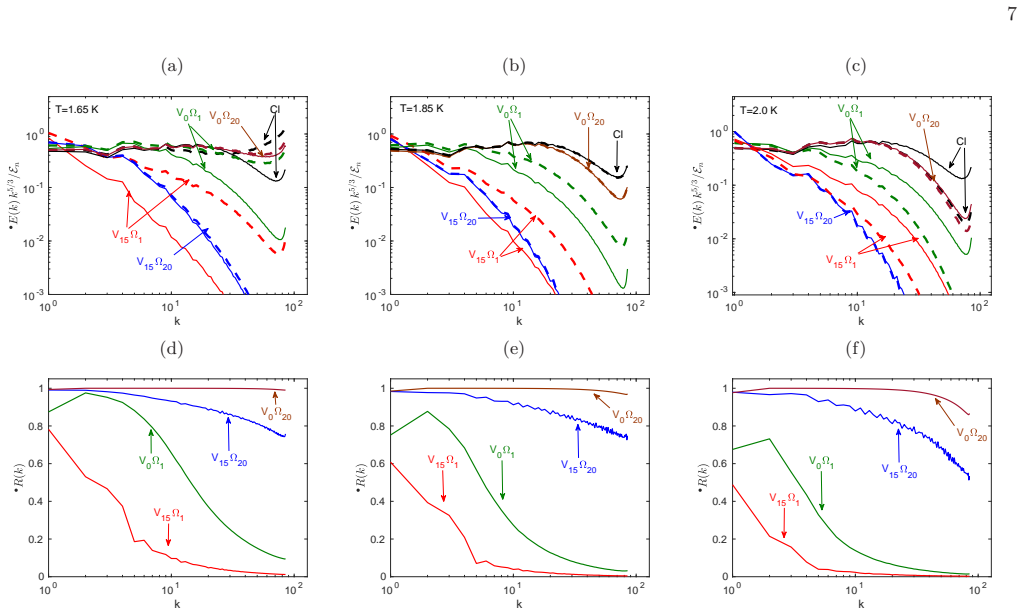
The central claim is that counterflow superfluid $^{4}$He turbulence is a special kind of quasi-two-dimensional turbulence: at small scales the energy is located in a narrow band of wavevectors near the plane orthogonal to the counterflow velocity $\boldsymbol{U}_{ns}$, and the velocity fluctuations are almost entirely the streamwise component $u_\parallel$ depending on the cross-stream coordinates. The angular dependence of the normal–superfluid velocity correlation, $D(k,\theta)$, controls the rate of mutual-friction dissipation $D^{\mathrm{mf}}_j(k,\theta)=\Omega_j \tilde{E}_j[1-D(k,\theta)]$, so fluctuations with wavevectors along the counterflow ($\cos\theta\to 1$) are damped and those in the perpendicular plane ($\cos\theta\to 0$) survive. The effect becomes stronger as $k$ increases and as temperature approaches $T_\lambda$, because the normal-fluid fraction and the coupling strength grow. The direct numerical simulations reported here confirm the predicted angular concentration, the dominance of the streamwise tensor component, and the temperature dependence.
Load-bearing premise
The prediction rests on the assumed formula for how quickly the normal and superfluid velocity fluctuations lose correlation as a function of scale and of angle relative to the counterflow; if that formula is wrong, the energy concentration in the perpendicular plane would not follow.
Editorial extensions
If this is right
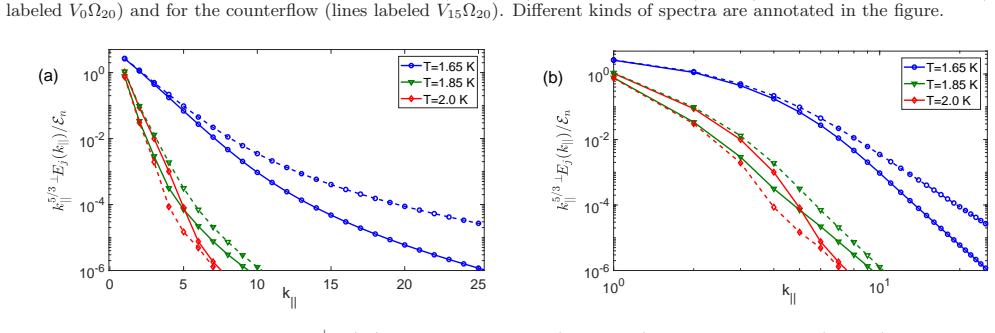
- Spherically averaged one-dimensional spectra hide the phenomenon; the informative diagnostics are the two-dimensional spectra $\tilde{E}_j(k,\theta)$ and the plane-averaged spectra, with the perpendicular-plane spectrum confined to small $k_\parallel$.
- At higher temperatures the anisotropy sharpens: at $T=2.0$ K roughly half the energy in the studied bands lies within $\cos\theta<0.025$, and the streamwise component $u_\parallel$ carries essentially all small-scale energy.
- The flow is smooth along the counterflow direction and turbulent across it, visualized as narrow jets or sheets $u_\parallel(r_\perp,t)$, the opposite tensor structure from stratified or rotating turbulence.
- Measured structure functions will not quantitatively reproduce the spectra, but the difference between longitudinal and transverse structure functions, and even more the second-difference structure functions, can reveal the anisotropy and the crossover scale $k_\times\simeq\Omega_{ns}/U_{ns}$.
Reading between the lines
- If the angular decoupling factor is accurate, coarse-grained models of counterflow turbulence could replace the full two-fluid equations with a direction-dependent dissipation term, since the perpendicular plane behaves almost classically while the streamwise direction is overdamped.
- The predicted angular concentration is a sharp experimental target: angularly resolved particle tracking should show the perpendicular-to-streamwise energy ratio growing steeply with $k$ and with $\rho_n/\rho$, tracking the temperature dependence reported here.
- The factorization $E(k_\parallel,k_\perp)\simeq f_1(k_\parallel)f_2(k_\perp)$, which the paper validates only at small $\cos\theta$, could be tested directly with higher-resolution simulations; its breakdown would indicate where the decoupling picture needs modification.
- Because the crossover scale $k_\times$ depends on the imposed counterflow velocity and mutual friction frequency, varying these in experiments should move the onset of anisotropy in a predictable way, providing an additional check of the mechanism.
Signed reviews
Editorial analysis
A structured set of objections, weighed in public.
Referee Report
Summary. This paper presents a combined analytical and numerical study of steady counterflow turbulence in superfluid 4He, described by the two-fluid coarse-grained Navier-Stokes equations (1b) with a mutual-friction force f_ns = Ω_s u_ns (plus a small anisotropic correction that is neglected). The theory starts from the balance equation (15) for the 2D energy spectrum and uses the Lorentzian cross-correlation form (16a)-(16c), imported from earlier work, to express the mutual-friction dissipation as Ω_j E_j [1-D(k,θ)] with D depending on (k U_ns cosθ / Ω_ns)^2. This leads to the prediction that eddies with wavevectors nearly aligned with the counterflow direction are selectively dissipated, so that most energy is concentrated in the perpendicular wavevector plane (small cosθ), with the streamwise velocity component dominant, and this anisotropy is stronger at higher temperature. The DNS solves the same equations at 256^3 resolution for three temperatures (1.65, 1.85, 2.0 K) and two mutual-friction frequencies, comparing counterflow with coflow. The simulations show strongly anisotropic 2D energy spectra (Fig. 2-3), a dominant streamwise component (Fig. 4), exponential angular falloff, and structure functions that differ strongly between longitudinal and transverse separations. The authors conclude that counterflow turbulence is a quasi-2D flow of the type u_parallel(r_perp), with smooth variation along the counterflow direction and turbulent variation across it.
Significance. If the central claim holds, the paper establishes a new kind of quasi-2D turbulent state that is qualitatively distinct from stratified or rotating turbulence: energy is concentrated in the wavevector plane perpendicular to the counterflow, while the dominant velocity component is the streamwise one. This is a falsifiable prediction with immediate experimental relevance, since existing tracer-line methods can measure S_parallel(R_parallel) and S_parallel(R_perp) separately. The paper's strengths include a systematic parameter scan (three temperatures, two coupling strengths, coflow controls), a direct visualization of the sheet-like structure (Fig. 5), the use of both spherical and cylindrical/planar spectral averages to expose anisotropy, and an honest treatment of the limitations of structure functions for non-scale-invariant spectra. The main gap is that the angular closure controlling the selective dissipation, Eq. (16c), is imported from a linearized analysis and never directly verified against the DNS; because the DNS uses the same coarse-grained equations, it cannot independently validate that closure.
major comments (3)
- [Sec. I C, Eq. (16c); Sec. II C, Fig. 2] The load-bearing element of the paper is the angular dependence of the decorrelation factor D(k,θ) in Eq. (16c), which controls the mutual-friction dissipation in Eq. (17) and hence the predicted concentration of energy near cosθ=0. This factor is imported from the linearized, white-noise solution of the two-fluid equations (Eq. (16a); Ref. 17) and is never directly tested against the DNS data. In fact, the DNS results shown in Fig. 2(d)-(f) and the text of Sec. II C state that the angular spectra and cross-correlations fall off roughly exponentially in cosθ, not as the Lorentzian 1/[1+(k U_ns cosθ/Ω_ns)^2]. Since the DNS solves the same coarse-grained equations used in the theory, a match between the DNS and the theoretical energy balance is not an independent validation of this closure. The authors should add a direct quantitative comparison between the DNS-measured R(k,θ) (or Ē_ns(k,θ)) and Eq. (16c), or alternatively reframe the quantitative predictions (k×, degree of anisotropy, temperature dependence) as consequences of the assumed closure rather than as tested results.
- [Sec. II E, Eqs. (24a)-(24c)] The factorization E(k||,k⊥) ≈ f1(k||)f2(k⊥) is introduced without independent justification and is then used to reconstruct the 2D spectrum and to assert agreement with the theoretical prediction that cosθ enters through the combination k cosθ = k||. This agreement is not a test of the factorization: the theoretical form (16c) already contains k cosθ, so the reconstructed θ-dependence is built in by construction. The authors should verify the factorization directly by comparing the DNS E_j(k||,k⊥) with the product of the cylindrical and planar spectra, Eq. (24b), over the claimed range of validity; without such a check, the reconstruction and the related discussion of the crossover should be presented as a working assumption.
- [Sec. II E, Eq. (25)] The proposed exponential form (25) and the identification k* ∝ k× = Ω_ns/U_ns are supported only by 'similar temperature trends' between k* read off from Fig. 7(a) and the values in Table I. This is explicitly a conjecture ('It is tempting to relate...'), yet it is used in the text as additional support for the factorization and the theory. Given that the crossover scale is one of the paper's quantitative outcomes, the identification should be tested by extracting k* from fits to the DNS spectra and comparing with k× for all temperatures and coupling values, or explicitly labeled as an open question. As written, the agreement is suggestive but does not constitute a quantitative confirmation.
minor comments (4)
- [Table I, Sec. II A] Table I appears to be misaligned or to have missing entries in several rows (e.g., runs #1, #3, #4 do not have entries in the columns for Ω, V, Re_n, Re_s, k× in the same pattern as the other runs). Please correct the table so that every run is fully specified.
- [Sec. II C] The method for estimating the cosθ range containing half of the energy is not described. Please state how the threshold was obtained (e.g., from cumulative integrals of the angular spectra over each band) so the quoted values (0.1, 0.05, 0.03, etc.) are reproducible.
- [Sec. II E, Fig. 3] The color scale of Fig. 3 spans many decades; please specify the normalization of the plotted quantity (e.g., E_s(k||,k⊥)/E_s) and whether the color bar is logarithmic.
- [Sec. I B 2] In the discussion of structure functions, the phrase 'apparent scaling' is used; it would be helpful to define it precisely (e.g., a local slope over a limited range) and to state the uncertainty in the measured exponents.
Circularity Check
Predicted angular anisotropy relies on a Lorentzian cross-correlation imported from the same group's earlier theory and not directly tested against the DNS; the DNS nevertheless provides an independent, model-based demonstration that anisotropy emerges.
-
self citation load bearing
[Sec. I C, Eqs. (16a)-(16c), (17)]
"The origin of the energy spectra anisotropy in counterflow turbulence can be deduced from the form of the dissipation rate Dmf_j(k,theta) (15b). In this term, the cross-correlation function ~Ens(k,theta) has the following form [cf. Eq.(13) in Ref. 17]: ~Ens(k,theta)=AB/[B^2+(k*Uns)^2]. ... D(k,theta)=1/[1+(kUns cos(theta)/Omega_ns)^2]."
The central theoretical prediction, that energy concentrates near cos(theta)=0, is obtained by substituting the imported D(k,theta) into Eq. (17) for mutual-friction dissipation. This D form is not derived in the present paper; it is cited to Ref. 17, whose authors overlap with the present authors. The paper does not directly compare D(k,theta) with the DNS cross-correlations: Fig. 2 shows the measured angular spectra and R(k,theta) falling roughly exponentially in cos(theta), not as the Lorentzian of Eq. (16c). The DNS solves Eqs. (1b) with isotropic mutual friction fns=Omega_s u_ns, so the simulations do not independently validate the angular Lorentzian closure.
full rationale
There is no fitted parameter relabeled as a prediction: Omega_s, Uns, nu_n, and nu_s are chosen as external control parameters, and the anisotropy is not imposed through an anisotropic friction term in the DNS. The DNS uses the isotropic mutual friction fns=Omega_s u_ns, so the observed angular localization emerges from the mean counterflow and the nonlinear dynamics. This gives the qualitative central claim substantial independent numerical content, even though it is tested on the same coarse-grained equations that the theory analyzes. However, the paper's analytical narrative presents the anisotropy as following from the selective-dissipation form D(k,theta), Eq. (16c), which is imported from the same authors' earlier Ref. 17 and is never directly verified against the DNS cross-correlation data. Because the quantitative shape and crossover scale of the predicted anisotropy reduce to that self-cited closure, while the main qualitative result is independently supported by the DNS, a partial circularity score of 4 is appropriate.
Assumptions & free parameters
free parameters (2)
- Mutual friction frequency Ω_s =
Ω = 1 and 20 (dimensionless)
- Counterflow velocity V = U_ns =
V = 15 (dimensionless)
assumptions (6)
- domain assumption Large-scale counterflow turbulence is described by the two-fluid coarse-grained Navier-Stokes equations (1b) with externally prescribed mean velocities and homogeneous statistics.
- domain assumption The fluctuating mutual friction force is f_ns = Ω_s u_ns, with the anisotropic vortex-tangle contribution neglected (I⊥-I‖)/2 ≈ 0.05, and L treated as constant.
- domain assumption The cross-correlation spectrum E_ns(k,θ) has the Lorentzian form AB/(B^2+(k·U_ns)^2), Eq. (16a), imported from Ref. 17.
- ad hoc to paper The decoupling approximation E_ns ≈ E_j D(k,θ), Eq. (16b), is accurate enough for the balance equations.
- domain assumption The energy-balance equation (15a) with the inertial transfer term div_k[ε_j(k)] does not itself introduce the anisotropy.
- ad hoc to paper 2D energy spectrum factorizes as E(k‖,k⊥) ≈ f1(k‖)f2(k⊥), Eq. (24a), in the energy-containing range of small k‖.
Cite this review
Pith. "Pith review of Strong anisotropy of superfluid $^4$He counterflow turbulence." pith.science (2026). https://pith.science/paper/SHH2RQ67
@misc{pith2026190801144,
  author       = {Pith},
  title        = {Pith review of: Strong anisotropy of superfluid $^4$He counterflow turbulence},
  year         = {2026},
  howpublished = {\url{https://pith.science/paper/SHH2RQ67}},
  note         = {Machine review of arXiv:1908.01144}
}
abstract
We report on a combined theoretical and numerical study of counterflow turbulence in superfluid $^{4}$He in a wide range of parameters. The energy spectra of the velocity fluctuations of both the normal-fluid and superfluid components are strongly anisotropic. The angular dependence of the correlation between velocity fluctuations of the two components plays the key role. A selective energy dissipation intensifies as scales decrease, with the streamwise velocity fluctuations becoming dominant. Most of the flow energy is concentrated in a wavevector plane which is orthogonal to the direction of the counterflow. The phenomenon becomes more prominent at higher temperatures as the coupling between the components depends on the temperature and the direction with respect to the counterflow velocity.
Figures


Figures from the paper (8 more)




Reference graph
Works this paper leans on
-
[1]
R. J. Donnelly, Quantized Vortices in Hellium II (Cambridge 3 University Press, Cambridge, 1991)
work page 1991
-
[2]
Quantized Vortex Dynamics and Superfluid Turbulence, edited by C.F. Barenghi, R.J. Donnelly and W.F. Vinen, Lecture Notes in Physics 571 (Springer-Verlag, Berlin, 2001)
work page 2001
-
[3]
W. F. Vinen and J. J. Niemela, Quantum turbulence. J. Low Temp. Phys. 128, 167 (2002)
work page 2002
-
[4]
P.Feynman, Application of quantum mechanics to liquid helium
R. P.Feynman, Application of quantum mechanics to liquid helium. Progress in Low Temperature Physics 1, 17 (1955)
work page 1955
-
[5]
H. E. Hall and W. F. Vinen, The rotation of liquid helium II. I. Experiments on the propagation of second sound in uniformly rotating helium II. Proc. Roy. Soc. A 238, 204 (1956).Donnel
work page 1956
-
[6]
I.L. Bekarevich, and I.M. Khalatnikov, Phenomenological Derivation of the Equations of Vortex Motion in He II, Sov. Phys. JETP 13, 643 (1961)
work page 1961
-
[7]
W. F. Vinen, Mutual friction in a heat current in liquid helium II I. Experiments on steady heat currents, Proc. R. Soc. 240, 114 (1957); Mutual friction in a heat current in liquid helium II. II. Experiments on transient effects, 240, 128 (1957); Mutual friction in a heat current in liquid helium II III. Theory of the mutual friction, 242, 493 (1957); Re...
work page 1957
-
[8]
R. N. Hills and P. H. Roberts, Superfluid mechanics for a high density of vortex lines, Arch. Ration. Mech. Anal. 66, 43 (1977)
work page 1977
Show all 53 references
-
[9]
K. W. Schwarz, Three-dimensional vortex dynamics in superfluid ^4 He: Homogeneous superfluid turbulence, Phys. Rev. B 38, 2398 (1988)
1988
-
[10]
Skrbek and K
L. Skrbek and K. R. Sreenivasan, in Ten Chapters in Turbulence, edited by P. A. Davidson, Y. Kaneda, and K. R. Sreenivasan (Cambridge University Press, Cambridge, 2013), pp. 405--437
2013
-
[11]
Marakov, J
A. Marakov, J. Gao, W. Guo, S. W. Van Sciver, G. G. Ihas, D. N. McKinsey, and W. F. Vinen. Visualization of the normal-fluid turbulence in counterflowing superfluid ^4 He, Phys. Rev. B, 91 094503. (2015)
2015
-
[12]
J. Gao, E. Varga, W. Guo and W. F. Vinen, Energy spectrum of thermal counterflow turbulence in superfluid Helium-4, Phys. Rev. B 96, 094511 (2017)
2017
-
[13]
S. Bao, W. Guo, V. S. L'vov, A. Pomyalov, Phys. Rev. B 98, 174509 (2018)
2018
-
[14]
La Mantia, L
M. La Mantia, L. Skrbek, Europhys. Lett. 105, 46002 (2014)
2014
-
[15]
La Mantia, P
M. La Mantia, P. S van c ara, D. Duda, and L. Skrbek, Small-scale universality of particle dynamics in quantum turbulence, Phys. Rev B 94, 184512 (2016)
2016
-
[16]
La Mantia, Particle dynamics in wall-bounded thermal counterflow of superfluid helium, Physics of Fluids 29, 065102 (2017)
M. La Mantia, Particle dynamics in wall-bounded thermal counterflow of superfluid helium, Physics of Fluids 29, 065102 (2017)
2017
-
[17]
Khomenko, V
D. Khomenko, V. S. L'vov, A. Pomyalov, and I. Procaccia, Counterflow induced decoupling in superfluid Turbulence. Phys. Rev. B 93, 014516 (2016)
2016
-
[18]
V. S. L'vov and A. Pomyalov, A theory of counterflow velocity dependence of superfluid ^4 He turbulence statistics, Phys. Rev. B, 97, 214513 (2018)
2018
-
[19]
Biferale; D
L. Biferale; D. Khomenko; V. L'vov; A. Pomyalov; I. Procaccia; G. Sahoo (2019). Superfluid Helium in Three-Dimensional Counterflow Differs Strongly from Classical Flows: Anisotropy on Small Scales. Physical Review Letters, 122,144501
2019
-
[20]
Biferale, D
L. Biferale, D. Khomenko, V.S. L'vov, A. Pomyalov, I. Procaccia, and G. Sahoo, Turbulent statistics and intermittency enhancement in coflowing superfluid ^4 He, Phys. Rev.Fluids 3, 024605 (2018)
2018
-
[21]
Bou\'e, V.S
L. Bou\'e, V.S. L'vov, A. Pomyalov, and I. Procaccia, Energy spectra of superfluid turbulence in ^3 He, Phys. Rev. B 85, 104502 (2012)
2012
-
[22]
Biferale, D
L. Biferale, D. Khomenko, V. L'vov, A. Pomyalov, I. Procaccia and G. Sahoo, Local and non-local energy spectra of superfuid ^3 He turbulence, Phys. Rev. B. 95, 184510 (2017)
2017
-
[23]
Kumar, M
A. Kumar, M. K. Verma and J. Sukhatme, Phenomenology of two-dimensional stably stratified turbulence under large-scale forcing, J. of Turbulence, 18, 219(2017)
2017
-
[24]
Alexakis, L
A. Alexakis, L. Biferale, Phys. Rep. 767-769,1 (2018)
2018
-
[25]
Biferale and I
L. Biferale and I. Procaccia, Anisotropy in Turbulent Flows and in Turbulent Transport, Phys. Rep. 414 43, (2005)
2005
-
[26]
Biferale, F
L. Biferale, F. Bonaccorso, I.M. Mazzitelli, M.A.T. van Hinsberg, A.S. Lanotte, S. Musacchio, P. Perlekar, and F. Toschi. Phys. Rev. X 6, 041036 (2016)
2016
-
[27]
Gallet, A
B. Gallet, A. Campagne, P.-P. Cortet, and F. Moisy, Phys. Fluids 26, 035108 (2014)
2014
-
[28]
Gallet, J
B. Gallet, J. Fluid Mech. 783, 412 (2015)
2015
-
[29]
R. J. Donnelly, C. F. Barenghi , The Observed Properties of Liquid Helium at the Saturated Vapor Pressure, J. Phys. Chem. Ref. Data 27, 1217(1998)
1998
-
[30]
C. F. Barenghi, V. S. L'vov, and P.-E. Roche, Experimental, numerical, and analytical velocity spectra in turbulent quantum fluid, Proc Natl Acad Sci USA 111, 4683 (2014)
2014
-
[31]
Skrbek, K.R
L. Skrbek, K.R. Sreenivasan Developed quantum turbulence and its decay. Phys Fluids 24, 011301 (2012)
2012
-
[32]
Rusaouen, B
E. Rusaouen, B. Chabaud, J. Salort, Philippe-E. Roche. Intermittency of quantum turbulence with superfluid fractions from 0\
-
[33]
Babuin, V.S
S. Babuin, V.S. L'vov, A. Pomyalov, L. Skrbek, E. Varga, Coexistence and interplay of quantum and classic al turbulence in superfluid He-4: Phys. Rev. B, 94, 174504 (2016)
2016
-
[34]
Boue, V.S
L. Boue, V.S. L'vov, Y. Nagar, S.V. Nazarenko, A. Pomyalov, I. Procaccia, Energy and vorticity spectra in turbulent superfluid He-4 from T=0 to T_ . Phys. Rev. B. 91, 144501, (2015)
2015
-
[35]
S. B. Pope, Turbulent Flows (Cambridge University Press, Cambridge, 2000)
2000
-
[36]
V. S. L'vov, S. V. Nazarenko and G. E. Volovik, Energy spectra of developed superfluid turbulence, JETP Letters, 80, 535 (2004)
2004
-
[37]
Salort, B
J. Salort, B. Chabaud, E. Leveque, and P.E. Roche. Investigation of intermittency in superfluid turbulence. Jour. Phys. : Conf. Series, 318, (2011)
2011
-
[38]
Salort, P.E
J. Salort, P.E. Roche and Leveque, Mesoscale equipartition of kinetic energy in quantum turbulence EPL, 94 24001 (2011)
2011
-
[39]
V. S. L'vov, S. V. Nazarenko, and L. Skrbek, Energy Spectra of Developed Turbulence in Helium Superfluids, Journal of Low Temperature Physics, 145, 125 (2006)
2006
-
[40]
C. J. Gorter and J. H. Mellink, Physica 15, 285 (1949)
1949
-
[41]
Kondaurova; V.S
L. Kondaurova; V.S. L'vov; A.Pomyalov; I. Procaccia. Structure of a quantum vortex tangle in He-4 counterflow turbulence. Physical Review B. 89 014502 (2014)
2014
-
[42]
D. N. McKinsey, C. R. Brome, J. S. Butterworth, S. N. Dzhosyuk, P. R. Huffman, C. E. H. Mattoni, J. M. Doyle, R. Golub, and K. Habicht, Habicht, Radiative decay of the metastable He_2(a^3 ^+_u ) molecule in liquid helium, Phys. Rev. A 59, 200 (1999)
1999
-
[43]
Biferale, M
L. Biferale, M. Cencini, A. Lanotte, and D. Vergini, Inverse velocity statistics in two dimensions, Phys. Fluids 15, 1012 (2003)
2003
-
[44]
Eyink, Exctact results on stationary turbulence in 2D: Consequences of vorticity conservation, Physica D (91), 97 (1991)
G.L. Eyink, Exctact results on stationary turbulence in 2D: Consequences of vorticity conservation, Physica D (91), 97 (1991)
1991
-
[45]
V. S. L'vov and A. Pomyalov, Statistics of Quantum Turbulence in Superfluid He, J. Low Temp Phys 187, 497 (2017)
2017
-
[46]
L'vov and I
V.S. L'vov and I. Procaccia, The universal scaling exponents of anisotropy in turbulence and their measurement. Physics of Fluids 8, 2565 (1996)
1996
-
[47]
L'vov and I
I Arad, V.S. L'vov and I. Procaccia, Correlation functions in isotropic and anisotropic turbulence: The role of the symmetry group, Phys. Rev. E 59, 6753 (1999)
1999
-
[48]
L'vov, and I
I Arad, V.S. L'vov, and I. Procaccia, Anomalous scaling in anisotropic turbulence, Physica A. 288, 280 (2000)
2000
-
[49]
L'vov, I
V.S. L'vov, I. Procaccia and V. Tiberkevich, Scaling exponents in anisotropic hydrodynamic turbulence, Phys. Rev. E 67, 026312 (2003)
2003
-
[50]
Please notice that in the AnisoLetter there is a typo referring to these data as u_ s,x ^2 and u_ s, y ^2
-
[51]
E. B. Sonin, Vortex oscillations and hydrodynamics of rotating superfluids, Rev. Mod. Phys. 59, 87 (1987)
1987
-
[52]
S. K. Nemirovskii and V. V. Lebedev, The hydrodynamics of superfluid turbulence Zh. Eksp. Teor. Fiz. 84, 1729-1742 (May 1983), Sov. Phys. JETP 57 1009 (1983)
1983
-
[53]
0<_/ BsR+`)umkF5i9nc:OTdIY3Q q+ZdI(33u4VlGJV*H+m,Ph
S. K. Nemirovskii, Physics Reports, 524, 85 (2013) Fig10.eps0000664000000000000000000015055413521257062011152 0ustar rootroot /bd bind def bind def /ld load def bd /GR/grestore ld /GS/gsave ld /RM/rmoveto ld /C/curveto ld /t/show ld /L/lineto ld /ML/setmiterlimit ld /CT/concat...
2013
Reviewed August 14, 2026 · model on record in the stance chip above.
Discussion (0). Continue with ORCID to comment.