REVIEW 3 major objections 4 minor 61 references
Cepheid metallicities from low-resolution near-infrared spectra: validation against the optical reference scale
T0 review · 3 major / 4 minor · reviewed 2026-08-06 · deepseek-v4-flash
Pith's one-line read Low-resolution near-infrared spectra of classical Cepheids can deliver metallicities that match the standard optical reference scale to within about $0.1$ dex.
desk verdict The empirical validation is solid: 14 Cepheids with low-res NIR spectra track optical [Fe/H] at ~0.1 dex, and the flagged-pixel mask worry is real but not fatal; it deserves a referee. read the letter →
The pith
A machine-rendered reading of the paper's core claim, the machinery that carries it, and where it could break.
The reading
What carries the argument
The mechanism is a Bayesian full-spectrum fitting pipeline built on a grid of MARCS/TURBOSPECTRUM synthetic spectra. A PCA-based emulator predicts the spectrum as a function of $T_{\rm eff}$, $\log g$, $[M/H]$, and microturbulent velocity; the forward model then applies instrumental broadening and a local polynomial continuum correction. The likelihood is a Gaussian with a regularised covariance matrix: a Matérn-3/2 kernel evaluated in velocity space captures correlated residuals with a characteristic length scale of about 4 pixels, and a fixed flagged-pixel mask inflates the variance of pixels whose baseline residuals exceed $3\sigma$ in at least 30% of the sample stars. This combination is designed to absorb genuine modelling imperfections while preventing the noise model from removing the metallicity-sensitive spectral structure.
What would settle it
A check that would settle the matter: rerun the full pipeline on spectra with a scrambled flagged-pixel mask (same mask size, random pixel positions) and compare the resulting offset; if it moves by more than about 0.1 dex, the mask itself is carrying the metallicity information.
Extended reading notes
Core claim
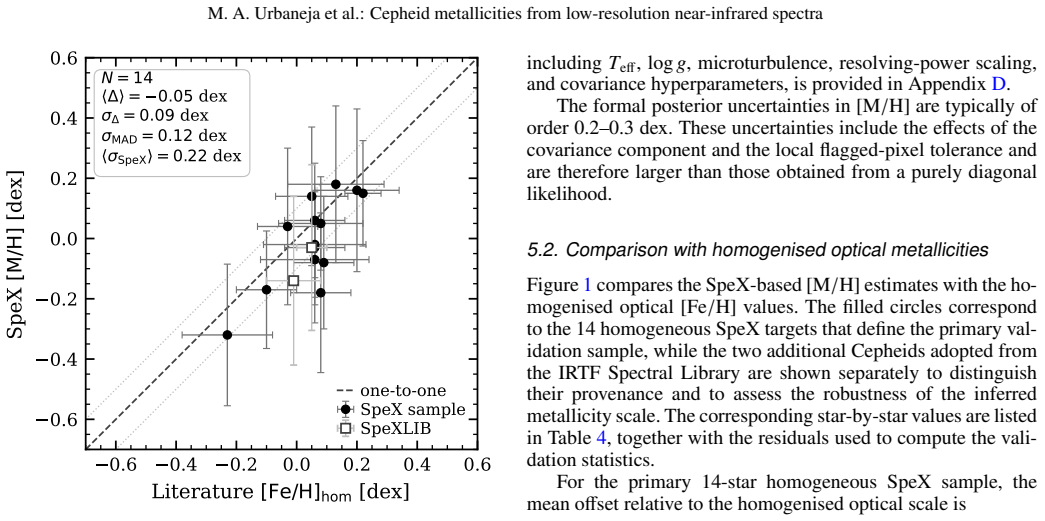
The central claim is that a global metallicity parameter $[M/H]$ inferred from low-resolution ($R\simeq2000$) SpeX/IRTF Y+J spectra of classical Cepheids is consistent with the homogenised optical iron-abundance scale for the same stars. For the primary 14-star homogeneous sample, the mean offset is $\langle \Delta[M/H]\rangle = -0.054$ dex, the standard deviation of the residuals is $0.085$ dex, and the scatter defined by the median absolute deviation is $0.119$ dex, with a median posterior uncertainty of $0.22$ dex. The paper interprets this as evidence that useful metallicity information is spread across many blended atomic and molecular features in the near-infrared, and that it can be extracted when the statistical model explicitly absorbs short-range correlated residuals and a small number of localised problematic wavelength regions. The near-infrared scale is therefore tied to the optical reference scale at the level of roughly $0.1$ dex.
Load-bearing premise
The method assumes that the pixels given extra tolerance and the correlated-noise model absorb only non-stellar modelling defects, never the spectral features that carry the metallicity signal.
Editorial extensions
If this is right
- The near-infrared metallicity scale for Cepheids is anchored to the homogenised optical scale at roughly the 0.1 dex level, so future low-resolution surveys can quote abundances directly comparable to high-resolution optical work.
- Only low-resolution Y+J spectra are needed, making it practical to extend direct metallicity measurements to Cepheids in the Local Group and nearby galaxies that are too faint or crowded for high-resolution optical spectroscopy.
- A J-band-only analysis still recovers a broadly consistent metallicity scale, albeit with a larger offset, which is useful for multi-object spectrographs that observe only one band.
- The explicit treatment of correlated residuals and flagged pixels is necessary: omitting it shifts the mean offset and degrades the uncertainty calibration, as shown by the diagonal-likelihood comparison.
Reading between the lines
- A natural extension would be to calibrate the same pipeline on Cepheids in the Large Magellanic Cloud, where the optical iron scale is independently established; if the agreement persists, the method can produce a homogeneous near-infrared metallicity scale for entire nearby galaxies.
- The covariance hyperparameters may themselves be useful diagnostics of model fidelity: if the inferred correlation length grows in specific wavelength regions, it could point to missing line opacity or incomplete telluric correction that a better model or line list could fix.
- The same regularised-covariance strategy could be applied to other cool luminous stars, such as red supergiants or blue supergiants, potentially creating a uniform near-infrared abundance scale across the young stellar populations of nearby galaxies.
Editorial analysis
A structured set of objections, weighed in public.
Referee Report
Summary. The paper validates a method for deriving Cepheid metallicities from low-resolution (R~2000) SpeX/IRTF Y+J-band spectra by comparing inferred [M/H] values from Bayesian full-spectrum fitting against homogenized optical [Fe/H] values from the literature. The primary sample consists of 14 homogeneous Galactic Cepheids, supplemented by two shorter-period stars from the IRTF Spectral Library. The analysis uses MARCS/TURBOSPECTRUM synthetic spectra with a PCA-based emulator, a regularized covariance likelihood, and a flagged-pixel tolerance term. For the primary 14-star sample the paper reports a mean offset of -0.054 dex, a residual scatter of 0.085 dex, a robust scatter of 0.119 dex, a median posterior uncertainty of 0.22 dex, and an RMS normalized residual of 0.383. The paper concludes that low-resolution Y+J spectra contain usable metallicity information for classical Cepheids when correlated and localized residuals are treated explicitly, and that the resulting near-infrared metallicity scale is tied to the homogenized optical scale.
Significance. External validation against an independent, homogenized optical abundance scale is the appropriate strategy, and the small empirical scatter relative to the conservative posterior uncertainties (RMS normalized residual of 0.383) is encouraging. The paper is transparent about the adopted likelihood, provides full posterior tables and spectral fit diagnostics, and tests a range of alternative residual models; the observation that increasingly flexible noise models degrade external agreement is a useful caution for this regime. If the flagged-pixel-mask issue raised below is resolved, the paper would provide a practical foundation for extending Cepheid metallicity work to more distant systems. The main caveat is that the production noise model contains a data-driven component constructed from residuals of the same sample, so one additional control is needed before the central claim is fully supported.
major comments (3)
- [§4.4, Eq. (13), and Table 5] The production likelihood's flagged-pixel mask is constructed from residuals of an initial baseline fit to the same 14-star sample, yet Table 5 does not include the control case of the regularized covariance likelihood with the mask disabled (a_flag=0). The text states that a_flag=0 recovers the regularized global-covariance likelihood without flagged-pixel tolerance, but no validation statistics are given for that configuration. Since the mask can in principle down-weight the very pixels that carry the [M/H] signal, the central claim requires an explicit demonstration that the offset and scatter of -0.054 and 0.085 dex are not produced by the noise model absorbing metallicity information. Please add this control to Table 5 and report the resulting offset, scatter, and RMS(z).
- [§4.4 and Appendix C] The baseline fit from which the flagged-pixel mask is derived is not fully specified, and the mask is defined using the same stars that are later used for validation. A direct test of whether the masked pixels are metallicity-sensitive would strengthen the paper: for example, compute the [M/H] posterior with and without the flagged pixels included at normal weight, or construct the mask from residuals of fits with [M/H] held fixed at the grid extremes and verify that the same pixels are flagged. Without such a test, the assumption that the flagged pixels capture only non-stellar, modelling-related defects remains unverified.
- [Appendix E, Table E.1] The Y+J reference row in Table E.1 does not reproduce the production-likelihood statistics reported in Section 5.2. For the 14-star sample the paper reports offset -0.054 dex, scatter 0.085 dex, robust scatter 0.119 dex, median uncertainty 0.22 dex, and RMS(z)=0.383; for the 16-star sample it reports offset -0.061 dex, scatter 0.082 dex, robust scatter 0.104 dex, and RMS(z)=0.382. Table E.1 lists -0.06, 0.09, 0.09, 0.23, and 0.41 for the same configuration. Since Appendix E states that no aspect of the methodology was modified apart from restricting the fit to the J band, the Y+J column should match one of these sets; please correct the table or specify which sample and configuration it refers to.
minor comments (4)
- [Abstract and §5.5] The robust scatter is quoted to different precision in the abstract (0.12 dex) and in Section 5.5 (0.119 dex); please harmonize.
- [Table 4] The entry for S Vul reads “0.06 +0.18 −0.20” without the usual spacing around the asymmetric uncertainties; the table would be easier to read with consistent formatting.
- [References and §1] The introduction cites “Nunnari et al. in prep” but the reference list does not include an entry for it; please add the reference or remove the citation.
- [Fig. 2 caption] The caption refers to panels (a), (b), and (c) but the panels are not labelled in the figure; please add labels.
Circularity Check
No significant circularity: the near-infrared metallicity scale is validated against an externally homogenised optical [Fe/H] reference, and the residual-model concerns are robustness issues rather than definitional reductions.
full rationale
The paper's central validation compares SpeX-based [M/H] estimates with homogenised optical [Fe/H] values taken from prior literature (Luck 2018; Bhardwaj et al. 2023) for the same stars. The homogenisation procedure (Appendix B) only applies zero-point corrections derived from stars in common, preserving each source's relative ranking; it does not use the SpeX fits as input. The metallicity inference itself is based on a MARCS/TURBOSPECTRUM synthetic grid and a PCA-based emulator (MAUI, Urbaneja 2026); the cited framework is methodological and not used to define the validation target. The period-log g_F prior is an external empirical relation (Groenewegen & Lub 2023), not a self-citation carrying the argument. The flagged-pixel mask (Sect. 4.4) is constructed from baseline residual statistics of the same sample, and the paper does not provide a dedicated no-mask control; this is a legitimate robustness concern about whether the noise model absorbs metallicity information. However, it is not a formal circularity: the mask is not defined in terms of the final [M/H] values, and the production likelihood is not fitted to the optical reference scale. The sensitivity tests in Sect. 6 and Table 5 show that more flexible residual models degrade external agreement, which partially addresses the concern. No step in the derivation equates the prediction to its input by construction, and no load-bearing claim reduces to a self-citation chain. The paper remains self-consistent and externally anchored, so the circularity score is 1 rather than 0 only because of the minor self-citation to the MAUI framework and the residual-mask robustness caveat.
Assumptions & free parameters
free parameters (4)
- Covariance amplitude log s_cov =
-1.0
- Correlation length ℓ_cov =
4.0 pixels
- Flagged-pixel extra tolerance log a_flag =
0.5
- Resolving-power scale factor s_R =
≈1.0
assumptions (4)
- domain assumption MARCS 1D hydrostatic LTE model atmospheres accurately represent Cepheid photospheres in the near-infrared.
- domain assumption Scaled-solar abundance pattern with all metals scaled together is adequate for Cepheid NIR spectra.
- domain assumption The empirical period-log g_F relation of Groenewegen & Lub (2023) provides an appropriate prior for surface gravity at the observed phases.
- ad hoc to paper The residual covariance and flagged-pixel mask capture only model imperfections, not metallicity signal.
Cite this review
Pith. "Pith review of Cepheid metallicities from low-resolution near-infrared spectra: validation against the optical reference scale." pith.science (2026). https://pith.science/paper/SIMQ6UJM
@misc{pith2026260804767,
  author       = {Pith},
  title        = {Pith review of: Cepheid metallicities from low-resolution near-infrared spectra: validation against the optical reference scale},
  year         = {2026},
  howpublished = {\url{https://pith.science/paper/SIMQ6UJM}},
  note         = {Machine review of arXiv:2608.04767}
}
read the original abstract
Classical Cepheid metallicities trace recent chemical enrichment and help assess systematics in Cepheid-based distance measurements. They are derived mainly from high-resolution optical spectroscopy, which provides the benchmark abundance scale but limits measurements to nearby systems. Extending such studies to more distant Cepheids with extremely large telescopes requires complementary low-resolution near-infrared methods and careful treatment of model--data residuals. We test whether low-resolution SpeX/IRTF Y+J-band spectra can yield metallicities compatible with homogenised optical abundances. We analyse 14 Galactic classical Cepheids with periods of approximately 13--69 d, supplemented by two shorter-period stars from the IRTF Spectral Library. Using Bayesian full-spectrum fitting based on MARCS/TURBOSPECTRUM spectra and a regularised covariance likelihood, we infer [M/H] and compare it with homogenised optical [Fe/H]. For the primary 14-star sample, the inferred metallicities reproduce the optical reference scale with a mean offset of -0.05 dex, a scatter of 0.09 dex, and a robust scatter of 0.12 dex; the median posterior uncertainty is 0.22 dex. Including the two additional stars changes these values only slightly. Compared with a diagonal likelihood, the covariance-aware treatment reduces the mean offset and improves the stability of the uncertainty calibration. Low-resolution Y+J spectra therefore contain usable metallicity information for classical Cepheids when short-range correlated residuals and localised modelling imperfections are treated explicitly. The resulting near-infrared metallicity scale provides a practical foundation for extending Cepheid metallicity work to larger and more distant samples.
Figures

Reference graph
Works this paper leans on
-
[1]
Near-infrared narrow-band photometry of M-giant and Mira stars: models meet observations. , keywords =. doi:10.48550/arXiv.astro-ph/9710157 , archivePrefix =. astro-ph/9710157 , primaryClass =
-
[2]
On the effect of rotation on populations of classical Cepheids. II. Pulsation analysis for metallicities 0.014, 0.006, and 0.002. , keywords =. doi:10.1051/0004-6361/201528031 , archivePrefix =. 1604.05691 , primaryClass =
-
[3]
Using Cepheids to determine the galactic abundance gradient. I. The solar neighbourhood. , keywords =. doi:10.1051/0004-6361:20011488 , archivePrefix =. astro-ph/0112525 , primaryClass =
-
[4]
Barium abundances in Cepheids. , keywords =. doi:10.1093/mnras/sts270 , archivePrefix =. 1210.6211 , primaryClass =
-
[5]
Quantitative Spectroscopy of Supergiants in the Local Group Dwarf Galaxy IC 1613: Metallicity and Distance. , keywords =. doi:10.3847/1538-4357/aac493 , archivePrefix =. 1805.07352 , primaryClass =
-
[6]
Fundamental parameters of Cepheids. III. Turbulence variations. , keywords =
-
[7]
Measurements of microturbulence of Cepheids using the autocorrelation function
Measurements of microturbulence of Cepheids using the autocorrelation function. , keywords =. doi:10.1093/mnras/stx1546 , archivePrefix =. 1707.00738 , primaryClass =
-
[8]
Blue Supergiants in the Pinwheel Galaxy M101: Comparison with H II Region Chemical Abundances, Spectroscopic Distance, and an Independent Determination of the Hubble Constant. , keywords =. doi:10.3847/1538-4357/adfc4c , archivePrefix =. 2508.11837 , primaryClass =
Show all 61 references
-
[9]
, keywords =
An Improved Calibration of the Wavelength Dependence of Metallicity on the Cepheid Leavitt Law. , keywords =. doi:10.3847/1538-4357/ac97e2 , archivePrefix =. 2205.06280 , primaryClass =
-
[10]
, keywords =
The Araucaria Project: VLT Spectra of Blue Supergiants in WLM- Classification and First Abundances. , keywords =. doi:10.1086/506200 , archivePrefix =. astro-ph/0605640 , primaryClass =
-
[11]
, keywords =
VLT Spectroscopy of Blue Supergiants in IC 1613. , keywords =. doi:10.1086/522571 , archivePrefix =. 0707.2881 , primaryClass =
-
[12]
, keywords =
sick: The Spectroscopic Inference Crank. , keywords =. doi:10.3847/0067-0049/223/1/8 , archivePrefix =. 1603.03043 , primaryClass =
-
[13]
High-resolution IGRINS spectroscopy of 23 classical Cepheids: Validating NIR abundances
Cepheid Metallicity in the Leavitt Law (C─MetaLL) survey: VII. High-resolution IGRINS spectroscopy of 23 classical Cepheids: Validating NIR abundances. , keywords =. doi:10.1051/0004-6361/202558020 , archivePrefix =. 2511.06264 , primaryClass =
-
[14]
The Messenger , keywords =
MOONS: The New Multi-Object Spectrograph for the VLT. The Messenger , keywords =. doi:10.18727/0722-6691/5195 , archivePrefix =. 2009.00628 , primaryClass =
2009 arXiv
-
[15]
, keywords =
Spextool: A Spectral Extraction Package for SpeX, a 0.8-5.5 Micron Cross-Dispersed Spectrograph. , keywords =. doi:10.1086/382907 , adsurl =
-
[16]
, keywords =
Constructing a Flexible Likelihood Function for Spectroscopic Inference. , keywords =. doi:10.1088/0004-637X/812/2/128 , archivePrefix =. 1412.5177 , primaryClass =
-
[17]
, keywords =
The potential of red supergiants as extragalactic abundance probes at low spectral resolution. , keywords =. doi:10.1111/j.1365-2966.2010.16965.x , archivePrefix =. 1005.1008 , primaryClass =
2010
-
[18]
, keywords =
The Hubble Constant. , keywords =. doi:10.1146/annurev-astro-082708-101829 , archivePrefix =. 1004.1856 , primaryClass =
-
[19]
, keywords =
Quantitative Spectroscopic J-band study of Red Supergiants in Perseus OB-1. , keywords =. doi:10.1088/0004-637X/788/1/58 , archivePrefix =. 1404.5713 , primaryClass =
-
[20]
, keywords =
Infrared diffuse interstellar bands in the Galactic Centre region. , keywords =. doi:10.1038/nature10527 , archivePrefix =. 1111.0613 , primaryClass =
-
[21]
, keywords =
On the fine structure of the Cepheid metallicity gradient in the Galactic thin disk. , keywords =. doi:10.1051/0004-6361/201323198 , archivePrefix =. 1403.6128 , primaryClass =
-
[22]
, keywords =
A Gaussian process framework for modelling instrumental systematics: application to transmission spectroscopy. , keywords =. doi:10.1111/j.1365-2966.2011.19915.x , archivePrefix =. 1109.3251 , primaryClass =
2011
-
[23]
, keywords =
The flux-weighted gravity-luminosity relation of Galactic classical Cepheids. , keywords =. doi:10.1051/0004-6361/202038292 , archivePrefix =. 2007.02148 , primaryClass =
2007 arXiv
-
[24]
, keywords =
Spectral energy distributions of classical Cepheids in the Magellanic Clouds. , keywords =. doi:10.1051/0004-6361/202346062 , archivePrefix =. 2307.07559 , primaryClass =
-
[25]
A grid of MARCS model atmospheres for late-type stars. I. Methods and general properties. , keywords =. doi:10.1051/0004-6361:200809724 , archivePrefix =. 0805.0554 , primaryClass =
-
[26]
, keywords =
Quantitative Spectroscopy of Blue Supergiants in Metal-poor Dwarf Galaxy NGC 3109. , keywords =. doi:10.1088/0004-637X/785/2/151 , archivePrefix =. 1402.6358 , primaryClass =
-
[27]
, keywords =
First metallicity determination from near-infrared spectra for five obscured Cepheids discovered in the inner disc. , keywords =. doi:10.1093/mnras/sty2661 , archivePrefix =. 1805.03212 , primaryClass =
-
[28]
Jolliffe, I. T. , title =
-
[29]
, keywords =
The chemical composition of Galactic beat Cepheids. , keywords =. doi:10.1093/mnras/stw1113 , adsurl =
-
[30]
, keywords =
A New Extragalactic Distance Determination Method Using the Flux-weighted Gravity of Late B and Early A Supergiants. , keywords =. doi:10.1086/367690 , archivePrefix =. astro-ph/0212042 , primaryClass =
-
[31]
Physica Scripta Volume T , keywords =
Extragalactic stellar astronomy with the brightest stars in the universe. Physica Scripta Volume T , keywords =. doi:10.1088/0031-8949/2008/T133/014039 , archivePrefix =. 0803.3656 , primaryClass =
2008 arXiv
-
[32]
Reviews in Modern Astronomy , year = 2010, month = jan, volume =
Karl Schwarzschild Lecture: Dissecting Galaxies with Quantitative Spectroscopy of the Brightest Stars in the Universe. Reviews in Modern Astronomy , year = 2010, month = jan, volume =. doi:10.1002/9783527410552.ch1 , adsurl =
2010 doi
-
[33]
, keywords =
The Hubble Constant Anchor Galaxy NGC 4258: Metallicity and Distance from Blue Supergiants. , keywords =. doi:10.3847/1538-4357/ad9279 , archivePrefix =. 2411.07974 , primaryClass =
-
[34]
Astronomy and Astrophysics Supplement Series , year =
-
[35]
Lee, D. D. and Seung, H. S. , title =. Nature , volume =. 1999 , doi =
1999
-
[36]
Lee, D. D. and Seung, H. S. , title =. Advances in Neural Information Processing Systems , volume =
-
[37]
, keywords =
Detailed chemical composition of classical Cepheids in the LMC cluster NGC 1866 and in the field of the SMC. , keywords =. doi:10.1051/0004-6361/201731370 , archivePrefix =. 1709.03083 , primaryClass =
-
[38]
The Distribution of the Elements in the Galactic Disk. III. A Reconsideration of Cepheids from l = 30 to 250. , keywords =. doi:10.1088/0004-6256/142/4/136 , archivePrefix =. 1108.1947 , primaryClass =
1947 arXiv
-
[39]
The Distribution of the Elements in the Galactic Disk. II. Azimuthal and Radial Variation in Abundances from Cepheids. , keywords =. doi:10.1088/0004-6256/142/2/51 , archivePrefix =. 1106.0182 , primaryClass =
-
[40]
, keywords =
Cepheid Abundances: Multiphase Results and Spatial Gradients. , keywords =. doi:10.3847/1538-3881/aadcac , archivePrefix =. 1808.05863 , primaryClass =
-
[41]
, keywords =
Metallicities of Classical Cepheids in the Inner Galactic Disk. , keywords =. doi:10.3847/1538-4357/aced93 , archivePrefix =. 2308.02853 , primaryClass =
-
[42]
Abundance gradients via non-local thermodynamic equilibrium spectral analysis
Classical Cepheids in the Galactic thin disk: I. Abundance gradients via non-local thermodynamic equilibrium spectral analysis. , keywords =. doi:10.1051/0004-6361/202558288 , archivePrefix =. 2511.22491 , primaryClass =
-
[43]
Turbospectrum: Code for spectral synthesis
-
[44]
A new and homogeneous metallicity scale for Galactic classical Cepheids. I. Physical parameters. , keywords =. doi:10.1051/0004-6361/201833087 , archivePrefix =. 1805.00727 , primaryClass =
-
[45]
, keywords =
The Infrared Telescope Facility (IRTF) Spectral Library: Cool Stars. , keywords =. doi:10.1088/0067-0049/185/2/289 , archivePrefix =. 0909.0818 , primaryClass =
-
[46]
, keywords =
A Comprehensive Measurement of the Local Value of the Hubble Constant with 1 km s ^ -1 Mpc ^ -1 Uncertainty from the Hubble Space Telescope and the SH0ES Team. , keywords =. doi:10.3847/2041-8213/ac5c5b , archivePrefix =. 2112.04510 , primaryClass =
-
[47]
, keywords =
Period-luminosity-metallicity relation of classical Cepheids. , keywords =. doi:10.1051/0004-6361/202038714 , archivePrefix =. 2008.04608 , primaryClass =
2008 arXiv
-
[48]
Equivalent width analysis with Kurucz stellar atmosphere models
The iron and oxygen content of LMC Classical Cepheids and its implications for the extragalactic distance scale and Hubble constant. Equivalent width analysis with Kurucz stellar atmosphere models. , keywords =. doi:10.1051/0004-6361/202142441 , archivePrefix =. 2110.08860 , p...
-
[49]
Physica Scripta , year =
-
[50]
Abundances in bulge stars from high-resolution, near-IR spectra. I. The CNO elements observed during the science verification of CRIRES at VLT. , keywords =. doi:10.1051/0004-6361/200811070 , archivePrefix =. 0902.2124 , primaryClass =
-
[51]
, keywords =
The Payne: Self-consistent ab initio Fitting of Stellar Spectra. , keywords =. doi:10.3847/1538-4357/ab2331 , archivePrefix =. 1804.01530 , primaryClass =
-
[52]
Radial abundance gradients of 29 chemical species in the Milky Way disc
Cepheid Metallicity in the Leavitt Law (C-MetaLL) survey: VI. Radial abundance gradients of 29 chemical species in the Milky Way disc. , keywords =. doi:10.1051/0004-6361/202450376 , archivePrefix =. 2404.17299 , primaryClass =
-
[53]
, keywords =
A New Distance to M33 Using Blue Supergiants and the FGLR Method. , keywords =. doi:10.1088/0004-637X/704/2/1120 , archivePrefix =. 0909.0032 , primaryClass =
-
[54]
, keywords =
The Araucaria Project: The Local Group Galaxy WLM Distance and Metallicity from Quantitative Spectroscopy of Blue Supergiants. , keywords =. doi:10.1086/590334 , archivePrefix =. 0805.3555 , primaryClass =
-
[55]
, keywords =
LMC Blue Supergiant Stars and the Calibration of the Flux-weighted Gravity-Luminosity Relationship. , keywords =. doi:10.3847/1538-3881/aa79a8 , archivePrefix =. 1706.03967 , primaryClass =
-
[56]
, keywords =
A statistical framework for the quantitative spectroscopy of luminous blue stars. , keywords =. doi:10.1051/0004-6361/202558001 , archivePrefix =. 2601.01491 , primaryClass =
-
[57]
, keywords =
A Method of Correcting Near-Infrared Spectra for Telluric Absorption. , keywords =. doi:10.1086/346193 , archivePrefix =. astro-ph/0211255 , primaryClass =
-
[58]
, keywords =
The Extended IRTF Spectral Library: Expanded Coverage in Metallicity, Temperature, and Surface Gravity. , keywords =. doi:10.3847/1538-4365/aa72ed , archivePrefix =. 1705.08906 , primaryClass =
-
[59]
Detection of 12 new DIBs in the YJ band and the introduction of a combined ISM sight line and stellar analysis approach
CRIRES high-resolution near-infrared spectroscopy of diffuse interstellar band profiles. Detection of 12 new DIBs in the YJ band and the introduction of a combined ISM sight line and stellar analysis approach. , keywords =. doi:10.1051/0004-6361/202142990 , archivePrefix =. 22...
-
[60]
Ground-based and Airborne Instrumentation for Astronomy X , year = 2024, editor =
The MICADO first light imager for the ELT: overview and current status. Ground-based and Airborne Instrumentation for Astronomy X , year = 2024, editor =. doi:10.1117/12.3017752 , archivePrefix =. 2408.16396 , primaryClass =
2024 arXiv
-
[61]
The Messenger , keywords =
MOSAIC on the ELT: High-multiplex Spectroscopy to Unravel the Physics of Stars and Galaxies from the Dark Ages to the Present Day. The Messenger , keywords =. doi:10.18727/0722-6691/5220 , archivePrefix =. 2011.03549 , primaryClass =
2011 arXiv
Reviewed August 6, 2026 · model on record in the stance chip above.
Discussion (0). Sign in to comment.