Hydrodynamic Resistance on Oscillating Planar Interfacial Bodies
Pith reviewed 2026-06-27 08:00 UTC · model grok-4.3
The pith
At high Womersley number and small amplitude, an oscillatory Stokes boundary layer approximates the flow under laterally oscillating planar bodies on an air-water interface and supplies the leading-order hydrodynamic resistance.
A machine-rendered reading of the paper's core claim, the machinery that carries it, and where it could break.
Core claim
Scaling arguments indicate that at high Womersley number and small oscillation amplitude the flow beneath the body can be approximated by an oscillatory Stokes boundary layer, yielding a leading-order description of the hydrodynamic resistance. Frequency-response measurements with magnetic actuation extract added mass and damping coefficients that remain consistent with this description in the limit of small interfacial deformation. Startup transients are likewise captured by a history integral that follows the development of the oscillatory boundary layer.
What carries the argument
Oscillatory Stokes boundary layer that supplies the leading-order hydrodynamic resistance under the oscillating body.
If this is right
- Added mass and damping coefficients are set by the properties of the oscillatory Stokes layer.
- Steady-state amplitude and phase data directly yield those coefficients across ranges of frequency, mass, size, and planar shape.
- A history integral constructed from the same layer accurately forecasts the transient response at startup.
- The method provides a repeatable experimental route to unsteady hydrodynamic forces at fluid interfaces.
Where Pith is reading between the lines
- The same boundary-layer reduction may apply to other small-amplitude lateral motions at interfaces, such as in floating sensors or microscale devices.
- If the small-deformation condition is met, the extracted coefficients could guide design of platforms that must resist or exploit oscillatory drag at a free surface.
- Checking the model against bodies with modest curvature would test how far the strictly planar assumption can be relaxed before wave or contact-line corrections appear.
Load-bearing premise
Interfacial deformation must remain small enough that surface-wave effects and contact-line motion leave the planar boundary-layer flow unchanged.
What would settle it
If added-mass and damping values extracted at larger amplitudes where surface waves become visible deviate systematically from the Stokes-layer formulas, the leading-order approximation does not hold.
Figures
read the original abstract
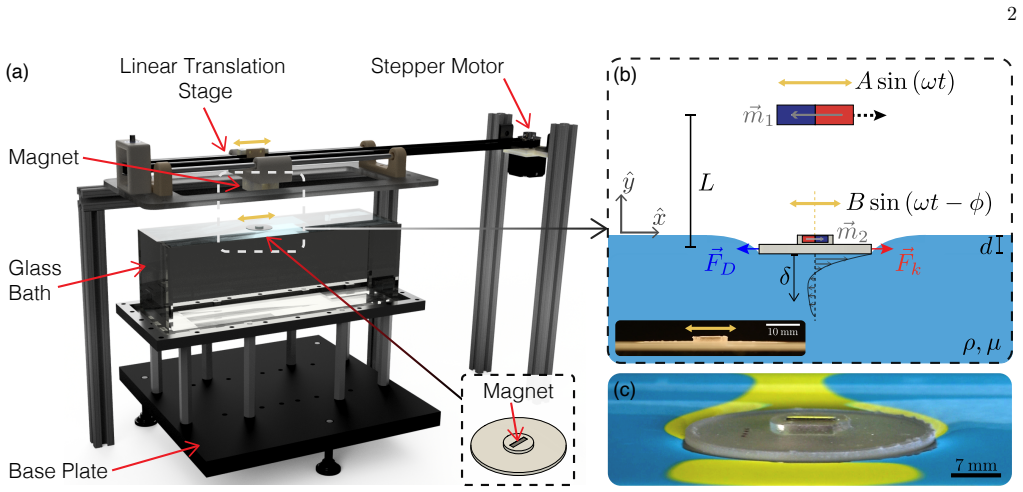
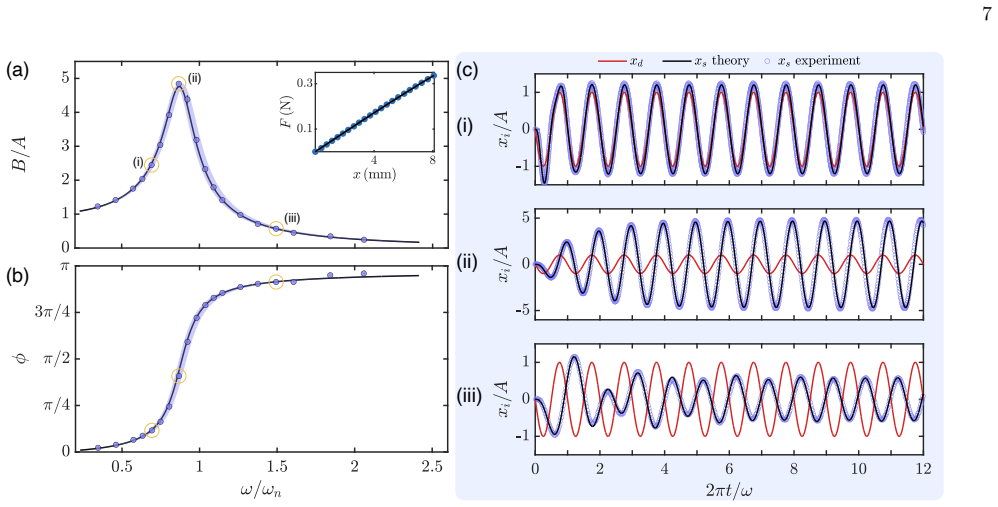
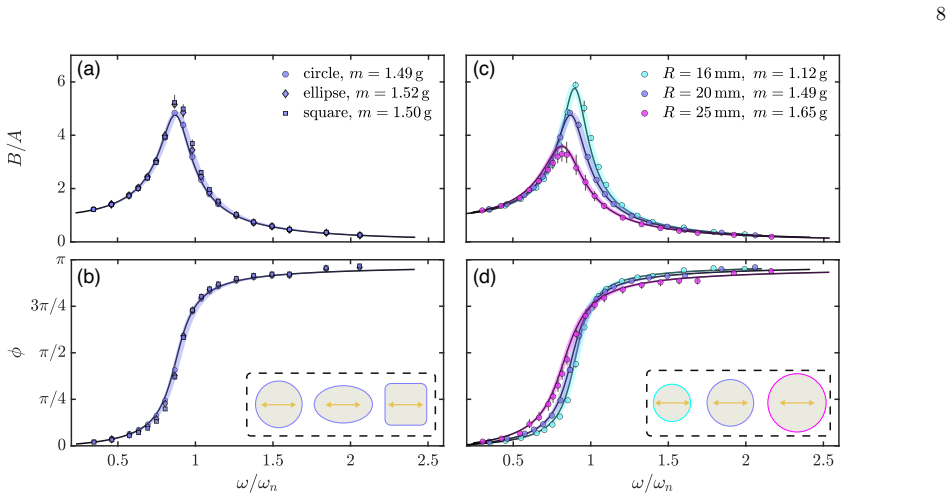
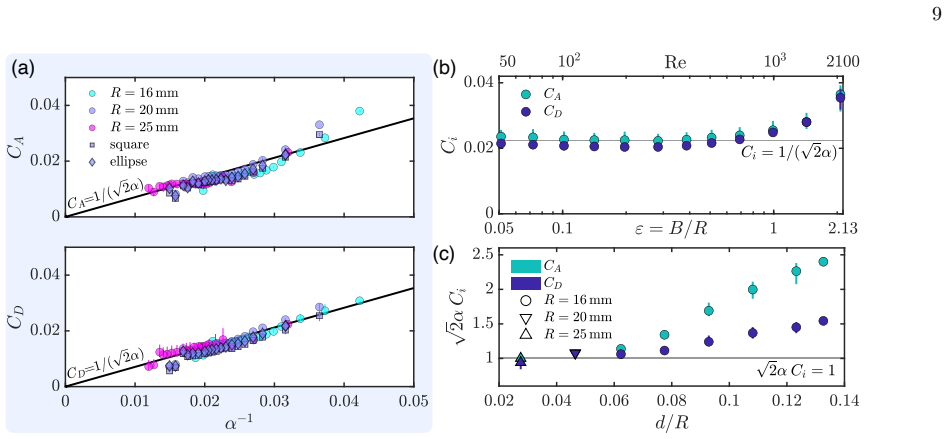
We study the unsteady dynamics of floating planar bodies undergoing lateral oscillations along an air-water interface. Scaling arguments indicate that at high Womersley number and small oscillation amplitude the flow beneath the body can be approximated by an oscillatory Stokes boundary layer, yielding a leading-order description of the hydrodynamic resistance. Using magnetic actuation, we drive the interfacial bodies harmonically and measure the amplitude response and phase lag in steady state over a range of frequencies, masses, sizes, and shapes. This frequency-response framework enables direct extraction of effective added mass and damping coefficients, which we find to be consistent with oscillatory boundary-layer theory in the limit of small interfacial deformation. The transient behavior during startup is also shown to be accurately predicted by a history integral that captures the development of the oscillatory boundary layer beneath the body. This work also establishes a simple experimental platform for quantifying unsteady hydrodynamic forces at fluid interfaces.
Editorial analysis
A structured set of objections, weighed in public.
Referee Report
Summary. The manuscript examines the unsteady lateral oscillations of floating planar bodies at an air-water interface. Scaling arguments show that at high Womersley number and small amplitude the flow beneath the body reduces to an oscillatory Stokes boundary layer, supplying a leading-order prediction for hydrodynamic resistance (added mass and damping). Experiments using magnetic actuation measure steady-state amplitude and phase response over ranges of frequency, mass, size and shape; coefficients extracted from the frequency-response data are reported to agree with the boundary-layer theory in the small-deformation limit. A history-integral model is also shown to capture the transient startup of the boundary layer.
Significance. If the small-deformation limit is verified, the work supplies a simple, experimentally validated leading-order description of unsteady interfacial forces together with a practical platform for measuring them. The independent extraction of coefficients from frequency-response data (rather than direct force measurement) and the agreement with scaling across multiple parameters constitute clear strengths.
major comments (2)
- [Abstract] Abstract and scaling argument: the planar oscillatory Stokes boundary-layer approximation is invoked only when interfacial deformation remains negligible relative to the boundary-layer thickness, yet no quantitative threshold (e.g., surface elevation ≪ δ = √(2ν/ω) or relative to body size) is supplied and no direct measurement or bound on surface elevation is reported to confirm that the limit holds across the tested parameter range.
- [Experimental results] Experimental results: the reported consistency between measured amplitude/phase and the boundary-layer prediction rests on the small-deformation regime, but the manuscript provides no separate verification (e.g., surface profilometry or contact-line imaging) that wave or contact-line effects remained negligible; without this check the agreement cannot be unambiguously attributed to the Stokes-layer model.
minor comments (2)
- [Scaling arguments] Clarify the precise definition of the Womersley number used and its relation to the oscillation frequency and body length scale.
- [Results] Add explicit error bars or uncertainty estimates on the extracted added-mass and damping coefficients in the frequency-response plots.
Simulated Author's Rebuttal
We thank the referee for their careful reading and constructive comments, which highlight important aspects of the small-deformation regime. We address each major comment below with proposed revisions to the manuscript.
read point-by-point responses
-
Referee: [Abstract] Abstract and scaling argument: the planar oscillatory Stokes boundary-layer approximation is invoked only when interfacial deformation remains negligible relative to the boundary-layer thickness, yet no quantitative threshold (e.g., surface elevation ≪ δ = √(2ν/ω) or relative to body size) is supplied and no direct measurement or bound on surface elevation is reported to confirm that the limit holds across the tested parameter range.
Authors: We agree that an explicit quantitative threshold would strengthen the presentation. In the revised manuscript we will add a scaling estimate demonstrating that the maximum surface elevation (inferred from the small-amplitude driving and the observed response) remains ≪ δ across the reported frequency and amplitude ranges. Although direct profilometry was not performed, the data collapse onto the Stokes-layer prediction for multiple body sizes, masses, and frequencies (which vary δ) provides indirect confirmation that the regime holds; we will include this discussion and the resulting bound in the text. revision: yes
-
Referee: [Experimental results] Experimental results: the reported consistency between measured amplitude/phase and the boundary-layer prediction rests on the small-deformation regime, but the manuscript provides no separate verification (e.g., surface profilometry or contact-line imaging) that wave or contact-line effects remained negligible; without this check the agreement cannot be unambiguously attributed to the Stokes-layer model.
Authors: The referee correctly identifies the absence of direct imaging. We will revise the experimental section to state explicitly that the precise match to the predicted frequency dependence (including the 1/√ω scaling of damping) over the tested range, together with the lack of systematic deviations at lower frequencies where waves might appear, constitutes indirect evidence that contact-line and wave contributions remained sub-dominant. We cannot add new profilometry data, but the text revision will clarify the evidential basis and note the limitation. revision: partial
Circularity Check
No significant circularity; derivation uses standard external scaling
full rationale
The paper's leading-order description rests on scaling arguments for the oscillatory Stokes boundary layer at high Womersley number, a standard result in unsteady viscous flow that is not derived from or fitted to the present data. Experiments supply independent frequency-response measurements from which added-mass and damping coefficients are extracted and then compared to the external theory; no equation or coefficient is shown to reduce to a fit of the target quantity by construction. No self-citations are invoked as load-bearing uniqueness theorems, and the transient history-integral prediction is likewise drawn from established boundary-layer analysis rather than the paper's own inputs.
Axiom & Free-Parameter Ledger
axioms (2)
- standard math Incompressible Newtonian fluid obeying the no-slip condition at the solid-fluid interface
- domain assumption Interfacial deformation remains small enough that the body can be treated as planar with negligible surface-wave coupling
Reference graph
Works this paper leans on
-
[1]
O. M. Faltinsen,Hydrodynamics of High-Speed Marine Vehicles(Cambridge University Press, 2005)
2005
-
[2]
M. J. Barratt, The wave drag of a hovercraft, J. Fluid Mech.22, 39 (1965)
1965
-
[3]
J. N. Newman,Marine Hydrodynamics(MIT Press, Cambridge, MA, 1977)
1977
-
[4]
J. R. Morison, M. P. O’Brien, J. W. Johnson, and S. A. Schaaf, The force exerted by surface waves on piles, J. Pet. Technol. 2, 149 (1950)
1950
-
[5]
Sarpkaya,Wave Forces on Offshore Structures(Cambridge University Press, Cambridge, UK, 2010)
T. Sarpkaya,Wave Forces on Offshore Structures(Cambridge University Press, Cambridge, UK, 2010)
2010
-
[6]
J. W. M. Bush and D. L. Hu, Walking on water: Biolocomotion at the interface, Annu. Rev. Fluid Mech.38, 339 (2006)
2006
-
[7]
D. L. Hu and J. W. M. Bush, The hydrodynamics of water-walking arthropods, J. Fluid Mech.644, 5 (2010)
2010
-
[8]
R. B. Suter, O. Rosenberg, S. Loeb, H. Wildman, and J. H. Long, Jr., Locomotion on the water surface: Propulsive mechanisms of the fisher spider Dolomedes triton, J. Exp. Biol.200, 2523 (1997)
1997
-
[9]
Mukundarajan, T
H. Mukundarajan, T. C. Bardon, D. H. Kim, and M. Prakash, Surface tension dominates insect flight on fluid interfaces, J. Exp. Biol.219, 752 (2016)
2016
-
[10]
S. T. Hsieh and G. V. Lauder, Running on water: Three-dimensional force generation by basilisk lizards, Proc. Natl. Acad. Sci. U.S.A.101, 16784 (2004)
2004
-
[11]
Roh and M
C. Roh and M. Gharib, Honeybees use their wings for water surface locomotion, Proc. Natl. Acad. Sci. U.S.A.116, 24446 (2019)
2019
-
[12]
Jung, Ground effect on undulation and pumping near surfaces, Integr
S. Jung, Ground effect on undulation and pumping near surfaces, Integr. Comp. Biol. , icag026 (2026)
2026
-
[13]
I. Ho, G. Pucci, A. U. Oza, and D. M. Harris, Capillary surfers: Wave-driven particles at a vibrating fluid interface, Phys. Rev. Fluids8, L112001 (2023)
2023
-
[14]
A. U. Oza, G. Pucci, I. Ho, and D. M. Harris, Theoretical modeling of capillary surfer interactions on a vibrating fluid bath, Phys. Rev. Fluids8, 114001 (2023)
2023
-
[15]
D. M. Harris and J.-W. Barotta, Propulsion and interaction of wave-propelled interfacial particles, Phys. Rev. Fluids10, 100503 (2025)
2025
-
[16]
Barotta, G
J.-W. Barotta, G. Pucci, E. Silver, A. Hooshanginejad, and D. M. Harris, Synchronization of wave-propelled capillary spinners, Phys. Rev. E111, 035105 (2025). 11
2025
-
[17]
Sungar, J
N. Sungar, J. Sharpe, L. Ijzerman, and J.-W. Barotta, Synchronization and self-assembly of free capillary spinners, Phys. Rev. E111, 035104 (2025)
2025
-
[18]
Z. Izri, M. N. van der Linden, S. Michelin, and O. Dauchot, Self-propulsion of pure water droplets by spontaneous Marangoni-stress-driven motion, Phys. Rev. Lett.113, 248302 (2014)
2014
-
[19]
Bormashenko, Y
E. Bormashenko, Y. Bormashenko, R. Grynyov, H. Aharoni, G. Whyman, and B. P. Binks, Self-propulsion of liquid marbles: Leidenfrost-like levitation driven by Marangoni flow, J. Phys. Chem. C119, 9910 (2015)
2015
-
[20]
E. Rhee, R. Hunt, S. J. Thomson, and D. M. Harris, SurferBot: A wave-propelled aquatic vibrobot, Bioinspir. Biomim. 17, 055001 (2022)
2022
-
[21]
G. P. Benham, O. Devauchelle, and S. J. Thomson, On wave-driven propulsion, J. Fluid Mech.987, A44 (2024)
2024
-
[22]
O’Donovan, M
D. O’Donovan, M. D. Bustamante, O. Devauchelle, and G. P. Benham, Achieving optimal locomotion using self-generated waves, J. Fluid Mech.1029, A4 (2026)
2026
-
[23]
S. W. Tarr, J. S. Brunner, D. Soto, and D. I. Goldman, Probing hydrodynamic fluctuation-induced forces with an oscillating robot, Phys. Rev. Lett.132, 084001 (2024)
2024
-
[24]
Hartmann, M
F. Hartmann, M. Baskaran, G. Raynaud, M. Benbedda, K. Mulleners, and H. Shea, Highly agile flat swimming robot, Sci. Robot.10, eadr0721 (2025)
2025
-
[25]
Y. Chen, N. Doshi, B. Goldberg, H. Wang, and R. J. Wood, Controllable water surface to underwater transition through electrowetting in a hybrid terrestrial-aquatic microrobot, Nat. Commun.9, 2495 (2018)
2018
-
[26]
Y. S. Song and M. Sitti, Surface-tension-driven biologically inspired water strider robots: Theory and experiments, IEEE Trans. Robot.23, 578 (2007)
2007
-
[27]
R. Hunt, Z. Zhao, E. Silver, J. Yan, Y. Bazilevs, and D. M. Harris, Drag on a partially immersed sphere at the capillary scale, Phys. Rev. Fluids8, 084003 (2023)
2023
-
[28]
D¨ orr, S
A. D¨ orr, S. Hardt, H. Masoud, and H. A. Stone, Drag and diffusion coefficients of a spherical particle attached to a fluid–fluid interface, J. Fluid Mech.790, 607 (2016)
2016
-
[29]
Z. Zhou, P. M. Vlahovska, and M. J. Miksis, Drag force on spherical particles trapped at a liquid interface, Phys. Rev. Fluids7, 124001 (2022)
2022
-
[30]
J. T. Petkov, N. D. Denkov, K. D. Danov, O. D. Velev, R. Aust, and F. Durst, Measurement of the drag coefficient of spherical particles attached to fluid interfaces, J. Colloid Interface Sci.172, 147 (1995)
1995
-
[31]
Ally and A
J. Ally and A. Amirfazli, Magnetophoretic measurement of the drag force on partially immersed microparticles at air–liquid interfaces, Colloids Surf. A: Physicochem. Eng. Asp.360, 120 (2010)
2010
-
[32]
Loudet, M
J.-C. Loudet, M. Qiu, J. Hemauer, and J. J. Feng, Drag force on a particle straddling a fluid interface: Influence of interfacial deformations, Eur. Phys. J. E43, 13 (2020)
2020
-
[33]
Le Merrer, C
M. Le Merrer, C. Clanet, D. Qu´ er´ e, E. Rapha¨ el, and F. Chevy, Wave drag on floating bodies, Proc. Natl. Acad. Sci. U.S.A. 108, 15064 (2011)
2011
-
[34]
K. D. Danov, R. Aust, F. Durst, and U. Lange, Influence of the surface viscosity on the hydrodynamic resistance and surface diffusivity of a large Brownian particle, J. Colloid Interface Sci.175, 36 (1995)
1995
-
[35]
K. D. Danov, R. Dimova, and B. Pouligny, Viscous drag of a solid sphere straddling a spherical or flat surface, Phys. Fluids 12, 2711 (2000)
2000
-
[36]
Pozrikidis, Particle motion near and inside an interface, J
C. Pozrikidis, Particle motion near and inside an interface, J. Fluid Mech.575, 333 (2007)
2007
-
[37]
A. Dani, G. Keiser, M. Yeganeh, and C. Maldarelli, Hydrodynamics of particles at an oil–water interface, Langmuir31, 13290 (2015)
2015
-
[38]
Kamoliddinov, I
F. Kamoliddinov, I. Vakarelski, and S. Thoroddsen, Hydrodynamic regimes and drag on horizontally pulled floating spheres, Phys. Fluids33, 093308 (2021)
2021
-
[39]
Pucci, I
G. Pucci, I. Ho, and D. M. Harris, Friction on water sliders, Sci. Rep.9, 4095 (2019)
2019
-
[40]
J. D. Anderson, Ludwig Prandtl’s boundary layer, Phys. Today58, 42 (2005)
2005
-
[41]
G. G. Stokes,Mathematical and Physical Papers, Vol. 3 (Cambridge University Press, 1922)
1922
-
[42]
Rayleigh, LXXXII
L. Rayleigh, LXXXII. on the motion of solid bodies through viscous liquid, Philos. Mag.21, 697 (1911)
1911
-
[43]
Schlichting and K
H. Schlichting and K. Gersten,Boundary-Layer Theory(Springer, 2016)
2016
-
[44]
Panton, The transient for Stokes’s oscillating plate: A solution in terms of tabulated functions, J
R. Panton, The transient for Stokes’s oscillating plate: A solution in terms of tabulated functions, J. Fluid Mech.31, 819 (1968)
1968
-
[45]
Liu and I.-C
C.-M. Liu and I.-C. Liu, A note on the transient solution of Stokes’ second problem with arbitrary initial phase, J. Mech. 22, 349 (2006)
2006
-
[46]
M. E. Erdogan, A note on an unsteady flow of a viscous fluid due to an oscillating plane wall, Int. J. Non-Linear Mech. 35, 1 (2000)
2000
-
[47]
K. W. Li and A. C. Marfatia, Stokes second problem for the cylinder, J. Basic Eng.93, 326 (1971)
1971
-
[48]
Rivero, F
M. Rivero, F. Garz´ on, J. Nunez, and A. Figueroa, Study of the flow induced by circular cylinder performing torsional oscillation, Eur. J. Mech. B/Fluids78, 245 (2019)
2019
-
[49]
Song and M
Y. Song and M. J. Rau, Viscous fluid flow inside an oscillating cylinder and its extension to Stokes’ second problem, Phys. Fluids32, 043603 (2020)
2020
-
[50]
Von Kerczek and S
C. Von Kerczek and S. H. Davis, Linear stability theory of oscillatory Stokes layers, J. Fluid Mech.62, 753 (1974)
1974
-
[51]
Hall, The linear stability of flat Stokes layers, Proc
P. Hall, The linear stability of flat Stokes layers, Proc. R. Soc. Lond. A359, 151 (1978)
1978
-
[52]
P. J. Blennerhassett and A. P. Bassom, The linear stability of flat Stokes layers, J. Fluid Mech.464, 393 (2002)
2002
-
[53]
Wang, The flow field induced by an oscillating sphere, J
C.-Y. Wang, The flow field induced by an oscillating sphere, J. Sound Vib.2, 257 (1965)
1965
-
[54]
Riley, On a sphere oscillating in a viscous fluid, Q
N. Riley, On a sphere oscillating in a viscous fluid, Q. J. Mech. Appl. Math.19, 461 (1966)
1966
-
[55]
M. S. Longuet-Higgins, Mass transport in water waves, Philos. Trans. R. Soc. Lond. A245, 535 (1953). 12
1953
-
[56]
M. T. Hehner, D. Gatti, and J. Kriegseis, Stokes-layer formation under absence of moving parts—a novel oscillatory plasma actuator design for turbulent drag reduction, Phys. Fluids31, 051701 (2019)
2019
-
[57]
Pal and S
D. Pal and S. Chakraborty, Fluid flow induced by periodic temperature oscillation over a flat plate: Comparisons with the classical Stokes problems, Phys. Fluids27, 053602 (2015)
2015
-
[58]
Ishfaq, W
N. Ishfaq, W. A. Khan, and Z. H. Khan, The Stokes’ second problem for nanofluids, J. King Saud Univ. Sci.31, 61 (2019)
2019
-
[59]
Miller and L
C. Miller and L. Scriven, The oscillations of a fluid droplet immersed in another fluid, J. Fluid Mech.32, 417 (1968)
1968
-
[60]
Plateau,Statique Exp´ erimentale et Th´ eorique des Liquides Soumis aux Seules Forces Mol´ eculaires, Vol
J. Plateau,Statique Exp´ erimentale et Th´ eorique des Liquides Soumis aux Seules Forces Mol´ eculaires, Vol. 2 (Gauthier- Villars, 1873)
-
[61]
Marangoni, The principle of the surface viscosity of liquids established by Mr
C. Marangoni, The principle of the surface viscosity of liquids established by Mr. J. Plateau, Nuovo Cim.5, 239 (1872)
-
[62]
Manikantan and T
H. Manikantan and T. M. Squires, Surfactant dynamics: Hidden variables controlling fluid flows, J. Fluid Mech.892, P1 (2020)
2020
-
[63]
Fitzgibbon, E
S. Fitzgibbon, E. S. G. Shaqfeh, G. G. Fuller, and T. W. Walker, Scaling analysis and mathematical theory of the interfacial stress rheometer, J. Rheol.58, 999 (2014)
2014
-
[64]
Braunreuther, M
M. Braunreuther, M. Liegeois, J. V. Fahy, and G. G. Fuller, Nondestructive rheological measurements of biomaterials with a magnetic microwire rheometer, J. Rheol.67, 579 (2023)
2023
-
[65]
A. Shih, S. J. Chung, O. B. Shende, S. E. Herwald, A. M. Vezeridis, and G. G. Fuller, Viscoelastic measurements of abscess fluids using a magnetic stress rheometer, Phys. Fluids36, 113603 (2024)
2024
-
[66]
Z. A. Zell, V. Mansard, J. Wright, K. Kim, S. Q. Choi, and T. M. Squires, Linear and nonlinear microrheometry of small samples and interfaces using microfabricated probes, J. Rheol.60, 141 (2016)
2016
-
[67]
D. M. Harris, J. Quintela, V. Prost, P.-T. Brun, and J. W. M. Bush, Visualization of hydrodynamic pilot-wave phenomena, J. Vis.20, 13 (2017)
2017
-
[68]
D. J. Griffiths,Introduction to Electrodynamics(Cambridge University Press, 2023)
2023
-
[69]
I. Ho, G. Pucci, and D. M. Harris, Direct measurement of capillary attraction between floating disks, Phys. Rev. Lett. 123, 254502 (2019)
2019
-
[70]
Rapha¨ el and P.-G
E. Rapha¨ el and P.-G. de Gennes, Capillary gravity waves caused by a moving disturbance: Wave resistance, Phys. Rev. E 53, 3448 (1996)
1996
-
[71]
Closa, A
F. Closa, A. D. Chepelianskii, and E. Rapha¨ el, Capillary-gravity waves generated by a sudden object motion, Phys. Fluids 22, 052107 (2010)
2010
-
[72]
J. R. Womersley, Method for the calculation of velocity, rate of flow and viscous drag in arteries when the pressure gradient is known, J. Physiol.127, 553 (1955)
1955
-
[73]
R. C. Ackerberg and J. H. Phillips, The unsteady laminar boundary layer on a semi-infinite flat plate due to small fluctuations in the magnitude of the free-stream velocity, J. Fluid Mech.51, 137 (1972)
1972
-
[74]
Rott and M
N. Rott and M. L. Rosenzweig, On the response of the laminar boundary layer to small fluctuations of the free-stream velocity, J. Aeronaut. Sci.27, 741 (1960)
1960
-
[75]
M. J. Lighthill, The response of laminar skin friction and heat transfer to fluctuations in the stream velocity, Proc. R. Soc. Lond. Ser. A-Math. Phys. Sci.224, 1 (1954)
1954
-
[76]
Ai and K
L. Ai and K. Vafai, An investigation of Stokes’ second problem for non-Newtonian fluids, Numer. Heat Transf. A47, 955 (2005)
2005
-
[77]
Fetecau, M
C. Fetecau, M. Jamil, C. Fetecau, and I. Siddique, A note on the second problem of Stokes for Maxwell fluids, Int. J. Non-Linear Mech.44, 1085 (2009)
2009
-
[78]
Foffano, J
G. Foffano, J. S. Lintuvuori, K. Stratford, M. E. Cates, and D. Marenduzzo, Colloids in active fluids: Anomalous mi- crorheology and negative drag, Phys. Rev. Lett.109, 028103 (2012)
2012
-
[79]
Kneˇ zevi´ c, L
M. Kneˇ zevi´ c, L. E. Avil´ es Podgurski, and H. Stark, Oscillatory active microrheology of active suspensions, Sci. Rep.11, 22706 (2021)
2021
-
[80]
P. A. R¨ uhs, L. B¨ oni, G. G. Fuller, R. F. Inglis, and P. Fischer, In-situ quantification of the interfacial rheological response of bacterial biofilms to environmental stimuli, PLoS One8, e78524 (2013)
2013
discussion (0)
Sign in with ORCID, Apple, or X to comment. Anyone can read and Pith papers without signing in.