REVIEW 4 major objections 5 minor 79 references
Multi-dimensional NLTE radiative transfer for a double detonation Type Ia explosion model in the photospheric phase
T0 review · 4 major / 5 minor · reviewed 2026-08-10 · deepseek-v4-flash
Pith's one-line read Full NLTE radiative transfer keeps double-detonation supernova spectra strongly viewing-angle dependent after peak and changes colours and light curves on observable scales.
desk verdict The first 2D NLTE photospheric-phase radiative transfer simulation for a double detonation model is a real step forward, but the headline post-peak viewing-angle claim is weaker than the abstract suggests and needs a quantitative treatment and an honest caveat about the model's acknowledged over-ionisation. read the letter →
The pith
A machine-rendered reading of the paper's core claim, the machinery that carries it, and where it could break.
The reading
What carries the argument
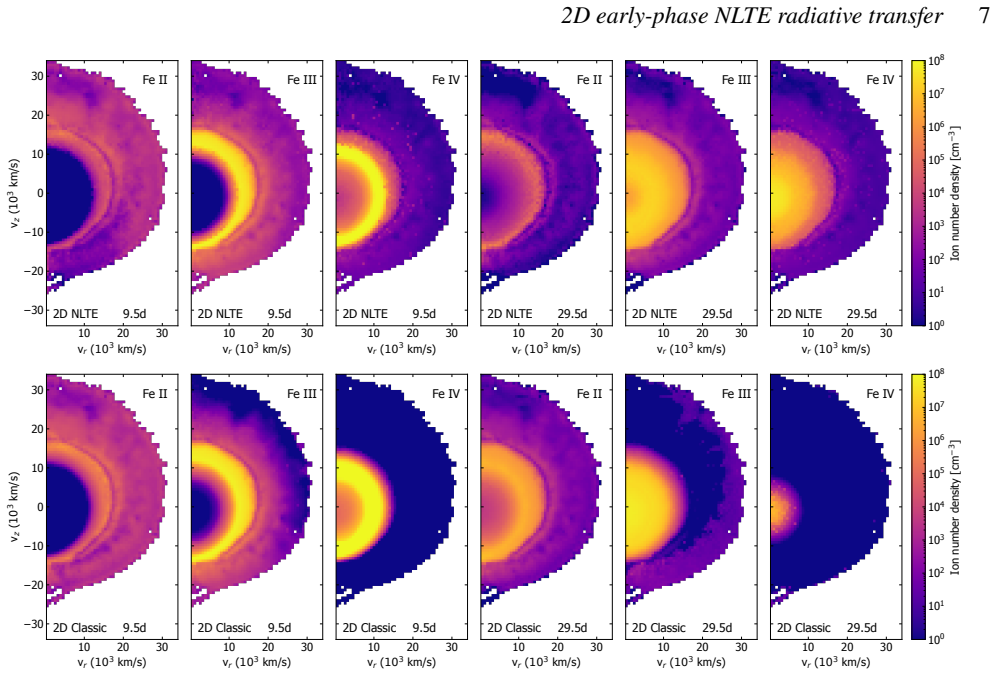
The central object is the 2D cylindrical ejecta model constructed from the $\phi=90^\circ$ half-plane slice of the 3D M10_02 double detonation explosion model (a 1 $M_\odot$ carbon-oxygen core with a 0.02 $M_\odot$ helium shell), which preserves the model's approximate axial symmetry. The argument is carried by the two plasma treatments in the Monte Carlo radiative transfer code artis: the full NLTE solver (artis-nlte) that solves the equations of statistical equilibrium and includes non-thermal ionisation, and the approximate NLTE treatment (artis-classic) that tracks only ground-state photoionisation and assumes Boltzmann level populations. The quantity that does the work is the ionisation state: the full NLTE treatment produces a higher and longer-lasting ionisation level, which shifts the spectral energy distribution blueward, removes the secondary near-infrared maximum, and keeps the post-peak spectra strongly viewing-angle dependent. An adaptive NLTE solver that strips ionisation stages with negligible populations when the matrix becomes singular is what makes the multi-dimensional early-phase simulation numerically stable.
What would settle it
A 3D full-NLTE simulation of the same M10_02 ejecta, comparing post-peak spectroscopic viewing-angle variation directly to the 2D NLTE result, would settle whether the retained variation is a genuine ejecta property or an artifact of the 2D slice; if the variation collapses in 3D, the central claim fails.
Extended reading notes
Core claim
We show that a 2D NLTE radiative transfer simulation of the M10_02 double detonation model in the photospheric phase is feasible and changes the predicted observables at levels relevant to observations. Compared to an approximate NLTE treatment, the full NLTE calculation keeps the ejecta more ionised: the free electron fraction is higher, singly ionised species such as Fe II, Co II, Ti II and Ca II recombine later, and the spectrum stays bluer with slower optical light curve declines. The most striking difference is the near-infrared behaviour: the approximate treatment predicts a strong, early secondary I-band maximum, while no viewing angle in the NLTE simulation produces one, indicating that the ejecta remain over-ionised relative to normal SNe Ia after peak. Up to peak, the two treatments predict a similar scale of viewing-angle variation, but after peak the NLTE simulation continues to show strong spectroscopic dependence on viewing angle, most visibly in the Ti II absorption trough and Ca II near-infrared triplet, whereas the approximate treatment predicts markedly reduced variation as its lower ionisation state homogenises the opacities. As a result, no single 1D model reproduces the equatorial line of sight, and the model matches normal SNe Ia only for southern viewing angles; the northern and equatorial angles show excessive line blanketing from helium-shell burning products, which we interpret as evidence that a 0.02 $M_\odot$ helium shell is too massive for the majority of lines of sight.
Load-bearing premise
The 2D cylindrical ejecta model, built from a single half-plane slice of the 3D M10_02 explosion, is assumed to capture the full 3D structure for NLTE radiative transfer, since no 3D NLTE simulation is performed to confirm this.
Editorial extensions
If this is right
- To judge double detonation models against normal Type Ia supernovae, radiative transfer must combine multi-dimensional geometry with a full NLTE treatment; approximate NLTE alone can erase genuine viewing-angle diversity after peak.
- The M10_02 model cannot reproduce normal SNe Ia over the majority of lines of sight because its 0.02 $M_\odot$ helium shell produces excessive line blanketing; lower helium-shell masses are required for most viewing angles, although some southern angles already match well.
- The complete absence of a secondary near-infrared maximum across all viewing angles indicates that the NLTE ejecta remain over-ionised after peak, so some additional recombination mechanism, such as density clumping, is needed in the models.
- 1D NLTE models constructed from a given direction do not reproduce the corresponding 2D line of sight: the 1D model gives brighter blue light curves and a different Ca II NIR triplet evolution, so 1D treatments can mislead when used for spectral interpretation.
- The width-luminosity position of the model shifts with the NLTE treatment: full NLTE gives slower declines and bluer peak colours, placing the model in better agreement with the observed normal SNe Ia distribution than the approximate treatment.
Reading between the lines
- If the post-peak retention of viewing-angle variation is a generic property of full NLTE treatments of asymmetric explosions, then previous multi-dimensional studies using approximate NLTE may have underestimated the intrinsic spectroscopic scatter expected from double detonation models, which could affect how observed SNe Ia diversity is interpreted.
- The adaptive NLTE solver that enables this 2D simulation makes it plausible to extend full NLTE to 3D for other asymmetric explosion channels, such as violent mergers or gravitationally confined detonations; the computational cost reported in the paper suggests such simulations will be expensive but within reach of current high-performance facilities.
- The paper's finding that excited-state photoionisation of Ca II drives the NIR triplet differences, and that the bluest edges suffer Monte Carlo noise, suggests that packet-frequency biasing in short-wavelength regions could improve future simulations and might change the quantitative strength of the high-velocity Ca II feature.
- The over-ionisation after peak, if confirmed by future 3D NLTE simulations, would strengthen the case that small-scale clumping is a missing ingredient in all current photospheric-phase SNe Ia models, not just double detonations.
Editorial analysis
A structured set of objections, weighed in public.
Referee Report
Summary. The paper presents the first multi-dimensional NLTE photospheric-phase radiative transfer simulation for a Type Ia supernova explosion model, applied to the double detonation model M10_02 (1 Msun CO core + 0.02 Msun He shell) of Gronow et al. (2021). The simulation is two-dimensional, built from a phi=90 degree slice of the 3D explosion model, and is compared with (i) a 2D simulation using the approximate NLTE treatment artis-classic, (ii) a 1D NLTE simulation based on the equatorial direction, (iii) observations of SN 2011fe and the Hicken et al. (2009) sample. The central claims are that NLTE and multi-dimensionality both matter on observational scales, that the full NLTE treatment produces a bluer SED and slower optical declines than the approximate treatment, and that after peak the 2D NLTE simulation retains strong spectroscopic viewing-angle variation whereas the approximate-NLTE simulation predicts significantly reduced variation. The paper further concludes that the 0.02 Msun He-shell mass is too large for the model to resemble normal SNe Ia over most lines of sight.
Significance. If the central claims hold, this is an important technical and scientific step: it is the first demonstration that multi-dimensionality and full NLTE must be treated simultaneously when evaluating explosion models against photospheric-phase observations of SNe Ia. The work has significant strengths beyond the headline result: the comparisons are carefully controlled (same ejecta model, same atomic data, same virtual-packet scheme); the 2D slice is cross-checked against other 2D constructions and a 3D artis-classic run; nothing is fitted to SN 2011fe or the Hicken sample, so the predictions are genuinely falsifiable; and the adaptive NLTE solver described in Appendix A is a valuable methodological development. The paper also makes a concrete, testable prediction, namely that the M10_02 configuration fails to produce a secondary NIR maximum for any viewing angle. For these reasons the result warrants publication once the load-bearing caveats identified below are addressed.
major comments (4)
- [Section 3.1.3, Figure 7] The headline claim that 'after peak, our 2D NLTE simulation retains a strong viewing-angle dependence in its spectra whereas our simulation of the same ejecta model using an approximate NLTE treatment predicts significantly reduced spectroscopic viewing-angle variation' is supported only by visual inspection of Figure 7. To make this claim quantitative, please provide a metric of spectroscopic variation across the five viewing angles (for example, the RMS or median absolute deviation of flux in the Ti II trough and Ca II NIR triplet regions, or a full-spectrum RMS-difference curve as a function of epoch) together with Monte Carlo uncertainties estimated from the packet seed. The absence of error bars is particularly consequential because Appendix D concedes that the high-velocity Ca II photoionisation rates, which control the high-velocity Ca II NIR triplet that is central to the retained angle dependence, 'could be somewhat impacted by Monte Carlo noise'; a quantified demonstration is needed to show that the NLTE-vs-classic difference in post-peak angle variation is larger than the Monte Carlo noise.
- [Section 3.3.1 and Section 4] The post-peak retention of viewing-angle variation is produced by the same high ionisation state that the paper itself identifies as unphysical: no viewing angle produces a secondary NIR maximum, and the text states that the ejecta 'remain over-ionised relative to observations after peak.' The retained angle variation is therefore argued from a model state that is acknowledged to be deficient. If the over-ionisation were reduced by a physically plausible mechanism such as clumping, which the paper itself suggests in Section 3.3.1, the post-peak angle variation could move toward the classic result, weakening the conclusion that multi-dimensionality and NLTE must be treated together. Please either qualify the central claim explicitly in the abstract and conclusions, or provide a test (for example, a calculation with enhanced recombination/clumping in the relevant regions) showing that the retained angle variation is not an artefact of the over-ionised state.
- [Section 2.2 and Section 3] The 2D cylindrical ejecta model is validated against the full 3D M10_02 model only with artis-classic simulations, not with full NLTE. Given that the paper's central claim concerns the interaction of multi-dimensional geometry with full NLTE, the possibility remains that angle-dependent radiative coupling in the true 3D structure behaves differently under full NLTE than in the reduced 2D slice. Please either present a 3D NLTE test at a few representative epochs (even with reduced packet number, clearly labelled as a convergence check), or provide a quantitative argument showing why the classic-run validation is sufficient to guarantee that the post-peak NLTE viewing-angle-retention claim is not an artefact of the slice geometry.
- [Appendix D] The paper states that the excited-state Ca II photoionisation rates, which drive the high-velocity Ca II population and hence the most striking spectroscopic differences between simulations, 'could be somewhat impacted by Monte Carlo noise.' Since this is a load-bearing quantity for both the 1D-vs-2D comparison and the NLTE-vs-classic angle-dependence claim, the paper should attach a quantitative estimate of the resulting uncertainty in the Ca II photoionisation rate and in the synthetic spectra, rather than relying on the qualitative concession in the appendix.
minor comments (5)
- [Title page] The preprint title contains 'T ype' with a space; this should be corrected to 'Type'.
- [Throughout] Code names such as 'artis-nlte' and '1Dartis-nlte' are inconsistently spaced; please use consistent formatting such as '1D artis-nlte' and '2D artis-nlte'.
- [Figure 7 caption] The caption states 'log(normalised flux) + offset' but does not define the offset values; please state the vertical offset and normalisation used.
- [Section 3.1.2, Figure 7] The highlighted region for the Ca II NIR triplet is described as only covering the observed feature, with the high-velocity component appearing just blueward of it; consider extending the shading so the reader can directly see the high-velocity component in the figure.
- [Table 1] The derived light-curve quantities (rise time, peak magnitude, Delta m_15) would benefit from a statement of Monte Carlo noise, either as quoted uncertainties or as an assertion that the noise is negligible relative to the quoted differences; this would strengthen the 1D vs 2D comparison.
Circularity Check
No significant circularity: all load-bearing ingredients (3D explosion model, atomic data, Monte Carlo RT methods) are independent inputs, and the claimed NLTE-vs-classic and viewing-angle differences are simulation outputs, not fitted or self-defined quantities.
full rationale
The derivation chain is not circular. The ejecta structure comes from the externally published Gronow et al. (2021) 3D M10_02 explosion simulation; the atomic data come from the cmfgen compilation; and the radiative transfer code artis is prior published work (Sim 2007; Kromer & Sim 2009; Shingles et al. 2020). No parameter is fitted to SN 2011fe or to the Hicken sample: the comparison data are used only as reference context, and the over-ionisation conclusion is a post-hoc interpretation of the missing NIR secondary maximum, not a constraint used to set simulation parameters. The central claim—that after peak the 2D NLTE run retains spectroscopic viewing-angle variation while the approximate-NLTE classic run does not—is a computed output of two separate simulations of the same ejecta model with the same atomic data, not an identity by construction. The validation of the 2D reduction via artis-classic slices and a 3D classic run is a methodological robustness check, and the absence of a 3D NLTE run is a stated limitation, not a circular step. Similarly, Appendix D's admission that high-velocity Ca II photoionisation rates 'could be somewhat impacted by Monte Carlo noise' is an acknowledged uncertainty. The citation of Collins et al. (2025) to argue that the 1D comparison is a lower limit is supporting context and not the load-bearing derivation. No fitted parameter is renamed as a prediction, and no self-cited uniqueness result is invoked to forbid alternatives. Consequently, the paper is self-contained against external benchmarks on the circularity axis, and the score is 0.
Assumptions & free parameters
free parameters (2)
- NLTE level truncation per ion =
100 levels for Z<20; 200 levels for Z>=20
- Monte Carlo packet number =
5e7 packets for 2D simulations; 3e7 for 1D
assumptions (5)
- domain assumption 2D phi=90 half-plane slice represents 3D M10_02 ejecta for NLTE radiative transfer.
- domain assumption The selected atomic data set with limited ion stages (neutral species omitted above Ne, five IGE stages) is sufficient.
- domain assumption Grey approximation in optically thick cells and LTE for the first three time steps do not affect conclusions.
- domain assumption The Gronow et al. (2021) M10_02 explosion model has the correct ejecta structure for the double detonation channel.
- domain assumption The Spencer-Fano treatment of non-thermal leptons from Kozma & Fransson (1992) is valid for these ejecta conditions.
Cite this review
Pith. "Pith review of Multi-dimensional NLTE radiative transfer for a double detonation Type Ia explosion model in the photospheric phase." pith.science (2026). https://pith.science/paper/SJOY73QL
@misc{pith2026260807288,
  author       = {Pith},
  title        = {Pith review of: Multi-dimensional NLTE radiative transfer for a double detonation Type Ia explosion model in the photospheric phase},
  year         = {2026},
  howpublished = {\url{https://pith.science/paper/SJOY73QL}},
  note         = {Machine review of arXiv:2608.07288}
}
abstract
Previous radiative transfer calculations have shown that both multi-dimensionality and NLTE (non local thermodynamic equilibrium) effects impact the synthetic observables predicted for Type Ia supernova explosion models. Here we carry out a 2D NLTE radiative transfer simulation in the photospheric phase for a double detonation model with a 1 M$_{\odot}$ carbon-oxygen core and 0.02 M$_{\odot}$ helium shell. The predicted observables demonstrate that departures from both spherical symmetry and local thermodynamic equilibrium are significant on scales relevant to comparisons with observations. The NLTE treatment leads to a bluer spectral energy distribution, more slowly declining optical-band light curves, changes to the near-infrared light curve shapes, and differences in the evolution of key spectral features. Although substantial viewing-angle variation is predicted for the model, the scale of the variation is not significantly impacted by NLTE effects up to peak. However, after peak, our 2D NLTE simulation retains a strong viewing-angle dependence in its spectra whereas our simulation of the same ejecta model using an approximate NLTE treatment predicts significantly reduced spectroscopic viewing-angle variation. The NLTE treatment leads to improved agreement with normal Type Ia supernovae, primarily due to the increased ionisation state of the simulation, although the absence of a secondary near-infrared maximum suggests that the ejecta remain over-ionised relative to observations after peak. Despite the improved agreement, many viewing angles still show excessive line blanketing, suggesting that the 0.02 M$_{\odot}$ helium-shell mass of the current model is too large to reproduce normal Type Ia supernovae over the majority of lines of sight.
Figures


Figures from the paper (6 more)




Reference graph
Works this paper leans on
-
[1]
S., 1989, @doi [ ] 10.1086/167317 , https://ui.adsabs.harvard.edu/abs/1989ApJ...339..558A 339, 558
Anderson L. S., 1989, @doi [ ] 10.1086/167317 , https://ui.adsabs.harvard.edu/abs/1989ApJ...339..558A 339, 558
doi:10.1086/167317 1989
-
[2]
S., 1980, PhD thesis, University of California, Santa Cruz
Axelrod T. S., 1980, PhD thesis, University of California, Santa Cruz
1980
-
[3]
Blondin S., et al., 2022, @doi [ ] 10.1051/0004-6361/202244134 , https://ui.adsabs.harvard.edu/abs/2022A&A...668A.163B 668, A163
-
[4]
Blondin S., Dessart L., Hillier D. J., Ramsbottom C. A., Storey P. J., 2023, @doi [ ] 10.1051/0004-6361/202347147 , https://ui.adsabs.harvard.edu/abs/2023A&A...678A.170B 678, A170
-
[5]
Boos S. J., Townsley D. M., Shen K. J., Caldwell S., Miles B. J., 2021, @doi [ ] 10.3847/1538-4357/ac07a2 , https://ui.adsabs.harvard.edu/abs/2021ApJ...919..126B 919, 126
-
[6]
Boos S. J., Townsley D. M., Shen K. J., 2024, @doi [ ] 10.3847/1538-4357/ad5da2 , https://ui.adsabs.harvard.edu/abs/2024ApJ...972..200B 972, 200
-
[7]
Boos S. J., Dessart L., Townsley D. M., Shen K. J., 2025, @doi [ ] 10.3847/1538-4357/add400 , https://ui.adsabs.harvard.edu/abs/2025ApJ...987...54B 987, 54
-
[8]
Bulla M., Sim S. A., Kromer M., 2015, @doi [ ] 10.1093/mnras/stv657 , http://adsabs.harvard.edu/abs/2015MNRAS.450..967B 450, 967
Show all 79 references
-
[9]
P., et al., 2025, @doi [ ] 10.1093/mnras/staf539 , https://ui.adsabs.harvard.edu/abs/2025MNRAS.539.1404C 539, 1404
Callan F. P., et al., 2025, @doi [ ] 10.1093/mnras/staf539 , https://ui.adsabs.harvard.edu/abs/2025MNRAS.539.1404C 539, 1404
2025 doi
-
[10]
E., Gronow S., Sim S
Collins C. E., Gronow S., Sim S. A., R \"o pke F. K., 2022, @doi [ ] 10.1093/mnras/stac2665 , https://ui.adsabs.harvard.edu/abs/2022MNRAS.517.5289C 517, 5289
2022 doi
-
[11]
E., Sim S
Collins C. E., Sim S. A., Shingles L. J., Gronow S., R \"o pke F. K., Pakmor R., Seitenzahl I. R., Kromer M., 2023, @doi [ ] 10.1093/mnras/stad2170 , https://ui.adsabs.harvard.edu/abs/2023MNRAS.524.4447C 524, 4447
2023 doi
-
[12]
E., et al., 2025, @doi [ ] 10.1093/mnras/staf261 , https://ui.adsabs.harvard.edu/abs/2025MNRAS.538.1289C 538, 1289
Collins C. E., et al., 2025, @doi [ ] 10.1093/mnras/staf261 , https://ui.adsabs.harvard.edu/abs/2025MNRAS.538.1289C 538, 1289
2025 doi
-
[13]
J., Blondin S., Khokhlov A., 2014, @doi [ ] 10.1093/mnras/stu789 , https://ui.adsabs.harvard.edu/abs/2014MNRAS.441.3249D 441, 3249
Dessart L., Hillier D. J., Blondin S., Khokhlov A., 2014, @doi [ ] 10.1093/mnras/stu789 , https://ui.adsabs.harvard.edu/abs/2014MNRAS.441.3249D 441, 3249
2014 doi
-
[14]
Ergon M., Fransson C., Jerkstrand A., Kozma C., Kromer M., Spricer K., 2018, @doi [ ] 10.1051/0004-6361/201833043 , https://ui.adsabs.harvard.edu/abs/2018A&A...620A.156E 620, A156
2018 doi
-
[15]
K., Hillebrandt W., Seitenzahl I
Fink M., R \"o pke F. K., Hillebrandt W., Seitenzahl I. R., Sim S. A., Kromer M., 2010, @doi [ ] 10.1051/0004-6361/200913892 , https://ui.adsabs.harvard.edu/abs/2010A&A...514A..53F 514, A53
2010 doi
-
[16]
Gall E. E. E., Taubenberger S., Kromer M., Sim S. A., Benetti S., Blanc G., Elias-Rosa N., Hillebrandt W., 2012, @doi [ ] 10.1111/j.1365-2966.2012.21999.x , http://adsabs.harvard.edu/abs/2012MNRAS.427..994G 427, 994
2012
-
[17]
P., et al., 2006, @doi [ ] 10.1007/s11214-006-8315-7 , https://ui.adsabs.harvard.edu/abs/2006SSRv..123..485G 123, 485
Gardner J. P., et al., 2006, @doi [ ] 10.1007/s11214-006-8315-7 , https://ui.adsabs.harvard.edu/abs/2006SSRv..123..485G 123, 485
2006 doi
-
[18]
T., Pakmor R., Kromer M., Seitenzahl I
Gronow S., Collins C., Ohlmann S. T., Pakmor R., Kromer M., Seitenzahl I. R., Sim S. A., R \"o pke F. K., 2020, @doi [ ] 10.1051/0004-6361/201936494 , https://ui.adsabs.harvard.edu/abs/2020A&A...635A.169G 635, A169
2020 doi
-
[19]
E., Sim S
Gronow S., Collins C. E., Sim S. A., R \"o pke F. K., 2021, @doi [ ] 10.1051/0004-6361/202039954 , https://ui.adsabs.harvard.edu/abs/2021A&A...649A.155G 649, A155
2021 doi
-
[20]
Guillochon J., Dan M., Ramirez-Ruiz E., Rosswog S., 2010, @doi [ ] 10.1088/2041-8205/709/1/L64 , https://ui.adsabs.harvard.edu/abs/2010ApJ...709L..64G 709, L64
2010 doi
-
[21]
R., et al., 2020, @doi [Nature] 10.1038/s41586-020-2649-2 , 585, 357
Harris C. R., et al., 2020, @doi [Nature] 10.1038/s41586-020-2649-2 , 585, 357
2020 doi
-
[22]
Hicken M., et al., 2009, @doi [ ] 10.1088/0004-637X/700/1/331 , https://ui.adsabs.harvard.edu/abs/2009ApJ...700..331H 700, 331
2009 doi
-
[23]
J., 1990, , https://ui.adsabs.harvard.edu/abs/1990A&A...231..116H 231, 116
Hillier D. J., 1990, , https://ui.adsabs.harvard.edu/abs/1990A&A...231..116H 231, 116
1990
-
[24]
J., Miller D
Hillier D. J., Miller D. L., 1998, @doi [ ] 10.1086/305350 , https://ui.adsabs.harvard.edu/abs/1998ApJ...496..407H 496, 407
1998 doi
-
[25]
Hoeflich P., Khokhlov A., 1996, @doi [ ] 10.1086/176748 , https://ui.adsabs.harvard.edu/abs/1996ApJ...457..500H 457, 500
1996 doi
-
[26]
Holas A., et al., 2025, @doi [ ] 10.1051/0004-6361/202554640 , https://ui.adsabs.harvard.edu/abs/2025A&A...698A.269H 698, A269
2025 doi
-
[27]
D., 2007, @doi [Computing in Science and Engineering] 10.1109/MCSE.2007.55 , https://ui.adsabs.harvard.edu/abs/2007CSE.....9...90H 9, 90
Hunter J. D., 2007, @doi [Computing in Science and Engineering] 10.1109/MCSE.2007.55 , https://ui.adsabs.harvard.edu/abs/2007CSE.....9...90H 9, 90
2007 doi
-
[28]
H., 2015, @doi [ ] 10.1093/mnras/stv474 , https://ui.adsabs.harvard.edu/abs/2015MNRAS.449.3581J 449, 3581
Jack D., Baron E., Hauschildt P. H., 2015, @doi [ ] 10.1093/mnras/stv474 , https://ui.adsabs.harvard.edu/abs/2015MNRAS.449.3581J 449, 3581
2015 doi
-
[29]
Kasen D., 2006, @doi [ ] 10.1086/506588 , https://ui.adsabs.harvard.edu/abs/2006ApJ...649..939K 649, 939
2006 doi
-
[30]
Kozma C., Fransson C., 1992, @doi [ ] 10.1086/171311 , http://adsabs.harvard.edu/abs/1992ApJ...390..602K 390, 602
1992 doi
-
[31]
A., 2009, @doi [ ] 10.1111/j.1365-2966.2009.15256.x , http://adsabs.harvard.edu/abs/2009MNRAS.tmp.1110K 398, 1809
Kromer M., Sim S. A., 2009, @doi [ ] 10.1111/j.1365-2966.2009.15256.x , http://adsabs.harvard.edu/abs/2009MNRAS.tmp.1110K 398, 1809
2009
-
[32]
A., Fink M., R \"o pke F
Kromer M., Sim S. A., Fink M., R \"o pke F. K., Seitenzahl I. R., Hillebrandt W., 2010, @doi [ApJ] 10.1088/0004-637X/719/2/1067 , http://adsabs.harvard.edu/abs/2010ApJ...719.1067K 719, 1067
2010 doi
- [33]
-
[34]
A., et al., 2025, @doi [ ] 10.3847/2041-8213/adf062 , https://ui.adsabs.harvard.edu/abs/2025ApJ...989L..33K 989, L33
Kwok L. A., et al., 2025, @doi [ ] 10.3847/2041-8213/adf062 , https://ui.adsabs.harvard.edu/abs/2025ApJ...989L..33K 989, L33
2025 doi
-
[35]
K., Han Z., 2023, @doi [Research in Astronomy and Astrophysics] 10.1088/1674-4527/acd89e , https://ui.adsabs.harvard.edu/abs/2023RAA....23h2001L 23, 082001
Liu Z.-W., R \"o pke F. K., Han Z., 2023, @doi [Research in Astronomy and Astrophysics] 10.1088/1674-4527/acd89e , https://ui.adsabs.harvard.edu/abs/2023RAA....23h2001L 23, 082001
2023 doi
-
[36]
Livne E., 1990, @doi [ ] 10.1086/185721 , http://adsabs.harvard.edu/abs/1990ApJ...354L..53L 354, L53
1990 doi
-
[37]
B., 2002, @doi [ ] 10.1051/0004-6361:20011756 , http://adsabs.harvard.edu/abs/2002A
Lucy L. B., 2002, @doi [ ] 10.1051/0004-6361:20011756 , http://adsabs.harvard.edu/abs/2002A
2002 doi
-
[38]
B., 2003, @doi [ ] 10.1051/0004-6361:20030357 , http://adsabs.harvard.edu/abs/2003A
Lucy L. B., 2003, @doi [ ] 10.1051/0004-6361:20030357 , http://adsabs.harvard.edu/abs/2003A
2003 doi
-
[39]
B., 2005, @doi [ ] 10.1051/0004-6361:20041656 , http://adsabs.harvard.edu/abs/2005A
Lucy L. B., 2005, @doi [ ] 10.1051/0004-6361:20041656 , http://adsabs.harvard.edu/abs/2005A
2005 doi
-
[40]
A., et al., 2020, @doi [ ] 10.1093/mnras/staa839 , https://ui.adsabs.harvard.edu/abs/2020MNRAS.494.2809M 494, 2809
Mazzali P. A., et al., 2020, @doi [ ] 10.1093/mnras/staa839 , https://ui.adsabs.harvard.edu/abs/2020MNRAS.494.2809M 494, 2809
2020 doi
-
[41]
Nomoto K., 1980, @doi [Space Science Reviews] 10.1007/BF00168350 , http://adsabs.harvard.edu/abs/1980SSRv...27..563N 27, 563
1980 doi
-
[42]
Nomoto K., 1982, @doi [ ] 10.1086/159682 , http://esoads.eso.org/cgi-bin/nph-bib_query?bibcode=1982ApJ...253..798N&db_key=AST 253, 798
1982 doi
-
[43]
H., 1997, @doi [ ] 10.1086/304459 , http://adsabs.harvard.edu/abs/1997ApJ...485..812N 485, 812
Nugent P., Baron E., Branch D., Fisher A., Hauschildt P. H., 1997, @doi [ ] 10.1086/304459 , http://adsabs.harvard.edu/abs/1997ApJ...485..812N 485, 812
1997 doi
-
[44]
E., et al., 2011, @doi [ ] 10.1038/nature10644 , https://ui.adsabs.harvard.edu/abs/2011Natur.480..344N 480, 344
Nugent P. E., et al., 2011, @doi [ ] 10.1038/nature10644 , https://ui.adsabs.harvard.edu/abs/2011Natur.480..344N 480, 344
2011 doi
-
[45]
K., Sim S
Pakmor R., Kromer M., R \"o pke F. K., Sim S. A., Ruiter A. J., Hillebrandt W., 2010, @doi [ ] 10.1038/nature08642 , https://ui.adsabs.harvard.edu/abs/2010Natur.463...61P 463, 61
2010 doi
-
[46]
K., Hillebrandt W., 2011, @doi [ ] 10.1051/0004-6361/201015653 , https://ui.adsabs.harvard.edu/abs/2011A&A...528A.117P 528, A117
Pakmor R., Hachinger S., R \"o pke F. K., Hillebrandt W., 2011, @doi [ ] 10.1051/0004-6361/201015653 , https://ui.adsabs.harvard.edu/abs/2011A&A...528A.117P 528, A117
2011 doi
-
[47]
A., R \"o pke F
Pakmor R., Kromer M., Taubenberger S., Sim S. A., R \"o pke F. K., Hillebrandt W., 2012, @doi [ ] 10.1088/2041-8205/747/1/L10 , https://ui.adsabs.harvard.edu/abs/2012ApJ...747L..10P 747, L10
2012 doi
-
[48]
Pakmor R., Kromer M., Taubenberger S., Springel V., 2013, @doi [ ] 10.1088/2041-8205/770/1/L8 , https://ui.adsabs.harvard.edu/abs/2013ApJ...770L...8P 770, L8
2013 doi
-
[49]
Pakmor R., et al., 2022, @doi [ ] 10.1093/mnras/stac3107 , https://ui.adsabs.harvard.edu/abs/2022MNRAS.517.5260P 517, 5260
2022 doi
-
[50]
R., Ruiter A
Pakmor R., Seitenzahl I. R., Ruiter A. J., Sim S. A., R \"o pke F. K., Taubenberger S., Bieri R., Blondin S., 2024, @doi [ ] 10.1051/0004-6361/202449637 , https://ui.adsabs.harvard.edu/abs/2024A&A...686A.227P 686, A227
2024 doi
-
[51]
Pakmor R., et al., 2026, @doi [ ] 10.1051/0004-6361/202557670 , https://ui.adsabs.harvard.edu/abs/2026A&A...706A.239P 706, A239
2026 doi
-
[52]
Pereira R., et al., 2013, @doi [ ] 10.1051/0004-6361/201221008 , https://ui.adsabs.harvard.edu/abs/2013A&A...554A..27P 554, A27
2013 doi
-
[53]
Polin A., Nugent P., Kasen D., 2019, @doi [ ] 10.3847/1538-4357/aafb6a , https://ui.adsabs.harvard.edu/abs/2019ApJ...873...84P 873, 84
2019 doi
-
[54]
M., Sim S
Pollin J. M., Sim S. A., Pakmor R., Callan F. P., Collins C. E., Shingles L. J., R \"o pke F. K., Srivastav S., 2024, @doi [ ] 10.1093/mnras/stae1909 , https://ui.adsabs.harvard.edu/abs/2024MNRAS.533.3036P 533, 3036
2024 doi
- [55]
-
[56]
M., Callan F
Pollin J. M., Callan F. P., Collins C. E., Holas A., Shingles L. J., Pakmor R., R \"o pke F. K., Sim S. A., 2026b, @doi [Research Notes of the AAS] 10.3847/2515-5172/ae8395 , https://ui.adsabs.harvard.edu/abs/2026RNAAS..10..172P 10, 172
-
[57]
M., et al., 2026c, @doi [ ] 10.1093/mnras/stag735 , https://ui.adsabs.harvard.edu/abs/2026MNRAS.548ag735P 548, stag735
Pollin J. M., et al., 2026c, @doi [ ] 10.1093/mnras/stag735 , https://ui.adsabs.harvard.edu/abs/2026MNRAS.548ag735P 548, stag735
- [58]
-
[59]
J., Seitenzahl I
Ruiter A. J., Seitenzahl I. R., 2025, @doi [ ] 10.1007/s00159-024-00158-9 , https://ui.adsabs.harvard.edu/abs/2025A&ARv..33....1R 33, 1
2025 doi
-
[60]
Sato Y., Nakasato N., Tanikawa A., Nomoto K., Maeda K., Hachisu I., 2015, @doi [ ] 10.1088/0004-637X/807/1/105 , https://ui.adsabs.harvard.edu/abs/2015ApJ...807..105S 807, 105
2015 doi
-
[61]
Sato Y., Nakasato N., Tanikawa A., Nomoto K., Maeda K., Hachisu I., 2016, @doi [ ] 10.3847/0004-637X/821/1/67 , https://ui.adsabs.harvard.edu/abs/2016ApJ...821...67S 821, 67
2016 doi
-
[62]
J., Simard L., Takami H., eds, Society of Photo-Optical Instrumentation Engineers (SPIE) Conference Series Vol
Schipani P., et al., 2018, in Evans C. J., Simard L., Takami H., eds, Society of Photo-Optical Instrumentation Engineers (SPIE) Conference Series Vol. 10702, Ground-based and Airborne Instrumentation for Astronomy VII. p. 107020F ( @eprint arXiv 1807.08828 ), @doi 10.1117/12.2307349
2018 arXiv
-
[63]
J., Blondin S., Kasen D., Dessart L., Townsley D
Shen K. J., Blondin S., Kasen D., Dessart L., Townsley D. M., Boos S., Hillier D. J., 2021a, @doi [ ] 10.3847/2041-8213/abe69b , https://ui.adsabs.harvard.edu/abs/2021ApJ...909L..18S 909, L18
-
[64]
J., Boos S
Shen K. J., Boos S. J., Townsley D. M., Kasen D., 2021b, @doi [ ] 10.3847/1538-4357/ac2304 , https://ui.adsabs.harvard.edu/abs/2021ApJ...922...68S 922, 68
-
[65]
J., Boos S
Shen K. J., Boos S. J., Townsley D. M., 2024, @doi [ ] 10.3847/1538-4357/ad7379 , https://ui.adsabs.harvard.edu/abs/2024ApJ...975..127S 975, 127
2024 doi
-
[66]
J., et al., 2020, @doi [ ] 10.1093/mnras/stz3412 , https://ui.adsabs.harvard.edu/abs/2020MNRAS.492.2029S 492, 2029
Shingles L. J., et al., 2020, @doi [ ] 10.1093/mnras/stz3412 , https://ui.adsabs.harvard.edu/abs/2020MNRAS.492.2029S 492, 2029
2020 doi
-
[67]
o rs A., Sim S. A., Collins C. E., R \
Shingles L. J., Fl \"o rs A., Sim S. A., Collins C. E., R \"o pke F. K., Seitenzahl I. R., Shen K. J., 2022, @doi [ ] 10.1093/mnras/stac902 , https://ui.adsabs.harvard.edu/abs/2022MNRAS.512.6150S 512, 6150
2022 doi
-
[68]
J., Collins C
Shingles L. J., Collins C. E., Holas A., Callan F., Sim S., 2025, artistools , @doi 10.5281/zenodo.7728326 , https://github.com/artis-mcrt/artistools
2025 doi
-
[69]
A., 2007, @doi [ ] 10.1111/j.1365-2966.2006.11271.x , http://adsabs.harvard.edu/abs/2007MNRAS.375..154S 375, 154
Sim S. A., 2007, @doi [ ] 10.1111/j.1365-2966.2006.11271.x , http://adsabs.harvard.edu/abs/2007MNRAS.375..154S 375, 154
2007
-
[70]
A., Fink M., Kromer M., R \"o pke F
Sim S. A., Fink M., Kromer M., R \"o pke F. K., Ruiter A. J., Hillebrandt W., 2012, @doi [ ] 10.1111/j.1365-2966.2011.20162.x , https://ui.adsabs.harvard.edu/abs/2012MNRAS.420.3003S 420, 3003
2012
-
[71]
E., 1980, @doi [ ] 10.1086/158509 , http://adsabs.harvard.edu/abs/1980ApJ...242..749T 242, 749
Taam R. E., 1980, @doi [ ] 10.1086/158509 , http://adsabs.harvard.edu/abs/1980ApJ...242..749T 242, 749
1980 doi
-
[72]
M., Miles B
Townsley D. M., Miles B. J., Shen K. J., Kasen D., 2019, @doi [ ] 10.3847/2041-8213/ab27cd , https://ui.adsabs.harvard.edu/abs/2019ApJ...878L..38T 878, L38
2019 doi
-
[73]
Y., Shugarov S
Tsvetkov D. Y., Shugarov S. Y., Volkov I. M., Goranskij V. P., Pavlyuk N. N., Katysheva N. A., Barsukova E. A., Valeev A. F., 2013, @doi [Contributions of the Astronomical Observatory Skalnate Pleso] 10.48550/arXiv.1311.3484 , https://ui.adsabs.harvard.edu/abs/2013CoSka..43......
-
[74]
Virtanen P., et al., 2020, @doi [Nature Methods] 10.1038/s41592-019-0686-2 , https://rdcu.be/b08Wh 17, 261
2020 doi
-
[75]
D., Hillier D
Wilk K. D., Hillier D. J., Dessart L., 2018, @doi [ ] 10.1093/mnras/stx2816 , https://ui.adsabs.harvard.edu/abs/2018MNRAS.474.3187W 474, 3187
2018 doi
-
[76]
D., Hillier D
Wilk K. D., Hillier D. J., Dessart L., 2020, @doi [ ] 10.1093/mnras/staa640 , https://ui.adsabs.harvard.edu/abs/2020MNRAS.494.2221W 494, 2221
2020 doi
-
[77]
E., Kasen D., 2011, @doi [ ] 10.1088/0004-637X/734/1/38 , http://adsabs.harvard.edu/abs/2011ApJ...734...38W 734, 38
Woosley S. E., Kasen D., 2011, @doi [ ] 10.1088/0004-637X/734/1/38 , http://adsabs.harvard.edu/abs/2011ApJ...734...38W 734, 38
2011 doi
-
[78]
E., Weaver T
Woosley S. E., Weaver T. A., 1994, @doi [ ] 10.1086/173813 , http://adsabs.harvard.edu/abs/1994ApJ...423..371W 423, 371
1994 doi
-
[79]
artis collaboration et al., 2025, artis, @doi 10.5281/zenodo.16684298 , https://doi.org/10.5281/zenodo.16684298
2025 doi
Reviewed August 10, 2026 · model on record in the stance chip above.
Discussion (0). Continue with ORCID to comment.