REVIEW 4 major objections 5 minor 17 references
PIMBS: Efficient Body Schema Learning for Musculoskeletal Humanoids with Physics-Informed Neural Networks
T0 review · 4 major / 5 minor · reviewed 2026-08-06 · deepseek-v4-flash
Pith's one-line read PIMBS adds physics constraints to body-schema networks so musculoskeletal robots learn muscle maps from very few samples.
desk verdict Real-world claim rests on test-set alpha selection; simulation is strong and the idea is sensible — worth reviewing with a required validation protocol. read the letter →
The pith
A machine-rendered reading of the paper's core claim, the machinery that carries it, and where it could break.
The reading
What carries the argument
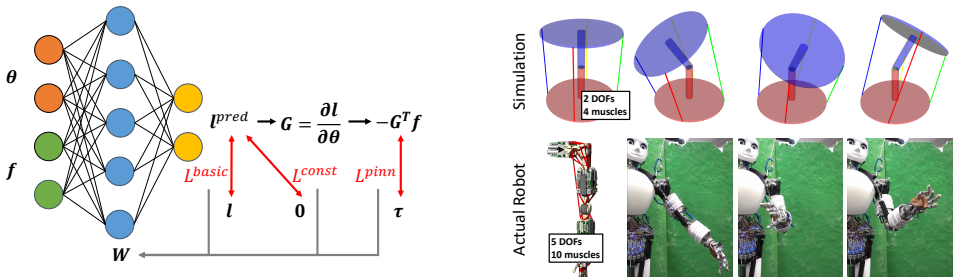
The load-bearing identity is the static torque-tension relation $\tau = -G^{\mathsf T} f$, where $G$ is the muscle Jacobian obtained by differentiating the learned network. Because the network's derivative is available by backpropagation, the physics loss $L_{\mathrm{pinn}}$ can push the learned map to be consistent with the robot's gravity-compensation torque without any extra measurements; $L_{\mathrm{const}}$ stabilizes the origin. The paper's experiments compare four loss configurations (Basic, Basic+Const, Basic+PINN, Basic+Const+PINN) across simulated and real musculoskeletal structures.
What would settle it
Run the 2-DOF simulation at $N_{\mathrm{train}} = 5$ with a deliberately incorrect joint axis inserted into the computation of $\tau(\theta)$: if Basic+Const+PINN no longer beats Basic+Const by the reported margin, the gain is tied to the joint model being exact; alternatively, add direction-dependent friction to the simulation and check that high $\alpha$ degrades performance as it does on the real robot.
Extended reading notes
Core claim
PIMBS claims that a physics-informed loss makes body-schema learning more sample-efficient. The network $h$ maps joint angle $\theta$ (and muscle tension $f$) to muscle length $l$; its derivative $G = \partial h/\partial \theta$ gives the muscle Jacobian. The paper adds $L_{\mathrm{pinn}} = \frac{1}{N_{\mathrm{train}}} \sum (G^{\mathsf T} f + \tau)^2$, which encodes $\tau = -G^{\mathsf T} f$ under the assumption that the joint geometry is correct, and $L_{\mathrm{const}} = h(0,0)^2$, which anchors the length to zero at the origin. In simulation, adding both losses gives the lowest held-out error whenever $N_{\mathrm{train}}$ is small, and the model with only PINN already improves extrapolation near joint-angle extremes where data are sparse; in the real robot, the physics loss must be weakened ($\alpha$ from $10^{-5}$ down to $10^{-7}$ or $10^{-8}$) to avoid the mismatch from friction, after which the combined method again matches or beats the conventional baseline.
Load-bearing premise
The method assumes the robot's joint structure is known accurately enough that the gravity-compensation torque at each joint angle can be treated as correct; when real friction violates that assumption the physics loss must be weakened or it actively degrades learning.
Editorial extensions
If this is right
- Body-schema networks for tendon-driven robots can be trained from tens rather than hundreds of measured postures, shortening the data-collection phase.
- The muscle Jacobian needed for state estimation and torque control comes out of the same trained network by differentiation, so the physics constraint doubles as a source of derivative supervision.
- The benefit of the physics loss concentrates in the small-data regime and fades as $N_{\mathrm{train}}$ grows, so the method is most useful for new robots, new limbs, or re-learning after damage.
- On physical hardware the physics weight $\alpha$ must be tuned down to offset friction and joint-model error; with that tuning the combined loss again matches or beats the plain-data baseline.
- Introducing the origin constraint $L_{\mathrm{const}}$ consistently helps in both simulation and hardware, and is a zero-cost addition to any body-schema network.
Reading between the lines
- The same torque-tension consistency loss could be applied to any learned actuator-to-joint map, not only muscle length, whenever a kinematic or dynamic model of the structure is available.
- The real-robot result suggests replacing the fixed scalar $\alpha$ with an automatically calibrated or heteroscedastic weight that down-weights the physics term exactly where data disagree with it; the paper does not test this.
- Because $L_{\mathrm{pinn}}$ provides gradient information in regions with no data, the method may generalize to other redundant, tendon-driven systems such as soft or cable-driven manipulators where geometric models are also unreliable.
Editorial analysis
A structured set of objections, weighed in public.
Referee Report
Summary. The paper proposes PIMBS, a physics-informed neural network approach for learning the body schema of musculoskeletal humanoids, specifically the mapping from joint angles (and, in the ATL-Map variant, muscle tension) to muscle length. The method augments the standard mean-squared-error loss with two additional terms: a physics loss L_pinn that enforces the static equilibrium relation τ = -G^T f through the network's Jacobian, and a constraint loss L_const that enforces zero muscle length at the zero configuration. The approach is evaluated on a 2-DOF 4-muscle simulation for both AL-Map and ATL-Map formulations and on the 5-DOF 10-muscle left arm of a real musculoskeletal humanoid, with training set sizes from 3 to 30. The simulation results show large and consistent improvements of Basic+Const+PINN over the conventional Basic baseline when the training set is small, while the real-robot results show smaller and noisier gains that depend strongly on the chosen physics-loss weight α.
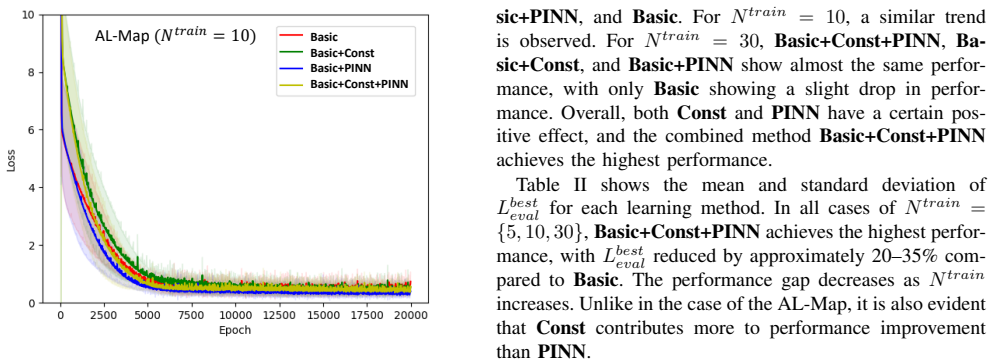
Significance. The paper addresses a real bottleneck in musculoskeletal humanoid research: the high cost and difficulty of collecting large amounts of ground-truth body-schema data. If the claimed data-efficiency were firmly established, the method would be practically valuable, and the idea of leveraging the muscle Jacobian as a physics-informed regularizer is a sensible and nontrivial contribution. The simulation experiments are a clear strength: Tables I and II show that Basic+Const+PINN reduces held-out muscle-length error by roughly 60-70% (AL-Map) and 20-35% (ATL-Map) compared to Basic at Ntrain=3-5 and 5-10, respectively, with modest standard deviations. The physics loss is a genuine external constraint derived from mechanics rather than from the target outputs, and the use of a real musculoskeletal humanoid in Section III-D is a valuable independent test. However, the real-robot evidence currently does not support the paper's central claim of superior performance on the actual robot, because the comparison selects the physics weight α using the evaluation set and because the best-case differences at Ntrain=30 are within one standard deviation.
major comments (4)
- [Section III-D, Table III] The real-robot comparison is distorted by selection on the evaluation set. The text states that α ∈ {1e-5, 1e-6, 1e-7, 1e-8} is varied, and Table III reports the Lbest_eval values for each α. No held-out validation set is used to choose α or the early-stopping epoch; the best value is effectively selected in hindsight on Deval. This is a load-bearing issue because the winning α differs by Ntrain (1e-8 for Ntrain=10, 1e-7 for Ntrain=30), which indicates that the reported gain is not a stable property of the method. Moreover, at Ntrain=30, all Basic+Const+PINN values (18.17±4.79, 18.39±4.51) overlap with Basic+Const (18.99±4.38) within one standard deviation, and at Ntrain=10, α=1e-7 (276.16±119.48) is worse than Basic+Const (256.57±72.48) while α=1e-8 (235.31±65.11) is only about 8% better. Without an untouched test set and a pre-specified α, the claim that PIMBS is more efficient on the real robot is not established.
- [Sections II-C and III-B/III-C] In the simulation experiments, both the training data and the physics loss are derived from the same geometric model: the exponential spring law f = exp(K·Δn) - 1 in Eq. (13) is used to generate muscle lengths, and the gravity torque τ is computed geometrically with the same model. This makes L_pinn exactly consistent with the data generator by construction, so the simulated advantage partly reflects a consistency check rather than robustness to the model mismatch that motivates the real-robot study. The real-robot experiment is the independent test, and, as discussed above, that test is currently too weak to support the generalization of the simulation gains.
- [Section III-D and Section IV] The paper acknowledges that friction and joint-model error invalidate Eq. (8) on the real robot, and that α must be reduced from 1e-5 to 1e-8 to avoid performance degradation. However, the paper provides no principled mechanism for setting α in practice; the only guidance is that smaller α works better empirically, and the best α is data-dependent. Since α is chosen using the evaluation metric, the real-robot results overstate the benefit of the method under a realistic deployment scenario where ground-truth muscle lengths are scarce. A sensitivity analysis with α fixed a priori, or a proper validation-split protocol for α selection, would be necessary to make the claim credible.
- [Section V (Conclusion)] The conclusion states that the approach enables 'more efficient body schema learning from a small amount of data with higher performance than conventional methods in both simulation and the actual musculoskeletal humanoid.' Given the evaluation-set selection issue and the overlapping standard deviations in Table III, the real-robot part of this claim is not supported by the presented evidence. The conclusion should be qualified to reflect the simulation results as the primary support, with the real-robot results described as preliminary or as a demonstration of feasibility requiring further validation.
minor comments (5)
- [Section III-D] The text contains a formatting error: 'α = 1.0 × 10{−5,−6,−7,−8}' should be rendered as α = 1.0 × 10^{-5,-6,-7,-8} with superscripts.
- [Section III-A] The paper says 'all displayed loss values are scaled by a factor of 1.0 × 10^5 for clearer visualization,' but Tables I-III report values that are not obviously scaled and the text uses the same Lbest_eval notation for both scaled and unscaled values. Please clarify whether the tables show scaled or raw values.
- [Section III-A] For the real-robot experiments, it is not specified how the five repeated runs (which produce the standard deviations in Table III) are constructed from the 496 collected data points: is the Ntrain subset randomly drawn for each seed, or are the same points used across seeds? This affects the interpretation of the reported variance.
- [Section II-A / Eq. (8)] Eq. (8) is used as the physics loss for both AL-Map and ATL-Map, but for the ATL-Map the network output also depends on f, and the Jacobian in Eq. (9) is evaluated at the observed f. The text could state more explicitly that τ is the gravity-compensation torque computed from the geometric model rather than a directly measured quantity; this is important for understanding the sensor/model assumptions behind L_pinn.
- [References] Reference [16] has a capitalization error ('Journal of Computational physics'), and the paper would benefit from a brief comparison with or citation of more recent PINN applications in robotics, if any exist.
Circularity Check
No significant circularity: the physics loss is an external mechanical constraint and the origin constraint is a definitional boundary condition.
full rationale
The derivation chain is self-contained, and no load-bearing step reduces to its own inputs. The core addition is the PINN loss Lpinn = mean((Gpred^T f_data + tau_data)^2), which couples the network Jacobian Gpred to the gravity-compensation torque tau through the mechanical equilibrium relation tau = -G^T f. This is an external constraint that does not use the target muscle-length labels, and on the real robot it is approximate enough to hurt performance unless the weight alpha is reduced, demonstrating that it carries independent content rather than being a restatement of the data. The Lconst term enforces l = 0 at theta = 0, f = 0, which is exactly the paper's declared convention that muscle length is expressed as a relative change with value at theta = 0 set to 0; it is a known boundary condition, not a re-derivation of the predicted output from that output. In simulation, the training data and the physics torque are generated from the same geometric model, but this makes the physics loss a consistency constraint rather than a circular one, and the real-robot experiment provides an independent test. Self-citations such as [4] and [13]-[15] identify the robot platform and prior baselines but are not used as evidence for the efficiency claim. The practice of reporting the best alpha among {1e-5, ..., 1e-8} on the evaluation set is a statistical-selection concern, not a circularity of the derivation. Overall, the method's claimed improvement is supported by an external physical constraint and an explicit boundary condition, with no fitted parameter renamed as a prediction.
Assumptions & free parameters
free parameters (2)
- alpha (weight of physics loss Lpinn) =
1e-5 in simulation; swept over 1e-5 to 1e-8 in real robot
- K in nonlinear elastic element model f = e^(K*Delta_n) - 1 =
1000
assumptions (4)
- domain assumption The robot's joint structure is correct enough to compute gravity compensation torque tau(theta).
- domain assumption Static force balance tau = -G^T f holds instantaneously for the collected data.
- domain assumption Muscle slack is eliminated during data collection.
- ad hoc to paper Simulation data uses the exponential spring model f = e^(K*Delta_n) - 1 with K=1000.
Cite this review
Pith. "Pith review of PIMBS: Efficient Body Schema Learning for Musculoskeletal Humanoids with Physics-Informed Neural Networks." pith.science (2026). https://pith.science/paper/SLH7WS3J
@misc{pith2026250620343,
  author       = {Pith},
  title        = {Pith review of: PIMBS: Efficient Body Schema Learning for Musculoskeletal Humanoids with Physics-Informed Neural Networks},
  year         = {2026},
  howpublished = {\url{https://pith.science/paper/SLH7WS3J}},
  note         = {Machine review of arXiv:2506.20343}
}
read the original abstract
Musculoskeletal humanoids are robots that closely mimic the human musculoskeletal system, offering various advantages such as variable stiffness control, redundancy, and flexibility. However, their body structure is complex, and muscle paths often significantly deviate from geometric models. To address this, numerous studies have been conducted to learn body schema, particularly the relationships among joint angles, muscle tension, and muscle length. These studies typically rely solely on data collected from the actual robot, but this data collection process is labor-intensive, and learning becomes difficult when the amount of data is limited. Therefore, in this study, we propose a method that applies the concept of Physics-Informed Neural Networks (PINNs) to the learning of body schema in musculoskeletal humanoids, enabling high-accuracy learning even with a small amount of data. By utilizing not only data obtained from the actual robot but also the physical laws governing the relationship between torque and muscle tension under the assumption of correct joint structure, more efficient learning becomes possible. We apply the proposed method to both simulation and an actual musculoskeletal humanoid and discuss its effectiveness and characteristics.
Figures


Figures from the paper (7 more)




Reference graph
Works this paper leans on
-
[1]
ECCE1: the first of a series of anthropomimetic musculoskeletal upper torsos,
H. G. Marques, M. J ¨antsh, S. Wittmeier, O. Holland, C. Alessandro, A. Diamond, M. Lungarella, and R. Knight, “ECCE1: the first of a series of anthropomimetic musculoskeletal upper torsos,” in IEEE-RAS International Conference on Humanoid Robots , 2010, pp. 391–396
work page 2010
-
[2]
Anthrob - A Printed Anthropomimetic Robot,
M. J ¨antsch, S. Wittmeier, K. Dalamagkidis, A. Panos, F. V olkart, and A. Knoll, “Anthrob - A Printed Anthropomimetic Robot,” in IEEE- RAS International Conference on Humanoid Robots , 2013, pp. 342– 347
work page 2013
-
[3]
Human Mimetic Musculoskele- tal Humanoid Kengoro toward Real World Physically Interactive Ac- tions,
Y . Asano, T. Kozuki, S. Ookubo, M. Kawamura, S. Nakashima, T. Katayama, Y . Iori, H. Toshinori, K. Kawaharazuka, S. Makino, Y . Kakiuchi, K. Okada, and M. Inaba, “Human Mimetic Musculoskele- tal Humanoid Kengoro toward Real World Physically Interactive Ac- tions,” in IEEE-RAS International Conference on Humanoid Robots , 2016, pp. 876–883
work page 2016
-
[4]
K. Kawaharazuka, S. Makino, K. Tsuzuki, M. Onitsuka, Y . Nagamatsu, K. Shinjo, T. Makabe, Y . Asano, K. Okada, K. Kawasaki, and M. Inaba, “Component Modularized Design of Musculoskeletal Hu- manoid Platform Musashi to Investigate Learning Control Systems,” in IEEE/RSJ International Conference on Intelligent Robots and Systems , 2019, pp. 7294–7301
work page 2019
-
[5]
Control strategies for tendon-driven manipulators,
S. C. Jacobsen, H. Ko, E. K. Iversen, and C. C. Davis, “Control strategies for tendon-driven manipulators,” IEEE Control Systems Magazine, vol. 10, no. 2, pp. 23–28, 1990
work page 1990
-
[6]
Mechanical stiffness control of tendon-driven joints,
K. Koganezawa and M. Yamazaki, “Mechanical stiffness control of tendon-driven joints,” in IEEE/RSJ International Conference on Intelligent Robots and Systems , 1999, pp. 818–825
work page 1999
-
[7]
K. Kawaharazuka, M. Nishiura, Y . Toshimitsu, Y . Omura, Y . Koga, Y . Asano, K. Okada, K. Kawasaki, and M. Inaba, “Robust Continuous Motion Strategy Against Muscle Rupture using Online Learning of Redundant Intersensory Networks for Musculoskeletal Humanoids,” Robotics and Autonomous Systems , vol. 152, pp. 1–14, 2022
work page 2022
-
[8]
Reflex-like control for the coupled tendon- driven manipulator,
H. Endo and M. Wada, “Reflex-like control for the coupled tendon- driven manipulator,” in IEEE/RSJ International Conference on Intel- ligent Robots and Systems , vol. 3, 1994, pp. 1810–1815. Basic Basic+Const Basic+PINN Basic+Const+PINN ATL-Map (𝑁𝑡𝑟𝑎𝑖𝑛 = 30) Basic+Const+PINN (𝛼 = 10−5) Basic+Const+PINN (𝛼 = 10−6) Basic+Const+PINN (𝛼 = 10−7) Basic+Const+PI...
work page 1994
Show all 17 references
-
[9]
Self-organization of reflexive behavior from spontaneous motor activity,
H. G. Marques, F. Imtiaz, F. Iida, and R. Pfeifer, “Self-organization of reflexive behavior from spontaneous motor activity,” Biological Cybernetics, vol. 107, no. 1, pp. 25–37, 2013
2013
-
[10]
Robotic investigation on effect of stretch reflex and crossed inhibitory response on bipedal hopping,
X. Liu, A. Rosendo, S. Ikemoto, M. Shimizu, and K. Hosoda, “Robotic investigation on effect of stretch reflex and crossed inhibitory response on bipedal hopping,” Journal of The Royal Society Interface , vol. 15, no. 140, p. 20180024, 2018
2018
-
[11]
Joint proprio- ception acquisition strategy based on joints-muscles topological maps for musculoskeletal humanoids,
Y . Nakanishi, K. Hongo, I. Mizuuchi, and M. Inaba, “Joint proprio- ception acquisition strategy based on joints-muscles topological maps for musculoskeletal humanoids,” in IEEE International Conference on Robotics and Automation , 2010, pp. 1727–1732
2010
-
[12]
Learning Nonlinear Muscle-Joint State Mapping Toward Geometric Model-Free Tendon Driven Musculoskeletal Robots,
S. Ookubo, Y . Asano, T. Kozuki, T. Shirai, K. Okada, and M. Inaba, “Learning Nonlinear Muscle-Joint State Mapping Toward Geometric Model-Free Tendon Driven Musculoskeletal Robots,” in IEEE-RAS International Conference on Humanoid Robots , 2015, pp. 765–770
2015
-
[13]
Online Learning of Joint-Muscle Mapping using Vision in Tendon-driven Musculoskeletal Humanoids,
K. Kawaharazuka, S. Makino, M. Kawamura, Y . Asano, K. Okada, and M. Inaba, “Online Learning of Joint-Muscle Mapping using Vision in Tendon-driven Musculoskeletal Humanoids,” IEEE Robotics and Automation Letters, vol. 3, no. 2, pp. 772–779, 2018
2018
-
[14]
Long-time Self-body Image Acquisition and its Application to the Control of Musculoskeletal Structures,
K. Kawaharazuka, K. Tsuzuki, S. Makino, M. Onitsuka, Y . Asano, K. Okada, K. Kawasaki, and M. Inaba, “Long-time Self-body Image Acquisition and its Application to the Control of Musculoskeletal Structures,” IEEE Robotics and Automation Letters , vol. 4, no. 3, pp. 2965–2972, 2019
2019
-
[15]
Musculoskeletal AutoEncoder: A Uni- fied Online Acquisition Method of Intersensory Networks for State Estimation, Control, and Simulation of Musculoskeletal Humanoids,
K. Kawaharazuka, K. Tsuzuki, M. Onitsuka, Y . Asano, K. Okada, K. Kawasaki, and M. Inaba, “Musculoskeletal AutoEncoder: A Uni- fied Online Acquisition Method of Intersensory Networks for State Estimation, Control, and Simulation of Musculoskeletal Humanoids,” IEEE Robotics and...
2020
-
[16]
Physics-informed neural networks: A deep learning framework for solving forward and inverse problems involving nonlinear partial differential equations,
M. Raissi, P. Perdikaris, and G. E. Karniadakis, “Physics-informed neural networks: A deep learning framework for solving forward and inverse problems involving nonlinear partial differential equations,” Journal of Computational physics , vol. 378, pp. 686–707, 2019
2019
-
[17]
Adam: A Method for Stochastic Optimiza- tion,
D. P. Kingma and J. Ba, “Adam: A Method for Stochastic Optimiza- tion,” in 3rd International Conference on Learning Representations , 2015, pp. 1–15
2015
Reviewed August 6, 2026 · model on record in the stance chip above.
Discussion (0). Sign in to comment.