On the weak formulation of Prandtl's minimum drag problem
Pith reviewed 2026-06-27 08:44 UTC · model grok-4.3
The pith
Prandtl's minimum induced drag problem is well-posed in H^{1/2} and solved explicitly in the periodic setting to recover the bell-shaped circulation.
A machine-rendered reading of the paper's core claim, the machinery that carries it, and where it could break.
Core claim
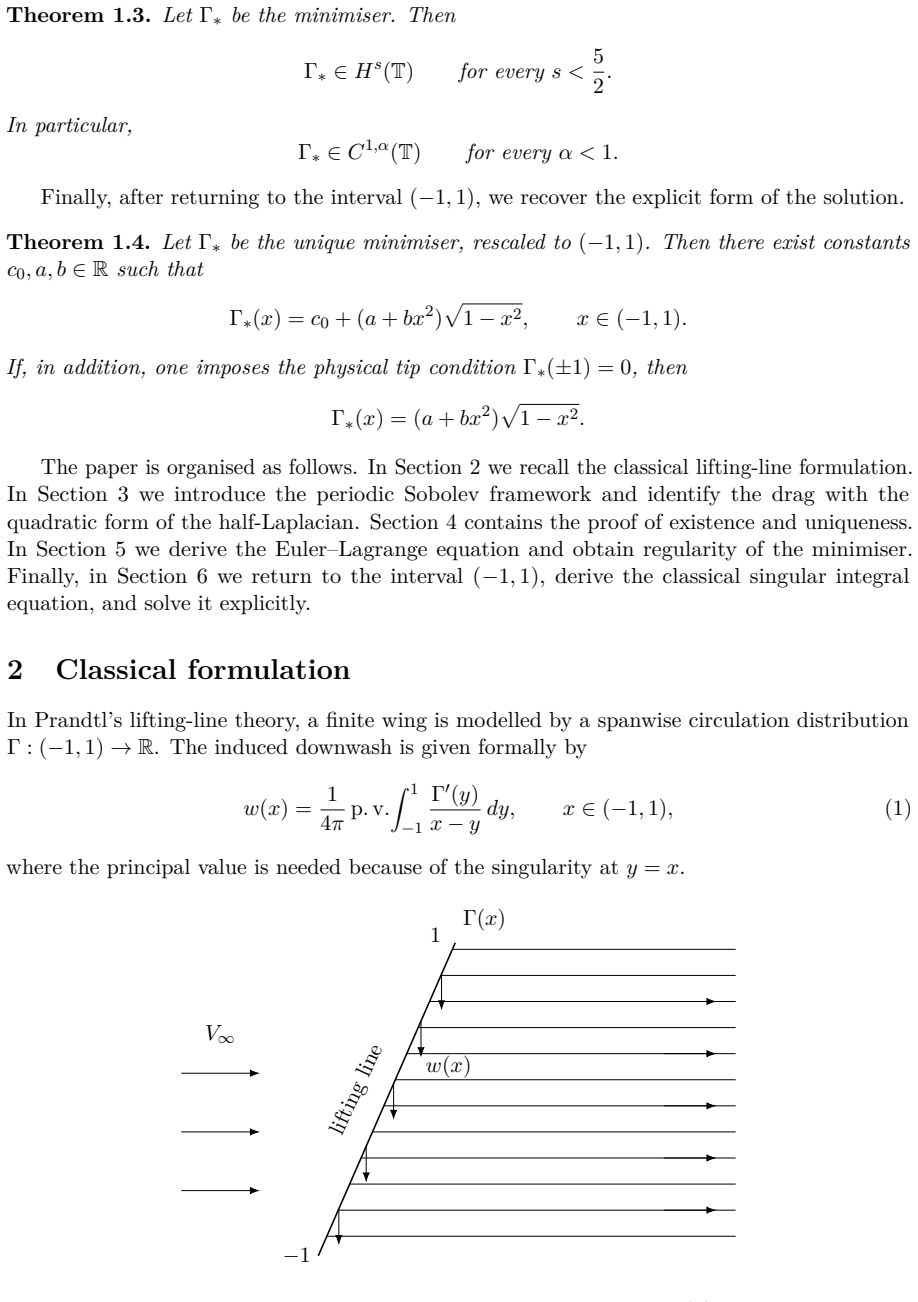
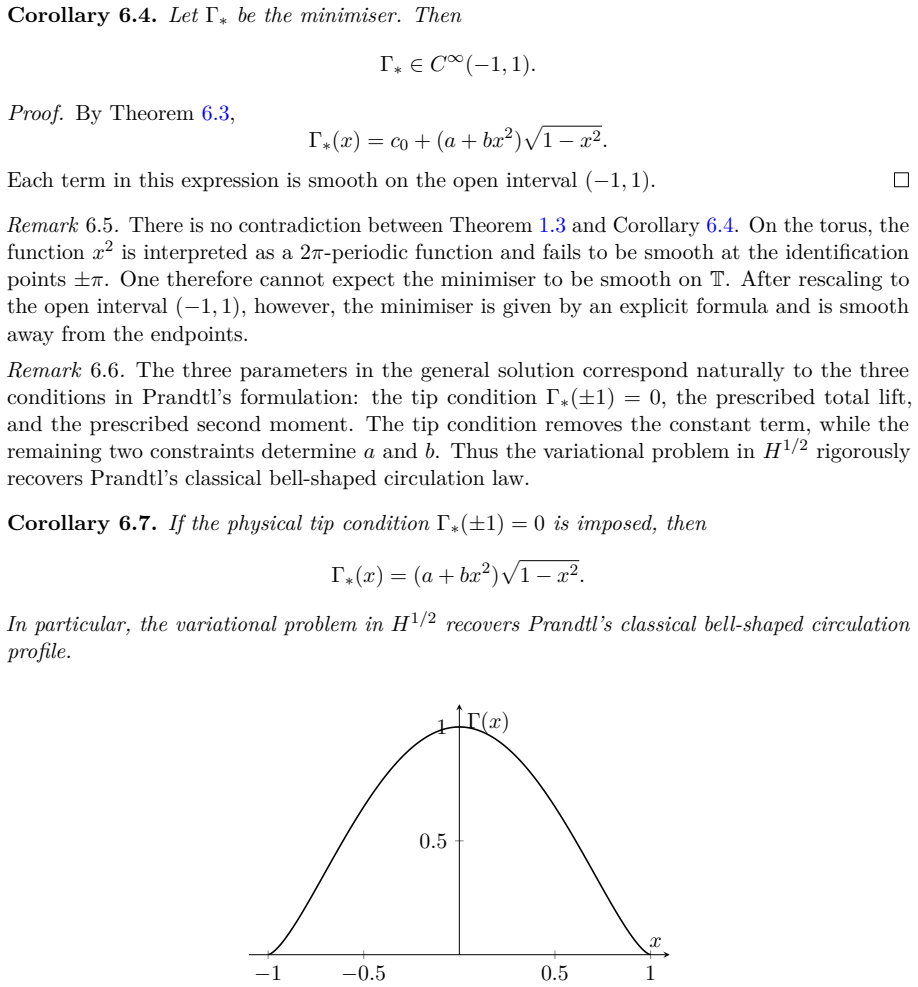
The induced drag minimization problem for a finite wing is formulated in the space H^{1/2} subject to fixed lift and second-moment constraints. Existence and uniqueness of minimizers follow from variational arguments, and the Euler-Lagrange equation is obtained. In the equivalent periodic formulation on the torus the drag coincides with the quadratic form of the half-Laplacian; the resulting singular integral equation is solved explicitly and yields Prandtl's bell-shaped circulation profile.
What carries the argument
The quadratic form of the half-Laplacian on the one-dimensional torus, which represents the drag functional and permits explicit solution of the Euler-Lagrange equation.
If this is right
- A unique minimizer exists in H^{1/2} under the given lift and second-moment constraints.
- The Euler-Lagrange equation holds pointwise for the minimizer.
- The periodic drag functional equals the quadratic form of the half-Laplacian.
- The singular integral equation on the torus admits the explicit bell-shaped circulation as its solution.
Where Pith is reading between the lines
- The weak formulation supplies a natural setting for studying stability of the minimizer with respect to small changes in lift or span.
- The explicit periodic solution can serve as an exact benchmark for numerical schemes applied to non-periodic or three-dimensional wing problems.
- The identification with the half-Laplacian suggests that similar singular quadratic functionals arising in other potential-flow problems may admit the same explicit treatment.
Load-bearing premise
The admissible set consists of functions in H^{1/2} satisfying the lift and second-moment conditions, and the periodic torus formulation captures the essential features of the original finite-wing problem.
What would settle it
A direct verification that the explicit bell-shaped solution fails to satisfy the derived Euler-Lagrange equation or to minimize the drag functional in the periodic H^{1/2} setting.
Figures
read the original abstract
We study Prandtl's classical problem on minimising the induced drag for a finite wing with fixed span. The induced drag is given by a singular quadratic functional of the circulation, with admissible functions satisfying the prescribed lift and second-moment conditions. We formulate the problem in the fractional Sobolev space \(H^{1/2}\), which is the natural energy space for the functional, prove existence and uniqueness of minimisers by variational methods, and derive the corresponding Euler--Lagrange equation. % Passing to a periodic formulation on the one-dimensional torus, we identify the drag functional with the quadratic form of the half-Laplacian and solve the resulting singular integral equation explicitly and recover Prandtl's bell-shaped circulation profile.
Editorial analysis
A structured set of objections, weighed in public.
Referee Report
Summary. The manuscript formulates Prandtl's minimum induced drag problem for a finite wing in the fractional Sobolev space H^{1/2}. It proves existence and uniqueness of minimizers satisfying fixed lift and second-moment conditions by direct variational methods, derives the associated Euler-Lagrange equation, and passes to a periodic formulation on the one-dimensional torus. There the drag is identified with the quadratic form of the half-Laplacian; the resulting singular integral equation is solved explicitly, recovering the classical bell-shaped circulation profile.
Significance. If the periodic reformulation is rigorously equivalent to the original finite-span problem, the work supplies a clean variational existence proof and an explicit solution in the natural energy space, confirming the classical result by modern methods. The use of standard fractional-Sobolev properties and the explicit solution of the integral equation are clear strengths.
major comments (1)
- [periodic formulation section] The passage to the periodic torus formulation (described after the derivation of the Euler-Lagrange equation) replaces the compact-support constraint and tip-vanishing condition of the original finite-wing problem with a second-moment condition on the torus. The periodic kernel differs from the finite-interval kernel, and the manuscript does not supply a detailed argument showing that the two problems are equivalent in H^{1/2}. Because the explicit bell-shaped profile is obtained only in the periodic setting, this equivalence is load-bearing for the central claim that the recovered profile solves Prandtl's original minimization problem.
minor comments (1)
- Notation for the admissible set and the precise statement of the second-moment constraint should be repeated when the periodic problem is introduced, to make the transition self-contained.
Simulated Author's Rebuttal
We thank the referee for the careful reading and for identifying the need to strengthen the justification of the periodic reformulation. We address the single major comment below and will revise the manuscript to incorporate a detailed equivalence argument.
read point-by-point responses
-
Referee: [periodic formulation section] The passage to the periodic torus formulation (described after the derivation of the Euler-Lagrange equation) replaces the compact-support constraint and tip-vanishing condition of the original finite-wing problem with a second-moment condition on the torus. The periodic kernel differs from the finite-interval kernel, and the manuscript does not supply a detailed argument showing that the two problems are equivalent in H^{1/2}. Because the explicit bell-shaped profile is obtained only in the periodic setting, this equivalence is load-bearing for the central claim that the recovered profile solves Prandtl's original minimization problem.
Authors: We agree that a more explicit argument is required to establish equivalence between the original problem on a finite interval (with compact support and tip-vanishing) and the periodic formulation on the torus. In the revised manuscript we will add a dedicated subsection that (i) compares the kernels directly, (ii) shows how the second-moment constraint on the torus reproduces the effect of the tip conditions in H^{1/2}, and (iii) proves that the two quadratic forms coincide on the admissible class, thereby confirming that the explicit half-Laplacian solution satisfies the Euler-Lagrange equation of the original finite-wing problem. revision: yes
Circularity Check
No significant circularity; derivation uses standard variational methods and fractional Sobolev space properties.
full rationale
The paper sets up the drag minimization in H^{1/2} with lift and second-moment constraints, applies standard existence/uniqueness arguments from variational calculus, derives the Euler-Lagrange equation, and reduces the periodic-torus case to the half-Laplacian quadratic form whose explicit solution recovers the known elliptical profile. None of these steps are self-definitional, fitted-then-renamed-as-prediction, or dependent on load-bearing self-citations; the chain rests on externally verifiable properties of fractional Sobolev spaces and singular integral operators. The periodic reformulation is presented as an equivalent reformulation rather than a tautological redefinition of the original finite-wing problem.
Axiom & Free-Parameter Ledger
axioms (1)
- domain assumption The fractional Sobolev space H^{1/2} is the natural energy space in which the drag functional is well-defined and coercive on the admissible set
Reference graph
Works this paper leans on
-
[1]
Brezis, Functional Analysis, Sobolev Spaces and Partial Differential Equations, Springer, New York, 2011
H. Brezis, Functional Analysis, Sobolev Spaces and Partial Differential Equations, Springer, New York, 2011
2011
-
[2]
L. C. Evans, Partial Differential Equations, 2nd ed., Graduate Studies in Mathematics, vol. 19, American Mathematical Society, 2010
2010
-
[3]
Hebey, Sobolev Spaces on Riemannian Manifolds, Lecture Notes in Mathematics, vol
E. Hebey, Sobolev Spaces on Riemannian Manifolds, Lecture Notes in Mathematics, vol. 1635, Springer, Berlin, 1996
1996
-
[4]
Katznelson, An Introduction to Harmonic Analysis, 3rd ed., Cambridge University Press, Cambridge, 2004
Y. Katznelson, An Introduction to Harmonic Analysis, 3rd ed., Cambridge University Press, Cambridge, 2004
2004
-
[5]
F. W. King, Hilbert Transforms. Vol. I, Cambridge University Press, Cambridge, 2009
2009
-
[6]
An Improvement to Prandtl’s 1933 Model for Minimizing Induced Drag, Appl Math Optim 89, 39 (2024)
Ożański, W.S. An Improvement to Prandtl’s 1933 Model for Minimizing Induced Drag, Appl Math Optim 89, 39 (2024)
1933
-
[7]
Panaro, M.T., Frediani, A., Giannessi, F., Rizzo, E. (2009). Variational Approach to the Problem of the Minimum Induced Drag of Wings. In: Variational Analysis and Aerospace Engineering. Springer Optimization and Its Applications, vol 33. Springer, New York, NY
2009
-
[8]
Prandtl, Applications of Modern Hydrodynamics to Aeronautics, translation of the 1933 article
L. Prandtl, Applications of Modern Hydrodynamics to Aeronautics, translation of the 1933 article. (Translated into English by ??? )
1933
-
[9]
Uber tragfl\
L. Prandtl, \"Uber tragfl\"ugel kleinsten induzierten widerstandes, Zeitschrift f\"ur Flugtechnik und Motorluftschiffahrt 24 (1933), no. 11, 305--306
1933
-
[10]
Roncal and P
L. Roncal and P. R. Stinga, Fractional Laplacian on the torus, Communications in Contemporary Mathematics 18 (2016), no. 3, 1550031
2016
discussion (0)
Sign in with ORCID, Apple, or X to comment. Anyone can read and Pith papers without signing in.