REVIEW 3 major objections 3 minor 1 cited by
$\textit{Eppur Si Muove}$: Self-Sustained Streaming Motions in Multi-Phase MHD
T0 review · 3 major / 3 minor · reviewed 2026-08-06 · deepseek-v4-flash
Pith's one-line read In magnetized gas, radiative cooling does not shatter clouds; it organizes them into long-lived, field-aligned, counter-streaming flows at ~100 km/s, because magnetic pressure can only resist compression perpendicular to field lines.
desk verdict A serious, well-diagnosed claim that MHD cooling gas streams rather than shatters; the main caveat is the unresolved grid-alignment question for oblique fields. read the letter →
The pith
A machine-rendered reading of the paper's core claim, the machinery that carries it, and where it could break.
The reading
What carries the argument
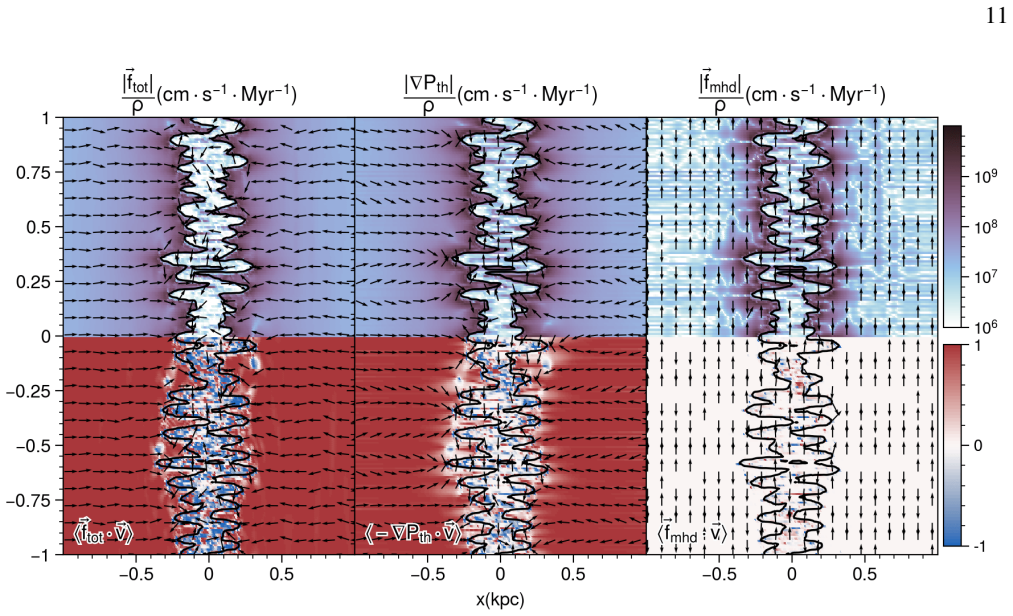
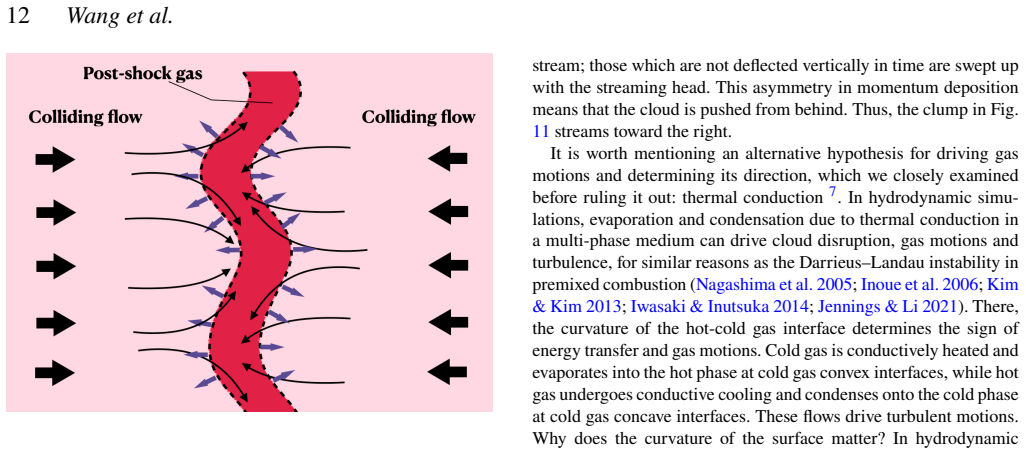
The load-bearing object is the anisotropic MHD pressure tensor: magnetic pressure and tension act only perpendicular to the field, so gas can slide freely along field lines and field-parallel thermal pressure gradients $\nabla P_{th,\parallel}$ go unbalanced. Cooling creates the conditions for this to matter — when the cooling time drops sharply below the sound-crossing time, gas falls out of thermal pressure balance and cools nearly isochorically, producing a deep thermal pressure deficit — and the unbalanced gradients then drive flows described by the conserved quantity $P_{th} + \frac{1}{2}\rho v^2 \approx {\rm const}$ along each flux tube, giving streaming velocities $v \sim (2\Delta P/\rho)^{1/2}$. The second element is the cooling-induced MHD thin shell instability, an adaptation of the non-linear thin shell instability (a corrugational instability of thin dense shells in colliding flows, first identified at shock fronts): because the cold gas is under-pressured rather than over-pressured as in the classic case, it is magnetic tension that deflects the inflows, diverting them away from convex heads and into concave tails of neighboring wrinkles, which amplifies the corrugation and sets up alternating counter-streaming winds in adjacent flux tubes. The mechanism holds together only if field lines stay nearly straight, with sub-Alfvénic flows (slower than the magnetic wave speed, $M_A \lesssim 1$), so the deflections remain small and the pressure gradients stay field-aligned.
What would settle it
Run the fiducial CGM thermal-instability setup in 3D with an initially tangled magnetic field (coherence length much smaller than the box, no mean guide field). The mechanism requires straight, ordered fields: if coherent ~100 km/s counter-streaming between adjacent flux tubes still develops, the central claim is wrong, whereas if streaming appears only where the field is locally ordered, the mechanism survives. The observational counterpart is spatially resolved spectroscopy of solar coronal rain, where the claimed alternating ~50–100 km/s velocity pattern between adjacent threads is a specific signature that would be absent if streaming is not the operating physics.
Extended reading notes
Core claim
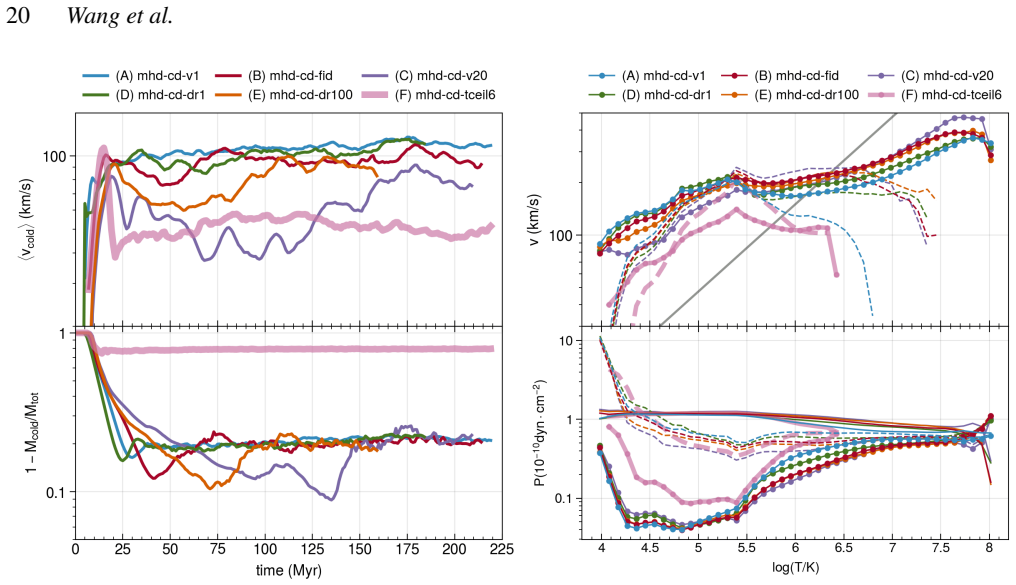
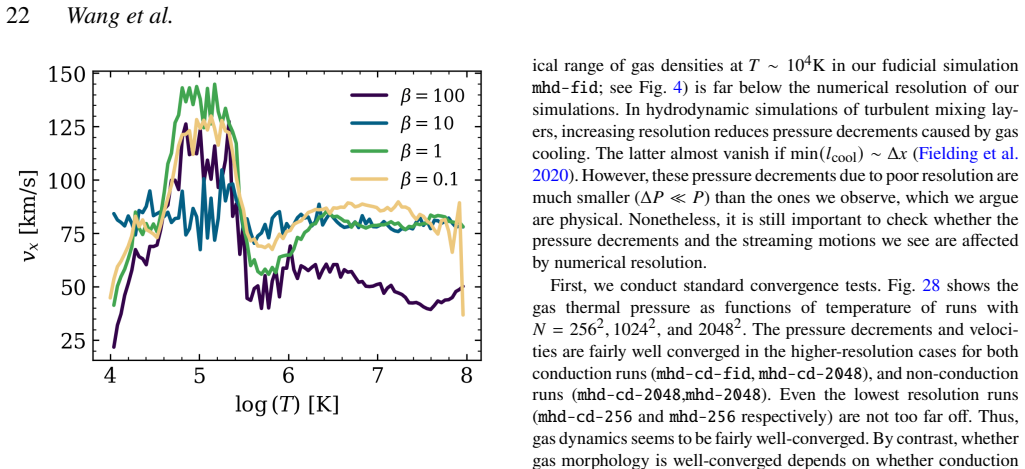
The paper's central claim is that magnetized, radiatively cooling gas does not shatter the way hydrodynamic gas does; instead it streams. After initial fragmentation, both the cold ($\sim 10^4$ K) and hot phases settle into long-lived, coherent, field-aligned flows at velocities up to the hot-phase sound speed — roughly 50–100 km/s for CGM and solar-corona conditions and up to an order of magnitude higher for the ICM — with adjacent flux tubes counter-streaming. The driver is the anisotropic character of magnetic pressure support: flux freezing makes the cooling gas magnetically dominated, so total-pressure balance $P_B + P_{\rm gas} \approx {\rm const}$ holds only perpendicular to the field, while field-parallel thermal pressure gradients are unopposed and accelerate the gas according to the Bernoulli relation $v \sim (2\Delta P/\rho)^{1/2}$. Counter-streaming is produced by a cooling-induced MHD version of the non-linear thin shell instability, in which magnetic tension deflects the pressure-driven inflows away from convex cold-gas heads and toward the concave tails of neighboring corrugations, amplifying the wrinkles and pushing each cloud from behind. The authors establish this with idealized 2D and 3D simulations, force analysis, and tracer-particle runs, and show the effect survives thermal conduction, weak initial fields (plasma $\beta_i = 100$), power-law cooling, and coarse resolution, while being suppressed for ISM-range cooling curves and whenever field lines become strongly bent.
Load-bearing premise
The mechanism requires the magnetic field to stay nearly straight while gas flows along it: streaming is coherent only for sub-Alfvénic flow, and the authors find that when fields become strongly bent — for instance in high-$\beta$ gas with strong thermal conduction — the ordered streaming is replaced by disordered motion.
Editorial extensions
If this is right
- Streaming velocities of roughly 50–100 km/s for $10^4$ K gas match the observed ~70–80 km/s counter-streaming speeds of solar coronal rain, giving a heating-independent origin for such 'siphon flows.'
- In the CGM and ICM, streaming adds a coherent, field-aligned ~100 km/s velocity component to cold gas, contributing non-thermal line broadening that unresolved observations would likely attribute to isotropic turbulence.
- In the ICM, where the hot phase reaches $10^8$ K, streaming velocities can be an order of magnitude higher than in the CGM — approaching ~1000 km/s.
- Streaming survives in weakly magnetized backgrounds because flux freezing amplifies the field as gas cools and compresses, so the cold phase always ends up magnetically dominated; conduction enlarges the streaming cloudlets but does not qualitatively change the dynamics.
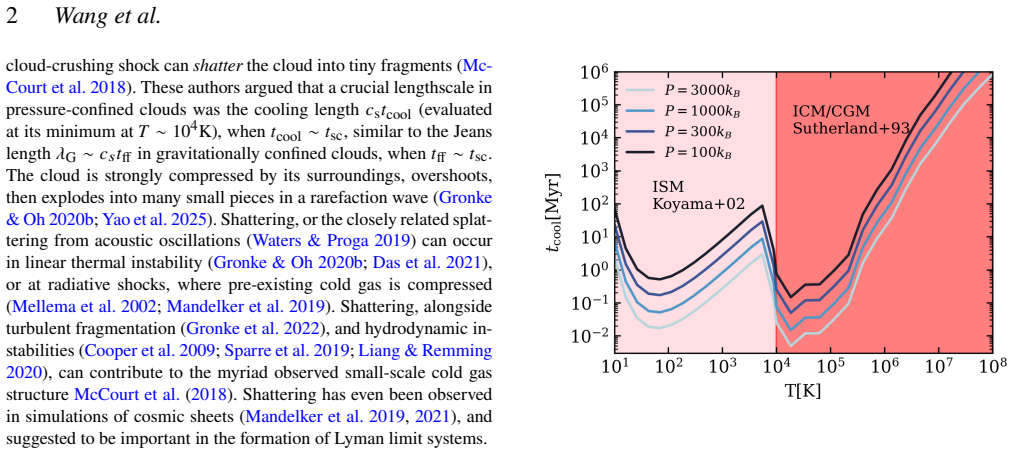
- The mechanism is suppressed for ISM-range cooling curves ($10$–$10^4$ K), where cooling remains isobaric, so molecular gas does not stream even though its hydrodynamic counterpart still shatters.
Reading between the lines
- The paper's temperature-independent conduction coefficient is far stronger than Spitzer conduction at $10^4$ K, and the authors themselves flag this as a source of artifacts in high-$\beta$ runs; the natural follow-up is a high-$\beta$ simulation with realistic $\kappa \propto T^{5/2}$, which the no-conduction high-$\beta$ results suggest would still stream.
- If streaming is real, single-line non-thermal broadening measurements in the CGM would be conflating an ordered, field-aligned velocity pattern with isotropic turbulence; comparing line widths measured along and across the projected field orientation in spatially resolved systems would separate the two.
- The mechanism's control parameter is field-line straightness, which predicts that initially tangled fields should show streaming only in patches where the field is locally coherent — a testable prediction the paper leaves open.
- Because the effect depends on anisotropic support, well-coupled cosmic rays (whose pressure is isotropic) should not produce streaming, making CR+MHD simulations a clean discriminator of the mechanism.
Editorial analysis
A structured set of objections, weighed in public.
Referee Report
Summary. The paper uses Athena++ MHD simulations of radiatively cooling gas in thermal-instability and cooling-cloud setups to argue that, unlike hydrodynamic 'shattering', magnetized cooling gas does not fragment chaotically but instead develops long-lived, field-aligned, self-sustained streaming motions at velocities of order 100 km/s, with adjacent flux tubes counter-streaming. The authors attribute the streaming to unbalanced field-aligned thermal pressure gradients arising from anisotropic MHD pressure support, quantified by a Bernoulli-type relation (Eqs. 16-17), and attribute the counter-streaming to a cooling-induced MHD version of the thin-shell instability driven by magnetic tension. The paper explores parameter dependence on cooling curve, temperature range, thermal conduction, plasma beta, and numerical resolution, and connects the results to coronal rain and CGM/ICM kinematics.
Significance. If correct, the paper identifies a potentially important new dynamical mode—self-sustained, counter-streaming, field-aligned flows in radiatively cooling multiphase gas—with direct implications for line broadening and kinematics in the CGM/ICM and for solar coronal rain. The evidence is unusually multi-pronged for an exploratory study: convergence tests in velocity and pressure over 256^2 to 2048^2, a run that explicitly resolves c_s t_cool, a 3D check, tracer-particle momentum asymmetry, and force-velocity correlations. The authors are also candid about assumptions and limitations, including the constant heat diffusivity, the diagonal-field discrepancy in Appendix A, and the suppression of streaming for ISM-like cooling curves. The main gap is that the central claim rests almost entirely on grid-aligned initial fields, while the only oblique-field run behaves qualitatively differently and is not subjected to a convergence study.
major comments (3)
- [Appendix A; §2] The diagonal-field run mhd-bxy is the most direct test of whether streaming is a physical outcome or a grid-alignment artifact, and the paper does not currently resolve this issue. With identical physics except a 45-degree field rotation, mhd-bxy forms long filaments instead of grid-scale clumps, and the authors attribute the difference to 'excessive numerical diffusion' without showing that the diagonal run converges to the grid-aligned behavior at higher resolution. Since nearly all physics claims rest on grid-aligned runs, please add a resolution study (e.g., 256^2, 1024^2, 2048^2) for mhd-bxy and demonstrate that streaming speed, pressure dip, and morphology approach those of mhd-fid; if they do not, the claim that streaming is a robust physical outcome of MHD thermal instability is not supported.
- [§3.2, Fig. 6] The 3D verification is a single low-resolution run (256^3) that the authors themselves describe as containing many underpressured single-grid-cell clumps due to poor resolution. This provides only weak evidence for robustness, especially because the 3D morphology differs from the 2D case. Please either add a 3D convergence sequence (at least 256^3 versus 512^3, with and without conduction) or explicitly restrict the robustness claim to 2D with a tentative 3D check.
- [Abstract; §5.3; Fig. 26] The abstract states that thermal conduction 'does not qualitatively modify dynamics', but the paper's own high-beta conduction run (Fig. 26) shows that ordered streaming disappears when magnetic fields become strongly bent, and §4.2 states that relatively straight field lines are a key requirement. This is a significant limitation of the central claim and should be reconciled or stated more prominently in the abstract and conclusions. As written, the abstract overstates the robustness of streaming with respect to conduction and field-line bending.
minor comments (3)
- [§5.4] In the sentence reporting the resolution study, the phrase 'non-conduction runs (mhd-cd-2048, mhd-2048)' lists mhd-cd-2048, which is a conduction run; this appears to be a typo and should likely read 'mhd-fid and mhd-2048'.
- [§4.2] The text uses 'NSTI' once ('The NSTI is a non-linear instability') where 'NTSI' is intended.
- [§3.2] The phrase 'our fidicial MHD thermal instability setup' contains a typo; 'fidicial' should be 'fiducial'.
Circularity Check
No significant circularity: the streaming mechanism is diagnosed from simulation outputs and tested against external benchmarks; the Bernoulli relation is a consistency check, not a fitted prediction.
full rationale
Score 0: no significant circularity. The paper's central claim—that MHD cooling gas streams along field lines instead of shattering—is derived from simulation outputs (force balances, pressure maps, tracer particles) and compared against external observables (coronal rain velocities) and controlled hydro/MHD pairs; it is not equivalent to its inputs by construction. The Bernoulli relation (Eqs. 16-17) is presented as a diagnostic consistency check: P_th + 1/2 rho v^2 is computed from the simulation and shown to be roughly constant, and the 'predicted' velocity v = sqrt(2 Delta P / rho) is compared with the measured velocity in the same runs. This is a momentum-conservation identity, not a fitted parameter renamed as a prediction; no free constant is adjusted to force agreement. The thin-shell-instability explanation is inferred from force-velocity cross-correlations and tracer-particle asymmetries, not assumed as an input. Self-citations (e.g., Gronke & Oh 2020b for the hydrodynamic shattering criterion; Jiang & Oh 2018 for the two-moment conduction solver; Kaul et al. 2025 for cloud infall) are background or methodological and are not used to justify the novel streaming claim. The Appendix A diagonal-field discrepancy is an acknowledged numerical robustness limitation (excessive numerical diffusion) rather than a circular derivation; it is a correctness/convergence risk, not a logical reduction of the conclusion to its premises.
Assumptions & free parameters
free parameters (4)
- Heat diffusivity alpha_parallel (fiducial alpha_FID) =
1.5e28 cm^2/s
- Anisotropy ratio alpha_parallel/alpha_iso =
30
- Two-moment conduction propagation speed V_m =
1000 km/s
- Temperature floor T_floor =
1e4 K
assumptions (5)
- domain assumption Global heating rate Gamma is set equal to the box-averaged cooling rate at every timestep, enforcing thermal equilibrium by fiat.
- domain assumption Ideal MHD with flux freezing; no viscosity or resistivity.
- domain assumption 2D simulations are representative of the 3D dynamics; only a single low-resolution 3D run is used as a check.
- ad hoc to paper Constant heat diffusivity approximates temperature-dependent Spitzer conduction.
- domain assumption Magnetic field lines remain nearly straight, with sub-Alfvenic flows (M_A <= 1), so that field-aligned pressure gradients are unopposed.
Cite this review
Pith. "Pith review of $\textit{Eppur Si Muove}$: Self-Sustained Streaming Motions in Multi-Phase MHD." pith.science (2026). https://pith.science/paper/SLVO2DFR
@misc{pith2026250700136,
  author       = {Pith},
  title        = {Pith review of: $\textitEppur Si Muove$: Self-Sustained Streaming Motions in Multi-Phase MHD},
  year         = {2026},
  howpublished = {\url{https://pith.science/paper/SLVO2DFR}},
  note         = {Machine review of arXiv:2507.00136}
}
abstract
Radiative cooling can drive dynamics in multi-phase gas. A dramatic example is hydrodynamic `shattering', the violent, pressure-driven fragmentation of a cooling cloud which falls drastically out of pressure balance with its surroundings. We run MHD simulations to understand how shattering is influenced by magnetic fields. In MHD, clouds do not `shatter' chaotically. Instead, after initial fragmentation, both hot and cold phases coherently `stream' in long-lived, field-aligned, self-sustaining gas flows, at high speed ($\sim 100 \, {\rm km \, s^{-1}}$). MHD thermal instability also produces such flows. They are due to the anisotropic nature of MHD pressure support, which only operates perpendicular to B-fields. Thus, even when $P_{\rm B} + P_{\rm gas} \approx$const, pressure balance only holds perpendicular to B-fields. Field-aligned gas pressure variations are unopposed, and results in gas velocities $v \sim (2 \Delta P/\rho)^{1/2}$ from Bernoulli's principle. Strikingly, gas in adjacent flux tubes $\textit{counter-stream}$ in opposite directions. We show this arises from a cooling-induced, MHD version of the thin shell instability. Magnetic tension is important both in enabling corrugational instability and modifying its non-linear evolution. Even in high $\beta$ hot gas, streaming can arise, since magnetic pressure support grows as gas cools and compresses. Thermal conduction increases the sizes and velocities of streaming cloudlets, but does not qualitatively modify dynamics. These results are relevant to the counter-streaming gas flows observed in solar coronal rain, as well as multi-phase gas cooling and condensation in the ISM, CGM and ICM.
Figures


Figures from the paper (25 more)








Forward citations
Cited by 1 Pith paper
-
Multiphase gas in Circumgalactic cloud complexes: Insights from kiloparsec-scale Magnetohydrodynamic Turbulence Simulations
Cold-gas survival in the circumgalactic medium is set by t_cool/t_mix; small-scale cold gas requires dense, quiescent regions, not turbulent cascade patches.
Reference graph
Works this paper leans on
-
[1]
Abruzzo M. W., Bryan G. L., Fielding D. B., 2022, @doi [ ] 10.3847/1538-4357/ac3c48 , https://ui.adsabs.harvard.edu/abs/2022ApJ...925..199A 925, 199
-
[2]
Ahn K., Chae J., Cao W., Goode P. R., 2010, @doi [ ] 10.1088/0004-637X/721/1/74 , https://ui.adsabs.harvard.edu/abs/2010ApJ...721...74A 721, 74
-
[3]
Alexander C. E., et al., 2013, @doi [ ] 10.1088/2041-8205/775/1/L32 , https://ui.adsabs.harvard.edu/abs/2013ApJ...775L..32A 775, L32
-
[4]
Antolin P., 2020, @doi [Plasma Physics and Controlled Fusion] 10.1088/1361-6587/ab5406 , https://ui.adsabs.harvard.edu/abs/2020PPCF...62a4016A 62, 014016
-
[5]
Antolin P., Froment C., 2022, @doi [Frontiers in Astronomy and Space Sciences] 10.3389/fspas.2022.820116 , https://ui.adsabs.harvard.edu/abs/2022FrASS...920116A 9, 820116
arXiv 2022
-
[6]
Antolin P., Vissers G., Pereira T. M. D., Rouppe van der Voort L., Scullion E., 2015, @doi [ ] 10.1088/0004-637X/806/1/81 , https://ui.adsabs.harvard.edu/abs/2015ApJ...806...81A 806, 81
-
[7]
Auch \`e re F., Bocchialini K., Solomon J., Tison E., 2014, @doi [ ] 10.1051/0004-6361/201322572 , https://ui.adsabs.harvard.edu/abs/2014A&A...563A...8A 563, A8
-
[8]
Choi E., Stone J. M., 2012, @doi [ ] 10.1088/0004-637X/747/2/86 , https://ui.adsabs.harvard.edu/abs/2012ApJ...747...86C 747, 86
Show all 83 references
-
[9]
Claes N., Keppens R., 2019, @doi [ ] 10.1051/0004-6361/201834699 , https://ui.adsabs.harvard.edu/abs/2019A&A...624A..96C 624, A96
2019 doi
-
[10]
Claes N., Keppens R., Xia C., 2020, @doi [ ] 10.1051/0004-6361/202037616 , https://ui.adsabs.harvard.edu/abs/2020A&A...636A.112C 636, A112
2020 doi
-
[11]
L., Bicknell G
Cooper J. L., Bicknell G. V., Sutherland R. S., Bland-Hawthorn J., 2009, @doi [ ] 10.1088/0004-637X/703/1/330 , http://adsabs.harvard.edu/abs/2009ApJ...703..330C 703, 330
2009 doi
-
[12]
K., Gronke M., 2023, @doi [ ] 10.1093/mnras/stad3125 , https://ui.adsabs.harvard.edu/abs/2023MNRAS.tmp.2982D
Das H. K., Gronke M., 2023, @doi [ ] 10.1093/mnras/stad3125 , https://ui.adsabs.harvard.edu/abs/2023MNRAS.tmp.2982D
2023 doi
-
[13]
K., Choudhury P
Das H. K., Choudhury P. P., Sharma P., 2021, @doi [ ] 10.1093/mnras/stab382 , https://ui.adsabs.harvard.edu/abs/2021MNRAS.502.4935D 502, 4935
2021 doi
-
[14]
J., 2007, @doi [ ] 10.1086/521997 , https://ui.adsabs.harvard.edu/abs/2007ApJ...670..221D 670, 221
Dursi L. J., 2007, @doi [ ] 10.1086/521997 , https://ui.adsabs.harvard.edu/abs/2007ApJ...670..221D 670, 221
2007 doi
-
[15]
J., Pfrommer C., 2008, @doi [ ] 10.1086/529371 , http://adsabs.harvard.edu/abs/2008ApJ...677..993D 677, 993
Dursi L. J., Pfrommer C., 2008, @doi [ ] 10.1086/529371 , http://adsabs.harvard.edu/abs/2008ApJ...677..993D 677, 993
2008 doi
-
[16]
C., Johnstone R
Fabian A. C., Johnstone R. M., Sanders J. S., Conselice C. J., Crawford C. S., Gallagher III J. S., Zweibel E., 2008, @doi [ ] 10.1038/nature07169 , http://adsabs.harvard.edu/abs/2008Natur.454..968F 454, 968
2008 doi
-
[17]
Fang X., Xia C., Keppens R., 2013, @doi [ ] 10.1088/2041-8205/771/2/L29 , https://ui.adsabs.harvard.edu/abs/2013ApJ...771L..29F 771, L29
2013 doi
-
[18]
Fang X., Xia C., Keppens R., Van Doorsselaere T., 2015, @doi [ ] 10.1088/0004-637X/807/2/142 , https://ui.adsabs.harvard.edu/abs/2015ApJ...807..142F 807, 142
2015 doi
-
[19]
P., 2023, @doi [ ] 10.1146/annurev-astro-052920-125203 , https://ui.adsabs.harvard.edu/abs/2023ARA&A..61..131F 61, 131
Faucher-Gigu \`e re C.-A., Oh S. P., 2023, @doi [ ] 10.1146/annurev-astro-052920-125203 , https://ui.adsabs.harvard.edu/abs/2023ARA&A..61..131F 61, 131
2023 doi
-
[20]
B., 1965, @doi [ ] 10.1086/148317 , http://adsabs.harvard.edu/abs/1965ApJ...142..531F 142, 531
Field G. B., 1965, @doi [ ] 10.1086/148317 , http://adsabs.harvard.edu/abs/1965ApJ...142..531F 142, 531
1965 doi
-
[21]
B., Ostriker E
Fielding D. B., Ostriker E. C., Bryan G. L., Jermyn A. S., 2020, @doi [ ] 10.3847/2041-8213/ab8d2c , https://ui.adsabs.harvard.edu/abs/2020ApJ...894L..24F 894, L24
2020 doi
-
[22]
Fogerty E., Carroll-Nellenback J., Frank A., Heitsch F., Pon A., 2017, @doi [ ] 10.1093/mnras/stx1381 , https://ui.adsabs.harvard.edu/abs/2017MNRAS.470.2938F 470, 2938
2017 doi
-
[23]
Froment C., Auch \`e re F., Bocchialini K., Buchlin E., Guennou C., Solomon J., 2015, @doi [ ] 10.1088/0004-637X/807/2/158 , https://ui.adsabs.harvard.edu/abs/2015ApJ...807..158F 807, 158
2015 doi
-
[24]
Fryxell B., et al., 2000, @doi [ ] 10.1086/317361 , http://adsabs.harvard.edu/abs/2000ApJS..131..273F 131, 273
2000 doi
-
[25]
P., 2013, @doi [ ] 10.1093/mnras/stt692 , http://adsabs.harvard.edu/abs/2013MNRAS.432.3401G 432, 3401
Gaspari M., Ruszkowski M., Oh S. P., 2013, @doi [ ] 10.1093/mnras/stt692 , http://adsabs.harvard.edu/abs/2013MNRAS.432.3401G 432, 3401
2013 doi
-
[26]
P., 2018, @doi [ ] 10.1093/mnrasl/sly131 , http://adsabs.harvard.edu/abs/2018MNRAS.tmpL.135G
Gronke M., Oh S. P., 2018, @doi [ ] 10.1093/mnrasl/sly131 , http://adsabs.harvard.edu/abs/2018MNRAS.tmpL.135G
2018 doi
-
[27]
P., 2020a, @doi [ ] 10.1093/mnras/stz3332 , https://ui.adsabs.harvard.edu/abs/2020MNRAS.492.1970G 492, 1970
Gronke M., Oh S. P., 2020a, @doi [ ] 10.1093/mnras/stz3332 , https://ui.adsabs.harvard.edu/abs/2020MNRAS.492.1970G 492, 1970
1970 doi
-
[28]
P., 2020b, @doi [ ] 10.1093/mnrasl/slaa033 , https://ui.adsabs.harvard.edu/abs/2020MNRAS.494L..27G 494, L27
Gronke M., Oh S. P., 2020b, @doi [ ] 10.1093/mnrasl/slaa033 , https://ui.adsabs.harvard.edu/abs/2020MNRAS.494L..27G 494, L27
-
[29]
P., 2023, @doi [ ] 10.1093/mnras/stad1874 , https://ui.adsabs.harvard.edu/abs/2023MNRAS.524..498G 524, 498
Gronke M., Oh S. P., 2023, @doi [ ] 10.1093/mnras/stad1874 , https://ui.adsabs.harvard.edu/abs/2023MNRAS.524..498G 524, 498
2023 doi
-
[30]
P., Ji S., Norman C., 2022, @doi [ ] 10.1093/mnras/stab3351 , https://ui.adsabs.harvard.edu/abs/2022MNRAS.511..859G 511, 859
Gronke M., Oh S. P., Ji S., Norman C., 2022, @doi [ ] 10.1093/mnras/stab3351 , https://ui.adsabs.harvard.edu/abs/2022MNRAS.511..859G 511, 859
2022 doi
-
[31]
D., Devriendt J
Heitsch F., Slyz A. D., Devriendt J. E. G., Hartmann L. W., Burkert A., 2007, @doi [ ] 10.1086/519513 , https://ui.adsabs.harvard.edu/abs/2007ApJ...665..445H 665, 445
2007 doi
-
[32]
Hennebelle P., Inutsuka S.-i., 2019, @doi [Frontiers in Astronomy and Space Sciences] 10.3389/fspas.2019.00005 , https://ui.adsabs.harvard.edu/abs/2019FrASS...6....5H 6, 5
2019
-
[33]
J., Gronke M., 2023, in American Astronomical Society Meeting Abstracts
Hidalgo Pineda F., Farber R. J., Gronke M., 2023, in American Astronomical Society Meeting Abstracts. p. 177.75
2023
-
[34]
W., 2022, @doi [ ] 10.3847/1538-4357/ac69dc , https://ui.adsabs.harvard.edu/abs/2022ApJ...931..140H 931, 140
Huang X., Jiang Y.-f., Davis S. W., 2022, @doi [ ] 10.3847/1538-4357/ac69dc , https://ui.adsabs.harvard.edu/abs/2022ApJ...931..140H 931, 140
2022 doi
-
[35]
Inoue T., Inutsuka S.-i., Koyama H., 2006, @doi [ ] 10.1086/508334 , http://adsabs.harvard.edu/abs/2006ApJ...652.1331I 652, 1331
2006 doi
-
[36]
Iwasaki K., Inutsuka S.-i., 2014, @doi [ ] 10.1088/0004-637X/784/2/115 , https://ui.adsabs.harvard.edu/abs/2014ApJ...784..115I 784, 115
2014 doi
-
[37]
M., Li Y., 2021, @doi [ ] 10.1093/mnras/stab1607 , https://ui.adsabs.harvard.edu/abs/2021MNRAS.505.5238J 505, 5238
Jennings R. M., Li Y., 2021, @doi [ ] 10.1093/mnras/stab1607 , https://ui.adsabs.harvard.edu/abs/2021MNRAS.505.5238J 505, 5238
2021 doi
-
[38]
P., McCourt M., 2018, @doi [ ] 10.1093/mnras/sty293 , http://adsabs.harvard.edu/abs/2018MNRAS.476..852J 476, 852
Ji S., Oh S. P., McCourt M., 2018, @doi [ ] 10.1093/mnras/sty293 , http://adsabs.harvard.edu/abs/2018MNRAS.476..852J 476, 852
2018 doi
-
[39]
P., Masterson P., 2019, @doi [ ] 10.1093/mnras/stz1248 , https://ui.adsabs.harvard.edu/abs/2019MNRAS.487..737J 487, 737
Ji S., Oh S. P., Masterson P., 2019, @doi [ ] 10.1093/mnras/stz1248 , https://ui.adsabs.harvard.edu/abs/2019MNRAS.487..737J 487, 737
2019 doi
-
[40]
P., 2018, @doi [ ] 10.3847/1538-4357/aaa6ce , http://adsabs.harvard.edu/abs/2018ApJ...854....5J 854, 5
Jiang Y.-F., Oh S. P., 2018, @doi [ ] 10.3847/1538-4357/aaa6ce , http://adsabs.harvard.edu/abs/2018ApJ...854....5J 854, 5
2018 doi
-
[41]
W., Gaalaas J
Jones T. W., Gaalaas J. B., Ryu D., Frank A., 1997, @doi [ ] 10.1086/304145 , http://adsabs.harvard.edu/abs/1997ApJ...482..230J 482, 230
1997 doi
-
[42]
Kanjilal V., Dutta A., Sharma P., 2021, @doi [ ] 10.1093/mnras/staa3610 , https://ui.adsabs.harvard.edu/abs/2021MNRAS.501.1143K 501, 1143
2021 doi
-
[43]
P., Mandelker N., 2025, @doi [ ] 10.1093/mnras/staf706 , https://ui.adsabs.harvard.edu/abs/2025MNRAS.539.3669K 539, 3669
Kaul I., Tan B., Oh S. P., Mandelker N., 2025, @doi [ ] 10.1093/mnras/staf706 , https://ui.adsabs.harvard.edu/abs/2025MNRAS.539.3669K 539, 3669
2025 doi
-
[44]
Kim J.-G., Kim W.-T., 2013, @doi [ ] 10.1088/0004-637X/779/1/48 , http://adsabs.harvard.edu/abs/2013ApJ...779...48K 779, 48
2013 doi
-
[45]
Koyama H., Inutsuka S.-i., 2002, @doi [ ] 10.1086/338978 , https://ui.adsabs.harvard.edu/abs/2002ApJ...564L..97K 564, L97
2002 doi
-
[46]
Koyama H., Inutsuka S.-i., 2004, @doi [ ] 10.1086/382478 , http://adsabs.harvard.edu/abs/2004ApJ...602L..25K 602, L25
2004 doi
-
[47]
Kriginsky M., Oliver R., Antolin P., Kuridze D., Freij N., 2021, @doi [ ] 10.1051/0004-6361/202140611 , https://ui.adsabs.harvard.edu/abs/2021A&A...650A..71K 650, A71
2021 doi
-
[48]
G., Norman M
Kritsuk A. G., Norman M. L., 2002, @doi [ ] 10.1086/340785 , http://adsabs.harvard.edu/abs/2002ApJ...569L.127K 569, L127
2002 doi
-
[49]
L., 2014, @doi [ ] 10.1088/0004-637X/789/1/54 , http://adsabs.harvard.edu/abs/2014ApJ...789...54L 789, 54
Li Y., Bryan G. L., 2014, @doi [ ] 10.1088/0004-637X/789/1/54 , http://adsabs.harvard.edu/abs/2014ApJ...789...54L 789, 54
2014 doi
-
[50]
F., Squire J., Hummels C., 2020, @doi [ ] 10.1093/mnras/stz3567 , https://ui.adsabs.harvard.edu/abs/2020MNRAS.492.1841L 492, 1841
Li Z., Hopkins P. F., Squire J., Hummels C., 2020, @doi [ ] 10.1093/mnras/stz3567 , https://ui.adsabs.harvard.edu/abs/2020MNRAS.492.1841L 492, 1841
2020 doi
-
[51]
J., Remming I., 2020, @doi [ ] 10.1093/mnras/stz3403 , https://ui.adsabs.harvard.edu/abs/2020MNRAS.491.5056L 491, 5056
Liang C. J., Remming I., 2020, @doi [ ] 10.1093/mnras/stz3403 , https://ui.adsabs.harvard.edu/abs/2020MNRAS.491.5056L 491, 5056
2020 doi
-
[52]
r., Wiik J
Lin Y., Engvold O. r., Wiik J. E., 2003, @doi [ ] 10.1023/A:1026150809598 , https://ui.adsabs.harvard.edu/abs/2003SoPh..216..109L 216, 109
2003 doi
-
[53]
Lyutikov M., 2006, @doi [ ] 10.1111/j.1365-2966.2006.10835.x , http://adsabs.harvard.edu/abs/2006MNRAS.373...73L 373, 73
2006
-
[54]
C., Springel V., van de Voort F., 2019, @doi [ ] 10.3847/2041-8213/ab30cb , https://ui.adsabs.harvard.edu/abs/2019ApJ...881L..20M 881, L20
Mandelker N., van den Bosch F. C., Springel V., van de Voort F., 2019, @doi [ ] 10.3847/2041-8213/ab30cb , https://ui.adsabs.harvard.edu/abs/2019ApJ...881L..20M 881, L20
2019 doi
-
[55]
C., Springel V., van de Voort F., Burchett J
Mandelker N., van den Bosch F. C., Springel V., van de Voort F., Burchett J. N., Butsky I. S., Nagai D., Oh S. P., 2021, @doi [ ] 10.3847/1538-4357/ac2d29 , https://ui.adsabs.harvard.edu/abs/2021ApJ...923..115M 923, 115
2021 doi
-
[56]
M., Dickey J
McClure-Griffiths N. M., Dickey J. M., Gaensler B. M., Green A. J., Haverkorn M., 2006, @doi [ ] 10.1086/508706 , https://ui.adsabs.harvard.edu/abs/2006ApJ...652.1339M 652, 1339
2006 doi
-
[58]
M., Madigan A.-M., Quataert E., 2015, Monthly Notices of the Royal Astronomical Society, 449, 2
McCourt M., O'Leary R. M., Madigan A.-M., Quataert E., 2015, Monthly Notices of the Royal Astronomical Society, 449, 2
2015
-
[59]
P., O'Leary R., Madigan A.-M., 2018, @doi [ ] 10.1093/mnras/stx2687 , http://adsabs.harvard.edu/abs/2018MNRAS.473.5407M 473, 5407
McCourt M., Oh S. P., O'Leary R., Madigan A.-M., 2018, @doi [ ] 10.1093/mnras/stx2687 , http://adsabs.harvard.edu/abs/2018MNRAS.473.5407M 473, 5407
2018 doi
-
[60]
D., R \" o ttgering H
Mellema G., Kurk J. D., R \" o ttgering H. J. A., 2002, @doi [Astronomy & Astrophysics] 10.1051/0004-6361:20021408 , 395, L13
2002 doi
-
[61]
Nagashima M., Koyama H., Inutsuka S.-i., 2005, @doi [ ] 10.1111/j.1745-3933.2005.00057.x , https://ui.adsabs.harvard.edu/abs/2005MNRAS.361L..25N 361, L25
2005
-
[62]
N., 1953, @doi [ ] 10.1086/145707 , https://ui.adsabs.harvard.edu/abs/1953ApJ...117..431P 117, 431
Parker E. N., 1953, @doi [ ] 10.1086/145707 , https://ui.adsabs.harvard.edu/abs/1953ApJ...117..431P 117, 431
1953 doi
-
[63]
A., Penn M
Schad T. A., Penn M. J., Lin H., Judge P. G., 2016, @doi [ ] 10.3847/0004-637X/833/1/5 , https://ui.adsabs.harvard.edu/abs/2016ApJ...833....5S 833, 5
2016 doi
-
[64]
E., Ostriker E
Schneider E. E., Ostriker E. C., Robertson B. E., Thompson T. A., 2020, @doi [ ] 10.3847/1538-4357/ab8ae8 , https://ui.adsabs.harvard.edu/abs/2020ApJ...895...43S 895, 43
2020 doi
-
[65]
J., Quataert E., 2010, @doi [ ] 10.1088/0004-637X/720/1/652 , http://adsabs.harvard.edu/abs/2010ApJ...720..652S 720, 652
Sharma P., Parrish I. J., Quataert E., 2010, @doi [ ] 10.1088/0004-637X/720/1/652 , http://adsabs.harvard.edu/abs/2010ApJ...720..652S 720, 652
2010 doi
-
[66]
J., 2012, @doi [ ] 10.1111/j.1365-2966.2011.20246.x , http://adsabs.harvard.edu/abs/2012MNRAS.420.3174S 420, 3174
Sharma P., McCourt M., Quataert E., Parrish I. J., 2012, @doi [ ] 10.1111/j.1365-2966.2011.20246.x , http://adsabs.harvard.edu/abs/2012MNRAS.420.3174S 420, 3174
2012
-
[67]
Sparre M., Pfrommer C., Vogelsberger M., 2019, @doi [ ] 10.1093/mnras/sty3063 , https://ui.adsabs.harvard.edu/abs/2019MNRAS.482.5401S 482, 5401
2019 doi
-
[68]
Sparre M., Pfrommer C., Ehlert K., 2020, @doi [ ] 10.1093/mnras/staa3177 , https://ui.adsabs.harvard.edu/abs/2020MNRAS.499.4261S 499, 4261
2020 doi
-
[69]
M., Tomida K., White C
Stone J. M., Tomida K., White C. J., Felker K. G., 2020, @doi [ ] 10.3847/1538-4365/ab929b , https://ui.adsabs.harvard.edu/abs/2020ApJS..249....4S 249, 4
2020 doi
-
[70]
S., Dopita M
Sutherland R. S., Dopita M. A., 1993, @doi [ ] 10.1086/191823 , http://adsabs.harvard.edu/abs/1993ApJS...88..253S 88, 253
1993 doi
- [71]
-
[72]
P., 2021, @doi [ ] 10.1093/mnrasl/slab100 , https://ui.adsabs.harvard.edu/abs/2021MNRAS.508L..37T 508, L37
Tan B., Oh S. P., 2021, @doi [ ] 10.1093/mnrasl/slab100 , https://ui.adsabs.harvard.edu/abs/2021MNRAS.508L..37T 508, L37
2021 doi
-
[73]
P., Gronke M., 2021, @doi [ ] 10.1093/mnras/stab053 , https://ui.adsabs.harvard.edu/abs/2021MNRAS.502.3179T 502, 3179
Tan B., Oh S. P., Gronke M., 2021, @doi [ ] 10.1093/mnras/stab053 , https://ui.adsabs.harvard.edu/abs/2021MNRAS.502.3179T 502, 3179
2021 doi
-
[74]
P., Gronke M., 2023, @doi [ ] 10.1093/mnras/stad236 , https://ui.adsabs.harvard.edu/abs/2023MNRAS.520.2571T 520, 2571
Tan B., Oh S. P., Gronke M., 2023, @doi [ ] 10.1093/mnras/stad236 , https://ui.adsabs.harvard.edu/abs/2023MNRAS.520.2571T 520, 2571
2023 doi
-
[75]
V \'a zquez-Semadeni E., Gazol A., Scalo J., 2000, @doi [ ] 10.1086/309318 , https://ui.adsabs.harvard.edu/abs/2000ApJ...540..271V 540, 271
2000 doi
-
[76]
415, @doi 10.1007/978-3-319-10416-4
Vial J.-C., Engvold O., eds, 2015, Solar Prominences Astrophysics and Space Science Library Vol. 415, @doi 10.1007/978-3-319-10416-4
2015 doi
-
[77]
T., 1983, @doi [ ] 10.1086/161433 , https://ui.adsabs.harvard.edu/abs/1983ApJ...274..152V 274, 152
Vishniac E. T., 1983, @doi [ ] 10.1086/161433 , https://ui.adsabs.harvard.edu/abs/1983ApJ...274..152V 274, 152
1983 doi
-
[78]
Waters T., Proga D., 2019, @doi [ ] 10.3847/1538-4357/ab10e1 , https://ui.adsabs.harvard.edu/abs/2019ApJ...875..158W 875, 158
2019 doi
- [79]
-
[80]
Xia C., Keppens R., Fang X., 2017, @doi [ ] 10.1051/0004-6361/201730660 , https://ui.adsabs.harvard.edu/abs/2017A&A...603A..42X 603, A42
2017 doi
-
[81]
Xu S., Ji S., Lazarian A., 2019, @doi [ ] 10.3847/1538-4357/ab21be , https://ui.adsabs.harvard.edu/abs/2019ApJ...878..157X 878, 157
2019 doi
-
[82]
P., Aung H., Dekel A., 2025, @doi [ ] 10.1093/mnras/stae2771 , https://ui.adsabs.harvard.edu/abs/2025MNRAS.536.3053Y 536, 3053
Yao Z., Mandelker N., Oh S. P., Aung H., Dekel A., 2025, @doi [ ] 10.1093/mnras/stae2771 , https://ui.adsabs.harvard.edu/abs/2025MNRAS.536.3053Y 536, 3053
2025 doi
-
[83]
H., Chen P
Zhou Y. H., Chen P. F., Hong J., Fang C., 2020, @doi [Nature Astronomy] 10.1038/s41550-020-1094-3 , https://ui.adsabs.harvard.edu/abs/2020NatAs...4..994Z 4, 994
2020 doi
-
[84]
B., Engvold O., Martin S
Zirker J. B., Engvold O., Martin S. F., 1998, @doi [ ] 10.1038/24798 , https://ui.adsabs.harvard.edu/abs/1998Natur.396..440Z 396, 440
1998 doi
Reviewed August 6, 2026 · model on record in the stance chip above.
Discussion (0). Continue with ORCID to comment.