REVIEW 2 major objections 2 minor 1 cited by
Effect of surface magnetic fields on limb darkening in main-sequence stars
T0 review · 2 major / 2 minor · reviewed 2026-06-26 · grok-4.3
Pith's one-line read Surface magnetic fields modify limb darkening significantly in K, G, and F dwarfs but negligibly in M-dwarfs.
desk verdict The paper delivers new center-to-limb spectra with magnetic fields across 3200-6800 K and two metallicities, but the negligible M-dwarf result may be limited by whether the fixed MURaM resolution holds at low Teff. read the letter →
The pith
A machine-rendered reading of the paper's core claim, the machinery that carries it, and where it could break.
The reading
What carries the argument
3D radiative magnetohydrodynamic box-in-a-star simulations with MURaM that self-consistently model photospheric magneto-convection to generate center-to-limb spectra via the MPS-ATLAS code.
What would settle it
High-precision transit observations of a G-type star with measured surface magnetic fields showing limb darkening coefficients that match non-magnetic models instead of the predicted magnetic ones.
Extended reading notes
Core claim
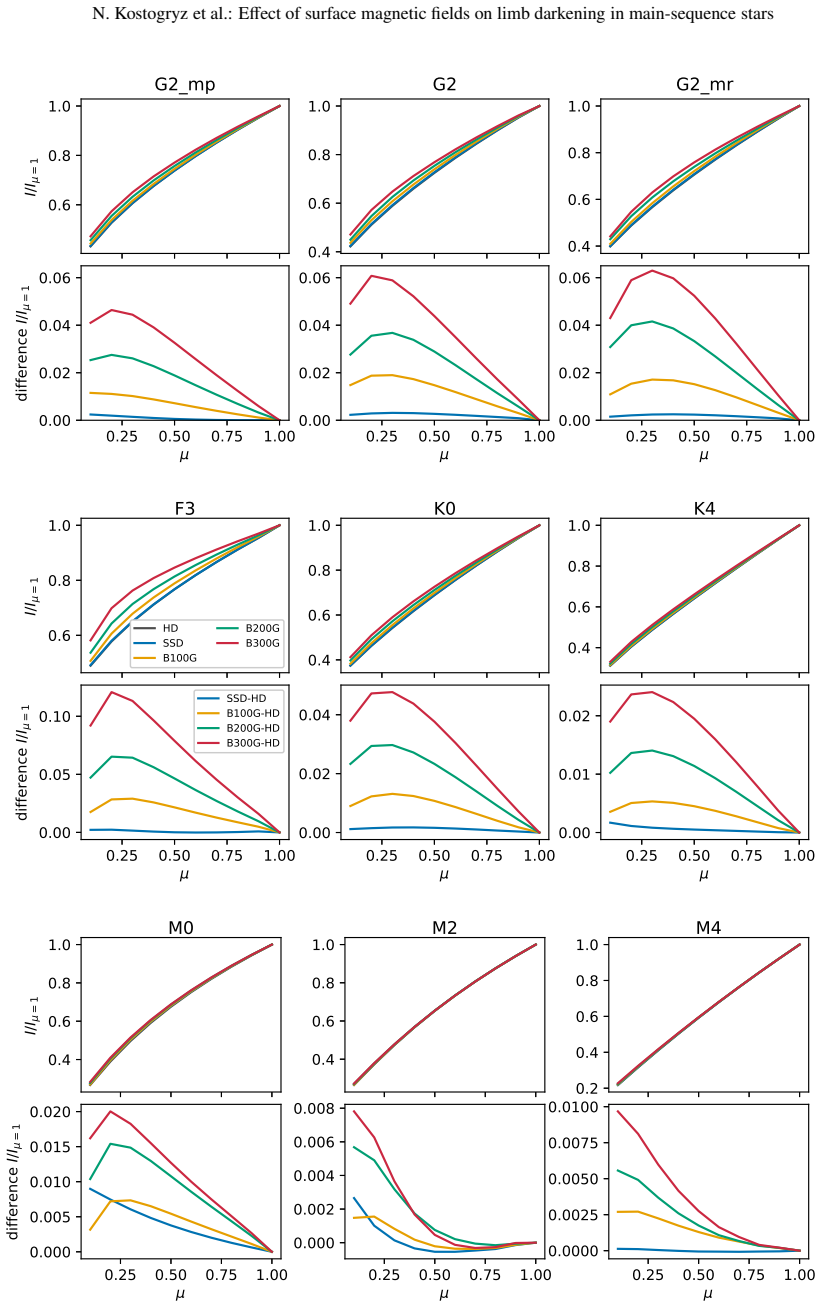
We show that the magnitude of the magnetic effect depends strongly on stellar fundamental parameters, increasing toward hotter and more metal-rich stars. Overall, limb darkening is significantly affected by magnetic fields in K, G, and F dwarfs, while the effect becomes negligible in M-dwarfs. We release a public database of synthetic spectra at 10 disk positions.
Load-bearing premise
The 3D box-in-a-star radiative magnetohydrodynamic simulations with MURaM self-consistently capture the photospheric magneto-convection relevant to limb darkening without ad hoc parameterizations for the full Teff range studied.
Editorial extensions
If this is right
- Transit light curve and transmission spectrum models for F, G, and K dwarfs must incorporate magnetic effects to reach high precision.
- The magnetic correction to limb darkening grows larger for metal-rich stars than for metal-poor stars at the same temperature.
- Non-magnetic models remain adequate for M-dwarfs across the studied parameter space.
- A public database now supplies center-to-limb spectra for multiple Teff values, metallicities, and magnetization levels.
Reading between the lines
- Transit-based exoplanet radius and atmospheric retrievals could shift measurably once magnetic limb darkening is included for active host stars.
- Stellar radius estimates derived from photometry may require systematic adjustments in stars with detectable surface fields.
- The same simulation approach could be extended to test whether the negligible effect in M-dwarfs persists at lower metallicities or different surface gravities.
Editorial analysis
A structured set of objections, weighed in public.
Referee Report
Summary. The paper uses 3D RMHD box-in-a-star simulations with MURaM (coupled to MPS-ATLAS for spectra) to compute center-to-limb intensity profiles for main-sequence stars at Teff = 3200–6800 K (solar metallicity) plus solar-Teff cases at M/H = −1.0 and +0.5. It reports that the magnetic modification to limb darkening grows with increasing Teff and metallicity, remains significant across K/G/F dwarfs, and becomes negligible in M-dwarfs; a public database of the resulting spectra is released.
Significance. If the numerical results are robust, the work supplies a physically grounded extension of earlier solar-parameter findings to a wide Teff–metallicity grid and supplies a reusable spectral library for transit and atmosphere modeling. The self-consistent treatment without ad-hoc parameterizations is a methodological strength.
major comments (2)
- [Methods / simulation setup] Simulation setup (Methods): fixed grid spacing and box aspect ratio are used across the entire 3200–6800 K range. At Teff = 3200 K the pressure scale height is substantially smaller and molecular opacities dominate; the same numerical resolution may therefore under-resolve magneto-convection, artificially suppressing the reported magnetic–non-magnetic difference and thereby supporting the central claim that the effect is “negligible in M-dwarfs.” A resolution or domain-size convergence test at the cool end is required to substantiate this null result.
- [Results] Results, Teff = 3200 K panel: the difference between magnetized and non-magnetized limb-darkening curves is stated to be negligible, yet no quantitative measure (e.g., maximum relative intensity difference or integrated flux difference) is provided to allow the reader to judge whether the null result is physically meaningful or resolution-limited.
minor comments (2)
- [Abstract] Abstract states the Teff range but gives no information on grid resolution, box size, or number of snapshots; these details belong in the abstract or a dedicated methods summary.
- [Conclusions / data availability] The public database is mentioned but its access URL, file format, and wavelength coverage are not specified in the text.
Simulated Author's Rebuttal
We thank the referee for the constructive comments and the positive overall assessment of the work. We address the two major comments point by point below.
read point-by-point responses
-
Referee: [Methods / simulation setup] Simulation setup (Methods): fixed grid spacing and box aspect ratio are used across the entire 3200–6800 K range. At Teff = 3200 K the pressure scale height is substantially smaller and molecular opacities dominate; the same numerical resolution may therefore under-resolve magneto-convection, artificially suppressing the reported magnetic–non-magnetic difference and thereby supporting the central claim that the effect is “negligible in M-dwarfs.” A resolution or domain-size convergence test at the cool end is required to substantiate this null result.
Authors: We acknowledge that a fixed grid spacing and box aspect ratio across the full Teff range results in comparatively coarser resolution (in units of pressure scale height) at Teff = 3200 K. Our uniform numerical setup was chosen to enable direct comparison across the grid while remaining computationally tractable. We will add a dedicated resolution and domain-size convergence test at the cool end in the revised manuscript to verify that the reported negligible magnetic effect is robust and not resolution-limited. revision: yes
-
Referee: [Results] Results, Teff = 3200 K panel: the difference between magnetized and non-magnetized limb-darkening curves is stated to be negligible, yet no quantitative measure (e.g., maximum relative intensity difference or integrated flux difference) is provided to allow the reader to judge whether the null result is physically meaningful or resolution-limited.
Authors: We agree that quantitative metrics would allow readers to better evaluate the null result. In the revised manuscript we will report the maximum relative intensity difference and the integrated flux difference between the magnetized and non-magnetized cases at Teff = 3200 K. revision: yes
Circularity Check
No circularity; results from direct numerical MHD simulations
full rationale
The paper obtains its central claims by running MURaM 3D radiative MHD box-in-a-star simulations at multiple Teff and metallicities, then synthesizing spectra with MPS-ATLAS at 10 disk positions. Limb-darkening differences between magnetized and non-magnetized runs are direct numerical outputs, not quantities fitted to data or defined in terms of themselves. No equations, ansatzes, or self-citations reduce the reported Teff dependence or the 'negligible in M-dwarfs' statement to the input parameters by construction. The methodology is externally falsifiable via higher-resolution runs or independent codes.
Assumptions & free parameters
assumptions (2)
- domain assumption MURaM 3D radiative MHD simulations accurately represent photospheric magneto-convection in main-sequence stars across Teff = 3200-6800 K
- domain assumption MPS-ATLAS radiative transfer calculations correctly produce center-to-limb spectra from the MHD snapshots
Cite this review
Pith. "Pith review of Effect of surface magnetic fields on limb darkening in main-sequence stars." pith.science (2026). https://pith.science/paper/SMC5PM6W
@misc{pith2026260621912,
  author       = {Pith},
  title        = {Pith review of: Effect of surface magnetic fields on limb darkening in main-sequence stars},
  year         = {2026},
  howpublished = {\url{https://pith.science/paper/SMC5PM6W}},
  note         = {Machine review of arXiv:2606.21912}
}
read the original abstract
Context.Stellar limb darkening encodes the thermal and radiative structure of stellar photospheres and is a key ingredient in modeling transit light curves and transmission spectra. It was recently shown that stellar surface magnetic fields modify limb darkening in stars with near-solar fundamental parameters, and that only magnetic models can reproduce high-precision transit observations for such stars. However, for stars with non-solar fundamental parameters, the magnitude of the magnetic effect on limb darkening remain unconstrained. Aims.We aim to investigate how surface magnetism affects stellar limb darkening across a range of fundamental parameters and to provide the community with center-to-limb spectra of stars at different magnetization levels. Methods. We use the MPS-ATLAS code to compute synthetic spectra from 3D radiative magnetohydrodynamic box-in-a-star simulations performed with the MURaM code. These simulations self-consistently capture photospheric magneto-convection without relying on ad hoc parameterizations. We perform calculations for main-sequence stars at solar metallicity with effective temperatures in the range Teff = 3200 - 6800 K. For stars with solar effective temperature we also consider metal-poor, M/H = -1.0, and metal-rich, M/H = 0.5, cases. Results. We show that the magnitude of the magnetic effect depends strongly on stellar fundamental parameters, increasing toward hotter and more metal-rich stars. Overall, limb darkening is significantly affected by magnetic fields in K, G, and F dwarfs, while the effect becomes negligible in M-dwarfs. We release a public database of synthetic spectra at 10 disk positions.
Figures


Figures from the paper (4 more)



Forward citations
Cited by 1 Pith paper
-
Something new under the Sun: A magnetically driven CH/CN anti-correlation
The solar magnetic cycle produces a CH/CN anti-correlation in the integrated solar spectrum, which the authors scale up to argue that surface magnetism could mimic globular cluster multi-population signatures.
Reference graph
Works this paper leans on
-
[1]
S., Shapiro, A
Anusha, L. S., Shapiro, A. I., Witzke, V ., et al. 2021, ApJS, 2 55, 3
2021
-
[2]
J., & Scott, P
Asplund, M., Grevesse, N., Sauval, A. J., & Scott, P . 2009, AR A&A, 47, 481
2009
-
[3]
H., Reiners, A., & Schüssler, M
Beeck, B., Cameron, R. H., Reiners, A., & Schüssler, M. 2013, A&A, 558, A48
2013
-
[4]
2012, A&A, 539, A121
Beeck, B., Collet, R., Ste ffen, M., et al. 2012, A&A, 539, A121
2012
-
[5]
H., & Reiners, A
Beeck, B., Schüssler, M., Cameron, R. H., & Reiners, A. 2015, A&A, 581, A42
2015
-
[6]
P ., Zins, G., Lazare ff, B., et al
Berger, J. P ., Zins, G., Lazare ff, B., et al. 2010, in Society of Photo-Optical In- strumentation Engineers (SPIE) Conference Series, V ol. 7734, Optical and In- frared Interferometry II, ed. W. C. Danchi, F. Delplancke, & J. K. Rajagopal, 773435
2010
-
[7]
Bethe, H. A. 1939, Phys. Rev., 55, 434
1939
-
[8]
2024, A&A, 6 81, A32
Bhatia, T., Cameron, R., Peter, H., & Solanki, S. 2024, A&A, 6 81, A32
2024
Show all 58 references
-
[9]
S., Cameron, R
Bhatia, T. S., Cameron, R. H., Solanki, S. K., et al. 2022, A&A , 663, A166
2022
-
[10]
S., Cameron, R
Bhatia, T. S., Cameron, R. H., Solanki, S. K., et al. 2026, A&A , 706, A308
2026
-
[11]
J., Koch, D., Basri, G., et al
Borucki, W. J., Koch, D., Basri, G., et al. 2010, Science, 327 , 977
2010
-
[12]
M., Charbonneau, D., Gilliland, R
Brown, T. M., Charbonneau, D., Gilliland, R. L., Noyes, R. W. , & Burrows, A. 2001, ApJ, 552, 699
2001
-
[13]
I., Witzke, V ., et al
Cernetic, M., Shapiro, A. I., Witzke, V ., et al. 2019, A&A, 62 7, A157
2019
-
[14]
M., Noyes, R
Charbonneau, D., Brown, T. M., Noyes, R. W., & Gilliland, R. L . 2002, ApJ, 568, 377
2002
-
[15]
2024, AJ, 168, 227
Coulombe, L.-P ., Roy, P .-A., & Benneke, B. 2024, AJ, 168, 227
2024
-
[16]
2018, in Handbook of Exoplanets (Springer)
Csizmadia, S. 2018, in Handbook of Exoplanets (Springer)
2018
-
[17]
Danilovic, S., Schüssler, M., & Solanki, S. K. 2010, A&A, 513 , A1 De Pontieu, B., Carlsson, M., Stein, R., et al. 2006, ApJ, 646 , 1405
2010
-
[18]
& Jordán, A
Espinoza, N. & Jordán, A. 2015, Monthly Notices of the Royal A stronomical Society, 450, 1879
2015
-
[19]
G., et al
Freytag, B., Ste ffen, M., Ludwig, H. G., et al. 2012, Journal of Computational Physics, 231, 919
2012
-
[20]
2008, A &A, 486, 951 Hestroffer, D
Gustafsson, B., Edvardsson, B., Eriksson, K., et al. 2008, A &A, 486, 951 Hestroffer, D. 1997, A&A, 327, 199
2008
-
[21]
Howarth, I. D. 2011, MNRAS, 418, 1165
2011
-
[22]
& Mihalas, D
Hubeny, I. & Mihalas, D. 2014, Theory of Stellar Atmospheres
2014
-
[23]
O., Wende-von Berg, S., Dreizler, S., et al
Husser, T. O., Wende-von Berg, S., Dreizler, S., et al. 2013, A&A, 553, A6
2013
-
[24]
Irwin, A. W. 2012, FreeEOS: Equation of State for stellar int eriors calculations, Astrophysics Source Code Library, record ascl:1211.002
2012
-
[25]
E., Shapiro, A
Keers, R. E., Shapiro, A. I., Kostogryz, N. M., et al. 2024, Ap J, 977, L7
2024
-
[26]
2017, A&A, 597, A137
Kervella, P ., Bigot, L., Gallenne, A., & Thévenin, F. 2017, A&A, 597, A137
2017
-
[27]
1950, Harvard College Observatory Circular, 454, 1
Kopal, Z. 1950, Harvard College Observatory Circular, 454, 1
1950
-
[28]
M., Shapiro, A
Kostogryz, N. M., Shapiro, A. I., Witzke, V ., et al. 2024, Nat ure Astronomy
2024
-
[29]
M., Witzke, V ., Shapiro, A
Kostogryz, N. M., Witzke, V ., Shapiro, A. I., et al. 2022, A&A , 666, A60
2022
-
[30]
F., Rodonò, M., Pagano, I., Barge, P ., & Llebaria, A
Lanza, A. F., Rodonò, M., Pagano, I., Barge, P ., & Llebaria, A. 2003, A&A, 403, 1135
2003
-
[31]
G., Ste ffen, M., & Freytag, B
Ludwig, H. G., Ste ffen, M., & Freytag, B. 2023, A&A, 679, A65
2023
-
[32]
2015, A&A , 573, A90
Magic, Z., Chiavassa, A., Collet, R., & Asplund, M. 2015, A&A , 573, A90
2015
-
[33]
2013, A&A, 557, A26
Magic, Z., Collet, R., Asplund, M., et al. 2013, A&A, 557, A26
2013
-
[34]
Maxted, P . F. L. 2023, MNRAS, 519, 3723 Mérand, A., Abuter, R., Aller-Carpentier, E., et al. 2014, i n Society of Photo- Optical Instrumentation Engineers (SPIE) Conference Seri es, V ol. 9146, Op- tical and Infrared Interferometry IV , ed. J. K. Rajagopal, M . J. Creech- Eak...
2023
-
[35]
Milne, E. A. 1921, MNRAS, 81, 361
1921
-
[36]
2020, AJ , 159, 75
Morello, G., Claret, A., Martin-Lagarde, M., et al. 2020, AJ , 159, 75
2020
-
[37]
1982, A&A, 107, 1
Nordlund, A. 1982, A&A, 107, 1
1982
-
[38]
& Dravins, D
Nordlund, A. & Dravins, D. 1990, A&A, 228, 155
1990
-
[39]
M., Unruh, Y
Norris, C. M., Unruh, Y . C., Witzke, V ., et al. 2023, MNRAS, 524, 1139
2023
-
[40]
Parker, E. N. 1978, ApJ, 221, 368
1978
-
[41]
Patel, J. A. & Espinoza, N. 2022, AJ, 163, 228
2022
-
[42]
P ., Kurucz, R
Rajaguru, S. P ., Kurucz, R. L., & Hasan, S. S. 2002, ApJ, 565, L 101
2002
-
[43]
2014, Experimental A stronomy, 38, 249
Rauer, H., Catala, C., Aerts, C., et al. 2014, Experimental A stronomy, 38, 249
2014
-
[44]
2014, ApJ, 789, 132
Rempel, M. 2014, ApJ, 789, 132
2014
-
[45]
& Schlichenmaier, R
Rempel, M. & Schlichenmaier, R. 2011, Living Reviews in Sola r Physics, 8, 3
2011
-
[46]
R., Winn, J
Ricker, G. R., Winn, J. N., V anderspek, R., et al. 2015, Journ al of Astronomical
2015
-
[47]
K., Mukherjee, S., et al
Rustamkulov, Z., Sing, D. K., Mukherjee, S., et al. 2023, Nat ure, 614, 659
2023
-
[48]
G., Steiner, O., Berdyugina, S
Salhab, R. G., Steiner, O., Berdyugina, S. V ., et al. 2018, A& A, 614, A78
2018
-
[49]
1906, Nachrichten von der Königlichen Ge sellschaft der Wis- senschaften zu Göttingen
Schwarzschild, K. 1906, Nachrichten von der Königlichen Ge sellschaft der Wis- senschaften zu Göttingen. Math.-phys. Klasse, 195, 41
1906
-
[50]
& Sasselov, D
Seager, S. & Sasselov, D. D. 2000, ApJ, 537, 916
2000
-
[51]
I., Seager, S., Solanki, S
Shapiro, A. I., Seager, S., Solanki, S. K., et al. 2026, ApJ
2026
-
[52]
Solanki, S. K. 1993, Space Sci. Rev., 63, 1
1993
-
[53]
K., Krivova, N
Solanki, S. K., Krivova, N. A., & Haigh, J. D. 2013, Annual Rev iew of Astron- omy and Astrophysics, 51, 311
2013
-
[54]
Spruit, H. C. 1976, Sol. Phys., 50, 269
1976
-
[55]
Spruit, H. C. & Zweibel, E. G. 1979, Sol. Phys., 62, 15 Vögler, A. & Schüssler, M. 2007, A&A, 465, L43 Vögler, A., Shelyag, S., Schüssler, M., et al. 2005, A&A, 429 , 335
1979
-
[56]
B., Shapiro, A
Witzke, V ., Duehnen, H. B., Shapiro, A. I., et al. 2023, A&A, 6 69, A157
2023
-
[57]
I., Cernetic, M., et al
Witzke, V ., Shapiro, A. I., Cernetic, M., et al. 2021, A&A, 65 3, A65
2021
-
[58]
I., Kostogryz, N
Witzke, V ., Shapiro, A. I., Kostogryz, N. M., et al. 2024, A&A , 681, A81 Article number, page 10 N. Kostogryz et al.: E ffect of surface magnetic fields on limb darkening in main-sequ ence stars 0.80 0.85 0.90 h ′ 1 0.10 0.12 0.14 0.16 0.18 0.20 0.22 0.24 h ′ 2 K epler M4 M0 M...
2024
Reviewed June 26, 2026 · model on record in the stance chip above.
Discussion (0). Sign in to comment.