REVIEW 4 major objections 5 minor 116 references
Binary Neutron Star Mergers as Potential Sources for Ultra-High-Energy Cosmic Rays and High-Energy Neutrinos
T0 review · 4 major / 5 minor · reviewed 2026-08-15 · deepseek-v4-flash
Pith's one-line read The prompt jets of short gamma-ray bursts can accelerate r-process nuclei to energies above 100 EeV and keep them intact, the paper argues, making neutron-star mergers viable candidate sources of the highest-energy cosmic rays.
desk verdict Careful conditional study of sGRB jets as UHECR accelerators; the main caveat is the unmodeled injection of r-process nuclei into the jet, which the authors themselves flag. read the letter →
The pith
A machine-rendered reading of the paper's core claim, the machinery that carries it, and where it could break.
The reading
What carries the argument
The load-bearing mechanism is the competition between acceleration and destruction of a nucleus inside the jet. The maximum energy is set by $t_{\rm acc}(E_{A,\max})=t_{\rm cool}(E_{A,\max})$, where $t_{\rm acc}=\kappa_{\rm acc}E_A/(ZecB)$, and the survival condition is $\tau_{A\gamma}(E_A)\simeq R/(\Gamma c\,t_{\rm reac,meson})\lesssim 1$ for the photomeson reaction that fragments heavy nuclei. The paper evaluates the photon fields of the three emission phases as broken power laws and computes Bethe-Heitler, giant-dipole-resonance photodisintegration, photomeson, hadronic, synchrotron, and adiabatic cooling; photomeson destruction and adiabatic cooling dominate. A secondary ingredient is the empirical photomeson cross section, calibrated for nuclei with $A\le 56$ and assumed to extend to $A\sim 130$, whose nuclear shadowing also suppresses neutrino production relative to protons.
What would settle it
Observe a short gamma-ray burst within a few hundred megaparsecs with both a neutrino telescope and a cosmic-ray observatory: a neutrino fluence above the $\tau_{A\gamma}=1$ ceiling while no event above 100 EeV points back to that burst, or a measured composition at 100 EeV that stays clearly proton-dominated rather than heavy-nucleus-dominated, would each falsify the central claim. A more direct calculation would rerun the $\Gamma$--$R$ scan using measured photodisintegration and photomeson cross sections for mass-130 nuclei instead of the scaled $A\le 56$ model.
Extended reading notes
Core claim
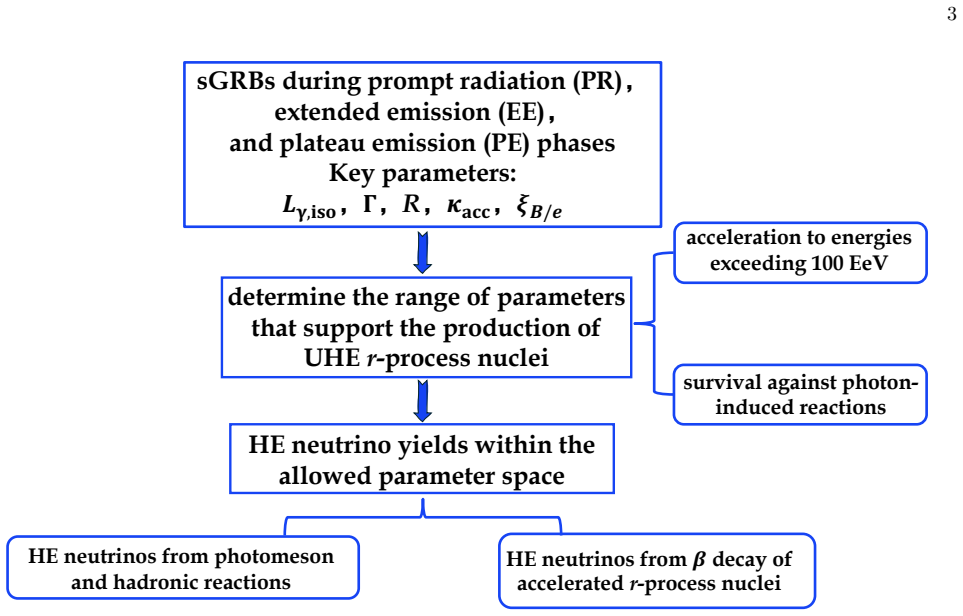
The paper's central claim is that the prompt radiation phase of a short gamma-ray burst can simultaneously satisfy the two conditions required of a source of the highest-energy cosmic rays: accelerate r-process nuclei (represented by mass-130 tellurium) to observed energies between roughly 100 and 1000 EeV, and keep the photomeson optical depth below $\tau_{A\gamma}\lesssim 1$ so the accelerated nuclei survive long enough to escape. Scanning the bulk Lorentz factor $\Gamma$, dissipation radius $R$, acceleration efficiency $\kappa_{\rm acc}$, and magnetic-to-electron energy ratio $\xi_{B/e}$, it finds allowed parameter windows for the prompt phase with $\Gamma \gtrsim 400$--$500$ and typical $\xi_{B/e}\sim 0.1$--$10$ and $\kappa_{\rm acc}\sim 10$--$100$; the extended-emission phase survives only at radii larger than commonly assumed, and the plateau phase only if acceleration is nearly Bohm-efficient with a strong magnetic field. A direct corollary is that high-energy neutrinos from such bursts are suppressed: imposing $\tau_{A\gamma}\lesssim 1$ limits the photomeson efficiency, so the predicted neutrino fluences are lower than earlier estimates that did not require nuclei to survive.
Load-bearing premise
The argument's load-bearing premise is that some r-process nuclei freshly made in the slow, neutron-rich merger ejecta somehow enter the fast relativistic jet, and the paper gives no mechanism or simulation for that mixing; if the mixing does not happen, no amount of jet acceleration can produce the cosmic rays.
Editorial extensions
If this is right
- If the prompt-phase conditions are realized, short gamma-ray bursts with $\Gamma\gtrsim 400$--$500$ are viable candidate sources of the observed cosmic rays above 100 EeV, linking UHECR origin to neutron-star mergers.
- The extended-emission and plateau phases are disfavored as UHECR sources unless their dissipation radii or magnetic-field and acceleration parameters lie far outside typical values.
- The neutrino fluence from a short burst that successfully produces UHECRs is bounded from above by the $\tau_{A\gamma}\le 1$ condition; higher neutrino output would imply the heavy nuclei are destroyed.
- If short bursts make the r-process component, the prompt phase must be dominated by conventional nuclei to avoid overproducing r-process nuclei, while a plateau-phase origin would require the opposite.
- The extended-emission phase, although disfavored for UHECRs, is the more promising source of detectable 1--100 PeV neutrinos, so the same class of events can be tested by separate messengers.
Reading between the lines
- Editorial extension: The paper stops short of modeling how r-process nuclei leave the slow ejecta and enter the relativistic jet; if that mixing is inefficient or absent, the UHECR conclusions weaken, while the proton-neutrino predictions survive unchanged.
- Editorial extension: The same survival constraint should apply to long gamma-ray bursts from collapsars if they also synthesize r-process nuclei, so the predicted forbidden regions in the $\Gamma$--$R$ plane and the suppression of neutrino flux would be generic to heavy-nuclei accelerators.
- Editorial extension: The $\tau_{A\gamma}\le 1$ ceiling implies an observable anti-correlation: searches for neutrinos from stacked short bursts can, even with no detection, place an upper bound on how much energy is being put into heavy-nuclei acceleration above 100 EeV.
- Editorial extension: A direct testable extension is to run the same calculation for a full r-process mass distribution rather than a single representative nucleus, since photodisintegration and photomeson rates vary with $A$ and could widen or shrink the allowed parameter window.
Signed reviews
Editorial analysis
A structured set of objections, weighed in public.
Referee Report
Summary. The paper examines whether short gamma-ray bursts (sGRBs) can accelerate freshly synthesized r-process nuclei to ultra-high energies (≳100 EeV) and release them as UHECRs, and it computes the associated high-energy neutrino fluxes. It models three emission phases (prompt radiation, extended emission, plateau emission) with broken power-law photon fields, calculates Bethe-Heitler, photodisintegration, and photomeson cooling rates for a representative nucleus (130Te), and derives constraints on the bulk Lorentz factor Γ, dissipation radius R, acceleration efficiency κacc, and magnetic-to-electron energy ratio ξB/e. The central result is that the prompt phase with Γ ≳ 400–500 and typical parameters can both accelerate and preserve such nuclei, provided they are present in the jet; the extended and plateau phases are less favorable. The paper also estimates neutrino fluences under the constraint that heavy nuclei survive (τAγ ≤ 1), finding that the PR phase gives the largest neutrino flux but is still below current sensitivities, while the EE phase could produce detectable 1–100 PeV neutrinos. The analysis is a conditional feasibility study: it assumes the r-process composition of the highest-energy UHECRs and takes the required energy range as input.
Significance. If the underlying r-process hypothesis is correct, this paper provides a valuable consistency check and a set of quantitative jet parameters for sGRBs as UHECR sources. Its strengths include a clear physical setup, standard reaction-rate calculations with numerically integrated Bethe-Heitler and photomeson rates, an explicit parameter scan, and an honest treatment of energy budgets, including the estimate that only ~10−6 M⊙ of r-process material would need to be mixed into the jets. The neutrino predictions are usefully connected to the survival requirement, providing a testable relation between UHECR production and neutrino emission. However, the paper's central claim is conditional on an unmodeled injection step and on an extrapolation of photomeson cross sections beyond their calibration range; these limitations must be addressed before the results can be regarded as definitive.
major comments (4)
- [Sec. V] The paper assumes that r-process nuclei synthesized in nonrelativistic ejecta are mixed into the relativistic jets, yet no physical mechanism is provided, and the authors state that this mixing 'remains to be explored.' This premise is load-bearing: without it, the abstract's assertion that sGRB PR jets 'can accelerate r-process nuclei' is unsupported. The estimated required mass (~10−6 M⊙) is small in absolute terms, but the paper offers no argument for why such nuclei would enter the dissipation region, survive jet launching, and be injected into the acceleration process. Please either add a physical mixing/entrainment discussion or explicitly reframe the central claim as a conditional feasibility statement (e.g., 'if r-process nuclei are injected into the jet, then...'), and make this condition prominent in the abstract and conclusions.
- [Sec. II (after Eq. 5)] The empirical photomeson cross-section model of Ref. [78] is calibrated using data for nuclei with A ≤ 56, but it is applied to A = 130 (tellurium). This directly affects the survival optical depth τAγ in Eq. (11) and the neutrino yields in Sec. IV.B, so the extrapolation is not a minor detail. Please quantify the uncertainty by testing the sensitivity of the constraints and neutrino fluences to plausible variations in δ(ϵγ) (e.g., comparing with alternative photomeson prescriptions for heavy nuclei), or provide a more detailed justification for the extrapolation beyond a single sentence.
- [Sec. III.B] The paper does not model particle escape, instead requiring that accelerated nuclei survive photon interactions for the dynamical timescale tdyn ≈ R/(Γc), which the authors describe as 'conservative.' This is not conservative for the UHECR contribution claim: if the actual escape time is longer than tdyn, nuclei spend more time in the photon field, so the survival constraint is stronger than τAγ(EA1) < 1 as computed. Moreover, even if nuclei survive for tdyn, they may not escape the source at all. The derived conditions are therefore necessary but not sufficient for UHECR emission. Please state this explicitly and, if possible, estimate the escape efficiency or at least discuss the uncertainty in the escape timescale relative to tdyn.
- [Sec. III.C, Eq. (12)] The energy window 100–1000 EeV is imposed as an input from the assumed r-process UHECR hypothesis (Refs. [10,11]), rather than derived within the model. Consequently, the finding that PR-phase jets can accelerate nuclei in this window is a consistency check of the hypothesis, not an independent prediction. The abstract and conclusions should make this condition explicit; otherwise the reader may overinterpret the result as a derivation of the energy range. This is not an internal inconsistency, but it is important for the accuracy of the paper's claims.
minor comments (5)
- [Sec. IV.B] The definitions of fAγ and fAp appear without the division operator in the typeset text; the formula should read fAγ = t_{cool,meson}^{-1} / t_{cool}^{-1} and fAp = t_{had}^{-1} / t_{cool}^{-1}.
- [Table II] For the EE-H and EE-L cases, the radii chosen to satisfy τAγ(EA1) = 1 (e.g., R ≈ 8.5×10^{15} cm for Γ = 30) are larger than the typical dissipation radii quoted in the literature (R ~ 10^{13}–10^{15} cm). The text notes this, but it would be helpful to state explicitly in the table caption that these are illustrative boundary values chosen to maximize the neutrino fluence consistent with UHECR survival.
- [Sec. IV.C] The β-decay neutrino fluence is normalized using the observed UHECR energy generation rate and assumed to be the same for all emission phases. This implicitly assumes equal escape efficiency for all phases; the text should state this assumption explicitly, as the escape efficiency is likely phase-dependent.
- [Sec. V] The statement that sGRBs are 'energetically capable of producing the UHE r-process nuclei above 100 EeV during the PR and EE phases' uses the total energy in accelerated nuclei per phase; this does not account for the fraction of that energy that actually reaches the narrow 100–1000 EeV band. A sentence clarifying the distinction would avoid overinterpretation.
- [General] References [10] and [11] are listed as arXiv preprints; if they have been accepted or published, the citations should be updated to the journal versions.
Circularity Check
No circularity: the 100 EeV energy window is an imposed benchmark from prior UHECR composition fits, while the derived jet-parameter constraints and neutrino-flux comparisons are independent outputs of the model.
full rationale
The paper is a conditional feasibility study rather than a derivation of the r-process UHECR hypothesis. The energy window in Eq. (12) ('Eob A1 < Eob A,max < Eob A2 ... where Eob A1 = Γ EA1 = 100 EeV and Eob A2 = Γ EA2 = 1000 EeV') is explicitly imposed as a requirement taken from Refs. [10,11], not derived. The actual scientific content is the existence of parameter space satisfying that benchmark: the contours in Figs. 4-5 and the derived constraints such as Γ ≳ 400-500 for the PR phase are genuine outputs of the acceleration/survival calculation. Because the parameter space could have been empty or incompatible with typical IS/ICMART radii, the statement that sGRB PR jets 'can' reach the benchmark is not tautological. The neutrino-flux calculation is normalized by an assumed ηcr = 10 and uses radii chosen to give τAγ(EA1) = 1 in Table II; this makes the quoted fluxes conditional on the survival constraint, but the comparison in Fig. 7 to smaller radii (where τAγ > 1) is an independently computed consequence, not a restatement of the input. The acknowledged limitations, such as the unmodeled mixing of r-process nuclei into jets and the extrapolation of the photomeson cross-section model from A ≤ 56 to A ~ 130, are explicitly stated assumptions or open modeling questions (Sec. V and Sec. II), not hidden reductions. The self-citations [91] and [104] are used for standard Monte Carlo and diffuse-flux methods and are not load-bearing for the central feasibility claim. No step was found in which a fitted parameter is renamed a prediction, a result is forced by self-citation, or a known empirical pattern is repackaged as new organization.
Assumptions & free parameters
free parameters (8)
- Photon spectral indices alpha, beta =
alpha=0.5, beta=2
- Isotropic photon luminosity L_gamma,iso =
1e52 (PR), 1e49 (EE), 1e47 (PE) erg/s
- Peak photon energy E_gamma,b^ob =
500 keV (PR), 10 keV (EE-H), 1 keV (EE-L), 0.1 keV (PE)
- Acceleration efficiency kappa_acc =
10 for neutrino fluxes; range 1-100 scanned
- Magnetic to electron energy ratio xi_B/e =
0.1 (PR, EE), 10 (PE) for neutrino fluxes; range 1e-3 to 1e3 scanned
- Dissipation radius R =
e.g., 8.5e14 cm for PR with Gamma=500 (chosen so tau=1)
- Energy ratio eta_cr = E_cr/E_gamma =
10
- Beta decay neutrino yield parameters =
~10 neutrinos per decay, E_nu ~ 1e-4 E_A
assumptions (6)
- domain assumption UHECRs above 100 EeV are dominated by r-process nuclei
- ad hoc to paper R-process nuclei are mixed into the relativistic jets
- domain assumption Empirical photomeson cross section model of Ref. [78] extends from A<=56 to A~130
- domain assumption Steady photon luminosity and fixed broken power-law spectrum during each phase
- domain assumption Neglect of cosmological redshift and of particle escape modeling
- standard math Acceleration timescale t_acc = kappa_acc E/(Z e B)
Cite this review
Pith. "Pith review of Binary Neutron Star Mergers as Potential Sources for Ultra-High-Energy Cosmic Rays and High-Energy Neutrinos." pith.science (2026). https://pith.science/paper/SMNPA7YD
@misc{pith2026250617581,
  author       = {Pith},
  title        = {Pith review of: Binary Neutron Star Mergers as Potential Sources for Ultra-High-Energy Cosmic Rays and High-Energy Neutrinos},
  year         = {2026},
  howpublished = {\url{https://pith.science/paper/SMNPA7YD}},
  note         = {Machine review of arXiv:2506.17581}
}
abstract
Recent studies suggest that the most energetic cosmic rays, exceeding 100 EeV, may primarily consist of $r$-process nuclei. This highlights binary neutron star mergers and collapsars as promising sources of ultra-high-energy cosmic rays (UHECRs). Building on these insights, we examine the conditions that facilitate the efficient production of UHE $r$-process nuclei during the prompt radiation (PR), extended emission (EE), and plateau emission phases of short gamma-ray bursts (sGRBs) following neutron star mergers. Our study reveals that jets associated with the PR phase, characterized by typical bulk Lorentz factors ($\gtrsim 400-500$), dissipation radii, and magnetic field strengths, can accelerate $r$-process nuclei to energies $\gtrsim 100$ EeV while preserving them during propagation within the source. Additionally, we investigate the production of HE neutrinos from photomeson and hadronic interactions, as well as from the $\beta$ decay of accelerated $r$-process nuclei. We find that the HE neutrino fluxes from sGRBs, mainly produced via photomeson interactions, are significantly limited to preserve the accelerated heavy nuclei, leading to lower fluxes than the predictions without allowing for contributions to UHECRs. Our results suggest that sGRBs may potentially contribute to UHECRs during the PR phase and to HE neutrinos during the EE phase$-$a scenario that can be tested by future neutrino observatories.
Figures


Figures from the paper (5 more)


Reference graph
Works this paper leans on
-
[78]
L. Morejon, A. Fedynitch, D. Boncioli, D. Biehl, and W. Winter, JCAP 11, 007 (2019), arXiv:1904.07999 [astro-ph.HE]
arXiv 2019
-
[1]
Abu-Zayyad et al
T. Abu-Zayyad et al. (Telescope Array), The Astrophys- ical Journal 768, L1 (2013)
2013
-
[2]
Ivanov (Telescope Array), PoS ICRC2019, 298 (2020)
D. Ivanov (Telescope Array), PoS ICRC2019, 298 (2020)
2020
-
[3]
Abraham et al
J. Abraham et al. (Pierre Auger), Physics Letters B 685, 239–246 (2010). 16 1012 1013 1014 1015 1016 1017 100 1000 τAγ (E A1) = 1τAγ (E A2) = 1 red, blue: κ acc = 1, 100 solid, dashed: ξ B/e = 0.1, 10 thin, thick: 100 EeV, 1000 EeVPR R = Γ 2 c x 0.1 s R = Γ 2 c x 0.01 s R [cm] Γ 1013 1014 1015 1016 1017 1018 10 50 τAγ (EA1) = 1 τAγ (EA2) = 1 PE R [cm] Γ 1...
2010
-
[4]
A. Abdul Halim et al. (Pierre Auger), Astrophys. J. Suppl. 264, 50 (2023), arXiv:2211.16020 [astro-ph.HE]
arXiv 2023
-
[5]
R. U. Abbasi et al. (Telescope Array), Science 382, abo5095 (2023), arXiv:2311.14231 [astro-ph.HE]
arXiv 2023
- [6]
-
[7]
A. A. Halim et al. (Pierre Auger), JCAP 05, 024 (2023), arXiv:2211.02857 [astro-ph.HE]
arXiv 2023
Show all 116 references
-
[8]
R. U. Abbasi et al. (Telescope Array), Phys. Rev. D 110, 022006 (2024), arXiv:2406.19286 [astro-ph.HE]
2024
-
[9]
R. U. Abbasi et al. (Telescope Array), Phys. Rev. Lett. 133, 041001 (2024), arXiv:2406.19287 [astro-ph.HE]
2024
-
[10]
G. R. Farrar, Phys. Rev. Lett. 134, 081003 (2025), arXiv:2405.12004 [astro-ph.HE]
2025 arXiv
-
[11]
B. T. Zhang, K. Murase, N. Ekanger, M. Bhattacharya, and S. Horiuchi, arXiv:2405.17409 [astro-ph.HE]
-
[12]
B. P. Abbott et al. (LIGO Scientific, and Virgo Col- laborations), Phys. Rev. Lett. 119, 161101 (2017), arXiv:1710.05832 [gr-qc]
2017 arXiv
-
[13]
B. P. Abbott et al. (LIGO Scientific, Virgo, Fermi GBM, INTEGRAL, IceCube, AstroSat Cadmium Zinc Telluride Imager Team, IPN, Insight-Hxmt, ANTARES, Swift, AGILE Team, 1M2H Team, Dark Energy Camera GW-EM, DES, DLT40, GRAWITA, Fermi-LAT, ATCA, ASKAP, Las Cumbres Observa- tory Gr...
2017 arXiv
-
[14]
Kasen, B
D. Kasen, B. Metzger, J. Barnes, E. Quataert, and E. Ramirez-Ruiz, Nature (London) 551, 80 (2017), 17 arXiv:1710.05463 [astro-ph.HE]
2017 arXiv
-
[15]
Shibata, S
M. Shibata, S. Fujibayashi, K. Hotokezaka, K. Kiuchi, K. Kyutoku, Y. Sekiguchi, and M. Tanaka, Phys. Rev. D 96, 123012 (2017), arXiv:1710.07579 [astro-ph.HE]
2017 arXiv
-
[16]
B. D. Metzger, Living Rev. Rel. 23, 1 (2020), arXiv:1910.01617 [astro-ph.HE]
2020 arXiv
-
[17]
Watson et al
D. Watson et al. , Nature (London) 574, 497 (2019), arXiv:1910.10510 [astro-ph.HE]
2019
-
[18]
N. R. Tanvir, A. J. Levan, A. S. Fruchter, J. Hjorth, K. Wiersema, R. Tunnicliffe, and A. de Ugarte Postigo, Nature 500, 547 (2013), arXiv:1306.4971 [astro-ph.HE]
2013 arXiv
-
[19]
Yang, Z.-P
B. Yang, Z.-P. Jin, X. Li, S. Covino, X.-Z. Zheng, K. Ho- tokezaka, Y.-Z. Fan, T. Piran, and D.-M. Wei, Na- ture Commun. 6, 7323 (2015), arXiv:1503.07761 [astro- ph.HE]
2015 arXiv
-
[20]
Z.-P. Jin, K. Hotokezaka, X. Li, M. Tanaka, P. D’Avanzo, Y.-Z. Fan, S. Covino, D.-M. Wei, and T. Piran, Nature Commun. 7, 12898 (2016), arXiv:1603.07869 [astro-ph.HE]
2016 arXiv
-
[21]
B. P. Abbott et al. (LIGO Scientific, Virgo, Fermi- GBM, INTEGRAL), Astrophys. J. Lett. 848, L13 (2017), arXiv:1710.05834 [astro-ph.HE]
2017 arXiv
-
[22]
D. M. Siegel, J. Barnes, and B. D. Metzger, Nature 569, 241 (2019), arXiv:1810.00098 [astro-ph.HE]
2019 arXiv
-
[23]
J. J. Cowan, C. Sneden, J. E. Lawler, A. Aprahamian, M. Wiescher, K. Langanke, G. Mart´ ınez-Pinedo, and F.-K. Thielemann, Rev. Mod. Phys. 93, 15002 (2021), arXiv:1901.01410 [astro-ph.HE]
2021 arXiv
-
[24]
Brauer, A
K. Brauer, A. P. Ji, M. R. Drout, and A. Frebel, Astrophys. J. 915, 81 (2021), arXiv:2010.15837 [astro- ph.HE]
2021 arXiv
-
[25]
Fraser and R
J. Fraser and R. Sch¨ onrich, Mon. Not. Roy. Astron. Soc. 509, 6008 (2021), arXiv:2111.11464
2021 arXiv
-
[26]
K. H. Lee, I. Bartos, A. Cook, A. Corsi, Z. Marka, G. C. Privon, and S. Marka, (2022), 10.3847/2041- 8213/ac7ff0, arXiv:2202.09739 [astro-ph.HE]
2022 arXiv
-
[27]
Barnes and B
J. Barnes and B. D. Metzger, Astrophys. J. Lett. 939, L29 (2022), arXiv:2205.10421 [astro-ph.HE]
2022 arXiv
-
[28]
Anand et al
S. Anand et al. , Astrophys. J. 962, 68 (2024), arXiv:2302.09226 [astro-ph.HE]
2024 arXiv
-
[29]
Barnes and P
J. Barnes and P. C. Duffell, Astrophys. J. 952, 96 (2023), arXiv:2305.00056 [astro-ph.HE]
2023 arXiv
-
[30]
Li, S.-Q
L. Li, S.-Q. Zhong, and Z.-G. Dai, Astrophys. J. Lett. 952, L39 (2023), arXiv:2307.09917 [astro-ph.HE]
2023 arXiv
-
[31]
Dean and R
C. Dean and R. Fern´ andez, Phys. Rev. D 110, 083024 (2024), arXiv:2408.15338 [astro-ph.HE]
2024 arXiv
-
[32]
Fischer, G
T. Fischer, G. Guo, K. Langanke, G. Martinez-Pinedo, Y.-Z. Qian, and M.-R. Wu, Prog. Part. Nucl. Phys. 137, 104107 (2024), arXiv:2308.03962 [astro-ph.HE]
2024 arXiv
-
[33]
Kisaka, K
S. Kisaka, K. Ioka, and T. Nakamura, Astrophys. J. Lett. 809, L8 (2015), arXiv:1506.02030 [astro-ph.HE]
2015 arXiv
-
[34]
Kisaka, K
S. Kisaka, K. Ioka, and T. Sakamoto, Astrophys. J. 846, 142 (2017), arXiv:1707.00675 [astro-ph.HE]
2017 arXiv
-
[35]
S. S. Kimura, K. Murase, P. M´ esz´ aros, and K. Kiuchi, Astrophys. J. Lett. 848, L4 (2017), arXiv:1708.07075 [astro-ph.HE]
2017 arXiv
-
[36]
Waxman and J
E. Waxman and J. N. Bahcall, Phys. Rev. Lett.78, 2292 (1997), arXiv:astro-ph/9701231
1997 arXiv
-
[37]
Waxman and J
E. Waxman and J. N. Bahcall, Astrophys. J. 541, 707 (2000), arXiv:hep-ph/9909286
2000 arXiv
-
[38]
M´ esz´ aros and E
P. M´ esz´ aros and E. Waxman,87, 171102 (2001)
2001
-
[39]
Z. Li, Z. G. Dai, and T. Lu, Astronomy & Astrophysics 396, 303 (2002)
2002
-
[40]
Guetta, D
D. Guetta, D. Hooper, J. Alvarez-Muniz, F. Halzen, and E. Reuveni, Astropart. Phys. 20, 429 (2004), arXiv:astro-ph/0302524
2004 arXiv
-
[41]
Murase and S
K. Murase and S. Nagataki, Phys. Rev. Lett. 97, 051101 (2006), arXiv:astro-ph/0604437
2006 arXiv
-
[42]
Murase, K
K. Murase, K. Ioka, S. Nagataki, and T. Naka- mura, Astrophys. J. Lett. 651, L5 (2006), arXiv:astro- ph/0607104
2006
-
[43]
Hummer, P
S. Hummer, P. Baerwald, and W. Winter, Phys. Rev. Lett. 108, 231101 (2012), arXiv:1112.1076 [astro- ph.HE]
2012 arXiv
-
[44]
Li, Phys
Z. Li, Phys. Rev. D 85, 027301 (2012)
2012
-
[45]
Zhang and P
B. Zhang and P. Kumar, Phys. Rev. Lett. 110, 121101 (2013), arXiv:1210.0647 [astro-ph.HE]
2013 arXiv
-
[46]
Liu and X.-Y
R.-Y. Liu and X.-Y. Wang, Astrophys. J. 766, 73 (2013), arXiv:1212.1260 [astro-ph.HE]
2013 arXiv
-
[47]
Tamborra and S
I. Tamborra and S. Ando, Phys. Rev. D93, 053010 (2016), arXiv:1512.01559 [astro-ph.HE]
2016 arXiv
-
[48]
Bustamante, P
M. Bustamante, P. Baerwald, K. Murase, and W. Win- ter, Nature Communications 6, 6783 (2015)
2015
-
[49]
S. S. Kimura, arXiv:2202.06480 [astro-ph.HE]
-
[50]
Chen, R.-C
M.-H. Chen, R.-C. Hu, and E.-W. Liang, Mon. Not. Roy. Astron. Soc. 520, 2806 (2023)
2023
-
[51]
An, M.-R
Y. An, M.-R. Wu, G. Guo, Y.-L. S. Tsai, S.-J. Huang, and Y.-Z. Fan, Phys. Rev. D 108, 123038 (2023), arXiv:2306.07659 [astro-ph.HE]
2023 arXiv
-
[52]
Casier, Search for High-Energy Neutrino Production in Short Gamma Ray Bursts with the IceCube Neutrino Observatory, Ph.D
M. Casier, Search for High-Energy Neutrino Production in Short Gamma Ray Bursts with the IceCube Neutrino Observatory, Ph.D. thesis, Brussels U., IIHE (2015)
2015
-
[53]
Albert et al
A. Albert et al. (ANTARES, IceCube, Pierre Auger, LIGO Scientific, Virgo), Astrophys. J. Lett. 850, L35 (2017), arXiv:1710.05839 [astro-ph.HE]
2017
-
[54]
A. D. Avrorin et al. (Baikal-GVD), JETP Lett. 108, 787 (2018), arXiv:1810.10966 [astro-ph.HE]
2018 arXiv
-
[55]
Fang and B
K. Fang and B. D. Metzger, Astrophys. J. 849, 153 (2017), arXiv:1707.04263 [astro-ph.HE]
2017 arXiv
-
[56]
Biehl, J
D. Biehl, J. Heinze, and W. Winter, Mon. Not. Roy. Astron. Soc. 476, 1191 (2018), arXiv:1712.00449 [astro- ph.HE]
2018 arXiv
-
[57]
S. S. Kimura, K. Murase, I. Bartos, K. Ioka, I. S. Heng, and P. M´ esz´ aros, Phys. Rev. D 98, 043020 (2018), arXiv:1805.11613 [astro-ph.HE]
2018 arXiv
-
[58]
Decoene, C
V. Decoene, C. Gu´ epin, K. Fang, K. Kotera, and B. D. Metzger, JCAP 04, 045 (2020), arXiv:1910.06578 [astro- ph.HE]
2020 arXiv
-
[59]
Matsui, S
R. Matsui, S. S. Kimura, K. Toma, and K. Murase, Astrophys. J. 950, 190 (2023), arXiv:2302.04130 [astro- ph.HE]
2023 arXiv
-
[60]
Mukhopadhyay, S
M. Mukhopadhyay, S. S. Kimura, and K. Murase, Phys. Rev. D 109, 043053 (2024), arXiv:2310.16875 [astro- ph.HE]
2024 arXiv
-
[61]
Mukhopadhyay, K
M. Mukhopadhyay, K. Kotera, S. Wissel, K. Murase, and S. S. Kimura, Phys. Rev. D 110, 063004 (2024), arXiv:2406.19440 [astro-ph.HE]
2024 arXiv
- [62]
-
[63]
Wanderman and T
D. Wanderman and T. Piran, Mon. Not. Roy. Astron. Soc. 448, 3026 (2015), arXiv:1405.5878 [astro-ph.HE]
2015 arXiv
-
[64]
Shahmoradi and R
A. Shahmoradi and R. J. Nemiroff, Mon. Not. Roy. Astron. Soc. 451, 126 (2015), arXiv:1412.5630 [astro- ph.HE]
2015 arXiv
-
[65]
Ghirlanda et al
G. Ghirlanda et al. , Astron. Astrophys. 594, A84 (2016), arXiv:1607.07875 [astro-ph.HE]
2016 arXiv
-
[66]
Kagawa, D
Y. Kagawa, D. Yonetoku, T. Sawano, A. Toyanago, T. Nakamura, K. Takahashi, K. Kashiyama, and 18 K. Ioka, Astrophys. J. 811, 4 (2015), arXiv:1506.02359 [astro-ph.HE]
2015 arXiv
-
[67]
Kaneko, Z
Y. Kaneko, Z. F. Bostancı, E. G¨ o˘ g¨ u¸ s, and L. Lin, Mon. Not. Roy. Astron. Soc. 452, 824 (2015), arXiv:1506.05899 [astro-ph.HE]
2015 arXiv
-
[68]
P. A. Evans et al. , Mon. Not. Roy. Astron. Soc. 397, 1177 (2009), arXiv:0812.3662 [astro-ph]
2009 arXiv
-
[69]
Rowlinson, P
A. Rowlinson, P. T. O’Brien, B. D. Metzger, N. R. Tan- vir, and A. J. Levan, Mon. Not. Roy. Astron. Soc. 430, 1061 (2013), arXiv:1301.0629 [astro-ph.HE]
2013 arXiv
-
[70]
Piran, Rev
T. Piran, Rev. Mod. Phys. 76, 1143 (2004)
2004
-
[71]
M´ esz´ aros, Rep
P. M´ esz´ aros, Rep. Prog. Phys.69, 2259 (2006)
2006
-
[72]
Kumar and B
P. Kumar and B. Zhang, Phys. Rep. 561, 1 (2014)
2014
-
[73]
Matsumoto, S
T. Matsumoto, S. S. Kimura, K. Murase, and P. M´ esz´ aros, Mon. Not. Roy. Astron. Soc. 493, 783 (2020), arXiv:2001.09851 [astro-ph.HE]
2020 arXiv
-
[74]
M. J. Chodorowski, A. A. Zdziarski, and M. Sikora, Astrophys. J. 400, 181 (1992)
1992
-
[75]
Weise, Physics Reports 13, 53 (1974)
W. Weise, Physics Reports 13, 53 (1974)
1974
-
[76]
Arneodo, Phys
M. Arneodo, Phys. Rept. 240, 301 (1994)
1994
-
[77]
Engel, J
R. Engel, J. Ranft, and S. Roesler, Phys. Rev. D 55, 6957 (1997), arXiv:hep-ph/9610281
1997 arXiv
-
[79]
Mucke, R
A. Mucke, R. Engel, J. P. Rachen, R. J. Protheroe, and T. Stanev, Comput. Phys. Commun. 124, 290 (2000), arXiv:astro-ph/9903478
2000 arXiv
-
[80]
Guzey and M
V. Guzey and M. Strikman, Phys. Lett. B 633, 245 (2006), arXiv:hep-ph/0505088
2006 arXiv
- [81]
-
[82]
Baerwald, M
P. Baerwald, M. Bustamante, and W. Winter, As- trophys. J. 768, 186 (2013), arXiv:1301.6163 [astro- ph.HE]
2013 arXiv
-
[83]
Biehl, D
D. Biehl, D. Boncioli, A. Fedynitch, and W. Winter, Astron. Astrophys. 611, A101 (2018), arXiv:1705.08909 [astro-ph.HE]
2018 arXiv
-
[84]
Globus, D
N. Globus, D. Allard, R. Mochkovitch, and E. Pari- zot, Mon. Not. Roy. Astron. Soc. 451, 751 (2015), arXiv:1409.1271 [astro-ph.HE]
2015 arXiv
-
[85]
B. T. Zhang, K. Murase, S. S. Kimura, S. Horiuchi, and P. M´ esz´ aros, Phys. Rev. D 97, 083010 (2018), arXiv:1712.09984 [astro-ph.HE]
2018 arXiv
-
[86]
Globus and R
N. Globus and R. Blandford, EPJ Web Conf.283, 04001 (2023), arXiv:2302.06791 [astro-ph.HE]
2023 arXiv
-
[87]
A. A. Halim et al. (Pierre Auger), JCAP 01, 022 (2024), arXiv:2305.16693 [astro-ph.HE]
2024 arXiv
-
[88]
Zhang and H
B. Zhang and H. Yan, Astrophys. J. 726, 90 (2011)
2011
-
[89]
B. P. Gompertz, A. J. van der Horst, P. T. O’Brien, G. A. Wynn, and K. Wiersema, Mon. Not. Roy. Astron. Soc. 448, 629 (2015)
2015
-
[90]
De Lia and I
V. De Lia and I. Tamborra, JCAP 10, 054 (2024), arXiv:2406.14975 [astro-ph.HE]
2024 arXiv
-
[91]
Guo, Y.-Z
G. Guo, Y.-Z. Qian, and M.-R. Wu, Phys. Rev. D 108, L021303 (2023), arXiv:2212.08266 [astro-ph.HE]
2023 arXiv
-
[92]
Bierlich et al
C. Bierlich et al. , SciPost Phys. Codeb. 2022, 8 (2022), arXiv:2203.11601 [hep-ph]
2022 arXiv
-
[93]
CUG Scholar
and van Vliet et al . [94, 95]. Cosmogenic neutri- nos are produced by the interactions of UHECRs with the cosmic microwave background and the extragalactic background light. Their diffuse flux has relatively large theoretical uncertainties (see, e.g., [109]). As can be seen f...
-
[94]
van Vliet, R
A. van Vliet, R. Alves Batista, and J. R. H¨ orandel, Phys. Rev. D 100, 021302 (2019), arXiv:1901.01899 [astro-ph.HE]
2019 arXiv
-
[95]
Ahlers and F
M. Ahlers and F. Halzen, Physical Review D 86 (2012), 10.1103/physrevd.86.083010
2012 doi
-
[96]
M. G. Aartsen et al. (IceCube), (2019), arXiv:1911.02561 [astro-ph.HE]
2019
-
[97]
Meier (IceCube), arXiv:2409.01740 [astro-ph.HE]
M. Meier (IceCube), arXiv:2409.01740 [astro-ph.HE]
-
[98]
J. A. Carpio, K. Murase, M. H. Reno, I. Sarcevic, and A. Stasto, Phys. Rev. D 102, 103001 (2020), arXiv:2007.07945 [astro-ph.HE]
2020 arXiv
-
[99]
´Alvarez-Mu˜ nizet al
J. ´Alvarez-Mu˜ nizet al. (GRAND), Sci. China Phys. Mech. Astron. 63, 219501 (2020), arXiv:1810.09994 [astro-ph.HE]
2020 arXiv
-
[100]
Over the range of Γ = 100–1000 considered for the PR phase (see Table I), λ = 2Eob A Eob γb/(Γ2mAϵ∆) > 1 and τAγ ∝ Lγ,isoR−1Γ−2 is approximately independent of EA [see Eq
(upper right), (10, 1) (lower left), and (10, 100) (lower right). Over the range of Γ = 100–1000 considered for the PR phase (see Table I), λ = 2Eob A Eob γb/(Γ2mAϵ∆) > 1 and τAγ ∝ Lγ,isoR−1Γ−2 is approximately independent of EA [see Eq. (6) for the rate of cooling by meson pr...
-
[101]
Murase and J
K. Murase and J. F. Beacom, Phys. Rev. D 81, 123001 (2010), arXiv:1003.4959 [astro-ph.HE]
2010 arXiv
-
[102]
M. G. Aartsen et al. (IceCube), Astrophys. J. 796, 109 (2014), arXiv:1406.6757 [astro-ph.HE]
2014 arXiv
-
[103]
B. P. Abbott et al. (LIGO Scientific, Virgo), Astro- phys. J. Lett. 832, L21 (2016), arXiv:1607.07456 [astro- ph.HE]
2016 arXiv
-
[104]
Berger, Ann
E. Berger, Ann. Rev. Astron. Astrophys. 52, 43 (2014), arXiv:1311.2603 [astro-ph.HE]
2014 arXiv
-
[105]
Murase and K
K. Murase and K. Ioka, Phys. Rev. Lett. 111, 121102 (2013), arXiv:1306.2274 [astro-ph.HE]
2013 arXiv
-
[106]
Guo, Y.-Z
G. Guo, Y.-Z. Qian, and M.-R. Wu, Astrophys. J. 890, 83 (2020), arXiv:1911.07568 [astro-ph.HE]
2020 arXiv
-
[107]
Guetta and T
D. Guetta and T. Piran, Astron. Astrophys. 453, 823 (2006), arXiv:astro-ph/0511239
2006 arXiv
-
[108]
Waxman and J
E. Waxman and J. N. Bahcall, Phys. Rev. D 59, 023002 (1999), arXiv:hep-ph/9807282
1999 arXiv
-
[109]
M. G. Aartsen et al. (IceCube), Astrophys. J. 843, 112 (2017), arXiv:1702.06868 [astro-ph.HE]
2017 arXiv
-
[110]
Abbasi et al
R. Abbasi et al. , Astrophys. J. 939, 116 (2022), arXiv:2205.11410 [astro-ph.HE]
2022
-
[111]
Wittkowski and K.-H
D. Wittkowski and K.-H. Kampert, Mon. Not. Roy. As- tron. Soc. 488, L119 (2019), arXiv:1810.03769 [astro- ph.HE]
2019 arXiv
-
[112]
Adrian-Martinez et al
S. Adrian-Martinez et al. (KM3Net), J. Phys. G 43, 084001 (2016), arXiv:1601.07459 [astro-ph.IM]
2016 arXiv
-
[113]
M. G. Aartsen et al. (IceCube-Gen2), J. Phys. G 48, 060501 (2021), arXiv:2008.04323 [astro-ph.HE]
2021
-
[114]
Z. P. Ye et al. (TRIDENT), Nature Astron. 7, 1497 (2023), arXiv:2207.04519 [astro-ph.HE]
2023
-
[115]
Aab et al
A. Aab et al. (Pierre Auger), Phys. Rev. Lett. 125, 121106 (2020), arXiv:2008.06488 [astro-ph.HE]
2020 arXiv
-
[116]
B. D. Metzger, E. Quataert, and T. A. Thomp- son, Mon. Not. Roy. Astron. Soc. 385, 1455 (2008), arXiv:0712.1233 [astro-ph]
2008 arXiv
Reviewed August 15, 2026 · model on record in the stance chip above.
Discussion (0). Continue with ORCID to comment.