REVIEW 2 major objections 4 minor 40 references
Energetic and Structural Properties of Two-Dimensional Trapped Mesoscopic Fermi Gases
T0 review · 2 major / 4 minor · reviewed 2026-08-06 · deepseek-v4-flash
Pith's one-line read This paper provides numerically exact energy spectra and pairing correlations for two, four, and six trapped fermions in two dimensions, showing that binding energies up to $2\hbar\omega_r$ lie outside the regime of tightly bound…
desk verdict Careful and useful 2D few-fermion reference data, but the finite-effective-range pairing claim rests on a quasi-2D mapping whose error is never quantified. read the letter →
The pith
A machine-rendered reading of the paper's core claim, the machinery that carries it, and where it could break.
The reading
What carries the argument
The machinery is the two-dimensional effective-range expansion, $\cot[\delta(k)] = (2/\pi)[\gamma + \ln(ka_{2D}/2)] + (1/\pi) k^2 r_{2D} + \cdots$, which reduces all short-range interaction details to the scattering length $a_{2D}$ and effective range $r_{2D}$. A finite-range Gaussian potential is tuned so that its width stays small, $r_0 \lesssim 0.1 l_r$, making higher-order terms negligible, and quasi-2D confinement is encoded through the mapping $r_{2D} = -l_z^2 \ln(2)$. The $N$-body Schrödinger equation is then solved by expanding the relative wave function in explicitly correlated Gaussian basis states with stochastically optimised width parameters, which allows numerically exact extraction of density matrices and their analytical Fourier transforms.
What would settle it
Compute the same few-body observables for two different short-range potentials that share the same 2D scattering length and effective range; if the energies or pair distributions differ systematically, the effective-range truncation used here is not sufficient.
Extended reading notes
Core claim
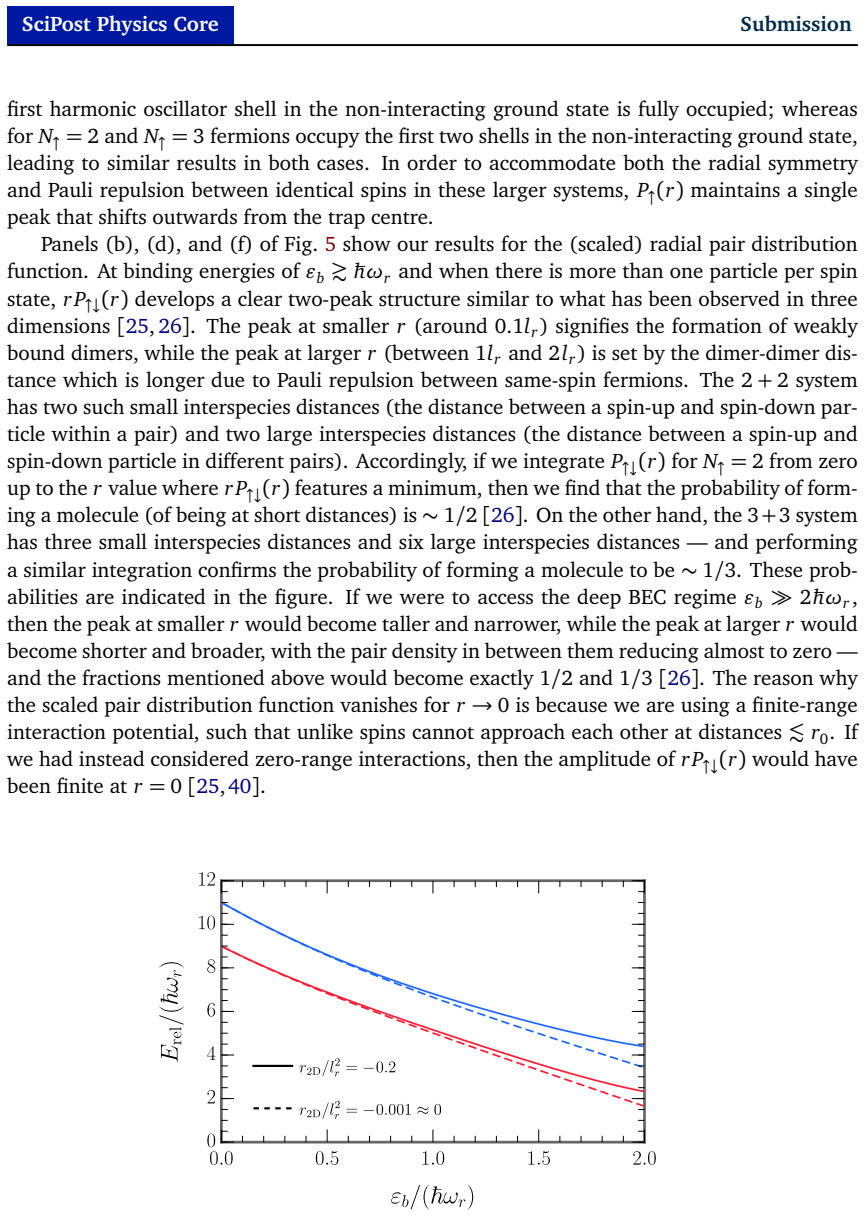
On the paper's own terms, the discovery is a complete numerical characterisation of trapped two-dimensional Fermi gases with $1+1$, $2+2$, and $3+3$ particles, including low-lying monopole spectra, one- and two-body density matrices, natural-orbital occupation numbers, atom and pair momentum distributions, and radial pair distribution functions. The key finding is that even at the strongest binding energies converged, $\epsilon_b \approx 2\hbar\omega_r$, the opposite-spin pair correlations have not developed the tight composite-boson structure of the deep BEC limit: the pair distribution function still shows a broad dimer-dimer peak, and the one-body density matrix can be reconstructed from only a handful of natural orbitals. Adding a finite, negative effective range, the signature of quasi-2D confinement, increases the short-distance molecular peak and lowers the occupation of the lowest natural orbitals at fixed $\epsilon_b$, so pairing is stronger in quasi-2D geometry. The paper also reports that the molecular "condensate fraction" extracted from the reduced two-body density matrix is non-monotonic in $\epsilon_b$ and has limited interpretability for such small systems.
Load-bearing premise
The calculations assume that the short-range interaction is fully described by the 2D scattering length and effective range, so that the detailed shape of the interatomic potential never matters at the trap energies studied.
Editorial extensions
If this is right
- The energy spectra for $1+1$, $2+2$, and $3+3$ fermions provide finite-system benchmarks that can be compared directly with deterministic few-atom experiments and with extrapolations toward many-body 2D Fermi gas theories.
- For binding energies $\epsilon_b \lesssim 2\hbar\omega_r$, the one-body density matrix is accurately decomposed into at most the six lowest natural orbitals, so few-body pairing in this regime is describable by a small effective single-particle Hilbert space.
- At fixed $\epsilon_b$, a more negative effective range, corresponding to stronger quasi-2D confinement, shifts energies upward, strengthens the short-distance peak of the pair distribution function, and lowers the lowest natural-orbital occupations, meaning confinement promotes molecule formation without changing the momentum distributions.
- The non-monotonic "condensate fraction" defined from the reduced two-body density matrix is not a reliable order parameter for these small systems, so molecular condensation in 2D few-fermion gases should be diagnosed through pair distribution functions and pair momentum distributions instead.
- Because the method cannot converge for $3+3$ fermions at binding energies above about $2\hbar\omega_r$, the deep BEC side of the crossover remains an open target for other few-body techniques.
Reading between the lines
- A direct experimental test would be to measure the pair momentum distribution $n(K)$ and the real-space pair distribution in a quasi-2D microtrap with two to twelve atoms while varying the axial confinement; the paper's results predict that $n(K)$ changes very little with binding energy, but the short-distance pair peak grows as the effective range becomes more negative.
- Because the correlated Gaussian approach fails to converge for $\epsilon_b > 2\hbar\omega_r$ in the six-fermion case, the paper leaves open whether the non-monotonic condensate fraction turns over and approaches unity at stronger coupling; alternative few-body methods could probe this part of the crossover.
- The strong effect of effective range at fixed binding energy suggests a practical tuning route for experiments: changing the trap aspect ratio may mimic changing the interaction strength even when the scattering length is held fixed.
Editorial analysis
A structured set of objections, weighed in public.
Referee Report
Summary. This manuscript studies equal-mass spin-balanced two-component Fermi gases with two, four, and six atoms confined in a two-dimensional harmonic trap, interacting via a short-range Gaussian potential parameterized by the 2D scattering length and effective range. Using the explicitly correlated Gaussian method with stochastic variational optimization, the authors compute ground- and low-lying monopole energy spectra as functions of the two-body binding energy, natural-orbital occupation numbers from one- and reduced two-body density matrices, a molecular condensate fraction, momentum distributions of atoms and pairs, and radial and pair distribution functions. Benchmarks are provided against the Busch spectrum for 1+1 fermions and against analytical results for the non-interacting 2+2 system in Appendix A. The main physical conclusions are that for up to six atoms at binding energies eps_b <~ 2 hbar omega_r the gas remains outside the tightly bound molecular regime, and that at fixed binding energy a finite negative effective range, representing quasi-2D confinement, enhances pairing.
Significance. If the results hold, this paper provides a useful two-dimensional counterpart to the established three-dimensional few-fermion studies of Blume and co-workers, with direct relevance to ongoing mesoscopic Fermi-gas experiments. The strengths are the use of an established numerical method, explicit checks against exact analytic limits, self-contained calculations with no fitted observables, and an analytic Fourier transform of the density matrices that makes momentum-space observables cheap to evaluate. The paper is also candid about the limitations of the ECG approach for larger atom numbers and deeper binding. The main uncertainty is the quantitative validity of the quasi-2D effective-range mapping at the largest binding energies considered, which is load-bearing for the central claim about enhanced pairing at fixed binding energy; this needs to be addressed before the finite-effective-range results can be taken as universal rather than as artifacts of truncation of the mapping.
major comments (2)
- [Section 2, Eq. (5); Section 3.5, Figs. 6-9] The central comparison between r2D/lr^2 = -0.2 and approximately zero is made without quantifying the error of the quasi-2D mapping in Eq. (5). This mapping is derived for klz << 1, but at the largest binding energies plotted, eps_b ~ 2 hbar omega_r, the relative momentum is k ~ sqrt(2)/lr, so with lz/lr = sqrt(0.2/ln 2) ~ 0.54 one obtains klz ~ 0.76. Higher-order confinement corrections of order (klz)^2 ~ 0.6 are then comparable to the effective-range term (1/pi)k^2 r2D ~ -0.06, and the next-order shape parameter is not computed. The condition r0 <= 0.1 lr controls only the short-range shape of the two-dimensional model potential and does not test the accuracy of the quasi-2D projection. I therefore request an explicit estimate of the omitted confinement corrections, or a restriction of the finite-range comparison to binding energies where klz is demonstrably small.
- [Section 3.1 and Section 4] The manuscript reports no convergence residuals, basis-size dependence, or error bars for the energies or the derived structural observables. The text states that convergence cannot currently be achieved for six atoms at eps_b > 2 hbar omega_r, yet the spectra and structural results extend to eps_b ~ 2.1 hbar omega_r, and the central conclusion that eps_b <~ 2 hbar omega_r lies outside the strong-interaction regime relies on data in this region. Please add a quantitative convergence statement for the 3+3 states near the upper end of the range (for example, energy change with basis size or an extrapolated value) and indicate how the uncertainty propagates to the occupation numbers, momentum distributions, and distribution functions.
minor comments (4)
- [Eq. (31)] The displayed equality [n_up(k)]_AA' == [n_up(k)]_AA' is a typo; the left-hand side should presumably be defined as the matrix element and the right-hand side as the closed-form expression c1/(g1 g4) exp(k^2/(2 g4)).
- [Eq. (35b)] The text states that V(rk - rl) = delta(r - rk - rl) is substituted into Eq. (35b), but the argument of the delta function should be r - (rk - rl); please correct the sign.
- [Section 3.2.3, Eqs. (21)-(22)] The definition of the condensate fraction is not fully explicit about the set over which the maximum is taken: Eq. (22a) includes the n=1,m=0 term while the surrounding text says the sum applies for m > 0. Please state the complete summation rule.
- [Fig. 1 caption] The caption reads 'at very nearly zero effective' and appears to be missing the word 'range'; please correct.
Circularity Check
No significant circularity: the calculations are self-contained, benchmarked against independent analytical results, and no observable is fitted to the target conclusions.
full rationale
The paper's derivation chain is not circular. The interaction model is a finite-range Gaussian potential with parameters V0 and r0, which are converted into the two-body scattering length a2D and effective range r2D by fitting the free-space phase shift to Eq. (4). The two-body binding energy eps_b is then computed from the 1+1 trapped relative ground-state energy, and all reported many-body energies and structural quantities are obtained by solving the N-body Hamiltonian (1) with the ECG/stochastic variational method. None of the reported observables is used as an input or fit target; the comparison at fixed eps_b between r2D approximately 0 and r2D = -0.2 is a genuine prediction of the model. The 1+1 spectrum is checked against the analytically known Busch spectrum, and the 2+2 non-interacting occupation numbers are reproduced analytically in Appendix A, providing external benchmarks. The main self-citations are to Ref. [11] for ECG matrix elements and for the potential parametrization used there; these are method-level references to a standard technique (Refs. [12-15]) and are not the load-bearing justification for the physics conclusions. The quasi-2D mapping r2D = -lz^2 ln(2) is attributed to external works [21-24]; whether its regime of validity extends to the largest |r2D| used is a quantitative accuracy concern, not a circularity. Accordingly, no circular step is identified; the score of 2 merely acknowledges minor method-level self-citation without making the central claim depend on it.
Assumptions & free parameters
free parameters (3)
- V0 (Gaussian potential depth) =
not specified; varied to realize target binding energies
- r0 (Gaussian width) =
r0 <= 0.1 lr
- r2D (effective range parameter) =
-0.001 lr^2 and -0.2 lr^2
assumptions (4)
- domain assumption The two-body low-energy scattering in 2D is universally determined by a2D and r2D, with higher-order terms negligible for r0 <= 0.1 lr (Section 2).
- domain assumption A quasi-2D trap with strong axial confinement maps to a 2D model with effective range r2D = -l2_z ln(2) (Eq. 5, Section 2).
- domain assumption The correlated Gaussian basis with the stochastic variational method converges to the exact eigensolutions for the reported states (Sections 2-3).
- domain assumption The ground states considered have zero total angular momentum, so restricting to the L=0 sector captures the relevant physics (Section 3.1).
Cite this review
Pith. "Pith review of Energetic and Structural Properties of Two-Dimensional Trapped Mesoscopic Fermi Gases." pith.science (2026). https://pith.science/paper/SN66AQIZ
@misc{pith2026250620891,
  author       = {Pith},
  title        = {Pith review of: Energetic and Structural Properties of Two-Dimensional Trapped Mesoscopic Fermi Gases},
  year         = {2026},
  howpublished = {\url{https://pith.science/paper/SN66AQIZ}},
  note         = {Machine review of arXiv:2506.20891}
}
read the original abstract
We theoretically investigate equal-mass spin-balanced two-component Fermi gases in which pairs of atoms with opposite spins interact via a short-range isotropic model potential. We probe the distinction between two-dimensional and quasi-two-dimensional harmonic confinement by tuning the effective range parameter within two-dimensional scattering theory. Our approach, which yields numerically exact energetic and structural properties, combines a correlated Gaussian basis-set expansion with the stochastic variational method. For systems containing up to six particles, we: 1) Present the ground- and excited-state energy spectra; 2) Study non-local correlations by analysing the one- and two-body density matrices, extracting from these the occupation numbers of the natural orbitals, the momentum distributions of atoms and pairs, and the molecular 'condensate fraction'; 3) Study local correlations by computing the radial and pair distribution functions. This paper extends current theoretical knowledge on the properties of trapped few-fermion systems as realised in state-of-the-art cold-atom experiments.
Figures


Figures from the paper (6 more)




Reference graph
Works this paper leans on
-
[1]
A. N. Wenz, G. Zürn, S. Murmann, I. Brouzos, T . Lompe and S. Jochim,From few to many: Observing the formation of a Fermi sea one atom at a time, Science 342, 457–460 (2013), doi:10.1126 /science.1240516
work page 2013
-
[2]
N. T . Zinner,Few-body physics in a many-body world, Few-Body Systems 55, 599–604 (2014), doi:10.1007 /s00601-014-0802-x
work page 2014
-
[3]
T . Grining, M. Tomza, M. Lesiuk, M. Przybytek, M. Musiał, R. Moszynski, M. Lewenstein and P . Massignan,Crossover between few and many fermions in a harmonic trap, Physical Review A 92, 061601 (2015), doi:10.1103 /PhysRevA.92.061601
work page 2015
-
[4]
L. Rammelmüller, W . J. Porter and J. E. Drut,Ground state of the two-dimensional attractive Fermi gas: Essential properties from few to many body, Physical Review A 93, 033639 (2016), doi:10.1103 /PhysRevA.93.033639
work page 2016
-
[5]
J. Levinsen, P . Massignan, S. Endo and M. M. Parish,Universality of the unitary Fermi gas: A few-body perspective, Journal of Physics B: Atomic, Molecular and Optical Physics 50, 072001 (2017), doi:10.1088 /1361-6455/aa5a1e
work page 2017
-
[6]
S.-J. Ran, A. Piga, C. Peng, G. Su and M. Lewenstein, Few-body systems capture many-body physics: Tensor network approach, Physical Review B 96, 155120 (2017), doi:10.1103/PhysRevB.96.155120
-
[7]
M. Schiulaz, M. Távora and L. F . Santos,From few- to many-body quantum systems, Quantum Science and Technology 3, 044006 (2018), doi:10.1088/2058-9565/aad913. 22 SciPost Physics Core Submission
- [8]
Show all 40 references
-
[9]
Holten, L
M. Holten, L. Bayha, K. Subramanian, S. Brandstetter, C. Heintze, P . Lunt, P . M. Preiss and S. Jochim, Observation of Cooper pairs in a mesoscopic two-dimensional Fermi gas, Nature 606, 287–291 (2022), doi:10.1038 /s41586-022-04678-1
2022
-
[10]
Serwane, G
F . Serwane, G. Zürn, T . Lompe, T . B. Ottenstein, A. N. Wenz and S. Jochim, Deterministic preparation of a tunable few-fermion system, Science 332, 336–338 (2011), doi:10.1126 /science.1201351
2011
-
[11]
E. K. Laird, B. C. Mulkerin, J. Wang and M. J. Davis, When does a Fermi puddle become a Fermi sea? Emergence of pairing in two-dimensional trapped mesoscopic Fermi gases, SciPost Physics 17, 163–200 (2024), doi:10.21468 /SciPostPhys.17.6.163
2024
-
[12]
Varga and Y
K. Varga and Y. Suzuki, Precise solution of few-body problems with the stochastic variational method on a correlated Gaussian basis, Physical Review C 52, 2885–2905 (1995), doi:10.1103 /PhysRevC.52.2885
1995
-
[13]
Varga and Y
K. Varga and Y. Suzuki, Stochastic variational method with a correlated Gaussian basis, Physical Review A 53, 1907–1910 (1996), doi:10.1103 /PhysRevA.53.1907
1996
-
[14]
Suzuki and K
Y. Suzuki and K. Varga, Stochastic Variational Approach to Quantum Mechanical Few-Body Problems, Springer Publishing, ISBN 978-3-5404-9541-3 (1998)
1998
-
[15]
Mitroy , S
J. Mitroy , S. Bubin, W . Horiuchi, Y. Suzuki, L. Adamowicz, W . Cencek, K. Szalewicz, J. Komasa, D. Blume and K. Varga, Theory and application of explicitly correlated Gaussians, Reviews of Modern Physics 85, 693–749 (2013), doi:10.1103/RevModPhys.85.693
2013 doi
-
[16]
S. F . Boys,The integral formulae for the variational solution of the molecular many-electron wave equation in terms of Gaussian functions with direct electronic correlation, Proceedings of the Royal Society of London A 258, 402–411 (1960), doi:10.1098/rspa.1960.0195
1960
-
[17]
Singer, The use of Gaussian (exponential quadratic) wave functions in molecular problems — I
K. Singer, The use of Gaussian (exponential quadratic) wave functions in molecular problems — I. General formulae for the evaluation of integrals, Proceedings of the Royal Society of London A 258, 412–420 (1960), doi:10.1098 /rspa.1960.0196
1960
-
[18]
B. J. Verhaar, J. P . H. W . van den Eijnde, M. A. J. Voermans and M. M. J. Schaffrath, Scattering length and effective range in two dimensions: Application to adsorbed hydrogen atoms, Journal of Physics A: Mathematical and General 17, 595–598 (1984), doi:10.1088/0305-4470/17/3/020
1984 doi
-
[19]
S. K. Adhikari, Quantum scattering in two dimensions, American Journal of Physics 54, 362–367 (1986), doi:10.1119 /1.14623
1986
-
[20]
S. K. Adhikari, W . G. Gibson and T . K. Lim,Effective-range theory in two dimensions, Journal of Chemical Physics 85, 5580–5583 (1986), doi:10.1063 /1.451572
1986
-
[21]
Levinsen and M
J. Levinsen and M. M. Parish, Bound states in a quasi-two-dimensional Fermi gas, Physical Review Letters 110, 055304 (2013), doi:10.1103 /PhysRevLett.110.055304
2013
-
[22]
Kirk and M
T . Kirk and M. M. Parish,Three-body correlations in a two-dimensional SU(3) Fermi gas, Physical Review A 96, 053614 (2017), doi:10.1103 /PhysRevA.96.053614. 23 SciPost Physics Core Submission
2017
-
[23]
H. Hu, B. C. Mulkerin, U. Toniolo, L. He and X.-J. Liu, Reduced quantum anomaly in a quasi-two-dimensional Fermi superfluid: Significance of the confinement-induced effective range of interactions, Physical Review Letters 122, 070401 (2019), doi:10.1103/PhysRevLett.122.070401
2019 doi
-
[24]
X. Y. Yin, H. Hu and X.-J. Liu, Few-body perspective of a quantum anomaly in two-dimensional Fermi gases, Physical Review Letters 124, 013401 (2020), doi:10.1103/PhysRevLett.124.013401
2020 doi
-
[25]
Blume and K
D. Blume and K. Daily ,Trapped two-component Fermi gases with up to six particles: Energetics, structural properties, and molecular condensate fraction, Comptes Rendus Physique 12, 86–109 (2011), doi:10.1016 /j.crhy .2010.11.010
2011
-
[26]
von Stecher, C
J. von Stecher, C. H. Greene and D. Blume, Energetics and structural properties of trapped two-component Fermi gases, Physical Review A 77, 043619 (2008), doi:10.1103/PhysRevA.77.043619
2008 doi
-
[27]
K. M. Daily and D. Blume, Energy spectrum of harmonically trapped two-component Fermi gases: Three- and four-particle problem, Physical Review A 81, 053615 (2010), doi:10.1103/PhysRevA.81.053615
2010 doi
-
[28]
C. J. Bradly , B. C. Mulkerin, A. M. Martin and H. M. Quiney ,Coupled-pair approach for strongly interacting trapped fermionic atoms, Physical Review A 90, 023626 (2014), doi:10.1103/PhysRevA.90.023626
2014 doi
-
[29]
X. Y. Yin and D. Blume, Trapped unitary two-component Fermi gases with up to ten particles, Physical Review A 92, 013608 (2015), doi:10.1103 /PhysRevA.92.013608
2015
-
[30]
D. S. Lewart, V . R. Pandharipande and S. C. Pieper,Single-particle orbitals in liquid-helium drops, Physical Review B 37, 4950–4964 (1988), doi:10.1103/PhysRevB.37.4950
1988 doi
-
[31]
J. J. Sakurai and J. Napolitano, Modern Quantum Mechanics, Addison–Wesley Publishing, 2nd Edition, ISBN 978-0-8053-8291-4 (2010)
2010
-
[32]
Levinsen and M
J. Levinsen and M. M. Parish, Chapter 1: Strongly interacting two-dimensional Fermi gases, Annual Review of Cold Atoms and Molecules 3, 1–75 (2015), doi:10.1142/9789814667746_0001
2015 doi
-
[33]
Zwerger, ed.,Lecture Notes in Physics (vol
W . Zwerger, ed.,Lecture Notes in Physics (vol. 836): The BCS–BEC Crossover and the Unitary Fermi Gas, Springer Publishing, ISBN 978-3-642-21977-1 (2012)
2012
-
[34]
Braaten and H.-W
E. Braaten and H.-W . Hammer,Universality in few-body systems with large scattering length, Physics Reports 428, 259–390 (2006), doi:10.1016 /j.physrep.2006.03.001
2006
-
[35]
Busch, B.-G
T . Busch, B.-G. Englert, K. Rza˙zewski and M. Wilkens, Two cold atoms in a harmonic trap, Foundations of Physics 28, 549–559 (1998), doi:10.1023 /A:1018705520999
1998
-
[36]
Efimov,Weakly bound states of three resonantly interacting particles, Soviet Journal of Nuclear Physics 12, 589–601 (1971)
V . Efimov,Weakly bound states of three resonantly interacting particles, Soviet Journal of Nuclear Physics 12, 589–601 (1971)
1971
-
[37]
X.-J. Liu, H. Hu and P . D. Drummond,Exact few-body results for strongly correlated quantum gases in two dimensions, Physical Review B 82, 054524 (2010), doi:10.1103/PhysRevB.82.054524. 24 SciPost Physics Core Submission
2010 doi
-
[38]
Bjerlin, S
J. Bjerlin, S. M. Reimann and G. M. Bruun, Few-body precursor of the Higgs mode in a Fermi gas, Physical Review Letters 116, 155302 (2016), doi:10.1103/PhysRevLett.116.155302
2016 doi
-
[39]
G. E. Astrakharchik, J. Boronat, J. Casulleras and S. Giorgini, Momentum distribution and condensate fraction of a fermion gas in the BCS–BEC crossover, Physical Review Letters 95, 230405 (2005), doi:10.1103 /PhysRevLett.95.230405
2005
-
[40]
Yan and D
Y. Yan and D. Blume, Incorporating exact two-body propagators for zero-range interactions into N-body Monte Carlo simulations, Physical Review A 91, 043607 (2015), doi:10.1103 /PhysRevA.91.043607. 25
2015
Reviewed August 6, 2026 · model on record in the stance chip above.
Discussion (0). Continue with ORCID to comment.