Photoionization of the Composite Nebula Surrounding NGC 5408 X-1: Implications for Beamed Emission
Pith reviewed 2026-07-01 04:54 UTC · model grok-4.3
The pith
The nebula around NGC 5408 X-1 requires a factor of 24 lower EUV and X-ray luminosity from the ULX than observed, implying mild beaming.
A machine-rendered reading of the paper's core claim, the machinery that carries it, and where it could break.
Core claim
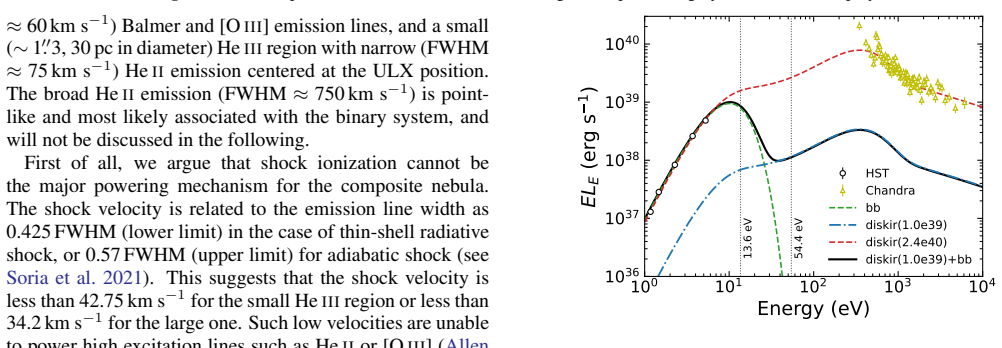
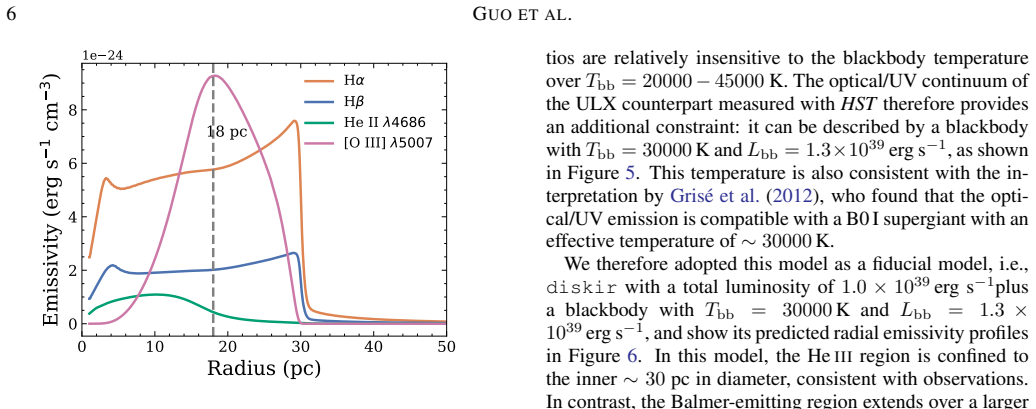
Adopting the same SED shape with a reduced luminosity of 1.0 × 10^39 erg s^{-1} together with a blackbody of temperature 30000 K and luminosity 1.3 × 10^39 erg s^{-1} successfully reproduces both the He III and H II regions in terms of their luminosities and sizes. This implies that the EUV and X-ray emission from the ULX may be mildly beamed toward our line of sight, consistent with the picture of supercritical accretion.
What carries the argument
Dual-component SED (scaled-down ULX plus 30,000 K blackbody) inserted into Cloudy photoionization simulations to match observed nebula luminosities and sizes.
If this is right
- The true power output of the ULX is lower than its isotropic X-ray luminosity by a factor of roughly 24.
- The model remains consistent with the ULX's observed optical and UV fluxes measured by HST.
- The point-like broad He II emission originates in the binary system rather than the extended nebula.
- The result supports mildly beamed emission as a generic feature of supercritical accretion.
Where Pith is reading between the lines
- The same luminosity mismatch may appear in other ULX nebulae if similar dual-component modeling is applied.
- Time-dependent changes in beaming angle could be tested by repeated nebula spectroscopy over years.
- Population studies of ULX nebulae may need to correct for orientation before inferring intrinsic luminosities.
Load-bearing premise
The nebula is powered solely by photoionization from the ULX with no significant contribution from shocks or other sources.
What would settle it
High-resolution spectra showing dominant shock velocity signatures or line ratios that deviate systematically from the dual-component model predictions.
Figures
read the original abstract
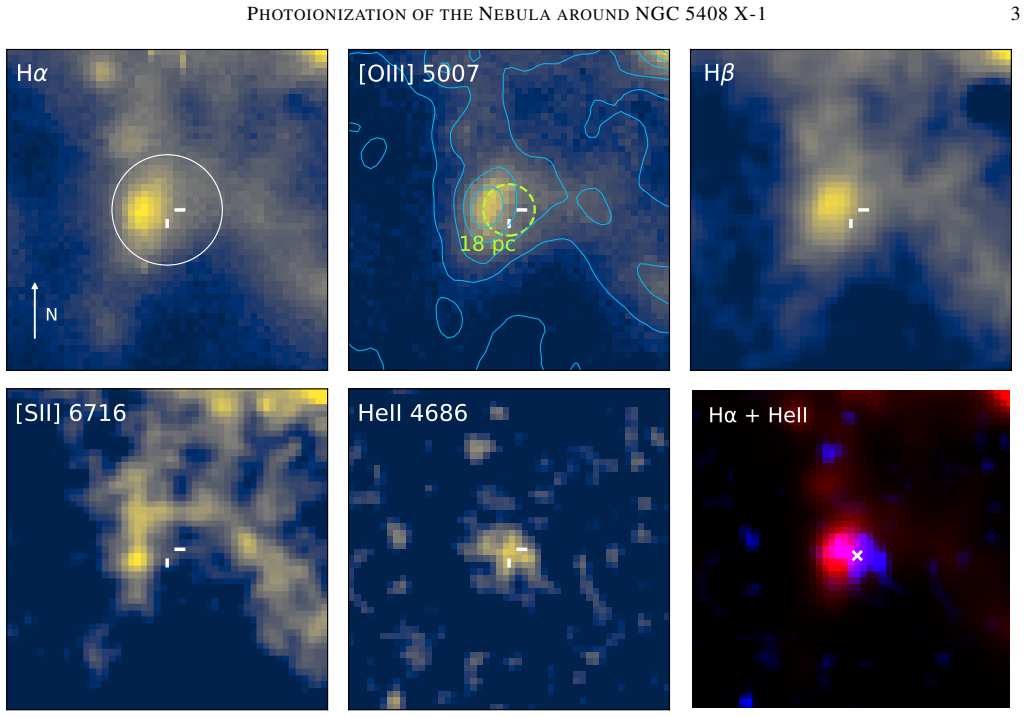
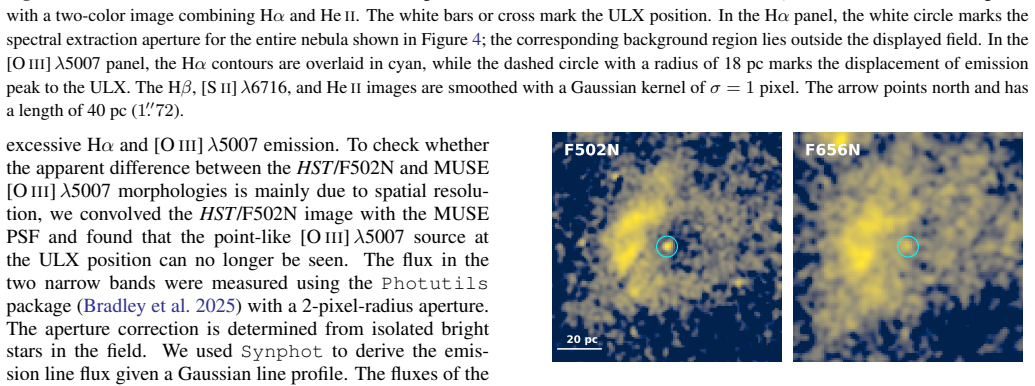
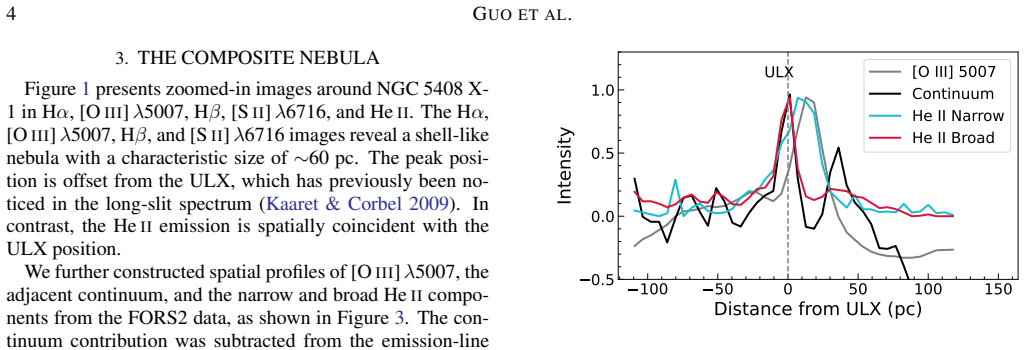
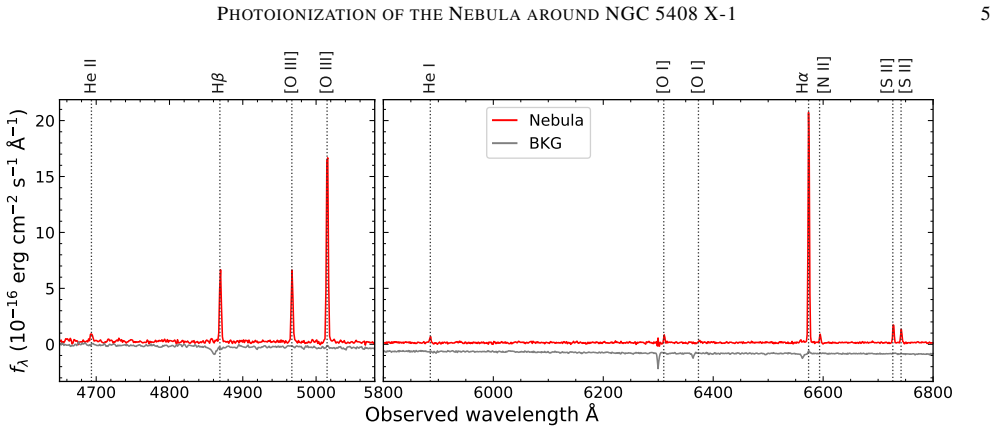
NGC 5408 X-1 is one of the best studied ultraluminous X-ray sources (ULXs) and is surrounded by a photoionized nebula. Previous optical spectroscopy established the presence of strong Balmer, [O III], and He II $\lambda4686$ emission from the nebula, but the powering engine remains uncertain. In this work, we present new integral-field observations of NGC 5408 X-1, supplemented by archival long-slit spectroscopy and Hubble Space Telescope (HST) imaging, and confirm the presence of a composite nebula, with a small He III region centered on the ULX and a large, shell-like H II region. We also confirm that the broad He II emission is point-like and most likely associated with the ULX binary system. Photoionization simulations with Cloudy show that the ULX spectral energy distribution (SED), with a total luminosity of $2.4 \times 10^{40}\ {\rm erg\ s^{-1}}$ obtained by fitting the optical/UV/X-ray data, overpredicts both the luminosity and size of the He III region. Instead, adopting the same SED shape with a reduced luminosity of $1.0 \times 10^{39}\ {\rm erg\ s^{-1}}$ together with a blackbody of temperature $30000\ {\rm K}$ and luminosity $1.3 \times 10^{39}\ {\rm erg\ s^{-1}}$ successfully reproduces both the He III and H II regions in terms of their luminosities and sizes. Such a dual-component ionizing spectrum is consistent with HST measurements of the ULX in the optical and UV, while being a factor of 24 lower than the inferred isotropic X-ray luminosity. This implies that the EUV and X-ray emission from the ULX may be mildly beamed toward our line of sight, consistent with the picture of supercritical accretion.
Editorial analysis
A structured set of objections, weighed in public.
Referee Report
Summary. The paper presents new integral-field observations confirming a composite nebula around NGC 5408 X-1 consisting of a compact He III region and an extended shell-like H II region, with point-like broad He II emission associated with the ULX. Cloudy photoionization simulations are used to show that the ULX SED fitted to optical/UV/X-ray data with total luminosity 2.4 × 10^40 erg s^{-1} overpredicts both the luminosity and size of the He III region. Instead, the same SED shape scaled to 1.0 × 10^39 erg s^{-1} plus an additional 30,000 K blackbody component of luminosity 1.3 × 10^39 erg s^{-1} reproduces the observed luminosities and sizes of both regions, implying that the EUV and X-ray emission is mildly beamed, consistent with supercritical accretion.
Significance. If the central modeling result holds after addressing parameter exploration, the work would provide independent evidence from nebula properties for mild beaming in a well-studied ULX, supporting the supercritical accretion scenario. The new observations and dual-component SED approach add to the empirical constraints on ULX emission geometry.
major comments (2)
- [Abstract] Abstract: The claim that the full-luminosity (2.4 × 10^40 erg s^{-1}) SED necessarily overpredicts the He III region relies on fixed values for hydrogen density, volume filling factor, metallicity, and geometry separating the He III zone from the H II shell. No exploration or marginalization over these parameters is indicated, so it remains possible that a different combination reproduces the observations without requiring the factor-of-24 luminosity reduction.
- [Abstract] Abstract: The reduced high-energy luminosity (1.0 × 10^39 erg s^{-1}) and blackbody parameters (T=30,000 K, L=1.3 × 10^39 erg s^{-1}) are selected specifically to match the observed He III and H II properties in Cloudy, making the beaming inference dependent on post-hoc fitting rather than an independent prediction from the original SED.
Simulated Author's Rebuttal
We thank the referee for their careful reading and constructive comments. We address the two major comments point by point below.
read point-by-point responses
-
Referee: [Abstract] Abstract: The claim that the full-luminosity (2.4 × 10^40 erg s^{-1}) SED necessarily overpredicts the He III region relies on fixed values for hydrogen density, volume filling factor, metallicity, and geometry separating the He III zone from the H II shell. No exploration or marginalization over these parameters is indicated, so it remains possible that a different combination reproduces the observations without requiring the factor-of-24 luminosity reduction.
Authors: The adopted values for hydrogen density, volume filling factor, metallicity, and geometry were taken from constraints provided by the observed H II region luminosity and size together with prior long-slit spectroscopy of the system. We nevertheless agree that the manuscript does not demonstrate robustness against variations in these parameters. In the revised version we will add a dedicated subsection presenting Cloudy grids that vary n_H (10–100 cm^{-3}), filling factor (0.01–0.1), metallicity (0.2–1 Z_⊙), and the radial separation between the He III and H II zones; these runs confirm that the factor-of-24 overprediction of the He III region by the full-luminosity SED persists across the explored range. revision: yes
-
Referee: [Abstract] Abstract: The reduced high-energy luminosity (1.0 × 10^39 erg s^{-1}) and blackbody parameters (T=30,000 K, L=1.3 × 10^39 erg s^{-1}) are selected specifically to match the observed He III and H II properties in Cloudy, making the beaming inference dependent on post-hoc fitting rather than an independent prediction from the original SED.
Authors: The SED shape (including the relative contributions of the disk, corona, and wind components) is fixed by the observed optical/UV/X-ray photometry and spectroscopy of the ULX itself; only the overall normalization of the high-energy portion is scaled downward to match the He III region. The additional 30 000 K blackbody is independently motivated by the HST UV photometry. The central inference—that the isotropic X-ray luminosity exceeds the ionizing luminosity required by the nebula by a factor of ~24—therefore rests on the mismatch between two independent observables (X-ray flux and nebula emission measure), not on an arbitrary fit. We will revise the abstract and §4 to state this distinction more explicitly and to note that the blackbody parameters were cross-checked against the HST data before being used in the Cloudy models. revision: partial
Circularity Check
Reduced luminosity fitted to match nebula sizes/luminosities, making beaming inference a direct result of the parameter choice
specific steps
-
fitted input called prediction
[Abstract]
"adopting the same SED shape with a reduced luminosity of 1.0 × 10^{39} erg s^{-1} together with a blackbody of temperature 30000 K and luminosity 1.3 × 10^{39} erg s^{-1} successfully reproduces both the He III and H II regions in terms of their luminosities and sizes. This implies that the EUV and X-ray emission from the ULX may be mildly beamed toward our line of sight"
The reduced luminosity (and added blackbody) is chosen specifically so the simulation matches the observed He III/H II luminosities and sizes. The factor-of-24 reduction relative to the X-ray-inferred isotropic luminosity, and the resulting beaming inference, are therefore achieved by construction through this parameter adjustment rather than emerging as an independent model prediction.
full rationale
The paper shows the 2.4e40 erg/s SED overpredicts He III properties in Cloudy, then selects a reduced 1e39 erg/s value (plus blackbody) that reproduces the observations. The factor-of-24 reduction and mild-beaming conclusion follow directly from this adjustment. This matches the fitted_input_called_prediction pattern: a parameter is tuned to data, then the tuned value is used to infer a physical implication (beaming). No self-citation or definitional loop is present; the central claim retains independent content from the overprediction demonstration, but the success of the reduced model is by construction of the fit.
Axiom & Free-Parameter Ledger
free parameters (3)
- reduced high-energy luminosity =
1.0e39 erg s^{-1}
- blackbody temperature =
30000 K
- blackbody luminosity =
1.3e39 erg s^{-1}
axioms (2)
- domain assumption The nebula is powered purely by photoionization from the ULX with no significant shocks or other sources
- domain assumption Nebula distance and geometry allow reliable size comparisons between model and data
Reference graph
Works this paper leans on
-
[1]
Kewley, L. J. 2008, The Astrophysical Journal Supplement Series, 178, 20
2008
-
[2]
Bachetti, M., Harrison, F. A., Walton, D. J., et al. 2014, Nature, 514, 202, doi: 10.1038/nature13791
-
[3]
2010, in Society of Photo-Optical Instrumentation Engineers (SPIE) Conference
Bacon, R., Accardo, M., Adjali, L., et al. 2010, in Society of Photo-Optical Instrumentation Engineers (SPIE) Conference
2010
-
[4]
Ground-based and Airborne Instrumentation for Astronomy III , year = 2010, editor =
Series, V ol. 7735, Ground-based and Airborne Instrumentation for Astronomy III, ed. I. S. McLean, S. K. Ramsay, & H. Takami, 773508, doi: 10.1117/12.856027
-
[5]
2025, astropy/photutils: 2.2.0, 2.2.0, Zenodo, doi: 10.5281/zenodo.596036
Bradley, L., Sip˝ocz, B., Robitaille, T., et al. 2025, astropy/photutils: 2.2.0, 2.2.0, Zenodo, doi: 10.5281/zenodo.596036
-
[6]
Cardelli, J. A., Clayton, G. C., & Mathis, J. S. 1989, ApJ, 345, 245, doi: 10.1086/167900
-
[7]
2018, MNRAS, 476, L45, doi: 10.1093/mnrasl/sly030
Carpano, S., Haberl, F., Maitra, C., & Vasilopoulos, G. 2018, MNRAS, 476, L45, doi: 10.1093/mnrasl/sly030
-
[8]
2011, ApJL, 728, L5, doi: 10.1088/2041-8205/728/1/L5
Cseh, D., Grisé, F., Corbel, S., & Kaaret, P. 2011, ApJL, 728, L5, doi: 10.1088/2041-8205/728/1/L5
-
[9]
2013, MNRAS, 435, 2896, doi: 10.1093/mnras/stt1484
Cseh, D., Grisé, F., Kaaret, P., et al. 2013, MNRAS, 435, 2896, doi: 10.1093/mnras/stt1484
-
[10]
2011, NewAR, 55, 166, doi: 10.1016/j.newar.2011.08.002
Feng, H., & Soria, R. 2011, NewAR, 55, 166, doi: 10.1016/j.newar.2011.08.002
-
[11]
J., Chatzikos, M., Guzmán, F., et al
Ferland, G. J., Chatzikos, M., Guzmán, F., et al. 2017, RMxAA, 53, 385, doi: 10.48550/arXiv.1705.10877 Fürst, F., Walton, D. J., Harrison, F. A., et al. 2016, ApJL, 831, L14, doi: 10.3847/2041-8205/831/2/L14 Grisé, F., Kaaret, P., Corbel, S., et al. 2012, ApJ, 745, 123, doi: 10.1088/0004-637X/745/2/123 Hernández-García, L., Vaughan, S., Roberts, T. P., & ...
-
[12]
2009, ApJ, 697, 950, doi: 10.1088/0004-637X/697/1/950 8 GUO ET AL
Kaaret, P., & Corbel, S. 2009, ApJ, 697, 950, doi: 10.1088/0004-637X/697/1/950 8 GUO ET AL
-
[13]
Kaaret, P., Feng, H., & Roberts, T. P. 2017, ARA&A, 55, 303, doi: 10.1146/annurev-astro-091916-055259
-
[14]
Kaaret, P., Ward, M. J., & Zezas, A. 2004, MNRAS, 351, L83, doi: 10.1111/j.1365-2966.2004.08020.x
-
[15]
Karachentsev, I. D., Sharina, M. E., Dolphin, A. E., et al. 2002, A&A, 385, 21, doi: 10.1051/0004-6361:20020042
-
[16]
2023, NewAR, 96, 101672, doi: 10.1016/j.newar.2022.101672
King, A., Lasota, J.-P., & Middleton, M. 2023, NewAR, 96, 101672, doi: 10.1016/j.newar.2022.101672
-
[17]
Luridiana, V ., Morisset, C., & Shaw, R. A. 2015, A&A, 573, A42, doi: 10.1051/0004-6361/201323152
-
[18]
2013, pyCloudy: Tools to manage astronomical Cloudy photoionization code, Astrophysics Source Code Library, record ascl:1304.020
Morisset, C. 2013, pyCloudy: Tools to manage astronomical Cloudy photoionization code, Astrophysics Source Code Library, record ascl:1304.020. http://ascl.net/1304.020
2013
-
[19]
Optical Counterparts of Ultraluminous X-Ray Sources
Pakull, M. W., & Mirioni, L. 2002, arXiv e-prints, astro. https://arxiv.org/abs/astro-ph/0202488
work page internal anchor Pith review Pith/arXiv arXiv 2002
-
[20]
Pinto, C., Middleton, M. J., & Fabian, A. C. 2016, Nature, 533, 64, doi: 10.1038/nature17417
-
[21]
Pinto, C., & Walton, D. J. 2023, arXiv e-prints, arXiv:2302.00006, doi: 10.48550/arXiv.2302.00006
-
[22]
Roberts, T. P., Gladstone, J. C., Goulding, A. D., et al. 2011, Astronomische Nachrichten, 332, 398, doi: 10.1002/asna.201011508
-
[23]
Soria, R., Motch, C., Read, A. M., & Stevens, I. R. 2004, A&A, 423, 955, doi: 10.1051/0004-6361:20041145
-
[24]
Soria, R., Pakull, M. W., Motch, C., et al. 2021, MNRAS, 501, 1644, doi: 10.1093/mnras/staa3784
-
[25]
Strohmayer, T. E. 2009, ApJL, 706, L210, doi: 10.1088/0004-637X/706/2/L210
discussion (0)
Sign in with ORCID, Apple, or X to comment. Anyone can read and Pith papers without signing in.