Multi-network comparison of between-farm contacts for infectious disease surveillance in swine production
Pith reviewed 2026-06-27 19:56 UTC · model grok-4.3
The pith
Vehicle movement networks among swine farms are far denser than pig movement or distance networks and flag largely different super-spreader farms.
A machine-rendered reading of the paper's core claim, the machinery that carries it, and where it could break.
Core claim
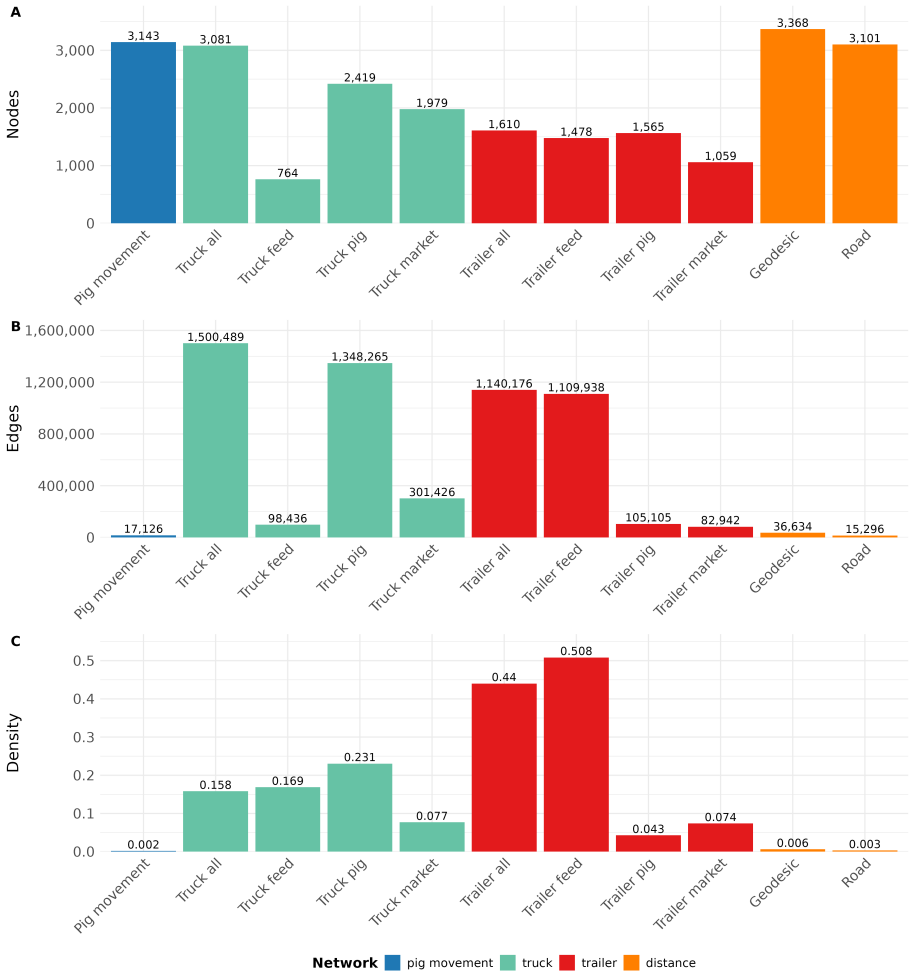
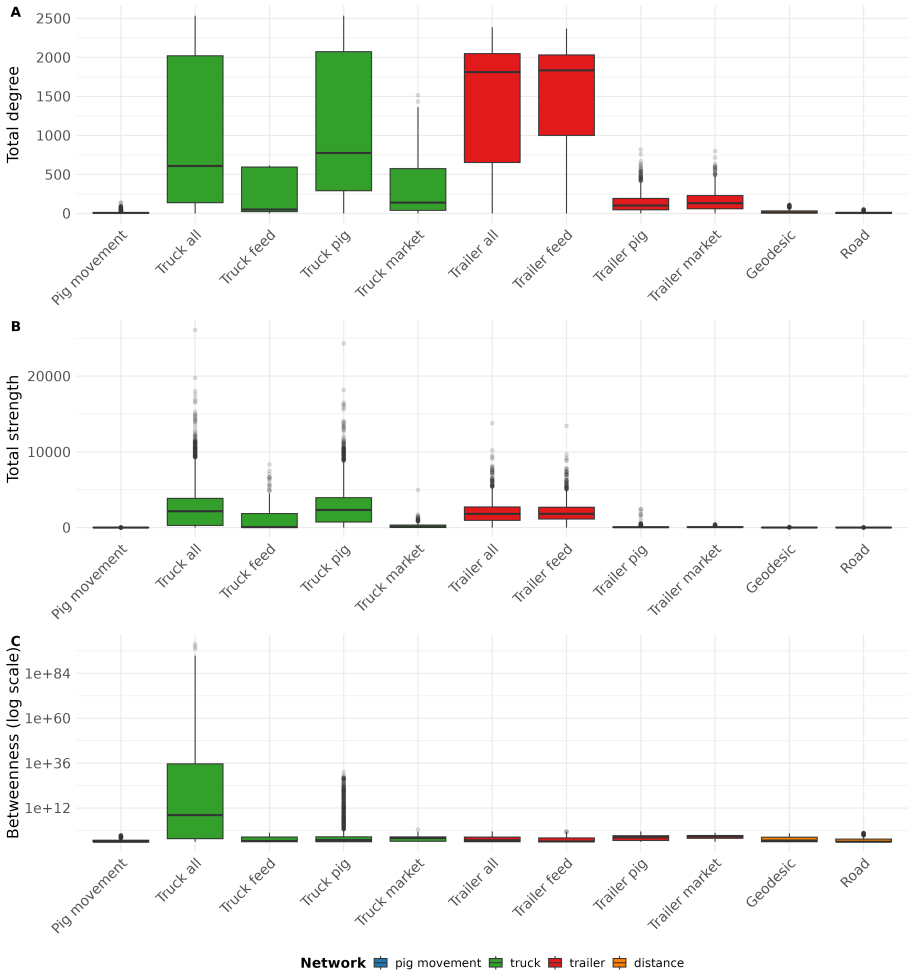
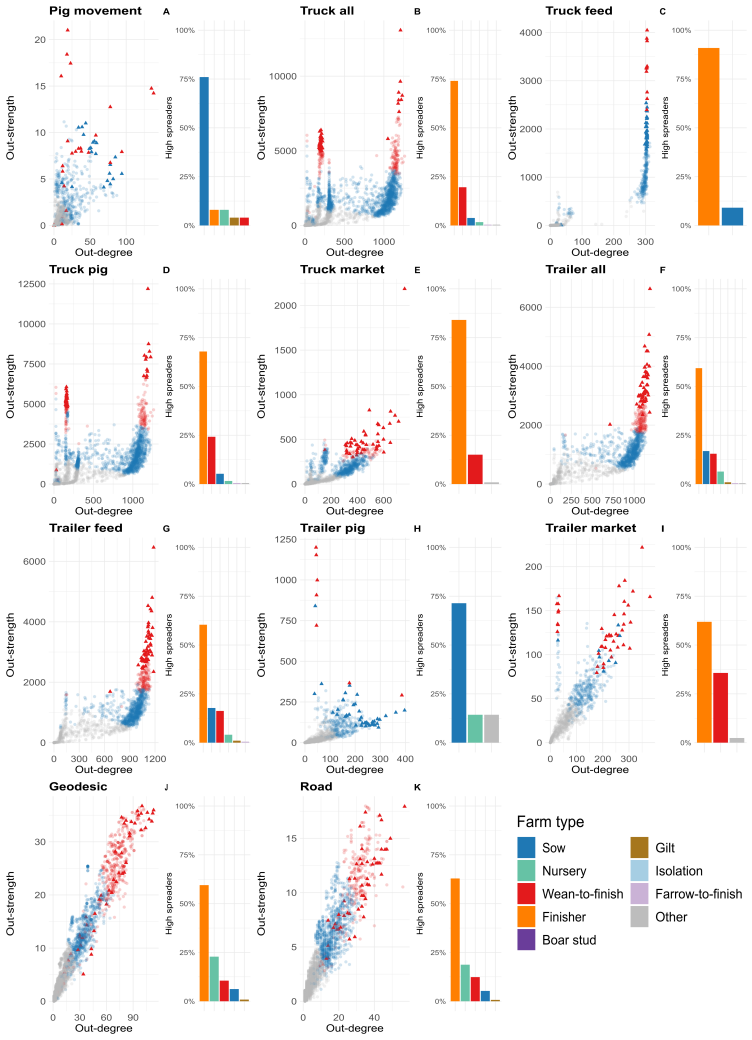
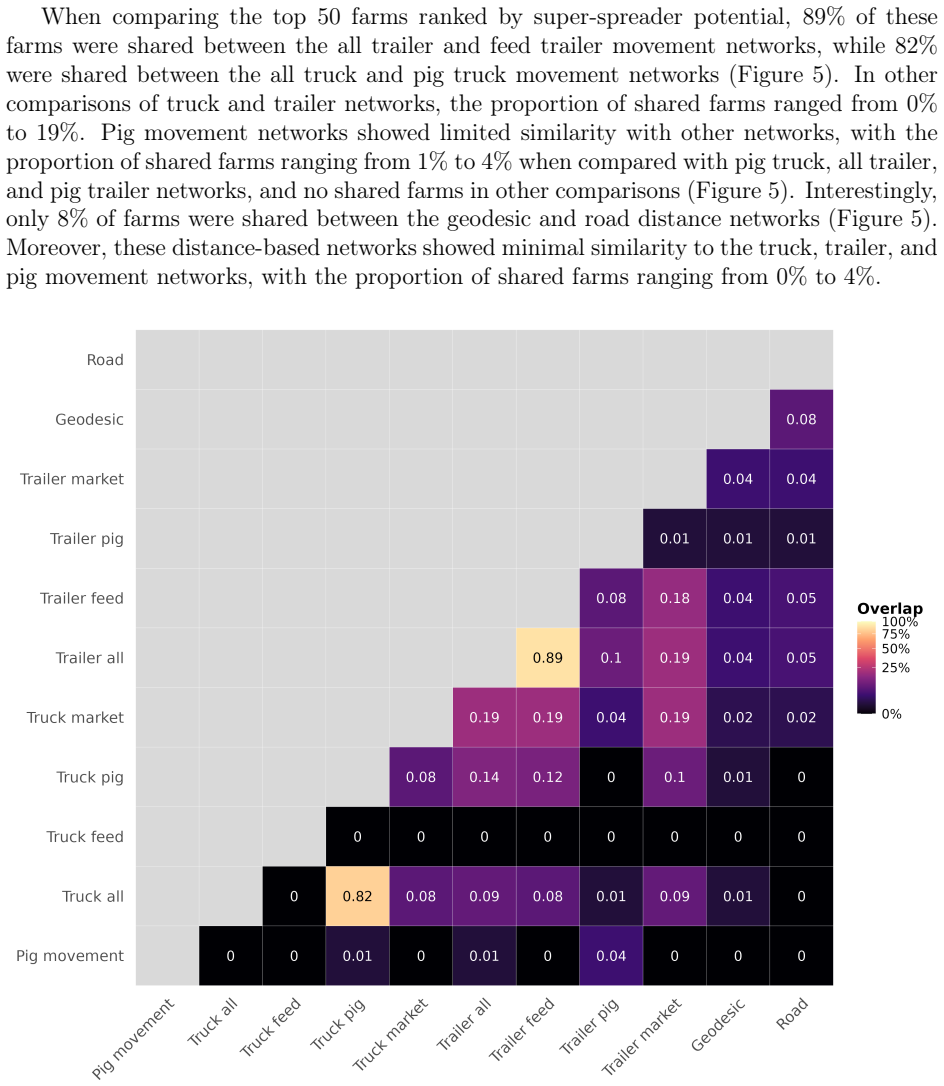
Truck and trailer movement networks were the most densely connected, particularly for feed transport, showing connectivity levels between 98.7% and 99.7% higher than those of pig movement and distance-based networks. When comparing the top 50 farms ranked by super-spreader score in each network, vehicle-based networks showed the highest similarity, with up to 89% of top-ranked farms shared between vehicle networks. In contrast, pig movement and distance-based networks identified largely distinct sets of top-ranked farms, sharing at most 4% and 8%, respectively, with other contact networks. Each network exhibited a distinct connectivity structure, resulting in different sets of high-risk farm
What carries the argument
Comparison of eleven contact networks (vehicle movements, pig movements, distance-based) ranked by super-spreader scores from network metrics such as degree and betweenness.
If this is right
- Surveillance programs should monitor feed truck routes because they create the most connections and reach sow farms frequently.
- Finisher farms should receive priority attention in vehicle-based monitoring since they rank high as super-spreaders in those networks.
- Aggregated truck data can serve as a bridge network linking many otherwise separate farms.
- Using only pig-movement or distance data would miss most of the high-connectivity links identified by vehicle networks.
- Different networks produce different high-risk farm lists, so single-network surveillance would overlook some transmission routes to breeding farms.
Where Pith is reading between the lines
- Real-time feed-truck tracking could give earlier alerts than waiting for pig shipment records.
- Combining the networks might reveal farms that act as bridges only when multiple contact types are considered together.
- The same multi-network method could be tested on other livestock species or regions to check whether vehicle movements remain the densest layer.
- Resource allocation for inspections could shift toward vehicle routes in areas where feed transport dominates connectivity.
Load-bearing premise
The networks built from movement records and distances correctly represent the routes that actually transmit infectious disease between farms.
What would settle it
Track a real swine disease outbreak and test whether the farms that become infected match the super-spreader lists from the vehicle networks more closely than the lists from the pig-movement or distance networks.
Figures
read the original abstract
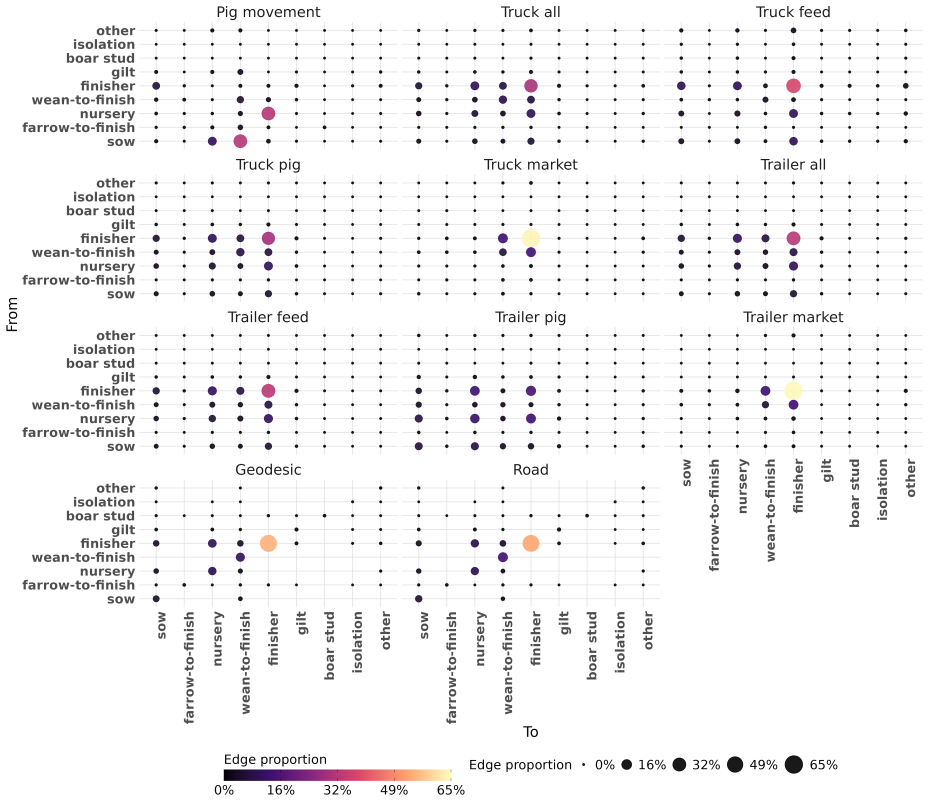
Understanding how swine farms are interconnected, directly and indirectly, is essential to characterizing infectious disease transmission. This study aimed to describe the connectivity of swine farms across 11 network types, including vehicle movements (i.e., trucks and trailers), animal movements, and distance-based farm-to-farm contacts, to identify links among production types and farms likely to be consistently characterized as super-spreaders. Truck and trailer movement networks were the most densely connected, particularly for feed transport, showing connectivity levels between 98.7% and 99.7% higher than those of pig movement and distance-based networks. These networks also exhibited the highest degree and frequency of connections between farms, while the aggregated truck network, which included all truck types, showed the greatest potential to act as a bridge connecting farms. Finisher farms were highly interconnected with other farm types across all networks. Sow farms were frequently reached by other farm types, especially through feed truck movements, representing up to 8.7% of these links. We demonstrated that in vehicle movements and proximity networks, finisher farms played a major role as super-spreaders. When comparing the top 50 farms ranked by super-spreader score in each network, vehicle-based networks showed the highest similarity, with up to 89% of top-ranked farms shared between vehicle networks. In contrast, pig movement and distance-based networks identified largely distinct sets of top-ranked farms, sharing at most 4% and 8%, respectively, with other contact networks. Overall, each network exhibited a distinct connectivity structure, resulting in different sets of high-risk farms, particularly regarding potential transmission to breeding farms. These findings support the integration of multiple transmission pathways into disease surveillance.
Editorial analysis
A structured set of objections, weighed in public.
Referee Report
Summary. The manuscript constructs 11 networks from vehicle (truck/trailer), pig movement, and distance-based contacts among swine farms. It compares their connectivity, degree, and bridge potential, identifies finisher and sow farms as highly interconnected, and ranks farms by a composite super-spreader score. Vehicle networks are reported as most densely connected (98.7–99.7% higher connectivity than others) and share up to 89% of their top-50 super-spreader farms, while pig-movement and distance networks share at most 4–8% with other networks, supporting the conclusion that each contact type identifies distinct high-risk sets for surveillance.
Significance. If the networks faithfully represent transmission routes and the super-spreader score correlates with actual secondary-case generation, the work would demonstrate that surveillance strategies must integrate multiple pathways rather than relying on any single network type. The explicit quantification of overlap percentages and the role of finisher farms across networks would be useful for prioritizing vehicle-based monitoring in swine systems.
major comments (3)
- [Methods] Methods (network construction and super-spreader definition): No epidemic simulation (SIR/SEIR or equivalent) on the constructed graphs or comparison to recorded outbreak data is reported to test whether the chosen centrality composite actually ranks farms by transmission risk. Without this check, the claim that vehicle networks identify largely overlapping high-risk farms while pig-movement and distance networks identify distinct sets lacks epidemiological grounding.
- [Results] Results (top-50 overlap analysis): The reported 89% overlap between vehicle networks and the 4–8% overlap with pig-movement/distance networks are presented as evidence of distinct high-risk sets, yet these percentages rest entirely on the unvalidated super-spreader ranking; a sensitivity analysis replacing the score with degree or betweenness alone is not shown.
- [Methods] Data and sample description: The abstract and methods summary provide no information on the number of farms, time window, or data sources used to build the 11 networks, preventing assessment of whether the reported connectivity differences (98.7–99.7%) are robust to sampling variation or missing links.
minor comments (2)
- [Methods] Clarify whether the aggregated truck network includes all vehicle types or only a subset, and provide the exact formula or weighting used for the super-spreader score.
- [Figures] Figure legends should explicitly state the number of farms and edges in each network so readers can judge the scale of the reported percentages.
Simulated Author's Rebuttal
We thank the referee for the detailed and constructive comments. We address each major point below, clarifying the scope of our descriptive network analysis while agreeing to strengthen the manuscript where possible.
read point-by-point responses
-
Referee: [Methods] Methods (network construction and super-spreader definition): No epidemic simulation (SIR/SEIR or equivalent) on the constructed graphs or comparison to recorded outbreak data is reported to test whether the chosen centrality composite actually ranks farms by transmission risk. Without this check, the claim that vehicle networks identify largely overlapping high-risk farms while pig-movement and distance networks identify distinct sets lacks epidemiological grounding.
Authors: Our manuscript presents a structural comparison of 11 contact networks and ranks farms using a composite of established centrality measures; it does not claim or test predictive validity for actual transmission. No outbreak data were available for validation, and performing new SIR/SEIR simulations falls outside the stated descriptive scope. We will add explicit language in the Discussion clarifying this limitation and the intended use of the composite score as a relative ranking tool rather than an epidemiologically validated predictor. revision: partial
-
Referee: [Results] Results (top-50 overlap analysis): The reported 89% overlap between vehicle networks and the 4–8% overlap with pig-movement/distance networks are presented as evidence of distinct high-risk sets, yet these percentages rest entirely on the unvalidated super-spreader ranking; a sensitivity analysis replacing the score with degree or betweenness alone is not shown.
Authors: The overlap figures quantify similarity in the ordering produced by the chosen composite score; they are descriptive of how different networks prioritize farms rather than a claim of validated risk. We agree that reporting overlaps under degree or betweenness alone would be informative and will add this sensitivity analysis to the revised Results section. revision: partial
-
Referee: [Methods] Data and sample description: The abstract and methods summary provide no information on the number of farms, time window, or data sources used to build the 11 networks, preventing assessment of whether the reported connectivity differences (98.7–99.7%) are robust to sampling variation or missing links.
Authors: We agree that these details belong in the abstract and opening methods paragraph. The full Methods section contains the farm count, study period, and data provenance; we will move the key summary statistics forward and ensure they appear in the abstract as well. revision: yes
Circularity Check
No circularity: empirical descriptive network comparison
full rationale
The paper constructs contact networks from movement and distance data, then computes standard metrics (degree, betweenness, composite super-spreader score) to rank farms and compare overlaps across network types. No equations, fitted parameters, or predictions are present that reduce to inputs by construction. No self-citation chains or uniqueness theorems are invoked as load-bearing. The analysis is self-contained data description with independent observational content.
Axiom & Free-Parameter Ledger
Reference graph
Works this paper leans on
-
[1]
Parker, Taylor B. and Rahe, Michael C. and Meiklejohn, Kelly A. and Darrow, Bradford Sean and Galvis, Jason A. and Machado, Gustavo and Ferreira, Juliana Bonin , year =. Evaluation of the infectivity of porcine epidemic diarrhea virus on swine vehicles after cleaning and disinfection , copyright =. doi:10.48550/ARXIV.2512.06037 , abstract =
-
[2]
R Core Team , year =. R:
-
[3]
Highly pathogenic avian influenza response plan:
USDA , year =. Highly pathogenic avian influenza response plan:
-
[4]
Transboundary and Emerging Diseases , author =
Porcine. Transboundary and Emerging Diseases , author =. 2018 , pages =. doi:10.1111/tbed.12974 , language =
-
[5]
International Journal of Climatology , author =
Development of gridded surface meteorological data for ecological applications and modelling , volume =. International Journal of Climatology , author =. 2013 , pages =. doi:10.1002/joc.3413 , abstract =
-
[6]
Preventive Veterinary Medicine , author =
Evaluation of porcine epidemic diarrhea virus. Preventive Veterinary Medicine , author =. 2025 , note =. doi:10.1016/j.prevetmed.2025.106447 , language =
-
[8]
African swine fever
USDA , year =. African swine fever
-
[9]
Veterinary Microbiology , author =
Survivability of porcine epidemic diarrhea virus (. Veterinary Microbiology , author =. 2014 , pages =. doi:10.1016/j.vetmic.2014.10.021 , language =
-
[10]
Comparative survival of five porcine reproductive and respiratory syndrome virus strains on six fomites , issn =. Veterinary World , author =. 2024 , pages =. doi:10.14202/vetworld.2024.2774-2779 , abstract =
-
[11]
Assessment of temperature and time on the survivability of porcine reproductive and respiratory syndrome virus (. PLOS ONE , author =. 2024 , pages =. doi:10.1371/journal.pone.0291181 , abstract =
-
[12]
Journal of Veterinary Diagnostic Investigation , author =
Stability of. Journal of Veterinary Diagnostic Investigation , author =. 2010 , pages =. doi:10.1177/104063871002200216 , abstract =
-
[13]
Disease. PLOS ONE , author =. 2016 , pages =. doi:10.1371/journal.pone.0155196 , language =
-
[14]
Preventive Veterinary Medicine , author =
Network analysis of swine movements in a multi-site pig production system in. Preventive Veterinary Medicine , author =. 2020 , pages =. doi:10.1016/j.prevetmed.2019.104856 , language =
-
[15]
Transboundary and Emerging Diseases , author =
Network analysis of pig movements in. Transboundary and Emerging Diseases , author =. doi:10.1111/tbed.14640 , language =
-
[16]
Transboundary and Emerging Diseases , author =
Quantifying the dynamics of pig movements improves targeted disease surveillance and control plans , volume =. Transboundary and Emerging Diseases , author =. 2021 , pages =. doi:10.1111/tbed.13841 , language =
-
[17]
Preventive Veterinary Medicine , author =
Analyzing the intrastate and interstate swine movement network in the. Preventive Veterinary Medicine , author =. 2024 , pages =. doi:10.1016/j.prevetmed.2024.106264 , language =
-
[18]
Transboundary and Emerging Diseases , author =
Modelling and assessing additional transmission routes for porcine reproductive and respiratory syndrome virus:. Transboundary and Emerging Diseases , author =. 2022 , file =. doi:10.1111/tbed.14488 , language =
-
[19]
Preventive Veterinary Medicine , author =
Modeling between-farm transmission dynamics of porcine epidemic diarrhea virus:. Preventive Veterinary Medicine , author =. 2022 , pages =. doi:10.1016/j.prevetmed.2022.105759 , language =
-
[20]
Emerging Infectious Diseases , author =
Transmission. Emerging Infectious Diseases , author =. 2021 , keywords =. doi:10.3201/eid2707.204230 , abstract =
-
[21]
Veterinary Microbiology , author =
Transmission of. Veterinary Microbiology , author =. 2017 , pages =. doi:10.1016/j.vetmic.2017.10.004 , language =
-
[22]
Transmission routes of. Veterinary Record , author =. 2016 , pages =. doi:10.1136/vr.103593 , abstract =
-
[23]
Transboundary and Emerging Diseases , author =
Sampling and detection of. Transboundary and Emerging Diseases , author =. 2022 , pages =. doi:10.1111/tbed.14335 , language =
-
[24]
Role of animal movement and indirect contact among farms in transmission of porcine epidemic diarrhea virus , volume =. Epidemics , author =. 2018 , pages =. doi:10.1016/j.epidem.2018.04.001 , language =
-
[25]
Preventive Veterinary Medicine , author =
The role of vehicle movement in swine disease dissemination:. Preventive Veterinary Medicine , author =. 2024 , pages =. doi:10.1016/j.prevetmed.2024.106168 , language =
-
[26]
Preventive Veterinary Medicine , author =
Mitigating between-farm disease transmission through simulating vehicle rerouting and enhanced cleaning and disinfection protocols , volume =. Preventive Veterinary Medicine , author =. 2025 , pages =. doi:10.1016/j.prevetmed.2025.106650 , language =
-
[27]
Preventive Veterinary Medicine , author =
Estimating the effectiveness of control actions on. Preventive Veterinary Medicine , author =. 2023 , pages =. doi:10.1016/j.prevetmed.2023.105962 , language =
-
[28]
Frontiers in Veterinary Science , author =
Spatiotemporal relative risk distribution of porcine reproductive and respiratory syndrome virus in the. Frontiers in Veterinary Science , author =. 2023 , pages =. doi:10.3389/fvets.2023.1158306 , abstract =
-
[29]
Preventive Veterinary Medicine , author =
Enhancing. Preventive Veterinary Medicine , author =. 2026 , pages =. doi:10.1016/j.prevetmed.2025.106765 , language =
-
[30]
Porcine Health Management , author =
Biosecurity in pig farms: a review , volume =. Porcine Health Management , author =. 2021 , pages =. doi:10.1186/s40813-020-00181-z , abstract =
-
[31]
, year =
Hijmans, Robert J. , year =. geosphere:
-
[32]
Transboundary and Emerging Diseases , author =
Analysis of. Transboundary and Emerging Diseases , author =. 2016 , pages =. doi:10.1111/tbed.12225 , language =
-
[33]
Transboundary and Emerging Diseases , author =
Modelling. Transboundary and Emerging Diseases , author =. doi:10.1111/tbed.14550 , language =
-
[34]
Transboundary and Emerging Diseases , author =
The. Transboundary and Emerging Diseases , author =. 2026 , pages =. doi:10.1155/tbed/5600771 , abstract =
-
[35]
Preventive Veterinary Medicine , author =
A network evaluation of human and animal movement data across multiple swine farm systems in. Preventive Veterinary Medicine , author =. 2025 , pages =. doi:10.1016/j.prevetmed.2024.106370 , language =
-
[36]
Galvis, Jason A. and Parker, Taylor B. and Corzo, Cesar A. and Ferreira, Juliana B. and Meiklejohn, Kelly A. and Machado, Gustavo , year =. Descriptive and risk analysis of vehicle movements linked to porcine reproductive and respiratory syndrome and porcine epidemic diarrhea transmission in. doi:10.48550/ARXIV.2601.18819 , abstract =
-
[37]
Journal of Open Source Software , author =
osrm:. Journal of Open Source Software , author =. 2022 , pages =. doi:10.21105/joss.04574 , number =
-
[38]
Transboundary and Emerging Diseases , author =
Social. Transboundary and Emerging Diseases , author =. 2009 , pages =. doi:10.1111/j.1865-1682.2009.01073.x , language =
-
[39]
Proceedings of the National Academy of Sciences , author =
The architecture of complex weighted networks , volume =. Proceedings of the National Academy of Sciences , author =. 2004 , pages =. doi:10.1073/pnas.0400087101 , abstract =
-
[40]
The anatomy of a large-scale hypertextual Web search engine , journal =
The anatomy of a large-scale hypertextual. Computer Networks and ISDN Systems , author =. 1998 , pages =. doi:10.1016/S0169-7552(98)00110-X , language =
-
[41]
Authoritative sources in a hyperlinked environment , volume =. Journal of the ACM , author =. 1999 , pages =. doi:10.1145/324133.324140 , abstract =
-
[42]
American Journal of Sociology , author =
Power and. American Journal of Sociology , author =. 1987 , pages =. doi:10.1086/228631 , language =
-
[43]
Preventive Veterinary Medicine , author =
Estimating sampling and laboratory capacity for a simulated. Preventive Veterinary Medicine , author =. 2025 , pages =. doi:10.1016/j.prevetmed.2025.106529 , language =
-
[44]
Australian Veterinary Journal , author =
Is transportation a risk factor for. Australian Veterinary Journal , author =. 2021 , pages =. doi:10.1111/avj.13106 , abstract =
-
[45]
Journal of Adolescent Health , author =
Effects of. Journal of Adolescent Health , author =. 2013 , pages =. doi:10.1016/j.jadohealth.2013.02.013 , language =
-
[46]
Schizophrenia Bulletin , author =
Map2k7. Schizophrenia Bulletin , author =. 2020 , pmid =. doi:10.1093/schbul/sbz044 , abstract =
-
[47]
Nature Communications , author =
Convergent causal mapping unravels distinct frontal networks for visuospatial selective attention , volume =. Nature Communications , author =. 2025 , pages =. doi:10.1038/s41467-025-67381-5 , abstract =
-
[48]
Frontiers in Veterinary Science , author =
Multilayer and. Frontiers in Veterinary Science , author =. 2020 , pages =. doi:10.3389/fvets.2020.00596 , urldate =
-
[49]
Multilayer network analysis of. Scientific Reports , author =. 2022 , pages =. doi:10.1038/s41598-022-19981-0 , abstract =
-
[50]
Canadian Journal of Veterinary Research = Revue Canadienne De Recherche Veterinaire , author =
An experimental model to evaluate the role of transport vehicles as a source of transmission of porcine reproductive and respiratory syndrome virus to susceptible pigs , volume =. Canadian Journal of Veterinary Research = Revue Canadienne De Recherche Veterinaire , author =. 2004 , keywords =
2004
-
[51]
IFAC Proceedings Volumes , author =
An. Foodborne Pathogens and Disease , author =. 2008 , pages =. doi:10.1089/fpd.2007.0069 , abstract =
-
[52]
Evaluation of. Animals , author =. 2024 , pages =. doi:10.3390/ani14020280 , abstract =
-
[53]
Veterinary Microbiology , author =
Natural inactivation of. Veterinary Microbiology , author =. 2020 , pages =. doi:10.1016/j.vetmic.2020.108609 , language =
-
[54]
Porcine Health Management , author =
Persistence of. Porcine Health Management , author =. 2022 , pages =. doi:10.1186/s40813-022-00277-8 , abstract =
-
[55]
Transboundary and Emerging Diseases , author =
Network analysis of pig movements in. Transboundary and Emerging Diseases , author =. 2020 , pages =. doi:10.1111/tbed.13441 , language =
-
[56]
Preventive Veterinary Medicine , author =
Network analysis of swine shipments in. Preventive Veterinary Medicine , author =. 2013 , pages =. doi:10.1016/j.prevetmed.2013.06.008 , language =
-
[57]
Foot-and-mouth disease:
USDA , year =. Foot-and-mouth disease:
-
[58]
Preventive Veterinary Medicine , author =
Economic impact of productivity losses attributable to porcine reproductive and respiratory syndrome virus in. Preventive Veterinary Medicine , author =. 2025 , pages =. doi:10.1016/j.prevetmed.2025.106627 , language =
-
[59]
Preventive Veterinary Medicine , author =
Spatio-temporal network analysis of pig trade to inform the design of risk-based disease surveillance , volume =. Preventive Veterinary Medicine , author =. 2021 , pages =. doi:10.1016/j.prevetmed.2021.105314 , language =
discussion (0)
Sign in with ORCID, Apple, or X to comment. Anyone can read and Pith papers without signing in.