REVIEW 4 major objections 5 minor 99 references
Machine learning and evolutionary algorithm studies of graphene metamaterials for optimized plasmon-induced transparency
T0 review · 4 major / 5 minor · reviewed 2026-08-14 · deepseek-v4-flash
Pith's one-line read Random forest can replace FDTD simulation for graphene metamaterial design, and NSGA-II optimization raises the peak-dip transmission contrast to 0.97.
desk verdict The device and transfer-matrix work are serviceable, but the ML results are built on a collapsed 81-point parameter grid, so the headline RF-over-ANN claim does not generalize as stated. read the letter →
The pith
A machine-rendered reading of the paper's core claim, the machinery that carries it, and where it could break.
The reading
What carries the argument
The load-bearing machinery is the regression mapping between the four graphene chemical potentials $(\mu_{c1}, \mu_{c2}, \mu_{c3}, \mu_{c4})$ and a 200-point transmission spectrum, learned from 20,000 FDTD-generated spectra and used forward for prediction and reversed for inverse design. The recommended regressor is random forest, an ensemble of bootstrapped decision trees whose split-based training is far cheaper than backpropagation. Around this mapping sits a fitted transfer-matrix model with phase parameters $\Phi_j$ that reproduces the PIT spectrum analytically, and the NSGA-II algorithm, a non-dominated-sorting genetic algorithm that returns a Pareto front of designs trading off competing peak-dip transmittance differences. The PIT effect itself is the optimization target: the difference between transmission peaks and dips is the performance metric the multi-objective search maximizes.
What would settle it
Train the same regressors on test spectra drawn from continuous chemical potentials or a much finer grid (for example, 0.01 eV) and see whether random forest's score advantage over the neural network survives; if it narrows or reverses, the reported ranking is tied to the coarseness of the sampling. Independently, fabricate the optimized parameter set and measure the transmission spectrum: a peak-dip contrast clearly below 0.97 would indicate that either the FDTD ground truth or the optimization objective misses the physical device.
Extended reading notes
Core claim
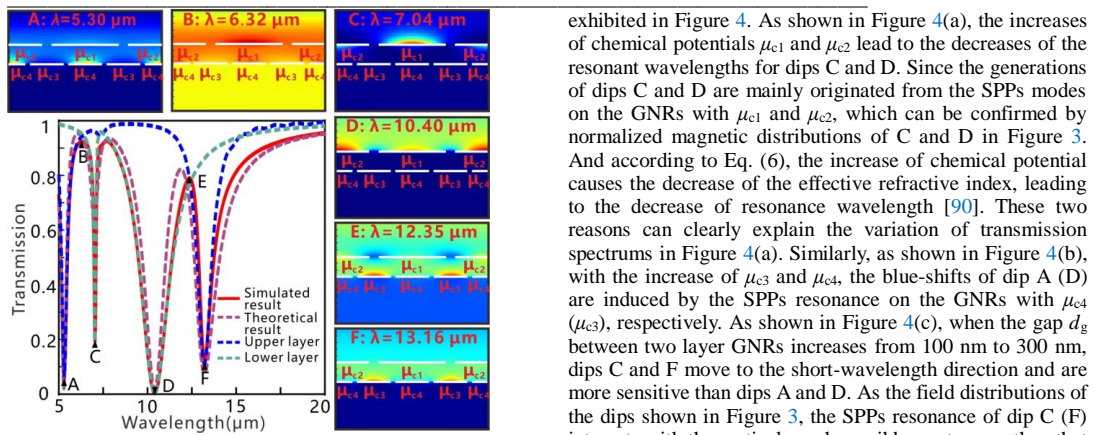
The central claim is that, for a four-parameter device of this kind, random forest is the best available surrogate for FDTD: it predicts the full 200-point transmission spectrum with a similarity score of 96, ahead of the artificial neural network's 95, and in inverse mode it recovers the chemical potentials with a score of 98, again ahead of the network's 97. The same 20,000 training instances are used for both directions, so the inverse-design model costs no additional simulation time. The paper further claims that gradient-free evolutionary optimization can exploit this surrogate to steepen the PIT profile: single-objective genetic, quantum-genetic, and particle-swarm searches converge to a target spectrum, and the multi-objective NSGA-II search, trading off the transmittance differences between peaks and dips, reaches a maximum peak-dip difference of 0.97 for one transparency window and (0.87, 0.83, 0.79, 0.69) for two windows. A fitted transfer-matrix model reproduces the FDTD spectrum with phase parameters $\Phi_1=3.77$, $\Phi_2=0.85$, $\Phi_3=5$, $\Phi_4=0.45$, tying the data-driven optimization to the underlying plasmon resonance mechanism.
Load-bearing premise
The load-bearing premise is that the 20,000 FDTD-generated spectra, whose four chemical potentials were discretized with 0.1 eV precision, are representative enough for the reported prediction and inverse-design scores, and that the FDTD spectra themselves faithfully describe the physical device.
Editorial extensions
If this is right
- Once the surrogate is trained, spectrum prediction for a new parameter set is far faster than a fresh FDTD run, and the same dataset yields the inverse-design model without extra simulation cost.
- For devices with a small number of tunable parameters (fewer than about 15), the paper's comparison implies random forest should be the first surrogate tried, ahead of neural networks.
- The paper explicitly qualifies this: ANNs may remain preferable for structurally complicated devices, so the choice of algorithm should depend on the design space.
- Multi-objective evolutionary search can jointly optimize several competing transmission features, so a single run produces a Pareto set of trade-off designs rather than one hand-tuned compromise.
- The fitted transfer-matrix model provides a fast analytic cross-check of optimized spectra before committing to fabrication.
Reading between the lines
- A natural stress test the paper does not run is to sample the chemical potentials continuously or on a much finer grid and check whether random forest's accuracy advantage over the neural network persists; the reported 0.1 eV grid leaves only a few discrete positions per potential in a sparse slice of the design space.
- The transfer-matrix model could itself serve as a cheap label generator for the training set, replacing FDTD when many more spectra are needed; the paper uses it only as a cross-check, not as the data source.
- If the workflow generalizes, a similar random-forest plus NSGA-II pipeline could be applied to other few-parameter photonic nanostructures whose optical response is a smooth function of geometry and material parameters, such as filters, sensors, or absorbers based on graphene microribbons.
Signed reviews
Editorial analysis
A structured set of objections, weighed in public.
Referee Report
Summary. The paper proposes a double-layer graphene-nanoribbon metamaterial that exhibits plasmon-induced transparency, models it with FDTD and a transfer-matrix method, and then applies classical machine-learning regressors (kNN, decision tree, extremely randomized trees, random forest, and a genetic-algorithm-tuned neural network) to forward spectrum prediction and inverse design. It additionally applies single-objective evolutionary optimizers (GA, QGA, PSO) and the multi-objective NSGA-II to steepen the PIT transmission profile, reporting a maximum peak-to-dip transmission difference of 0.97. The manuscript also contains a broad review of machine-learning-based photonic design.
Significance. If the quantitative claims held, the paper would provide a useful practical comparison of classical ML regressors against ANNs for a small-parameter photonic device, and it would demonstrate that a Pareto-based optimizer can jointly shape multiple transmission features. The physical modeling is thoughtful: the Fabry-Perot resonance condition in Eq. (5) is checked against FDTD absorption contours in Fig. 2(d), and the field-distribution analysis of the PIT dips and peaks in Fig. 3 gives a clear mechanistic picture. The paper is also honest in noting that ANNs are not universally superior for low-dimensional design spaces. However, the central ML and optimization claims are currently undermined by the discrete sampling of the input space, as detailed below, so the significance is conditional on a redesign of the numerical experiments.
major comments (4)
- [Section 3, forward spectrum prediction] The design space is effectively a coarse grid: the four chemical potentials are 'randomly generated from the ranges with the precision of 0.1 eV', so each of μc1, μc2, μc3, μc4 has at most three allowed values and the whole input space contains at most 3^4=81 distinct parameter combinations. The 20,000 training and 2,000 test instances are both drawn from this same grid, meaning the test set contains parameter vectors already present in training. The reported scores (91-98 in Figs. 5(c) and 6(b)) therefore measure the models' ability to recall repeated or near-duplicate spectra rather than to generalize to continuous parameters. Since the paper's central claim is that machine learning can 'equivalently substitute' FDTD for spectrum prediction, the experiments should be rerun with continuously sampled parameters and a test set of unseen combinations, or the claims should be explicitly restricted to the 81-point grid.
- [Section 3, inverse design] The inverse-design experiment has the same discretization problem and it is more severe there: the four output chemical potentials are labels drawn from the same 81-point grid used for training, so recovering the 'ground truth' potentials from a test spectrum is close to a nearest-neighbor lookup among already-seen labels. The near-perfect inverse-design scores in Fig. 6(b) and the visual agreement in Fig. 6(d) do not establish that the method can recover continuous design parameters from an arbitrary target spectrum. Please add inverse-design tests on continuous target parameters, report per-parameter errors, and verify the predicted spectra with FDTD simulations.
- [Section 4, NSGA-II optimization] The headline result that 'the maximum difference between the transmission peaks and dips in the optimized transmission spectrum can reach 0.97' is presented from a single optimization run with no repeated-start statistics, no indication of the spread of the Pareto front, and no independent FDTD verification of the selected optimized structure. Because this number appears in the abstract and conclusion, please provide multiple NSGA-II runs, report the distribution of the achieved objectives, show the Pareto front, and confirm the selected design with FDTD.
- [Section 2, Eq. (10) and Fig. 3] The agreement between the transfer-matrix transmission spectrum and the FDTD spectrum is obtained after fitting the four phase factors Φj to the FDTD data, as stated in the text ('the fitting parameters Φj are fitted as Φ1=3.77, Φ2=0.85, Φ3=5 and Φ4=0.45'). As presented, this agreement is a fit rather than a predictive validation of the theoretical model. To support the claim that the TMM explains the PIT effect, please provide a predictive check, for example by fitting Φj on one parameter set and testing the model on different chemical potentials, or by reporting the sensitivity of the transmission spectrum to the fitted phase factors.
minor comments (5)
- [Section 3, parameter ranges] The sentence listing the ranges repeats '0.6 eV< μc1<0.8 eV' twice; the fourth range should presumably be for μc4.
- [Section 3, score definition] The 'score' used in Figs. 5 and 6 is described only by the statement that the best and worst values are 1 and an arbitrary negative number; since scikit-learn is cited, please state explicitly that this is the coefficient of determination R² and report the variability of the scores (e.g., standard deviation across test spectra or repeated training runs).
- [Section 4, Eq. (11)] The fitness in Eq. (11) is written as a sum over wavelength, but the text does not specify the wavelength discretization or whether the optimized spectra are obtained from FDTD or from a surrogate model; please clarify the evaluation procedure.
- [Section 3, data generation] The sentence 'the labels of training data are continuous variables rather than discrete variables' conflicts with the stated 0.1 eV sampling precision, under which the labels are in fact discrete; please reconcile this statement.
- [General] There are several typographical and grammatical issues, including 'date regression' for 'data regression' and 'metasturctures' for 'metastructures'; a careful language edit would improve readability.
Circularity Check
The theoretical TMM 'agreement' is produced by fitting the four phase factors to the same FDTD spectrum, and the ML test set is drawn from the same at-most-81-point parameter grid as training, so the reported forward and inverse 'predictions' largely measure retrieval of memorized training instances rather than generalization.
-
fitted input called prediction
[Section 2, after Eq. (10), Figure 3 comparison]
"The phase factor Φj=m-φj (m=1, 2, 3, 4…) is a fitting parameter deduced from the FDTD simulation. ... We find that the theoretical transmission spectrum (purple dashed line) agrees with the simulated transmission spectrum (solid red line) when the fitting parameters Φj are fitted as Φ1=3.77, Φ2=0.85, Φ3=5 and Φ4=0.45."
Equation (10) is not an independent prediction: the four Φj are 'deduced from the FDTD simulation' and then tuned until the purple theoretical curve matches the red FDTD curve. The agreement is therefore imposed by the fit rather than derived from first principles. No held-out spectrum or parameter set is used to test the transfer-matrix model. Thus the 'theoretically demonstrated' PIT spectrum is a self-consistent fit to the same data it is claimed to explain.
-
fitted input called prediction
[Section 3, training and test set generation for forward spectrum prediction and inverse design]
"all structure parameters are initialized in different ranges specified by minimum and maximum values 0.6 eV<μc1<0.8 eV, 0.4 eV < μc2< 0.6 eV, 0.05 eV<μc3< 0.25 eV and 0.6 eV< μc1<0.8 eV. It means that the chemical potentials of graphene ribbons are randomly generated from the ranges with the precision of 0.1 eV. ... another 2000 instances are left as the test set to validate the training effect."
With 0.1 eV precision, each μcj has at most three allowed values (0.6/0.7/0.8, 0.4/0.5/0.6, 0.05/0.15/0.25, 0.6/0.7/0.8), so the whole design space is at most 3^4=81 distinct parameter vectors. The 20,000 training and 2,000 test spectra are drawn from this same 81-point grid, so every test input duplicates a training input. kNN can retrieve the identical stored spectrum, and RF can memorize all 81 outputs; the reported scores (91–98) and the RF-over-ANN ranking therefore quantify recall of repeated grid points, not generalization to new parameters. The same duplication applies to inverse design, whose target labels are among the same at-most-81 vectors. Calling this 'equivalent substitution' of FDTD for arbitrary parameters is thus a fitted-input result, not a predictive one.
full rationale
Two concrete reductions keep this from being a clean self-contained benchmark. First, the transfer-matrix 'validation' in Eq. (10) and Figure 3 is made by fitting the four phase factors Φj to the FDTD spectrum, so the agreement is an imposed fit rather than a prediction. Second, and more important for the central claim, the training and test sets share the same at-most-81-point parameter grid because of the stated 0.1 eV precision; test spectra are not new, so the kNN/RF scores and the RF-over-ANN ranking largely measure memorization and retrieval of training rows. The inverse-design labels are likewise confined to the same small set of combinations. Thus parts of the forward and inverse 'prediction' claims reduce by construction to fitting the training grid. I do not see a load-bearing self-citation chain: the authors' earlier papers are used for standard formulas, terminology, or background, and the ML models are benchmarked internally against FDTD, which is an external reference in principle. The NSGA-II 0.97 value is the fitness it maximizes and is not itself circular, though it lacks repeated-run validation. Overall, the central claim is partially circular because the reported predictive scores are constructed from duplicated training inputs, giving a score of 6.
Assumptions & free parameters
free parameters (2)
- Phase factors Φ1..Φ4 =
Φ1=3.77, Φ2=0.85, Φ3=5, Φ4=0.45
- Resonance width multiplier Γrj =
1.1 x Drude scattering width
assumptions (5)
- domain assumption Graphene conductivity follows the Kubo formula with T=300 K and τ=0.5 ps
- domain assumption SPP edge reflection phase is φ=0.27π
- domain assumption 2D FDTD with periodic boundaries is an accurate ground truth
- ad hoc to paper Chemical potentials are sampled with 0.1 eV precision
- domain assumption The scikit-learn score measures useful prediction quality
Cite this review
Pith. "Pith review of Machine learning and evolutionary algorithm studies of graphene metamaterials for optimized plasmon-induced transparency." pith.science (2026). https://pith.science/paper/SPWZKRR4
@misc{pith2026190801354,
  author       = {Pith},
  title        = {Pith review of: Machine learning and evolutionary algorithm studies of graphene metamaterials for optimized plasmon-induced transparency},
  year         = {2026},
  howpublished = {\url{https://pith.science/paper/SPWZKRR4}},
  note         = {Machine review of arXiv:1908.01354}
}
read the original abstract
Machine learning and optimization algorithms have been widely applied in the design and optimization for photonic devices. In this article, we briefly review recent progress of this field of research and show some data-driven applications (e.g. spectrum prediction, inverse design and performance optimization) for novel graphene metamaterials (GMs). The structure of the GMs is well-designed to achieve the wideband plasmon induced transparency effect, which is regarded as optimization object and can be theoretically demonstrated by using transfer matrix method. Some classical machine learning algorithms, including k nearest neighbour, decision tree, random forest and artificial neural networks, are utilized to equivalently substitute the numerical simulation in the forward spectrum prediction and complete the inverse design for the GMs. The calculated results demonstrate that all the algorithms are effective and the random forest has advantages in terms of accuracy and training speed. Moreover, the single-objective and multi-objective optimization algorithms are used to achieve steep transmission characteristics by synthetically taking many performance metrics into consideration. The maximum difference between the transmission peaks and dips in the optimized transmission spectrum can reach 0.97. In comparison to previous works, we provide a guidance for intelligent design of photonic devices and advanced materials based on machine learning and evolutionary algorithms.
Figures


Figures from the paper (1 more)

Reference graph
Works this paper leans on
-
[1]
Inverse design in nanophotonics ,
S. Molesky, and et al., " Inverse design in nanophotonics ," Nature photonics 12, 659-670 (2018)
2018
-
[2]
Silicon photonics circuit design: methods, tools and challenges,
W. Bogaerts, and L. Chrostowski, " Silicon photonics circuit design: methods, tools and challenges," Laser Photonics Rev 12, 170 0237 (2019)
2019
-
[3]
Intelligent nanophotonics: merging photonics and artificial intelligence at the nanoscale ,
K. Yao, R. Unni, and Y. Zheng, " Intelligent nanophotonics: merging photonics and artificial intelligence at the nanoscale ," Nanophotonics 8(3), 339 - 966 (2019)
2019
-
[4]
Superior thermal conductivity of single -layer graphene,
A. A. Balandin, S. Ghosh, W. Bao, I. Calizo, D. Teweldebrhan, F. Miao, et al., "Superior thermal conductivity of single -layer graphene," Nano Lett. 8, 902- 907 (2008)
2008
-
[5]
Response of graphene to femtosecond high -intensity laser irradiation,
A. Roberts, D. Cormode, C. Reynolds, and T. Newhouse -Illige, "Response of graphene to femtosecond high -intensity laser irradiation," Appl. Phys. Lett. 99, 197 (2011)
2011
-
[6]
Coherent nonlinear optical response of graphene,
E. Hendry, P. J. Hale, J. Moger, A. Savchenko, and S. Mikhailov, "Coherent nonlinear optical response of graphene," Phys. Rev. Lett. 105, 097401 (2010)
2010
-
[7]
Graphene photonics, plasmonics, and broadband optoelectronic devices,
Q. Bao and K. P. Loh, "Graphene photonics, plasmonics, and broadband optoelectronic devices," ACS nano 6, 3677-3694 (2012)
2012
-
[8]
Tunable plasmon induced transparency in a metallodielectric grating coupled with graphene metamaterials,
T. Zhang, J. Dai, Y. Dai, Y. Fan, X. Han, J. Li, et al., "Tunable plasmon induced transparency in a metallodielectric grating coupled with graphene metamaterials," J. Lightwave Technol. 35, 5142-5149 (2017)
2017
Show all 99 references
-
[9]
Fine structure constant defines visual transparency of graphene,
R. R. Nair, P. Blake, A. N. Grigorenko, K. S. Novoselov, T. J. Booth, T. Stauber, et al., "Fine structure constant defines visual transparency of graphene," Science 320, 1308-1308 (2008)
2008
-
[10]
The rise of graphene,
A. K. Geim and K. S. Novoselov, "The rise of graphene," Nat. Mater. 6, 183-191 (2007)
2007
-
[11]
A graphene-based broadband optical modulator,
M. Liu, X. Yin, E. Ulin -Avila, B. Geng, T. Zentgraf, L. Ju, et al., "A graphene-based broadband optical modulator," Nature 474, 64-67 (2011)
2011
-
[12]
Photothermoelectric and photoelectric contributions to light detection in metal –graphene–metal photodetectors,
T. J. Echtermeyer, P. Nene, M. Trushin, R. V. Gorbachev, A. L. Eiden, S. Milana, et al., "Photothermoelectric and photoelectric contributions to light detection in metal –graphene–metal photodetectors," Nano Lett. 14, 3733 -3742 (2014)
2014
-
[13]
Graphene-based transparent strain sensor,
S.-H. Bae, Y. Lee, B. K. Sharma, H. -J. Lee, J. -H. Kim, and J. -H. Ahn, "Graphene-based transparent strain sensor," Carbon 51, 236-242 (2013)
2013
-
[14]
An ultra -broadband multilayered graphene absorber,
M. Amin, M. Farhat, and H. Bağcı, "An ultra -broadband multilayered graphene absorber," Opt. Express 21, 29938-29948 (2013)
2013
-
[15]
Dynamically tunable plasmon induced transparency in a graphene -based nanoribbon waveguide coupled with graphene rectangular resonators structure on sapphire substrate,
X. Han, T. Wang, X. Li, S. Xiao, and Y. Zhu, "Dynamically tunable plasmon induced transparency in a graphene -based nanoribbon waveguide coupled with graphene rectangular resonators structure on sapphire substrate," Opt. Express 23, 31945-31955 (2015)
2015
-
[16]
Ultra -compact polarization beam splitter utilizing a graphene -based asymmetrical directional coupler,
T. Zhang, X. Yin, L. Chen, and X. Li, "Ultra -compact polarization beam splitter utilizing a graphene -based asymmetrical directional coupler," Opt. Lett. 41, 356-359 (2016)
2016
-
[17]
Chemically modulated graphene diodes,
H.-Y. Kim, K. Lee, N. McEvoy, C. Yim, and G. S. Duesberg, "Chemically modulated graphene diodes," Nano Lett. 13, 2182-2188 (2013)
2013
-
[18]
Plasmonically induced transparency in double -layered graphene nanoribbons,
S.-X. Xia, X. Zhai, L. -L. Wang, and S. -C. Wen, "Plasmonically induced transparency in double -layered graphene nanoribbons," Photon. Res. 6, 692-702 (2018)
2018
-
[19]
Investigation of multiband plasmonic metamaterial perfect absorber s based on graphene ribbons by the phase-coupled method,
H. Li, C. Ji, Y. Ren, J. Hu, M. Qin, and L. Wang, "Investigation of multiband plasmonic metamaterial perfect absorber s based on graphene ribbons by the phase-coupled method," Carbon 141, 481-487 (2019)
2019
-
[20]
Efficient spectrum prediction and inverse design for plasmonic waveguide systems based on artificial neural networks,
T. Zhang, J. Wang, Q. Liu, J. Zhou, J. Dai, X. Han, et al., "Efficient spectrum prediction and inverse design for plasmonic waveguide systems based on artificial neural networks," Photon. Res. 7, 368-380 (2019)
2019
-
[21]
Deep learning in neural networks: An overview,
J. Schmidhuber, "Deep learning in neural networks: An overview," Neural networks 61, 85-117 (2015)
2015
-
[22]
Recent trends in deep learning based natural lang uage processing,
T. Young, D. Hazarika, S. Poria, and E. Cambria, "Recent trends in deep learning based natural lang uage processing," IEEE Computational intelligenCe magazine 13, 55-75 (2018)
2018
-
[23]
Deep neural networks for acoustic modeling in speech recognition: the shared views of four research gro ups,
G. Hinton, L. Deng, D. Yu, G. E. Dahl, A. Mohamed, N. Jaitly, et al., "Deep neural networks for acoustic modeling in speech recognition: the shared views of four research gro ups," IEEE Signal Processing Magazine 29, 82 -97 (2012)
2012
-
[24]
A review of unsupervised feature learning and deep learning for time -series modeling,
M. Lä ngkvist, L. Karlsson, and A. Loutfi, "A review of unsupervised feature learning and deep learning for time -series modeling," Pattern Recognition Letters 42, 11-24 (2014)
2014
-
[25]
End to end learning for self -driving cars,
M. Bojarski, D. Del Testa, D. Dworakowski, B. Firner, B. Flepp, P. Goyal, et al., "End to end learning for self -driving cars," arXiv preprint arXiv:1604.07316 (2016)
2016 arXiv
-
[26]
Playing atari with deep reinforcement learning,
V. Mnih, K. Kavukcuoglu, D. Silver, A. Graves, I. Antonoglou, D. Wierstra, et al., "Playing atari with deep reinforcement learning," arXiv preprint arXiv:1312.5602 (2013)
2013 arXiv
-
[27]
Deep reinforcement learning for robotic manipulation with asynchronous off -policy updates,
S. Gu, E. Holly, T. Lillicrap, and S. Levine, "Deep reinforcement learning for robotic manipulation with asynchronous off -policy updates," in 2017 IEEE international conference on robotics and automation (ICRA) , (IEEE, 2017), 3389-3396
2017
-
[28]
Nanophotonic particle simulation and inverse design using artificial neural networks,
J. Peurifoy, Y. Shen, L. Jing, Y. Yang, F. Canorenteria, B. Delacy, et al., "Nanophotonic particle simulation and inverse design using artificial neural networks," Sci. Adv. 4, eaar4206 (2018)
2018
-
[29]
Neural network based design of metagratings,
S. Inampudi and H. Mosallaei, "Neural network based design of metagratings," Appl. Phys. Lett. 112, 241102 (2018)
2018
-
[30]
Training artificial neural network for optimization of nanostructured VO 2-based smart window performance,
I. Balin, and et al., "Training artificial neural network for optimization of nanostructured VO 2-based smart window performance, " Opt. Express 27(16), A1030-A1040 (2019)
2019
-
[31]
Designing integrated photonic devices using artificial neural networks,
A.M. Hammond and R.M. Camacho, "Designing integrated photonic devices using artificial neural networks," Opt. Express 27(21), 29620 -29638 (2019)
2019
-
[32]
An open -source artifici al neural network model for polarization -insensitive silicon -on-insulator subwavelength grating couplers,
D. Gostimirovic and N.Y. Winnie, "An open -source artifici al neural network model for polarization -insensitive silicon -on-insulator subwavelength grating couplers," IEEE Journal of Selected Topics in Quantum Electronics 25(23), 8200205 (2019)
2019
-
[33]
Plasmonic nanoparticl e simulations and inverse design using machine learning,
J. He, C. He, C. Zheng, Q. Wang, and J Ye, "Plasmonic nanoparticl e simulations and inverse design using machine learning," Nanoscale 11, 17444 - 17459 (2019)
2019
-
[34]
Deep Neural Network Inverse Design of Integrated Photonic Power Splitters,
M. H. Tahersima, K. Kojima, T. Koike -Akino, D. Jha, B. Wang, C. Lin, et al., "Deep Neural Network Inverse Design of Integrated Photonic Power Splitters," Sci. Rep. 9, 1368 (2019)
2019
-
[35]
A deep learning approach for objective -driven all - dielectric metasurface design,
S. An, and et al., "A deep learning approach for objective -driven all - dielectric metasurface design," ACS Photonics (2019)
2019
-
[36]
Deep learning for accelerated all -dielectric me tasurface design,
C.C. Nadell, B. Huang, J.M. Malof, and W.J. Padilla, "Deep learning for accelerated all -dielectric me tasurface design," Opt. Express 27(20), 25(23), 27523-27535 (2019)
2019
-
[37]
Plasmonic colours predicted by deep learning,
J. Baxter, and et al., "Plasmonic colours predicted by deep learning," Sci. Rep. 9, 8074 (2019)
2019
-
[38]
Optimization of photonic crystal nanocavities based on deep learning,
T. Asano and S. Noda, "Optimization of photonic crystal nanocavities based on deep learning," Opt. Express 26(25), 32704-32717 (2018)
2018
-
[39]
Iterative optimization of photonic crystal nanocavity designs by using deep neural networks,
T. Asano and S. Noda, "Iterative optimization of photonic crystal nanocavity designs by using deep neural networks," Nanophotonics 8(12), 2243–2256 (2019). ______________________________________________________________________________________
2019
-
[40]
Self -learning per fect optical chirality via a deep neural network,
Y. Li and et al., "Self -learning per fect optical chirality via a deep neural network," Phys. Rev. Lett. 123, 213902 (2019)
2019
-
[41]
Deep neural network for plasmonic sensor modeling,
X. Li and et al., "Deep neural network for plasmonic sensor modeling," Optical Materials Express 9(9), 3857-3862 (2019)
2019
-
[42]
Smart inverse de sign of graphene -based photonic metamaterials by an adaptive artificial neural network,
Y. Chen and et al., "Smart inverse de sign of graphene -based photonic metamaterials by an adaptive artificial neural network," Nanoscale 11, 9749 - 9755 (2019)
2019
-
[43]
Deep -learning-enabled on-demand design of chiral metamaterials,
W. Ma, F. Cheng, and Y. Liu, "Deep -learning-enabled on-demand design of chiral metamaterials," ACS nano 12, 6326-6334 (2018)
2018
-
[44]
A bidirectional deep neural network for accurate silicon color design,
L. Gao, X. Li, D. Liu, L. Wang, and Z Yu, "A bidirectional deep neural network for accurate silicon color design," Advanced Materials (2019)
2019
-
[45]
Training deep neural networks for the inverse design of nanophotonic structures,
D. Liu, Y. Tan, E. Khoram, and Z. Yu, "Training deep neural networks for the inverse design of nanophotonic structures," ACS Photonics 5, 1365 -1369 (2018)
2018
-
[46]
Migrating knowledge between physical scenarios based on artificial neural networks,
Y. Qu, L. Jing, Y. Shen, M. Qiu, and M. Soljacic, "Migrating knowledge between physical scenarios based on artificial neural networks," ACS Photonics 6(5), 1168-1174 (2019)
2019
-
[47]
Generative model for the inverse design of metasurfaces,
Z. Liu, D. Zhu, S. P. Ro drigues, K.-T. Lee, and W. Cai, "Generative model for the inverse design of metasurfaces," Nano Lett. 18, 6570-6576 (2018)
2018
-
[48]
Simulator -based training of generative neural networks for the inverse design of metasurfaces,
J. Jiang, and J.A. Fan, "Simulator -based training of generative neural networks for the inverse design of metasurfaces," Nanosc ale (2019)
2019
-
[49]
Probabilistic representation and inverse design of metamaterials based on a deep generative model with semi-supervised learning strategy,
W. Ma, F. Cheng, Y. Xu, Q. Wen, and Y. Liu, "Probabilistic representation and inverse design of metamaterials based on a deep generative model with semi-supervised learning strategy," arXiv:1901.10819 (2019)
2019 arXiv
-
[50]
Free -form diffractive metagrating design based on generative adversarial networks,
J. Jiang, D. Sell, S. Hoy er, J. Hickey, J. Yang, J.A. Fan, "Free -form diffractive metagrating design based on generative adversarial networks," ACS Nano 13(8), 8872-8878 (2019)
2019
-
[51]
The inverse design of structural color using machine learning,
Z. Huang, X. Liu, and J Zang, "The inverse design of structural color using machine learning," Nanoscale 11, 21748-21758 (2018)
2018
-
[52]
Optimisation of colour generation from dielectric nanostructures using reinforcement learning,
I. Sajedian, T. Badloe, J. Rho, "Optimisation of colour generation from dielectric nanostructures using reinforcement learning," Opt. Express 27(4), 5874-5883 (2019)
2019
-
[53]
Finding the op tical properties of plasmonic structures by image processing using a combination of convolutional neural networks and recurrent neural networks,
I. Sajedian, T. Badloe, J. Rho, "Finding the op tical properties of plasmonic structures by image processing using a combination of convolutional neural networks and recurrent neural networks," Microsystems & Nanoengineering 5(1), 27 (2019)
2019
-
[54]
Double -deep Q -learning t o increase the efficiency of metasurface holograms,
I. Sajedian, T. Badloe, J. Rho, "Double -deep Q -learning t o increase the efficiency of metasurface holograms," Sci. Rep. 9(1), 1-8 (2019)
2019
-
[55]
Ultra-compact photonic structure design for strong light confinement and coupling into nano-waveguide,
M. Turduev, E. Bor, C. Latifoglu, I. H. Giden, Y. S. Hanay, and H. Kurt, "Ultra-compact photonic structure design for strong light confinement and coupling into nano-waveguide," J. Lightwave Technol. 36, 2812-2819 (2018)
2018
-
[56]
Towards an integrated evolutionary strategy and artificial neural network computational tool for designing photon ic coupler devices,
A. da Silva Ferreira, C. H. da Silva Santos, M. S. Gonç alves, and H. E. H. Figueroa, "Towards an integrated evolutionary strategy and artificial neural network computational tool for designing photon ic coupler devices," Appl. Soft Comput. 65, 1-11 (2018)
2018
-
[57]
Photonics inverse design: pairing deep neural networks with evolutionary algorithms,
R.S. Hegde, "Photonics inverse design: pairing deep neural networks with evolutionary algorithms," IEEE Journal of Selected Topics in Quantum Electronics 26(1), 7700908 (2020)
2020
-
[58]
Ultranarrow-band wavelength -selective thermal emission with aperiodic multilayered metamaterials designed by Bayesian optimization,
A. Sakurai, K. Yada, T. Simomura, S. Ju, M. Kashiwagi, H. Okada, et al., "Ultranarrow-band wavelength -selective thermal emission with aperiodic multilayered metamaterials designed by Bayesian optimization," ACS central science 5, 319-326 (2019)
2019
-
[59]
Mapping the global design space of nanophotonic components using machine learning pattern recognition,
D. Melati, and et al., "Mapping the global design space of nanophotonic components using machine learning pattern recognition," Nature Communication 10, 4775 (2019)
2019
-
[60]
K. Were, D. T. Bui, Ø. B. Dick, and B. R. Singh, "A comparative assessment of support vector regressio n, artificial neural networks, and random forests for predicting and mapping soil organic carbon stocks across an Afromontane landscape," Ecological Indicators 52, 394-403 (2015)
2015
-
[61]
A review on applications of ANN and SVM for building electrical energy consumption forecasting,
A. Ahmad, M. Hassan, M. Abdullah, H. Rahman, F. Hussin, H. Abdullah, et al., "A review on applications of ANN and SVM for building electrical energy consumption forecasting," Renewable and Sustainable Energy Reviews 33, 102- 109 (2014)
2014
-
[62]
Cavity-enhanced seco nd-harmonic generation via nonlinear -overlap optimization,
Z. Lin, X. Liang, M. Lončar, S. G. Johnson, and A. W. Rodriguez, "Cavity-enhanced seco nd-harmonic generation via nonlinear -overlap optimization," Optica 3, 233-238 (2016)
2016
-
[63]
Adjoint method and inverse design for nonlinear nanophotonic devices,
T. W. Hughes, M. Minkov, I. A. Williamson, and S. Fan, "Adjoint method and inverse design for nonlinear nanophotonic devices," ACS Photonics 5, 4781-4787 (2018)
2018
-
[64]
Training of photonic neural networks through in situ backpropagation and gradient measurement,
T. W. Hughes, M. Minkov, Y. Shi, and S. Fan, "Training of photonic neural networks through in situ backpropagation and gradient measurement," Optica 5(7), 864-871 (2018)
2018
-
[65]
Inverse design and demonstration of a compact and b roadband on -chip wavelength demultiplexer,
A.Y. Piggott, and et al., "Inverse design and demonstration of a compact and b roadband on -chip wavelength demultiplexer," Nat. Photonics 9, 374 -377 (2015)
2015
-
[66]
Inverse -designed metastructures that solve equations,
N.N. Estakhri, and et al., "Inverse -designed metastructures that solve equations," Science 363, 1333-1338 (2019)
2019
-
[67]
An integra ted- nanophotonics polarization beamsplitter with 2.4 × 2.4 μm 2 footprint,
B. Shen, P. Wang, R. Polson, and R. Menon, "An integra ted- nanophotonics polarization beamsplitter with 2.4 × 2.4 μm 2 footprint," Nat. Photonics 9, 378-382 (2015)
2015
-
[68]
Genetic -algorithm-optimized wideband on - chip polarization rotator with an ultrasmall footprint,
H. Cui, X. Sun, and Z. Yu, "Genetic -algorithm-optimized wideband on - chip polarization rotator with an ultrasmall footprint," Opt. Lett. 42, 3093 (2017)
2017
-
[69]
Binary particle swarm optimized 2× 2 power splitters in a standard foundry silicon photonic platform,
J. C. Mak, C. Sideris, J. Jeong, A. Hajimiri, and J. K. Poon, "Binary particle swarm optimized 2× 2 power splitters in a standard foundry silicon photonic platform," Opt. Lett. 41, 3868 (2016)
2016
-
[70]
Efficient training and design of photonic neural network through neuroevolution,
T. Zhang, J. Wang, Y. Dan, Y. Lanqiu, J. D ai, X. Han and K. Xu, " Efficient training and design of photonic neural network through neuroevolution," Opt. Express 27(26), 37150-37163 (2019)
2019
-
[71]
Complex Inverse Design of Meta -optics by Segmented Hierarchical Evolutionary Algori thm,
Z. Jin, and et al., "Complex Inverse Design of Meta -optics by Segmented Hierarchical Evolutionary Algori thm," ACS Nano 13(1), 821-829 (2019)
2019
-
[72]
Stochastic collocation for device -level variability analysis in integrated photonics,
Y. Xing, D. Spina, A. Li, T. Dhaene, and W. Bogaerts, "Stochastic collocation for device -level variability analysis in integrated photonics," Photon. Res. 4, 93-100 (2016)
2016
-
[73]
Nano -optics of surface plasmon polaritons,
A. V. Zayats, I. I. Smolyaninov, an d A. A. Maradudin, "Nano -optics of surface plasmon polaritons," Phys. Rep. 408, 131-314 (2005)
2005
-
[74]
Plasmonics in graphene at infrared frequencies,
M. Jablan, H. Buljan, and M. Soljačić, "Plasmonics in graphene at infrared frequencies," Phys. Rev. B 80, 245435 (2009)
2009
-
[75]
Graphene -based tunable broadband hyperlens for far -field subdiffraction imaging at mid -infrared frequencies,
T. Zhang, L. Chen, and X. Li, "Graphene -based tunable broadband hyperlens for far -field subdiffraction imaging at mid -infrared frequencies," Opt. Express 21, 20888-20899 (2013)
2013
-
[76]
Transformation optics using graphene,
A. Vakil and N. Engheta, "Transformation optics using graphene," Science 332, 1291-1294 (2011)
2011
-
[77]
Graphene plasmonics for tunable t erahertz metamaterials,
L. Ju, B. Geng, J. Horng, C. Girit, M. Martin, Z. Hao, et al., "Graphene plasmonics for tunable t erahertz metamaterials," Nat. Nanotechnol. 6, 630 -634 (2011)
2011
-
[78]
Graphene -based tunable hyperbolic metamaterials and enhanced near -field absorption,
M. A. Othman, C. Guclu, and F. Capolino, "Graphene -based tunable hyperbolic metamaterials and enhanced near -field absorption," Opt. Express 21, 7614-7632 (2013)
2013
-
[79]
Active modulation of electromagnetically induced transparency analogue in terahertz hybrid metal - graphene metamaterials,
S. Xiao, T. Wang, T. L iu, X. Yan, Z. Li, and C. Xu, "Active modulation of electromagnetically induced transparency analogue in terahertz hybrid metal - graphene metamaterials," Carbon 126, 271-278 (2018)
2018
-
[80]
A perfect absorber made of a graphene micro -ribbon metamaterial,
R. Alaee, M. Farhat, C. Rockstuhl, and F. Lederer, "A perfect absorber made of a graphene micro -ribbon metamaterial," Opt. Express 20, 28017-28024 (2012)
2012
-
[81]
Mid -infrared plasmonic biosensing with graphene,
D. Rodrigo, O. Limaj, D. Janner, D. Etezadi, F. J. G. de Abajo, V. Pruneri, et al., "Mid -infrared plasmonic biosensing with graphene," Science 349, 165 - 168 (2015)
2015
-
[82]
Tunable broadband plasmonic field enhancement on a graphene surface using a normal -incidence plane wave at mid-infrared frequencies,
T. Zhang, L. Chen, B. Wang, and X. Li, "Tunable broadband plasmonic field enhancement on a graphene surface using a normal -incidence plane wave at mid-infrared frequencies," Sci. Rep. 5, 11195 (2015)
2015
-
[83]
Investigation of the graphene based planar plasmonic filters,
H. Li, L. Wang, J. Liu, Z. Huang, B. Sun, and X . Zhai, "Investigation of the graphene based planar plasmonic filters," Appl. Phys. Lett. 103, 211104 (2013)
2013
-
[84]
Edge and waveguide terahertz surface plasmon modes in graphene microribb ons,
A. Y. Nikitin, F. Guinea, F. J. Garcí a-Vidal, and L. Martí n-Moreno, "Edge and waveguide terahertz surface plasmon modes in graphene microribb ons," Phys. Rev. B 84, 161407 (2011)
2011
-
[85]
Plasmon induced absorption in a graphene -based nanoribbon waveguide system and its applications in logic gate and sensor,
T. Zhang, J. Zhou, J. Dai, Y. Dai, X. Han, J. Li, et al., "Plasmon induced absorption in a graphene -based nanoribbon waveguide system and its applications in logic gate and sensor," J. Phys. D: Appl. Phys. 51, 055103 (2018)
2018
-
[86]
Phase - coupled plasmon-induced transparency,
R. D. Kekatpure, E. S. Barnard, W. Cai, and M. L. Brongersma, "Phase - coupled plasmon-induced transparency," Phys. Rev. Lett. 104, 243902 (2010)
2010
-
[87]
Inverse design and demonstration of a compact and broadband on - chip wavelength demultiplexer,
A. Y. Piggott, J. Lu, K. G. Lagoudakis, J. Petykiewicz, T. M. Babinec, and J. Vučković, "Inverse design and demonstration of a compact and broadband on - chip wavelength demultiplexer," Nat. Photonics 9, 374-377 (2015)
2015
-
[88]
Topology optimized mode multiplexing in silicon -on-insulator photonic wire waveguides,
L. F. Frellsen, Y. Ding, O. Sigmund, and L. H. Frandsen, "Topology optimized mode multiplexing in silicon -on-insulator photonic wire waveguides," Opt. Express 24, 16866-16873 (2016)
2016
-
[89]
Edge -reflection phase directed plasmonic resonances on graphene nano-structures,
L. Du, D. Tang, and X. Yuan, "Edge -reflection phase directed plasmonic resonances on graphene nano-structures," Opt. Express 22, 22689-22698 (2014)
2014
-
[90]
High -contrast electro -optic modulation of spatial light induced by graphene -integrated Fabry -Pé rot microcavity,
C. Zeng, J. Guo, and X. Liu, "High -contrast electro -optic modulation of spatial light induced by graphene -integrated Fabry -Pé rot microcavity," Appl. Phys. Lett. 105, 121103 (2014)
2014
-
[91]
Methods based on k -nearest neighbor regression in the prediction of basal area diameter distribution,
M. Maltamo a nd A. Kangas, "Methods based on k -nearest neighbor regression in the prediction of basal area diameter distribution," Canadian Journal of Forest Research 28, 1107-1115 (1998)
1998
-
[92]
A novel decision tree regression -based fault distance estimation scheme for transmission lines,
A. Swetapadma and A. Yadav, "A novel decision tree regression -based fault distance estimation scheme for transmission lines," IEEE Transactions on Power Delivery 32, 234-245 (2016)
2016
-
[93]
Classification and regression by randomForest,
A. Liaw and M. Wiener, "Classification and regression by randomForest," R news 2, 18-22 (2002)
2002
-
[94]
Extr emely randomized trees,
P. Geurts, D. Ernst, and L. Wehenkel, "Extr emely randomized trees," Machine learning 63, 3-42 (2006)
2006
-
[95]
C. M. Bishop, Pattern recognition and machine learning (springer, 2006). ______________________________________________________________________________________
2006
-
[96]
Scikit -learn: Machine learning in Python,
F. Pedregosa, G. Varoquaux, A. Gramfort, V. Michel, B. Thirion, O. Grisel, et al., "Scikit -learn: Machine learning in Python," J. Mach. Learn. Res. 12, 2825-2830 (2011)
2011
-
[97]
The MATLAB genetic algorithm toolbox,
A. Chipperfield and P. Fleming, "The MATLAB genetic algorithm toolbox," From IEE Colloquium on Applied Control Techniques Using MATLAB Digest No. 1995/014 (1995)
1995
-
[98]
G enetic quantum algorithm and its application to combinatorial optimization problem,
K.-H. Han and J. -H. Kim, "G enetic quantum algorithm and its application to combinatorial optimization problem," in Proceedings of the 2000 Congress on Evolutionary Computation. CEC00 (Cat. No. 00TH8512), (IEEE, 2000), 1354 - 1360
2000
-
[99]
A fast and elitist multiobjective genetic algorithm: NSGA -II,
K. Deb, A. Pratap, S. Agarwal, and T. Meyarivan, "A fast and elitist multiobjective genetic algorithm: NSGA -II," IEEE transactions on evolutionary computation 6, 182-197 (2002)
2002
Reviewed August 14, 2026 · model on record in the stance chip above.
Discussion (0). Continue with ORCID to comment.