REVIEW 2 major objections 4 minor 30 references
FIRTEZ-dz: A Forward and Inverse solver of the polarized Radiative Transfer Equation under Zeeman regime in geometrical scale
T0 review · 2 major / 4 minor · reviewed 2026-08-14 · deepseek-v4-flash
Pith's one-line read FIRTEZ-dz is the first code to solve the polarized radiative transfer equation in both forward and inverse modes directly in geometrical height, with analytic response functions, and it shows that height-scale inferences are only as…
desk verdict A plausible first in z-space polarized RTE inversion with analytic response functions, a clean degeneracy analysis, and public code—but the printed Saha factor has a wrong temperature exponent and the Jacobian is never checked against finite differences; deserves review after fixes. read the letter →
The pith
A machine-rendered reading of the paper's core claim, the machinery that carries it, and where it could break.
The reading
What carries the argument
The load-bearing object is the slab-wise Stokes evolution operator in geometrical scale: the atmosphere is divided into $N$ slabs of constant properties, the formal solution of the polarized transfer equation is written as a concatenation of analytic evolution operators, and the response functions are obtained by differentiating that concatenation with respect to the physical parameter of each slab. For the thermodynamic parameters this differentiation requires the derivatives of the electron density with respect to $T$, $P_g$, and $\rho$, which the paper derives analytically from Saha ionization with at most three ionization stages per element and an ideal-gas equation of state. The inverse solver uses these analytical response functions as the Jacobian of a Levenberg-Marquardt optimizer, regularized through singular-value decomposition, with a sequential cycle that increases the number of perturbed slabs from a constant shift up to all 256 height levels.
What would settle it
Take a realistic penumbral atmosphere, perturb a single slab's temperature by a small amount, and compare the analytic response function from Eq. (6) with a finite-difference derivative obtained by re-running the forward solver on the perturbed atmosphere; a mismatch above numerical noise at the SVD threshold of $10^{-4}$ times the largest eigenvalue would show that the thermodynamic derivatives in Appendices A-C are the weak link.
Extended reading notes
Core claim
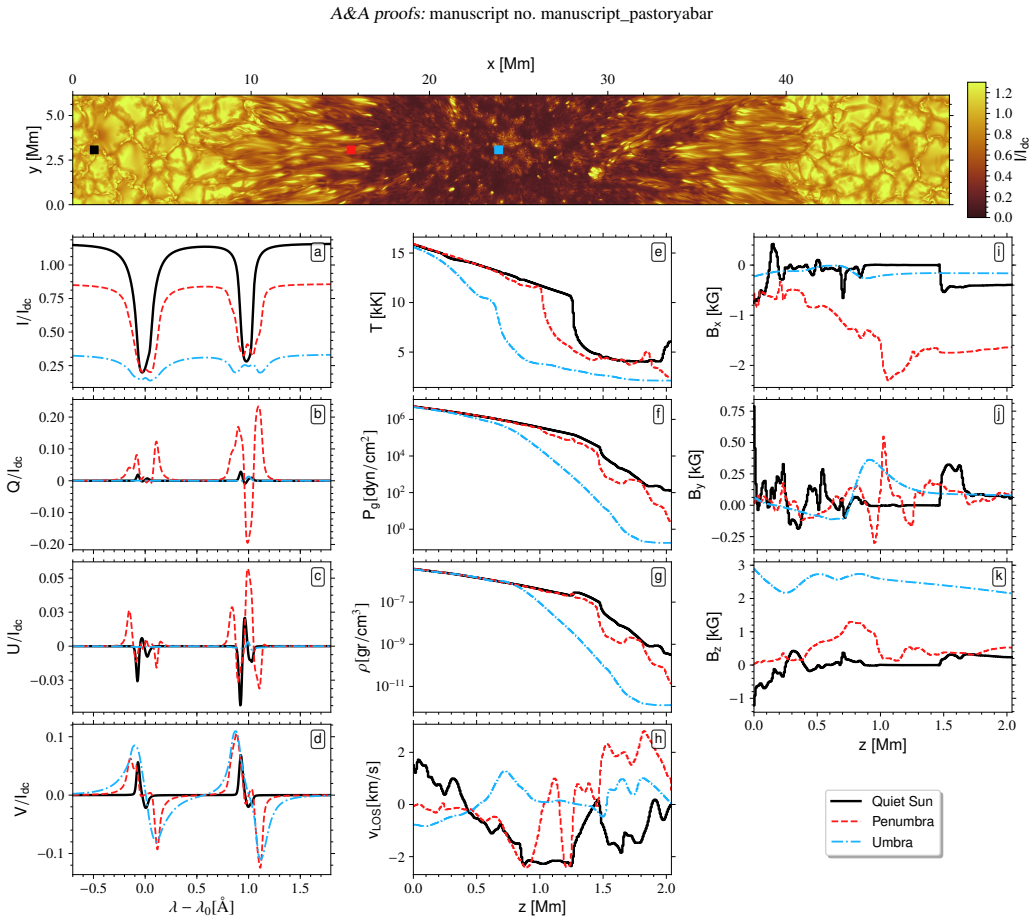
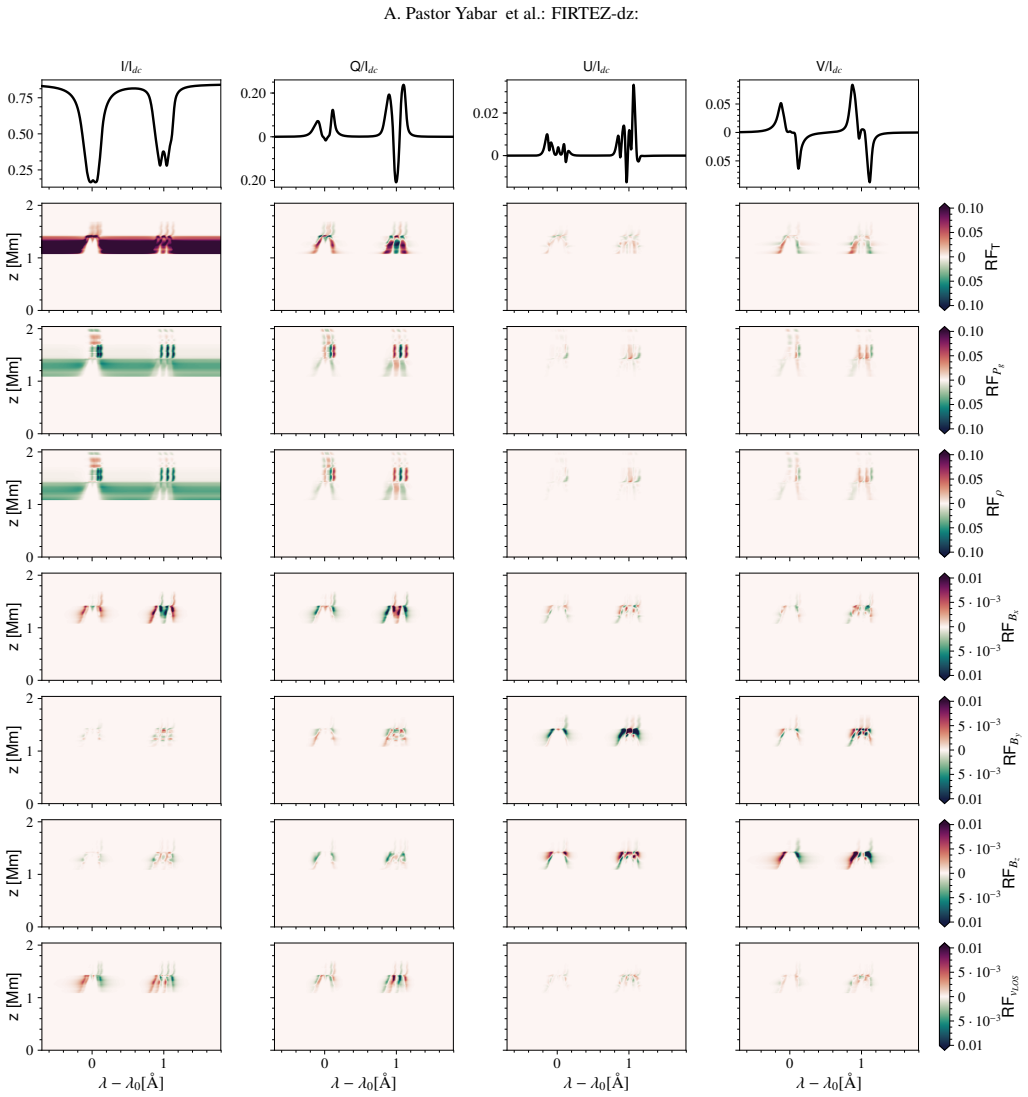
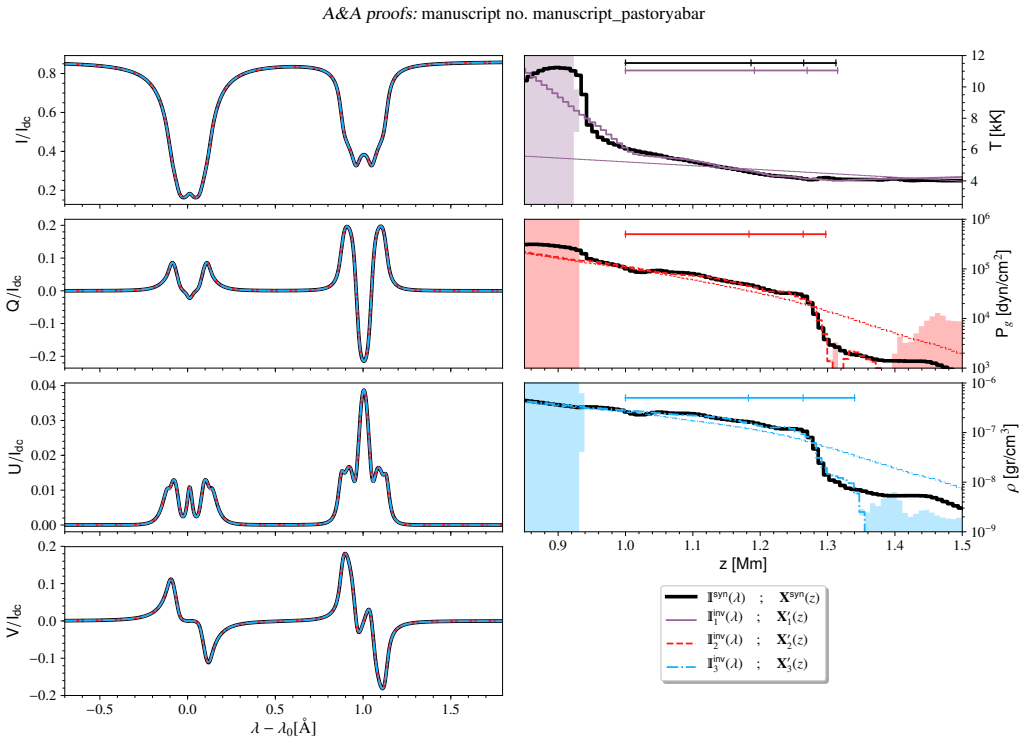
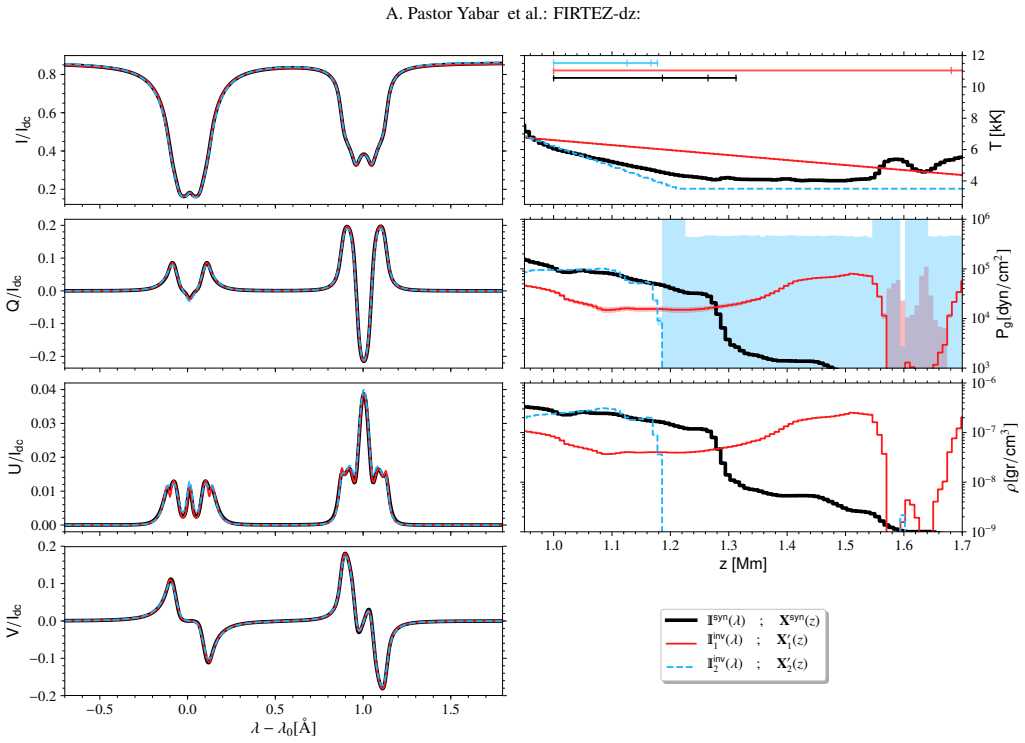
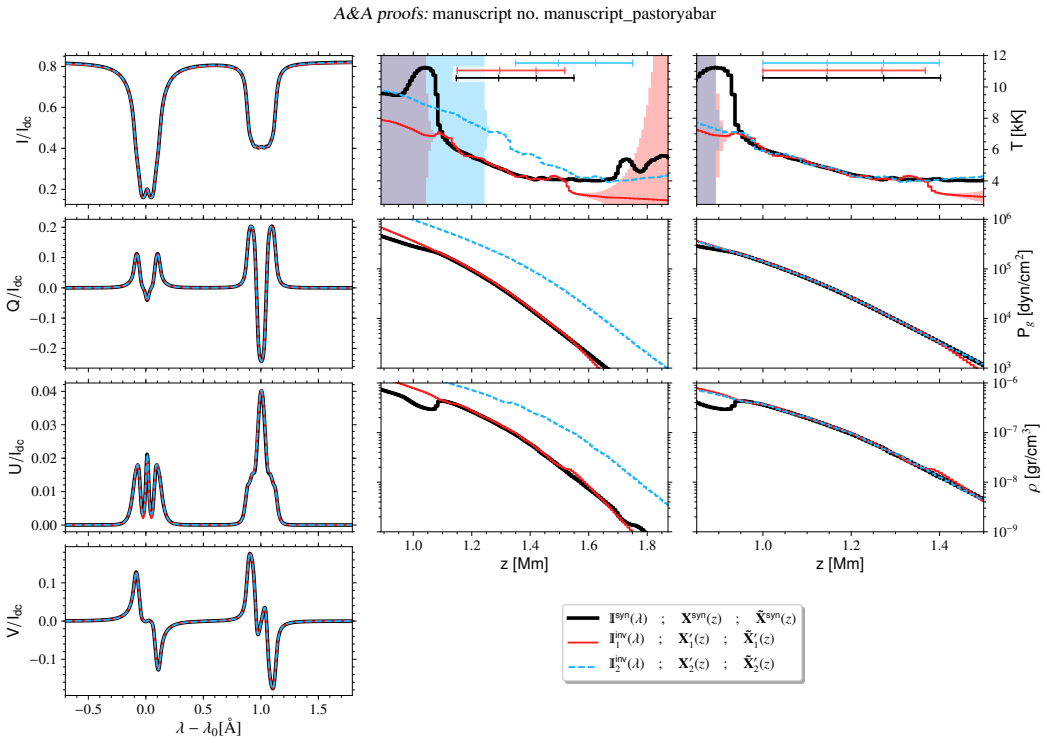
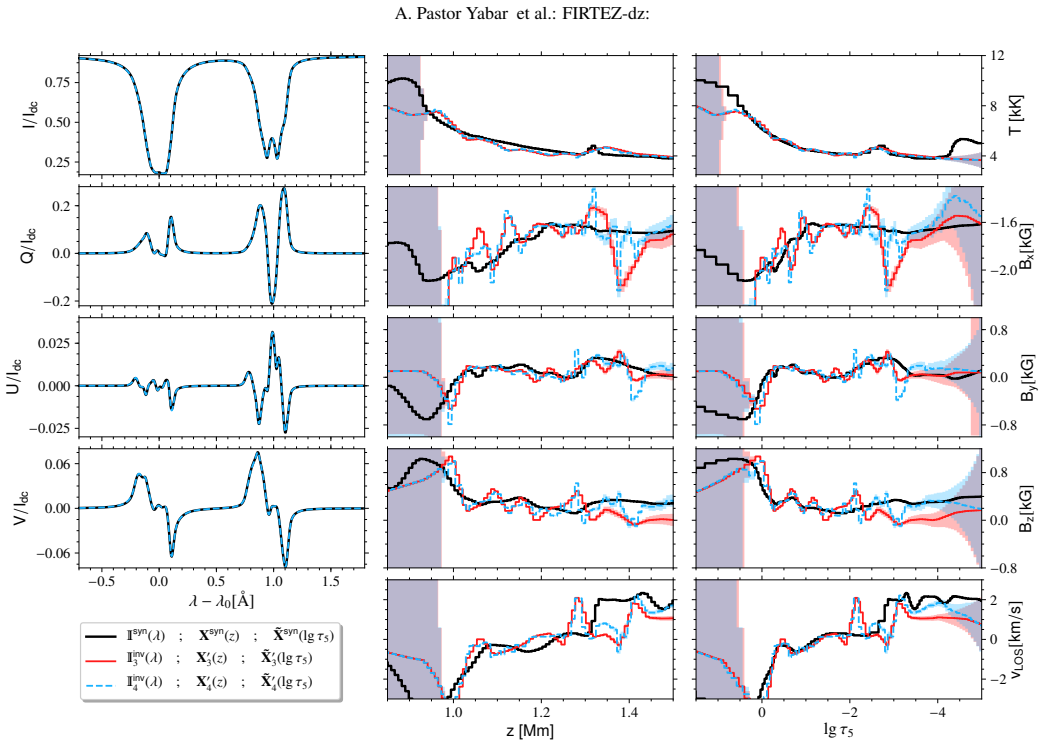
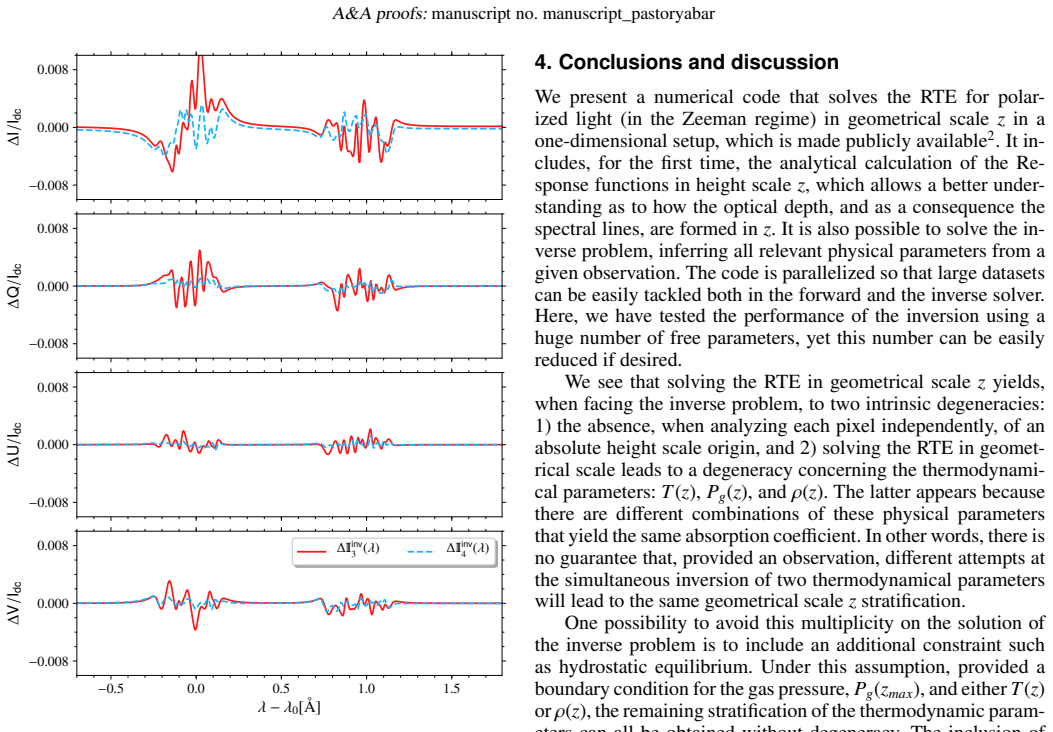
The paper's central claim is that solving the polarized radiative transfer equation in geometrical height $z$ rather than optical depth $\tau$ is not only feasible but yields analytic response functions, and that this changes what can be inferred. The code computes the derivatives of the Stokes vector with respect to $T$, $P_g$, $\rho$, $B_x$, $B_y$, $B_z$, and $v_{\rm LOS}$ at each height slab analytically, by differentiating the slab-wise formal solution; the thermodynamic derivatives require the electron-density derivatives derived in Appendices A-C under Saha equilibrium and an ideal-gas equation of state. Tested on a penumbral pixel from a sunspot MHD simulation, the inverse solver recovers temperature, magnetic field, and velocity stratifications reliably in optical depth, but in height these stratifications are distorted whenever the assumed gas pressure and density are wrong. The paper also shows two intrinsic degeneracies of height-scale inversion: shifting the entire atmosphere vertically leaves spectra unchanged, and different combinations of $T$, $P_g$, and $\rho$ can produce the same absorption coefficient. Adding hydrostatic equilibrium removes the second degeneracy up to a vertical shift, but applying that assumption to MHD-simulated data biases the height scale while leaving the optical-depth inference accurate.
Load-bearing premise
The inversion's height-scale credibility rests on analytic derivatives of the electron density with respect to $T$, $P_g$, and $\rho$, derived under an ideal-gas equation of state and Saha ionization with at most three ionization stages per element; if those derivatives are wrong, the Jacobian is biased and the code's synthetic tests would not reveal it because the same forward model generates the data being fitted.
Editorial extensions
If this is right
- Inversions in geometrical scale inherit two unavoidable degeneracies: a vertical shift of the whole atmosphere produces identical Stokes spectra, and distinct thermodynamic triples $(T, P_g, \rho)$ can yield the same absorption coefficients.
- If the gas pressure and density used are not accurate, the height-scale stratifications of temperature, magnetic field, and velocity are inaccurate even when their optical-depth stratifications are perfectly recovered.
- Enforcing hydrostatic equilibrium removes the thermodynamic degeneracy but leaves the vertical-origin degeneracy, so height maps remain ambiguous by an overall shift unless additional forces, such as magnetic pressure and tension, are included.
- Solving in $z$ makes spatial derivatives such as $\nabla\times\mathbf{B}$ and the Lorentz force directly computable from the inverted atmosphere, which is the paper's stated route toward self-consistent three-dimensional inversions.
Reading between the lines
- A finite-difference check of the analytic response functions against numerical perturbations would isolate whether the electron-density derivatives are the limiting ingredient; the paper's synthetic tests cannot do this because the forward and inverse modules share the same derivatives.
- The paper's thermodynamic degeneracy suggests a test it does not run: fitting spectra with two line pairs formed at very different heights, or with multi-wavelength continuum, should shrink the family of equivalent $(T, P_g, \rho)$ stratifications.
- Because the Jacobian is computed analytically, coupling this solver to an update of gas pressure and density from the three-dimensional momentum equation looks computationally cheap; in that mode the missing absolute height origin would come from the force balance itself.
Signed reviews
Editorial analysis
A structured set of objections, weighed in public.
Referee Report
Summary. This manuscript presents FIRTEZ-dz, a parallelized one-dimensional code that solves the forward and inverse polarized radiative transfer equation in the Zeeman regime on a geometrical height grid. The forward solver uses a slab-wise formal solution with constant-property slabs, LTE source functions, an ideal-gas equation of state with variable molecular weight, a reduced NICOLE opacity package, and Zeeman line opacities. The inverse solver uses a Levenberg-Marquardt algorithm with analytically computed response functions (Eq. 6) and SVD regularization, together with a sequential cycle schedule that progressively increases the number of free parameters. The forward module is demonstrated on a Rempel (2012) sunspot MHD snapshot, and the inverse module is tested on noise-free synthetic Stokes profiles generated by the same forward model. The paper identifies two intrinsic degeneracies of the geometrical-scale formulation (a height-origin shift and a thermodynamic-parameter degeneracy) and shows that under hydrostatic equilibrium the thermodynamic stratification is recovered only up to a height shift. A final test on an MHD pixel shows accurate recovery in optical depth but systematic distortions in geometrical height when hydrostatic equilibrium is assumed, supporting the abstract claim that the reliability of the height-scale output depends on the accuracy of the gas-pressure and density inputs.
Significance. If the analytic response functions are correct, FIRTEZ-dz is a valuable new tool: it is the first publicly released code that computes analytic response functions and performs inversion directly in geometrical height, which is a necessary step toward incorporating Lorentz-force and solenoidality constraints into inversions. The paper's main physical finding—the two intrinsic degeneracies and the dependence of the inferred z-stratification on the accuracy of Pg and rho—is clearly demonstrated and is a property of the radiative transfer equations rather than of the specific fitting algorithm. The code is released on GitHub, which enables independent verification and application to large DKIST/EST datasets, and the parallelization is well matched to the intended per-pixel use. The main caveat is that the numerical tests are all self-consistent, with synthetic data generated by the same forward module, so the correctness of the analytic derivatives is not independently established; the printed thermodynamic-derivative formulas also contain a sign error that must be resolved.
major comments (2)
- [Appendix A, Eq. (A.5); Appendices B and C] Equation (A.5) defines alpha_{i,j} with a factor c1 T^{+3/2}, whereas the Saha-Boltzmann population ratio n_j/(n_e n_{j+1}) requires c1 T^{-3/2} with c1 = h^3/(2 pi m_e k_B)^{3/2}. Since Eqs. (A.11), (B.6), and (C.2), and through them the thermodynamic response functions in Eq. (6), all build on this definition, the printed formulas describe a Jacobian with the wrong temperature dependence unless the implementation uses the corrected exponent. The paper provides no finite-difference check of the response functions, so an implementation error of this kind would not be exposed by the synthetic inversions. Please correct the formula, re-derive the dependent expressions, and add a finite-difference validation against the forward code. Note also that the second term of Eq. (B.5) is printed as (partial n_e/partial T)_rho but should be (partial n_e/partial P_g)_T.
- [Section 3.2, Figs. 3-6] All inversion tests use noise-free synthetic profiles generated by the same forward module whose analytic response functions are being tested. This closed loop cannot reveal a biased Jacobian caused by an error in the thermodynamic derivatives, because both the synthetic data and the inversion share the same forward code. The authors should validate the response functions against high-accuracy finite-difference derivatives of their own forward code and, ideally, invert profiles synthesized by an independent code (e.g., SIR, NICOLE, or STIC) for a common model atmosphere, to establish that the recovery of T, Bx, By, Bz, and vLOS in optical depth is not an artifact of self-consistency.
minor comments (4)
- [Section 2.2.1] The word 'folloing' in the sentence introducing the derivatives of the Stokes evolution operator should be 'following'.
- [Section 3.1] In the paragraph discussing Fig. 2, the text 'unlike the response function to Bx, Bx, Bx' repeats 'Bx' three times; the intended quantity is likely Bx, By, or Bz.
- [Appendix A] The section title states 'Derivative of the number of electron density with respect to temperature at constant gas density', but the first sentence says 'at constant gas pressure'; both should refer to the same variable (rho).
- [Section 4] The GitHub repository link would be more reproducible if a specific version or commit identifier, and ideally a DOI, were provided for the code version used in the tests.
Circularity Check
No circularity: the code's forward and inverse derivations are self-contained, and the central degeneracy result is an analytic property of the RTE rather than a fitted prediction.
full rationale
The paper's load-bearing derivations are self-contained: the analytic response functions in Eq. (6) are obtained by direct differentiation of the slab-wise formal solution in Eq. (4), and the thermodynamic derivatives in Appendices A-C are solved analytically from the Saha equation and the ideal-gas equation of state. No parameter is fitted and then renamed as a prediction, and no uniqueness claim is imported from the authors' prior work. The inversion tests use synthetic spectra generated by the same forward model, which is a closed-loop validation rather than a circular derivation; the central degeneracy result (height-scale reliability depends on Pg/rho) is an analytic property of the RTE in geometrical scale and is also tested against a Rempel (2012) MHD snapshot, so it does not reduce to a fit. Self-citations to Ruiz Cobo & del Toro Iniesta (1992) and Puschmann et al. (2010) are methodological background and are not load-bearing for the paper's central novelty claim. The apparent T^{3/2} in Eq. (A.5) and the typo in Eq. (B.5) are correctness or typographical concerns, not circularity. Overall, the derivation chain does not exhibit any step where a result is equivalent to its inputs by construction.
Assumptions & free parameters
free parameters (3)
- SVD eigenvalue threshold =
10^-4 of the largest eigenvalue
- Response function normalization constants =
Tbar=6000 K, Pgbar=1e5 dyn/cm2, rhobar=3e-7 g/cm3, Bbar=1000 G, vbar=1e5 cm/s
- Sequential cycle schedule =
1, 8, 64, 256 perturbations per physical parameter
assumptions (7)
- domain assumption LTE holds, so the source function is the Planck function.
- domain assumption Plane-parallel atmosphere and complete redistribution approximation.
- domain assumption Zeeman effect is the only magnetic polarization mechanism.
- domain assumption Ideal gas EOS with variable molecular weight, including free electrons.
- standard math Analytic Stokes-evolution operator from Landi Degl'Innocenti and Landi Degl'Innocenti (1985, Eq. 10).
- domain assumption Saha ionization equilibrium with at most three ionization stages per element.
- domain assumption Reduced NICOLE opacity package is adequate for continuum opacity.
Cite this review
Pith. "Pith review of FIRTEZ-dz: A Forward and Inverse solver of the polarized Radiative Transfer Equation under Zeeman regime in geometrical scale." pith.science (2026). https://pith.science/paper/SQDZ2AKE
@misc{pith2026190808075,
  author       = {Pith},
  title        = {Pith review of: FIRTEZ-dz: A Forward and Inverse solver of the polarized Radiative Transfer Equation under Zeeman regime in geometrical scale},
  year         = {2026},
  howpublished = {\url{https://pith.science/paper/SQDZ2AKE}},
  note         = {Machine review of arXiv:1908.08075}
}
read the original abstract
We present a numerical code that solves the forward and inverse problem of the polarized radiative transfer equation in geometrical scale under the Zeeman regime. The code is fully parallelized, making it able to easily handle large observational and simulated datasets. We checked the reliability of the forward and inverse modules through different examples. In particular, we show that even when properly inferring various physical parameters (temperature, magnetic field components, and line-of-sight velocity) in optical depth, their reliability in height-scale depends on the accuracy with which the gas-pressure or density are known. The code is made publicly available as a tool to solve the radiative transfer equation and perform the inverse solution treating each pixel independently. An important feature of this code, that will be exploited in the future, is that working in geometrical-scale allows for the direct calculation of spatial derivatives, which are usually required in order to estimate the gas pressure and/or density via the momentum equation in a three-dimensional volume, in particular the three-dimensional Lorenz force.
Figures
Figures from the paper (4 more)
Reference graph
Works this paper leans on
-
[1]
Anstee, S. D. & O’Mara, B. J. 1995, MNRAS, 276, 859
1995
-
[2]
Barklem, P. S. 1998, PhD thesis, The University of Queensland, Australia
work page 1998
- [3]
-
[4]
Barklem, P. S. & O’Mara, B. J. 1997, MNRAS, 290, 102
1997
-
[5]
Borrero, J. M., Lites, B. W., Lagg, A., Rezaei, R., & Rempel, M. 2014, A&A, 572, A54
work page 2014
-
[6]
Borrero, J. M., Rempel, M., & Solanki, S. K. 2010, Astronomische Nachrichten, 331, 567
work page 2010
-
[7]
M., Tomczyk, S., Kubo, M., et al
Borrero, J. M., Tomczyk, S., Kubo, M., et al. 2011, Sol. Phys., 273, 267
work page 2011
-
[8]
Cao, W., Gorceix, N., Coulter, R., Coulter, A., & Goode, P. R. 2010, in Proc. SPIE, V ol. 7733, Ground-based and Airborne Telescopes III, 773330
work page 2010
Show all 30 references
-
[9]
2010, in Proc
Collados, M., Bettonvil, F., Cavaller, L., et al. 2010, in Proc. SPIE, V ol. 7733, Ground-based and Airborne Telescopes III, 77330H
2010
-
[10]
2008, A&A, 484, L17
Danilovic, S., Gandorfer, A., Lagg, A., et al. 2008, A&A, 484, L17
2008
-
[11]
Danilovic, S., Schüssler, M., & Solanki, S. K. 2010b, A&A, 513, A1 de la Cruz Rodríguez, J., Leenaarts, J., Danilovic, S., & Uitenbroek, H. 2019, A&A, 623, A74 del Toro Iniesta, J. C. & Ruiz Cobo, B. 2016, Living Reviews in Solar Physics, 13, 4 del Toro Iniesta, J. C., Ruiz Co...
2019
-
[12]
2012, Journal of Computational Physics, 231, 919
Freytag, B., Steffen, M., Ludwig, H.-G., et al. 2012, Journal of Computational Physics, 231, 919
2012
-
[13]
K., Fligge, M., & Bruls, J
Frutiger, C., Solanki, S. K., Fligge, M., & Bruls, J. H. M. J. 2000, A&A, 358, 1109 González-Morales, P. A., Khomenko, E., Downes, T. P., & de Vicente, A. 2018, A&A, 615, A67
2000
-
[14]
2007, Sol
Kosugi, T., Matsuzaki, K., Sakao, T., et al. 2007, Sol. Phys., 243, 3 Landi Degl’Innocenti, E. 1976, A&AS, 25, 379 Landi Degl’Innocenti, E. & Landi Degl’Innocenti, M. 1972, Sol. Phys., 27, 319 Landi Degl’Innocenti, E. & Landi Degl’Innocenti, M. 1985, Sol. Phys., 97, 239 Landi ...
2007
-
[15]
1944, Quart
Levenberg, K. 1944, Quart. Appl. Math., 2, 164
1944
-
[16]
W., Rempel, M., Borrero, J
Lites, B. W., Rempel, M., Borrero, J. M., & Danilovic, S. 2017, ApJ, 835, 14 Löptien, B., Lagg, A., van Noort, M., & Solanki, S. K. 2018, A&A, 619, A42
2017
-
[17]
Marquardt, D. W. 1963, Journal of the Society for Industrial and Applied Math- ematics, 11, 431 Martinez Pillet, V . & Vazquez, M. 1993, A&A, 270, 494
1963
-
[18]
K., Solanki, S
Mathew, S. K., Solanki, S. K., Lagg, A., et al. 2004, A&A, 422, 693 Mili´c, I. & van Noort, M. 2018, A&A, 617, A24
2004
-
[19]
Priest, E. R. 1987, Solar magneto-hydrodynamics
1987
-
[20]
G., Ruiz Cobo, B., & Martínez Pillet, V
Puschmann, K. G., Ruiz Cobo, B., & Martínez Pillet, V . 2010, ApJ, 720, 1417
2010
-
[21]
Rachkovsky, D. N. 1967, Izvestiya Ordena Trudovogo Krasnogo Znameni Krymskoj Astrofizicheskoj Observatorii, 37, 56
1967
-
[22]
H., & Knölker, M
Rempel, M., Schüssler, M., Cameron, R. H., & Knölker, M. 2009, Science, 325, 171 Riethmüller, T. L., Solanki, S. K., Barthol, P., et al. 2017, ApJS, 229, 16
2009
-
[23]
R., Wagner, J., Keil, S., et al
Rimmele, T. R., Wagner, J., Keil, S., et al. 2010, in Proc. SPIE, V ol. 7733, Ground-based and Airborne Telescopes III, 77330G Ruiz Cobo, B. & del Toro Iniesta, J. C. 1992, ApJ, 398, 375
2010
-
[24]
B., Bjelksjo, K., Korhonen, T
Scharmer, G. B., Bjelksjo, K., Korhonen, T. K., Lindberg, B., & Petterson, B. 2003, in Proc. SPIE, V ol. 4853, Innovative Telescopes and Instrumentation for Solar Astrophysics, ed. S. L. Keil & S. V . Avakyan, 341–350
2003
-
[25]
H., Schou, J., Bush, R
Scherrer, P. H., Schou, J., Bush, R. I., et al. 2012, Sol. Phys., 275, 207
2012
-
[26]
2012, Astronomische Nachrichten, 333, 796
Schmidt, W., von der Lühe, O., V olkmer, R., et al. 2012, Astronomische Nachrichten, 333, 796
2012
-
[27]
2015, A&A, 577, A7
Socas-Navarro, H., de la Cruz Rodríguez, J., Asensio Ramos, A., Trujillo Bueno, J., & Ruiz Cobo, B. 2015, A&A, 577, A7
2015
-
[28]
K., Walther, U., & Livingston, W
Solanki, S. K., Walther, U., & Livingston, W. 1993, A&A, 277, 639
1993
-
[29]
1955, Physik der Sternatmospharen, MIT besonderer Berucksichti- gung der Sonne
Unsold, A. 1955, Physik der Sternatmospharen, MIT besonderer Berucksichti- gung der Sonne
1955
-
[30]
1974, Sol
Wittmann, A. 1974, Sol. Phys., 35, 11 Article number, page 13 of 16 A&A proofs: manuscript no. manuscript_pastoryabar Appendix A: Derivative of the number of electron density with respect to temperature at constant gas density We focus on the derivative of the density of elect...
1974
Reviewed August 14, 2026 · model on record in the stance chip above.
Discussion (0). Continue with ORCID to comment.