Bayesian Reconstruction of the Local Universe from 2MRS: Testing the Gravitational Flow with Cosmicflows-4
Pith reviewed 2026-06-27 18:09 UTC · model grok-4.3
The pith
A Bayesian reconstruction from the 2MRS survey reproduces the gravitational velocities measured by Cosmicflows-4 at the observed galaxy positions.
A machine-rendered reading of the paper's core claim, the machinery that carries it, and where it could break.
Core claim
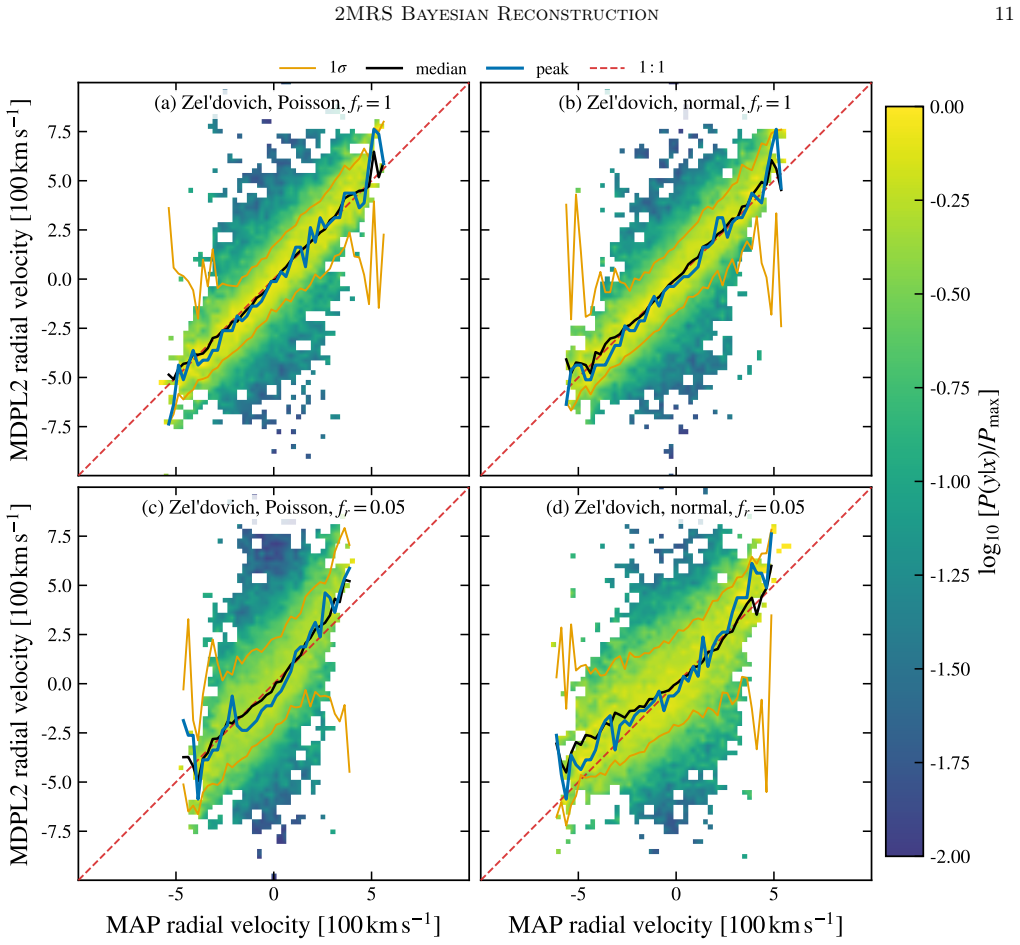
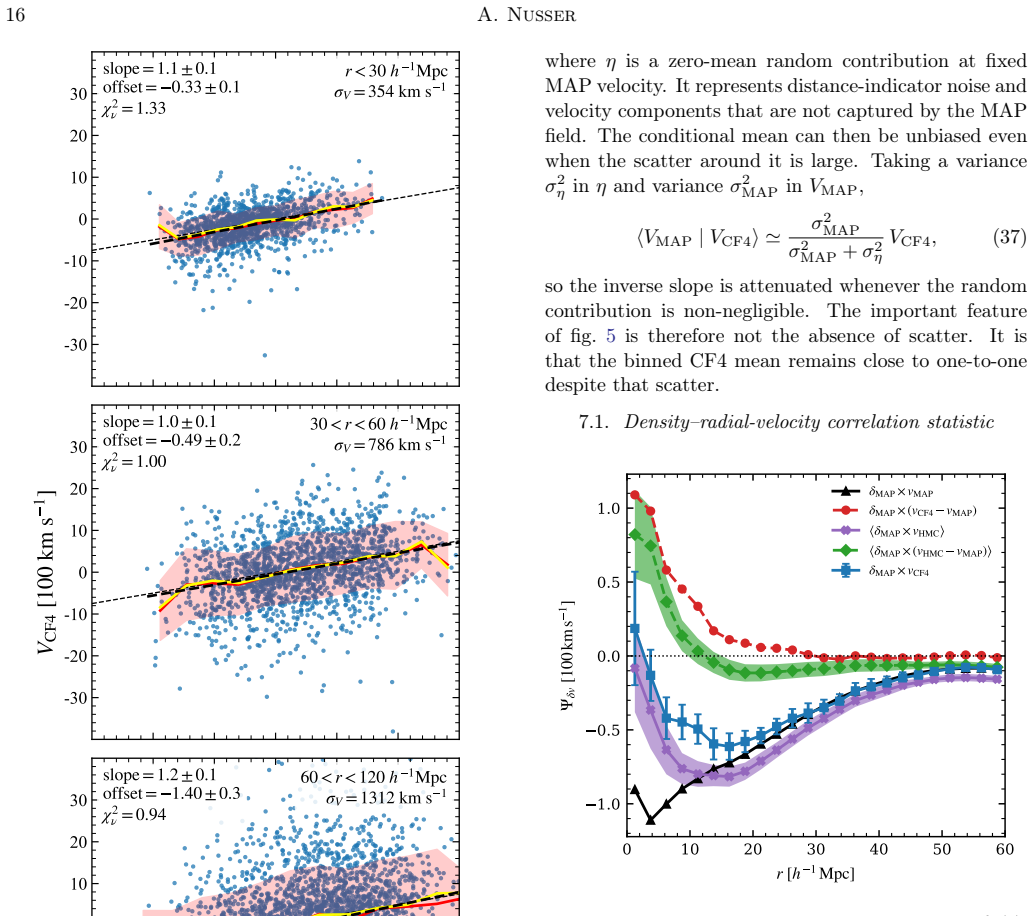
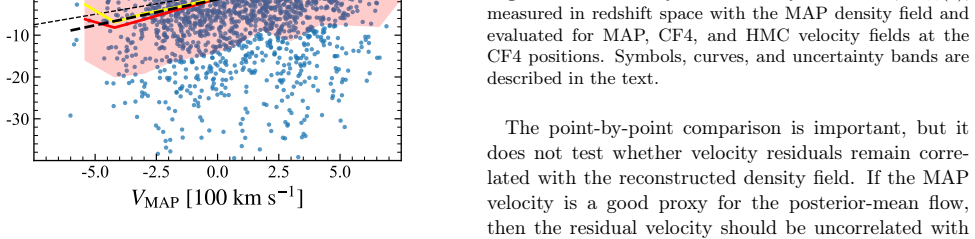
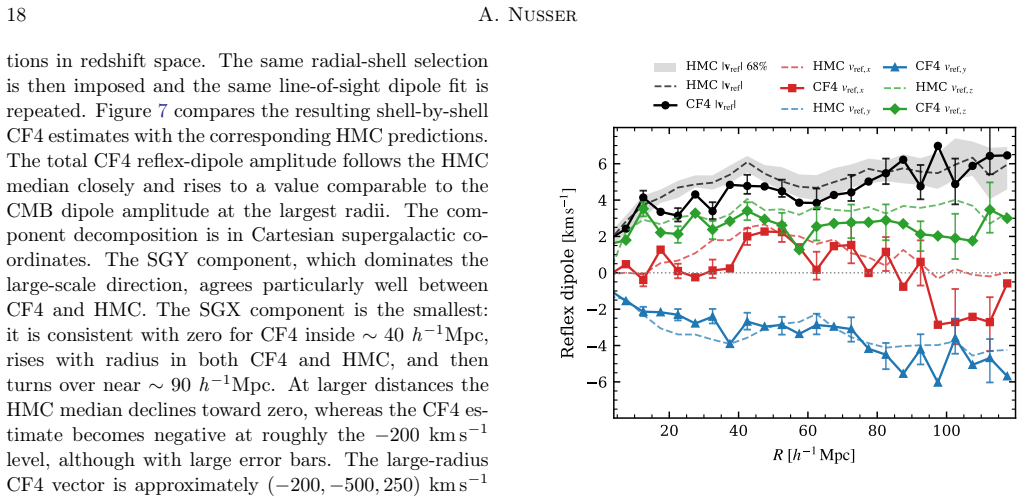
The maximum-a-posteriori solution of the Zel'dovich-approximation forward model constrained by the 2MRS redshift-space distribution yields a velocity field that agrees with Cosmicflows-4 peculiar velocities in object-by-object, density-velocity correlation, and shell-by-shell reflex-dipole tests performed at the CF4 redshift-space positions.
What carries the argument
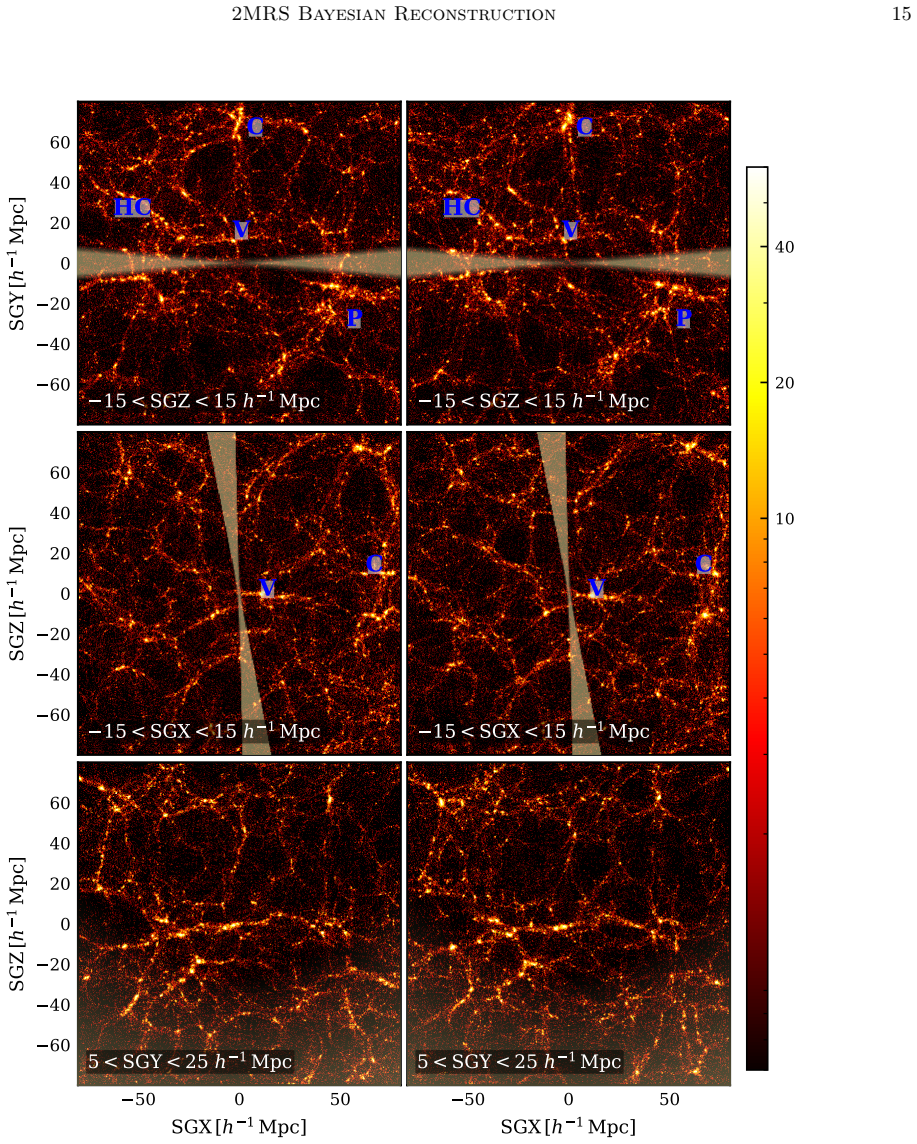
Zel'dovich-approximation forward model with unbinned Poisson point-process likelihood that incorporates the 2MRS selection function, Zone of Avoidance, redshift-space distortions, and distance-dependent galaxy bias.
If this is right
- The reconstruction captures the large-scale gravitational flow of the nearby Universe.
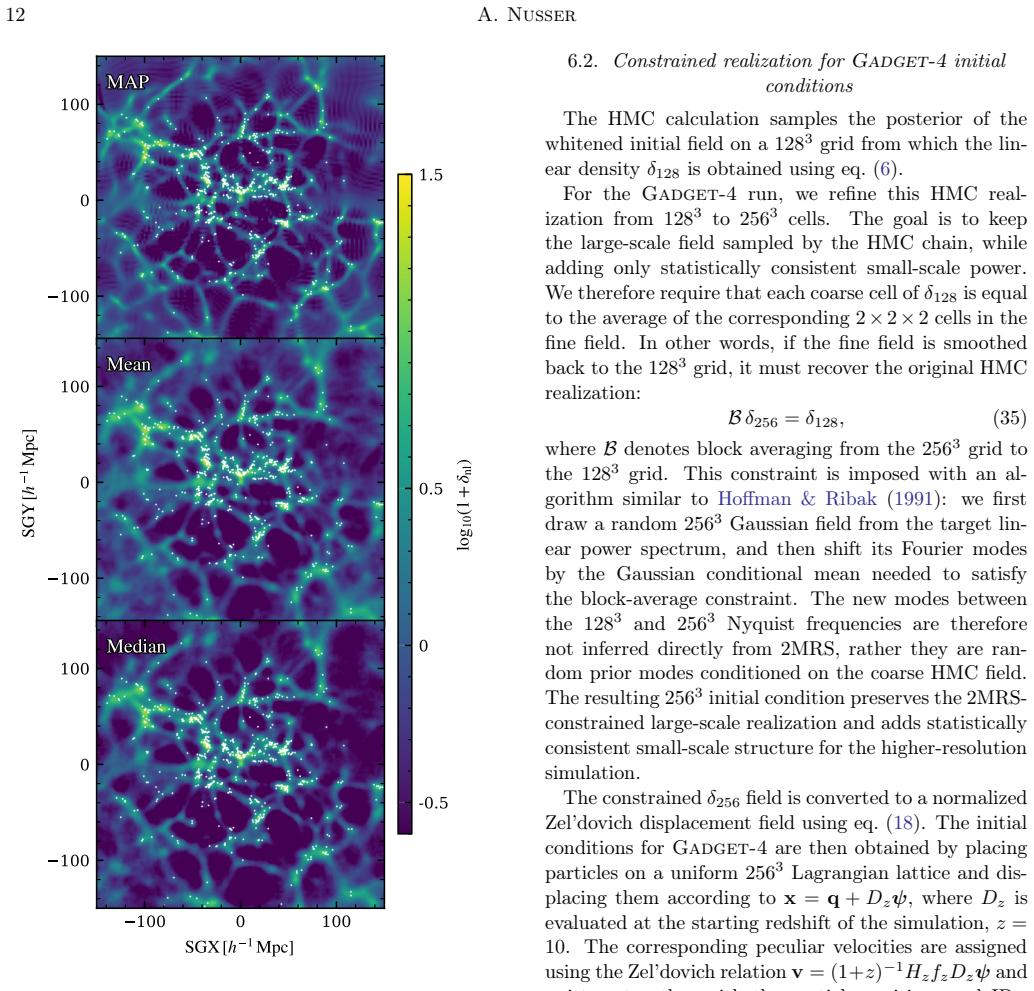
- Constrained initial conditions from the reconstruction can be evolved with N-body simulations to develop additional nonlinear small-scale structure while retaining the large-scale Zel'dovich features.
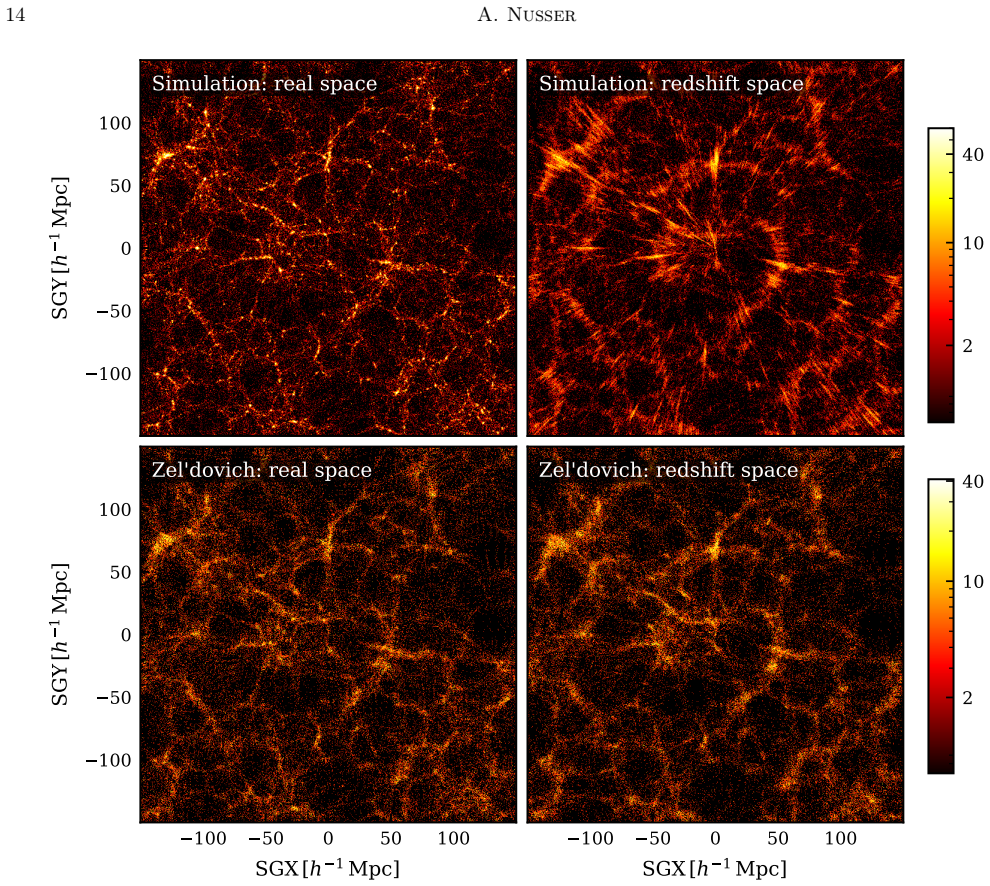
- The redshift-space distribution in the evolved simulations develops nonlinear Fingers of God.
- The same framework supplies both the MAP reconstruction and posterior samples for uncertainty quantification.
Where Pith is reading between the lines
- The method could be extended to deeper redshift surveys to map flows on larger scales.
- Agreement at unsmoothed positions suggests the linear model suffices for velocity reconstruction where CF4 provides dense sampling.
- The constrained realizations offer a way to test how nonlinear evolution affects inferred initial conditions in future work.
Load-bearing premise
The Zel'dovich approximation combined with the distance-dependent bias prescription and selection function produces an accurate representation of the true gravitational flow at the scales probed by CF4.
What would settle it
A statistically significant mismatch between the reconstructed velocities and the CF4 velocities in the object-by-object comparison at the CF4 redshift-space positions would falsify the agreement claim.
Figures
read the original abstract
We present a Bayesian reconstruction of the local density and velocity fields traced by the 2MASS Redshift Survey (2MRS) and test the inferred gravitational flow against independent Cosmicflows-4 (CF4) galaxy-group peculiar velocities. The fiducial reconstruction is the maximum-a-posteriori (MAP) solution of a Zel'dovich-approximation forward model, constrained by the 2MRS redshift-space distribution through an unbinned Poisson point-process likelihood. The model assumes Gaussian initial conditions and includes the 2MRS selection function, the Zone of Avoidance, redshift-space distortions, and a distance-dependent galaxy-bias prescription. Hamiltonian Monte Carlo provides posterior samples and constrained realizations within the same framework. The reconstructed velocity field agrees well with CF4 in object-by-object, density--velocity-correlation, and shell-by-shell reflex-dipole tests. These comparisons are made at the CF4 redshift-space positions and do not require smoothing the observed CF4 velocities to the MAP resolution. We also evolve constrained initial conditions with Gadget-4. The real-space density retains the large-scale Zel'dovich structure while developing additional nonlinear small-scale structure, and the redshift-space distribution develops nonlinear Fingers of God. The results show that the 2MRS field-level reconstruction captures the large-scale gravitational flow of the nearby Universe and provides initial conditions suitable for constrained simulations.
Editorial analysis
A structured set of objections, weighed in public.
Referee Report
Summary. The paper presents a Bayesian reconstruction of the local density and velocity fields from the 2MRS catalog using a Zel'dovich-approximation (ZA) forward model with an unbinned Poisson point-process likelihood. The fiducial MAP solution incorporates the 2MRS selection function, Zone of Avoidance, redshift-space distortions, and a distance-dependent galaxy-bias prescription. Hamiltonian Monte Carlo sampling yields posterior realizations, and the reconstructed velocity field is tested against independent CF4 peculiar velocities via object-by-object, density-velocity correlation, and shell-by-shell reflex-dipole comparisons performed at the observed CF4 redshift-space positions. Constrained initial conditions are also evolved with Gadget-4 to illustrate nonlinear structure formation.
Significance. If the central claim of accurate capture of the large-scale gravitational flow holds, the work supplies a field-level reconstruction of the nearby universe suitable as initial conditions for constrained N-body simulations. The direct use of unsmoothed CF4 positions for validation and the consistent Bayesian framework (including HMC sampling) are strengths that enhance the result's utility for testing cosmological flows on ~10-100 h^{-1} Mpc scales.
major comments (2)
- [Abstract (fiducial reconstruction paragraph)] Abstract (fiducial reconstruction paragraph): the central claim that the ZA forward model (with distance-dependent bias and selection function) produces velocities faithfully representing the true gravitational flow at CF4 scales is load-bearing, yet the manuscript supplies no mock-based quantification of systematic velocity bias or scatter induced by truncation of higher-order Lagrangian terms (v = a f H abla^{-2} abla· abla, omitting dispersion and bulk-flow contributions below ~15-20 h^{-1} Mpc).
- [Abstract (tests description)] Abstract (tests description): the reported agreement in object-by-object, density-velocity-correlation, and reflex-dipole tests is presented without quantitative metrics (e.g., Pearson coefficients, rms residuals, or χ^{2} values), error budgets, or details on how the bias prescription and Zone of Avoidance are implemented, preventing verification of the support for the claim that the reconstruction captures the gravitational flow.
minor comments (1)
- [Abstract] The notation for the velocity operator in the ZA model is written with spaces around nabla symbols; consistent LaTeX rendering would improve readability.
Simulated Author's Rebuttal
We thank the referee for their thorough review and constructive comments on our manuscript. We address each major comment point by point below, providing clarifications and indicating where revisions will be made to improve the presentation.
read point-by-point responses
-
Referee: [Abstract (fiducial reconstruction paragraph)] Abstract (fiducial reconstruction paragraph): the central claim that the ZA forward model (with distance-dependent bias and selection function) produces velocities faithfully representing the true gravitational flow at CF4 scales is load-bearing, yet the manuscript supplies no mock-based quantification of systematic velocity bias or scatter induced by truncation of higher-order Lagrangian terms (v = a f H abla^{-2} abla· abla, omitting dispersion and bulk-flow contributions below ~15-20 h^{-1} Mpc).
Authors: We acknowledge that mock-based tests could provide a useful quantification of any systematic velocity bias or scatter arising from the truncation of higher-order terms in the Zel'dovich approximation. Our validation strategy relies instead on direct, unsmoothed comparisons with the independent CF4 dataset across multiple statistics (object-by-object, density-velocity correlation, and reflex dipole), which empirically test whether the reconstructed velocities capture the gravitational flow on the scales probed by CF4. The ZA forward model was selected for its suitability within the Bayesian HMC framework. We agree that a concise discussion of ZA limitations on scales ≾15 h^{-1} Mpc, supported by existing literature, would strengthen the manuscript and will add this in the revised version. revision: partial
-
Referee: [Abstract (tests description)] Abstract (tests description): the reported agreement in object-by-object, density-velocity-correlation, and reflex-dipole tests is presented without quantitative metrics (e.g., Pearson coefficients, rms residuals, or χ^{2} values), error budgets, or details on how the bias prescription and Zone of Avoidance are implemented, preventing verification of the support for the claim that the reconstruction captures the gravitational flow.
Authors: The abstract is a high-level summary; the quantitative metrics (Pearson coefficients, rms residuals, and χ^{2} values), error budgets, and full implementation details for the distance-dependent bias prescription and Zone of Avoidance treatment are provided in the methods and results sections of the manuscript. To improve clarity and verifiability, we will revise the abstract to incorporate key quantitative results from the tests and add explicit cross-references to the relevant sections describing the bias model and Zone of Avoidance handling. revision: yes
Circularity Check
No circularity: independent CF4 validation on external positions
full rationale
The derivation reconstructs the density/velocity field from 2MRS via a ZA forward model (with selection function and distance-dependent bias) and then compares the resulting velocities to the separate CF4 catalog at CF4 redshift-space positions. These object-by-object, density-velocity, and reflex-dipole tests use data outside the 2MRS likelihood, so agreement is not forced by construction. No self-citations, fitted-input-as-prediction, or ansatz smuggling appear in the load-bearing chain; the model assumptions are stated explicitly and the external test remains falsifiable.
Axiom & Free-Parameter Ledger
free parameters (1)
- distance-dependent galaxy-bias parameters
axioms (2)
- domain assumption Initial conditions are Gaussian
- domain assumption Zel'dovich approximation suffices for the forward model
Reference graph
Works this paper leans on
-
[1]
Tully, R. B. 1982, The Astrophysical Journal, 258, 64, doi: 10.1086/160053
-
[2]
Bilicki, M., Chodorowski, M., Jarrett, T., & Mamon, G. A. 2011, ApJ, 741, 31, doi: 10.1088/0004-637X/741/1/31 20A. Nusser
-
[3]
Ajhar, E. A. 1999, \apjl, 527, L73, doi: 10.1086/312404
-
[4]
S., Fiedorowicz, P., & Rozo, E
Boruah, S. S., Fiedorowicz, P., & Rozo, E. 2024, Physical Review D, 110, 023524, doi: 10.1103/PhysRevD.110.023524
-
[5]
Branchini, E., Davis, M., & Nusser, A. 2012, MNRAS, 424, 472, doi: 10.1111/J.1365-2966.2012.21210.X
-
[6]
Classification of halo A-type stars
Branchini, E., Eldar, A., & Nusser, A. 2002, MNRAS, 335, 53, doi: 10.1046/j.1365-8711.2002.05611.x
-
[7]
1993, MNRAS, 264, 375
Buchert, T., & Ehlers, J. 1993, MNRAS, 264, 375
1993
-
[8]
G., Hoffman, Y., Gottlöber, S., et al
Carlesi, E., Sorce, J. G., Hoffman, Y., Gottlöber, S., et al. 2016, MNRAS, 458, 900, doi: 10.1093/mnras/stw357
-
[9]
Carrick, J., Turnbull, S. J., Lavaux, G., & Hudson, M. J. 2015, MNRAS, 450, 317, doi: 10.1093/mnras/stv547
-
[10]
Courtois, H. M., Pomarède, D., Tully, R. B., Hoffman, Y., & Courtois, D. 2013, Astronomical Journal, 146, 69, doi: 10.1088/0004-6256/146/3/69 de Grijs, R., & Bono, G. 2020, Astrophysical Journal Supplement Series, 251, 15, doi: 10.3847/1538-4365/abbb96
-
[11]
Djorgovski, S., & Davis, M. 1987, ApJ, 313, 59, doi: 10.1086/164948
-
[12]
1995, MNRAS, 272, 885
Zaroubi, S. 1995, MNRAS, 272, 885
1995
-
[13]
2002, \nat, 417, 260 Gottlöber, S., Hoffman, Y., & Yepes, G
Frisch, U., Matarrese, S., Mohayaee, R., & Sobolevski, A. 2002, \nat, 417, 260 Gottlöber, S., Hoffman, Y., & Yepes, G. 2010, in High Performance Computing in Science and Engineering, Garching/Munich 2009, ed. S. Wagner, M. Steinmetz, A. Bode, & M. M. Müller (Berlin, Heidelberg: Springer Berlin Heidelberg), 309–322 Haugbølle, T., Hannestad, S., Thomsen, B....
-
[14]
Hoffman, Y., & Ribak, E. 1991, ApJL, 380, L5, doi: 10.1086/186160
-
[15]
Huchra, J. P., Macri, L. M., Masters, K. L., et al. 2012, ApJS, 199, 26, doi: 10.1088/0067-0049/199/2/26
-
[16]
Jasche, J., & Wandelt, B. D. 2013, MNRAS, 432, 894, doi: 10.1093/mnras/stt449
-
[17]
1987, MNRAS, 227, 1
Kaiser, N. 1987, MNRAS, 227, 1
1987
-
[18]
Karachentsev, I. D., Kaisina, E. I., Makarov, D. I., et al. 2013, Astronomical Journal, 145, 101, doi: 10.1088/0004-6256/145/4/101
-
[19]
2017, MNRAS, 467, 1915, doi: 10.1093/mnras/stx152
Keselman, A., & Nusser, A. 2017, MNRAS, 467, 1915, doi: 10.1093/mnras/stx152
-
[20]
Kitaura, F.-S., Erdogdu, P., Nuza, S. E., et al. 2012, MNRAS, 427, L35, doi: 10.1111/j.1745-3933.2012.01330.x
-
[21]
2016, MNRAS, 457, 4340, doi: 10.1093/mnras/stw248
Klypin, A., Yepes, G., Gottlöber, S., Prada, F., & Heß, S. 2016, MNRAS, 457, 4340, doi: 10.1093/mnras/stw248
-
[22]
Kourkchi, E., Tully, R. B., Eftekharzadeh, S., et al. 2020, ApJ, 902, 145, doi: 10.3847/1538-4357/ABB66B
-
[23]
2016, MNRAS, 455, 3169, doi: 10.1093/mnras/stv2499
Lavaux, G., & Jasche, J. 2016, MNRAS, 455, 3169, doi: 10.1093/mnras/stv2499
-
[24]
B., Mohayaee, R., & Colombi, S
Lavaux, G., Tully, R. B., Mohayaee, R., & Colombi, S. 2010, ApJ, 709, 483, doi: 10.1088/0004-637X/709/1/483
-
[25]
Libeskind, N. I., Carlesi, E., Grand, R. J., et al. 2020, MNRAS, 498, 2968, doi: 10.1093/mnras/staa2541
-
[26]
2024, A&A, 689, A226, doi: 10.1051/0004-6361/202450219
Lilow, R., Ganeshaiah Veena, P., & Nusser, A. 2024, A&A, 689, A226, doi: 10.1051/0004-6361/202450219
-
[27]
2021, MNRAS, 507, 1557, doi: 10.1093/MNRAS/STAB2009
Lilow, R., & Nusser, A. 2021, MNRAS, 507, 1557, doi: 10.1093/MNRAS/STAB2009
-
[28]
Linder, E. V. 2005, PRD, 72, 043529, doi: 10.1103/PhysRevD.72.043529
-
[29]
Macri, L. M., Kraan-Korteweg, R. C., Lambert, T., et al. 2019, The Astrophysical Journal Supplement Series, 245, 6, doi: 10.3847/1538-4365/ab465a
-
[30]
Mei, S., Blakeslee, J. P., Côté, P., et al. 2007, Astrophysical Journal, 655, 144, doi: 10.1086/509598
-
[31]
2025, The Astrophysical Journal, 994, 38, doi: 10.3847/1538-4357/ae17c0
Mundow, R., & Nusser, A. 2025, The Astrophysical Journal, 994, 38, doi: 10.3847/1538-4357/ae17c0
-
[32]
2021, Journal of Cosmology and Astroparticle Physics, 2021, 058, doi: 10.1088/1475-7516/2021/03/058
Nguyen, N.-M., Schmidt, F., Lavaux, G., & Jasche, J. 2021, Journal of Cosmology and Astroparticle Physics, 2021, 058, doi: 10.1088/1475-7516/2021/03/058
-
[33]
2023, Physical Review D, 108, 083534, doi: 10.1103/PhysRevD.108.083534
Mohayaee, R. 2023, Physical Review D, 108, 083534, doi: 10.1103/PhysRevD.108.083534
-
[34]
Nikakhtar, F., Sheth, R. K., Lévy, B., & Mohayaee, R. 2022, Physical Review Letters, 129, 251101, doi: 10.1103/PhysRevLett.129.251101
-
[35]
2024, Physical Review D, 109, 123512, doi: 10.1103/PhysRevD.109.123512
Mohayaee, R. 2024, Physical Review D, 109, 123512, doi: 10.1103/PhysRevD.109.123512
-
[36]
The panoramic integral-field spectrograph
Norberg, P., Baugh, C. M., Hawkins, E., et al. 2001, MNRAS, 328, 64, doi: 10.1046/j.1365-8711.2001.04839.x
-
[37]
Nusser, A. 2017, Mon. Not. R. Astron. Soc. , 470, 445, doi: 10.1093/mnras/stx1225
-
[38]
Nusser, A., & Branchini, E. 2000, MNRAS, 313, 587, doi: 10.1046/j.1365-8711.2000.03261.x
-
[39]
2011, ApJ, 735, 77, doi: 10.1088/0004-637X/735/2/77
Nusser, A., Branchini, E., & Davis, M. 2011, ApJ, 735, 77, doi: 10.1088/0004-637X/735/2/77
-
[40]
1994, ApJL, 421, L1, doi: 10.1086/187172
Nusser, A., & Davis, M. 1994, ApJL, 421, L1, doi: 10.1086/187172
-
[41]
2014, ApJ, 788, 157, doi: 10.1088/0004-637X/788/2/157
Nusser, A., Davis, M., & Branchini, E. 2014, ApJ, 788, 157, doi: 10.1088/0004-637X/788/2/157
-
[42]
1992, The Astrophysical Journal, 391, 443, doi: 10.1086/171360
Nusser, A., & Dekel, A. 1992, The Astrophysical Journal, 391, 443, doi: 10.1086/171360
-
[43]
2020, ApJ, 905, 47, doi: 10.3847/1538-4357/abc42f 2MRS Bayesian Reconstruction21
Nusser, A., Yepes, G., & Branchini, E. 2020, ApJ, 905, 47, doi: 10.3847/1538-4357/abc42f 2MRS Bayesian Reconstruction21
-
[44]
Peebles, P. J. E. 1980, The large-scale structure of the universe (Princeton University Press, NJ). http://adsabs.harvard.edu/abs/1980lssu.book.....P —. 1989, ApJ, 344, L53, doi: 10.1086/185529
-
[45]
Peebles, P. J. E., & Tully, R. B. 2013, Astrophysical Journal, 778, 137, doi: 10.1088/0004-637X/778/2/137
-
[46]
The Astronomical Journal , eprint =
Riess, A. G., Filippenko, A. V., Challis, P., et al. 1998, AJ, 116, 1009, doi: 10.1086/300499 Rodríguez-Puebla, A., Behroozi, P., Primack, J., et al. 2016, MNRAS, 462, 893, doi: 10.1093/mnras/stw1705
work page internal anchor Pith review doi:10.1086/300499 1998
-
[47]
Saulder, C., Mieske, S., Zeilinger, W. W., & Chilingarian, I. 2013, AA, 557, A21, doi: 10.1051/0004-6361/201321466
-
[48]
2021, Journal of Cosmology and Astroparticle Physics, 2021, 033, doi: 10.1088/1475-7516/2021/04/033
Schmidt, F. 2021, Journal of Cosmology and Astroparticle Physics, 2021, 033, doi: 10.1088/1475-7516/2021/04/033
-
[49]
2024, arXiv e-prints, arXiv:2409.14546
Scolnic, D., et al. 2024, arXiv e-prints, arXiv:2409.14546. https://arxiv.org/abs/2409.14546
arXiv 2024
-
[50]
2021, Monthly Notices of the Royal Astronomical Society, 506, 2871, doi: 10.1093/mnras/stab1855
Springel, V., Pakmor, R., Zier, O., & Reinecke, M. 2021, MNRAS, 506, 2871, doi: 10.1093/mnras/stab1855
-
[51]
Tully, R. B., Rizzi, L., Shaya, E. J., et al. 2009, Astronomical Journal, 138, 323, doi: 10.1088/0004-6256/138/2/323
-
[52]
Tully, R. B., Shaya, E. J., Karachentsev, I. D., et al. 2008, ApJ, 676, 184, doi: 10.1086/527428
-
[53]
Tully, R. B., Kourkchi, E., Courtois, H. M., et al. 2023, ApJ, 944, 94, doi: 10.3847/1538-4357/ac94d8
-
[54]
Valade, A., Libeskind, N. I., Pomarède, D., et al. 2024, Nature Astronomy, 8, 1610, doi: 10.1038/s41550-024-02370-0
-
[55]
Veena, P. G., Lilow, R., & Nusser, A. 2023, MNRAS, 522, 5291, doi: 10.1093/mnras/stad1222
-
[56]
Wempe, E., Lavaux, G., White, S. D. M., et al. 2024, Astronomy & Astrophysics, 691, A348, doi: 10.1051/0004-6361/202450975
-
[57]
Zaroubi, S., Hoffman, Y., Fisher, K. B., & Lahav, O. 1995, ApJ, 449, 446, doi: 10.1086/176070
-
[58]
Zehavi, I., Zheng, Z., Weinberg, D. H., et al. 2011, The Astrophysical Journal, 736, 59, doi: 10.1088/0004-637X/736/1/59 Zel’dovich, Y. B. 1970, A&A, 5, 84
discussion (0)
Sign in with ORCID, Apple, or X to comment. Anyone can read and Pith papers without signing in.