REVIEW 3 major objections 8 minor 43 references
Cosmography for a General Spacetime Centred at Arbitrary Redshift
T0 review · 3 major / 8 minor · reviewed 2026-08-10 · deepseek-v4-flash
Pith's one-line read The paper derives a model-independent Taylor expansion of the angular-diameter distance about any redshift in any four-dimensional Lorentzian spacetime, and tests its convergence in two LTB models.
desk verdict Genuinely new analytic extension of covariant cosmography to arbitrary redshift, with a solid derivation but a numerical benchmark that quietly drops Weyl focusing. read the letter →
The pith
A machine-rendered reading of the paper's core claim, the machinery that carries it, and where it could break.
The reading
What carries the argument
The central object is the Taylor expansion of the angular-diameter distance along a null geodesic, using redshift as the expansion variable. The machinery is a chain of optical and kinematic identities: $dz/d\lambda=-(1+z)^2 E_o H$ converting affine parameter to redshift, the focusing equation $d\hat\theta/d\lambda=-\tfrac12\hat\theta^2-2|\hat\sigma|^2-k^\mu k^\nu R_{\mu\nu}$ for the beam, the area law $dd_A/d\lambda=\tfrac12\hat\theta d_A$, and the observer-defined line-of-sight Hubble rate $H=\tfrac13\theta-e^\mu a_\mu+e^\mu e^\nu\sigma_{\mu\nu}$. Chaining these identities produces $d'_A$, $d''_A$, and the new $d'''_A$ in terms of local geometry; the FLRW limit of each coefficient is recovered in Appendix A as a check.
What would settle it
Recompute the exact angular-diameter distance for the same observers and light rays in the two LTB models including the full Weyl (shear) contribution to the optical Jacobian, by parallel transporting a screen basis along each ray; if the resulting $d_A$ differs from the Ricci-only $d_A$ by an amount comparable to the reported third-order expansion residuals, the benchmark used to quantify convergence is not reliable.
Extended reading notes
Core claim
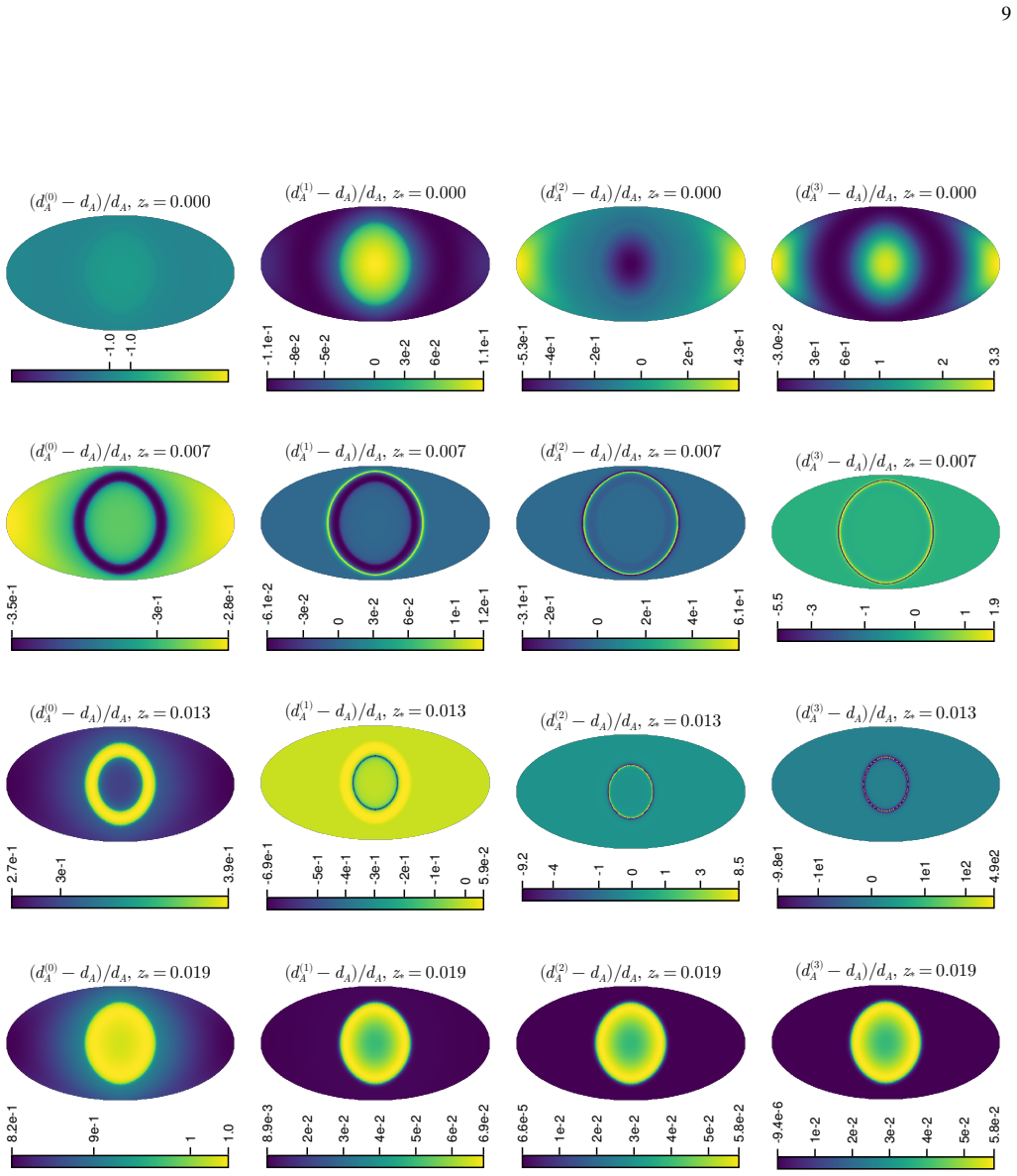
The discovery is that the standard cosmographic expansion, previously tied to $z=0$ and to Friedmann–Lemaître–Robertson–Walker (FLRW) geometry, can be repositioned to any redshift in a general spacetime, with the angular-diameter distance written as $d_A(z)=d_A(z_*)+d'_A(z_*)\Delta z+\tfrac12 d''_A(z_*)\Delta z^2+\tfrac16 d'''_A(z_*)\Delta z^3+\dots$, where $\Delta z=z-z_*$. The authors derive $d'''_A$ explicitly in terms of the beam expansion $\hat\theta$, the line-of-sight Hubble rate $H$ and its derivatives $H'$ and $H''$, the shear $|\hat\sigma|^2$, the Ricci term $k^\mu k^\nu R_{\mu\nu}$, and the Weyl term $k^\alpha k^\beta C_{\mu\alpha\nu\beta}\hat\sigma^{\mu\nu}$, and they show how the series maps to the luminosity distance through the Etherington relation. Applying the series to LTB models, they establish that its convergence is governed chiefly by the local density gradient at the expansion centre: third-order truncations fail near sharp contrasts and improve markedly in smooth regions, and piecewise stitching helps only when each centre sits in a well-behaved region.
Load-bearing premise
The exact distances used to judge the expansions are computed without the image-distorting part of spacetime curvature (the Weyl term), on the strength of an earlier result that it is very small in this type of LTB model; if that earlier result does not hold for the particular rays and density gradients studied here, the reported convergence errors would change.
Editorial extensions
If this is right
- A third-order general cosmographic expansion can be constructed around any redshift in any four-dimensional Lorentzian spacetime, not only at $z=0$.
- The third-order coefficient $d'''_A$ contains explicit Weyl-shear and Ricci-focusing terms, so distance measurements at successive orders can in principle probe local curvature and shear.
- In the LTB void and overdensity models, the third-order expansion error stays around ten percent or less in the studied maps when the expansion centre avoids steep density gradients, but grows rapidly when the centre lies in a steep gradient.
- Piecewise stitching of expansions is not automatically beneficial: the deciding factor is where the expansion centres sit relative to density fluctuations.
- Coefficients fitted to observations in inhomogeneous spacetimes do not necessarily equal local geometric quantities; they should be interpreted as effective parameters reflecting the finite redshift range probed.
Reading between the lines
- Because the arbitrary-centre expansion loses the finite multipole truncation that makes $z=0$ cosmography tractable, practical use will require explicitly patching data in redshift and angle; the paper gestures at this but does not develop a full data-analysis prescription.
- The formalism could be turned into a model-independent consistency test for probes naturally centred at $z>0$, such as BAO, by comparing their distance anchors with local $z_*$ expansions; the paper mentions such cross-checks without working out the statistical procedure.
- A direct test of the $d'''_A$ formula in a shear-dominated or vacuum spacetime, where the Weyl contribution is not negligible, would extend the validation beyond the LTB regime studied here.
- The term ratio found along the fiducial rays suggests that in smooth regions the second-order coefficient mostly constrains the combination $-\hat\theta H'/H$; a forecast could quantify how well future surveys can isolate that product.
Editorial analysis
A structured set of objections, weighed in public.
Referee Report
Summary. This paper presents a general cosmographic framework in which the angular diameter distance is Taylor-expanded about an arbitrary redshift z* in a 4-dimensional Lorentzian spacetime. Section 2 derives the first three redshift derivatives of d_A in terms of local beam expansion, line-of-sight Hubble rate H, Ricci focusing, shear, and Weyl curvature (Eqs. (6), (8), (9)/(10)), and gives the corresponding expansion for the luminosity distance via Etherington reciprocity (Eq. (13)). The framework is then applied to two LTB models, one void and one overdensity, with observers placed in high-density-gradient regions. The authors compare third-order truncations of the d_A expansion with numerically integrated 'exact' distance-redshift relations along many rays, construct sky maps of the expansion coefficients, and study piecewise expansions with varying numbers of expansion centres. Their main numerical conclusions are that low-order cosmography fails near strong density gradients, that piecewise stitching does not automatically improve convergence unless centres are chosen in smooth regions, and that fitted coefficients in inhomogeneous spacetimes behave as effective range-dependent parameters rather than strictly local quantities.
Significance. If the Section 2 derivation is correct, the paper provides a genuinely more general tool than the standard z=0 cosmography: it works at arbitrary redshift and in arbitrary Lorentzian spacetimes, and it maps d_A coefficients to d_L. The FLRW limits in Appendix A reproduce the standard distance expansion, which is a reassuring consistency check. The numerical experiments are also valuable as concrete stress tests of low-order cosmography in inhomogeneous models, and the piecewise-expansion comparison is a practical question for future surveys. However, the strength of the numerical conclusions is currently limited by the unverified omission of Weyl focusing in the benchmark LTB light propagation (Section 3.1), and by the lack of code/data release; these issues are load-bearing for the claims about convergence and coefficient interpretation, even though they do not affect the analytic core.
major comments (3)
- [3.1] The exact d_A used as benchmark is computed with the Weyl term in the optical tidal matrix omitted, on the basis of an unreferenced assertion that Weyl distortion is 'highly sub-dominant' in these models. The third-order expansion in Eq. (9) however contains the explicit Weyl term k^α k^β C_{μανβ} σ̂^{μν}. The paper never specifies whether the numerical expansion coefficients are evaluated from Eq. (9) (in which case the benchmark omits a term that the expansion includes, so the reported discrepancies are not pure Taylor truncation error) or by differentiating the Ricci-only exact d_A (in which case the Weyl part of the formalism is never exercised). Either way, the quantitative claims in Section 4—that third-order cosmography fails near strong gradients and that piecewise coefficients are range-dependent effective parameters—are not established as stated. A demonstration of Weyl sub-dominance for the specific rays and density contrasts studied, or a computation including the Weyl term, is required.
- [4] The computational pipeline is underspecified. The reader is not told how the coefficients d_A(z*), d'_A(z*), d''_A(z*) and d'''_A(z*) entering Figures 3–9 are obtained: from the analytic expressions (6), (8), (10) using quantities integrated along each ray, or by numerical differentiation of the exact d_A. This matters because the first option requires the screen-space basis and shear, whose computation Section 3.1 explicitly avoids when omitting the Weyl term. Please state the procedure precisely and, if the geometric expressions are used, list which terms (Ricci, shear, Weyl, derivatives of H) are included in each coefficient.
- [6] The concluding claim that cosmographic coefficients 'provide meaningful descriptions of the local expansion and geometry on appropriately smoothed scales' goes beyond what is demonstrated: the numerical evidence is limited to two specific LTB models with a Weyl-truncated exact solution and no quantified comparison of the omitted term. Please either soften this claim or support it with the full optical computation.
minor comments (8)
- [Figure 3 caption] The caption reads 'z∗ =0.0015' where it should read 'z∗ =0.015'.
- [Figure 4 caption] The caption reads 'z∗ =0.0006' where it should read 'z∗ =0.006'.
- [4.1] The word 'dispalyed' in the text should be 'displayed'.
- [4.2] The phrase 'This in in agreement' should be 'This is in agreement'.
- [6] The sentence 'The expansion centred at arbitrary redshift lose the finite multipole structure' should read 'loses'.
- [3.1] The sentence 'we do not need to set initial conditions for and parallel transport the screen space basis vectors' is ungrammatical; suggest 'we do not need to set initial conditions for, or to parallel-transport, the screen-space basis vectors'.
- [References] Reference [35] is cited as a 2026 work that appears unpublished; please provide an arXiv identifier or publication status.
- [General] The absence of a code/data release is not an error, but for a numerical paper of this type a reproducibility statement would help; at minimum, the parameter values and the exact procedure for evaluating coefficients should be listed.
Circularity Check
No significant circularity: the Section 2 derivation and d_L mapping are self-contained; the LTB benchmark is an independent convergence test. A Weyl-truncation caveat affects the numerical examples but does not make the central claim reduce to its inputs.
full rationale
The Section 2 derivation is self-contained: Eqs. (6)-(10) are obtained by differentiating the standard optical scalar relations (2)-(4) with respect to redshift, with no use of the final Taylor expansion as an input. The d_L mapping in Section 2.1 is an algebraic identity from Etherington reciprocity and the polynomial (1+z)^2. The agreement of d''_A with [35] is a check, not a load-bearing citation, and the third-order expression is derived here. The LTB numerical test is an external convergence test rather than a fit: the exact d_A is obtained by direct integration of the geodesic and optical transport equations, and the Taylor approximations are evaluated from local quantities along the same solutions; the reported discrepancies are therefore genuine truncation/convergence effects. The one substantive caveat is in Section 3.1, where the benchmark omits Weyl focusing on the authority of an unreported earlier result by one of the authors; this could bias the quantitative convergence errors and the piecewise-error conclusions, but it does not make the expansion's predictions equal to its inputs. No equation in the paper is defined in terms of the quantity it is used to predict, and no fitted parameter is renamed as a prediction. The self-citations present (e.g., [35]) do not carry the derivation.
Assumptions & free parameters
free parameters (7)
- LTB1 curvature amplitude k_max =
5.4e-8
- LTB1 boundary radius r_b =
40 Mpc
- LTB1 shape exponents (m, n) =
m = 4, n = 4
- LTB2 overdensity amplitude delta_0 =
1e-3
- LTB2 width r_sigma =
7 Mpc
- Background FLRW parameters =
Omega_m,0 = 0.30, H0 = 70 km/s/Mpc
- Observer positions in the LTB models =
not stated numerically; shown only by vertical lines in Figure 1
assumptions (6)
- domain assumption Spacetime is a 4-dimensional Lorentzian manifold.
- domain assumption Light follows null geodesics and redshift as a function of affine parameter is invertible.
- standard math Sachs optical equations for the beam expansion, shear, and angular diameter distance.
- domain assumption Etherington reciprocity relation holds.
- ad hoc to paper Weyl focusing is highly sub-dominant to Ricci focusing in the LTB models used as benchmarks.
- domain assumption LTB dust plus Lambda model with the specified mass function M(r) from Eq. (20).
Cite this review
Pith. "Pith review of Cosmography for a General Spacetime Centred at Arbitrary Redshift." pith.science (2026). https://pith.science/paper/SRTNWRCI
@misc{pith2026260807008,
  author       = {Pith},
  title        = {Pith review of: Cosmography for a General Spacetime Centred at Arbitrary Redshift},
  year         = {2026},
  howpublished = {\url{https://pith.science/paper/SRTNWRCI}},
  note         = {Machine review of arXiv:2608.07008}
}
read the original abstract
With upcoming surveys providing large volumes of highly precise observational data across a wide range of redshifts, it is increasingly important to have tools that can translate observational data into geometric and dynamical information without imposing a predetermined cosmological model. General cosmographic expansions centred at arbitrary redshift provide exactly such a tool. We here present the formalism for general cosmographic expansions centred at an arbitrary redshift, valid for 4-dimensional Lorentzian spacetimes. We then apply the expansion formalism to test its ability to reproduce the redshift-distance relation in two examples of large-scale cosmic structures (an underdensity and an overdensity) modelled by the Lema\^itre-Tolman-Bondi metric, where we examine the effect of choosing different redshift intervals for the cosmographic series expansions. This quantifies the extent to which cosmographic coefficients inferred from redshift-distance observations retain their interpretation as local geometric and dynamical quantities, as is expected in standard FLRW cosmology. Similarly to earlier results, we here find that in more general spacetimes the coefficients instead become effective parameters reflecting the finite observational range probed. Lastly, we discuss possible strategies for using the expansions to constrain dynamical and geometric quantities.
Figures


Figures from the paper (6 more)




Reference graph
Works this paper leans on
-
[1]
Ellis, George F. R. and Maartens, Roy and MacCallum, Malcolm A. H. Relativistic Cosmology. 2012
work page 2012
-
[2]
The Expansion of the Universe is Faster than Expected
Riess, Adam G. The Expansion of the Universe is Faster than Expected. Nature Rev. Phys. 2019. doi:10.1038/s42254-019-0137-0. arXiv:2001.03624
arXiv 2019
-
[3]
Lodha, K. and others. Extended dark energy analysis using DESI DR2 BAO measurements. Phys. Rev. D. 2025. doi:10.1103/w4c6-1r5j. arXiv:2503.14743
arXiv 2025
-
[4]
Did DESI DR2 truly reveal dynamical dark energy?
Wang, Deng and Mota, David. Did DESI DR2 truly reveal dynamical dark energy?. Eur. Phys. J. C. 2025. doi:10.1140/epjc/s10052-025-15076-y. arXiv:2504.15222
arXiv 2025
-
[5]
On DESI's DR2 exclusion of CDM
Cort \^e s, Marina and Liddle, Andrew R. On DESI's DR2 exclusion of CDM. Mon. Not. Roy. Astron. Soc. 2025. doi:10.1093/mnrasl/slaf108. arXiv:2504.15336
arXiv 2025
-
[6]
Colloquium: The cosmic dipole anomaly
Secrest, Nathan and von Hausegger, Sebastian and Rameez, Mohamed and Mohayaee, Roya and Sarkar, Subir. Colloquium: The cosmic dipole anomaly. Rev. Mod. Phys. 2025. doi:10.1103/9ygx-z2yq. arXiv:2505.23526
arXiv 2025
-
[7]
Multipole expansion of the local expansion rate
Kalbouneh, Basheer and Marinoni, Christian and Bel, Julien. Multipole expansion of the local expansion rate. Phys. Rev. D. 2023. doi:10.1103/PhysRevD.107.023507. arXiv:2210.11333
arXiv 2023
-
[8]
Towards Cosmography of the Local Universe
Adamek, Julian and Clarkson, Chris and Durrer, Ruth and Heinesen, Asta and Kunz, Martin and Macpherson, Hayley J. Towards Cosmography of the Local Universe. Open J. Astrophys. 2024. doi:10.33232/001c.118782. arXiv:2402.12165
arXiv 2024
Show all 43 references
-
[9]
Cosmological Applications of Pad \'e Approximant
Wei, Hao and Yan, Xiao-Peng and Zhou, Ya-Nan. Cosmological Applications of Pad \'e Approximant. JCAP. 2014. doi:10.1088/1475-7516/2014/01/045. arXiv:1312.1117
2014 arXiv
-
[10]
Etherington, I. M. H. On the Definition of Distance in General Relativity. General Relativity and Gravitation. 2007. doi:10.1007/s10714-007-0488-4
2007 doi
-
[11]
Probing cosmic background dynamics with a cosmological-model-independent method
Liu, Yang and Wang, Bao and Yu, Hongwei and Wu, Puxun. Probing cosmic background dynamics with a cosmological-model-independent method. Mon. Not. Roy. Astron. Soc. 2024. doi:10.1093/mnras/stae1808. arXiv:2305.19634
2024 arXiv
-
[12]
Cosmographic Footprints of Dynamical Dark Energy
Fazzari, Elisa and Giar \`e , William and Di Valentino, Eleonora. Cosmographic Footprints of Dynamical Dark Energy. Astrophys. J. Lett. 2026. doi:10.3847/2041-8213/ae2917. arXiv:2509.16196
2026
-
[13]
and Koksbang, S
Modan, Asha B. and Koksbang, S. M. On the convergence of cosmographic expansions in Lema \^ tre Tolman Bondi models. Class. Quant. Grav. 2024. doi:10.1088/1361-6382/ad8abc. arXiv:2408.07459
2024 arXiv
-
[14]
Koksbang, S. M. Testing inhomogeneous cosmography in our cosmic neighborhood using CosmicFlows-4. Phys. Rev. D. 2025. doi:10.1103/6z7w-47rc. arXiv:2412.12637
2025
-
[15]
Cosmography with -Szekeres models
Hills, Morag and Heinesen, Asta. Cosmography with -Szekeres models. JCAP. 2026. doi:10.1088/1475-7516/2026/06/016. arXiv:2601.16844
2026
-
[16]
Three-dimensional mapping of dark matter
Hu, Wayne and Keeton, Charles R. Three-dimensional mapping of dark matter. Phys. Rev. D. 2002. doi:10.1103/PhysRevD.66.063506. arXiv:astro-ph/0205412
2002 arXiv
-
[17]
Camacho and others
Quevedo, B. Camacho and others. Euclid preparation. Galaxy power spectrum modelling in redshift space. 2026. arXiv:2601.20826
2026
-
[18]
Cosmology with Peculiar Velocity Surveys
Turner, Ryan J. Cosmology with Peculiar Velocity Surveys. 2024. arXiv:2411.19484
2024 arXiv
-
[19]
Courtois, H. M. and Dupuy, A. and Guinet, D. and Baulieu, G. and Ruppin, F. and Brenas, P. Gravity in the Local Universe : density and velocity fields using CosmicFlows-4. Astron. Astrophys. 2023. doi:10.1051/0004-6361/202245331. arXiv:2211.16390
2023 arXiv
-
[20]
and others
Riess, Adam G. and others. A 2.4 \. Astrophys. J. 2016. doi:10.3847/0004-637X/826/1/56. arXiv:1604.01424
2016 arXiv
-
[21]
and others
Riess, Adam G. and others. A Comprehensive Measurement of the Local Value of the Hubble Constant with 1 km s ^ -1 Mpc ^ -1 Uncertainty from the Hubble Space Telescope and the SH0ES Team. Astrophys. J. Lett. 2022. doi:10.3847/2041-8213/ac5c5b. arXiv:2112.04510
2022 arXiv
-
[22]
A Uniform Type Ia Supernova Distance Ladder with the Zwicky Transient Facility: Absolute Calibration Based on the Tip of the Red Giant Branch Method
Dhawan, Suhail and others. A Uniform Type Ia Supernova Distance Ladder with the Zwicky Transient Facility: Absolute Calibration Based on the Tip of the Red Giant Branch Method. Astrophys. J. 2022. doi:10.3847/1538-4357/ac7ceb. arXiv:2203.04241
2022 arXiv
-
[23]
An updated measurement of the Hubble constant from near-infrared observations of Type Ia supernovae
Galbany, Llu \' s and others. An updated measurement of the Hubble constant from near-infrared observations of Type Ia supernovae. Astron. Astrophys. 2023. doi:10.1051/0004-6361/202244893. arXiv:2209.02546
2023 arXiv
-
[24]
and others
Uddin, Syed A. and others. Carnegie Supernova Project I and II: Measurements of H _ 0 Using Cepheid, Tip of the Red Giant Branch, and Surface Brightness Fluctuation Distance Calibration to Type Ia Supernovae*. Astrophys. J. 2024. doi:10.3847/1538-4357/ad3e63. arXiv:2308.01875
2024 arXiv
-
[25]
and Breuval, Louise
Riess, Adam G. and Breuval, Louise. The Local Value of H0. IAU Symp. 2022. doi:10.1017/S1743921323003034. arXiv:2308.10954
2022 arXiv
-
[26]
and others
Camilleri, R. and others. The Dark Energy Survey Supernova Program: an updated measurement of the Hubble constant using the inverse distance ladder. Mon. Not. Roy. Astron. Soc. 2025. doi:10.1093/mnras/staf122. arXiv:2406.05049
2025 arXiv
-
[27]
Is backreaction really small within concordance cosmology?
Clarkson, Chris and Umeh, Obinna. Is backreaction really small within concordance cosmology?. Class. Quant. Grav. 2011. doi:10.1088/0264-9381/28/16/164010. arXiv:1105.1886
2011 arXiv
-
[28]
The influence of structure formation on the evolution of the universe
Umeh, Obinna. The influence of structure formation on the evolution of the universe. 2013
2013
-
[29]
Multipole decomposition of the general luminosity distance 'Hubble law' -- a new framework for observational cosmology
Heinesen, Asta. Multipole decomposition of the general luminosity distance 'Hubble law' -- a new framework for observational cosmology. JCAP. 2021. doi:10.1088/1475-7516/2021/05/008. arXiv:2010.06534
2021 arXiv
-
[30]
Covariant cosmography: the observer-dependence of the Hubble parameter
Maartens, Roy and Santiago, Jessica and Clarkson, Chris and Kalbouneh, Basheer and Marinoni, Christian. Covariant cosmography: the observer-dependence of the Hubble parameter. JCAP. 2024. doi:10.1088/1475-7516/2024/09/070. arXiv:2312.09875
2024 arXiv
-
[31]
Cosmography of the local Universe by multipole analysis of the expansion rate fluctuation field
Kalbouneh, Basheer and Marinoni, Christian and Maartens, Roy. Cosmography of the local Universe by multipole analysis of the expansion rate fluctuation field. JCAP. 2024. doi:10.1088/1475-7516/2024/09/069. arXiv:2401.12291
2024 arXiv
-
[32]
and Heinesen, Asta
Dhawan, Suhail and Borderies, Antonin and Macpherson, Hayley J. and Heinesen, Asta. The quadrupole in the local Hubble parameter: first constraints using Type Ia supernova data and forecasts for future surveys. Mon. Not. Roy. Astron. Soc. 2023. doi:10.1093/mnras/stac3812. arXi...
2023 arXiv
-
[33]
and Dhawan, Suhail and Macpherson, Hayley J
Cowell, Jessica A. and Dhawan, Suhail and Macpherson, Hayley J. Potential signature of a quadrupolar hubble expansion in Pantheon+supernovae. Mon. Not. Roy. Astron. Soc. 2023. doi:10.1093/mnras/stad2788. arXiv:2212.13569
2023 arXiv
-
[34]
and Heinesen, Asta
Macpherson, Hayley J. and Heinesen, Asta. A theoretical prediction for the dipole in nearby distances using cosmography. 2025. doi:10.33232/001c.150319. arXiv:2507.01095
2025 arXiv
-
[35]
L'Univers en expansion
Lema \^i tre, Georges. L'Univers en expansion. Annales de la Soci\'et\'e Scientifique de Bruxelles A. 1933
1933
-
[36]
The Expanding Universe
Lema \^i tre, Georges. The Expanding Universe. General Relativity and Gravitation. 1997
1997
-
[37]
Effect of Inhomogeneity on Cosmological Models
Tolman, Richard C. Effect of Inhomogeneity on Cosmological Models. Proceedings of the National Academy of Sciences. 1934
1934
-
[38]
Spherically Symmetrical Models in General Relativity
Bondi, Hermann. Spherically Symmetrical Models in General Relativity. Monthly Notices of the Royal Astronomical Society. 1947
1947
-
[39]
Koksbang, S. M. and Heinesen, A. , title = "
-
[40]
Structures in the universe by exact methods : formation, evolution, interactions , isbn =
Bolejko, Krzysztof , address =. Structures in the universe by exact methods : formation, evolution, interactions , isbn =. 2010 , abstract =
2010
-
[41]
LTB solutions in Newtonian gauge: From Strong to weak fields
Van Acoleyen, Karel. LTB solutions in Newtonian gauge: From Strong to weak fields. JCAP. 2008. doi:10.1088/1475-7516/2008/10/028. arXiv:0808.3554
2008 arXiv
-
[42]
Koksbang, S. M. Understanding the Dyer-Roeder approximation as a consequence of local cancellations of projected shear and expansion rate fluctuations. Phys. Rev. D. 2021. doi:10.1103/PhysRevD.104.043505. arXiv:2106.12913
2021 arXiv
-
[43]
G \'o rski, K. M. and Hivon, E. and Banday, A. J. and Wandelt, B. D. and Hansen, F. K. and Reinecke, M. and Bartelmann, M. HEALPix - A Framework for high resolution discretization, and fast analysis of data distributed on the sphere. Astrophys. J. 2005. doi:10.1086/427976. arX...
2005 arXiv
Reviewed August 10, 2026 · model on record in the stance chip above.
Discussion (0). Continue with ORCID to comment.