REVIEW 3 major objections 4 minor 59 references
Direct reciprocity in asynchronous interactions
T0 review · 3 major / 4 minor · reviewed 2026-08-07 · deepseek-v4-flash
Pith's one-line read In asynchronous repeated games with environmental feedback, any cooperative memory-1 strategy is a Nash equilibrium once the benefit gap between environmental states reaches the cooperation cost.
desk verdict A nice extension of direct reciprocity to asynchrony, but the central 'Δ≥c' universality threshold only holds on the λ_CD=0 boundary and needs qualification. read the letter →
The pith
A machine-rendered reading of the paper's core claim, the machinery that carries it, and where it could break.
The reading
What carries the argument
The load-bearing object is the two-state environmental Markov process with transition vector $\lambda=(\lambda_{CC},\lambda_{CD},\lambda_{DC},\lambda_{DD})$, where each entry is the probability of moving to the high-benefit state given the two preceding actions. The paper focuses on $\lambda=(1,0,\eta,0)$, which encodes two real-world assumptions: mutual cooperation always restores the high state, the second mover's defection guarantees a move to the low state, and the first mover's defection sends the environment low with probability $1-\eta$, so more recent actions matter more. The strategy space is the eight-entry memory-1 vector $p=(p^H_{CC},\ldots,p^L_{DD})$ describing cooperation probabilities conditional on environment, one's own action two periods ago, and the co-player's action last period. The proof of the partner-strategy conditions computes the stationary distribution of the resulting Markov chain and compares the payoffs from cooperating forever versus deviating once, then checks that no deviation improves the long-term payoff.
What would settle it
One can settle the universality claim by computing partner-strategy conditions for a transition rule in which the probability of entering the high state depends on the current environmental state, or in which the ordering $\lambda_{CC}\ge\lambda_{DC}\ge\lambda_{CD}\ge\lambda_{DD}$ is violated while keeping $\Delta\ge c$. If some strategy with $p^H_{CC}=1$ then fails the Nash-equilibrium inequalities, the paper's central threshold is an artifact of the state-independent rule rather than a general property of asynchronous feedback. A second check is to simulate the evolutionary process with $\Delta\ge c$ and state-dependent transitions and see whether the full-cooperation rate drops below the predicted level.
Extended reading notes
Core claim
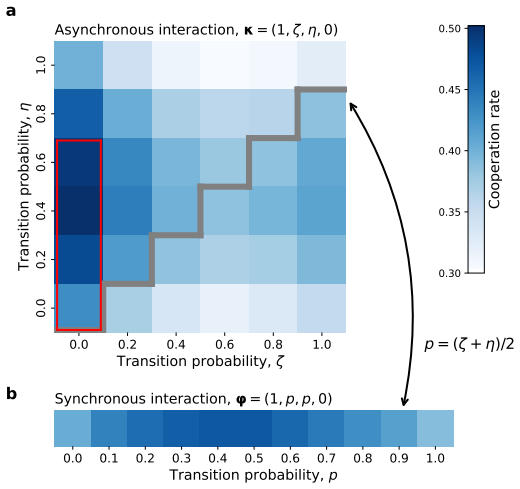
The paper's central claim is a characterization of partner strategies in asynchronous stochastic games with transition vector $\lambda=(1,0,\eta,0)$. A strategy is a partner strategy if and only if it has $p^H_{CC}=1$, and the remaining parameters obey the inequalities in Eq. (5); in particular, defection after the environment has been driven low is heavily constrained. The striking corollary is that whenever $\Delta = b_H - b_L \ge c$, these inequalities are satisfied by every cooperative memory-1 strategy, so the entire cooperative strategy space becomes a set of Nash equilibria. In static asynchronous games, by contrast, partner strategies never fill the cooperative space, so this universality is a genuine effect of environmental feedback. The paper also demonstrates in evolutionary simulations that dynamic feedback raises cooperation rates and payoffs above static baselines, and that asynchronous play generally yields less cooperation than synchronous play unless the transition rule punishes the most recent defection hardest.
Load-bearing premise
The argument assumes the environment is a two-state Markov process whose transition probabilities are state-independent and ordered as $\lambda_{CC}\ge\lambda_{DC}\ge\lambda_{CD}\ge\lambda_{DD}$, with the working rule that the second mover's defection always pushes the environment to the low state; if real-world feedback depends on the current state, or if the most recent defection is not the most damaging, the $\Delta\ge c$ threshold need not hold.
Editorial extensions
If this is right
- If the threshold $\Delta \ge c$ holds, cooperation in turn-taking games requires no knowledge of which punishment or forgiveness pattern works; any strategy that cooperates after mutual cooperation is uninvadable.
- Environmental feedback increases the abundance of partner strategies relative to static asynchronous games for every tested benefit gap and transition probability, so dynamic environments favor reciprocity even when players act sequentially.
- Asynchronous interactions suppress cooperation relative to synchronous ones when both use the same symmetric transition rule, and this gap persists across population size, selection strength, error rate, and mutation rate.
- A transition rule that gives the most recent defection the heaviest environmental penalty ($\lambda=(1,0,\eta,0)$) cancels much of asynchrony's harmful effect, providing a design principle for promoting cooperation in sequential interactions.
Reading between the lines
- If the same gap condition survives a third environmental state, then variation in resource abundance itself—not the details of reciprocity norms—may be the main stabilizer of turn-taking cooperation; adding an intermediate state and checking whether a similar threshold appears is the direct next test.
- Because the second mover observes the first mover's action before choosing, the model attributes asynchrony's cost to information lag; one could test this by randomizing who moves first each round and asking whether the cooperation gap with synchronous play disappears.
- The paper's transition rule is state-independent, so applying the same conditions to environments that recover slowly (where the low state persists after overuse) would require a new derivation; the authors themselves flag state-dependent transitions as the key open case.
- The threshold result suggests an empirical target: systems with turn-taking reciprocity should show more stable cooperation when the payoffs of the two resource states differ by more than the cost of helping, a prediction that could be checked in sentinel or blood-sharing data.
Editorial analysis
A structured set of objections, weighed in public.
Referee Report
Summary. The paper introduces a model of direct reciprocity in asynchronous (alternating-move) interactions with dynamic environmental feedback. Two players alternate actions within each round, the environment switches between a high-benefit and a low-benefit state according to a transition vector that depends on the players' recent actions, and each player is modeled by a memory-one strategy. The authors derive partner-strategy conditions for this stochastic game and report that, for the transition vector λ=(1,0,η,0), every cooperative strategy with p^H_CC=1 is a partner strategy once the benefit difference Δ=b_H−b_L reaches the cooperation cost c. They further use evolutionary simulations and a weak-selection approximation to argue that environmental feedback promotes cooperation in asynchronous settings, while asynchrony generally inhibits cooperation relative to synchronous interactions except for a specific class of feedback rules.
Significance. If the main claims hold, the paper makes a valuable conceptual contribution: it extends the theory of direct reciprocity from static synchronous games to asynchronous stochastic games and shows that the environment can act as a second 'shadow of the future' that stabilizes cooperation. The analytical partner-strategy conditions are parameter-free in the sense that no payoff data are fitted, and the threshold Δ≥c is a derived rather than assumed consequence. The comparison between asynchronous and synchronous games using a matched average transition probability is a thoughtful design. However, the central threshold claim is currently tied to a boundary transition vector, and the derivations are deferred to an absent SI, so the significance is somewhat reduced until these issues are resolved.
major comments (3)
- [Section 3, Eq. (5), Fig. 3, Abstract] The headline threshold Δ≥c is established only for the transition vector λ=(1,0,η,0), i.e. for λ_CD=0, which is a boundary point of the ordering λ_CC≥λ_DC≥λ_CD≥λ_DD introduced in Section 2. The claim that 'when Δ≥c, any cooperative strategy qualifies as a partner strategy' is not a consequence of that ordering alone. To see this, take λ=(1,q,η,0) with q>0 and let Player 2 use Always Cooperate. A Player 1 who always defects receives b_L+qΔ per round, because after Player 1's defection the environment is H with probability q before Player 2's action; mutual cooperation gives b_H−c=b_L+Δ−c. For Δ=c, defection is strictly profitable for every q>0, so Always Cooperate is not a partner strategy. Thus the general condition is at least Δ≥c/(1−λ_CD), and the universal statements in the abstract and in Section 3 must either be restricted to λ_CD=0 or re-derived for general transition vectors. As written, Eq. (5) and Fig. 3 overgeneralize the boundary case.
- [Section 3, Eq. (5) and Methods] The main analytical results—the partner-strategy conditions in Eq. (5) and the weak-selection approximation in Methods—are stated as 'derived in SI Appendix section 3' and 'SI Appendix section 4', but the SI is not included in this arXiv version. Because these derivations are load-bearing for the central claims, I could not verify them from the manuscript. Please include the SI in the review version, or summarize the key steps of the Markov-chain analysis in the main text or an appendix.
- [Section 3, 'Stability of cooperative strategies'] The statement that 'any cooperative strategy qualifies as a partner strategy' should specify the domain precisely: it holds for the error-free case and for strategies with p^H_CC=1, but it is not true for arbitrary memory-one strategies once implementation errors are introduced, because the modified strategy p^ε=ε+(1−2ε)p no longer satisfies p^H_CC=1. The paper does later discuss robustness to errors, but the universal claim in the abstract and in the stability subsection is stated without these qualifications.
minor comments (4)
- [Eq. (5)] The second inequality in Eq. (5) is typeset ambiguously in the main text; please add explicit parentheses, e.g. ((1−p^L_CD+p^L_DD)b_H−c)/b_L, so that the expression is unambiguous.
- [Abstract and Section 3] The phrase 'above a critical environmental threshold, any cooperative strategy can form a Nash equilibrium' should be qualified to 'for the transition vector λ=(1,0,η,0) and error-free play', as the paper itself uses this transition vector for most of its analytical results.
- [Figure 5] The red-box exception is described qualitatively as 'ζ=0 and η moderate or small'. Please state the precise range of η used in the figure, since the text elsewhere describes η=0.5 as moderate.
- [Section 2, Eq. (1)] The notation λ_{a\tilde a} is introduced compactly; a sentence clarifying that the first index is the focal player's own previous action and the second is the co-player's previous action would help readers parse Eqs. (5) and (6).
Circularity Check
No significant circularity: the paper derives its threshold and partner-strategy conditions from an explicit Markov-chain analysis rather than assuming them.
full rationale
The derivation chain is self-contained. The central result, Eq. (5), gives the partner-strategy conditions for asynchronous stochastic games; these conditions are obtained analytically from the stationary distribution of the interaction Markov chain (SI Appendix section 3), not from a fitted parameter or from the conclusion. The threshold claim that any cooperative strategy with p^H_CC = 1 is a partner strategy when Δ ≥ c is a consequence of substituting the transition vector λ = (1,0,η,0) into the derived inequalities, as shown in Fig. 3 and the surrounding text. The paper does cite prior work for definitions and baselines: [35] defines partner strategies, and [51] provides the asynchronous static-game partner criteria, which the authors recover as the special case in Eq. (6). These citations are used as context, not as the source of the stochastic-game result. The weaker assumption that the universal threshold holds only for λ_CD = 0 is a robustness/generality concern about the chosen transition vector, not a circularity: the claimed derivation does not secretly assume the conclusion. There are no fitted inputs renamed as predictions, no load-bearing self-citation chain, and no ansatz smuggled in via citation.
Assumptions & free parameters
assumptions (4)
- domain assumption Players use average payoff per round (limit-of-means) as the fitness criterion for Nash equilibria.
- domain assumption The environment follows a state-independent two-state Markov chain with transition ordering λ_CC ≥ λ_DC ≥ λ_CD ≥ λ_DD, and most results use λ = (1, 0, η, 0).
- domain assumption Analytical partner-strategy conditions are derived for error-free play (ε = 0); implementation error is treated only in simulations and the weak-selection approximation.
- domain assumption Partner strategies are defined as in Hilbe et al. [35] (full cooperation in self-play and Nash equilibrium).
Cite this review
Pith. "Pith review of Direct reciprocity in asynchronous interactions." pith.science (2026). https://pith.science/paper/SS2MHJX5
@misc{pith2026250604264,
  author       = {Pith},
  title        = {Pith review of: Direct reciprocity in asynchronous interactions},
  year         = {2026},
  howpublished = {\url{https://pith.science/paper/SS2MHJX5}},
  note         = {Machine review of arXiv:2506.04264}
}
read the original abstract
Cooperation is vital for the survival of living systems but is challenging due to the costs borne by altruistic individuals. Direct reciprocity, where actions are based on past encounters, is a key mechanism fostering cooperation. However, most studies assume synchronous decision-making, whereas real-world interactions are often asynchronous, with individuals acting in sequence. This asynchrony can undermine standard cooperative strategies like Tit-for-Tat and Win-Stay Lose-Shift. To better understand cooperation in real-world contexts, it is crucial to explore the theory of direct reciprocity in asynchronous interactions. To address this, we introduce a framework based on asynchronous stochastic games, incorporating asynchronous decisions and dynamic environmental feedback. We analytically derive the conditions under which strategies form cooperative Nash equilibria. Our results demonstrate that the order of interactions can significantly alter outcomes: interaction asynchrony generally inhibits cooperation, except under specific conditions where environmental feedback effectively mitigates its negative impact. When environmental feedback is incorporated, a variety of stable reciprocal strategies can be sustained. Notably, above a critical environmental threshold, any cooperative strategy can form a Nash equilibrium. Overall, our work underscores the importance of interaction order in long-term evolutionary processes and highlights the pivotal role of environmental feedback in stabilizing cooperation in asynchronous interactions.
Figures


Figures from the paper (3 more)


Reference graph
Works this paper leans on
-
[1]
Spatial dilemmas of diffusible public goods.Elife, 2:e01169, 2013
Benjamin Allen, Jeff Gore, and Martin A Nowak. Spatial dilemmas of diffusible public goods.Elife, 2:e01169, 2013
work page 2013
-
[2]
Carey D Nadell, Knut Drescher, and Kevin R Foster. Spatial structure, cooperation and competition in biofilms.Nature Reviews Microbiology, 14:589–600, 2016
work page 2016
-
[3]
Reciprocal food sharing in the vampire bat.Nature, 308:181–184, 1984
Gerald S Wilkinson. Reciprocal food sharing in the vampire bat.Nature, 308:181–184, 1984
work page 1984
-
[4]
Bernhard V oelkl, Steven J Portugal, Markus Uns¨old, James R Usherwood, Alan M Wilson, and Johannes Fritz. Matching times of leading and following suggest cooperation through direct reciprocity during v-formation flight in ibis.Proceedings of the National Academy of Sciences, 112:2115–2120, 2015
work page 2015
-
[5]
Joan B Silk, Sarah F Brosnan, Joseph Henrich, Susan P Lambeth, and Steven Shapiro. Chimpanzees share food for many reasons: the role of kinship, reciprocity, social bonds and harassment on food transfers.Animal Behaviour, 85:941–947, 2013
work page 2013
-
[6]
Alicia P Melis and Dirk Semmann. How is human cooperation different?Philosophical Transactions of the Royal Society B, 365:2663–2674, 2010
work page 2010
-
[7]
Human cooperation.Trends in Cognitive Sciences, 17:413–425, 2013
David G Rand and Martin A Nowak. Human cooperation.Trends in Cognitive Sciences, 17:413–425, 2013
work page 2013
-
[8]
Garrett Hardin. The tragedy of the commons: the population problem has no technical solution; it requires a fundamental extension in morality.Science, 162:1243–1248, 1968
work page 1968
Show all 59 references
-
[9]
Super-additive coop- eration.Nature, 626:1034–1041, 2024
Charles Efferson, Helen Bernhard, Urs Fischbacher, and Ernst Fehr. Super-additive coop- eration.Nature, 626:1034–1041, 2024
2024
-
[10]
Cooper- ating with the future.Nature, 511:220–223, 2014
Oliver P Hauser, David G Rand, Alexander Peysakhovich, and Martin A Nowak. Cooper- ating with the future.Nature, 511:220–223, 2014
2014
-
[11]
The evolution of eusociality
Martin A Nowak, Corina E Tarnita, and Edward O Wilson. The evolution of eusociality. Nature, 466:1057–1062, 2010
2010
-
[12]
Altruism in viscous populations—an inclusive fitness model.Evolutionary Ecology, 6:352–356, 1992
Peter D Taylor. Altruism in viscous populations—an inclusive fitness model.Evolutionary Ecology, 6:352–356, 1992
1992
-
[13]
A theoretical basis for measures of kin selection in subdivided populations: finite populations and localized dispersal.Journal of Evolutionary Biology, 13:814–825, 2000
Rousset and Billiard. A theoretical basis for measures of kin selection in subdivided populations: finite populations and localized dispersal.Journal of Evolutionary Biology, 13:814–825, 2000. 17
2000
-
[14]
Evolu- tionary instability of selfish learning in repeated games.PNAS nexus, 1:pgac141, 2022
Alex McAvoy, Julian Kates-Harbeck, Krishnendu Chatterjee, and Christian Hilbe. Evolu- tionary instability of selfish learning in repeated games.PNAS nexus, 1:pgac141, 2022
2022
-
[15]
Mutation enhances cooperation in direct reciprocity.Proceedings of the National Academy of Sciences, 120:e2221080120, 2023
Josef Tkadlec, Christian Hilbe, and Martin A Nowak. Mutation enhances cooperation in direct reciprocity.Proceedings of the National Academy of Sciences, 120:e2221080120, 2023
2023
-
[16]
Indirect reciprocity with optional interactions.Journal of Theoretical Biology, 365:1–11, 2015
Whan Ghang and Martin A Nowak. Indirect reciprocity with optional interactions.Journal of Theoretical Biology, 365:1–11, 2015
2015
-
[17]
A solution for private assessment in indirect reciprocity using solitary observation.Journal of Theoretical Biology, 455:7–15, 2018
Isamu Okada, Tatsuya Sasaki, and Yutaka Nakai. A solution for private assessment in indirect reciprocity using solitary observation.Journal of Theoretical Biology, 455:7–15, 2018
2018
-
[18]
The leading eight: social norms that can maintain coop- eration by indirect reciprocity.Journal of Theoretical Biology, 239:435–444, 2006
Hisashi Ohtsuki and Yoh Iwasa. The leading eight: social norms that can maintain coop- eration by indirect reciprocity.Journal of Theoretical Biology, 239:435–444, 2006
2006
-
[19]
A simple rule for the evolution of cooperation on graphs and social networks.Nature, 441:502–505, 2006
Hisashi Ohtsuki, Christoph Hauert, Erez Lieberman, and Martin A Nowak. A simple rule for the evolution of cooperation on graphs and social networks.Nature, 441:502–505, 2006
2006
-
[20]
Evolutionary dynamics on any population struc- ture.Nature, 544:227–230, 2017
Benjamin Allen, Gabor Lippner, Yu-Ting Chen, Babak Fotouhi, Naghmeh Momeni, Shing-Tung Yau, and Martin A Nowak. Evolutionary dynamics on any population struc- ture.Nature, 544:227–230, 2017
2017
-
[21]
Strategy evolution on dynamic networks
Qi Su, Alex McAvoy, and Joshua B Plotkin. Strategy evolution on dynamic networks. Nature Computational Science, 3:763–776, 2023
2023
-
[22]
Strategy evolution on higher- order networks.Nature Computational Science, 4:274–284, 2024
Anzhi Sheng, Qi Su, Long Wang, and Joshua B Plotkin. Strategy evolution on higher- order networks.Nature Computational Science, 4:274–284, 2024
2024
-
[23]
Evolution of prosocial be- haviours in multilayer populations.Nature Human Behaviour, 6:338–348, 2022
Qi Su, Alex McAvoy, Yoichiro Mori, and Joshua B Plotkin. Evolution of prosocial be- haviours in multilayer populations.Nature Human Behaviour, 6:338–348, 2022
2022
-
[24]
Evolution of cooperation with asymmetric social interactions.Proceedings of the National Academy of Sciences, 119:e2113468118, 2022
Qi Su, Benjamin Allen, and Joshua B Plotkin. Evolution of cooperation with asymmetric social interactions.Proceedings of the National Academy of Sciences, 119:e2113468118, 2022
2022
-
[25]
Social goods dilemmas in hetero- geneous societies.Nature Human Behaviour, 4:819–831, 2020
Alex McAvoy, Benjamin Allen, and Martin A Nowak. Social goods dilemmas in hetero- geneous societies.Nature Human Behaviour, 4:819–831, 2020
2020
-
[26]
Evolution of cooperation on temporal networks.Nature communications, 11:2259, 2020
Aming Li, Lei Zhou, Qi Su, Sean P Cornelius, Yang-Yu Liu, Long Wang, and Simon A Levin. Evolution of cooperation on temporal networks.Nature communications, 11:2259, 2020. 18
2020
-
[27]
Evolutionary dynamics within and among competing groups.Proceedings of the National Academy of Sciences, 120:e2216186120, 2023
Daniel B Cooney, Simon A Levin, Yoichiro Mori, and Joshua B Plotkin. Evolutionary dynamics within and among competing groups.Proceedings of the National Academy of Sciences, 120:e2216186120, 2023
2023
-
[28]
Evolution of cooperation by generalized reciprocity.Proceedings of the Royal Society B, 272:1115–1120, 2005
Thomas Pfeiffer, Claudia Rutte, Timothy Killingback, Michael Taborsky, and Sebastian Bonhoeffer. Evolution of cooperation by generalized reciprocity.Proceedings of the Royal Society B, 272:1115–1120, 2005
2005
-
[29]
Emergence of cooperation and evolutionary stability in finite populations.Nature, 428:646–650, 2004
Martin A Nowak, Akira Sasaki, Christine Taylor, and Drew Fudenberg. Emergence of cooperation and evolutionary stability in finite populations.Nature, 428:646–650, 2004
2004
-
[30]
Memory-n strategies of direct reciprocity.Proceedings of the National Academy of Sci- ences, 114:4715–4720, 2017
Christian Hilbe, Luis A Martinez-Vaquero, Krishnendu Chatterjee, and Martin A Nowak. Memory-n strategies of direct reciprocity.Proceedings of the National Academy of Sci- ences, 114:4715–4720, 2017
2017
-
[31]
Compar- ing reactive and memory-one strategies of direct reciprocity.Scientific Reports, 6:25676, 2016
Seung Ki Baek, Hyeong-Chai Jeong, Christian Hilbe, and Martin A Nowak. Compar- ing reactive and memory-one strategies of direct reciprocity.Scientific Reports, 6:25676, 2016
2016
-
[32]
Adaptive dynamics of memory- one strategies in the repeated donation game.PLoS Computational Biology, 19:e1010987, 2023
Philip LaPorte, Christian Hilbe, and Martin A Nowak. Adaptive dynamics of memory- one strategies in the repeated donation game.PLoS Computational Biology, 19:e1010987, 2023
2023
-
[33]
Cooperation and con- trol in multiplayer social dilemmas.Proceedings of the National Academy of Sciences, 111:16425–16430, 2014
Christian Hilbe, Bin Wu, Arne Traulsen, and Martin A Nowak. Cooperation and con- trol in multiplayer social dilemmas.Proceedings of the National Academy of Sciences, 111:16425–16430, 2014
2014
-
[34]
Outlearning extortioners: unbending strategies can foster reciprocal fairness and cooperation.PNAS nexus, 2:pgad176, 2023
Xingru Chen and Feng Fu. Outlearning extortioners: unbending strategies can foster reciprocal fairness and cooperation.PNAS nexus, 2:pgad176, 2023
2023
-
[35]
Partners and rivals in direct reciprocity.Nature Human Behaviour, 2:469–477, 2018
Christian Hilbe, Krishnendu Chatterjee, and Martin A Nowak. Partners and rivals in direct reciprocity.Nature Human Behaviour, 2:469–477, 2018
2018
-
[36]
Effects of increasing the number of players and memory size in the iterated prisoner’s dilemma: a numerical approach.Proceedings of the Royal Society of London
Christoph Hauert and Heinz Georg Schuster. Effects of increasing the number of players and memory size in the iterated prisoner’s dilemma: a numerical approach.Proceedings of the Royal Society of London. Series B, 264:513–519, 1997
1997
-
[37]
Crosstalk in concurrent repeated games impedes direct reciprocity and requires stronger levels of forgiveness.Nature Communications, 9:555, 2018
Johannes G Reiter, Christian Hilbe, David G Rand, Krishnendu Chatterjee, and Martin A Nowak. Crosstalk in concurrent repeated games impedes direct reciprocity and requires stronger levels of forgiveness.Nature Communications, 9:555, 2018
2018
-
[38]
From extortion to generosity, evolution in the it- erated prisoner’s dilemma.Proceedings of the National Academy of Sciences, 110:15348– 15353, 2013
Alexander J Stewart and Joshua B Plotkin. From extortion to generosity, evolution in the it- erated prisoner’s dilemma.Proceedings of the National Academy of Sciences, 110:15348– 15353, 2013. 19
2013
-
[39]
Evo- lution of all-or-none strategies in repeated public goods dilemmas.PLoS Computational Biology, 10:e1003945, 2014
Flavio L Pinheiro, Vitor V Vasconcelos, Francisco C Santos, and Jorge M Pacheco. Evo- lution of all-or-none strategies in repeated public goods dilemmas.PLoS Computational Biology, 10:e1003945, 2014
2014
-
[40]
The evolution of cooperation.Science, 211:1390–1396, 1981
Robert Axelrod and William D Hamilton. The evolution of cooperation.Science, 211:1390–1396, 1981
1981
-
[41]
Tit for tat in heterogeneous populations.Nature, 355:250–253, 1992
Martin A Nowak and Karl Sigmund. Tit for tat in heterogeneous populations.Nature, 355:250–253, 1992
1992
-
[42]
A strategy of win-stay, lose-shift that outperforms tit-for-tat in the Prisoner’s Dilemma game.Nature, 364:56–58, 1993
Martin Nowak and Karl Sigmund. A strategy of win-stay, lose-shift that outperforms tit-for-tat in the Prisoner’s Dilemma game.Nature, 364:56–58, 1993
1993
-
[43]
Iterated prisoner’s dilemma contains strategies that dominate any evolutionary opponent.Proceedings of the National Academy of Sciences, 109:10409–10413, 2012
William H Press and Freeman J Dyson. Iterated prisoner’s dilemma contains strategies that dominate any evolutionary opponent.Proceedings of the National Academy of Sciences, 109:10409–10413, 2012
2012
-
[44]
What you gotta know to play good in the iterated prisoner’s dilemma.Games, 6:175–190, 2015
Ethan Akin. What you gotta know to play good in the iterated prisoner’s dilemma.Games, 6:175–190, 2015
2015
-
[45]
Functional significance of social grooming in primates.Folia Prima- tologica, 57:121–131, 1991
Robin IM Dunbar. Functional significance of social grooming in primates.Folia Prima- tologica, 57:121–131, 1991
1991
-
[46]
Is sentinel behaviour safe? An experimental investigation.Animal Behaviour, 85:137–142, 2013
Amanda R Ridley, Martha J Nelson-Flower, and Alex M Thompson. Is sentinel behaviour safe? An experimental investigation.Animal Behaviour, 85:137–142, 2013
2013
-
[47]
The alternating prisoner’s dilemma.Journal of Theoretical Biology, 168:219–226, 1994
Martin A Nowak and Karl Sigmund. The alternating prisoner’s dilemma.Journal of Theoretical Biology, 168:219–226, 1994
1994
-
[48]
The prisoner’s dilemma without synchrony.Proceedings of the Royal Society of London
Marcus R Frean. The prisoner’s dilemma without synchrony.Proceedings of the Royal Society of London. Series B, 257:75–79, 1994
1994
-
[49]
Forgiver triumphs in alternating prisoner’s dilemma.PLoS One, 8:e80814, 2013
Benjamin M Zagorsky, Johannes G Reiter, Krishnendu Chatterjee, and Martin A Nowak. Forgiver triumphs in alternating prisoner’s dilemma.PLoS One, 8:e80814, 2013
2013
-
[50]
Autocratic strategies for alternating games.Theo- retical Population Biology, 113:13–22, 2017
Alex McAvoy and Christoph Hauert. Autocratic strategies for alternating games.Theo- retical Population Biology, 113:13–22, 2017
2017
-
[51]
Cooperation in alternating interac- tions with memory constraints.Nature Communications, 13:737, 2022
Peter S Park, Martin A Nowak, and Christian Hilbe. Cooperation in alternating interac- tions with memory constraints.Nature Communications, 13:737, 2022
2022
-
[52]
Evolutionary games with environ- mental feedbacks.Nature Communications, 11:915, 2020
Andrew R Tilman, Joshua B Plotkin, and Erol Akc ¸ay. Evolutionary games with environ- mental feedbacks.Nature Communications, 11:915, 2020. 20
2020
-
[53]
Evolutionary dynamics with game transitions.Proceedings of the National Academy of Sciences, 116:25398–25404, 2019
Qi Su, Alex McAvoy, Long Wang, and Martin A Nowak. Evolutionary dynamics with game transitions.Proceedings of the National Academy of Sciences, 116:25398–25404, 2019
2019
-
[54]
Evolution of state-dependent strategies in stochastic games.Journal of Theoretical Biology, 527:110818, 2021
Guocheng Wang, Qi Su, and Long Wang. Evolution of state-dependent strategies in stochastic games.Journal of Theoretical Biology, 527:110818, 2021
2021
-
[55]
Rhoda F Aderinto, J Alfonso Ortega-S, Ambrose O Anoruo, Richard Machen, and Ben- jamin L Turner. Can the tragedy of the commons be avoided in common-pool forage resource systems? An application to small-holder herding in the semi-arid grazing lands of Nigeria.Sustainability, 1...
2020
-
[56]
The hydrogeomorphological effects of beaver dam-building activity
Angela M Gurnell. The hydrogeomorphological effects of beaver dam-building activity. Progress in Physical Geography, 22:167–189, 1998
1998
-
[57]
Elephants in the understory: opposing direct and indirect effects of consumption and ecosystem en- gineering by megaherbivores.Ecology, 97:3219–3230, 2016
Tyler C Coverdale, Tyler R Kartzinel, Kathryn L Grabowski, Robert K Shriver, Ab- dikadir A Hassan, Jacob R Goheen, Todd M Palmer, and Robert M Pringle. Elephants in the understory: opposing direct and indirect effects of consumption and ecosystem en- gineering by megaherbivore...
2016
-
[58]
Evolution of cooperation in stochastic games.Nature, 559:246–249, 2018
Christian Hilbe, ˇStˇep´an ˇSimsa, Krishnendu Chatterjee, and Martin A Nowak. Evolution of cooperation in stochastic games.Nature, 559:246–249, 2018
2018
-
[59]
Multiple strategies in structured populations.Proceedings of the National Academy of Sciences, 108:2334–2337, 2011
Corina E Tarnita, Nicholas Wage, and Martin A Nowak. Multiple strategies in structured populations.Proceedings of the National Academy of Sciences, 108:2334–2337, 2011. 21
2011
Reviewed August 7, 2026 · model on record in the stance chip above.
Discussion (0). Sign in to comment.