REVIEW 3 major objections 5 minor 43 references
Quantifying the unwinding due to ram pressure stripping in simulated galaxies
T0 review · 3 major / 5 minor · reviewed 2026-08-06 · deepseek-v4-flash
Pith's one-line read An edge-on wind unwinds a galaxy's spiral arms — measurably in gas, faintly in stars.
desk verdict Solid but modest quantitative follow-up; the gas unwinding result is credible, but the stellar claim needs a no-tide control and the abstract overstates what Section 3.1 supports. read the letter →
The pith
A machine-rendered reading of the paper's core claim, the machinery that carries it, and where it could break.
The reading
What carries the argument
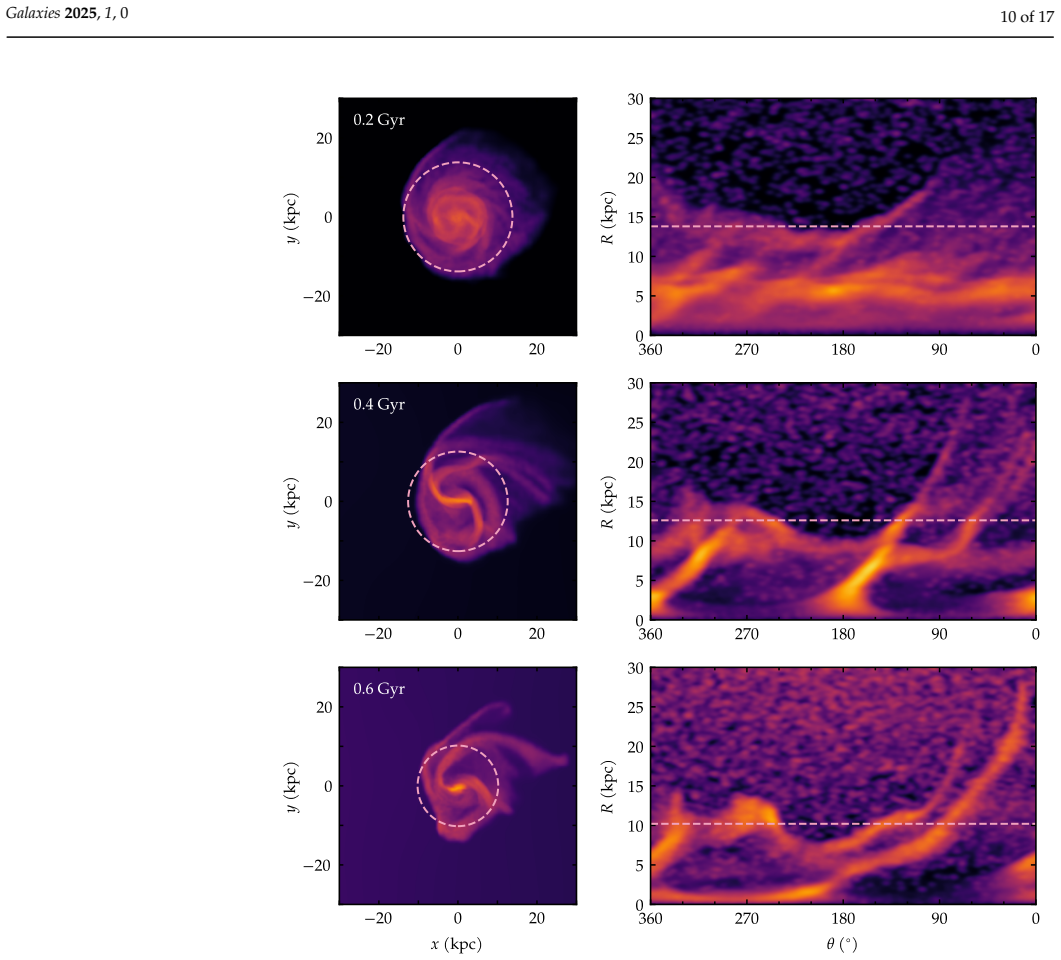
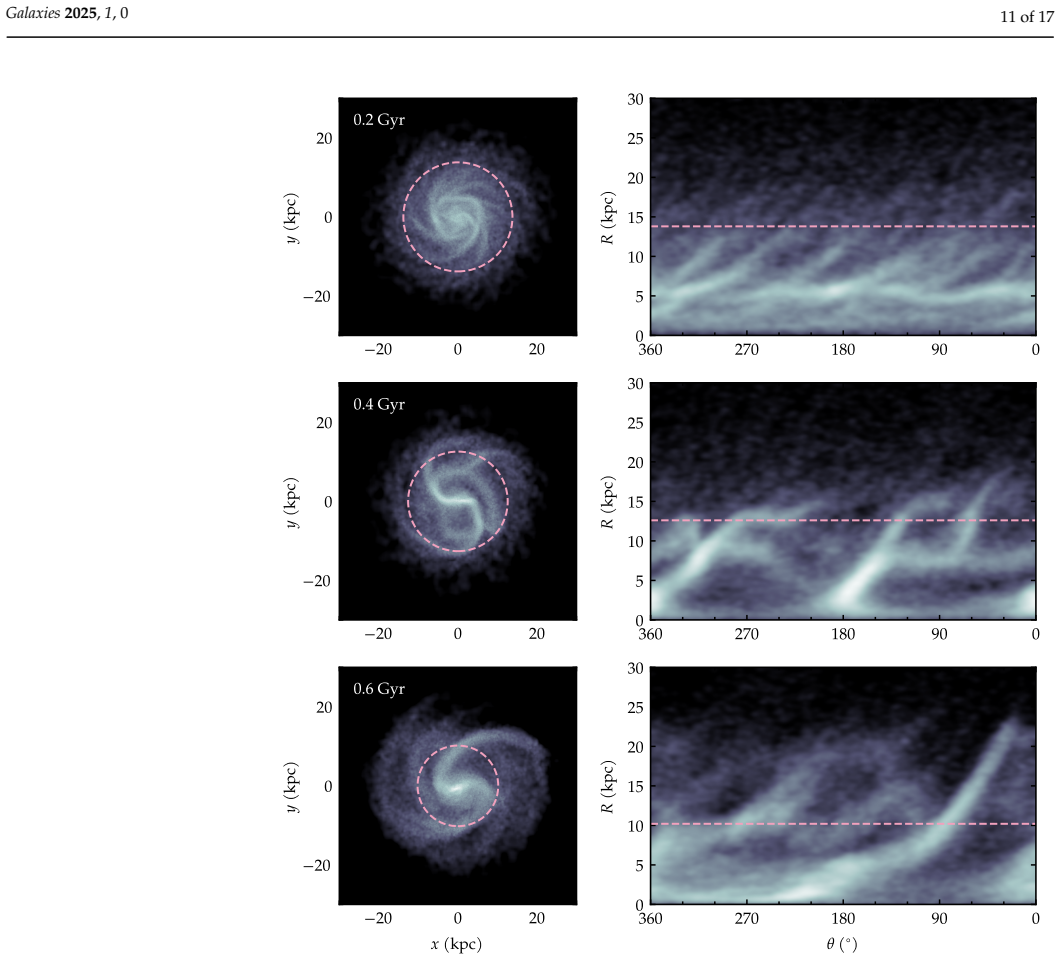
The central tool is the $m=1$ Fourier decomposition of projected mass: in each cylindrical annulus, $A_1(R)=\sqrt{a_1^2+b_1^2}/a_0$ measures how much of the disk's mass lies on one side. The asymmetry radius $R_s$, the first minimum to the left of the $A_1(R)$ peak, locates where the disk stops being symmetric. The Radon transform supplies the projected direction of greatest elongation, effectively the angle of the 'tail' relative to the wind. Unwrapped azimuthal plots of radius versus angle translate a tightly wound arm into a flat feature and an unwound arm into an upward branch, letting the authors compare how far gas and stellar arms extend beyond $R_s$.
What would settle it
Re-run the same galaxy infall at several higher and lower mass resolutions and compare the $A_1(R)$ peaks, the $R_s$ evolution, and the extra reach of gas arms over stellar arms; if those metrics do not converge, the unwinding asymmetry is a resolution artifact rather than a ram-pressure morphology.
Extended reading notes
Core claim
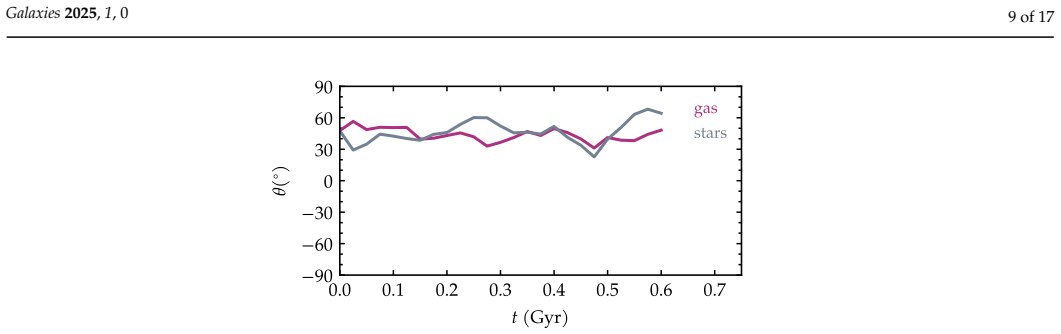
On the paper's own terms, the central discovery is that edge-on ram pressure stripping naturally unwinds a disk galaxy's spiral arms, an effect already suspected but here quantified in both gas and stars. The $m=1$ amplitude $A_1(R)$, measured from Fourier coefficients of the projected mass in cylindrical annuli, peaks at the radius of greatest asymmetry; in the gas the peaks are pronounced and grow with time, while in the stars $A_1$ is much smaller but still rises. The asymmetry radius $R_s$, defined as the first minimum to the left of the $A_1$ peak, starts beyond about 20 kpc and migrates inward to about 10 kpc, meaning the disturbance propagates from the outskirts into the disk. Azimuthal plots of radius against angle show that gas arms rise into long upward branches that extend well beyond the same arms traced in stars, so the gas arms are more open and more unwound. The global elongation direction, found with a Radon transform, stays roughly 45 degrees from the wind, confined to the quadrant consistent with the galaxy's counter-clockwise rotation.
Load-bearing premise
The whole result rests on the assumed particle resolution being high enough to resolve the spiral arms and their unwinding, and the paper explicitly defers a systematic convergence study.
Editorial extensions
If this is right
- Observational classifications of ram-pressure-stripped galaxies should look for gas spiral arms that extend far beyond the stellar arms, especially at radii outside $R_s$.
- The inward migration of $R_s$ over time gives a phase indicator: a stripped galaxy with asymmetry confined to the outer disk is in an earlier stage than one whose asymmetry reaches to about 10 kpc.
- A measured elongation angle near 45 degrees from the direction of motion, set by the sense of rotation, can help infer the wind geometry in edge-on stripping cases.
- The stellar asymmetry, though small, should be present and dominated by young stars, because star formation in the disturbed gas imprints the unwound morphology onto part of the stellar disk.
- Near the cluster center the distortions are increasingly tidal rather than ram-pressure driven, so classifications should be trusted mainly during infall, before the galaxy reaches the core.
Reading between the lines
- Beyond the paper's own analysis, the same Fourier and azimuthal measurements could be applied to observed face-on stripped galaxies in broadband and H-alpha images, turning $R_s$ into a directly observable stripping-stage indicator.
- A resolution convergence test at fixed initial conditions would settle whether the gas-vs-stars arm-length difference survives; the authors themselves defer such a study.
- One could split simulated stellar particles by age and check that recent star formation traces the unwound gas arms, testing the expected young-star dominance in the unwound component.
- The consistent 45-degree elongation angle suggests that velocity-field maps of edge-on stripped galaxies should show streaming motions offset from the wind axis, a kinematic signature that could separate ram pressure from tidal tails.
Editorial analysis
A structured set of objections, weighed in public.
Referee Report
Summary. The paper uses a single Gadget-3 simulation of a disk galaxy falling radially into a galaxy cluster with the wind edge-on, and quantifies the resulting non-axisymmetric morphology through m=1 Fourier amplitudes A1(R), a derived asymmetry radius Rs, and Radon-transform elongation angles. It reports that the gas develops pronounced, time-increasing unwinding with the asymmetry radius migrating inward, while the stellar disk shows a smaller but measurable A1 signal, and that gas spiral arms extend further than the corresponding stellar arms. An isolated-galaxy control is presented in Appendix A to argue that the gas asymmetry is not due to secular evolution.
Significance. If substantiated, the gas-side result provides a quantitative characterization of the edge-on ram-pressure unwinding morphology and a useful reference for observational classification of stripped galaxies. The Fourier and Radon measurements are straightforward and the isolated-galaxy control is a good safeguard for the gas interpretation. The stellar claim is the weakest link: the control cannot separate tidal forces from ram pressure, and the paper itself flags tidal contamination at late times. The paper also explicitly defers a systematic resolution convergence study, so the quantitative trends should be treated as preliminary rather than definitive.
major comments (3)
- [Section 3.1, Fig. 7, Appendix A] The claim that the stellar asymmetry is 'also measurable in the stars' and that its amplitude increases with time is not uniquely attributable to ram-pressure-induced unwinding. The only control run, Appendix A, is an isolated galaxy in vacuum; it controls for secular evolution but cannot separate the cluster's tidal gravitational field from ram pressure. Section 3.1 itself states that the apparent stellar asymmetry near t~0.8 Gyr cannot be confidently attributed to ram pressure and is more likely due to strong tidal forces near the cluster center. Since Fig. 7 shows a monotonic increase of stellar A1max over the full interval and the abstract places no time restriction, the stellar component of the headline result is not demonstrated to be hydrodynamically driven. Please either restrict the stellar claim to early snapshots with an explicit caveat, or add a control run with the cluster potential but without the ICM gas so that tidal and ram-pressure effects can be separated.
- [Section 2, Figs. 6 and 7] The quantitative trends—A1max increasing with time and Rs migrating inward—rest on a single simulation with no resolution convergence study (acknowledged in Section 2: 'A systematic convergence study is deferred to a future work') and no error bars or noise estimates in Figs. 6 and 7. The A1(R) profiles are described in Section 3.2 as 'generally noisy,' and for the stars Rs is explicitly called 'ill-defined and difficult to determine.' A bootstrap or scatter estimate over radial bins, or at least a second realization, is needed before the time-evolution of A1max and Rs can be considered robust, especially for the stellar component.
- [Section 3.2, lower panel of Fig. 7] The definition of the asymmetry radius Rs as 'the first minimum to the left of the peak of A1(R)' is sensitive to the noise in the radial profiles and to the choice of radial binning. Since the inward migration of Rs is a central result highlighted in the abstract and discussion, the stability of this measurement should be demonstrated, for example by varying bin width or by smoothing the profiles. Without such a test, the quoted migration from about 20 kpc to about 10 kpc is not sufficiently justified.
minor comments (5)
- [Section 3.2] Typos: 'quatify' should be 'quantify' and 'distribuition' should be 'distribution'; similar typographical errors appear elsewhere, including 'reminescent' in the Introduction, 'alhtough' and 'efects' in the Discussion, and 'the the' and 'develps' in Section 4.
- [Appendix B, Eq. (A1)] Equation (A1) is incomplete as typeset ('˜f = R L f (x, y)ds'); the integral notation is mangled and should be corrected to match the explicit form given in Eq. (A2).
- [Figs. 6 and A2] The legend entries in Figs. 6 and A2 appear as overlapping 'gasgasgas' and 'starsstarsstars' labels, obscuring the line identification; please fix the legend rendering.
- [Section 3.2] The sentence 'The Rs are in principle measurable, but are ill-defined and difficult to determine' is contradictory; please clarify that Rs is defined from the gas profiles and is not reliably measurable for the stars.
- [Section 2, Fig. 2] The text says 'the first two panels of Fig. 2,' but Fig. 2 contains four panels; please specify which two are meant, or refer to the figure as a whole.
Circularity Check
No significant circularity: the A1 asymmetry measurements are direct Fourier sums over simulated particles, the isolated-galaxy control separates secular evolution, and the stellar-tide caveat is a confound, not a circular derivation.
full rationale
The paper is an experiment rather than a derivation chain: the central quantity A1 is defined in Eqs. (3)-(6) as a direct Fourier decomposition of the simulated particle distribution (a1 = sum of m_i cos(theta_i), b1 = sum of m_i sin(theta_i), A1 = sqrt(a1^2 + b1^2)/a0), with no parameter fitted to the measured asymmetry. The unwinding claim is therefore read off the simulation output, not derived from an input that already contains it. The Appendix A isolated-galaxy run provides a control against secular evolution, and the paper explicitly notes in Section 3.1 that late-time stellar asymmetry "cannot be confidently attributed to ram pressure effects" and is "more likely due to strong tidal forces near the cluster center"; this is a limitation of the tidal/ram-pressure control, not a circular step. The only reference that includes one of the present authors (Krone-Martins et al. 2013, cited for the Radon transform) concerns a standard image-analysis tool and is not load-bearing for the unwinding claim. No equation is equivalent to another by construction, and no fitted parameter is renamed as a prediction. The deliberate choice of an edge-on radial orbit is a setup choice that maximizes the effect, but the measured asymmetry still emerges from the hydrodynamical simulation rather than being imposed by the measurement definition.
Assumptions & free parameters
free parameters (4)
- fR (velocity dispersion anisotropy) =
0.8
- Gas disk vertical scale length zg =
0.035 zd (0.0245 kpc)
- Galaxy orbital initial conditions =
x=1000 kpc, vx=-1000 km/s (radial, edge-on)
- Cluster ICM gas mass and scale length =
1e13 Msun, a_g=280 kpc
assumptions (5)
- domain assumption Hernquist density profiles for bulge, dark matter halo, cluster DM and ICM gas
- domain assumption Gadget-3 with star formation correctly models the hydrodynamics and gravity of the ISM-ICM interaction on the resolved scales
- standard math Ram pressure formula P_ram = rho_ICM v^2 applies
- domain assumption Early-time asymmetries are due to ram pressure rather than tidal forces
- domain assumption Frozen analytic cluster DM potential adequately represents the cluster halo
Cite this review
Pith. "Pith review of Quantifying the unwinding due to ram pressure stripping in simulated galaxies." pith.science (2026). https://pith.science/paper/SS5NJUQ4
@misc{pith2026250702555,
  author       = {Pith},
  title        = {Pith review of: Quantifying the unwinding due to ram pressure stripping in simulated galaxies},
  year         = {2026},
  howpublished = {\url{https://pith.science/paper/SS5NJUQ4}},
  note         = {Machine review of arXiv:2507.02555}
}
read the original abstract
Galaxies moving through the gas of the intracluster medium (ICM) experience ram pressure stripping, which can leave behind a gas tail. When a disk galaxy receives the wind edge-on, however, the characteristic signature is not a typical jellyfish tail, but rather an unwinding of the spiral arms. We aim to quantify such asymmetries both in the gas and in the stellar component of a simulated galaxy. To this end, we simulate a gas-rich star-forming spiral galaxy moving through a self-consistent ICM gas. The amplitude and location of the asymmetries were measured via Fourier decomposition. We found that the asymmetry is much more evident in the gas component, but it is also measurable in the stars. The amplitude tends to increase with time and the asymmetry radius migrates inwards. We found that, when considering the gas, the spiral arms extend much further and are more unwound than the corresponding stellar arms. Characterizing the unwinding via simulations should help inform the observational criteria used to classify ram pressure stripped galaxies, as opposed to asymmetries induced by other mechanisms.
Figures


Figures from the paper (7 more)


Reference graph
Works this paper leans on
-
[1]
Gunn, J.E.; Gott, J. Richard, I. On the Infall of Matter Into Clusters of Galaxies and Some Effects on Their Evolution. Astrophys. J. 1972, 176, 1. https://doi.org/10.1086/151605
doi:10.1086/151605 1972
-
[2]
Ram pressure stripping in high-density environments
Boselli, A.; Fossati, M.; Sun, M. Ram pressure stripping in high-density environments. Astron. Astrophys. Rev. 2022, 30, 3, [arXiv:astro-ph.GA/2109.13614]. https://doi.org/10.1007/s00159-022-00140-3
arXiv 2022
-
[3]
Poggianti, B.M.; Moretti, A.; Gullieuszik, M.; Fritz, J.; Jaffé, Y.; Bettoni, D.; Fasano, G.; Bellhouse, C.; Hau, G.; Vulcani, B.; et al. GASP . I. Gas Stripping Phenomena in Galaxies with MUSE. Astrophys. J. 2017, 844, 48, [arXiv:astro-ph.GA/1704.05086]. https://doi.org/10.3847/1538-4357/aa78ed
arXiv 2017
-
[4]
Gullieuszik, M.; Poggianti, B.M.; Moretti, A.; Fritz, J.; Jaffé, Y.L.; Hau, G.; Bischko, J.C.; Bellhouse, C.; Bettoni, D.; Fasano, G.; et al. GASP . IV . A Muse View of Extreme Ram-pressure-stripping in the Plane of the Sky: The Case of Jellyfish Galaxy JO204.Astrophys. J. 2017, 846, 27, [arXiv:astro-ph.GA/1708.09035]. https://doi.org/10.3847/1538-4357/aa8322
arXiv 2017
-
[5]
Jaffé, Y.L.; Poggianti, B.M.; Moretti, A.; Gullieuszik, M.; Smith, R.; Vulcani, B.; Fasano, G.; Fritz, J.; Tonnesen, S.; Bettoni, D.; et al. GASP . IX. Jellyfish galaxies in phase-space: an orbital study of intense ram-pressure stripping in clusters.Mon. Not. R. Astron. Soc. 2018, 476, 4753–4764, [arXiv:astro-ph.GA/1802.07297]. https://doi.org/10.1093/mnr...
arXiv 2018
-
[6]
Ram pressure stripping of disc galaxies: The role of the inclination angle
Roediger, E.; Brüggen, M. Ram pressure stripping of disc galaxies: the role of the inclination angle. Mon. Not. R. Astron. Soc. 2006, 369, 567–580, [arXiv:astro-ph/astro-ph/0512365]. https://doi.org/10.1111/j.1365-2966.2006.10335.x
work page Pith review arXiv 2006
-
[7]
Star formation in ram pressure stripped galactic tails
Tonnesen, S.; Bryan, G.L. Star formation in ram pressure stripped galactic tails. Mon. Not. R. Astron. Soc. 2012, 422, 1609–1624, [arXiv:astro-ph.CO/1203.0308]. https://doi.org/10.1111/j.1365-2966.2012.20737.x
arXiv 2012
-
[8]
Steinhauser, D.; Haider, M.; Kapferer, W.; Schindler, S. Galaxies undergoing ram-pressure stripping: the influence of the bulge on morphology and star formation rate. Astron. Astrophys. 2012, 544, A54, [arXiv:astro-ph.CO/1208.1265]. https: //doi.org/10.1051/0004-6361/201118311. Galaxies 2025, 1, 0 16 of 17
work page Pith review arXiv 2012
Show all 43 references
-
[9]
It’s Cloud’s Illusions I Recall: Mixing Drives the Acceleration of Clouds from Ram Pressure Stripped Galaxies
Tonnesen, S.; Bryan, G.L. It’s Cloud’s Illusions I Recall: Mixing Drives the Acceleration of Clouds from Ram Pressure Stripped Galaxies. Astrophys. J. 2021, 911, 68, [arXiv:astro-ph.GA/2102.05061]. https://doi.org/10.3847/1538-4357/abe7e2
2021 arXiv
-
[10]
How Ram Pressure Drives Radial Gas Motions in the Surviving Disk
Akerman, N.; Tonnesen, S.; Poggianti, B.M.; Smith, R.; Marasco, A. How Ram Pressure Drives Radial Gas Motions in the Surviving Disk. Astrophys. J. 2023, 948, 18, [arXiv:astro-ph.GA/2301.09652]. https://doi.org/10.3847/1538-4357/acbf4d
2023 arXiv
-
[11]
Jellyfish galaxies with the IllustrisTNG simulations - I
Yun, K.; Pillepich, A.; Zinger, E.; Nelson, D.; Donnari, M.; Joshi, G.; Rodriguez-Gomez, V .; Genel, S.; Weinberger, R.; Vogelsberger, M.; et al. Jellyfish galaxies with the IllustrisTNG simulations - I. Gas-stripping phenomena in the full cosmological context. Mon. Not. R. As...
2019 arXiv
-
[12]
The fate of disc galaxies in IllustrisTNG clusters
Joshi, G.D.; Pillepich, A.; Nelson, D.; Marinacci, F.; Springel, V .; Rodriguez-Gomez, V .; Vogelsberger, M.; Hernquist, L. The fate of disc galaxies in IllustrisTNG clusters. Mon. Not. R. Astron. Soc. 2020, 496, 2673–2703, [arXiv:astro-ph.GA/2004.01191]. https://doi.org/10.10...
2020 arXiv
-
[13]
Jellyfish galaxies with the IllustrisTNG simulations - when, where, and for how long does ram pressure stripping of cold gas occur? Mon
Rohr, E.; Pillepich, A.; Nelson, D.; Zinger, E.; Joshi, G.D.; Ayromlou, M. Jellyfish galaxies with the IllustrisTNG simulations - when, where, and for how long does ram pressure stripping of cold gas occur? Mon. Not. R. Astron. Soc. 2023, 524, 3502–3525, [arXiv:astro-ph.GA/230...
2023 arXiv
-
[14]
The better half - asymmetric star formation due to ram pressure in the EAGLE simulations
Troncoso-Iribarren, P .; Padilla, N.; Santander, C.; Lagos, C.D.P .; García-Lambas, D.; Rodríguez, S.; Contreras, S. The better half - asymmetric star formation due to ram pressure in the EAGLE simulations. Mon. Not. R. Astron. Soc. 2020, 497, 4145–4161, [arXiv:astro-ph.GA/200...
2020 arXiv
-
[15]
Ram Pressure Stripping in the EAGLE Simulation
Kulier, A.; Poggianti, B.; Tonnesen, S.; Smith, R.; Ignesti, A.; Akerman, N.; Marasco, A.; Vulcani, B.; Moretti, A.; Wolter, A. Ram Pressure Stripping in the EAGLE Simulation. Astrophys. J. 2023, 954, 177, [arXiv:astro-ph.GA/2305.03758]. https: //doi.org/10.3847/1538-4357/aceda3
2023 arXiv
-
[16]
GASP XXIX - unwinding the arms of spiral galaxies via ram-pressure stripping
Bellhouse, C.; McGee, S.L.; Smith, R.; Poggianti, B.M.; Jaffé, Y.L.; Kraljic, K.; Franchetto, A.; Fritz, J.; Vulcani, B.; Tonnesen, S.; et al. GASP XXIX - unwinding the arms of spiral galaxies via ram-pressure stripping. Mon. Not. R. Astron. Soc. 2021, 500, 1285–1312, [arXiv:a...
2021 arXiv
-
[17]
Multi stage three-dimensional sweeping and annealing of disc galaxies in clusters
Schulz, S.; Struck, C. Multi stage three-dimensional sweeping and annealing of disc galaxies in clusters. Mon. Not. R. Astron. Soc. 2001, 328, 185–202, [arXiv:astro-ph/astro-ph/0107570]. https://doi.org/10.1046/j.1365-8711.2001.04847.x
2001 arXiv
-
[18]
Star formation in shocked cluster spirals and their tails
Roediger, E.; Bruggen, M.; Owers, M.S.; Ebeling, H.; Sun, M. Star formation in shocked cluster spirals and their tails. Mon. Not. R. Astron. Soc. 2014, 443, L114–L118, [arXiv:astro-ph.GA/1405.1033]. https://doi.org/10.1093/mnrasl/slu087
2014 arXiv
-
[19]
Simulations of ram-pressure stripping in galaxy-cluster interactions
Steinhauser, D.; Schindler, S.; Springel, V . Simulations of ram-pressure stripping in galaxy-cluster interactions. Astron. Astrophys. 2016, 591, A51, [arXiv:astro-ph.GA/1604.05193]. https://doi.org/10.1051/0004-6361/201527705
2016 arXiv
-
[20]
NGC 2276: a remarkable galaxy with a large number of ultraluminous X-ray sources
Wolter, A.; Esposito, P .; Mapelli, M.; Pizzolato, F.; Ripamonti, E. NGC 2276: a remarkable galaxy with a large number of ultraluminous X-ray sources. Mon. Not. R. Astron. Soc. 2015, 448, 781–791, [arXiv:astro-ph.HE/1501.01994]. https: //doi.org/10.1093/mnras/stv054
2015 arXiv
-
[21]
Bellhouse, C.; Jaffé, Y.L.; Hau, G.K.T.; McGee, S.L.; Poggianti, B.M.; Moretti, A.; Gullieuszik, M.; Bettoni, D.; Fasano, G.; D’Onofrio, M.; et al. GASP . II. A MUSE View of Extreme Ram-Pressure Stripping along the Line of Sight: Kinematics of the Jellyfish Galaxy JO201. Astro...
2017 arXiv
-
[22]
UVIT view of ram-pressure stripping in action: star formation in the stripped gas of the GASP jellyfish galaxy JO201 in Abell 85
George, K.; Poggianti, B.M.; Gullieuszik, M.; Fasano, G.; Bellhouse, C.; Postma, J.; Moretti, A.; Jaffé, Y.; Vulcani, B.; Bettoni, D.; et al. UVIT view of ram-pressure stripping in action: star formation in the stripped gas of the GASP jellyfish galaxy JO201 in Abell 85. Mon. ...
2018 arXiv
-
[23]
Two Orders of Magnitude Variation in the Star Formation Efficiency across the Premerger Galaxy NGC 2276.Astrophys
Tomiˇ ci´ c, N.; Hughes, A.; Kreckel, K.; Renaud, F.; Pety, J.; Schinnerer, E.; Saito, T.; Querejeta, M.; Faesi, C.M.; Garcia-Burillo, S. Two Orders of Magnitude Variation in the Star Formation Efficiency across the Premerger Galaxy NGC 2276.Astrophys. J. Lett. 2018, 869, L38,...
2018 arXiv
-
[24]
The Relevance of Ram Pressure Stripping for the Evolution of Blue Cluster Galaxies as Seen at Optical Wavelengths
Vulcani, B.; Poggianti, B.M.; Smith, R.; Moretti, A.; Jaffé, Y.L.; Gullieuszik, M.; Fritz, J.; Bellhouse, C. The Relevance of Ram Pressure Stripping for the Evolution of Blue Cluster Galaxies as Seen at Optical Wavelengths. Astrophys. J. 2022, 927, 91, [arXiv:astro-ph.GA/2201....
2022 arXiv
-
[25]
Candidate ram-pressure stripped galaxies in six low-redshift clusters revealed from ultraviolet imaging
George, K.; Poggianti, B.M.; Omizzolo, A.; Vulcani, B.; Côté, P .; Postma, J.; Smith, R.; Jaffe, Y.L.; Gullieuszik, M.; Moretti, A.; et al. Candidate ram-pressure stripped galaxies in six low-redshift clusters revealed from ultraviolet imaging. Astron. Astrophys. 2024, 690, A3...
2024 arXiv
-
[26]
Diagnostic diagrams for ram pressure stripped candidates.Mon
Krabbe, A.C.; Hernandez-Jimenez, J.A.; Mendes de Oliveira, C.; Jaffe, Y.L.; Oliveira, C.B.; Cardoso, N.M.; Smith Castelli, A.V .; Dors, O.L.; Cortesi, A.; Crossett, J.P . Diagnostic diagrams for ram pressure stripped candidates.Mon. Not. R. Astron. Soc. 2024, 528, 1125–1141, [...
2024 arXiv
-
[27]
Identifi- cation of ram pressure stripping features in galaxies using citizen science
Crossett, J.P .; Jaffé, Y.L.; McGee, S.L.; Smith, R.; Bellhouse, C.; Bettoni, D.; Vulcani, B.; Kelkar, K.; Lourenço, A.C.C. Identifi- cation of ram pressure stripping features in galaxies using citizen science. Astron. Astrophys. 2025, 694, A204, [arXiv:astro- ph.GA/2412.10060...
2025 arXiv
-
[28]
Lopsided galaxies in a cosmological context: a new galaxy-halo connection
Varela-Lavin, S.; Gómez, F.A.; Tissera, P .B.; Besla, G.; Garavito-Camargo, N.; Marinacci, F.; Laporte, C.F.P . Lopsided galaxies in a cosmological context: a new galaxy-halo connection. Mon. Not. R. Astron. Soc. 2023, 523, 5853–5868, [arXiv:astro- ph.GA/2211.16577]. https://d...
2023 arXiv
-
[29]
An analytical model for spherical galaxies and bulges
Hernquist, L. An analytical model for spherical galaxies and bulges. Astrophys. J. 1990, 356, 359–364. https://doi.org/10.1086/16 8845
1990 doi
-
[30]
Modelling feedback from stars and black holes in galaxy mergers.Mon
Springel, V .; Di Matteo, T.; Hernquist, L. Modelling feedback from stars and black holes in galaxy mergers.Mon. Not. R. Astron. Soc. 2005, 361, 776–794, [arXiv:astro-ph/astro-ph/0411108]. https://doi.org/10.1111/j.1365-2966.2005.09238.x. Galaxies 2025, 1, 0 17 of 17
2005 arXiv
-
[31]
The fate of the gaseous discs of galaxies that fall into clusters
Ruggiero, R.; Lima Neto, G.B. The fate of the gaseous discs of galaxies that fall into clusters. Mon. Not. R. Astron. Soc. 2017, 468, 4107–4115, [1703.08550]. https://doi.org/10.1093/mnras/stx744
2017 arXiv
-
[32]
First results from the IllustrisTNG simulations: matter and galaxy clustering
Springel, V .; Pakmor, R.; Pillepich, A.; Weinberger, R.; Nelson, D.; Hernquist, L.; Vogelsberger, M.; Genel, S.; Torrey, P .; Marinacci, F.; et al. First results from the IllustrisTNG simulations: matter and galaxy clustering. Mon. Not. R. Astron. Soc. 2018, 475, 676–698, [ar...
2018 arXiv
-
[33]
Spiral Instabilities in N-body Simulations
Sellwood, J.A. Spiral Instabilities in N-body Simulations. I. Emergence from Noise. Astrophys. J. 2012, 751, 44, [arXiv:astro- ph.GA/1203.0444]. https://doi.org/10.1088/0004-637X/751/1/44
2012 arXiv
-
[34]
Relaxation in N-body Simulations of Disk Galaxies.Astrophys
Sellwood, J.A. Relaxation in N-body Simulations of Disk Galaxies.Astrophys. J. Lett. 2013, 769, L24, [arXiv:astro-ph.CO/1303.4919]. https://doi.org/10.1088/2041-8205/769/2/L24
2013 arXiv
-
[35]
First results from the TNG50 simulation: galactic outflows driven by supernovae and black hole feedback
Nelson, D.; Pillepich, A.; Springel, V .; Pakmor, R.; Weinberger, R.; Genel, S.; Torrey, P .; Vogelsberger, M.; Marinacci, F.; Hernquist, L. First results from the TNG50 simulation: galactic outflows driven by supernovae and black hole feedback. Mon. Not. R. Astron. Soc. 2019,...
2019 arXiv
-
[36]
The redshift evolution of galactic bar pattern speed in TNG50
Habibi, A.; Roshan, M.; Hosseinirad, M.; Khosroshahi, H.; Aguerri, J.A.L.; Cuomo, V .; Abbassi, S. The redshift evolution of galactic bar pattern speed in TNG50. Astron. Astrophys. 2024, 691, A122, [arXiv:astro-ph.GA/2409.02456]. https://doi.org/10.105 1/0004-6361/202451028
2024 arXiv
-
[37]
Revisiting the tension between fast bars and the ΛCDM paradigm
Fragkoudi, F.; Grand, R.J.J.; Pakmor, R.; Springel, V .; White, S.D.M.; Marinacci, F.; Gomez, F.A.; Navarro, J.F. Revisiting the tension between fast bars and the ΛCDM paradigm. Astron. Astrophys. 2021, 650, L16, [arXiv:astro-ph.GA/2011.13942]. https://doi.org/10.1051/0004-636...
2021 arXiv
-
[38]
The cosmological simulation code GADGET-2
Springel, V . The cosmological simulation code GADGET-2. Mon. Not. R. Astron. Soc. 2005, 364, 1105–1134, [arXiv:astro- ph/0505010]. https://doi.org/10.1111/j.1365-2966.2005.09655.x
2005
-
[39]
SDSS-IV MaNGA: characterizing non-axisymmetric motions in galaxy velocity fields using the Radon transform
Stark, D.V .; Bundy, K.A.; Westfall, K.; Bershady, M.; Weijmans, A.M.; Masters, K.L.; Kruk, S.; Brinchmann, J.; Soler, J.; Abraham, R.; et al. SDSS-IV MaNGA: characterizing non-axisymmetric motions in galaxy velocity fields using the Radon transform. Mon. Not. R. Astron. Soc. ...
2018 arXiv
-
[40]
Pushing the limits of the Gaia space mission by analyzing galaxy morphology
Krone-Martins, A.; Ducourant, C.; Teixeira, R.; Galluccio, L.; Gavras, P .; dos Anjos, S.; de Souza, R.E.; Machado, R.E.G.; Le Campion, J.F. Pushing the limits of the Gaia space mission by analyzing galaxy morphology. Astron. Astrophys. 2013, 556, A102, [arXiv:astro-ph.IM/1307...
2013 arXiv
-
[41]
Ram pressure stripping of disc galaxies orbiting in clusters - I
Roediger, E.; Brüggen, M. Ram pressure stripping of disc galaxies orbiting in clusters - I. Mass and radius of the remaining gas disc. Mon. Not. R. Astron. Soc. 2007, 380, 1399–1408, [arXiv:astro-ph/0707.2698]. https://doi.org/10.1111/j.1365-2966.2007.12241.x
2007 arXiv
-
[42]
Ram pressure drag - the effects of ram pressure on dark matter and stellar disc dynamics
Smith, R.; Fellhauer, M.; Assmann, P . Ram pressure drag - the effects of ram pressure on dark matter and stellar disc dynamics. Mon. Not. R. Astron. Soc. 2012, 420, 1990–2005, [arXiv:astro-ph.CO/1110.5555]. https://doi.org/10.1111/j.1365-2966.2011.20077.x
2012 arXiv
-
[43]
The Journey Counts: The Importance of Including Orbits when Simulating Ram Pressure Stripping
Tonnesen, S. The Journey Counts: The Importance of Including Orbits when Simulating Ram Pressure Stripping. Astrophys. J. 2019, 874, 161, [arXiv:astro-ph.GA/1903.08178]. https://doi.org/10.3847/1538-4357/ab0960. Disclaimer/Publisher’s Note: The statements, opinions and data co...
2019 arXiv
Reviewed August 6, 2026 · model on record in the stance chip above.
Discussion (0). Sign in to comment.