An Adaptive Glicko-2 Rating Framework for Probabilistic Football Forecasting and Season Simulation
Pith reviewed 2026-07-03 03:30 UTC · model grok-4.3
The pith
Extending Glicko-2 with margin-of-victory, dominance, shocks, home advantage and ordered-logit draws produces dynamic team ratings that convert to win-draw-loss probabilities for Monte Carlo league simulations.
A machine-rendered reading of the paper's core claim, the machinery that carries it, and where it could break.
Core claim
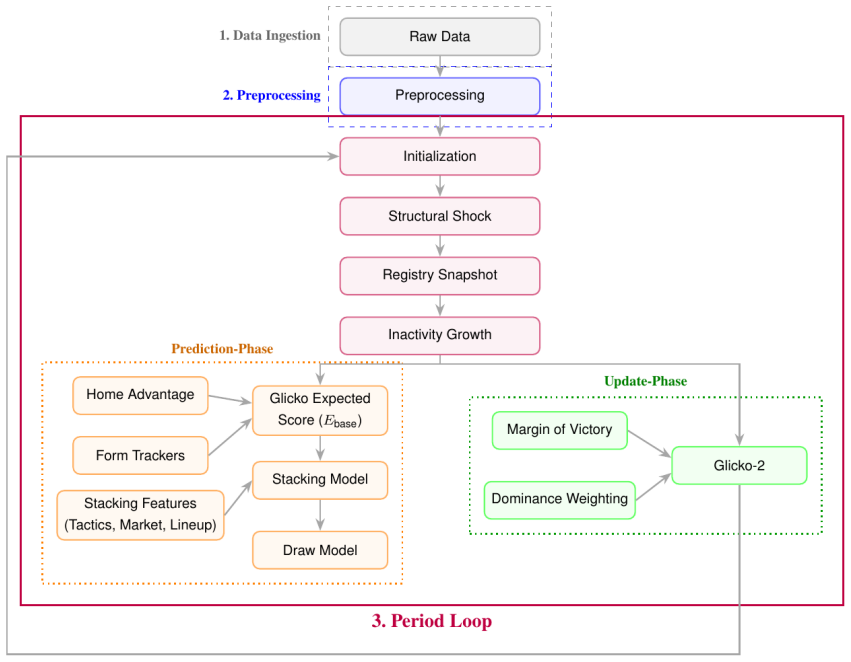
The framework extends the standard Glicko-2 model by incorporating football-specific mechanisms, including margin-of-victory adjustment, dominance weighting, structural shocks, home advantage modelling, and an ordered-logit draw model. The framework estimates latent team strength dynamically, converts rating differences into win-draw-loss probabilities, and uses these probabilities to simulate the remaining part of a league season through Monte Carlo sampling.
What carries the argument
The adaptive Glicko-2 rating system augmented with margin-of-victory adjustment, dominance weighting, structural shocks, home advantage and an ordered-logit draw model that turns rating gaps into ordered outcome probabilities.
If this is right
- Team ratings update after every match using margin and home information rather than binary results alone.
- Win, draw and loss probabilities are obtained directly from the difference in current ratings via the ordered-logit component.
- Monte Carlo sampling of remaining fixtures yields probability distributions over final league tables.
- Structural shocks allow abrupt changes in a team's latent strength to be absorbed without manual intervention.
- Dominance weighting scales the impact of a result according to how convincingly it was achieved.
Where Pith is reading between the lines
- The same machinery could be tested on other draw-heavy sports such as ice hockey or field hockey to check transferability.
- If the probabilities prove well-calibrated, the system supplies a ready-made generator for synthetic match histories usable in strategy research.
- Real-time rating updates after each round would allow running conditional simulations that incorporate the latest results.
- Comparison against simpler Elo or unmodified Glicko-2 baselines on the same data would quantify the incremental value of each added mechanism.
Load-bearing premise
The added football-specific mechanisms accurately capture latent team strength dynamics and outcome probabilities in football without post-hoc fitting bias.
What would settle it
Running the full season simulation on historical league data and checking whether the empirical frequency of simulated final standings and match outcomes matches the observed frequencies across multiple seasons.
Figures
read the original abstract
Football match outcome prediction is a challenging problem because team strength changes over time, match outcomes contain a high level of randomness, and draws play a central role in the result structure. Classical rating systems such as Elo provide simple and interpretable dynamic summaries of team ability, but they do not explicitly model uncertainty and often ignore football-specific contextual information. This paper proposes an adaptive Glicko-2-based rating framework for probabilistic football forecasting and leaguelevel season simulation. The proposed framework extends the standard Glicko-2 model by incorporating football-specific mechanisms, including margin-of-victory adjustment, dominance weighting, structural shocks, home advantage modelling, and an ordered-logit draw model. The framework estimates latent team strength dynamically, converts rating differences into win-draw-loss probabilities, and uses these probabilities to simulate the remaining part of a league season through Monte Carlo sampling.
Editorial analysis
A structured set of objections, weighed in public.
Referee Report
Summary. The paper claims to propose an adaptive Glicko-2-based rating framework for probabilistic football forecasting and league-level season simulation. It extends the standard Glicko-2 model with five football-specific mechanisms (margin-of-victory adjustment, dominance weighting, structural shocks, home advantage modelling, and an ordered-logit draw model), dynamically estimates latent team strength, converts rating differences to win-draw-loss probabilities, and uses Monte Carlo sampling for remaining-season simulations.
Significance. If the extensions are explicitly defined with low parameter count (five free parameters) and produce coherent forecasts, the work could contribute a practical, interpretable dynamic rating system tailored to football's randomness and draw frequency. Credit is due for the explicit modeling of draws via ordered logit and the inclusion of structural shocks to handle time-varying strength. However, the absence of any reported performance data makes it difficult to assess whether these additions improve upon standard Glicko-2 or other rating systems.
major comments (2)
- [Results section] Results section: The manuscript supplies no validation metrics, error analysis, or performance data (e.g., Brier score, log-loss, or comparison against baseline Glicko-2 on held-out matches), which is load-bearing for the central claim that the framework enables effective probabilistic forecasting and season simulation.
- [Model description (extensions)] Model description (extensions): While the five mechanisms are named, the manuscript does not demonstrate with a concrete out-of-sample test that the fitted parameters (margin-of-victory adjustment, ordered-logit thresholds, etc.) avoid post-hoc fitting bias when generating simulated probabilities, raising a correctness-risk concern for the forecasting application.
Simulated Author's Rebuttal
We thank the referee for their constructive comments, which highlight important gaps in empirical validation. We address each major comment below and will revise the manuscript accordingly to include the requested performance assessments.
read point-by-point responses
-
Referee: [Results section] The manuscript supplies no validation metrics, error analysis, or performance data (e.g., Brier score, log-loss, or comparison against baseline Glicko-2 on held-out matches), which is load-bearing for the central claim that the framework enables effective probabilistic forecasting and season simulation.
Authors: We agree that the current manuscript lacks quantitative validation metrics, as it primarily presents the methodological framework. This is a substantive omission. In revision we will add a results section containing out-of-sample Brier scores, log-loss values, and head-to-head comparisons against standard Glicko-2 on held-out matches from multiple seasons. revision: yes
-
Referee: [Model description (extensions)] While the five mechanisms are named, the manuscript does not demonstrate with a concrete out-of-sample test that the fitted parameters (margin-of-victory adjustment, ordered-logit thresholds, etc.) avoid post-hoc fitting bias when generating simulated probabilities, raising a correctness-risk concern for the forecasting application.
Authors: We concur that explicit out-of-sample validation of the parameter estimates is necessary to address potential post-hoc fitting concerns. The revised manuscript will incorporate temporal hold-out experiments and cross-validation procedures to demonstrate that the five football-specific parameters produce stable probabilistic forecasts without overfitting to the training data. revision: yes
Circularity Check
No significant circularity detected
full rationale
The manuscript proposes an extension of the standard Glicko-2 model by adding five named football-specific components (margin-of-victory adjustment, dominance weighting, structural shocks, home advantage, ordered-logit draw model) and then uses the resulting rating differences to generate win-draw-loss probabilities for Monte Carlo season simulation. No equations or derivation steps are supplied in the available text that reduce any claimed prediction to a fitted parameter by construction, nor is any load-bearing premise justified solely by self-citation. The central claim therefore remains a methodological definition whose outputs are not forced to equal its inputs; the framework is self-contained against external benchmarks once the added mechanisms are specified.
Axiom & Free-Parameter Ledger
free parameters (5)
- margin-of-victory adjustment
- home advantage parameter
- ordered-logit draw thresholds
- dominance weighting factor
- structural shock variance
axioms (2)
- domain assumption Team strength evolves dynamically and can be tracked via Bayesian updates
- domain assumption Match outcomes follow an ordered-logit distribution conditional on rating difference
Reference graph
Works this paper leans on
-
[1]
Elo, A. E. (1978).The Rating of Chessplayers, Past and Present. Arco Publishing
work page 1978
-
[2]
Glickman, M. E. (1999). Parameter estimation in large dynamic paired comparison ex- periments.Journal of the Royal Statistical Society: Series C (Applied Statistics), 48(3), 377–394
work page 1999
-
[3]
Glickman, M. E. (2022).Example of the Glicko-2 System. Boston University. Available at:https://www.glicko.net/glicko/glicko2.pdf
work page 2022
-
[4]
Hvattum, L. M., & Arntzen, H. (2010). Using ELO ratings for match result prediction in association football.International Journal of Forecasting, 26(3), 460–470. 15
work page 2010
-
[5]
Dixon, M.J., &Coles, S.G.(1997).Modellingassociationfootballscoresandinefficiencies in the football betting market.Journal of the Royal Statistical Society: Series C (Applied Statistics), 46(2), 265–280
work page 1997
-
[6]
Rue, H., & Salvesen, O. (2000). Prediction and retrospective analysis of soccer matches in a league.Journal of the Royal Statistical Society: Series D (The Statistician), 49(3), 399–418
work page 2000
-
[7]
Suzuki, A. K., Salasar, L. E. B., Leite, J. G., & Louzada-Neto, F. (2010). A Bayesian approach for predicting match outcomes: The 2006 Association Football World Cup. Journal of the Operational Research Society, 61(10), 1530–1539
work page 2010
-
[8]
Ryall, R., & Bedford, A. (2010). An optimized ratings-based model for forecasting Aus- tralian Rules football.International Journal of Forecasting, 26(3), 511–517
work page 2010
-
[9]
Constantinou, A. C., & Fenton, N. (2013). Determining the level of ability of football teams by dynamic ratings based on the relative discrepancies in scores between adver- saries.Journal of Quantitative Analysis in Sports, 9(1), 37–50
work page 2013
-
[10]
Pollard, R. (1986). Home advantage in soccer: A retrospective analysis.Journal of Sports Sciences, 4(3), 237–248
work page 1986
-
[11]
Ponzo, M., & Scoppa, V. (2018). Does the home advantage depend on crowd support? Evidence from same-stadium derbies.Journal of Sports Economics, 19(6), 890–909
work page 2018
-
[12]
Nevill, A. M., Balmer, N. J., & Williams, A. M. (2002). The influence of crowd noise and experience upon refereeing decisions in football.Psychology of Sport and Exercise, 3(4), 261–272
work page 2002
-
[13]
European Journal of Sport Science, 21(12), 1597–1605
Sors, F., Grassi, M., Agostini, T., &Murgia, M.(2021).Thesoundofsilenceinassociation football: Home advantage and referee bias decrease in matches played without spectators. European Journal of Sport Science, 21(12), 1597–1605
work page 2021
-
[14]
Iso-Ahola, S. E., & Dotson, C. O. (2016). Psychological momentum: A key to continued success.Frontiers in Psychology, 7, Article 1328
work page 2016
- [15]
-
[16]
Marques, A., Travassos, B., Branquinho, L., & Ferraz, R. (2022). Periods of competitive break in soccer: Implications on individual and collective performance.The Open Sports Sciences Journal, 15
work page 2022
- [17]
-
[18]
(2013).The Numbers Game: Why Everything You Know About Soccer Is Wrong
Sally, D., & Anderson, C. (2013).The Numbers Game: Why Everything You Know About Soccer Is Wrong. Penguin Books. 16
work page 2013
-
[19]
Brier, G. W. (1950). Verification of forecasts expressed in terms of probability.Monthly Weather Review, 78(1), 1–3
work page 1950
-
[20]
(2022).Predicting Football Match Outcomes Using Machine Learning Algo- rithms
Heijboer, M. (2022).Predicting Football Match Outcomes Using Machine Learning Algo- rithms. Master’s thesis, Tilburg University. 17
work page 2022
discussion (0)
Sign in with ORCID, Apple, or X to comment. Anyone can read and Pith papers without signing in.