REVIEW 3 major objections 6 minor 41 references
An Active Flux method for the Euler equations based on the exact acoustic evolution operator
T0 review · 3 major / 6 minor · reviewed 2026-08-07 · deepseek-v4-flash
Pith's one-line read The paper constructs a one-stage Active Flux method for the multi-dimensional Euler equations by additively splitting an exactly solved, locally linearized acoustic operator from a third-order approximate advective evolution operator…
desk verdict A promising, honestly limited one-stage Active Flux method for multi-D Euler; the claimed CFL 0.5 is not actually supported by analysis. read the letter →
The pith
A machine-rendered reading of the paper's core claim, the machinery that carries it, and where it could break.
The reading
What carries the argument
The load-bearing object is the exact evolution operator for linear acoustics, given by formulas (5)-(6): spherical means of the initial data, together with $n$-weighted variants, are differentiated in the radius variable and evaluated at $r = ct$, producing the exact solution for piecewise polynomial data even when discontinuities are straight lines. The paper supplies the first efficient implementation details for this operator, including precomputed polynomials for wedge-shaped angular subdomains. The second ingredient is the additive operator splitting $S_2(q_0,t) + S_1(q_0,t) - q_0$, which lets each sub-operator act on the same initial data instead of sequentially, avoiding the need for conservative updates of the non-conservative sub-operators. The third ingredient is the third-order advective evolution operator from Theorem 3.2, a nested characteristic formula that generates the required second-order Taylor term without spatial derivatives. A biparabolic reconstruction in primitive variables provides globally continuous initial data, and a blended a priori/a posteriori bound-preserving limiter keeps density and pressure positive.
What would settle it
A decisive test is a mesh-refinement study of the moving vortex, or a similar genuinely multi-dimensional smooth flow, at fixed CFL number on grids from roughly $50\times50$ to $400\times400$, computing both point-value and average errors: if the measured order of convergence moves toward 2 rather than 3 as the mesh is refined, or if halving $\Delta t$ at fixed grid size isolates an $O(\Delta t^2)$ acoustic-splitting term that dominates the error, then the effective-third-order claim would be disproved.
Extended reading notes
Core claim
The central discovery is that the acoustic and advective operators of the Euler equations can be treated asymmetrically inside one Active Flux step. The acoustic sub-operator is linearized by freezing density and sound speed at each point value and then evolved exactly, using the exact solution formula for linear acoustics in terms of spherical means of the initial data, so all multi-dimensional wave information is included. The advective sub-operator is evolved by a nested characteristic evaluation, $x \mapsto x - v_0(x - v_0(x)t)t$, which Theorem 3.2 shows reproduces the correct $O(t^2)$ Taylor term for systems whose Jacobians are $v_x I, v_y I$, i.e. the advective part of Euler in primitive variables. The two updates are combined additively, and the cell average is then updated conservatively in conserved variables using the evolved point values. The paper reports third-order spatial convergence, stability to CFL 0.5, low-Mach compliance, and visibly less diffusion than the semi-discrete Active Flux method.
Load-bearing premise
The load-bearing premise is that applying a third-order advective update, designed and proved for smooth data, to the $C^0$ piecewise biparabolic reconstruction produces an error that stays below the formal second-order acoustic/splitting error; the paper observes near-third-order behavior experimentally but does not prove that the smoothness mismatch or the $O(t^2)$ acoustic term does not dominate on finer meshes.
Editorial extensions
If this is right
- The method is third-order accurate in space and shows near-third-order convergence on smooth tests such as the contact wave and the moving vortex, with point values of pressure and velocity reaching machine precision for the contact wave.
- It remains stable at CFL numbers up to 0.5, the theoretical limit for the Cartesian Active Flux structure, whereas the semi-discrete Active Flux method used for comparison has lower CFL limits.
- The scheme is low-Mach compliant: stationary vortices are preserved on an $\epsilon$-independent time scale in the limit Mach number $\to 0$, avoiding the artificial dissipation that plagues non-compliant finite volume methods.
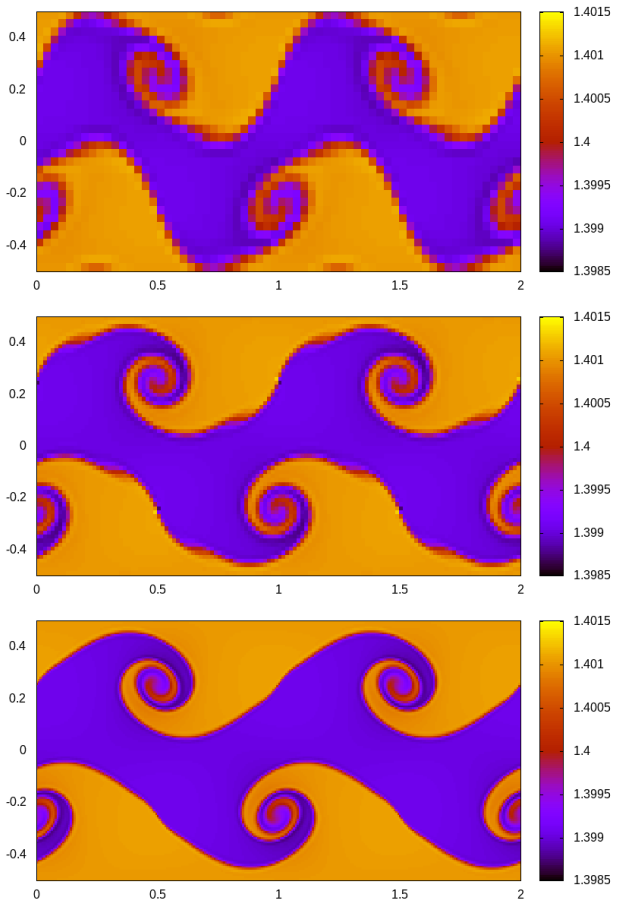
- In the Kelvin-Helmholtz tests the new method develops vortices earlier and more homogeneously than the semi-discrete Active Flux method, indicating substantially less numerical diffusion in the subsonic regime.
- The average update is conservative because fluxes are evaluated in conserved variables using the primitive-variable point values, and the blended limiter guarantees positivity of density and pressure.
Reading between the lines
- Because the acoustic sub-operator is exact for the locally linearized acoustics and the splitting is additive, the low-Mach compliance is plausibly inherited from the stationarity-preserving property of the exact acoustic Active Flux method; the same split may extend to other systems that admit an exact linear-acoustics solver, such as shallow water equations.
- The nested characteristic update resembles a Runge-Kutta-style staged evaluation; substituting a higher-order acoustic treatment could in principle raise the method to full third order in time, at the cost of the extra computational effort the paper deliberately avoids.
- A quantitative comparison against the semi-discrete Active Flux method at matched resolution and CFL on the Kelvin-Helmholtz and moving-vortex tests would isolate whether the reduced diffusion comes from the evolution operator, the splitting, or the primitive-variable reconstruction.
- The bound-preserving limiter could be adapted to enforce additional physical constraints such as entropy or velocity bounds, since it already blends a priori and a posteriori strategies and is activated rarely.
Editorial analysis
A structured set of objections, weighed in public.
Referee Report
Summary. The paper presents a new one-stage Active Flux method for the two-dimensional Euler equations, based on an additive operator split into an acoustic subproblem (solved by the exact evolution operator for linear acoustics from a prior work, using locally linearized coefficients) and an advective subproblem (solved by a nested characteristic tracing formula). The method uses primitive variables for point values and for the reconstruction, a conservative update of cell averages, and a blended a priori/a posteriori bound-preserving limiter. The authors prove Theorems 3.1 and 3.2 giving third-order accuracy of the advective evolution operator for smooth data, note explicitly that the acoustic linearization and the splitting are only formally second-order in time, and present numerical tests (contact wave, moving vortex, spherical Sod, multi-dimensional Riemann problems, low-Mach vortex, Kelvin-Helmholtz instability) indicating third-order space convergence, low-Mach compliance, and low numerical diffusion. The paper also provides detailed pseudocode for an efficient implementation of the acoustic evolution operator.
Significance. If the claims hold, this is a valuable contribution: it offers a simple, efficient, fully discrete Active Flux scheme for multi-dimensional Euler equations that avoids the time-step restrictions of semi-discrete Active Flux methods, gives detailed implementation recipes for the exact acoustic evolution operator (Appendices B and C), and demonstrates competitive resolution of multi-dimensional Riemann problems and low-Mach flows, with apparently less diffusion than the semi-discrete method in the Kelvin-Helmholtz tests. The Taylor-level proofs in Theorems 3.1 and 3.2 are clean and self-contained, and the convergence tests against exact solutions support the accuracy claims. However, the advertised maximal CFL 0.5 is not demonstrated for the actual additive-split scheme, and the relationship between the formal second-order temporal error and the observed near-third-order convergence is not analyzed. These are load-bearing gaps that should be addressed before the claims can be accepted as stated.
major comments (3)
- [Section 3.3 (CFL stability claim, Eq. (51), Remark 3.1)] The statement that the method has a maximal CFL number of 0.5 is not supported for the additive-split update (51). Stability of the acoustic and advective operators individually does not imply stability of the combined operator S_ac + S_adv − I; no von Neumann analysis of this one-step amplification operator is provided, and all numerical experiments in Section 4 are run at CFL 0.45, below the claimed limit. The citation to [CHK21] concerns the linear stability of a coupled (non-split) evolution operator, not the present additive combination, which also neglects the O(t^2) acoustic-advection cross terms. Because the large stability domain and the CFL advantage over the semi-discrete Active Flux method are central selling points (Sections 1 and 5), the authors should either prove stability for the additive-split operator or explicitly limit the claim to the observed CFL 0.45.
- [Section 3.4.1 and Section 4.1] The observed near-third-order convergence is not reconciled with the formal O(Δt^2) error of the local acoustic linearization and of the additive splitting, as acknowledged in Section 3.4.1. All convergence tests refine space and time together at fixed CFL 0.45, so a genuine second-order temporal error would normally manifest as second-order global convergence unless its coefficient vanishes for the tested solutions (e.g., for the contact wave, p and v are constant and the acoustic linearization is exact). The paper does not provide a time-refinement study at fixed spatial resolution, nor an error decomposition that would justify the claim that 'the global error is not dominated by its second-order component' (Section 3.4.1). Please add such a study or a quantitative discussion of the leading error terms.
- [Theorems 3.1 and 3.2, applied in Section 3.3] Theorems 3.1 and 3.2 assume smooth initial data for the PDE, but in the numerical update they are applied to a piecewise biparabolic reconstruction that is only globally C^0 across cell edges (Section 3.1). The paper does not analyze the error introduced by this smoothness mismatch, including the situation where the characteristic foot crosses a cell boundary and the node update receives contributions from several cells. The third-order accuracy of the advective evolution operator for the actual numerical data is therefore not established by the theorems. The authors should state the local smoothness assumptions under which Theorem 3.2 is applied to the reconstruction and provide evidence that the observed convergence order is robust with respect to this mismatch.
minor comments (6)
- [Section 3.4.2, Eq. (54)] Equation (54) contains a typographical error: the second argument of λ2 should read x − t(λ1(x)+λ2(x))/2, not 'x − t λ1(x)+λ2(x) 2' as printed.
- [Section 3.5.1, Eqs. (73)–(74)] Equations (73)–(74) are hard to read because the fraction bars are missing; the terms '(f^x(q̄_{i+1,j}) − f^x(q̄_{ij}))/2' and 'λ_{HLL}/2 (q̄_{i+1,j} − 2 q^n_{i+1/2,j} + q̄_{ij})' should be typeset with explicit division bars.
- [Section 3.3, item 2] The sentence 'a two-dimensional Simpson rule is inverted to find the value at cell center' would benefit from a few more details or a reference, since this step is not immediately obvious and is important for the reconstruction.
- [Section 4.1.2] The statement that convergence 'starts to deviate slightly towards finer grids' is left unexplained; given the formal second-order temporal error, a brief discussion of whether this deviation is consistent with the O(Δt^2) term would be useful.
- [Appendix B, Listing 1] The pseudocode uses the variable name 'diffX' to differentiate with respect to the radius r (the polynomial variable), which is confusing; a comment or a different name (e.g., 'diffR') would improve readability.
- [Section 5] The statement that the usage of operators that are exact for linearized problems 'guarantees von Neumann stability of the method' is too strong for the nonlinear additive-split scheme and should be qualified as in the major comment on CFL stability.
Circularity Check
No significant circularity: the acoustic and advective evolution operators are derived from stated mathematical identities, and the numerical results are benchmarked externally.
full rationale
The paper's central derivation chain is self-contained. Section 2 states the exact acoustic evolution operator (5)-(6) with explicit spherical-mean definitions and cites [BK22] for the derivation; this is a parameter-free exact PDE solution with stated regularity assumptions, not a fitted input and not the target Euler Active Flux result. Section 3.4.2 proves Theorems 3.1 and 3.2 by direct Taylor expansion, so the third-order advective evolution operator (71) is derived rather than imported as a prediction. The additive splitting is defined explicitly in Remark 3.1, and Section 3.4.1 openly states that 'the locally linearized acoustics operator and the operator splitting both have errors O(t^2) and thus make the method formally second-order in time'; this is an honest limitation, not a disguised prediction. The numerical tests in Sections 4.1-4.5 compare against exact solutions and established benchmark configurations, so the observed convergence orders and low-Mach behavior are externally falsifiable. The CFL=0.5 stability claim in Section 3.3 is the clearest unsupported step: it cites [CHK21] for the stability of a combination of advection and acoustics and then concludes 'The method thus has a maximal CFL number of 0.5,' without a von Neumann analysis of the additive-split operator q_new = S_ac + S_adv - q0, and all experiments run at CFL 0.45. This is a stability/correctness gap, not a circular reduction of the central derivation to its own inputs. Self-citations to [BK22], [Bar21a], and [BHKR19] are load-bearing in the sense of building on prior work, but they are parameter-free mathematical results or analyses with stated assumptions; no central claim reduces to a self-citation chain or to a fitted constant renamed as a prediction.
Assumptions & free parameters
free parameters (2)
- positivity threshold epsilon =
1e-10
- test CFL number =
0.45
assumptions (5)
- standard math The exact solution formula (5)-(6) of the linear acoustic equations from [BK22] is valid for the piecewise polynomial, possibly discontinuous data used in the wedge decomposition in Section 2.
- ad hoc to paper The Taylor analysis in Theorems 3.1 and 3.2 assumes smooth initial data, and this analysis is applied to the C^0 biparabolic reconstruction used in the actual point value update.
- domain assumption Additive operator splitting S2(q0,t) + S1(q0,t) - q0 approximates the unsplit Euler evolution to the required accuracy for these non-conservative suboperators.
- domain assumption The von Neumann stability limit CFL <= 0.5 for the linearized scheme in [CHK21] carries over to the nonlinear split Active Flux method.
- domain assumption The bound-preserving limiting conditions in equations (79)-(85) guarantee positivity of density and pressure for both the point value update and the average update.
Cite this review
Pith. "Pith review of An Active Flux method for the Euler equations based on the exact acoustic evolution operator." pith.science (2026). https://pith.science/paper/SSVHK44L
@misc{pith2026250603291,
  author       = {Pith},
  title        = {Pith review of: An Active Flux method for the Euler equations based on the exact acoustic evolution operator},
  year         = {2026},
  howpublished = {\url{https://pith.science/paper/SSVHK44L}},
  note         = {Machine review of arXiv:2506.03291}
}
read the original abstract
A new Active Flux method for the multi-dimensional Euler equations is based on an additive operator splitting into acoustics and advection. The acoustic operator is solved in a locally linearized manner by using the exact evolution operator. The nonlinear advection operator is solved at third order accuracy using a new approximate evolution operator. To simplify the splitting, the new method uses primitive variables for the point values and for the reconstruction. In order to handle discontinuous solutions, a blended bound preserving limiting is used, that combines a priori and a posteriori approaches. The resulting method is able to resolve multi-dimensional Riemann problems as well as low Mach number flow, and has a large domain of stability.
Figures


Figures from the paper (9 more)




Reference graph
Works this paper leans on
-
[1]
Extensions of A ctive F lux to arbitrary order of accuracy
Remi Abgrall and Wasilij Barsukow. Extensions of A ctive F lux to arbitrary order of accuracy. ESAIM: Mathematical Modelling and Numerical Analysis , 57(2):991--1027, 2023
2023
-
[2]
R \'e mi Abgrall. A combination of R esidual D istribution and the A ctive F lux formulations or a new class of schemes that can combine several writings of the same hyperbolic problem: application to the 1d E uler equations. Communications on Applied Mathematics and Computation , pages 1--33, 2022
2022
-
[3]
A semi-discrete A ctive F lux method for the E uler equations on C artesian grids
R \'e mi Abgrall, Wasilij Barsukow, and Christian Klingenberg. A semi-discrete A ctive F lux method for the E uler equations on C artesian grids. Journal of Scientific Computing , 102(2):36, 2025
2025
-
[4]
R \'e mi Abgrall and Yongle Liu. A new approach for designing well-balanced schemes for the shallow water equations: a combination of conservative and primitive formulations. SIAM Journal on Scientific Computing , 46(6):A3375--A3400, 2024
work page 2024
-
[5]
The active flux scheme for nonlinear problems
Wasilij Barsukow. The active flux scheme for nonlinear problems. Journal of Scientific Computing , 86(1):1--34, 2021
2021
-
[6]
Truly multi-dimensional all-speed schemes for the euler equations on cartesian grids
Wasilij Barsukow. Truly multi-dimensional all-speed schemes for the euler equations on cartesian grids. Journal of Computational Physics , 435:110216, 2021
work page 2021
-
[7]
Implicit active flux methods for linear advection
Wasilij Barsukow and Raul Borsche. Implicit active flux methods for linear advection. Journal of Scientific Computing , 98(3):52, 2024
work page 2024
-
[8]
A numerical scheme for the compressible low- M ach number regime of ideal fluid dynamics
Wasilij Barsukow, Philipp VF Edelmann, Christian Klingenberg, Fabian Miczek, and Friedrich K R \"o pke. A numerical scheme for the compressible low- M ach number regime of ideal fluid dynamics. Journal of Scientific Computing , 72(2):623--646, 2017
work page 2017
Show all 41 references
-
[9]
The active flux scheme on C artesian grids and its low M ach number limit
Wasilij Barsukow, Jonathan Hohm, Christian Klingenberg, and Philip L Roe. The active flux scheme on C artesian grids and its low M ach number limit. Journal of Scientific Computing , 81(1):594--622, 2019
2019
-
[10]
Exact solution and a truly multidimensional G odunov scheme for the acoustic equations
Wasilij Barsukow and Christian Klingenberg. Exact solution and a truly multidimensional G odunov scheme for the acoustic equations. ESAIM: M2AN , 56(1), 2022
2022
-
[11]
Analysis of the multi-dimensional semi-discrete A ctive F lux method using the F ourier transform
Wasilij Barsukow, Janina Kern, Christian Klingenberg, and Lisa Lechner. Analysis of the multi-dimensional semi-discrete A ctive F lux method using the F ourier transform. arXiv preprint arXiv:2412.03477 , 2024
2024 arXiv
-
[12]
The C artesian G rid A ctive F lux method: L inear stability and bound preserving limiting
Erik Chudzik, Christiane Helzel, and David Kerkmann. The C artesian G rid A ctive F lux method: L inear stability and bound preserving limiting. Applied Mathematics and Computation , 393:125501, 2021
2021
-
[13]
Active F lux methods for hyperbolic systems using the method of bicharacteristics
Erik Chudzik, Christiane Helzel, and M \'a ria Luk \'a c ov \'a -Medvid’ov \'a . Active F lux methods for hyperbolic systems using the method of bicharacteristics. Journal of Scientific Computing , 99(1):16, 2024
2024
-
[14]
Active F lux methods for hyperbolic conservation laws— F lux V ector splitting and bound-preservation
Junming Duan, Wasilij Barsukow, and Christian Klingenberg. Active F lux methods for hyperbolic conservation laws— F lux V ector splitting and bound-preservation. SIAM Journal on Scientific Computing , 47(2):A811--A837, 2025
2025
-
[15]
Analysis of G odunov type schemes applied to the compressible E uler system at low M ach number
St \'e phane Dellacherie. Analysis of G odunov type schemes applied to the compressible E uler system at low M ach number. Journal of Computational Physics , 229(4):978--1016, 2010
2010
-
[16]
Active flux schemes
Timothy A Eymann and Philip L Roe. Active flux schemes. In 49th AIAA Aerospace Science meeting , 2011
2011
-
[17]
Active flux schemes for systems
Timothy A Eymann and Philip L Roe. Active flux schemes for systems. In 20th AIAA computational fluid dynamics conference , 2011
2011
-
[18]
Multidimensional active flux schemes
Timothy A Eymann and Philip L Roe. Multidimensional active flux schemes. In 21st AIAA computational fluid dynamics conference , 2013
2013
-
[19]
On the acoustic component of active flux schemes for nonlinear hyperbolic conservation laws
Duoming Fan. On the acoustic component of active flux schemes for nonlinear hyperbolic conservation laws . PhD thesis, University of Michigan, Dissertation, 2017
2017
-
[20]
Investigations of a new scheme for wave propagation
Doreen Fan and Philip L Roe. Investigations of a new scheme for wave propagation. In 22nd AIAA Computational Fluid Dynamics Conference , page 2449, 2015
2015
-
[21]
Invariant domains and first-order continuous finite element approximation for hyperbolic systems
Jean-Luc Guermond and Bojan Popov. Invariant domains and first-order continuous finite element approximation for hyperbolic systems. SIAM Journal on Numerical Analysis , 54(4):2466--2489, 2016
2016
-
[22]
Tablitsy integralov, summ, ryadov i proyavleniy.—izd
IS Gradshteyn and IM Ryzhik. Tablitsy integralov, summ, ryadov i proyavleniy.—izd. 4-ye pererab. M.: Fizmatgiz , 1963
1963
-
[23]
On the behaviour of upwind schemes in the low M ach number limit
Herv \'e Guillard and C \'e cile Viozat. On the behaviour of upwind schemes in the low M ach number limit. Computers & fluids , 28(1):63--86, 1999
1999
-
[24]
Monolithic convex limiting in discontinuous galerkin discretizations of hyperbolic conservation laws
Hennes Hajduk. Monolithic convex limiting in discontinuous galerkin discretizations of hyperbolic conservation laws. Computers & Mathematics with Applications , 87:120--138, 2021
2021
-
[25]
A new ADER method inspired by the active flux method
Christiane Helzel, David Kerkmann, and Leonardo Scandurra. A new ADER method inspired by the active flux method. Journal of Scientific Computing , 80(3):1463--1497, 2019
2019
-
[26]
Weighted essentially non-oscillatory schemes on triangular meshes
Changqing Hu and Chi-Wang Shu. Weighted essentially non-oscillatory schemes on triangular meshes. Journal of Computational Physics , 150(1):97--127, 1999
1999
-
[27]
Efficient implementation of weighted ENO schemes
Guang-Shan Jiang and Chi-Wang Shu. Efficient implementation of weighted ENO schemes. Journal of computational physics , 126(1):202--228, 1996
1996
-
[28]
Flux- Corrected Transport : Principles , Algorithms , and Applications
Dmitri Kuzmin, Rainald Löhner, and Stefan Turek, editors. Flux- Corrected Transport : Principles , Algorithms , and Applications . Scientific Computation . Springer Netherlands, Dordrecht, 2012
2012
-
[29]
Monolithic convex limiting for continuous finite element discretizations of hyperbolic conservation laws
Dmitri Kuzmin. Monolithic convex limiting for continuous finite element discretizations of hyperbolic conservation laws. Computer Methods in Applied Mechanics and Engineering , 361:112804, April 2020
2020
-
[30]
Performance of high-order godunov-type methods in simulations of astrophysical low mach number flows
Giovanni Leidi, R Andrassy, Wasilij Barsukow, J Higl, Philipp VF Edelmann, and Friedrich K R \"o pke. Performance of high-order godunov-type methods in simulations of astrophysical low mach number flows. Astronomy & Astrophysics , 686:A34, 2024
2024
-
[31]
Finite volume methods for hyperbolic problems , volume 31
Randall J LeVeque. Finite volume methods for hyperbolic problems , volume 31. C ambridge U niversity P ress, 2002
2002
-
[32]
Solution of two-dimensional riemann problems of gas dynamics by positive schemes
Peter D Lax and Xu-Dong Liu. Solution of two-dimensional riemann problems of gas dynamics by positive schemes. SIAM Journal on Scientific Computing , 19(2):319--340, 1998
1998
-
[33]
On the advective component of active flux schemes for nonlinear hyperbolic conservation laws
Jungyeoul Maeng. On the advective component of active flux schemes for nonlinear hyperbolic conservation laws . PhD thesis, University of Michigan, Dissertation, 2017
2017
-
[34]
The extension of incompressible flow solvers to the weakly compressible regime
C-D Munz, Sabine Roller, Rupert Klein, and Karl J Geratz. The extension of incompressible flow solvers to the weakly compressible regime. Computers & Fluids , 32(2):173--196, 2003
2003
-
[35]
High-order discontinuous G alerkin methods for CFD
Jaime Peraire and Per-Olof Persson. High-order discontinuous G alerkin methods for CFD . In Adaptive high-order methods in computational fluid dynamics , pages 119--152. World Scientific, 2011
2011
-
[36]
On positivity preserving finite volume schemes for euler equations
Benoit Perthame and Chi-Wang Shu. On positivity preserving finite volume schemes for euler equations. Numerische Mathematik , 73:119--130, 1996
1996
-
[37]
Comparing active flux and D iscontinuous G alerkin methods for compressible flow
Philip L Roe, Jungyeoul Maeng, and Doreen Fan. Comparing active flux and D iscontinuous G alerkin methods for compressible flow. In 2018 AIAA Aerospace Sciences Meeting , page 0836, 2018
2018
-
[38]
Multidimensional upwinding
Philip Roe. Multidimensional upwinding. Handbook of Numerical Analysis , 18:53--80, 2017
2017
-
[39]
Designing CFD methods for bandwidth—a physical approach
Philip Roe. Designing CFD methods for bandwidth—a physical approach. Computers & Fluids , 214:104774, 2021
2021
-
[40]
A posteriori correction of high-order discontinuous galerkin scheme through subcell finite volume formulation and flux reconstruction
Fran c ois Vilar. A posteriori correction of high-order discontinuous galerkin scheme through subcell finite volume formulation and flux reconstruction. Journal of Computational Physics , 387:245--279, 2019
2019
-
[41]
Towards the ultimate conservative difference scheme
Bram van Leer. Towards the ultimate conservative difference scheme. IV . A new approach to numerical convection. Journal of computational physics , 23(3):276--299, 1977
1977
Reviewed August 7, 2026 · model on record in the stance chip above.
Discussion (0). Sign in to comment.