REVIEW 3 major objections 5 minor 1 cited by
On the chaos induced by the Galactic bar on the orbits of nearby halo stars
T0 review · 3 major / 5 minor · reviewed 2026-08-07 · deepseek-v4-flash
Pith's one-line read The Milky Way's rotating, triaxial bar puts more than half of nearby halo stars on chaotic orbits, so the energy and angular-momentum coordinates commonly used to find the debris of past mergers are not conserved for most of them.
desk verdict A useful quantitative study of bar-induced chaos in the local halo, but the headline 60% chaotic fraction is internally inconsistent with the 26% fully chaotic figure and needs to be reconciled before the paper can be taken at face value. read the letter →
The pith
A machine-rendered reading of the paper's core claim, the machinery that carries it, and where it could break.
The reading
What carries the argument
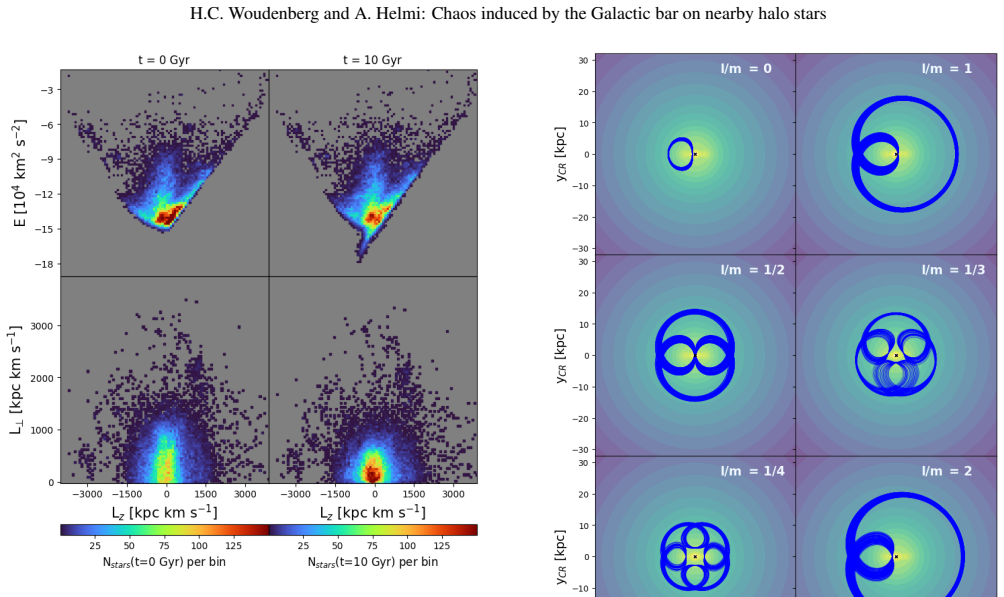
The machinery is a rotating, triaxial Galactic bar embedded in a full Milky Way potential: the Sormani et al. (2022) analytic bar model, rendered as a basis-function expansion by Hunter et al. (2024) in AGAMA, with pattern speed $\Omega_b = -37.5\ \mathrm{km\,s^{-1}\,kpc^{-1}}$ and bar angle $\varphi_b = -25^\circ$. In such a potential no classical integral survives except the Jacobi energy $E_J = E - \Omega_b L_z$, so the paper classifies orbits by two complementary chaos indicators — the Lyapunov exponent $\lambda$, obtained by fitting exponential growth of the largest deviation vector (with an onset time $t_{\mathrm{onset}}$), and the frequency diffusion rate $f_{\mathrm{dr}}$, the logarithm of the geometric mean of fractional frequency shifts between two equal time windows — and flags chaotic orbits by $\lambda > 0$ and $f_{\mathrm{dr}} > -1.9$. Bar resonances are located through the corotating-frame frequency condition $m\,\Omega_{\phi,\mathrm{CR}} + l\,\Omega_{R,\mathrm{CR}} = 0$, whose $l/m = 0$, $-1/2$, $1/2$ cases are the corotation, inner Lindblad, and outer Lindblad resonances; comparisons against a static-bar and an axisymmetrised version of the same potential isolate triaxiality as the dominant source of chaos.
What would settle it
Recompute the chaotic fraction for the same local halo sample in a model with the shorter ($\sim 3.5$ kpc) bar favoured by recent measurements: if the fraction of chaotic orbits among stars with $|L_z| < 500$ km/s does not stay high, the quantitative claim fails. Alternatively, an observational measurement of the bar's pattern-speed history over the past 10 Gyr that deviates strongly from the assumed constant $-37.5$ km s$^{-1}$ kpc$^{-1}$ would relocate the resonances and change the affected regions of $(E, L_z, L_\perp)$ space.
Extended reading notes
Core claim
The central discovery is that the Galactic bar makes the standard orbital labels — total energy $E$ and the angular-momentum components $L_z$ and $L_\perp$ — unreliable for the majority of the local stellar halo. Classifying each orbit in a 27,885-star sample with two independent chaos indicators, the Lyapunov exponent $\lambda$ and the frequency diffusion rate $f_{\mathrm{dr}}$, the authors find 60% of the stars chaotic in the rotating-bar potential, 56% in a static-bar potential, but only about 7–10% once the potential is axisymmetrised; this comparison identifies the bar's triaxial shape, rather than its rotation alone, as the main driver of chaos. The chaotic orbits concentrate among strongly bound stars with $|L_z| \lesssim 1000$ km/s, where Lyapunov timescales can be a few Gyr, and the stars wander along bar-resonance stripes in $(E, L_z)$ space, sometimes flipping from prograde to retrograde. Applied to the substructures of Dodd et al. (2023), these drifts connect the hot thick disk with ED-1 and L-RL3 and pull the most bound Gaia-Enceladus stars toward Thamnos, while retrograde, high-inclination, and loosely bound structures stay coherent. The paper concludes that clustering in $(E_J, L_z, L_\perp)$, with $E_J = E - \Omega_b L_z$, would be more robust, since $E_J$ is conserved in a rotating barred potential.
Load-bearing premise
The load-bearing assumption is that the adopted bar model — its mass ($1.83 \times 10^{10}\,M_\odot$), length out to $\sim 5$ kpc, pattern speed $-37.5$ km s$^{-1}$ kpc$^{-1}$, and angle $-25^\circ$ — represents the real Milky Way bar closely enough that the computed chaotic fractions and resonance locations transfer to our Galaxy; a substantially shorter, lighter, or slowed bar would shift which orbits are chaotic.
Editorial extensions
If this is right
- Substructure searches that cluster halo stars in $(E, L_z, L_\perp)$ will merge or mislabel debris in the strongly bound, low-$|L_z|$ regions, where chaotic drift along resonance stripes acts within a few Gyr or less.
- Known groups shift and overlap after 10 Gyr of integration: the hot thick disk connects with ED-1 and L-RL3, and the most bound Gaia-Enceladus stars extend toward Thamnos, so identifications in those zones carry extra uncertainty.
- Clustering in $(E_J, L_z, L_\perp)$ — possibly rescaled along the $E_J$ axis — should be more robust, because $E_J$ is conserved in a rotating barred potential and changes only adiabatically if the bar slows.
- Retrograde orbits ($L_z \lesssim -1000$ km/s), high-inclination orbits ($L_\perp \gtrsim 1500$ km/s), and loosely bound high-energy halo stars have Lyapunov timescales longer than a Hubble time, so substructures in those regions remain coherent.
- Bar resonances imprint overdensity stripes in $(E, L_z, L_\perp)$ that resemble merger debris; recognising them as bar artefacts protects against false substructure detections and, in principle, lets the stripes constrain the bar model.
Reading between the lines
- If the chaotic fractions are right, globular-cluster associations to merger events — which are often assigned using $E$ and $L_z$ — inherit the same contamination for clusters on radial, bound orbits, making the comparable chaotic fraction reported for globular clusters a natural expectation rather than a surprise.
- A direct test of the chaos: spatially thin streams whose orbits pass near the Galactic centre should show premature smearing or bifurcations; Ophiuchus has already been proposed as such a case, and other short, bar-crossing streams are observable targets for the same signature.
- Since most of the chaos comes from triaxiality rather than rotation, the recommendation to switch to $E_J$ solves the rotating case only; in a static triaxial potential $E_J$ reduces to $E$, while $L_z$ and $L_\perp$ still scatter, so a fully chaos-robust clustering coordinate may need to account for the non-axisymmetric shape itself.
Editorial analysis
A structured set of objections, weighed in public.
Referee Report
Summary. The paper studies the effect of the Milky Way's rotating bar on the orbital dynamics of nearby halo stars. Using a Gaia DR3 RVS sample of 27,885 stars within 1 kpc of the Sun, the authors integrate orbits in an AGAMA implementation of a barred potential based on the Sormani et al. (2022) bar model, compute Lyapunov exponents and frequency diffusion rates, and classify stars as regular, sticky chaotic, or fully chaotic. They map the chaotic fraction in (E, Lz, L⊥) space, identify bar resonances, and assess how specific accreted substructures are smeared after 10 Gyr. The central claim is that more than half of the local halo sample is on chaotic orbits, with the fraction highest for very bound and/or radial orbits, and the paper proposes using Jacobi energy EJ instead of E in future clustering analyses.
Significance. If the central result is correct, the paper makes a valuable point for Galactic archaeology: a large part of the local halo, especially the radial and tightly bound component, is chaotic in a barred Milky Way potential, so E, Lz, and L⊥ are not conserved and substructure clustering can suffer contamination. The paper's strengths are the large Gaia-based sample, the use of two independent chaos indicators, explicit parameter choices, and the comparison across rotating, static, and axisymmetric potentials together with alternative bar models and pattern speeds in Appendices A and B. These robustness checks make the qualitative conclusion plausible. However, the internal inconsistency in the classification statistics in Section 4.1 currently prevents the reader from trusting the quantitative headline, and the threshold used for the headline fraction deserves a sensitivity analysis.
major comments (3)
- [§4.1] The headline fraction is internally inconsistent. The text first states that the criterion λ>0 and fdr>-1.9 identifies chaotic orbits and yields 60% of the sample in the rotating bar potential. In the same section, 'fully chaotic' orbits are defined as '(λ>0.15 and -3<fdr<-1.9) or (λ>0 and fdr>-1.9)' and reported to comprise 26%. Because the second disjunct is exactly the same set used for the 60% figure, the 26% number cannot be correct as written, and the two categories overlap by construction. The 13% 'sticky chaotic' set (λ<0.15, fdr<-1.9) is also not positioned relative to the other two categories, and orbits with λ>0.15 and fdr<-3 are left unclassified. Since the abstract and conclusions advertise the 60% figure, the paper needs a mutually exclusive partition of the (λ, fdr) plane with explicit inequalities, a table of counts for each category, and a clear statement of which categories are included in the 'more than half' claim.
- [§4.1, Figs. 5-6] The chaotic-fraction estimate is sensitive to the choice of the fdr threshold, and the threshold is calibrated on the same model in which the fraction is measured. The authors choose fdr>-1.9 as the 99th percentile of the fdr distribution of λ=0 orbits in the fiducial potential and then apply this criterion to the same potential to obtain 60%. This is a reasonable false-positive control among regular orbits, but it does not by itself show that the 60% is robust. Since the central quantitative claim depends on this threshold, please report the chaotic fraction as a function of the fdr threshold (or calibrate the threshold using the λ=0 fdr distribution of the axisymmetric model and quote the resulting fraction), and state how many of the 'chaotic' orbits have Lyapunov timescales tλ longer than a Hubble time.
- [§5.1 and Appendix A] The conclusion that the chaotic fraction is 'not strongly dependent' on bar properties is stronger than what Appendix A shows. For the short boxy bar model, the overall fraction is still about 60%, but the fraction of stars with |Lz|<500 kpc km/s becomes 81% instead of 70% in the fiducial potential, and the affected regions of (E,Lz,L⊥) space shift noticeably. The paper should soften the robustness claim or quantify these differences explicitly, because a reader using the paper to assess which stellar populations are safe for clustering needs to know that the spatial pattern of chaos is model-dependent even if the global fraction is stable.
minor comments (5)
- [Fig. 9 caption] The caption repeats 'red halo' where 'blue halo' is clearly intended; please correct the second occurrence.
- [Appendix A, Eq. (A.1)] The definition of r appears to be missing the outer k-th root or exponent; it should read r = [(x/a)^k + (y/b)^k + (z/c)^k]^{1/k} as typeset.
- [§2.2 and §3.2] Please clarify the integration times: Section 2.2 lists Tint=15 Gyr for regime 1, but Section 3.2 says the deviation vectors for regime 1 were integrated for 25 Gyr, and Fig. 5 also says 'after 25 Gyr of integration'. A reader cannot tell which integration time enters the Lyapunov exponents and which enters the frequency diffusion rate.
- [Fig. 6 caption] The caption uses 'correspondance'; this should be 'correspondence'.
- [§4.3 and §5.3] Section 4.3 says approximately 13% of stars are 'sufficiently close' to a resonance, while Section 5.3 says the percentage of stars 'on bar resonances' is of the order of a few percent; please distinguish these two quantities explicitly in the text.
Circularity Check
No material circularity; the chaos fractions are benchmarked against axisymmetric and static-bar controls, but the headline 60% figure is internally inconsistent with the 26% 'fully chaotic' number in Sect. 4.1 (a correctness defect, not a circular derivation).
full rationale
The paper's central claim (more than half of the local halo sample is chaotic) is not a circular derivation. The chaotic fraction is measured by integrating orbits in an externally parameterized potential (Sormani et al. 2022 / Portail et al. 2016 via Hunter et al. 2024; McMillan 2017; Hunt & Vasiliev 2025) and is benchmarked against two controls: an axisymmetric model (56% of stars have lambda=0) and a static-bar model (8% have lambda=0, chaotic fraction 56% vs 60% for the rotating bar), so the rotating-bar result has independent discriminatory content. The fdr > -1.9 threshold is calibrated as the 99th percentile of fdr among lambda=0 orbits in the fiducial potential; this is a transparent classification choice, not a fitted parameter later renamed a prediction. The proposed use of the Jacobi energy EJ follows from the standard definition EJ = E - Omega_b L_z in a rotating bar potential and is demonstrated empirically in Fig. 8; it is not presented as a new derived law. Self-citations (Dodd et al. 2023 for sample and substructure membership; Woudenberg & Helmi 2024 for the triaxial-halo robustness test) are used as data or robustness inputs and are not load-bearing for the central claim. One serious defect is flagged, though it is not circularity: in Sect. 4.1 the paper first defines chaotic orbits as lambda>0 and fdr>-1.9 (60% of the sample) and then states 'Stars on fully chaotic orbits would be those with (lambda>0.15 and -3<fdr<-1.9) or (lambda>0 and fdr>-1.9), and comprise 26% of the sample.' Since the second disjunct is exactly the earlier 60% set, the quoted 26% cannot be correct as written, and the relationship of the 13% 'sticky chaotic' population to the 60% and 26% categories is unspecified. This makes the headline fraction currently ill-defined, but it is an internal arithmetic/definitional inconsistency, not a case of the result being equivalent to its inputs by construction.
Assumptions & free parameters
free parameters (4)
- fdr threshold for chaotic classification =
-1.9
- Bar pattern speed Ωb =
-37.5 km/s/kpc
- Bar angle φb =
-25 degrees
- Integration sampling regimes =
ΔT=0.001-0.005 Gyr, Tint=15-100 Gyr
assumptions (5)
- domain assumption The Hunter et al. (2024) AGAMA potential, based on Sormani et al. (2022) bar and McMillan/Gas disks, accurately represents the Milky Way's mass distribution.
- domain assumption Chaotic orbits are correctly identified by the combination λ>0 and fdr>-1.9, and this threshold separates regular from chaotic orbits.
- domain assumption The sample of 27,885 stars selected via Toomre cut and distance/velocity cuts is representative of the local halo population.
- domain assumption The bar's parameters (pattern speed, angle, shape) are constant over the integration times, or their evolution is adiabatic.
- standard math Orbital frequencies derived via SuperFreq from the Poincaré symplectic coordinate time series correspond to the fundamental frequencies needed for resonance and fdr analysis.
Cite this review
Pith. "Pith review of On the chaos induced by the Galactic bar on the orbits of nearby halo stars." pith.science (2026). https://pith.science/paper/SSVMFP7H
@misc{pith2026250520143,
  author       = {Pith},
  title        = {Pith review of: On the chaos induced by the Galactic bar on the orbits of nearby halo stars},
  year         = {2026},
  howpublished = {\url{https://pith.science/paper/SSVMFP7H}},
  note         = {Machine review of arXiv:2505.20143}
}
abstract
Many of the Milky Way's accreted substructures have been discovered and studied in the space of energy $E$, and angular momentum components $L_z$ and $L_{\bot}$. In a static axisymmetric system, these quantities are (reasonable approximations of) the integrals of motion of an orbit. However, in a galaxy like the Milky Way with a triaxial, rotating bar, none of these quantities are conserved, and the only known integral is the Jacobi energy $E_J$. This may result in chaotic orbits, especially for inner halo stars. Here, we investigate the bar's effect on the dynamics of nearby halo stars, and more specifically its impact on their distribution in $(E, L_z, L_{\bot})$ space. To this end, we have integrated and characterised the orbits of halo stars located within 1 kpc from the Sun. We computed their orbital frequencies and quantified the degree of chaoticity and associated timescales, using the Lyapunov exponent and the frequency diffusion rate. We find that the bar introduces a large degree of chaoticity on the stars in our sample: more than half are found to be on chaotic orbits, and this fraction is highest for stars on very bound and/or radial orbits. Such stars wander in $(E, L_z, L_{\bot})$ space on timescales shorter than a Hubble time. This introduces some overlap and hence contamination amongst previously identified accreted substructures with these orbital characteristics, although our assessment is that this is relatively limited. The bar also induces a number of resonances in the stellar halo, which are of larger importance for lower inclination, prograde orbits. Because the effect of the Galactic bar on the local halo is important for stars on very bound and/or radial orbits, clustering analyses in these regions should be conducted with care. Replacing the energy by $E_J$ in such analyses could be an improvement.
Figures


Figures from the paper (6 more)


Forward citations
Cited by 1 Pith paper
-
Bar-driven dispersal of Galactic substructure
The Galactic bar disperses low-energy stellar substructure in integral-of-motion space along lines with gradient equal to the bar's pattern speed, so searches should use the Jacobi integral and chemistry instead.
Reference graph
Works this paper leans on
-
[1]
, " * write output.state after.block = add.period write newline
ENTRY address archiveprefix author booktitle chapter edition editor howpublished institution eprint journal key month note number organization pages publisher school series title type volume year label extra.label sort.label short.list INTEGERS output.state before.all mid.sentence after.sentence after.block FUNCTION init.state.consts #0 'before.all := #1 ...
-
[2]
write newline
" write newline "" before.all 'output.state := FUNCTION n.dashify 't := "" t empty not t #1 #1 substring "-" = t #1 #2 substring "--" = not "--" * t #2 global.max substring 't := t #1 #1 substring "-" = "-" * t #2 global.max substring 't := while if t #1 #1 substring * t #2 global.max substring 't := if while FUNCTION word.in bbl.in " " * FUNCTION format....
-
[3]
P., Tollerud , E
Astropy Collaboration , Robitaille , T. P., Tollerud , E. J., et al. 2013, , 558, A33
2013
-
[4]
Bajkova , A., Smirnov , A., & Bobylev , V. 2025, arXiv e-prints, arXiv:2504.20749
work page Pith review arXiv 2025
-
[5]
Belokurov , V., Deason , A. J., Erkal , D., et al. 2019, , 488, L47
work page 2019
-
[6]
W., Koposov , S
Belokurov , V., Erkal , D., Evans , N. W., Koposov , S. E., & Deason , A. J. 2018, , 478, 611
2018
-
[7]
Breddels , M. A. & Veljanoski , J. 2018, , 618, A13
work page 2018
-
[8]
Chiba , R., Friske , J. K. S., & Sch \"o nrich , R. 2021, , 500, 4710
work page 2021
Show all 71 references
-
[9]
K., Altendorf, K., et al
da Costa-Luis, C., Larroque, S. K., Altendorf, K., et al. 2024, tqdm: A fast, Extensible Progress Bar for Python and CLI
2024
-
[10]
Deason , A. J. & Belokurov , V. 2024, , 99, 101706
2024
-
[11]
1999, , 524, L35
Dehnen , W. 1999, , 524, L35
1999
-
[12]
M., Belokurov , V., & Evans , N
Dillamore , A. M., Belokurov , V., & Evans , N. W. 2024, , 532, 4389
2024
-
[13]
M., Belokurov , V., Evans , N
Dillamore , A. M., Belokurov , V., Evans , N. W., & Davies , E. Y. 2023, , 524, 3596
2023
-
[14]
M., Sanders , J
Dillamore , A. M., Sanders , J. L., Belokurov , V., & Zhang , H. 2025, arXiv e-prints, arXiv:2503.02926
2025 arXiv
-
[15]
M., Helmi, A., et al
Dodd, E., Callingham, T. M., Helmi, A., et al. 2023, A&A, 670, L2
2023
-
[16]
2024, arXiv e-prints, arXiv:2408.13763
Dodd , E., Ruiz-Lara , T., Helmi , A., et al. 2024, arXiv e-prints, arXiv:2408.13763
2024 arXiv
-
[17]
W., Rix , H.-W., & Ness , M
Eilers , A.-C., Hogg , D. W., Rix , H.-W., & Ness , M. K. 2019, , 871, 120
2019
-
[18]
1969, Astronomische Nachrichten, 291, 97
Einasto , J. 1969, Astronomische Nachrichten, 291, 97
1969
-
[19]
2018 a , , 616, A10
Gaia Collaboration , Babusiaux , C., van Leeuwen , F., et al. 2018 a , , 616, A10
2018
-
[20]
Gaia Collaboration , Brown , A. G. A., Vallenari , A., et al. 2018 b , , 616, A1
2018
-
[21]
2022, A&A
Gaia Collaboration , Vallenari, A., Brown, A., Prusti, T., et al. 2022, A&A
2022
-
[22]
J., Brook , C
Gallart , C., Bernard , E. J., Brook , C. B., et al. 2019, Nature Astronomy, 3, 932
2019
-
[23]
Garavito-Camargo , N., Besla , G., Laporte , C. F. P., et al. 2019, , 884, 51
2019
-
[24]
A., Helmi , A., Cooper , A
G \'o mez , F. A., Helmi , A., Cooper , A. P., et al. 2013, , 436, 3602
2013
-
[25]
2020, , 58, 205
Helmi , A. 2020, , 58, 205
2020
-
[26]
H., et al
Helmi , A., Babusiaux , C., Koppelman , H. H., et al. 2018, , 563, 85
2018
-
[27]
& de Zeeuw , P
Helmi , A. & de Zeeuw , P. T. 2000, , 319, 657
2000
- [28]
-
[29]
& White , S
Helmi , A. & White , S. D. M. 1999, , 307, 495
1999
-
[30]
Helmi , A., White , S. D. M., de Zeeuw , P. T., & Zhao , H. 1999, , 402, 53
1999
-
[31]
2020, , 497, 933
Hilmi , T., Minchev , I., Buck , T., et al. 2020, , 497, 933
2020
-
[32]
Hunt , J. A. S. & Vasiliev , E. 2025, arXiv e-prints, arXiv:2501.04075
2025 arXiv
-
[33]
H., Sormani , M
Hunter , G. H., Sormani , M. C., Beckmann , J. P., et al. 2024, , 692, A216
2024
-
[34]
Hunter, J. D. 2007, Computing in Science & Engineering, 9, 90
2007
-
[35]
2023, , 677, A90
Khoperskov , S., Minchev , I., Libeskind , N., et al. 2023, , 677, A90
2023
-
[36]
2016, in Positioning and Power in Academic Publishing: Players, Agents and Agendas, ed
Kluyver, T., Ragan-Kelley, B., P \'e rez, F., et al. 2016, in Positioning and Power in Academic Publishing: Players, Agents and Agendas, ed. F. Loizides & B. Scmidt (IOS Press), 87--90
2016
-
[37]
2018, , 860, L11
Koppelman , H., Helmi , A., & Veljanoski , J. 2018, , 860, L11
2018
-
[38]
Koppelman , H. H. & Helmi , A. 2021, , 649, A136
2021
-
[39]
L., Babusiaux , C., & Cox , N
Lallement , R., Vergely , J. L., Babusiaux , C., & Cox , N. L. J. 2022, , 661, A147
2022
-
[40]
Law , D. R. & Majewski , S. R. 2010, , 714, 229
2010
-
[41]
2021, , 649, A4
Lindegren , L., Bastian , U., Biermann , M., et al. 2021, , 649, A4
2021
-
[42]
Lucey , M., Pearson , S., Hunt , J. A. S., et al. 2023, , 520, 4779
2023
-
[43]
P., G \'o mez , F
Maffione , N. P., G \'o mez , F. A., Cincotta , P. M., et al. 2015, , 453, 2830
2015
-
[44]
& Athanassoula , E
Manos , T. & Athanassoula , E. 2011, , 415, 629
2011
-
[45]
H., & Helmi , A
Massari , D., Koppelman , H. H., & Helmi , A. 2019, , 630, L4
2019
-
[46]
McMillan , P. J. 2017, , 465, 76
2017
-
[47]
M., et al
Mr \'o z , P., Udalski , A., Skowron , D. M., et al. 2019, , 870, L10
2019
-
[48]
2023, [ [arXiv] 2208.01056 ]
Ou , X., Necib , L., & Frebel , A. 2023, [ [arXiv] 2208.01056 ]
2023 arXiv
-
[49]
& Laskar , J
Papaphilippou , Y. & Laskar , J. 1996, , 307, 427
1996
-
[50]
2016, Monthly Notices of the Royal Astronomical Society, 465, 1621
Portail, M., Gerhard, O., Wegg, C., & Ness, M. 2016, Monthly Notices of the Royal Astronomical Society, 465, 1621
2016
-
[51]
Price-Whelan , A. M. 2015, SuperFreq
2015
-
[52]
M., Johnston , K
Price-Whelan , A. M., Johnston , K. V., Valluri , M., et al. 2016 a , , 455, 1079
2016
-
[53]
M., Sesar , B., Johnston , K
Price-Whelan , A. M., Sesar , B., Johnston , K. V., & Rix , H.-W. 2016 b , , 824, 104
2016
-
[54]
S., et al
Ruiz-Lara , T., Matsuno , T., L \"o vdal , S. S., et al. 2022, , 665, A58
2022
-
[55]
2010, , 403, 1829
Sch \"o nrich , R., Binney , J., & Dehnen , W. 2010, , 403, 1829
2010
-
[56]
C., Gerhard , O., Portail , M., Vasiliev , E., & Clarke , J
Sormani , M. C., Gerhard , O., Portail , M., Vasiliev , E., & Clarke , J. 2022, , 514, L1
2022
-
[57]
P., Quinn , T., & Moore , B
Valluri , M., Debattista , V. P., Quinn , T., & Moore , B. 2010, , 403, 525
2010
-
[58]
P., Quinn , T
Valluri , M., Debattista , V. P., Quinn , T. R., Ro s kar , R., & Wadsley , J. 2012, , 419, 1951
2012
-
[59]
C., & Varoquaux , G
van der Walt , S., Colbert , S. C., & Varoquaux , G. 2011, Computing in Science and Engineering, 13, 22
2011
-
[60]
2013, , 434, 3174
Vasiliev , E. 2013, , 434, 3174
2013
-
[61]
2019 a , , 482, 1525
Vasiliev , E. 2019 a , , 482, 1525
2019
-
[62]
2019 b , MNRAS, 482, 1525
Vasiliev , E. 2019 b , MNRAS, 482, 1525
2019
- [63]
-
[64]
& Baumgardt , H
Vasiliev , E. & Baumgardt , H. 2021, , 505, 5978
2021
-
[65]
2021, MNRAS, 501, 2279
Vasiliev , E., Belokurov , V., & Erkal , D. 2021, MNRAS, 501, 2279
2021
-
[66]
E., et al
Virtanen , P., Gommers , R., Oliphant , T. E., et al. 2020, Nature Methods
2020
-
[67]
2024, , 528, 3576
Vislosky , E., Minchev , I., Khoperskov , S., et al. 2024, , 528, 3576
2024
-
[68]
Vogelsberger , M., White , S. D. M., Helmi , A., & Springel , V. 2008, , 385, 236
2008
-
[69]
2002, , 337, 619
Voglis , N., Kalapotharakos , C., & Stavropoulos , I. 2002, , 337, 619
2002
-
[70]
Woudenberg , H. C. & Helmi , A. 2024, , 691, A277
2024
-
[71]
F., Erkal , D., et al
Yang , Y., Lewis , G. F., Erkal , D., et al. 2025, arXiv e-prints, arXiv:2503.19221
2025 arXiv
Reviewed August 7, 2026 · model on record in the stance chip above.
Discussion (0). Continue with ORCID to comment.