REVIEW 5 major objections 4 minor 51 references
TacCompress: A Benchmark for Multi-Point Tactile Data Compression in Dexterous Hand
T0 review · 5 major / 4 minor · reviewed 2026-08-07 · deepseek-v4-flash
Pith's one-line read This paper claims that multi-point tactile data can be losslessly compressed to 0.0364 bits per sub-sample (about 200x) by converting the three-axis force stream into an RGB image and applying standard image codecs.
desk verdict Tactile image-codec compression results are real but measured on mostly static sequences, so the real-time bandwidth claims are overstated. read the letter →
The pith
A machine-rendered reading of the paper's core claim, the machinery that carries it, and where it could break.
The reading
What carries the argument
The load-bearing mechanism is a deterministic format conversion: 1,140 tactile units, each producing three-axis force values, are flattened along the image width, time steps become the image height, and the (x,y,z) force components are written into the R, G, B channels. This yields an image of size 1140 x T that preserves every sample while exposing the strong spatial and temporal redundancy of the signals. The image then carries the recognizable screen-content structure the paper relies on: sharp transitions, limited color variation, and repeating patterns. These properties are what let screen-content coding tools inside the HEVC and VVC test models achieve the reported rate-distortion gains.
What would settle it
Collect a comparable multi-point tactile dataset from continuous in-hand manipulation with no static-hold segment, run the same six lossless codecs, and compute average bpss; if the average rises above roughly 0.1 bpss (below 80x compression) or the SCC gains in HM and VTM disappear, the paper's central compression claim is limited to static-dominant grasping rather than general dexterous manipulation.
Extended reading notes
Core claim
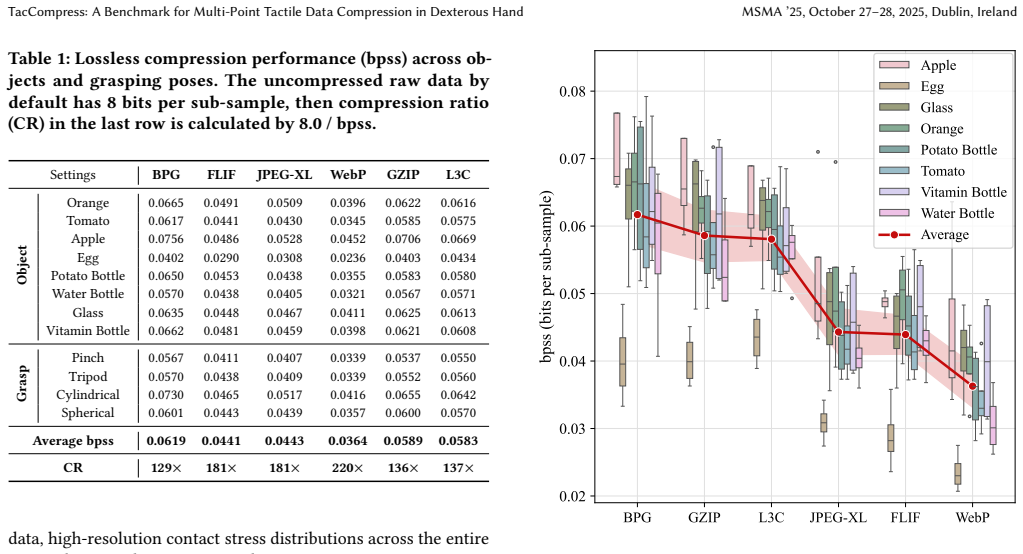
The central discovery is that tactile signals from a multi-point dexterous hand are highly redundant once arranged as images, and off-the-shelf image compressors exploit that redundancy. Losslessly, WebP achieves the best average 0.0364 bpss (220x compression), with FLIF and JPEG-XL close behind at 181x. Lossily, the video codecs HM and VTM keep reconstruction quality above 38 dB PSNR below 0.01 bpss (roughly 800x), and switching on their screen-content coding tools gives 56.42% (HM) and 30.67% (VTM) BD-Rate savings over intra-only coding. On a downstream object-classification task, VTM-SCC compressed data at 0.0067 bpss (about 1200x) still lets SVM and logistic regression exceed 70% accuracy. The paper frames these results as evidence that tactile data compression should be studied jointly with the physical hand structure and that screen-content-targeted tools are a better match for tactile images than general-purpose codecs.
Load-bearing premise
The compression ratios depend on a collection protocol in which each trial records ten seconds before grasping, a fifteen-second static hold, and a release, so the sequences are dominated by near-static frames; if real transmissions are dominated by dynamic manipulation, the reported ratios would not carry over.
Editorial extensions
If this is right
- At 100 Hz sampling, lossless compression drops the hand's raw tactile stream from about 2.7 Mbps to about 12.5 Kbps, making continuous whole-hand tactile feedback feasible over low-bandwidth links.
- WebP, FLIF, and JPEG-XL form a strong lossless baseline; any future tactile-specific codec should be measured against these numbers on the same benchmark.
- Enabling SCC tools in HM and VTM improves rate-distortion performance by 56.42% and 30.67% BD-Rate respectively, so standard video codecs configured for screen content are a ready-made lossy solution.
- Even at roughly 1200x compression, object classification remains viable, suggesting lossy tactile compression can serve downstream perception rather than only storage.
Reading between the lines
- The reported ratios likely reflect the protocol's long static-hold phase; a workload dominated by fast contact transients, slips, and re-grasps would probably compress less well, so the 200x and 1000x figures are an upper envelope rather than a guaranteed rate.
- The same RGB-mapping trick could transfer to other array-based tactile skins, where spatially ordered taxels and smooth temporal evolution create similar redundancy.
- The neural codecs' weaker showing on this out-of-domain data suggests a fine-tuning experiment: adapting learned codecs to tactile-image statistics could close or reverse the gap with traditional codecs.
- Because the dataset is structured by object and grasp pose, it also enables compression-conditioned studies of perception, for example how much rate is needed per pose or material before classification accuracy degrades.
Editorial analysis
A structured set of objections, weighed in public.
Referee Report
Summary. The paper introduces Dex-MPTD, a multi-point tactile dataset collected with the DexH13 dexterous hand across four grasp poses, eight objects, and ten repeats per condition. The authors convert the 1140 three-axis tactile units over time into RGB images of size 1140 x T and evaluate six lossless and five lossy image codecs, including screen-content coding (SCC) modes of HM and VTM. They report a lossless rate of 0.0364 bits per sub-sample (bpss), about 220x compression relative to 8-bit raw data, and lossy rates around 0.0067 bpss (about 1190x) while maintaining a 70%+ accuracy in a downstream object classification task. The paper's central claim is that tactile data can be losslessly compressed to roughly 200x and lossily to roughly 1000x by treating tactile signals as screen-content images, and that SCC tools are particularly effective.
Significance. The dataset and the systematic off-the-shelf codec comparison are useful contributions to the tactile-communication and dexterous-manipulation communities. The core measurements are direct outputs of standard codecs on a newly collected dataset, so there is no parametric circularity in the compression numbers, and the bpss arithmetic is internally consistent (8/0.0364 ≈ 220). The comparison across six lossless and five lossy codecs, including SCC variants, is broader than what is usually reported for tactile data. If the dataset is released as promised and the representativeness concerns below are addressed, this can become a valuable reference benchmark. The current limitation is that the headline ratios are whole-trial averages over a protocol dominated by near-static frames, so the practical scope of the claims is narrower than the abstract suggests.
major comments (5)
- [Section 3.2 and Table 1] The collection protocol in Section 3.2 records 10 seconds before grasping and a 15-second static hold after lifting, so each trial is dominated by near-static frames. The reported 0.0364 bpss is a whole-trial average, and no per-segment rates are given for the grasp, lift, and release transients, which are precisely the segments that stress a real-time transmission link. The central claim that tactile data can be compressed to about 200x (lossless) and 1000x (lossy) is therefore not established for dynamic manipulation workloads; the paper should report segment-level or transient-only bpss, or clearly restrict the claim to near-static holding scenarios.
- [Figure 1 and Section 4.1] Figure 1 estimates an online bandwidth of 12.5 kbps at 100 Hz by multiplying the whole-trial average bpss by the sensor rate. However, the evaluated pipeline encodes a single image whose height T corresponds to the full trial duration (T ≈ 2500 at 100 Hz), which requires buffering the entire sequence and incurs a coding delay on the order of tens of seconds. The paper does not implement or evaluate a frame-wise or segment-wise streaming codec, so the real-time bandwidth claim conflates offline storage compression with sustainable online transmission. The authors should either provide a streaming experiment or explicitly reframe Figure 1 as an offline storage estimate.
- [Section 2.2 and Sections 4.2–4.4] The experimental comparison includes only general-purpose image codecs. The related work section lists tactile-specific compression methods, including compressed sensing, wavelet sparsification, and kinesthetic coding (refs [13, 33, 34, 36, 46]), but none of these is evaluated on Dex-MPTD. Since the paper's contribution is presented as a compression benchmark, the absence of any tactile-specific baseline prevents the conclusion that the image-conversion approach is preferable to existing tactile-domain methods; at least one representative baseline should be added and compared on the same data.
- [Table 1 and Section 3.2] Each object-pose combination is repeated ten times, yet Table 1 reports only a single average bpss per cell with no variance or per-repeat distribution. Without standard deviations, it is unclear whether differences such as WebP at 0.0364 bpss versus JPEG-XL and FLIF at 0.0441 bpss are meaningful given trial-to-trial contact variability. The authors should report variance across the ten repeats or present box plots over repeats for each condition.
- [Table 2 and Section 4.5] The claim that lossy compression preserves 'acceptable fidelity' at about 1000x reduction rests on a single classification experiment with one random 70/30 split. At 0.0067 bpss, only SVM and LR remain above 70% accuracy, while RF and K-NN drop by roughly 9–10 percentage points relative to the raw data. The paper should specify the fidelity criterion (e.g., a PSNR threshold or a task-accuracy tolerance), report results over multiple splits or with confidence intervals, and avoid overgeneralizing the 1000x claim until that criterion is clearly met.
minor comments (4)
- [Section 4.3] The text states that the lossless results correspond to 'compression ratios of 100 to 200 times,' but 8/0.0364 ≈ 220 and 8/0.0619 ≈ 129; the stated range should be corrected to approximately 129x to 220x.
- [Table 2 caption] The caption contains a typo: 'compressed dats' should be 'compressed data.'
- [Section 4.4] The reported BD-Rate reductions of 30.67% and 56.42% should state explicitly that a negative BD-Rate value indicates bitrate savings and should clarify whether the numbers are averaged over all objects or over a single representative RD point.
- [Section 3.1] The dataset is said to include 11 sensors with 1140 tactile units, but Figure 3 labels only distal, proximal, and intermediate positions; a more explicit mapping between the 11 sensor arrays and the 1140 flattened columns would improve reproducibility.
Circularity Check
No circularity found; compression figures are direct measurements on the new dataset, with no fitted parameter relabeled as a prediction.
full rationale
The paper's central results are direct measurements of off-the-shelf codecs on a newly collected dataset, not predictions derived from fitted parameters. The lossless figure of 0.0364 bpss is the measured average bitrate reported in Table 1; the approximate 1000x lossy reduction is read from measured rate-distortion curves in Figures 6-9; and the claim that screen-content coding tools outperform general-purpose codecs is an empirical A/B comparison quantified by BD-Rate, not an assumed conclusion. No equation in the paper defines the target metric in terms of an input parameter, and no fitted quantity is subsequently relabeled as a prediction. The only self-reference is the use of the PaXiniTech DexH13 hand for data collection, with co-authors affiliated with PaXiniTech and a PaXiniTech research fund acknowledged, but this is a provenance issue for the dataset, not a load-bearing argument whose conclusion is contained in its premise. The skeptic's concern that the collection protocol includes 10 seconds of pre-grasp recording and a 15-second static hold, making whole-trial compression averages dominated by near-static frames, is a legitimate question about the benchmark's representativeness and external validity, but it does not make the reported compression measurements circular. The compression ratios are what they measure on this dataset; whether they generalize to fast dynamic transients is an open empirical question, not a logical reduction of the claim to its inputs.
Assumptions & free parameters
assumptions (3)
- domain assumption The mapping from (x, y, z) force readings to (R, G, B) channels is information-preserving, so lossless compression of the image is lossless compression of the tactile data.
- domain assumption The near-static collection protocol (10 s pre-grasp, 15 s hold, then release) produces data representative of the bandwidth workloads faced by dexterous-hand controllers.
- domain assumption The flattened spatial ordering of the 1,140 tactile units into the image width is a sensible arrangement for image codecs.
Cite this review
Pith. "Pith review of TacCompress: A Benchmark for Multi-Point Tactile Data Compression in Dexterous Hand." pith.science (2026). https://pith.science/paper/SSZ2QOH7
@misc{pith2026250516289,
  author       = {Pith},
  title        = {Pith review of: TacCompress: A Benchmark for Multi-Point Tactile Data Compression in Dexterous Hand},
  year         = {2026},
  howpublished = {\url{https://pith.science/paper/SSZ2QOH7}},
  note         = {Machine review of arXiv:2505.16289}
}
abstract
Though robotic dexterous manipulation has progressed substantially recently, challenges like in-hand occlusion still necessitate fine-grained tactile perception, leading to the integration of more tactile sensors into robotic hands. Consequently, the increased data volume imposes substantial bandwidth pressure on signal transmission from the hand's controller. However, the acquisition and compression of multi-point tactile signals based on the dexterous hands' physical structures have not been thoroughly explored. In this paper, our contributions are twofold. First, we introduce a Multi-Point Tactile Dataset for Dexterous Hand Grasping (Dex-MPTD). This dataset captures tactile signals from multiple contact sensors across various objects and grasping poses, offering a comprehensive benchmark for advancing dexterous robotic manipulation research. Second, we investigate both lossless and lossy compression on Dex-MPTD by converting tactile data into images and applying six lossless and five lossy image codecs for efficient compression. Experimental results demonstrate that tactile data can be losslessly compressed to as low as 0.0364 bits per sub-sample (bpss), achieving approximately 200$\times$ compression ratio compared to the raw tactile data. Efficient lossy compressors like HM and VTM can achieve about 1000$\times$ data reductions while preserving acceptable data fidelity. The exploration of lossy compression also reveals that screen-content-targeted coding tools outperform general-purpose codecs in compressing tactile data.
Figures


Figures from the paper (7 more)


Reference graph
Works this paper leans on
-
[1]
K Ahanat, ACR Juan, and P Veronique. 2015. Tactile sensing in dexterous robot hands-Review. Rob. Auton. Syst 74 (2015), 195–220
work page 2015
-
[2]
Illya Bakurov, Marco Buzzelli, Raimondo Schettini, Mauro Castelli, and Leonardo Vanneschi. 2022. Structural similarity index (SSIM) revisited: A data-driven approach. Expert Systems with Applications 189 (2022), 116087. TacCompress: A Benchmark for Multi-Point Tactile Data Compression in Dexterous Hand MSMA ’25, October 27–28, 2025, Dublin, Ireland
work page 2022
-
[3]
Fabrice Bellard. 2014. BPG Image format. https://bellard.org/bpg/. Accessed: 2025-02-28
work page 2014
-
[4]
Raunaq Bhirangi, Abigail DeFranco, Jacob Adkins, Carmel Majidi, Abhinav Gupta, Tess Hellebrekers, and Vikash Kumar. 2023. All the feels: A dexterous hand with large-area tactile sensing. IEEE Robotics and Automation Letters 8, 12 (2023), 8311–8318
work page 2023
-
[5]
Gisle Bjontegaard. 2001. Calculation of average PSNR differences between RD- curves. ITU SG16 Doc. VCEG-M33 (2001)
2001
-
[6]
Andrew J Bremner and Charles Spence. 2017. The development of tactile percep- tion. Advances in child development and behavior 52 (2017), 227–268
work page 2017
-
[7]
Javier Cepriá-Bernal and Antonio Pérez-González. 2021. Dataset of tactile sig- natures of the human right hand in twenty-one activities of daily living using a high spatial resolution pressure sensor. Sensors 21, 8 (2021), 2594
work page 2021
-
[8]
Glenn Fung. 2001. A comprehensive overview of basic clustering algorithms. (2001)
work page 2001
Show all 51 references
-
[9]
Alberto Garcia-Garcia, Sergio Orts-Escolano, Sergiu Oprea, Jose Garcia- Rodriguez, Jorge Azorin-Lopez, Marcelo Saval-Calvo, and Miguel Cazorla. 2017. Multi-sensor 3D object dataset for object recognition with full pose estimation. Neural Computing and Applications 28 (2017), 941–952
2017
-
[10]
Google. 2010. WebP Image Format. https://developers.google.com/speed/webp. Accessed: 2025-02-28
2010
-
[11]
John A Hartigan and Manchek A Wong. 1979. Algorithm AS 136: A k-means clustering algorithm. Journal of the royal statistical society. series c (applied statistics) 28, 1 (1979), 100–108
1979
-
[12]
Hearst, Susan T Dumais, Edgar Osuna, John Platt, and Bernhard Scholkopf
Marti A. Hearst, Susan T Dumais, Edgar Osuna, John Platt, and Bernhard Scholkopf. 1998. Support vector machines. IEEE Intelligent Systems and their applications 13, 4 (1998), 18–28
1998
-
[13]
Brayden Hollis, Stacy Patterson, and Jeff Trinkle. 2016. Compressed sensing for tactile skins. In 2016 IEEE International Conference on Robotics and Automation (ICRA). IEEE, 150–157
2016
-
[14]
ISO/IEC. 2000. JPEG 2000 Image Coding System. https://www.jpeg.org/jpeg2000/. Accessed: 2025-02-28
2000
-
[15]
Joint Video Experts Team (JVET). 2020. VVC Test Model (VTM). https://jvet.hhi. fraunhofer.de/. Accessed: 2025-02-28
2020
-
[16]
Shubham Kanitkar, Helen Jiang, and Wenzhen Yuan. 2022. PoseIt: A Visual- Tactile Dataset of Holding Poses for Grasp Stability Analysis. In 2022 IEEE/RSJ International Conference on Intelligent Robots and Systems (IROS) . 71–78. doi:10. 1109/IROS47612.2022.9981562
2022
-
[17]
Jari Korhonen and Junyong You. 2012. Peak signal-to-noise ratio revisited: Is simple beautiful?. In 2012 Fourth international workshop on quality of multimedia experience. IEEE, 37–38
2012
-
[18]
Nathan F Lepora. 2024. The future lies in a pair of tactile hands. Science Robotics 9, 91 (2024), eadq1501
2024
-
[19]
Tong Li, Yuhang Yan, Chengshun Yu, Jing An, Yifan Wang, Xiaojun Zhu, and Gang Chen. 2024. VTG: A Visual-Tactile Dataset for Three-Finger Grasp. IEEE Robotics and Automation Letters 9, 11 (2024), 10684–10691. doi:10.1109/LRA.2024.3477168
2024
-
[20]
Bruno Monteiro Rocha Lima, Venkata Naga Sai Siddhartha Danyamraju, Thiago Eustaquio Alves de Oliveira, and Vinicius Prado da Fonseca. 2023. A multimodal tactile dataset for dynamic texture classification. Data in Brief 50 (2023), 109590
2023
-
[21]
Jinming Liu, Heming Sun, and Jiro Katto. 2023. Learned image compression with mixed transformer-cnn architectures. In Proceedings of the IEEE/CVF conference on computer vision and pattern recognition . 14388–14397
2023
-
[22]
Jean loup Gailly and Mark Adler. 1992. GNU Gzip. https://www.gnu.org/software/ gzip/. Accessed: 2025-02-28
1992
-
[23]
Dengsheng Lu and Qihao Weng. 2007. A survey of image classification methods and techniques for improving classification performance. International journal of Remote sensing 28, 5 (2007), 823–870
2007
-
[24]
Hang Lu, Xinmeng Tan, Mingkai Chen, Zhe Zhang, Xuguang Zhang, Jianxin Chen, Xin Wei, and Tiesong Zhao. 2025. Cross-Modal Haptic Compression Inspired by Embodied AI for Haptic Communications. IEEE Transactions on Multimedia (2025)
2025
-
[25]
Siwei Ma, Xinfeng Zhang, Chuanmin Jia, Zhenghui Zhao, Shiqi Wang, and Shan- she Wang. 2019. Image and video compression with neural networks: A review. IEEE Transactions on Circuits and Systems for Video Technology 30, 6 (2019), 1683– 1698
2019
-
[26]
Fabian Mentzer, Eirikur Agustsson, Michael Tschannen, Radu Timofte, and Luc Van Gool. 2019. Practical Full Resolution Learned Lossless Image Com- pression. In Proceedings of the IEEE/CVF Conference on Computer Vision and Pattern Recognition (CVPR). 10629–10638. doi:10.1109/CVP...
2019
-
[27]
Tung Nguyen, Xiaozhong Xu, Felix Henry, Ru-Ling Liao, Mohammed Golam Sarwer, Marta Karczewicz, Yung-Hsuan Chao, Jizheng Xu, Shan Liu, Detlev Marpe, et al. 2021. Overview of the screen content support in VVC: Applications, coding tools, and performance. IEEE Transactions on Cir...
2021
-
[28]
Joint Collaborative Team on Video Coding (JCT-VC). 2013. HEVC Test Model (HM). https://hevc.hhi.fraunhofer.de/. Accessed: 2025-02-28
2013
-
[29]
PaXiniTech. 2024. DexH13 Dexterous Hand. Online. https://mall.paxini.com/ product/dex/66f27ea530cd11a8e9d1d5ff?skuId=66f27ec230cd11a8e9d1d610 Ac- cessed: 2025-02-28
2024
-
[30]
Leif E Peterson. 2009. K-nearest neighbor. Scholarpedia 4, 2 (2009), 1883
2009
-
[31]
Steven J Rigatti. 2017. Random forest. Journal of Insurance Medicine 47, 1 (2017), 31–39
2017
-
[32]
George AF Seber and Alan J Lee. 2012. Linear regression analysis. John Wiley & Sons
2012
-
[33]
Yitian Shao, Vincent Hayward, and Yon Visell. 2020. Compression of dynamic tactile information in the human hand. Science advances 6, 16 (2020), eaaz1158
2020
-
[34]
Ariel Slepyan, Michael Zakariaie, Trac Tran, and Nitish Thakor. 2024. Wavelet Transforms Significantly Sparsify and Compress Tactile Interactions. Sensors 24, 13 (2024), 4243
2024
-
[35]
Jon Sneyers. 2015. FLIF - Free Lossless Image Format. https://flif.info/. Accessed: 2023-10-01
2015
-
[36]
Eckehard Steinbach, Matti Strese, Mohamad Eid, Xun Liu, Amit Bhardwaj, Qian Liu, Mohammad Al-Ja’afreh, Toktam Mahmoodi, Rania Hassen, Abdulmotaleb El Saddik, et al. 2018. Haptic codecs for the tactile internet. Proc. IEEE 107, 2 (2018), 447–470
2018
-
[37]
Subramanian Sundaram, Petr Kellnhofer, Yunzhu Li, Jun-Yan Zhu, Antonio Tor- ralba, and Wojciech Matusik. 2019. Learning the signatures of the human grasp using a scalable tactile glove. Nature 569, 7758 (2019), 698–702
2019
-
[38]
Kuniyuki Takahashi and Jethro Tan. 2019. Deep visuo-tactile learning: Estimation of tactile properties from images. In 2019 International Conference on Robotics and Automation (ICRA). IEEE, 8951–8957
2019
-
[39]
Gyan Tatiya, Jonathan Francis, and Jivko Sinapov. 2023. Transferring implicit knowledge of non-visual object properties across heterogeneous robot morpholo- gies. In 2023 IEEE International Conference on Robotics and Automation (ICRA) . IEEE, 11315–11321
2023
-
[40]
JPEG XL Team. 2021. JPEG XL Image Coding System. https://jpeg.org/jpegxl/. Accessed: 2025-02-28
2021
-
[41]
Kuipers, Jochem Lugtenburg, Kurian Polachan, Prabhakar T
Daniël Van Den Berg, Rebecca Glans, Dorian De Koning, Fernando A. Kuipers, Jochem Lugtenburg, Kurian Polachan, Prabhakar T. Venkata, Chandramani Singh, Belma Turkovic, and Bryan Van Wijk. 2017. Challenges in Haptic Communications Over the Tactile Internet. IEEE Access 5 (2017)...
2017
-
[42]
Laurens Van der Maaten and Geoffrey Hinton. 2008. Visualizing data using t-SNE. Journal of machine learning research 9, 11 (2008)
2008
-
[43]
Yijing Watkins, Oleksandr Iaroshenko, Mohammad Sayeh, and Garrett Kenyon
-
[44]
Jizheng Xu, Rajan Joshi, and Robert A Cohen. 2015. Overview of the emerging HEVC screen content coding extension.IEEE Transactions on Circuits and Systems for Video Technology 26, 1 (2015), 50–62
2015
-
[45]
Xiaozhong Xu and Shan Liu. 2021. Overview of screen content coding in recently developed video coding standards. IEEE Transactions on Circuits and Systems for Video Technology 32, 2 (2021), 839–852
2021
-
[46]
Yiwen Xu, Qingfeng Huang, Quanfei Zheng, Ying Fang, and Tiesong Zhao. 2024. Perception-Based Prediction for Efficient Kinesthetic Coding. IEEE Signal Pro- cessing Letters (2024)
2024
-
[47]
Jun Yang, Dong Li, and Steven L Waslander. 2021. Probabilistic multi-view fusion of active stereo depth maps for robotic bin-picking.IEEE Robotics and Automation Letters 6, 3 (2021), 4472–4479
2021
-
[48]
Wenzhen Yuan, Siyuan Dong, and Edward H Adelson. 2017. Gelsight: High- resolution robot tactile sensors for estimating geometry and force. Sensors 17, 12 (2017), 2762
2017
-
[49]
Yiming Zhao, Taein Kwon, Paul Streli, Marc Pollefeys, and Christian Holz. 2024. EgoPressure: A Dataset for Hand Pressure and Pose Estimation in Egocentric Vision. arXiv preprint arXiv:2409.02224 (2024)
2024 arXiv
-
[50]
Jacob Ziv and Abraham Lempel. 1977. A universal algorithm for sequential data compression. IEEE Transactions on information theory 23, 3 (1977), 337–343
1977
-
[2018]
bottleneck autoencoders
Image compression: Sparse coding vs. bottleneck autoencoders. In 2018 IEEE Southwest Symposium on Image Analysis and Interpretation (SSIAI) . IEEE, 17–20
2018
Reviewed August 7, 2026 · model on record in the stance chip above.
Discussion (0). Continue with ORCID to comment.